Screener / SEC EDGAR /CIK 0001299709 /10-K filed Aug 20, 2026, compared with Aug 21, 2025 /Numbers from the XBRL of the 10-Ks
NYSE Financials · Savings Institution, Federally Chartered

Axos Financial, Inc. AX

Compare with peers Embed
SEC comment letters, last 20 years

2 reviews of AX's filings by SEC staff

UPLOAD and CORRESP
Reviews 2 latest letter Feb 9, 2023
Questions asked 3 each answered in the company's own letter
No closing letter 0 reviews without a letter saying the staff completed it

When the SEC's staff reviews a filing, it writes to the company with numbered questions, and the company answers each one in a letter. SEC publishes the exchange once the review is over, at least 20 business days later. A question is not an accusation; most reviews end with the company adding detail to its next filing.

How the reviews went

Every review on EDGAR, from the first staff letter to the letter that closes it

  1. 1. Staff letters 2 UPLOAD
  2. 2. Questions in them 3 numbered comments
  3. 3. Company replies 2 CORRESP
  4. 4. Reviews closed 2 of 2 closing letter

Half the closed reviews took 77 days or less from the first letter to the closing letter.

Form 10-K

2023-02-09 to 2023-04-27 · 1 question · 1 letter from the SEC, 1 from the company
Review closed 2023-04-27
Legal and contingencies
Note 8. Commitments and Contingencies · Litigation, page 24
SEC asked
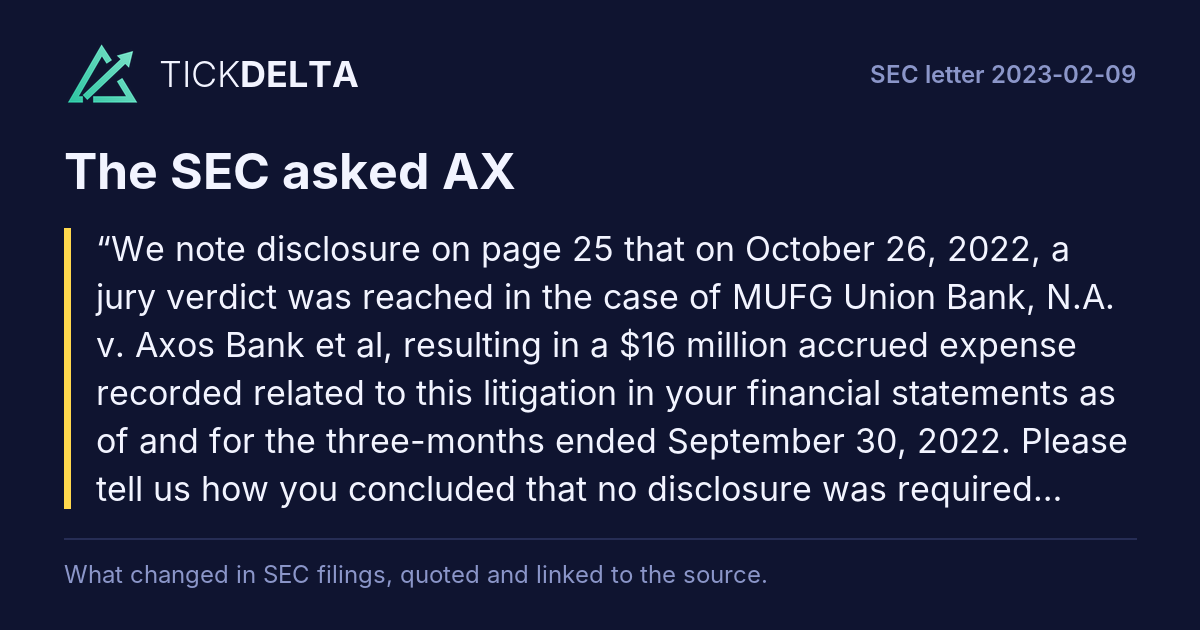
We note disclosure on page 25 that on October 26, 2022, a jury verdict was reached in the case of MUFG Union Bank, N.A. v. Axos Bank et al, resulting in a $16 million accrued expense recorded related to this litigation in your financial statements as of and for the three-months ended September 30, 2022.
Rest of the question

Please tell us how you concluded that no disclosure was required related to this litigation in your Form 10-K for the fiscal year ended June 30, 2022 and any prior filings. Specifically, please tell us how you complied with disclosure requirements of ASC 450-20-50-3 thru 50-5 as well as Item 103 of Regulation S-K related to legal proceedings in current and prior periods. Please also confirm that all disclosures related to similar loss contingencies required by ASC 450-2050 and legal proceedings required by Item 103 of Regulation S-K have been and will be disclosed in your future filings.

AX answered
Pending Litigation with MUFG

The Company has requested confidential treatment for the redacted portion under Rule 83 of the SEC’s Rules of Practice and has delivered a complete unredacted copy of the letter to its examiner at the Division of Corporation Finance.

On October 26, 2022, following a week-long trial, the jury rendered a verdict finding Axos liable and awarding approximately $18 million to MUFG, which verdict has yet to be entered as a judgment by the court and remains subject to pending post-verdict motions .
Rest of the answer

The following day, October 27, 2022, Axos announced its first quarter fiscal 2023 financial results and included a disclosure on page 25 of its Report on Form 10-Q concerning the litigation and jury verdict. The disclosure states:

On October 26, 2022, a jury verdict was reached in the case of MUFG Union Bank, N.A. v. Axos Bank, et al, resulting in an award to Union Bank. The Company continues to believe that the evidence supports the defendants’ understanding of the facts and that meritorious defenses exist to substantially all claims made by Union Bank. In addition, the Company believes that there exists substantial grounds for post-verdict relief and appeal. The Company recorded a $16 million accrued expense in accounts payable and other liabilities on the condensed consolidated balance sheets and in general and administrative expense on the condensed consolidated statements of income as of and for the three months ended September 30, 2022, respectively.

ASC 450

Axos did not disclose the litigation in its Report on Form 10-K for the fiscal year ended June 30, 2022, or any prior filings because after careful consideration it concluded that disclosure was not required. Accounting Standard Codification 450 (“ASC 450”) provides accounting guidance for the disclosure and accrual of certain loss contingencies. ASC 450 -20-20 defines a loss contingency as an “existing condition, situation, or set of circumstances involving uncertainty as to possible loss to an entity that will ultimately be resolved when one or more future events occur or fail to occur.” An estimated loss from a loss contingency shall be accrued by a charge to income if both of the following conditions are met:

a. “Information available before the financial statements are issued ... indicates that it is probable that an asset had been impaired or a liability had been incurred at the date of the financial statements....” It is implicit in this condition that it must be probable that one or more future events will occur confirming the fact of the loss.

b. The amount of loss can be reasonably estimated.

ASC 450-20-50-3 notes that when no accrual is made, either because the loss is not “probable” or because the amount of loss cannot be “reasonably estimated,” the loss contingency must nevertheless be disclosed “if there is at least a reasonable possibility that a loss . . . may have been incurred.” ASC 450-20-20 defines “reasonably possible” as the chance of occurrence being “more than remote but less than likely.” [Redacted].

Item 103 of Regulation S-K

Item 103 of Regulation S-K requires disclosure of any material pending legal proceeding, other than ordinary routine litigation incidental to the business, to which the Company, or any of its subsidiaries, are a party. No information need be given under Item 103 relating to proceedings that involve primarily a claim for damages if the amount involved, exclusive of interest and

The Company has requested confidential treatment for the redacted portion under Rule 83 of the SEC’s Rules of Practice and has delivered a complete unredacted copy of the letter to its examiner at the Division of Corporation Finance.

costs, does not exceed 10 percent of the current assets of the registrant and its subsidiaries on a consolidated basis.

Company Assessment

In consideration of the guidance outlined in ASC 450 and Item 103 of Regulation S-K, the Company performs a multi-step assessment each reporting period of pending and threatened legal matters to assess the potential outcomes of these matters, the likelihood of loss, an estimate of a reasonably possible range of losses, and any disclosure required. In connection with the end of each fiscal quarter, senior members of the Company's Legal department, including the Chief Legal Officer and in consultation with outside legal counsel, meet with members of the Company's Finance department, including the Chief Financial Officer and Executive Vice President, Finance to discuss the status of pending and threatened legal matters to determine whether it is probable that a liability has been incurred and whether a reasonable estimate of possible loss or range of loss can be made under ASC450-20-50-4. Furthermore, the Audit Committee of the Company's Board of Directors meets, prior to the earnings release and Form 10-Q or Form 10-K filing, with the Company's executive management, the senior members of the Accounting, Finance and Legal departments, the Company's auditing firm, and other Company representatives, where a summary of any material legal matters is presented to and discussed with the Audit Committee.

In determining whether it is probable, reasonably possible or remote that a liability will be incurred, the Company considers, among other things: (a) the nature of the litigation, claim, or assessment; (b) the progress of the matter; (c) the opinions, assessments or views of outside legal counsel and other advisors; (d) our experience in similar matters; (e) any decision by management as to how we intend to respond to the lawsuit, claim, or assessment; and (f) with respect to unasserted claims and assessments, our assessment of the degree of probability that a suit may be filed or a claim or assessment may be asserted and the possibility of an unfavorable outcome.

* * *

Axos will review its prior disclosures concerning its pending or threatened litigation to determine whether it has been adequately disclosed and, going forward, will update its disclosures in future filings as needed, including with respect to its litigation with MUFG as material developments warrant.

The Company acknowledges that it and its management are responsible for the accuracy and adequacy of their disclosures, notwithstanding any review, comments, action or absence of action by the staff.

The Company has requested confidential treatment for the redacted portion under Rule 83 of the SEC’s Rules of Practice and has delivered a complete unredacted copy of the letter to its examiner at the Division of Corporation Finance.

Read in the reply
In its next report

First report after the company's reply of Mar 2, 2023: 10-Q filed Apr 27, 2023 ↗, against the 10-Q filed Jan 26, 2023 ↗.

Tickdelta does not hold the text of both reports, so they are not compared here.

Also in this review: closing letter, 2023-04-27
Form 10-K for the Fiscal Year Ended June 30, 2017

2018-02-01 to 2018-02-28 · 2 questions · 1 letter from the SEC, 1 from the company
Review closed 2018-02-28
LeasesRisk factorsLegal and contingencies
Operations · Allowance for Loan and Lease Losses, page 45
SEC asked (1)
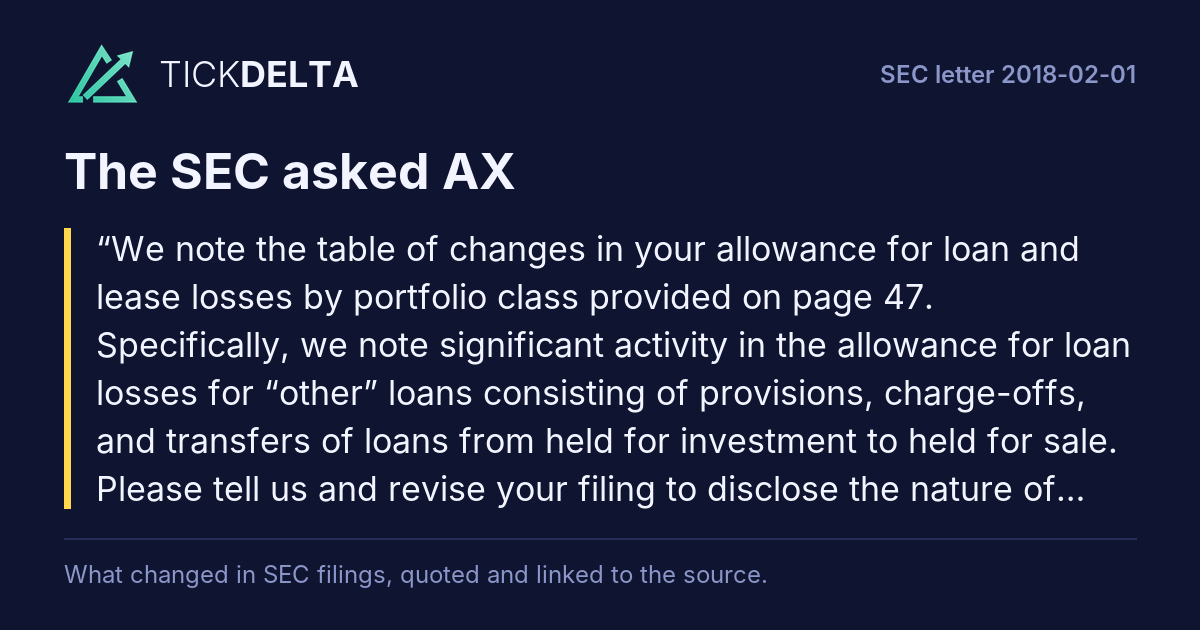
We note the table of changes in your allowance for loan and lease losses by portfolio class provided on page 47. Specifically, we note significant activity in the allowance for loan losses for “other” loans consisting of provisions, charge-offs, and transfers of loans from held for investment to held for sale.
Rest of the question

Please tell us and revise your filing to disclose the nature of loans included in “other” and explain the reasons for the significant activity in allowance for loan losses for this loan class and how the movements in asset quality for these loans impact overall asset quality and corresponding trends.

AX answered
In response to your letter, we acknowledge the Staff's comment and confirm that the Company will in future filings enhance the discussion of the nature of loans included in the other loan classification and the activity in the allowance for loan and lease losses for other loans, including provision methodology, charge-offs, and transfers of certain allowance amounts from loans held for investment to loans held for sale, for the table of changes in the Company's allowance for loan and lease losses.
Rest of the answer

Pursuant to the telephone conversation on February 2, 2018, held between William Schroeder, Staff Accountant in the Office of Financial Services, and Andrew J. Micheletti, EVP and Chief Financial Officer of BofI Holding, Inc., the Company will not be required to amend its Form 10-K for Fiscal Year Ended June 30, 2017 filing.

Please be advised that the loans included in the other loan classification that account for substantially all of the activity in the other loan classification and in the allowance for loan and lease losses for the other loan classification consist of the Company's Emerald Advance and Refund Advance tax season loan products co-branded with H&R Block, Inc. (collectively, the "Advances"), which are described on page 34 and page F-9 of the Company's Form 10-K for Fiscal Year Ended June 30, 2017 filing. The Advances are generally short term in nature, in that they are intended to be repaid within a few weeks or months of origination and if they are not repaid timely, they are charged off in their entirety at 120 days delinquent, consistent with regulatory guidance for unsecured consumer loan products. Advances that are not repaid and are less than 120 days delinquent may be considered for sale, at which point, upon the decision to sell the Advances not previously classified as held for sale, such Advances are transferred into the held-for-sale classification. At the time of the transfer into the held-for-sale classification, the loan value is adjusted to the lower of cost or fair value and any amount by which the cost exceeds fair value is accounted for as a valuation allowance with a corresponding transfer out of the allowance for loan and lease losses in accordance with ASC 310-10-35. There is no long-term impact on the loan and lease portfolio credit quality, because substantially all of the Advances are either collected, charged-off or sold by the end of the Company's fiscal year. While the Advances do incur higher proportional default and charge-off rates than the remainder of the Company's loan and lease portfolio, these asset quality attributes are within expectations of the design of the products.

Read in the reply
In its next report

First report after the company's reply of Feb 14, 2018: 10-Q filed Apr 26, 2018 ↗, against the 10-Q filed Jan 30, 2018 ↗.

Tickdelta does not hold the text of both reports, so they are not compared here.

Note 14. Commitments and Contingencies, page F-52
SEC asked (2)
We note your disclosures pertaining to your various legal proceedings and your risk factor disclosure on page 23. In accordance with ASC 450-20-50, please tell us and revise future filings to clearly disclose the following information for your loss contingencies in aggregate or individually:  the amount or range of reasonably possible losses in excess of amounts recognized,  that the amount or range of reasonably
Rest of the question

possible losses in excess of amounts recognized cannot be estimated, or  that reasonably possible losses in excess of amounts recognized are not material to your financial statements.

AX answered
We acknowledge the Staff’s comment and confirm that the Company will disclose information pertaining to the Company's loss contingencies in future filings in accordance with ASC 450-20-50. Regarding the pending legal proceedings against the Company, in view of the inherent difficulty of predicting the outcome of each legal action, particularly since claimants seek substantial or indeterminate damages, it is not possible to reasonably predict or estimate the eventual loss or range of loss, if any, related to each legal action.
Rest of the answer

Although outcomes cannot be known in advance, the Company has thus far successfully defended and believes it maintains affirmative defense to each legal action discussed in its Form 10-K for Fiscal Year Ended June 30, 2017 filing brought against the Company.

* * * * *

In connection with the Staff’s comment letter and our responses, the Company acknowledges that:

The Company is responsible for the adequacy and accuracy of the disclosure in its filings;

Staff comments or changes to disclosure in response to comments from Commission staff do not foreclose the Commission from taking any action with respect to the filing; and

The Company may not assert Commission staff comments as a defense in any proceeding initiated by the Commission or any person under the federal securities laws of the United States.

Read in the reply
In its next report

First report after the company's reply of Feb 14, 2018: 10-Q filed Apr 26, 2018 ↗, against the 10-Q filed Jan 30, 2018 ↗.

Tickdelta does not hold the text of both reports, so they are not compared here.

Also in this review: closing letter, 2018-02-28

From the SEC's correspondence on EDGAR: staff letters (form UPLOAD) and company letters (form CORRESP), 6 letters filed since 2018-02-01. Questions and answers are matched by their numbers; topics come from words in each question. The reports are compared word for word (same form, before the first SEC letter against the first report after the company's reply). No AI.

Sources

The SEC's correspondence on EDGAR: staff letters (form UPLOAD) and company letters (form CORRESP), matched question by question. No AI.

Also

Filings: the letters in the filing list.

Work with it

Excel workbook · CSV. Google Sheet that stays up to date: paste =IMPORTDATA("https://tickdelta.com/company/AX/export.csv") into a cell.

Next in Owners and insiders:Insider trades
Esc

Type a ticker such as AAPL, a name, an investor such as Buffett, or a topic such as tariffs. ↑ ↓ to move, Enter to open.