23 paragraphs in Risk Factors of the 10-K filed Feb 25, 2026
with nothing like them in the 10-K filed Feb 28, 2025. Quoted exactly.
Paragraphs that were only edited are under 10-K change.
Compared with the Risk Factors in the latest 10-K of the other 81 Industrials companies:
a paragraph with at least half its words the same at another company is called similar, and the companies are listed under it.
A paragraph most of them have is marked boilerplate. No line means no other company has one like it.
This counts text; it does not say how serious a risk is.
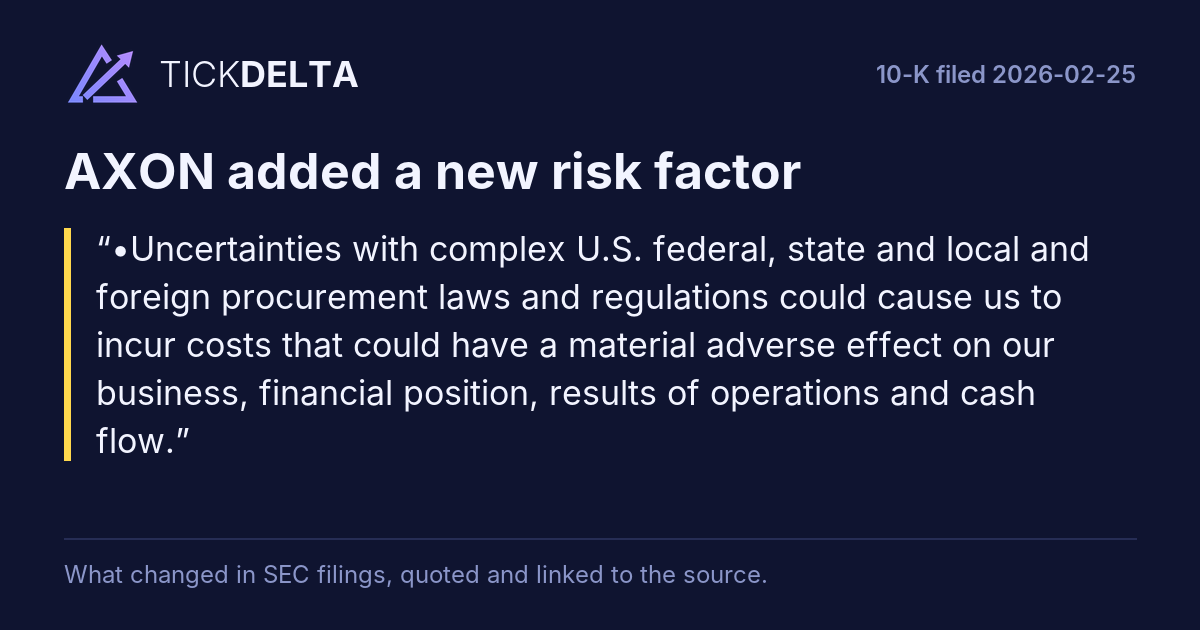
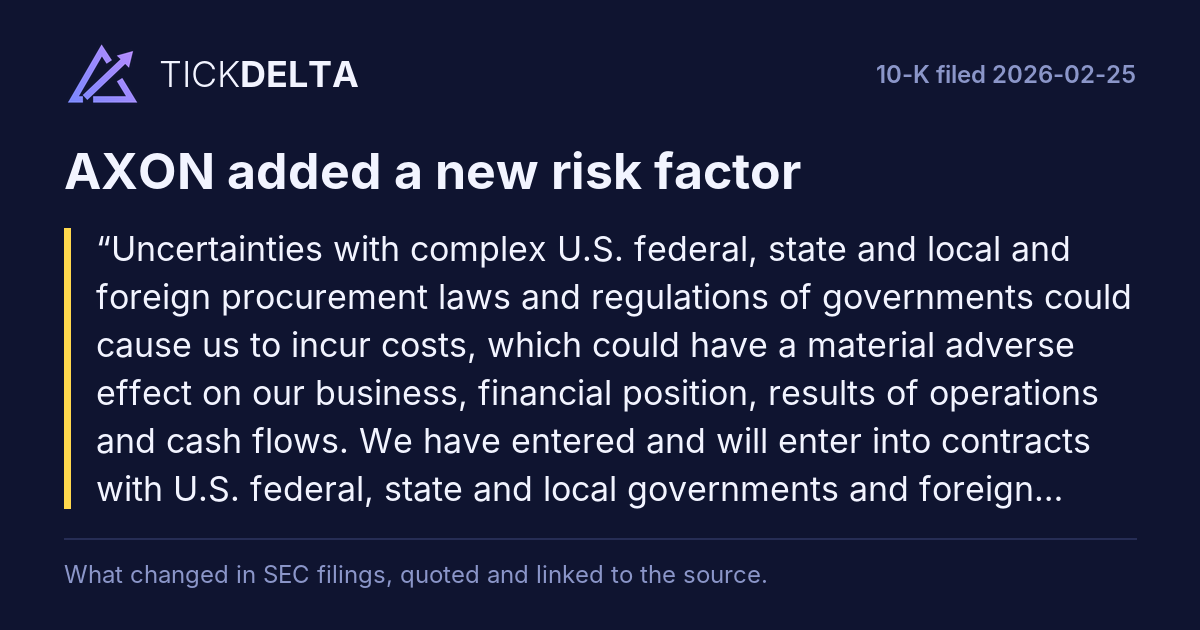
•Uncertainties with complex U.S. federal, state and local and foreign procurement laws and regulations could cause us to incur costs that could have a material adverse effect on our business, financial position, results of operations and cash flow.
Read in the 10-K ↗
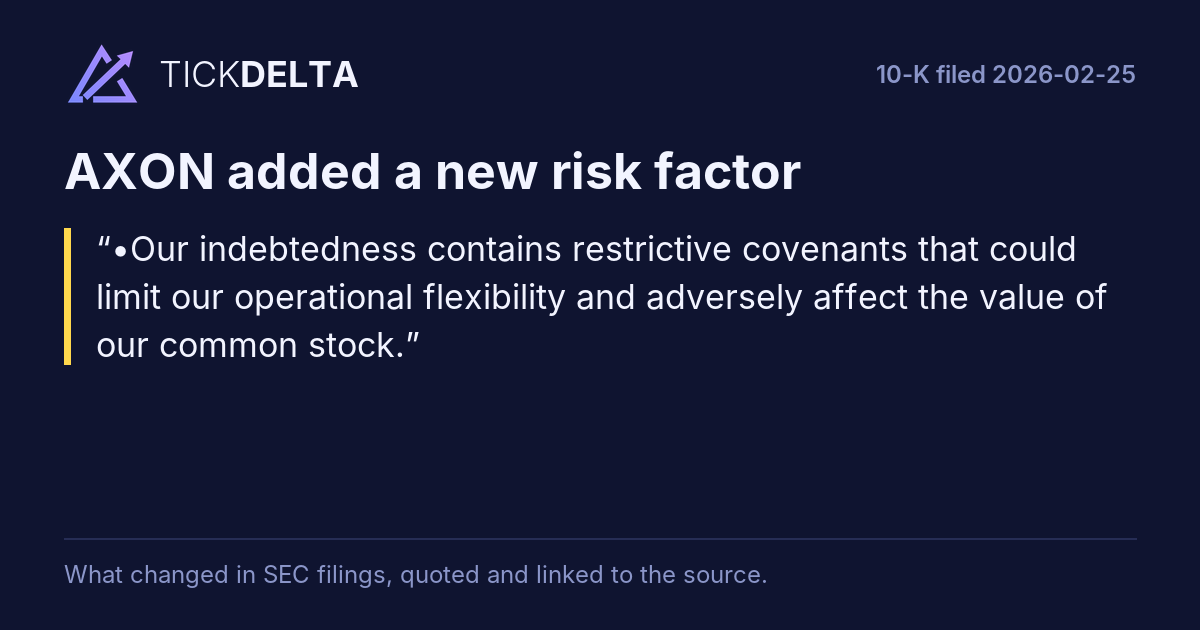
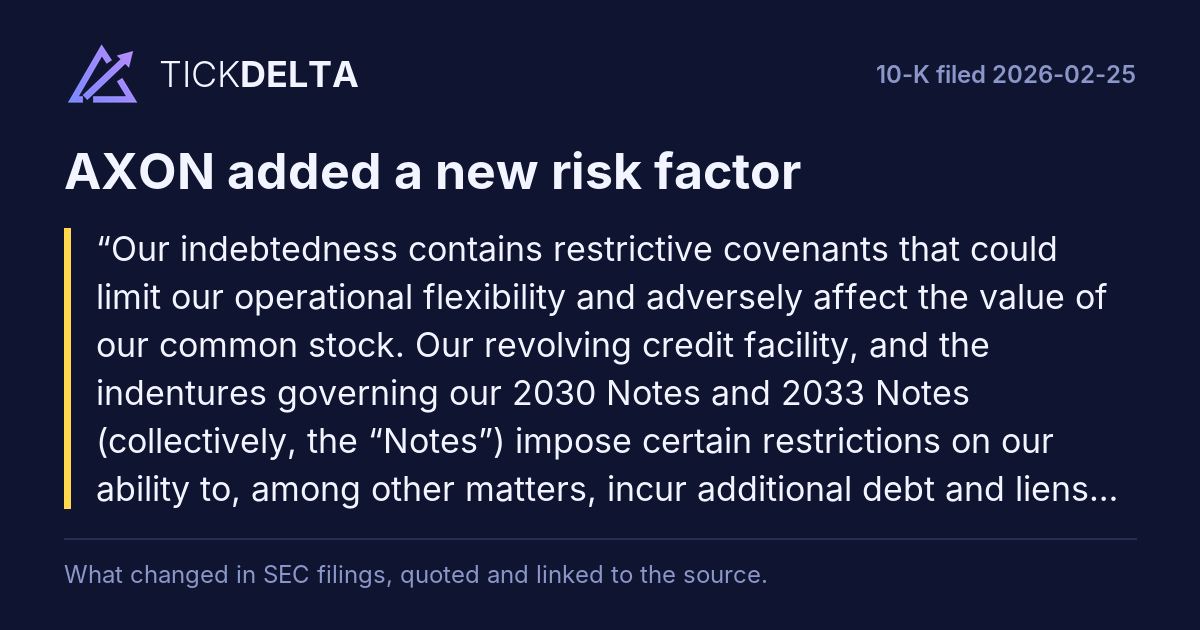
•Our indebtedness contains restrictive covenants that could limit our operational flexibility and adversely affect the value of our common stock.
Similar paragraph at 2 of 81 other Industrials companies:
PH,
URI
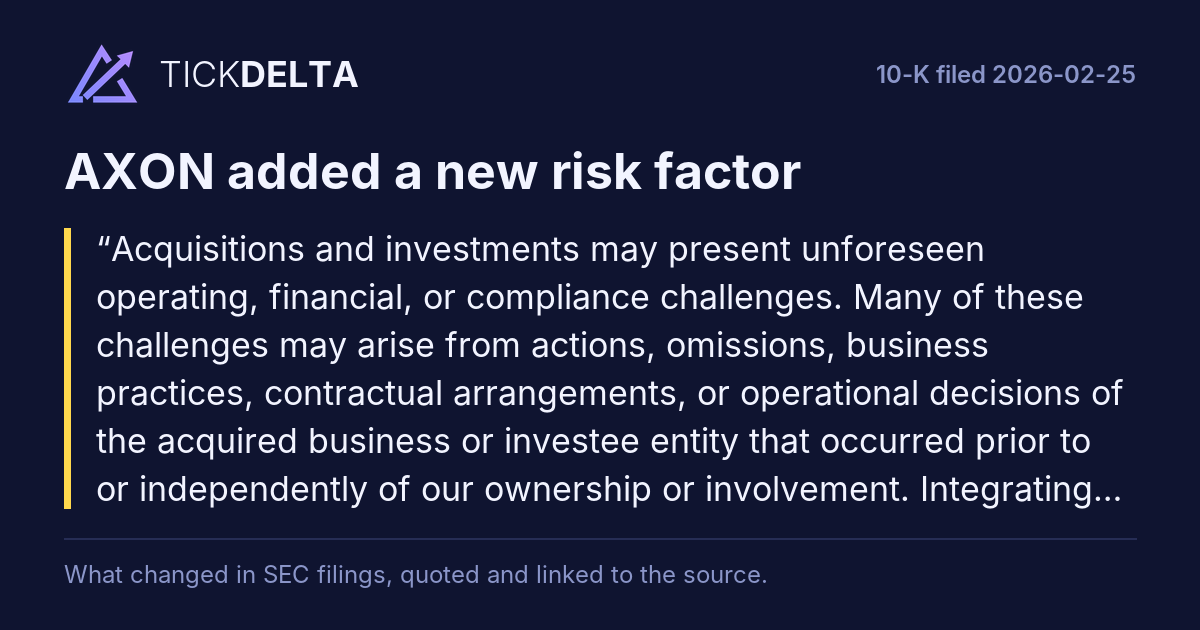
Acquisitions and investments may present unforeseen operating, financial, or compliance challenges. Many of these challenges may arise from actions, omissions, business practices, contractual arrangements, or operational decisions of the acquired business or investee entity that occurred prior to or independently of our ownership or involvement. Integrating acquired personnel, operations, systems, technologies, and products or effectively managing the combined business can be complex, costly, and disruptive. Our ability to identify and assess material risks and liabilities through due diligence may be limited, particularly where sellers restrict access to information, transaction timelines are compressed, or we acquire a non-controlling interest. Anticipated benefits of such transactions may not materialize due to factors such as:
•inability to integrate or profitably benefit from acquired products, technologies (including AI and machine learning models), or businesses; inherited risks associated with AI or machine learning models (including model performance limitations, bias, explainability challenges, or reliance on training data) that may be incomplete, inaccurate, or subject to regulatory restrictions;
•exposure to unexpected regulatory obligations, including those related to export controls, data protection, AI, or product safety, which could require significant investment to satisfy;
•unanticipated costs, liabilities, or risks related to litigation (including intellectual property claims and disputes, government inquiries, or regulatory actions); exposure to actual or alleged intellectual property infringement, misappropriation, or other intellectual property claims arising from the technologies, products, software, data, or business practices of an acquired company or an entity in which we hold a minority investment (including claims that pre-date our acquisition or investment, discontinuation of products, modification of technologies, commencement of licensing arrangements on unfavorable terms, or payment of damages, settlements, or ongoing royalties);
Read in the 10-K ↗
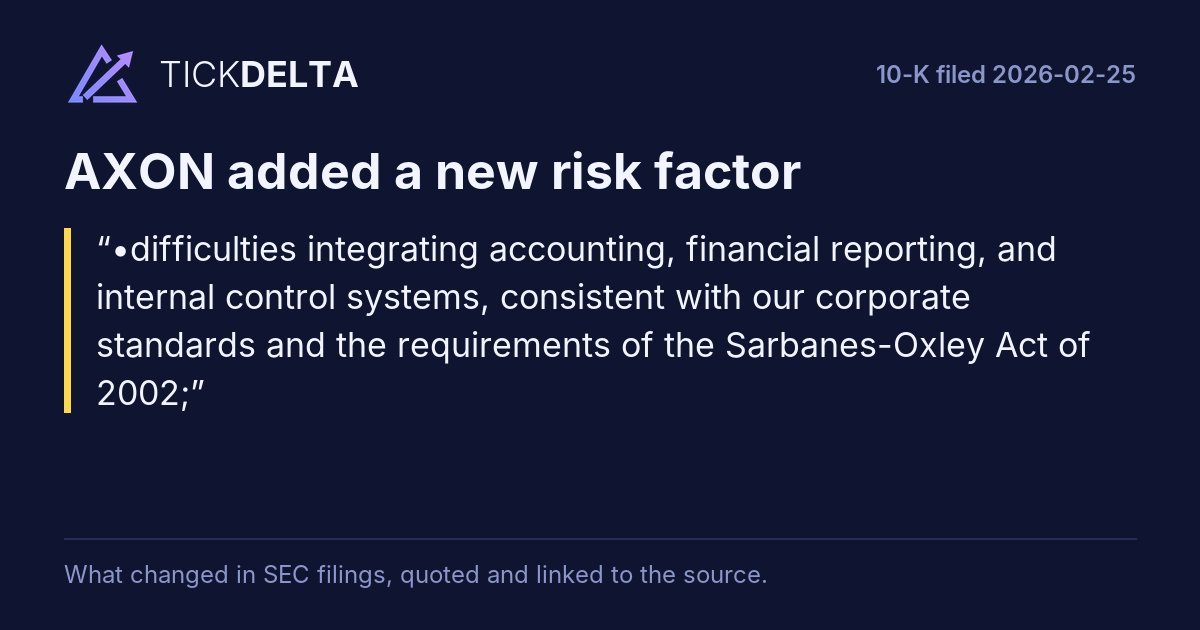
•difficulties integrating accounting, financial reporting, and internal control systems, consistent with our corporate standards and the requirements of the Sarbanes-Oxley Act of 2002;
Read in the 10-K ↗
•write-downs or impairment of goodwill or other intangible assets if the acquired business underperforms expectations;
Similar paragraph at 2 of 81 other Industrials companies:
DD,
SNA
•loss, modification, or non-renewal of government contracts, framework agreements, or sole-source arrangements following a change of control or integration into our operations;
•diversion of management’s attention and critical resources away from existing business priorities;
Similar paragraph at 2 of 81 other Industrials companies:
PWR,
WAB•disruption to relationships with existing customers, suppliers, or strategic partners;
•supply chain, manufacturing, or sourcing disruptions affecting acquired businesses;
•difficulties scaling manufacturing capacity, production volumes, or supply chain operations of acquired businesses;
Read in the 10-K ↗
In the case of minority or non-controlling investments, we may have limited ability to influence the strategic direction, governance, regulatory compliance, risk management, or operations of the investee business, may be subject to conflicts with other shareholders or founders, and may receive less timely or less complete information regarding the investee’s performance or risks.
We may finance acquisitions or investments through the issuance of equity or debt. The issuance of equity could dilute existing shareholders, and the issuance of debt could reduce liquidity or increase leverage and interest expense. Debt financing activities may also include restrictive covenants or repayment obligations that limit operational flexibility or our ability to pursue additional strategic transactions.
Significant acquisitions typically result in the recognition of goodwill and other intangible assets. If the acquired business does not perform as expected, we may be required to record non-cash impairment charges, which could materially affect our operating results and financial condition.
Similar paragraph at 1 of 81 other Industrials companies:
CMI
Our suppliers may themselves be subject to export controls or other trade restrictions on the materials and components they provide, including controls imposed by their countries of origin. In addition, increased use by the PRC of foreign “entity lists,” modeled in part on U.S. and other Western trade controls, could restrict Axon’s ability to import components or materials sourced from the PRC. Components or other items that are incorporated into our weapons or defense articles may also become subject to export controls in their originating jurisdictions based on their ultimate end use, which could further disrupt supply chains, delay production, or increase costs.
Read in the 10-K ↗
2 more
Uncertainties with complex U.S. federal, state and local and foreign procurement laws and regulations of governments could cause us to incur costs, which could have a material adverse effect on our business, financial position, results of operations and cash flows.
We have entered and will enter into contracts with U.S. federal, state and local governments and foreign governments. This subjects us to various statutes and regulations applicable to companies doing business with governments, including the Federal Acquisition Regulation (“FAR”). We must comply with laws and regulations relating to the formation, administration and performance of U.S. federal, state and local and foreign government contracts. These laws and regulations govern how we conduct business with government customers.
Recently issued executive orders are intended to (i) simplify and accelerate the procurement process through a review and restructuring of the FAR, and its supplements and (ii) modernize defense acquisitions by promoting commercial solutions, innovative acquisition authorities, and other existing streamlined processes. Among the actions directed is a review of major defense acquisition programs that are more than 15% behind schedule or over budget, including identifying any programs for potential cancellation. Should the U.S. government review one or more major defense programs in which we provide products and/or services, and such review leads to a full or partial cancellation of one of these programs, it could have an adverse effect on our business, financial condition, results of operations and cash flows.
Read in the 10-K ↗
Our indebtedness contains restrictive covenants that could limit our operational flexibility and adversely affect the value of our common stock.
Similar paragraph at 2 of 81 other Industrials companies:
PH,
URIOur revolving credit facility, and the indentures governing our 2030 Notes and 2033 Notes (collectively, the “Notes”) impose certain restrictions on our ability to, among other matters, incur additional debt and liens, make distributions to our shareholders in certain circumstances, dispose of assets and enter into mergers, consolidations and transfers of all or substantially all of our assets. In addition, the revolving credit facility requires us to maintain specified financial ratios and satisfy other financial condition tests. Further, following certain change of control events, we would be required to offer to repurchase the Notes, and such events would also constitute an event of default under our revolving credit facility.
These limitations may restrict our ability to operate our business, pursue strategic transactions, or otherwise respond to changing business or economic conditions. Consequently, compliance with these covenants could adversely affect our business and the value of our common stock.
Read in the 10-K ↗
New in the latest 10-Q
49 paragraphs in the 10-Q filed Nov 6, 2026 with nothing like
them in the 10-Q filed Aug 6, 2026 (at least half the words must differ; new numbers alone do not count).
Quoted exactly, grouped by the item heading above them. This is text that changed, not a judgement of how serious it is.
Financial statements and notes
Certain amounts in prior periods’ consolidated financial statements have been reclassified to conform to current period presentation. These reclassifications are not material and had no effect on the previously reported consolidated financial statements.
Read in the 10-Q ↗
(2) The dilutive effect of our 2031 Notes is calculated based upon the most advantageous conversion rate from the standpoint of the holder. Refer to Note 8 for additional details related to the conversion criteria applicable for our 2031 Notes.
Read in the 10-Q ↗
The 2031 Notes mature on September 15, 2031, unless earlier converted, redeemed, or repurchased. The 2031 Notes will not bear regular cash interest and the principal amount of the notes will not accrete. The effective interest rate for the 2031 Notes is approximately 0.26 %, which reflects amortization of debt issuance costs. The total combined gross proceeds from the issuance of the 2031 Notes were $ 1.15 billion. After deducting initial net underwriters’ discounts and commissions and other debt issuance costs of $ 14.7 million, the total combined net proceeds were approximately $ 1.14 billion, of which we used $ 114.9 million to pay the cost of the capped call transactions described below. The fair value of the 2031 Notes is determined based on the closing trading price of the respective notes payable as of the last day of trading for each period. We consider the fair value to be a Level 2 measurement, as the fair value is primarily affected by the trading price of our common stock and market interest rates.
Read in the 10-Q ↗
Upon conversion, the terms of the 2031 Notes generally permit us to pay or deliver, as the case may be, cash, shares of our common stock, or a combination thereof, at our election. Any shares issued upon conversion shall be recorded in stockholders’ equity. The 2031 Notes are convertible, in multiples of $1,000 principal amount, at the option of the holders prior to the close of business on the business day immediately preceding June 15, 2031 only under the following circumstances:
Read in the 10-Q ↗
• during any calendar quarter commencing after the calendar quarter ending on December 31, 2026 (and only during such calendar quarter), if the last reported sale price of our common stock for at least 20 trading days (whether or not consecutive) during the 30 consecutive trading days ending on, and including, the last trading day of the immediately preceding calendar quarter is greater than or equal to 130 % of the conversion price on each applicable trading day;
Read in the 10-Q ↗
• during the five business day period immediately after any ten consecutive trading day period (the “Measurement Period”), if the trading price per $1,000 principal amount of 2031 Notes for each trading day of the Measurement Period was less than 98 % of the product of the last reported sale price per share of our common stock on such trading day and the conversion rate on such trading day;
Read in the 10-Q ↗
• upon the occurrence of certain corporate events (e.g., change in control or delisting of our common stock) or distributions on our common stock, as provided in the indenture governing the 2031 Notes; and
Read in the 10-Q ↗
• if we call the 2031 Notes for redemption at any time prior to the close of business on the second scheduled trading day immediately preceding the applicable redemption date, but only with respect to the 2031 Notes called (or deemed called) for redemption.
Read in the 10-Q ↗
On or after June 15, 2031 until the close of business on the second scheduled trading day immediately preceding the maturity date of the 2031 Notes, holders of the 2031 Notes may convert all or any portion of their 2031 Notes at any time, regardless of the foregoing conditions. Upon conversion, the 2031 Notes will be settled in cash, shares of our common stock or a combination thereof, at our option, as described in the indenture governing the 2031 Notes.
Read in the 10-Q ↗
If we undergo a fundamental change (as defined in the indenture governing the 2031 Notes), other than an exempted fundamental change, holders may require us to repurchase for cash all or any portion of their 2031 Notes at a price equal to 100 % of the principal amount of the 2031 Notes to be repurchased, plus accrued and unpaid special interest, if any, up to but excluding the fundamental change repurchase date.
Read in the 10-Q ↗
In addition, subject to certain conditions, holders may require us to repurchase their 2031 Notes on or around March 20, 2031 (the “Holder Repurchase Option”) at a repurchase price equal to the principal amount of the 2031 Notes to be repurchased, plus accrued and unpaid special interest, if any. We may elect to satisfy all or a portion of our obligation with respect to the principal amount of the repurchase price for the Holder Repurchase Option by issuing or delivering shares of our common stock, up to a specified maximum number of 2,875,000 shares (subject to customary anti-dilution and pro-rata adjustments) with the remainder, if any, of the repurchase price payable in cash, subject to and in accordance with the terms of the indenture governing the 2031 Notes.
Read in the 10-Q ↗
Following certain corporate events or if we issue a notice of redemption, the conversion rate may be increased for holders who elect to convert their 2031 Notes in connection with such corporate event or during the relevant redemption period. Except in the case of a cleanup redemption, on or after September 20, 2029 and before the 31st scheduled trading day immediately before the maturity date, we may redeem for cash all or any portion of the 2031 Notes, at our option, if the last reported sale price of our common stock has been at least 130 % of the conversion price then in effect for at least 20 trading days (whether or not consecutive) during any 30 consecutive trading day period ending on, and including, the trading day immediately preceding the date on which we provide notice of redemption, at a redemption price equal to 100 % of the principal amount of the 2031 Notes to be redeemed, plus accrued and unpaid special interest, if any. We may also redeem for cash all, but not less than all, of the 2031 Notes at any time if the principal amount of 2031 Notes outstanding is less than 10 % of the aggregate principal amount of 2031 Notes initially issued under the indenture (a “cleanup redemption”).
Read in the 10-Q ↗
The 2031 Capped Calls cover 1,763,640 shares of our common stock, which corresponds to the number of shares initially underlying the 2031 Notes. The 2031 Capped Calls have an initial strike price of $ 652.06 per share, corresponding to the initial conversion price of the 2031 Notes, and an initial cap price of $ 1,049.94 per share, in each case subject to certain adjustments. The 2031 Capped Calls may also offset potential cash payments in excess of the principal amount of converted 2031 Notes, subject to the cap.
Read in the 10-Q ↗
The 2031 Capped Calls may be settled in cash, shares of our common stock, or a combination thereof, generally consistent with our elected settlement method for the related 2031 Notes. The aggregate purchase price was recorded as a reduction to additional paid-in capital. The 2031 Capped Calls are separate from the 2031 Notes, expire upon the maturity of the 2031 Notes, and do not provide any rights to holders of the 2031 Notes. The 2031 Capped Calls are intended to reduce potential economic dilution associated with the 2031 Notes but do not offset their dilutive effect for purposes of calculating diluted income per common share. As of September 30, 2026, all 1,763,640 shares remained subject to the 2031 Capped Calls.
Read in the 10-Q ↗
In September 2026, in connection with the issuance of the 2031 Notes, we entered into a second amendment to the Credit Agreement. The amendment increases the existing revolving credit facility by $ 200.0 million to a total aggregate principal amount of $ 500.0 million and permits us to request an increase in the facility by an additional $ 150.0 million. The amendment extends the maturity date of the Credit Agreement from March 11, 2030 to the earliest of: (i) the fifth anniversary of the amendment’s closing (September 18, 2031), (ii) 91 days prior to the stated maturity of the 2031 Notes (unless fully redeemed, repurchased, converted, or defeased, with qualifying refinancing), (iii) 91 days prior to March 20, 2031 (the 2031 Notes’ optional repurchase date) if certain share-settlement notice and stock-price conditions are met, or (iv) 91 days prior to the maturity of any other permitted convertible indebtedness (subject to similar conditions).
Read in the 10-Q ↗
Pending in the Northern District of California (Case No. 3:26-cv-11183) and in Riverside County (CA) Superior Court (Case No. CVRI26O6719) are putative class actions seeking statutory damages and injunctive relief for alleged violations of California’s Automated License Plate Reader (“ALPR”) disclosure statute. We deny all allegations, including the statute’s applicability to Axon, and will vigorously defend these cases. We are also aware of a third ALPR complaint recently filed in the Northern District, but we have not yet been served. These cases will likely be consolidated.
Read in the 10-Q ↗
On November 5, 2026, the Company entered into agreements for incremental non-voting minority investments of up to $ 1.2 billion in Skydio, Inc. (“Skydio”), a privately-owned autonomous drone manufacturer, which are expected to increase the Company’s ownership from 15 % to approximately 37 % on a fully diluted basis. The Company expects the investments to be settled with up to approximately $ 720.0 million in cash and the remainder in shares of the Company’s common stock, with the final mix subject to the results of a tender offer and secondary purchases that are expected to close in the fourth quarter of 2026 and first quarter of 2027. The number of shares of the Company’s common stock issued shall be determined utilizing the volume-weighted average price per share of the Company’s common stock, as reported on the NASDAQ Global Select Market, for the 10-trading day period up to and including the trading day immediately preceding two business days prior to settlement.
Read in the 10-Q ↗
The Company’s primary investment in Skydio, with an aggregate purchase price of approximately $254.9 million, payable 50% in cash and 50% in shares of the Company’s common stock, closed on November 5, 2026, resulting in a cash payment of approximately $127.5 million and a commitment to deliver approximately $127.5 million of the Company’s common stock. The remaining investments, consisting of a tender offer and secondary purchases, are valued at up to approximately $968.6 million in aggregate and are expected to close through a series of transactions during the fourth quarter of 2026 and first quarter of 2027. The incremental investments will be included in non-marketable equity investments and accounted for under the measurement alternative method, as we do not have significant influence over Skydio’s operations.
Read in the 10-Q ↗
(1) Interest income decreased primarily due to lower average balances of short-term investments compared to the prior year September 30, 2025 comparable period.
Read in the 10-Q ↗
(1) Interest income decreased primarily due to lower average balances of short-term investments compared to the prior year September 30, 2025 comparable period.
Read in the 10-Q ↗
On November 5, 2026, we entered into agreements to make incremental minority investments of up to $1.2 billion in Skydio. We expect the investments to be settled with up to approximately $720.0 million in cash and the remainder in shares of the Company’s common stock, with the final mix subject to the results of a tender offer and secondary purchases that are expected to close in the fourth quarter of 2026 and first quarter of 2027. We paid approximately $127.5 million in cash at the closing of the Company’s primary investment on November 5, 2026, and the remaining cash consideration will be funded utilizing our available cash on hand. Refer to Note 15 in Part I, Item 1 of this Quarterly Report on Form 10-Q for additional details.
Read in the 10-Q ↗
Risk Factors
Our 2027 Note Hedge, 2027 Warrant, and 2031 Capped Call transactions may impact the value of our common stock.
Read in the 10-Q ↗
In connection with the pricing of the 2027 Notes, we entered into 2027 Note Hedge transactions and 2027 Warrant transactions with certain investment banks (together with the 2031 Option Counterparties, the “Option Counterparties”). We entered into agreements with the 2027 Option Counterparties in March 2025 to leave the 2027 Note Hedge transactions outstanding until the original maturity of the 2027 Notes in respect of the 2027 Notes we exchanged in March 2025. Further, we unwound a portion of the 2027 Note Hedge and 2027 Warrant transactions in conjunction with our redemption of all of our outstanding 2027 Notes. As of the date of filing this Quarterly Report on Form 10-Q, a portion of the 2027 Note Hedge and 2027 Warrant transactions were still outstanding, notwithstanding the extinguishment of our 2027 Notes. As a result, the 2027 Warrant transactions could have a dilutive effect on our common stock to the extent that the market price per share of our common stock exceeds the strike price of the 2027 Warrants.
Read in the 10-Q ↗
In September 2026, in connection with the pricing of the 2031 Notes, we entered into the 2031 Capped Calls with the 2031 Option Counterparties, which may reduce potential dilution to our common stock or offset any potential cash payments we are required to make in excess of the principal amount of converted 2031 Notes, as the case may be, with such reduction or offset subject to a cap. The 2031 Capped Calls do not offset any potential dilutive effect for purposes of calculating diluted income per common share. Additionally, the Option Counterparties or their affiliates may adjust their hedge positions by entering into or unwinding various derivatives linked to our common stock, or by buying or selling our common stock or other securities in secondary market transactions. Such actions could cause fluctuations in the market price of our common stock, potentially causing it to rise or fall. If any of the 2027 Note Hedge, 2027 Warrant or 2031 Capped Call transactions do not perform as anticipated, the 2027 Option Counterparties or 2031 Option Counterparties, as the case may be, may unwind their positions, which could adversely affect our stock price.
Read in the 10-Q ↗
The effect of these transactions and related activities on the market price of our common stock will depend in part on market conditions and other factors beyond our control, and their impact cannot be ascertained at this time. Any of these activities could adversely affect the value of our common stock.
Read in the 10-Q ↗
We are exposed to counterparty risk with respect to the 2027 Note Hedge and 2031 Capped Call transactions.
Read in the 10-Q ↗
The Option Counterparties are financial institutions, and we face the risk that any or all of them might default on their obligations under the 2027 Note Hedge transactions or the 2031 Capped Call transactions. Our exposure to this credit risk is unsecured, as the Option Counterparties have not secured their obligations by any collateral.
Read in the 10-Q ↗
If an Option Counterparty becomes subject to insolvency proceedings, we will become an unsecured creditor in those proceedings with a claim equal to our exposure under the 2027 Note Hedge transactions or the 2031 Capped Call transactions, as applicable, at that time. Our exposure will depend on many factors, including an increase in the market price and volatility of our common stock. An Option Counterparty default could also have tax consequences, could reduce the anticipated benefits of the 2027 Note Hedge transactions or the 2031 Capped Call transactions, as applicable, and could increase dilution relative to our current expectations. We cannot provide assurances as to the financial stability or solvency of the Option Counterparties, and any default could materially and adversely affect our financial results.
Read in the 10-Q ↗
Our indebtedness contains restrictive covenants that could limit our operational flexibility and adversely affect the value of our common stock.
Read in the 10-Q ↗
Our revolving credit facility, as amended in September 2026, and the indentures governing our 2030 Notes, 2031 Notes and 2033 Notes (collectively, the “Notes”) impose certain restrictions, as applicable, on our ability to, among other matters, incur additional debt and liens, make distributions to our shareholders in certain circumstances, dispose of assets and enter into mergers, consolidations, and transfers of all or substantially all of our assets. In addition, the revolving credit facility requires us to maintain specified financial ratios and satisfy other financial condition tests. Further, following certain change of control events, we would be required to offer to repurchase the Notes, and such events would also constitute an event of default under our revolving credit facility. The indenture governing the 2031 Notes contains customary provisions relating to consolidation, merger, and sale of assets and certain protections in connection with a “Fundamental Change” and certain make-whole events, as described therein.
Read in the 10-Q ↗
These limitations may restrict our ability to operate our business, pursue strategic transactions, or otherwise respond to changing business or economic conditions. Consequently, compliance with these covenants could adversely affect our business and the value of our common stock.
Read in the 10-Q ↗
The conditional conversion and settlement features of the 2031 Notes may adversely affect our liquidity, financial condition, and existing stockholders. Prior to June 15, 2031, holders of the 2031 Notes may convert their notes only during specified periods under specified conditions. If the conditional conversion feature is triggered, holders may convert their 2031 Notes at any time during specified periods. On or after June 15, 2031, holders of the 2031 Notes may convert their 2031 Notes at any time. If one or more holders elect to convert their 2031 Notes, unless we elect to satisfy our conversion obligation by delivering solely shares of our common stock (other than paying cash in lieu of delivering any fractional share), we would be required to settle a portion or all of our conversion obligation through the payment of cash, which could adversely affect our liquidity.
Read in the 10-Q ↗
Even if no holders convert their 2031 Notes, under applicable accounting rules we may be required, in certain circumstances, to reclassify some or all of the outstanding principal amount of the 2031 Notes from a long-term to a current liability, which would reduce our reported working capital. If we settle our conversion obligations or any repurchase obligations arising upon a “Fundamental Change” under the 2031 Notes, in whole or in part, through the issuance of shares of our common stock, that issuance could dilute the ownership interests of our existing stockholders and could depress the market price of our common stock.
Read in the 10-Q ↗
Conversion of the 2031 Notes, or any issuance or delivery of our common stock in connection with the Holder Repurchase Option under the 2031 Notes, may dilute the ownership interest of our stockholders or may otherwise depress the price of our common stock.
Read in the 10-Q ↗
The conversion of some or all of the 2031 Notes, or any issuance or delivery of our common stock in connection with the Holder Repurchase Option under the 2031 Notes, may dilute the ownership interests of our stockholders. Upon conversion of the 2031 Notes, we have the option to pay or deliver, as the case may be, cash, shares of our common stock, or a combination of cash and shares of our common stock, at our election. In addition, we may elect to satisfy some or all of our obligation in respect of the principal amount of the repurchase price for holders exercising any Holder Repurchase Option by issuing or delivering shares of our common stock in certain circumstances. If we elect to settle our conversion obligation in shares of our common stock or a combination of cash and shares of our common stock, or to deliver any shares of our common stock in connection with the Holder Repurchase Option, any sales in the public market of our common stock so issuable could adversely affect prevailing market prices of our common stock. In addition, the existence of the 2031 Notes may encourage short selling by market participants because the shares of our common stock issuable or deliverable upon conversion of the 2031 Notes or in connection with the Holder Repurchase Option, as the case may be, could be used to satisfy short positions, or anticipated conversion of the 2031 Notes into shares of our common stock, or anticipated issuance or delivery of shares of our common stock in connection with the Holder Repurchase Option, could depress the price of our common stock.
Read in the 10-Q ↗
Fulfilling our debt obligations requires significant cash resources, which may exceed our available cash flow.
Read in the 10-Q ↗
Our ability to meet our debt obligations, including making scheduled principal and interest payments, refinancing obligations, and satisfying conversion or repurchase obligations under our 2031 Notes, depends on our future performance and external factors beyond our control. In particular, we may need cash to satisfy obligations arising from the maturity or refinancing of our outstanding notes, conversions of the 2031 Notes to the extent we elect or are required to settle any portion of our conversion obligations in cash, repurchases of the 2031 Notes following a fundamental change, or repurchases of the 2031 Notes for cash in connection with any exercises of the Holder Repurchase Option under the 2031 Notes. If our business fails to generate sufficient cash flow from operations to meet these obligations and fund capital expenditures, we may be required to adopt alternatives (for example, asset sales, debt restructuring or equity financing) that may be on unfavorable or dilutive terms. Further, our ability to refinance our indebtedness will depend on market conditions and our financial standing at such time, which may be unfavorable. If we are unable to identify or pursue acceptable alternatives on commercially reasonable terms, we could be unable to meet our debt obligations, which could result in a default.
Read in the 10-Q ↗
Item 6
3.1 Amended and Restated Certificate of Incorporation (incorporated by reference to Exhibit 3.1 to the
Read in the 10-Q ↗
3.2 Bylaws, as amended and restated (incorporated by reference to Exhibit 3.2 to the Current Report on Form 8-K, filed December 21, 2023)
Read in the 10-Q ↗
4.1 Base Indenture, dated as of September 18, 2026, between Axon Enterprise, Inc. and U.S. Bank Trust Company, National Association, as trustee (incorporated by reference to Exhibit 4.1 to the Current Report on Form 8-K, filed September 21, 2026)
Read in the 10-Q ↗
4.2 First Supplemental Indenture, dated as of September 18, 2026, between Axon Enterprise, Inc. and U.S. Bank Trust Company, National Association, as trustee (incorporated by reference to Exhibit 4.2 to the Current Report on Form 8-K, filed September 21, 2026)
Read in the 10-Q ↗
4.3 Form of 0% Convertible Senior Note due 2031 (incorporated by reference to Exhibit A in Exhibit 4.2 to the Current Report on Form 8-K, filed September 21, 2026)
Read in the 10-Q ↗
10.1 Form of Capped Call Confirmation (incorporated by reference to Exhibit 10.1 to the Current Report on Form 8-K, filed September 21, 2026)
Read in the 10-Q ↗
10.2 Amendment No. 2, dated September 15, 2026 amending the Credit Agreement dated December 15, 2022, among the Company, the Lenders party thereto and the Administrative Agent (incorporated by reference to Exhibit 10.2 to the Current Report on Form 8-K, filed September 21, 2026)
Read in the 10-Q ↗
31.1* Principal Executive Officer Certification pursuant to Rule 13a-14(a) or Rule 15d-14(a)
Read in the 10-Q ↗
31.2* Principal Financial Officer Certification pursuant to Rule 13a-14(a) or Rule 15d-14(a)
Read in the 10-Q ↗
32** Principal Executive Officer and Principal Financial Officer Certification pursuant to 18 U.S.C. Section 1350 as adopted pursuant to Section 906 of the Sarbanes-Oxley Act of 2002
Read in the 10-Q ↗
101. INS* Inline XBRL Instance Document - the instance document does not appear in the Interactive Data File because its XBRL tags are embedded within the Inline XBRL document.
Read in the 10-Q ↗
104* The cover page from the Company’s Quarterly Report on Form 10-Q for the quarter ended September 30, 2026, formatted in Inline XBRL
Read in the 10-Q ↗
The 10-Q's risk factors against the 10-K
Item 1A of the 10-Q filed Nov 6, 2026 against Item 1A of the 10-K filed Feb 25, 2026.
A 10-Q repeats only the risks that changed, so a 10-K paragraph that is missing from it is not counted as removed.
Added is a paragraph with nothing like it in the 10-K, Reworded a sentence that is in both with several words changed,
Quiet changes a sentence in both where one to four words changed and one is a hedge or a modal
(cut words struck through, new words highlighted and underlined).
Text on the page, not a score; each links to the filing at sec.gov.
What the 10-Q itself says about its risk factors:
There have been no material changes to the risk factors outlined in our Annual Report on Form 10-K for the year ended December 31, 2025, with the exception of the following risks related to our indebtedness. Refer to Note 8 to our consolidated financial statements included in Part I, Item 1 of this Quarterly Report on Form 10-Q for additional details.
Read in the 10-Q ↗
Added10-Q 2026-11-06 vs 10-K 2026-02-25
The conditional conversion and settlement features of the 2031 Notes may adversely affect our liquidity, financial condition, and existing stockholders. Prior to June 15, 2031, holders of the 2031 Notes may convert their notes only during specified periods under specified conditions. If the conditional conversion feature is triggered, holders may convert their 2031 Notes at any time during specified periods. On or after June 15, 2031, holders of the 2031 Notes may convert their 2031 Notes at any time. If one or more holders elect to convert their 2031 Notes, unless we elect to satisfy our conversion obligation by delivering solely shares of our common stock (other than paying cash in lieu of delivering any fractional share), we would be required to settle a portion or all of our conversion obligation through the payment of cash, which could adversely affect our liquidity.
Read it in the 10-Q at sec.gov ↗
Added10-Q 2026-11-06 vs 10-K 2026-02-25
Even if no holders convert their 2031 Notes, under applicable accounting rules we may be required, in certain circumstances, to reclassify some or all of the outstanding principal amount of the 2031 Notes from a long-term to a current liability, which would reduce our reported working capital. If we settle our conversion obligations or any repurchase obligations arising upon a “Fundamental Change” under the 2031 Notes, in whole or in part, through the issuance of shares of our common stock, that issuance could dilute the ownership interests of our existing stockholders and could depress the market price of our common stock.
Read it in the 10-Q at sec.gov ↗
Added10-Q 2026-11-06 vs 10-K 2026-02-25
Conversion of the 2031 Notes, or any issuance or delivery of our common stock in connection with the Holder Repurchase Option under the 2031 Notes, may dilute the ownership interest of our stockholders or may otherwise depress the price of our common stock.
Read it in the 10-Q at sec.gov ↗
Added10-Q 2026-11-06 vs 10-K 2026-02-25
The conversion of some or all of the 2031 Notes, or any issuance or delivery of our common stock in connection with the Holder Repurchase Option under the 2031 Notes, may dilute the ownership interests of our stockholders. Upon conversion of the 2031 Notes, we have the option to pay or deliver, as the case may be, cash, shares of our common stock, or a combination of cash and shares of our common stock, at our election. In addition, we may elect to satisfy some or all of our obligation in respect of the principal amount of the repurchase price for holders exercising any Holder Repurchase Option by issuing or delivering shares of our common stock in certain circumstances. If we elect to settle our conversion obligation in shares of our common stock or a combination of cash and shares of our common stock, or to deliver any shares of our common stock in connection with the Holder Repurchase Option, any sales in the public market of our common stock so issuable could adversely affect prevailing market prices of our common stock. In addition, the existence of the 2031 Notes may encourage short selling by market participants because the shares of our common stock issuable or deliverable upon conversion of the 2031 Notes or in connection with the Holder Repurchase Option, as the case may be, could be used to satisfy short positions, or anticipated conversion of the 2031 Notes into shares of our common stock, or anticipated issuance or delivery of shares of our common stock in connection with the Holder Repurchase Option, could depress the price of our common stock.
Read it in the 10-Q at sec.gov ↗
Reworded10-Q 2026-11-06 vs 10-K 2026-02-25
A counterparty An Option Counterparty default could also have tax consequences consequences, could reduce the anticipated benefits of the 2027 Note Hedge transactions or the 2031 Capped Call transactions, as applicable, and could increase dilution relative to our current expectations.
Read it in the 10-Q at sec.gov ↗ · The 10-K sentence ↗
Reworded10-Q 2026-11-06 vs 10-K 2026-02-25
Further, we unwound a portion of the 2027 Note Hedge and 2027 Warrant transactions corresponding to the principal amount in conjunction with our redemption of the all of our outstanding 2027 Notes that we exchanged in December 2025. Notes.
Read it in the 10-Q at sec.gov ↗ · The 10-K sentence ↗
Reworded10-Q 2026-11-06 vs 10-K 2026-02-25
The option counterparties for the 2027 Note Hedge transactions Option Counterparties are financial institutions, and we face the risk that any or all of them might default on their obligations under these the 2027 Note Hedge transactions or the 2031 Capped Call transactions.
Read it in the 10-Q at sec.gov ↗ · The 10-K sentence ↗
Reworded10-Q 2026-11-06 vs 10-K 2026-02-25
Our ability to meet our debt obligations, including making, making scheduled principal and interest payments or payments, refinancing obligations, and satisfying conversion or repurchase obligations under our 2031 Notes, depends on our future performance and external factors beyond our control.
Read it in the 10-Q at sec.gov ↗ · The 10-K sentence ↗
Reworded10-Q 2026-11-06 vs 10-K 2026-02-25
In connection with the pricing of the 2027 Notes, we entered into 2027 Note Hedge transactions and 2027 Warrant transactions with certain investment banks (together with the option counterparties. 2031 Option Counterparties, the “Option Counterparties”).
Read it in the 10-Q at sec.gov ↗ · The 10-K sentence ↗
Reworded10-Q 2026-11-06 vs 10-K 2026-02-25
Our revolving credit facility, as amended in September 2026, and the indentures governing our 2030 Notes, 2031 Notes and 2033 Notes (collectively, the “Notes”) impose certain restrictions restrictions, as applicable, on our ability to, among other matters, incur additional debt and liens, make distributions to our shareholders in certain circumstances, dispose of assets and enter into mergers, consolidations consolidations, and transfers of all or substantially all of our assets.
Read it in the 10-Q at sec.gov ↗ · The 10-K sentence ↗
Reworded10-Q 2026-11-06 vs 10-K 2026-02-25
If an option counterparty Option Counterparty becomes subject to insolvency proceedings, we will become an unsecured creditor in those proceedings with a claim equal to our exposure under the 2027 Note Hedge transactions or the 2031 Capped Call transactions, as applicable, at that time.
Read it in the 10-Q at sec.gov ↗ · The 10-K sentence ↗
Reworded10-Q 2026-11-06 vs 10-K 2026-02-25
The Our 2027 Note Hedge Hedge, 2027 Warrant, and Warrant 2031 Capped Call transactions may impact the value of our common stock.
Read it in the 10-Q at sec.gov ↗ · The 10-K sentence ↗
Reworded10-Q 2026-11-06 vs 10-K 2026-02-25
We entered into agreements with the counterparties to our 2027 Note Hedge transactions Option Counterparties in March 2025 to leave the 2027 Note Hedge transactions outstanding until the original maturity of the 2027 Notes in respect of the 2027 Notes we exchanged in March 2025.
Read it in the 10-Q at sec.gov ↗ · The 10-K sentence ↗
Reworded10-Q 2026-11-06 vs 10-K 2026-02-25
Our exposure to this credit risk is unsecure, unsecured, as the option counterparties Option Counterparties have not secured their obligations by any collateral.
Read it in the 10-Q at sec.gov ↗ · The 10-K sentence ↗
Reworded10-Q 2026-11-06 vs 10-K 2026-02-25
As of the date of filing this Annual Quarterly Report on Form 10-K, 10-Q, a portion of the 2027 Note Hedge and 2027 Warrant transactions were still outstanding, notwithstanding the extinguishment of our 2027 Notes.
Read it in the 10-Q at sec.gov ↗ · The 10-K sentence ↗