Screener / SEC EDGAR /CIK 0001579428 /10-K filed Feb 23, 2026, compared with Feb 18, 2025 /Numbers from the XBRL of the 10-Ks
Nasdaq Health care · Pharmaceuticals

Axsome Therapeutics, Inc. AXSM

Compare with peers Embed
New in the 10-K 22 paragraphs with nothing like them in the 10-K filed Feb 18, 2025 New in the 10-Q 6 paragraphs not in the 10-Q filed Aug 10, 2026 10-Q against the 10-K 87 risk factor paragraphs and sentences added or reworded

New risk paragraphs, branching off last year

Each branch is a paragraph in Risk Factors with nothing like it in the 10-K filed Feb 18, 2025. A box jumps to the paragraph as filed, below.

22 new

Paragraphs with nothing like them in last year's 10-K

Quoted exactly

22 paragraphs in Risk Factors of the 10-K filed Feb 23, 2026 with nothing like them in the 10-K filed Feb 18, 2025. Quoted exactly. Paragraphs that were only edited are under 10-K change.

On May 8, 2025 (the “Closing Date”), we entered into a loan agreement (the “Blackstone Loan Agreement”) with Blackstone Alternative Credit Advisors LP and Blackstone Life Sciences Advisors L.L.C. (collectively, the “Blackstone Representative” and referred to herein as “Blackstone”), certain subsidiaries party thereto as guarantors, Wilmington Trust, National Association, in its capacity as administrative agent, collateral agent and security trustee (“Wilmington Trust”), and the lenders from time to time party thereto (collectively, the “Lenders”), providing for loans in an aggregate principal amount of up to $570.0 million, consisting of (i) a first lien senior secured term loan in an aggregate principal amount of $120.0 million funded to us on the Closing Date, (ii) a $180.0 million senior secured term loan which is available to us at the Company’s option, of which $90.0 million is available to us until May 31, 2026, and of which the remaining $90.0 million is available until May 31, 2027 (the “Term Loans”) and (iii) a super senior revolving credit facility in an aggregate principal amount of up to $70.0 million available at our option (the “Revolver” and collectively with the Term Loans, the “Loans”). The Blackstone Loan Agreement also permits us, subject to the consent of the Lenders, to request incremental term loans in an aggregate principal amount of up to $200.0 million at any time and on the same terms as the initial Term Loans, except that any call protection will be determined at the time the incremental term loans are incurred. The proceeds of the Term Loans were used, together with cash on hand, to repay in full our obligations under the Hercules Loan Agreement, which resulted in a recording of a loss on debt extinguishment of approximately $10.4 million in the Company’s consolidated statement of operations. The Term Loans bear interest at a variable SOFR plus 4.75%. The Revolver bears interest at SOFR plus 4.0%. The maturity date of the Loans is May 8, 2030. The Blackstone Loan Agreement provides for additional drawdowns at our option, subject to certain conditions, and includes customary covenants and a minimum liquidity covenant of $30.0 million. The obligations under the Blackstone Loan Agreement are secured by a first lien on certain assets of ours and our subsidiaries.

Read in the 10-K

General political uncertainty may have an adverse impact on our operating performance and results of operations. In particular, the U.S. continues to experience significant political events that cast uncertainty on the U.S. and global financial and economic markets. For example, on October 1, 2025, the U.S. federal government commenced a shutdown due to an impasse over funding for the 2026 fiscal year, impacting a number of federal services, including essential services such as Medicare and Medicaid, and it is uncertain when it will end. In addition, the U.S. Department of Commerce initiated national security investigations into the importation of pharmaceuticals and pharmaceutical ingredients pursuant to Section 232 of the Trade Expansion Act of 1962, which could result in the imposition of new tariffs on imports within the pharmaceutical industry. Further, the U.S. announced a 100% tariff on any branded or patented pharmaceuticals imported into the U.S. from drug manufacturers that do not have, or are not in the process of building, a manufacturing facility in the U.S., which has been delayed as negotiations with large drug manufacturers continue. Although imposition of such tariffs was paused for negotiations, the threat remains significant. Recent developments indicate that, by early 2026, sixteen major pharmaceutical companies secured a three-year exemption from 100% tariffs on imported, branded, or patented drugs in exchange for commitments related to increasing domestic manufacturing and adopting most favored nation (MFN) pricing – aligning U.S. drug costs with lower international prices. While we currently do not anticipate a material impact from such tariffs on our business or operations, such tariffs, if and as they are implemented along with other policy changes, could have adverse implications on drug pricing, drug production levels and patient access, and may result in supply chain or other operational disruptions. Further, if we are required to change our current manufacturing partners or suppliers now or in the future in order to avoid such tariffs, the terms of new agreements that we may enter into may not be favorable to us and related operational disruptions may heighten manufacturing and compliance risks and derail commercialization plans.

Furthermore, in April 2025, the U.S. administration imposed increased tariffs on all countries and individualized “reciprocal” higher tariffs on certain countries with which the U.S. has the largest trade deficits. Certain countries responded by announcing retaliatory tariffs on U.S. imports. A few days later, the U.S. administration reduced the tariffs imposed on most countries to 10 percent for a period of 90 days to allow trade negotiations with those countries. This pause was initially set to expire on July 9, 2025, but was extended thereafter, with significant tariff changes taking effect with certain countries on August 1, 2025. Tariffs remain a dynamic issue and have become a central part of the U.S. trade policy, undergoing continuous expansion and modification, such as China’s tariffs being reduced in November 2025 and further actions in early 2026. Additionally, on January 17, 2026, President Trump announced 10% tariffs (increasing to 25% on June 1, 2026) on imports from eight European allies to pressure for a ‘deal’ regarding Greenland. It is presently unclear how these actions may impact the biopharmaceutical industry in the U.S. Any actions taken by the U.S. administration, including the many recent executive orders and tariff increases, may have a negative impact on the U.S. economy, global markets and on our business, financial condition, and results of operations.

The new U.S. administration may also enact other new regulations or policies that affect trade with China or otherwise impact the pharmaceutical industry by enacting laws to restrict U.S. pharmaceutical companies from contracting with Chinese companies on the development, research or manufacturing of pharmaceutical products. In December 2025, the BIOSECURE Act was signed into law as part of the Fiscal Year 2026 National Defense Authorization Act, which restricts U.S. government agencies from purchasing or obtaining certain biotechnology equipment or services from “biotechnology companies of concern” (BCC), which includes certain Chinese biotech firms; entering, extending or renewing a contract with any entity using biotechnology equipment or services provided by a BCC to perform a government contract; or granting government funds or loans for such biotechnology equipment or services provided by a BCC. The BIOSECURE ACT may have significant implications for U.S. companies with government contracts that obtain biotechnology equipment or services from a BCC. In April 2025, the U.S. Department of Commerce initiated national security investigations into the importation of pharmaceuticals and pharmaceutical ingredients pursuant to Section 232 of the Trade Expansion Act of 1962, which could result in the imposition of new tariffs on imports within the pharmaceutical industry.

Further, executive orders were signed to implement MFN drug pricing policies designed to align certain prescription drug prices in the U.S. to lower prices available in other countries. Investigations are being conducted to examine price differentials and consider policy approaches for implementation, including through administrative action. If such MFN policies are implemented, changes to drug pricing are expected to affect the profitability of pharmaceutical and biotech companies in the U.S. as well as in other countries, as a price referencing policy to the U.S. market could make it commercially unviable to commercialize a drug product in a price constrained market. The details of such proposed regulations and policies are unclear and the final terms and impact remain uncertain, and may pose long-term risks to our business and our future commercialization plans of our drug candidates. In addition, the Fair Prescription Drug Prices for Americans Act was re-introduced in May 2025 and proposes to cap the retail list price of prescription drugs and biological products in the United States at the average retail list price for such product among certain countries. Although it is uncertain if these pricing proposals will take effect, reducing drug prices remains a bipartisan effort and, if made effective, could significantly impact coverage, pricing, and reimbursement for any approved product. These and other similar developments could significantly limit the degree of market acceptance of our products or any of our other product candidates that receive marketing authorization. We expect that healthcare reform measures that may be adopted in the future may result in increased manufacturer financial liability and additional downward pressure on the price that we may receive for any of our product candidates, if approved. Any reduction in reimbursement from Medicare or other government health care programs may result in a similar reduction in payments from private payors.

Read in the 10-K

Further, the FDA’s review of our regulatory submissions may be delayed in the future due to reasons beyond our control. FDA operations are affected by various factors, such as shifting government priorities, budgets and funding levels, authorization and payment of user fees, the ability to hire and retain key personnel, as well as other statutory, regulatory, and policy changes impacting HHS, the FDA, or other HHS agencies. Specifically, in 2025, FDA faced a reduction in size, a prolonged federal government shutdown, as well as frequent administrative turnover and agency restructuring following the institution of the new administration, which have directly or indirectly impacted FDA’s ability to support research and development activities. If legislation, administrative action, or changes in policy prevent the FDA or other regulatory authorities from conducting routine inspections, reviews, or other regulatory activities, it could significantly impact the ability of the FDA to provide feedback on our clinical programs, meet with or engage in other informal interactions with us, and review and process our regulatory submissions (including our pending regulatory submissions) in a timely manner. In addition, any future government shutdown or a widespread freeze on federal funding could significantly impact the ability of the FDA to timely review and process our regulatory submissions or cause other agencies that support the FDA to slow their work. Any such factors could have a material adverse effect on our business.

Read in the 10-K

For example, in early September 2025, following a presidential memorandum directing the FDA to “take appropriate action to enforce the Federal Food, Drug, and Cosmetic Act’s prescription drug advertising provisions, and otherwise ensure truthful and non-misleading information in direct-to-consumer (DTC) prescription drug advertisements”, the FDA issued more than 100 enforcement letters to pharmaceutical companies and compounding firms, alleging that certain promotional communications and DTC advertisements are false and misleading. Furthermore, the Department of Health and Human Services (HHS) and FDA have stated that they are committed to a “more expansive reading” of the FDA’s enforcement authorities than that taken by previous administrations. In connection with these developments, we received an untitled letter from the FDA’s Center for Drug Evaluation and Research, asserting that a particular DTC print advertisement for AUVELITY was false and misleading. We responded to the untitled letter, and the FDA confirmed via close-out letter that we adequately addressed the FDA’s concerns. Failure to comply with current or forthcoming FDA requirements may trigger enforcement by the FDA, Department of Justice, or HHS Office of Inspector General (as well as state authorities), which may result in warning letters, civil and criminal penalties, agreements restricting promotional practices, and significant reputational harm.

Read in the 10-K

•stricter harmonized EU rules on data privacy and cybersecurity. These include enhanced rules on the processing of personal data, including health data, under the EU General Data Protection Regulation (GDPR), which became enforceable beginning May 25, 2018, as well as cybersecurity obligations under Directive (EU) 2022/2555 (NIS 2 Directive). The NIS 2 Directive establishes a harmonized cybersecurity framework for 18 critical sectors, including the health sector, and imposes significant compliance obligations on in-scope organizations, including risk management measures, incident prevention, detection and notification requirements, supply chain security controls, and enhanced governance and oversight, including potential personal liability at the Board level;

Read in the 10-K
Show the other 7

In November 2025, we acquired all the outstanding shares of Baergic. The acquisition provided global rights to AZD7325 (AXS-17), an oral GABAA receptor α2,3 subtype-selective PAM, originally licensed from AstraZeneca AB (AZ), for the potential treatment of epilepsy. We also assumed the AZD7325 license agreement between Baergic and AZ. The total upfront payment was $2.3 million, and the former Baergic shareholders and AZ are also eligible to receive contingent development, regulatory and sales-based milestone payments of up to $159.5 million and tiered low double-digit to mid-teen royalties on potential global net sales of AZD7325.

In December 2025, we acquired the global rights to deuterium-stabilized S-bupropion from DeuteRx. DeuteRx is eligible to receive contingent development, regulatory and sales-based milestones of up to $523 million and a tiered low single-digit royalty on potential global net sales.

Read in the 10-K

There are also federal and state laws on marketing and solicitation, such as CAN-SPAM. The CAN-SPAM Act, among other things, obligates the sender of commercial emails to provide recipients with the ability to opt out of receiving future commercial emails from the sender. Any failure by us to comply fully with the CAN-SPAM Act may leave us subject to substantial fines and penalties.

In addition, foreign jurisdictions, such as Canada, have enacted laws that regulate our ability to send commercial messages via email. For example, Canada’s Anti-Spam Legislation (“CASL”) prohibits email marketing without the recipient’s consent, with limited exceptions. The penalties for non-compliance with CASL are considerable, including administrative monetary penalties of up to $10 million and a private right of action.

Read in the 10-K

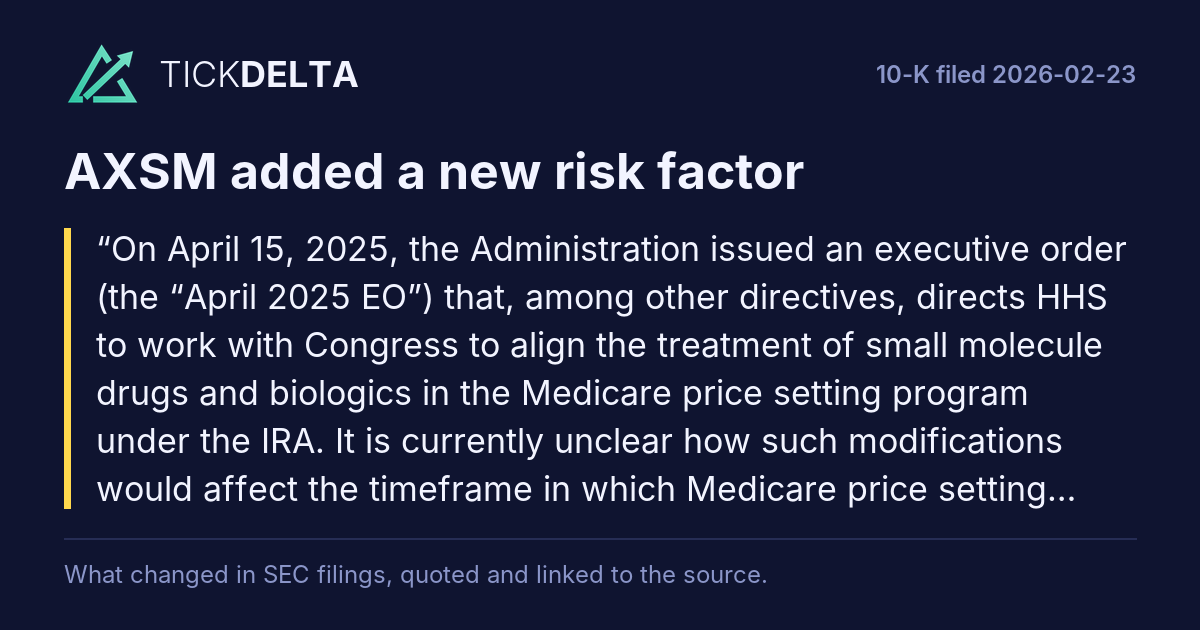
On April 15, 2025, the Administration issued an executive order (the “April 2025 EO”) that, among other directives, directs HHS to work with Congress to align the treatment of small molecule drugs and biologics in the Medicare price setting program under the IRA. It is currently unclear how such modifications would affect the timeframe in which Medicare price setting becomes applicable for selected drugs or biologics. The April 2025 EO also directs HHS to provide recommendations within 180 days to accelerate the approval of generics, biosimilars, combination products and second-in-class medications, as well as to address Medicaid drug rebates and Medicaid drug payment methodologies, and, within one year, to develop and implement a plan to test a payment model to enable Medicare to obtain pharmaceuticals at lower cost. Other Centers for Medicare & Medicaid Services (CMS) policy changes and demonstration projects to test new care, delivery and payment models can also significantly affect how drugs, including our products, are covered and reimbursed. Legislative and regulatory proposals may also be made to expand post-approval requirements and restrict sales and promotional activities for drugs. To date, CMS has selected ten Medicare Part D drugs with prices to go into effect on January 1, 2026 and another 15 Part D drugs with prices to go into effect on January 1, 2027. Another 15 drugs from Medicare Part B or Medicare Part D will be selected by February 1, 2026, for the maximum price to be set and in effect by January 1, 2028.

Read in the 10-K

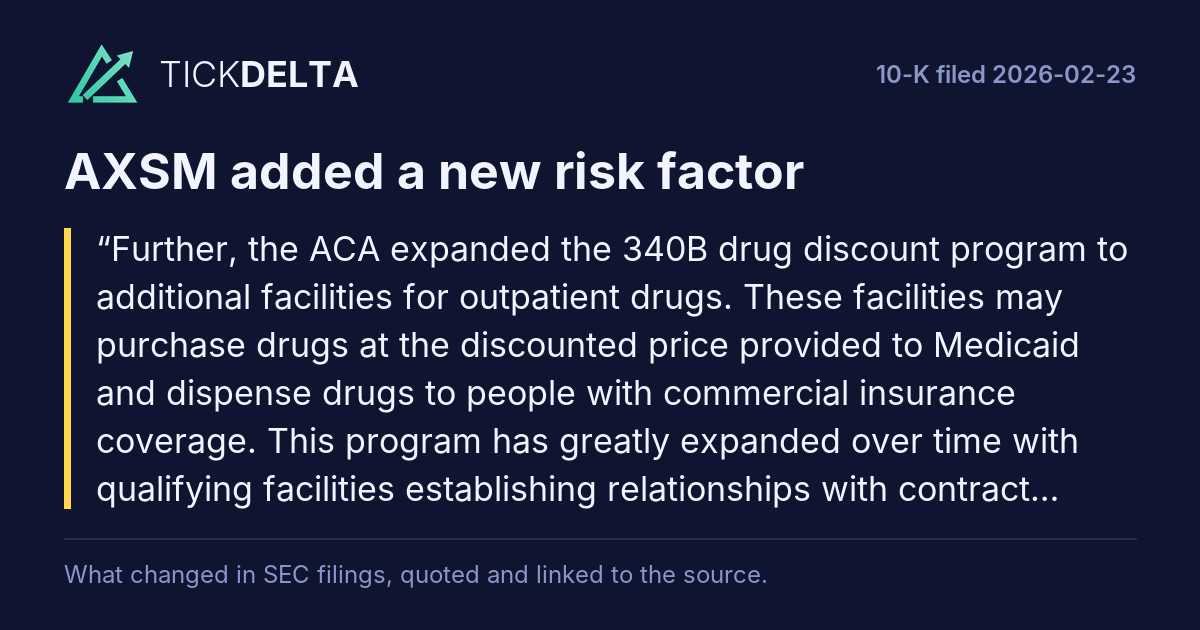
Further, the ACA expanded the 340B drug discount program to additional facilities for outpatient drugs. These facilities may purchase drugs at the discounted price provided to Medicaid and dispense drugs to people with commercial insurance coverage. This program has greatly expanded over time with qualifying facilities establishing relationships with contract pharmacies, which has continued to exert downward pressure on price and profitability of outpatient medicines. Any changes to Medicaid required rebates could also affect our 340B pricing. Other aspects of the 340B program are subject to ongoing litigation, the resolution of which could impact the scope of the 340B program.

Read in the 10-K

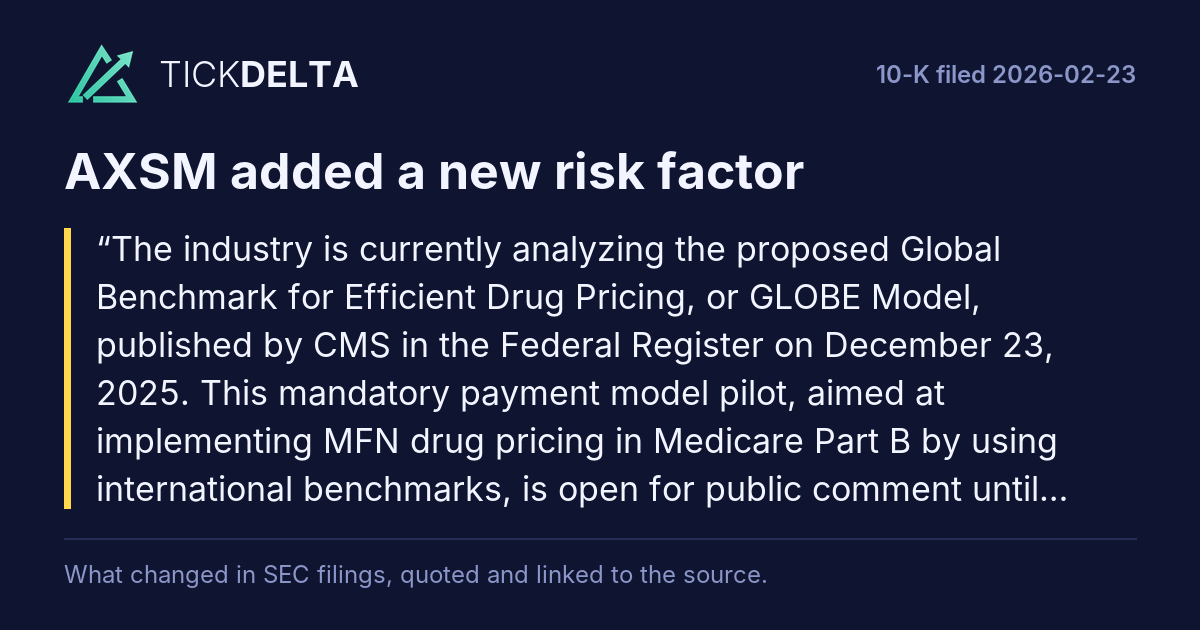
The industry is currently analyzing the proposed Global Benchmark for Efficient Drug Pricing, or GLOBE Model, published by CMS in the Federal Register on December 23, 2025. This mandatory payment model pilot, aimed at implementing MFN drug pricing in Medicare Part B by using international benchmarks, is open for public comment until February 23, 2026, and would require pharmaceutical companies to pay additional rebates on certain medicines whose U.S. net-of-discount prices exceed those in certain other countries. If finalized as proposed, the model is expected to begin on October 1, 2026, and run through September 30, 2031. The implications of this rule, along with its companion, Guarding U.S. Medicare Against Rising Drug Costs, or GUARD Model, which is focused on Part D drugs, and other MFN pricing pressures, could lead to voluntary or involuntary manufacturer price changes, which could be either temporary or long term, but all of which could adversely affect our business. Furthermore, these actions may lead to legal challenges, introducing additional uncertainty into our business operations.

Read in the 10-K

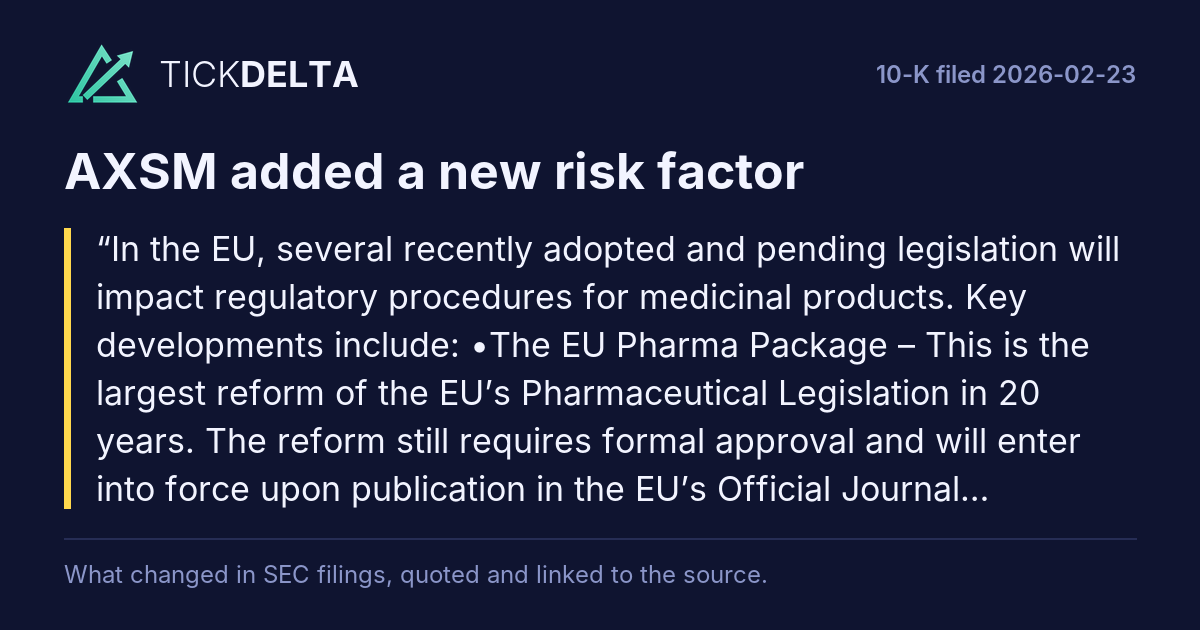
In the EU, several recently adopted and pending legislation will impact regulatory procedures for medicinal products. Key developments include:

•The EU Pharma Package – This is the largest reform of the EU’s Pharmaceutical Legislation in 20 years. The reform still requires formal approval and will enter into force upon publication in the EU’s Official Journal, expected in 2026. Most provisions are expected to apply from 2028, following a two-year transition period. The reform encompasses a broad range of measures, including changes to regulatory exclusivity, incentives to combat antimicrobial resistance, intellectual property exemptions for generic medicines, orphan products, and marketing authorization procedures;

•Regulation (EU) 2021/2282 on health technology assessment (HTA Regulation) – This became applicable in the EU on January 12, 2025, introducing a single EU-level submission file for joint clinical assessments for oncology medicines and advanced therapy medicinal products The EU HTA-R will be extended to orphan medicines in January 2028 and as of 2030, will cover all new centrally authorized medicinal products;

•Other legislative initiatives include new rules on substances of human origin (Regulation (EU) 2024/1938 – SoHO Regulation) and the proposed SPC Regulation revision, Critical Medicines Act, and Biotech Act.

Moreover, other EU “horizontal” legislation may impact companies operating in the pharmaceutical sector, including Regulation (EU) 2024/1689 (AI Act), Regulation (EU) 2023/2854 (Data Act), Regulation (EU) 2025/327 (Health Data Space Regulation), and the NIS 2 Directive. Moreover, the EU is currently discussing the Digital Omnibus Package, which comprises a series of technical amendments to a wide body of EU digital legislation.

Read in the 10-K

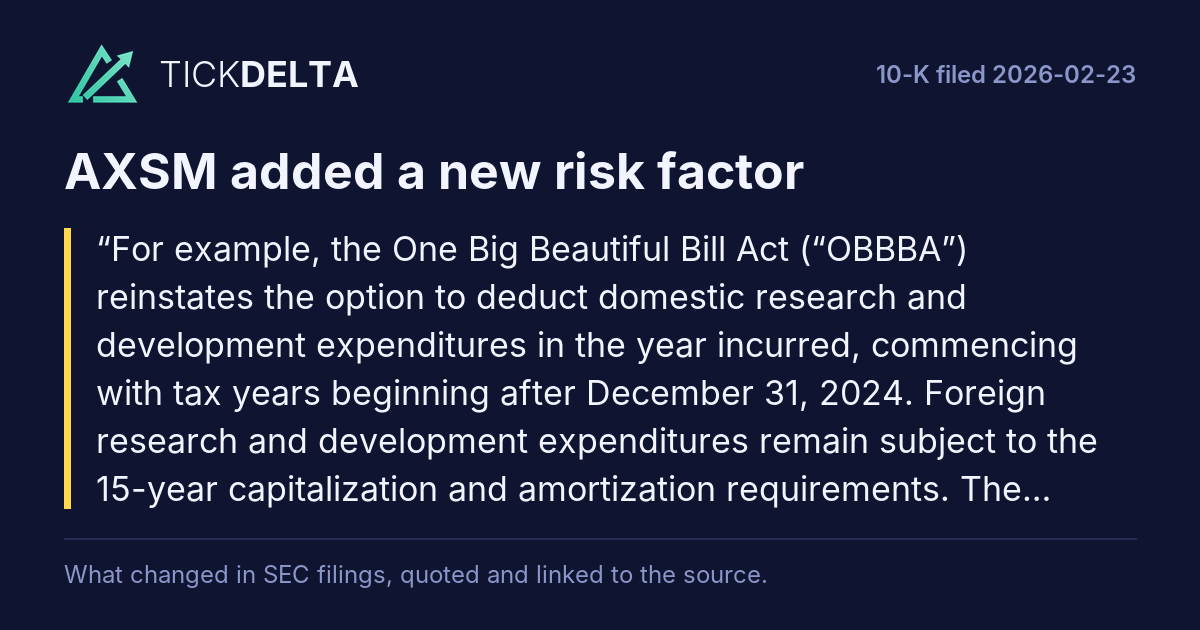
For example, the One Big Beautiful Bill Act (“OBBBA”) reinstates the option to deduct domestic research and development expenditures in the year incurred, commencing with tax years beginning after December 31, 2024. Foreign research and development expenditures remain subject to the 15-year capitalization and amortization requirements. The OBBBA also includes other significant provisions, including tax cut extensions and modifications to the international tax framework. While we continue to evaluate the impact of these legislative changes as additional guidance becomes available, uncertainty remains regarding the timing and interpretation by tax authorities in affected jurisdictions.

Further, OBBBA enacted, among others, changes to eligibility requirements for premium tax credits, which are expected to result in less coverage in the ACA’s health insurance marketplace (“Marketplace”) over the next few years. The ACA’s enhanced premium tax credits expired at the end of 2025, which is expected to result in significant increases in the uninsured population who may have otherwise enrolled in insurance plans obtained through the Marketplace. In addition, the OBBBA made other changes to the enrollment and eligibility requirements for Medicaid, which resulted in the loss of coverage for certain individuals who were previously enrolled in Medicaid programs.

Read in the 10-K

Paragraphs in the 10-Q filed Nov 2, 2026 that were not in the one before

New in the latest 10-Q

6 paragraphs in the 10-Q filed Nov 2, 2026 with nothing like them in the 10-Q filed Aug 10, 2026 (at least half the words must differ; new numbers alone do not count). Quoted exactly, grouped by the item heading above them. This is text that changed, not a judgement of how serious it is.

Financial statements and notes

On November 3, 2025, the Company filed an automatic shelf registration statement (File No. 333-291228) (the “2025 Shelf Registration Statement”) with the SEC for the issuance of common stock, preferred stock, warrants, rights, debt securities and units. It became effective upon filing with the SEC and is currently the Company’s only active shelf registration.

Read in the 10-Q

In October 2015, the Board adopted the 2015 Omnibus Incentive Compensation Plan, as amended from time to time (the “2015 Plan”) and the Company’s stockholders approved the 2015 Plan in November 2015. In April 2025, the Board adopted the Company’s 2025 Long-Term Incentive Plan (“2025 Plan”) and the Company’s stockholders approved the 2025 Plan in June 2025. The Company will make all future equity awards from the 2025 Plan and the Company does not intend to grant any future equity awards from the 2015 Plan. As of September 30, 2026, there were 2,022,667 shares available for future grant under the 2025 Plan.

Read in the 10-Q

As of September 30, 2026, there was $54.2 million of total unrecognized compensation cost related to unvested stock options which is expected to be recognized over a weighted average period of 1.5 years.

Read in the 10-Q

In the second quarter of 2026, Hercules exercised the 2020 warrants and the 2022 warrants on a cashless basis in accordance with the net issuance provisions of the warrants, resulting in the net issuance of 40,177 shares of the Company’s common stock. The Company received no cash proceeds in connection with the exercise. The 2023 warrants remained outstanding as of September 30, 2026.

Read in the 10-Q

In January 2020, the Company entered into an exclusive license agreement with Pfizer Inc. (“Pfizer”) for Pfizer’s clinical and non-clinical data, and intellectual property for reboxetine, the active pharmaceutical ingredient in AXS-12 which the Company is developing for the treatment of narcolepsy. The agreement also provides the Company exclusive rights to develop and commercialize esreboxetine, a new late-stage product candidate referred to as AXS-14, in the United States for the treatment of fibromyalgia.

Read in the 10-Q
Show the other 1

The Company did not have any unrecognized tax benefits as of September 30, 2026 related to uncertain tax positions that would impact the effective income tax rate if recognized.

Read in the 10-Q

The 10-Q's risk factors against the 10-K

Item 1A of the 10-Q filed Nov 2, 2026 against Item 1A of the 10-K filed Feb 23, 2026. A 10-Q repeats only the risks that changed, so a 10-K paragraph that is missing from it is not counted as removed. Added is a paragraph with nothing like it in the 10-K, Reworded a sentence that is in both with several words changed, Quiet changes a sentence in both where one to four words changed and one is a hedge or a modal (cut words struck through, new words highlighted). Text on the page, not a score; each links to the filing at sec.gov.

Added10-Q Nov 2, 2026 vs 10-K Feb 23, 2026
In addition, the United States and other countries maintain extensive sanctions and trade restrictions with respect to Iran. These measures could be modified, broadened in scope or subject to more rigorous enforcement in response to future developments involving Iran or the broader Middle East.

Read it in the 10-Q at sec.gov

Added10-Q Nov 2, 2026 vs 10-K Feb 23, 2026
Further, executive orders were signed to implement MFN drug pricing policies designed to align certain prescription drug prices in the U.S. to lower prices available in other countries. Since issuance of these executive orders, the U.S. administration has begun implementing MFN pricing through a combination of voluntary pricing agreements with pharmaceutical manufacturers, proposed mandatory pricing models applicable to certain Medicare programs, and other administrative actions. A number of pharmaceutical manufacturers, including most of the largest manufacturers, have entered into such voluntary agreements, which reportedly include commitments relating to Medicaid pricing, the pricing of new product launches and investment in U.S. manufacturing, and in certain cases relief from tariffs. Manufacturers that have not entered into such agreements may be more exposed to mandatory pricing models and other measures, and we may face pressure to enter into such an agreement or to otherwise adjust our pricing, which could adversely affect our business, financial condition and results of operations. Investigations and regulatory proceedings have examined international price differentials and policy approaches for implementation, including through administrative rulemaking and demonstration models. On September 30, 2026, CMS finalized the mandatory GLOBE Model for certain Medicare Part B drugs, which begins January 1, 2027, with the first performance year starting April 1, 2027. The GUARD Model for certain Medicare Part D drugs remains proposed. MFN pricing initiatives have been linked to other regulatory and trade measures, including tariff exemptions and incentives for domestic manufacturing, further increasing their potential impact on commercialization and pricing strategies.

Read it in the 10-Q at sec.gov

Added10-Q Nov 2, 2026 vs 10-K Feb 23, 2026
We, directly or through our third-party service providers, may adopt, use or incorporate artificial intelligence (AI) technology and capabilities into the information technology systems, software or other tools that we use in our business and operations. Defects in such AI technology or related security breaches, loss of data and other disruptions, as well as changes in implementation standards and enforcement practices under a rapidly evolving regulatory framework for AI technology, may adversely affect our business and operations and potentially expose us to increasing liability.

Read it in the 10-Q at sec.gov

Added10-Q Nov 2, 2026 vs 10-K Feb 23, 2026
We, directly or through our third-party service providers, may adopt, use or incorporate AI technology and capabilities into information technology systems, software or other tools to help us operate our business more efficiently. Use of AI technology may introduce operational, cybersecurity, privacy, intellectual property, data-integrity, bias and quality-control risks, including risks arising from inaccurate outputs, inappropriate reliance on AI-generated content, unauthorized use or disclosure of confidential or personal information, and failures by vendors to develop, deploy or monitor AI tools in accordance with applicable requirements.

Read it in the 10-Q at sec.gov

Show the other 19
Added10-Q Nov 2, 2026 vs 10-K Feb 23, 2026
The regulatory framework for AI technologies is rapidly evolving as many federal, state and foreign government bodies and agencies have introduced, enacted or are considering additional laws, regulations, executive orders, guidance and other enforcement initiatives that may affect the development, procurement, deployment and use of AI technology. In addition, existing laws and regulations may be interpreted in ways that would affect the use of AI in our business. In the EU, the AI Act establishes a comprehensive, risk-based governance framework for AI in the EU market. The AI Act and developing interpretation and application of the GDPR in respect of automated decision making, together with developing guidance and decisions concerning the impact of AI technology on data privacy, may affect our use of AI technologies.

Read it in the 10-Q at sec.gov

Added10-Q Nov 2, 2026 vs 10-K Feb 23, 2026
Further, interpretation and implementation of intellectual property protection in the field of AI are rapidly evolving and there is uncertainty and ongoing litigation in different jurisdictions as to the degree and extent of protection warranted for AI and relevant system inputs and outputs. If we fail to obtain protection for intellectual property rights for any of our intellectual property that may incorporate or be developed using AI technologies, or later have our intellectual property rights invalidated or otherwise diminished, our competitors may be able to take advantage of our research and development efforts to develop competing products that could adversely affect our business, reputation and financial condition.

Read it in the 10-Q at sec.gov

Added10-Q Nov 2, 2026 vs 10-K Feb 23, 2026
The evolving regulatory framework for AI technologies and related implementation standards and enforcement practices remain uncertain, and we cannot yet determine the impact that current or future laws, regulations, standards, agency guidance, enforcement priorities or market perception of such requirements may have on our business and may not always be able to anticipate how to respond to these laws or regulations. We may need to expend resources to adjust our systems in certain jurisdictions if the laws, regulations, decisions or guidance are not consistent across jurisdictions. Further, the cost to comply with such laws, regulations, decisions and/or guidance interpreting existing laws could be significant and would increase our operating expenses. Such an increase in operating expenses, as well as any actual or perceived failure to comply with such laws and regulations, could materially and adversely affect our business, financial condition, results of operations, and prospects.

Read it in the 10-Q at sec.gov

Reworded10-Q Nov 2, 2026 vs 10-K Feb 23, 2026
Although we submitted NDAs to the FDA for AUVELITY to treat MDD (which was approved) and for approved), SYMBRAVO (which received a complete response letter (CRL) was approved), and has now been approved) and for AXS-14 (which received a Refuse to File letter from the FDA, and which we plan to resubmit), as well as submitted a supplemental New Drug Application (sNDA) for AXS-05 to treat ADA (which was approved) and an NDA for AXS-12 for the treatment of cataplexy in narcolepsy (which was accepted for filing by the FDA in July 2026), we have not otherwise submitted an NDA to the FDA, or similar drug approval filings to comparable foreign authorities, for any product candidate, and we cannot be certain that our current or future product candidates will be successful in clinical trials or receive regulatory approval.

Read it in the 10-Q at sec.govThe 10-K sentence

Reworded10-Q Nov 2, 2026 vs 10-K Feb 23, 2026
As a pharmaceutical company, we are subject to many federal and state healthcare laws, including those described in the “Business—Government “Business - Government Regulation and Product Approval” section of this our most recent Annual Report on Form 10-K, such laws may include the federal Anti-Kickback Statute, the federal civil and criminal FCA, the CMP Law, the Medicaid Drug Rebate Statute and other price reporting requirements, the Veterans Health Care Act of 1992, the Sunshine Act, HIPAA, the FCPA, the ACA, and other state and foreign laws. 10-K.

Read it in the 10-Q at sec.govThe 10-K sentence

Reworded10-Q Nov 2, 2026 vs 10-K Feb 23, 2026
As a pharmaceutical company, we are subject to many federal and state healthcare laws, including those described in the “Business—Government Regulation and Product Approval” section of this Annual Report on Form 10-K, such Such laws may include the federal Anti-Kickback Statute, the federal civil and criminal FCA, the CMP Civil Monetary Penalties (“CMP”) Law, the Medicaid Drug Rebate Statute and other price reporting requirements, the Veterans Health Care Act of 1992, the Sunshine Act, HIPAA, the Health Insurance Portability and Accountability Act of 1996 (“HIPAA”), the FCPA, the ACA, Affordable Care Act (“ACA”), and other state and foreign laws.

Read it in the 10-Q at sec.govThe 10-K sentence

Reworded10-Q Nov 2, 2026 vs 10-K Feb 23, 2026
Furthermore, In particular, HHS and the Department of Health and Human Services (HHS) and FDA have stated announced plans to pursue rulemaking designed to require more extensive risk disclosure in DTC prescription drug advertising, including by revisiting the long-standing “adequate provision” framework applicable to broadcast advertising, and have indicated that they are committed to a “more expansive reading” of the FDA’s enforcement authorities than that taken by previous administrations.

Read it in the 10-Q at sec.govThe 10-K sentence

Reworded10-Q Nov 2, 2026 vs 10-K Feb 23, 2026
Although Since Russia’s full-scale invasion of Ukraine in February 2022, the length duration, severity, and impact broader economic effects of the ongoing military conflict is highly unpredictable, have remained uncertain, and the conflict in Ukraine has contributed to, and could lead continue to contribute to market disruptions, including significant volatility in commodity prices, credit and capital markets, as well as supply chain interruptions.

Read it in the 10-Q at sec.govThe 10-K sentence

Reworded10-Q Nov 2, 2026 vs 10-K Feb 23, 2026
To date, CMS has selected ten Medicare Part D drugs with prices to go that went into effect on January 1, 2026 and another 15 Part D drugs with prices to that will go into effect on January 1, 2027. 2027, and an additional 15 Medicare Part B or Medicare Part D drugs selected on February 1, 2026 for prices to go into effect in 2028.

Read it in the 10-Q at sec.govThe 10-K sentence

Reworded10-Q Nov 2, 2026 vs 10-K Feb 23, 2026
Tariffs remain a dynamic issue and have become a central part of the U.S. trade policy, undergoing continuous expansion and modification, such as including the imposition in February 2026 of a temporary 10% global import surcharge under separate statutory authority, although pharmaceuticals and pharmaceutical ingredients were identified among exempt categories under that temporary surcharge, and China’s tariffs being reduced in November 2025 and further actions in early 2026.

Read it in the 10-Q at sec.govThe 10-K sentence

Reworded10-Q Nov 2, 2026 vs 10-K Feb 23, 2026
Other aspects of the 340B program are subject to ongoing litigation, most notably a federal lawsuit seeking to block Health Resources and Services Administration’s (HRSA) upcoming January 1, 2027 implementation of a mandatory backend rebate model pilot for high-cost Medicare-negotiated drugs, the resolution of which could impact the scope and financial mechanics of the 340B program.

Read it in the 10-Q at sec.govThe 10-K sentence

Reworded10-Q Nov 2, 2026 vs 10-K Feb 23, 2026
Additionally, on January 17, 2026, President Trump announced 10% proposed tariffs (increasing of 10%, increasing to 25% on June 1, 2026) 2026, on imports from eight European allies to pressure for a ‘deal’ regarding Greenland. in connection with Greenland, but withdrew the proposed tariffs on January 21, 2026 before they took effect.

Read it in the 10-Q at sec.govThe 10-K sentence

Reworded10-Q Nov 2, 2026 vs 10-K Feb 23, 2026
The Although certain MFN pricing initiatives have been announced or implemented, the details of such proposed regulations future regulations, pricing models, enforcement mechanisms and related policies are unclear and the final terms and impact remain uncertain, and may pose long-term risks to our business and our future commercialization plans of our drug candidates.

Read it in the 10-Q at sec.govThe 10-K sentence

Reworded10-Q Nov 2, 2026 vs 10-K Feb 23, 2026
For example, in February 2023, we received a paragraph Paragraph IV certification notice letter from Teva providing notification to the Company that Teva has submitted an ANDA to the FDA seeking approval to manufacture, use, or sell a generic version of AUVELITY. Pharmaceuticals, Inc.

Read it in the 10-Q at sec.govThe 10-K sentence

Reworded10-Q Nov 2, 2026 vs 10-K Feb 23, 2026
U.S. and global markets are experiencing volatility and disruption following the escalation of geopolitical tensions and the start of tensions, including the military conflict between Russia and Ukraine. Ukraine and heightened instability in the Middle East involving Iran and the ongoing war involving the United States, Israel and Iran.

Read it in the 10-Q at sec.govThe 10-K sentence

Quiet changes10-Q Nov 2, 2026 vs 10-K Feb 23, 2026
The proceeds of the Term Loans were used, together with cash on hand, to repay in full our obligations under the Hercules Loan Agreement, which resulted in a recording of a loss on debt extinguishment of approximately $10.4 million in the Company’s consolidated statement of operations.

Read it in the 10-Q at sec.govThe 10-K sentence

Quiet changes10-Q Nov 2, 2026 vs 10-K Feb 23, 2026
SUNOSI is a controlled substance and may be is subject to U.S. federal and state controlled substance laws and regulations, and our failure to comply with these laws and regulations, or the cost of compliance with these laws and regulations, could materially and adversely affect our business, results of operations, financial condition and growth prospects.

Read it in the 10-Q at sec.govThe 10-K sentence

Quiet changes10-Q Nov 2, 2026 vs 10-K Feb 23, 2026
Patent litigation is inherently uncertain, and we cannot guarantee the outcome of any such proceedings, that we would succeed in stopping the “at risk” launch of a generic version of either any of our currently commercialized products during the pendency of litigation following expiry of the 30-month stay, or that we would commence such proceedings.

Read it in the 10-Q at sec.govThe 10-K sentence

The first 24 of 87 are shown (at most 12 of each type).

Phrases used for the first time

Two-word phrases in Risk Factors of the 10-K filed Feb 23, 2026 that are in none of the 1 earlier 10-Ks stored, back to Feb 18, 2025

blackstone loan ×8term loans ×7biotechnology equipment ×4non-clinical testing ×4drug prices ×3marketing authorization ×3received refuse ×3nis directive ×3loan facility ×2potential revenue ×2closing date ×2party thereto ×2wilmington trust ×2first lien ×2senior secured ×2secured term ×2
Where each one is used
  • blackstone loan: On May 8, 2025 (the “Closing Date”), we entered into a loan agreement (the “Blackstone Loan Agreement”) with Blackstone Alternative Credit Advisors LP and Blackstone Life Sciences Advisors L.L.C. (collectively, the “Blackstone Representative” and referred to herein as “Blackstone”), certain subsidiaries party...
  • term loans: On May 8, 2025 (the “Closing Date”), we entered into a loan agreement (the “Blackstone Loan Agreement”) with Blackstone Alternative Credit Advisors LP and Blackstone Life Sciences Advisors L.L.C. (collectively, the “Blackstone Representative” and referred to herein as “Blackstone”), certain subsidiaries party...
  • biotechnology equipment: The new U.S. administration may also enact other new regulations or policies that affect trade with China or otherwise impact the pharmaceutical industry by enacting laws to restrict U.S. pharmaceutical companies from contracting with Chinese companies on the development, research or manufacturing of pharmaceutical...
  • non-clinical testing: In order to obtain approval of a product candidate we must demonstrate safety in various non-clinical tests (including, for example, carcinogenicity studies, drug-drug interaction studies, and toxicity studies), in addition to human clinical trials. At the time of initiating human clinical trials, we may not have...
  • drug prices: Further, executive orders were signed to implement MFN drug pricing policies designed to align certain prescription drug prices in the U.S. to lower prices available in other countries. Investigations are being conducted to examine price differentials and consider policy approaches for implementation, including...
  • marketing authorization: Further, executive orders were signed to implement MFN drug pricing policies designed to align certain prescription drug prices in the U.S. to lower prices available in other countries. Investigations are being conducted to examine price differentials and consider policy approaches for implementation, including...
  • received refuse: Although we submitted NDAs to the FDA for AUVELITY (which was approved) and for SYMBRAVO (which received a complete response letter (CRL) and has now been approved) and for AXS-14 (which received a Refuse to File letter from the FDA, and which we plan to resubmit), we have not otherwise submitted an NDA to the FDA,...
  • nis directive: •stricter harmonized EU rules on data privacy and cybersecurity. These include enhanced rules on the processing of personal data, including health data, under the EU General Data Protection Regulation (GDPR), which became enforceable beginning May 25, 2018, as well as cybersecurity obligations under Directive (EU)...

The 10-K at sec.gov

Used at least twice, small words left out. Counted, not picked: a phrase can be new because the company renamed something.

What was taken out

5 paragraphs of last year's Risk Factors with nothing like them now. The longest are quoted.

Across all companies
In September 2020, we entered into a Loan and Security Agreement, or the Loan Agreement, for a term loan, which we refer to as the 2020 Term Loan, with Hercules Capital, Inc., or Hercules, in its capacity as administrative agent and collateral agent and as a lender, and the other financial institutions that from time to time become parties to the Loan Agreement, collectively referred to as the Lenders, secured by a lien on substantially all of our assets, including intellectual property. In October 2021, we entered into a First Amendment to the Loan Agreement to, among other things,...
In the 10-K filed Feb 18, 2025
In the EU, recently adopted and pending legislation will impact regulatory procedures for medicinal products. Key developments include Regulation (EU) 2021/2282 on health technology assessment (HTA Regulation), which became applicable in the EU on 12 January 2025. Additionally, in April 2023, the EC adopted a proposal to revise the EU pharmaceutical legislation consisting of a new directive and a new regulation that would replace Directive 2001/83/EC and Regulation (EC) 726/2004, among others. In April 2024, the European Parliament introduced amendments to the EC’s proposal. The EU...
In the 10-K filed Feb 18, 2025
In addition, on October 7, 2023, Hamas militants and members of other terrorist organizations infiltrated Israel’s southern border from the Gaza Strip and conducted a series of terror attacks on civilian and military targets. Shortly following the attack, Israel’s security cabinet declared war against Hamas, and Israel launched an aerial bombardment of various targets within the Gaza Strip and then also began ground operations in the Gaza Strip, which remain ongoing. Other terrorist and/or regional organizations have joined the hostilities as well, including Hezbollah in Lebanon, and the...
In the 10-K filed Feb 18, 2025
General political uncertainty may have an adverse impact on our operating performance and results of operations. In particular, the U.S. continues to experience significant political events that cast uncertainty on global financial and economic markets, especially following the recent presidential election. It is presently unclear exactly what actions the second Trump administration in the U.S. will implement, and if implemented, how these actions may impact the biopharmaceutical industry in the U.S. Any actions taken by the Trump administration, including the many recent executive orders,...
In the 10-K filed Feb 18, 2025

Sources

Item 1A of each 10-K and 10-Q on EDGAR, quoted exactly. Each paragraph links to the filing at sec.gov.

Also

10-K change: what was reworded or cut, section by section.

Work with it

Excel workbook · CSV. Google Sheet that stays up to date: paste =IMPORTDATA("https://tickdelta.com/company/AXSM/export.csv") into a cell.

Next:10-K change
Esc

Type a ticker such as AAPL, a name, an investor such as Buffett, or a topic such as tariffs. ↑ ↓ to move, Enter to open.