Axalta Coating Systems Ltd. AXTA
New risk paragraphs, branching off last year
Each branch is a paragraph in Risk Factors with nothing like it in the 10-K filed Feb 13, 2025. A box jumps to the paragraph as filed, below.
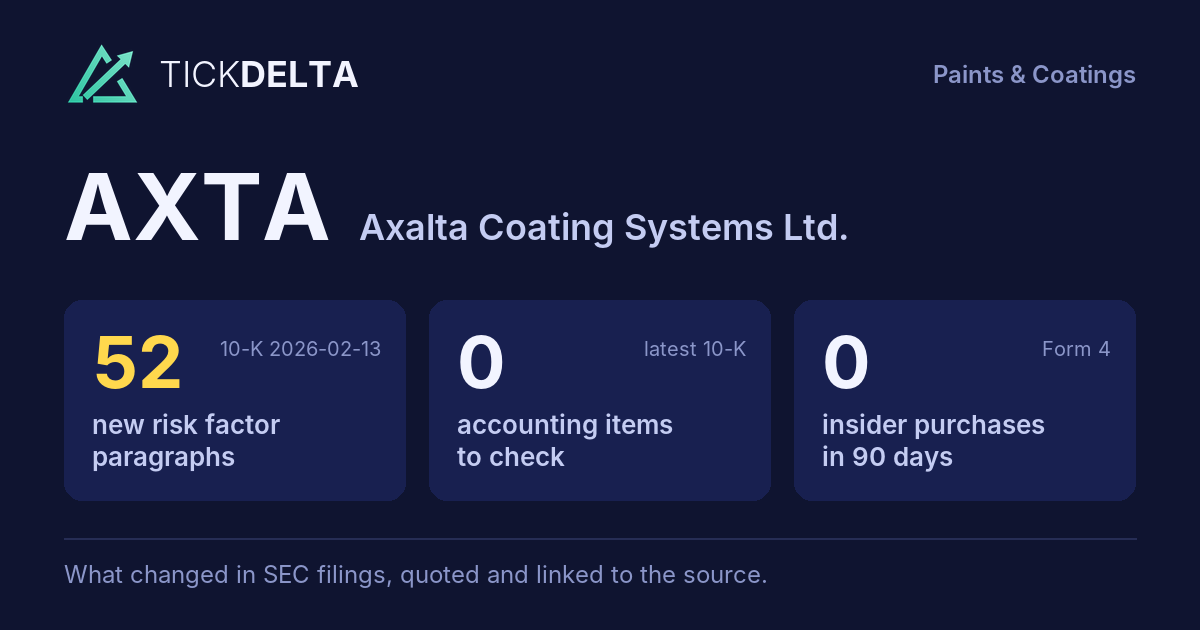
Paragraphs with nothing like them in last year's 10-K
52 paragraphs in Risk Factors of the 10-K filed Feb 13, 2026 with nothing like them in the 10-K filed Feb 13, 2025. Quoted exactly. Paragraphs that were only edited are under 10-K change.
•The Merger Agreement may be terminated in accordance with its terms and the Merger may not be completed.
•Failure to consummate the Merger could negatively impact the share price and the future business and financial results of the Company.
•The Merger Agreement contains provisions that limit the Company’s ability to pursue alternatives to the Merger.
•Because the value of the Company and AkzoNobel ordinary shares may fluctuate, our shareholders cannot be sure of the value of the Merger Consideration they will receive.
•The Merger Agreement subjects us to restrictions on business activities prior to the effective time of the Merger.
•While the Merger is pending, the Company will be subject to business uncertainties.
•After the Merger, our shareholders will have a significantly lower ownership and voting interest in the Combined Company than they currently have in the Company.
•The ordinary shares of the Combined Company will have different rights from our common shares and the market price of the Combined Company ordinary shares may be affected by factors different from those currently affecting the market price of our common shares.
•The Company and AkzoNobel may be targets of legal proceedings that could result in substantial costs and may delay or prevent the Merger from being completed.
•The Company and AkzoNobel have incurred, and will incur additional, substantial transaction fees and costs in connection with the Merger.
•Our results of operations could be adversely affected by litigation and claims.
•We have substantial indebtedness, which could have a material adverse effect on us.
For a more complete discussion of the material risks facing our business, see below.
The Merger Agreement may be terminated in accordance with its terms and the Merger may not be completed.
The completion of the Merger is subject to the satisfaction or waiver of certain conditions as set forth in the Merger Agreement (the “Closing Conditions”) and there can be no assurance that such conditions will be satisfied or waived. The failure to timely satisfy the Closing Conditions could delay the completion of the Merger for a significant period of time or prevent the completion of the Merger from occurring at all. The Closing Conditions require that the parties seek certain applicable foreign antitrust and other regulatory approvals in connection with the Merger, and the governmental agencies from which such approvals are sought have broad discretion in administering applicable governing regulations. Those agencies may impose requirements, limitations or costs, require divestitures or place restrictions on the conduct of the Combined Company’s business after the closing. Such requirements, limitations, costs, divestitures or restrictions could delay or prevent the consummation of the Merger or have a material adverse effect on the Combined Company’s business and results of operations.
Approval by the Company’s shareholders is one such Closing Condition. A proxy contest or activist campaign related to the Merger could reduce the likelihood that we obtain shareholder approval for the Merger, demand extensive management attention and require that we incur additional costs to respond to the proxy contest or activist campaign, and, if successful, prevent the Merger from being completed.
In addition, the Merger Agreement contains certain termination rights for the Company and AkzoNobel, including (i) if the Merger is not consummated on or before the “outside date” of May 18, 2027 (subject to extension to November 18, 2027 under certain circumstances), (ii) subject to compliance with certain terms of the Merger Agreement, in order to enter into a definitive agreement providing for a superior proposal, or (iii) if, prior to the applicable shareholders’ meeting, the Company Board or either of the AkzoNobel Boards, as applicable, changes its recommendation or fails to reaffirm such recommendation in certain circumstances.
Failure to consummate the Merger could negatively impact the share price and the future business and financial results of the Company.
If the Merger is not consummated, the Company will not realize any of the potential benefits of consummation of the Merger and the Company will be subject to a number of risks, including the following:
•The Company may experience negative reactions from the financial markets, including significant and lasting negative impacts on its stock price;
•The Company may experience negative reactions from its customers, suppliers, business partners and employees;
•The Company will be required to pay certain costs and expenses relating to the Merger whether or not the Merger is consummated;
•Matters relating to the Merger (including integration planning) require substantial Company management time and resources, which could otherwise have been devoted to other beneficial opportunities;
•The Merger Agreement restricts the Company, without AkzoNobel’s consent and subject to certain exceptions, from taking certain specified actions during the pendency of the Merger. These restrictions may prevent the Company from pursuing otherwise attractive business opportunities, entering into contracts, incurring capital expenditures to grow its business and making other changes to its business; and
•If the Merger Agreement is terminated in certain circumstances, the Company may be required to pay a termination fee of €150 million to AkzoNobel.
If the Merger is not consummated, these risks may materialize and may materially and adversely affect our business, operations, financial results and share price.
The Merger Agreement contains provisions that limit the Company’s ability to pursue alternatives to the Merger.
Under the Merger Agreement, the Company is subject to certain restrictions on its ability to solicit alternative business combination proposals from third parties, engage in discussion or negotiations with respect to such proposals or provide information in connection with such proposals, subject to certain customary exceptions. Further, other than in response to a superior proposal or an intervening event, the Board may not withdraw or modify its recommendation to the Company’s shareholders in favor of the adoption of the Merger Agreement, and AkzoNobel generally has a right to match any competing business combination proposals that may be made. The Company may terminate the Merger Agreement and enter into an agreement providing for a superior proposal only if specified conditions have been satisfied, and such a termination would result in the Company being required to pay AkzoNobel a termination fee equal to €150 million. If the Merger Agreement is terminated and the Company determines to seek another business combination, the Company may not be able to negotiate a transaction with another party on terms comparable to, or better than, the terms of the Merger. While the Company believes these provisions and agreements are reasonable and customary and are not preclusive of other offers, these provisions could discourage a third party that may have an interest in entering into a strategic transaction with the Company from proposing such a strategic transaction, even if such third party were prepared to pay consideration with a higher value than the Merger Consideration (as defined below).
Because the value of the Company and AkzoNobel ordinary shares may fluctuate, our shareholders cannot be sure of the value of the Merger Consideration they will receive.
Upon completion of the Merger, our shareholders will be entitled to receive 0.6539 ordinary shares in the Combined Company in exchange for each outstanding and issued ordinary share of the Company (the “Merger Consideration”). Because this exchange ratio is fixed and will only be adjusted in certain limited circumstances (including reclassifications, stock splits or combinations, exchanges or readjustments of shares, or stock dividends, reorganization, recapitalization or similar transactions involving the Company or AkzoNobel), any changes in the market value of Company ordinary shares or AkzoNobel common shares may affect the value that our shareholders will be entitled to receive upon completion of the Merger. Share price changes may result from a variety of factors, including changes in the business, operations or prospects of the Company or AkzoNobel, market assessments of the likelihood that the Merger will be completed, the timing of the Merger, regulatory considerations, general market and economic conditions and other factors.
The Merger Agreement subjects us to restrictions on business activities prior to the effective time of the Merger.
The Merger Agreement restricts us from entering into certain corporate transactions, including with respect to certain acquisitions, and taking other specified actions without the consent of AkzoNobel and generally requires us to continue our operations in the ordinary course through the completion of the Merger. These restrictions could be in place for an extended period of time as the pendency of the Merger continues and could prevent us from pursuing attractive business opportunities that may arise during the pendency of the Merger.
While the Merger is pending, the Company will be subject to business uncertainties which could adversely affect the Company’s business, results of operations, financial condition and cash flows.
Uncertainty about the effect of the Merger on our employees, customers, suppliers and other business partners may have an adverse effect on the Company. These uncertainties may impair the Company’s ability to attract, retain and motivate key personnel until the Merger is consummated and for a period of time thereafter. If, despite the Company’s retention efforts, key employees depart because of issues relating to the uncertainty and difficulty of integration or a desire not to remain with the Combined Company, the Combined Company’s (or, if the Merger is not consummated, the Company’s) business could be harmed and its ability to realize the anticipated benefits of the Merger could be adversely affected.
Parties with which the Company does business may experience uncertainty associated with the Merger, including with respect to current or future business relationships with the Company. The Company’s business relationships may be subject to disruption as customers and suppliers may attempt to negotiate changes in existing business relationships or consider entering into business relationships with parties other than the Company. These disruptions could have an adverse effect on the businesses, financial condition, results of operations or prospects of the Company, including an adverse effect on the anticipated benefits of the Merger, which may be exacerbated by a delay in completion of the Merger or termination of the Merger Agreement. Additionally, certain contracts entered into by the Company contain change in control, anti-assignment, or certain other provisions that may be triggered as a result of the Merger. If the counterparties to these agreements do not consent to the Merger, the counterparties may have the ability to exercise certain rights (including termination rights), resulting in the Combined Company incurring liabilities as a consequence of breaching such agreements, or causing the Combined Company to lose the benefit of such agreements or incur costs in seeking replacement agreements.
The Company and AkzoNobel entered into the Merger Agreement with the expectation that the Merger will result in various benefits. Achieving the anticipated benefits of the transaction is subject to a number of uncertainties, including whether the businesses of the Company and AkzoNobel can be integrated in an efficient and effective manner.
It is possible that the integration process could take longer than anticipated, could give rise to unanticipated costs and could result in the loss of valuable employees, the disruption of each of our and AkzoNobel’s ongoing businesses, processes and systems or inconsistencies in standards, controls, procedures, practices, policies and compensation arrangements, any of which could adversely affect the Combined Company’s ability to achieve the anticipated benefits of the transaction. The Company and AkzoNobel may have difficulty addressing possible differences in corporate cultures and management philosophies, and there can be no assurance that the Company and AkzoNobel will be able to effectively integrate their management teams. Failure to successfully integrate the businesses of the Company and AkzoNobel in the expected timeframe may adversely affect the future results of the Combined Company, and, consequently, the value of the Merger Consideration.
In addition, there can be no assurance that the Combined Company will achieve a particular credit rating or maintain a particular credit rating in the future. Such credit ratings will affect the cost and availability of future borrowings and, accordingly, the Combined Company’s cost of capital. Further, there can be no guarantee that the Combined Company will obtain or maintain a listing on a U.S. stock exchange.
After the Merger, our shareholders will have a significantly lower ownership and voting interest in the Combined Company than they currently have in the Company.
Under the terms of the Merger Agreement, our shareholders are expected to own 45% of the Combined Company on a pro forma basis immediately after closing. As a result of this reduced ownership percentage, our shareholders will have less ability to influence matters that are put to a vote of the Combined Company.
The ordinary shares of the Combined Company will have different rights from our common shares and the market price of the Combined Company ordinary shares may be affected by factors different from those currently affecting the market price of our common shares.
Upon completion of the Merger, our shareholders will no longer be shareholders of the Company but will instead become holders of ordinary shares of the Combined Company. Certain rights of our shareholders as holders of Combined Company ordinary shares will be governed by Dutch law, and the terms of the Combined Company’s organizational documents are expected to be in some respects materially different than the terms of our memorandum of association and bye-laws, which currently govern the rights of our shareholders. For example, Dutch law significantly limits the circumstances under which shareholders of Dutch companies may bring an action on behalf of a company. In addition, the businesses of AkzoNobel differ from those of the Company in important respects, and, accordingly, the results of operations of the Combined Company, as well as the market price of the Combined Company ordinary shares, may be affected by factors different from those currently affecting the results of operations of the Company.
The Company and AkzoNobel may be targets of legal proceedings that could result in substantial costs and may delay or prevent the Merger from being completed.
Although, currently, we are not aware of any legal proceedings having been brought against the Company or AkzoNobel in connection with the Merger, securities class action lawsuits, derivative lawsuits and other legal proceedings are often brought against public companies that have entered into merger agreements. Even if such legal proceedings are without merit, defending against these claims can result in substantial costs and divert management attention, time and resources. An adverse judgment or settlement could result in significant costs, which could have a negative impact on our and AkzoNobel’s respective liquidity and financial condition. Additionally, if a plaintiff is successful in obtaining an injunction prohibiting completion of the Merger, such injunction may delay or prevent the Merger from being completed, or from being completed within the expected timeframe, which may adversely affect our business, financial position and results of operation.
The Company and AkzoNobel have incurred, and will incur additional, substantial transaction fees and costs in connection with the Merger.
The Company and AkzoNobel have incurred, and expect to further incur, a number of non-recurring transaction-related costs associated with completing the Merger, combining the operations of the two organizations and achieving desired benefits of the Merger. These fees and costs will be substantial. Non-recurring transaction costs include, but are not limited to, fees paid to legal, financial and accounting advisors, retention, severance, change in control and other integration-related costs, filing fees and printing costs. Additional unanticipated costs may be incurred in order to complete the Merger (including, for example, in the event of a proxy fight or activist campaign) or as part of the integration of the businesses of the Company and AkzoNobel. Some of these costs will be payable by us regardless of whether or not the Merger is completed.
Risks Related to our Business Risks Related to Execution of our Strategic and Operating Plans
Several of the end-markets we serve are cyclical, and macroeconomic and other factors beyond our control have in the past and could in the future reduce demand from these end-markets for our products, including as a result of depressed demand for
Show the other 4
In addition, certain key customers have substantial purchasing power and leverage in negotiating contractual arrangements with us. These customers have demanded and may in the future demand contract terms that differ considerably from our
The Board has authorized a common share repurchase program of $700 million, of which $435 million remains available, though the Merger Agreement prohibits us from repurchasing shares, whether under the repurchase program or otherwise,
The legal and regulatory landscape surrounding AI technologies is rapidly evolving and uncertain, including in the areas of intellectual property, cybersecurity, and privacy and data protection. Compliance with new or changing laws, regulations or industry standards relating to AI may impose significant operational costs, limit or foreclose our ability to develop, deploy or use AI technologies or result in legal liability, regulatory action, or reputational harm.
On July 4, 2025, the President of the U.S. signed into law the One Big Beautiful Bill Act (“OBBBA”). The OBBBA maintains the 21% corporate tax rate and makes permanent many of the beneficial expired and expiring provisions originally enacted in the Tax Cuts and Jobs Act of 2017, including immediate expensing of domestic research and development expenditures, more favorable interest deductibility, and 100% business depreciation with effective dates in 2025. Revisions to the international tax framework are effective in 2026. The effect of the OBBBA did not have a material impact on the effective tax rate in our condensed consolidated financial statements as of December 31, 2025. The OBBBA reduced cash paid for taxes during the year ended December 31, 2025.
Paragraphs in the 10-Q filed Oct 29, 2026 that were not in the one before
New in the latest 10-Q
4 paragraphs in the 10-Q filed Oct 29, 2026 with nothing like them in the 10-Q filed Jul 29, 2026 (at least half the words must differ; new numbers alone do not count). Quoted exactly, grouped by the item heading above them. This is text that changed, not a judgement of how serious it is.
Financial statements and notes
During the three months ended September 30, 2026, an interest rate swap associated with the 2029 Dollar Term Loans was voluntarily terminated resulting in cash proceeds of $ 2 million. The associated gains accumulated within AOCI will amortize into interest expense through the original maturity date of June 30, 2028.
Read in the 10-Q
Former Notional amount $ 175 Interest rate pay 3.303 % Interest rate receive 3-month SOFR Initial effective date 9/25/2025 Maximum expiration date 6/30/2028
Read in the 10-Q
The conflict in the Middle East involving Iran has increased the level of economic and political uncertainty globally. While our operations in the Middle East region do not constitute a material portion of our business, during the three months ended September 30, 2026, we were negatively impacted by the broader economic impact on raw material and freight costs, which were partially offset by mitigation strategies developed in response to these pressures. We will continue to monitor these conditions and take actions that we believe will help mitigate costs.
Read in the 10-Q
Currency exchange impacts on cash for the nine months ended September 30, 2026 were immaterial.
Read in the 10-Q
The 10-Q's risk factors against the 10-K
Item 1A of the 10-Q filed Oct 29, 2026 against Item 1A of the 10-K filed Feb 13, 2026.
A 10-Q repeats only the risks that changed, so a 10-K paragraph that is missing from it is not counted as removed.
Added is a paragraph with nothing like it in the 10-K, Reworded a sentence that is in both with several words changed,
Quiet changes a sentence in both where one to four words changed and one is a hedge or a modal
(cut words struck through, new words highlighted).
Text on the page, not a score; each links to the filing at sec.gov.
What the 10-Q itself says about its risk factors:There have been no material changes in our risk factors from those previously disclosed in Part I, Item 1A of our Annual Report on Form 10-K for the year ended December 31, 2025.
Read in the 10-Q
1 paragraph in the 10-Q's Item 1A, and none of them adds, rewords or quietly edits a paragraph of the 10-K's.
Phrases used for the first time
Two-word phrases in Risk Factors of the 10-K filed Feb 13, 2026 that are in none of the 1 earlier 10-Ks stored, back to Feb 13, 2025
Where each one is used
- merger agreement: •The Merger Agreement may be terminated in accordance with its terms and the Merger may not be completed.
- ordinary shares: •Because the value of the Company and AkzoNobel ordinary shares may fluctuate, our shareholders cannot be sure of the value of the Merger Consideration they will receive.
- combined company’s: The completion of the Merger is subject to the satisfaction or waiver of certain conditions as set forth in the Merger Agreement (the “Closing Conditions”) and there can be no assurance that such conditions will be satisfied or waived. The failure to timely satisfy the Closing Conditions could delay the completion...
- merger consideration: •Because the value of the Company and AkzoNobel ordinary shares may fluctuate, our shareholders cannot be sure of the value of the Merger Consideration they will receive.
- legal proceedings: •The Company and AkzoNobel may be targets of legal proceedings that could result in substantial costs and may delay or prevent the Merger from being completed.
- agreement contains: •The Merger Agreement contains provisions that limit the Company’s ability to pursue alternatives to the Merger.
- company’s ability: •The Merger Agreement contains provisions that limit the Company’s ability to pursue alternatives to the Merger.
- factors different: •The ordinary shares of the Combined Company will have different rights from our common shares and the market price of the Combined Company ordinary shares may be affected by factors different from those currently affecting the market price of our common shares.
Used at least twice, small words left out. Counted, not picked: a phrase can be new because the company renamed something.
What was taken out
7 paragraphs of last year's Risk Factors with nothing like them now. The longest are quoted.
Sources
Item 1A of each 10-K and 10-Q on EDGAR, quoted exactly. Each paragraph links to the filing at sec.gov.
Also
10-K change: what was reworded or cut, section by section.
Work with it
Excel workbook · CSV. Google Sheet that stays up to date: paste =IMPORTDATA("https://tickdelta.com/company/AXTA/export.csv") into a cell.