tickdelta
Sign in

Tickdelta is free for now. Sign up and get Pro free

← Screener

AZOAutoZone

Consumer discretionary · Auto Parts Retail · NYSE
Compare with peers → Embed

When the SEC's staff reviews a filing, it writes to the company with numbered questions, and the company answers each one in a letter. SEC publishes the exchange once the review is over, at least 20 business days later. Below: what the staff asked AZO, and the company's answer to each question, quoted from the letters. A question is not an accusation; most reviews end with the company adding detail to its next filing.

Form 10-K for the Year Ended August 29, 2020

2021-03-16 to 2021-05-18 · 2 questions · 2 letters from the SEC, 2 from the company
Review closed 2021-05-18
Non-GAAP measuresDebt
Reconciliation of Non-GAAP Financial Measures: Adjusted After-tax ROIC and Adjusted Debt · to EBITDAR, page 38
SEC asked
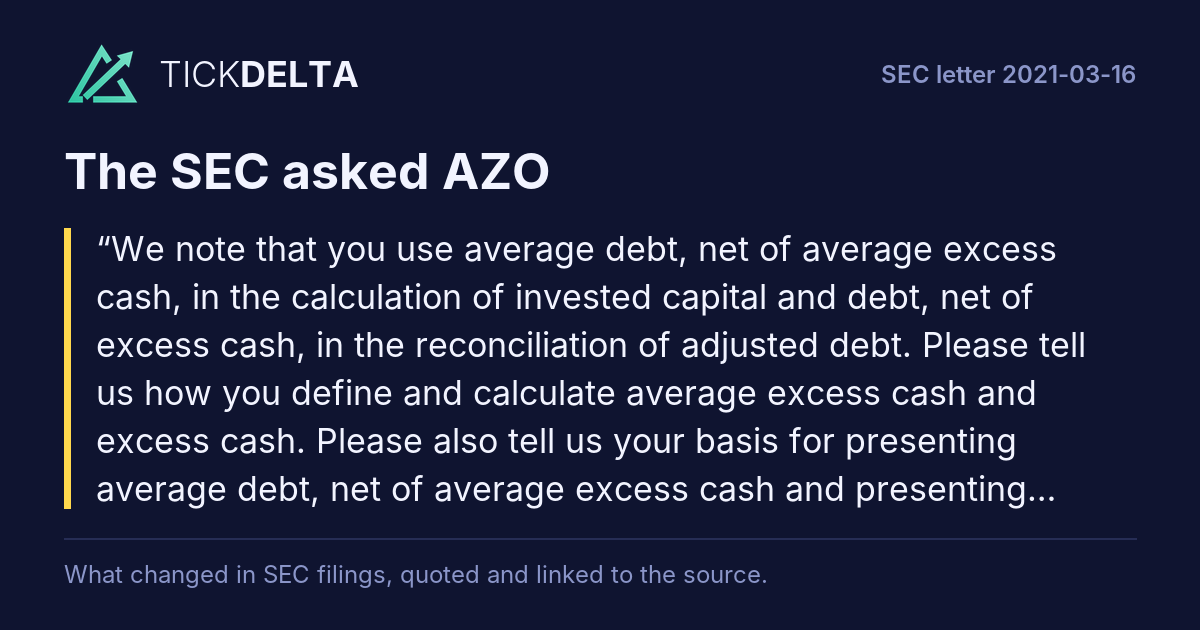
We note that you use average debt, net of average excess cash, in the calculation of invested capital and debt, net of excess cash, in the reconciliation of adjusted debt. Please tell us how you define and calculate average excess cash and excess cash. Please also tell us your basis for presenting average debt, net of average excess cash and presenting debt, net of excess cash.
AZO answered

No numbered answer found in the reply. Read the reply ↗

In its next report

First report after the company's reply of 2021-03-29: 10-Q filed 2021-06-11 ↗, against the 10-Q filed 2020-12-18 ↗.

Tickdelta does not hold the text of both reports, so they are not compared here.
Reconciliation of Non-GAAP Financial Measures: Adjusted After-tax ROIC and Adjusted Debt · to EBITDAR, page 38
SEC asked
We note your response to our prior comment #1. We understand that the “excess cash” arose as a result of unique circumstances related COVID-19. We further note your belief that in post-pandemic periods you do not expect to maintain excess cash and therefore do not expect to present debt or average debt, net of excess cash or average excess cash, respectively.
Rest of the question

However, it is not appropriate to present and label your amounts as “debt” and “average debt” with titles that are similar to GAAP titles. If you present these measures in future filings, please revise your disclosure accordingly. Please refer to Item 10(e)(1)(ii)(E) of Regulation S-K for further guidance.

AZO answered
In future filings, the Company will not present debt or average debt, net of excess cash or average excess cash.

Please let us know if you have any further questions or if we can clarify any other issue that you may have.

Yours truly,

AutoZone, Inc. Read in the reply ↗
In its next report

First report after the company's reply of 2021-05-14: 10-Q filed 2021-06-11 ↗, against the 10-Q filed 2020-12-18 ↗.

Tickdelta does not hold the text of both reports, so they are not compared here.

Also in this review: closing letter, 2021-05-18
Form 10-K for the Fiscal Year Ended August 31, 2019

2020-02-19 to 2020-03-13 · 2 questions · 1 letter from the SEC, 1 from the company
Review closed 2020-03-13
Results discussion (MD&A)RevenueRisk factors
Item 7. Management's Discussion and Analysis of Financial Condition and Results of · Operations, page 24
SEC asked (1)
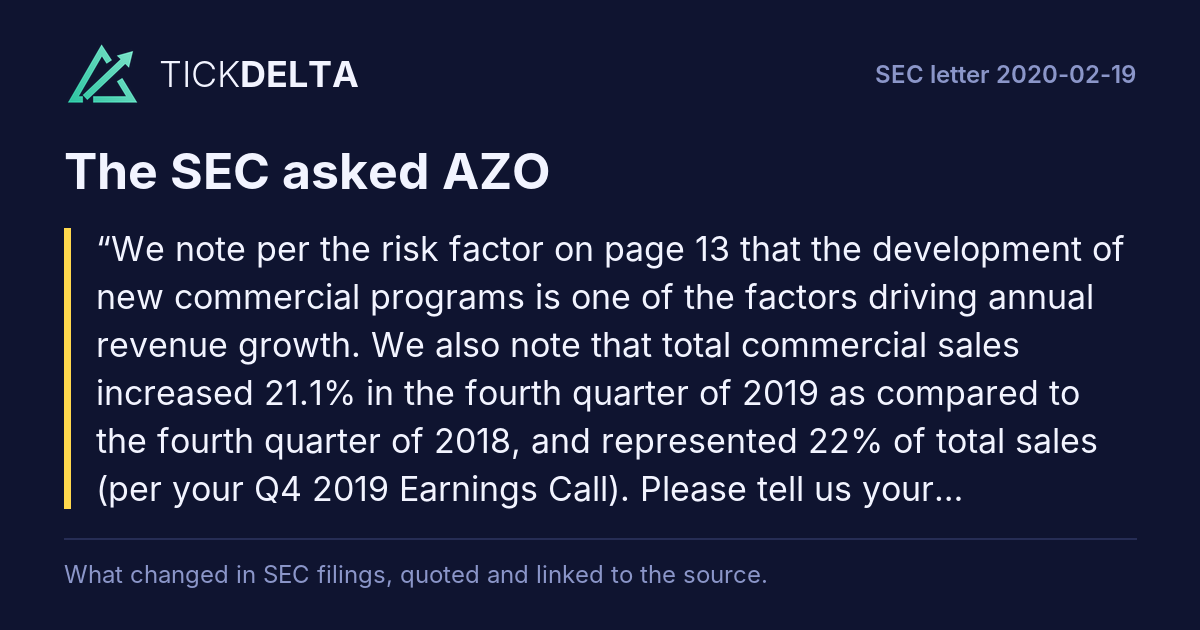
We note per the risk factor on page 13 that the development of new commercial programs is one of the factors driving annual revenue growth. We also note that total commercial sales increased 21.1% in the fourth quarter of 2019 as compared to the fourth quarter of 2018, and represented 22% of total sales (per your Q4 2019 Earnings Call).
Rest of the question

Please tell us your consideration of separately quantifying the amount of sales, cost of sales, and gross margin derived from your commercial programs, as well as discussing the factors causing changes in these amounts between reporting periods, in addition to discussing the impact of these operations on total gross profit and cost of sales.

AZO answered
As of August 31, 2019, over 85% of the Company’s domestic stores have sales to commercial customers (commercial programs). Sales to domestic commercial customers have been a significant driver of our domestic same store sales growth rates over the last several years as we have increased our focus on growing these sales. In discussing our Results of Operations within

Management’s Discussion and Analysis we have quantified the dollar and percent increase of our domestic commercial sales growth in discussing our sales results.
Rest of the answer

We have not quantified the total domestic commercial sales in any given year, but in response to this comment we will start quantifying domestic commercial sales in future filings as that information is routinely provided as part of our earnings releases.

We do not separately disclose the cost of sales nor gross margin for commercial programs as we do not separately calculate a cost of sales in accordance with the U.S. generally accepted accounting principles for sales to commercial customers. We know that the direct product cost portion of cost of sales would be the same whether the product is sold to a retail or a commercial customer;

however, the gross margin will be lower when sold to a commercial customer due to the typically lower sales price.

Read in the reply ↗
In its next report

First report after the company's reply of 2020-03-03: 10-Q filed 2020-03-17 ↗, against the 10-Q filed 2019-12-20 ↗.

Tickdelta does not hold the text of both reports, so they are not compared here.

Item 7. Management's Discussion and Analysis of Financial Condition and Results of · Operations, page 24
SEC asked (2)
We note that a separate discussion and analysis of cost of sales is not provided. We also note from your fourth quarter 2019 earnings call that products sold in the commercial business have a lower margin than products sold in the retail business.
Rest of the question

In light of this, please expand your disclosure to provide a separate discussion and analysis on cost of sales, including separate quantification and discussion of changes in the significant components comprising cost of sales. Please note that in periods when total cost of sales does not materially vary from the prior period, the impacts of material variances in components of the cost of sales that offset each other should still be separately quantified and discussed. Refer to Item 303(a)(3) of Regulation S-K.

AZO answered
As noted in response to the first question, we do not separately calculate a cost of sales in accordance with the U.S. generally accepted accounting principles for sales to commercial customers. As such, the lower selling price on products sold to commercial customers lowers our overall gross margin. We believe that discussing our business performance by discussing the significant components of gross margin versus cost of sales is more beneficial to the reader and in future filings the

Company will indicate any material change in the significant components of gross margin even if changes in
Rest of the answer

those components offset.

Please let us know if you have any further questions or if we can clarify any other issue that you may have.

Yours truly,

By:

Read in the reply ↗
In its next report

First report after the company's reply of 2020-03-03: 10-Q filed 2020-03-17 ↗, against the 10-Q filed 2019-12-20 ↗.

Tickdelta does not hold the text of both reports, so they are not compared here.

Also in this review: closing letter, 2020-03-13

From the SEC's correspondence on EDGAR: staff letters (form UPLOAD) and company letters (form CORRESP), 8 letters filed since 2020-02-19. Questions and answers are matched by their numbers; topics come from words in each question. The reports are compared word for word (same form, before the first SEC letter against the first report after the company's reply). No AI.

Next in Owners and insiders Insider trades →

Work on AZO in a spreadsheet: Excel workbook (a sheet per section, ten years by column, charts, links to the filings) · CSV. For a Google Sheet that stays up to date, paste =IMPORTDATA("https://tickdelta.com/company/AZO/export.csv") into a cell.