Banc Of California, Inc. BANC
New risk paragraphs, branching off last year
Each branch is a paragraph in Risk Factors with nothing like it in the 10-K filed Mar 3, 2025. A box jumps to the paragraph as filed, below.
Paragraphs with nothing like them in last year's 10-K
10 paragraphs in Risk Factors of the 10-K filed Feb 27, 2026 with nothing like them in the 10-K filed Mar 3, 2025. Quoted exactly. Paragraphs that were only edited are under 10-K change.
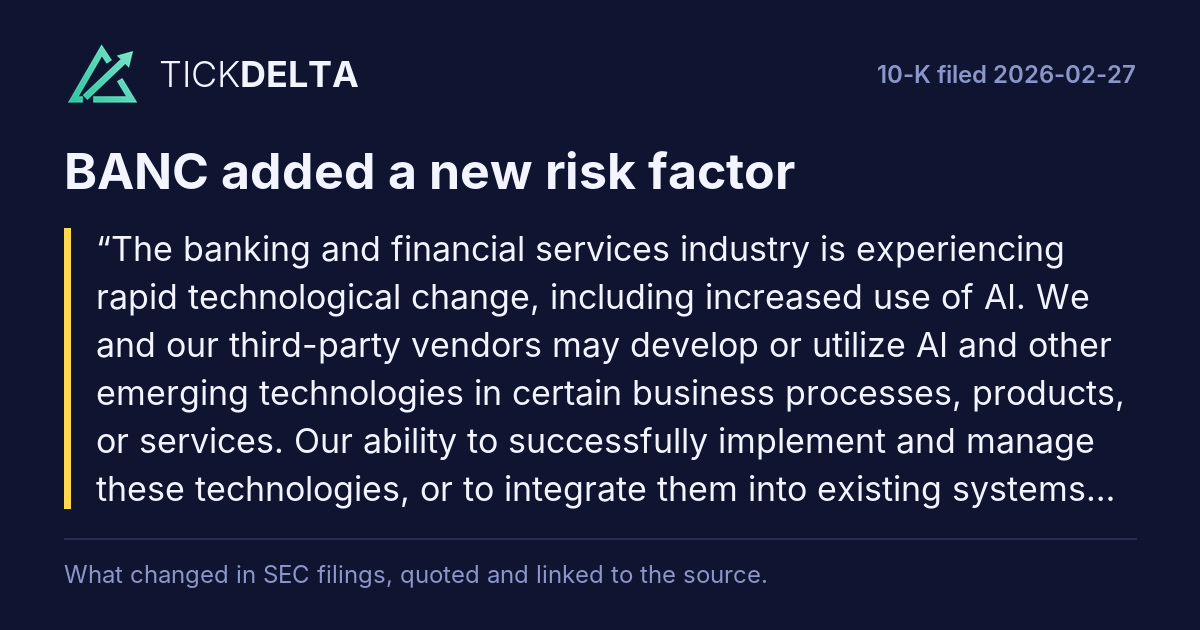
The banking and financial services industry is experiencing rapid technological change, including increased use of AI. We and our third-party vendors may develop or utilize AI and other emerging technologies in certain business processes, products, or services. Our ability to successfully implement and manage these technologies, or to integrate them into existing systems, may be limited and could result in service disruptions, processing errors, compliance failures, or increased operational risk.
AI systems, particularly those developed or operated by third parties, may produce inaccurate or harmful outputs, improperly disclose confidential or proprietary information, reflect unintended biases, or otherwise fail to perform as intended. Our reliance on third-party technology providers may limit our visibility into or control over these risks. Any failures in the development, implementation, or use of AI or other technologies, or evolving legal and regulatory requirements governing their use, could expose us to regulatory scrutiny, litigation, financial losses, or reputational harm and adversely affect our business, financial condition, and results of operations.
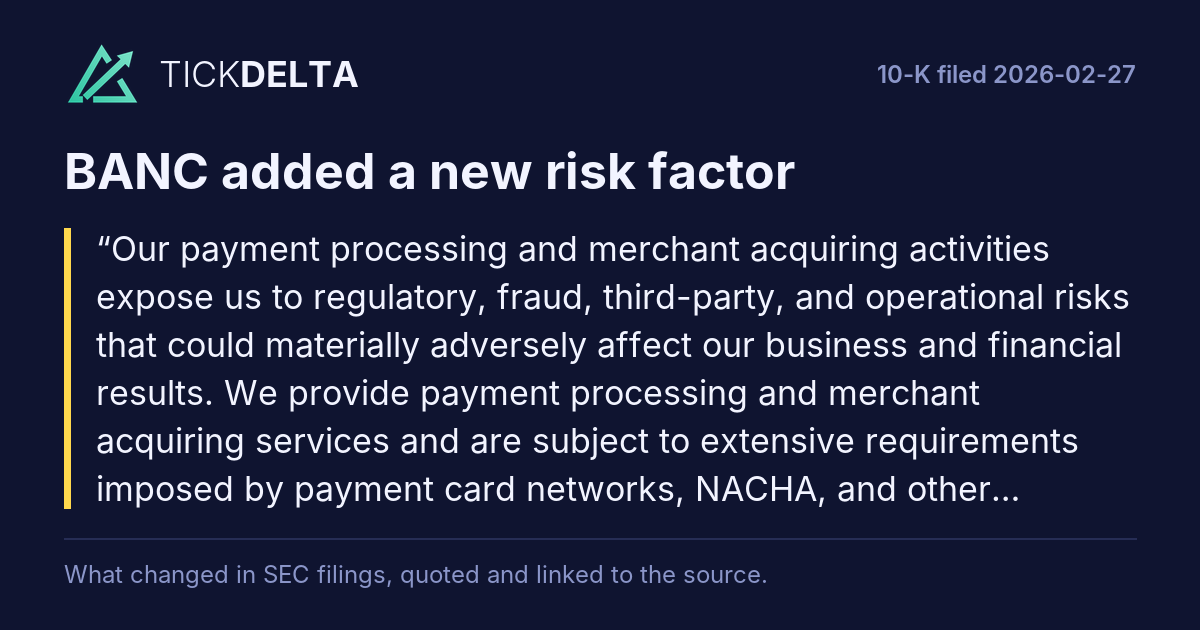
Our payment processing and merchant acquiring activities expose us to regulatory, fraud, third-party, and operational risks that could materially adversely affect our business and financial results.
We provide payment processing and merchant acquiring services and are subject to extensive requirements imposed by payment card networks, NACHA, and other payment networks. Failure by us, our merchants, or third-party intermediaries to comply with these requirements, or changes in network rules or their interpretation, could result in fines, penalties, increased costs, suspension, or termination of our registrations or certifications, which could limit our ability to provide these services and adversely affect our business. In some cases, we may be required to bear fines, penalties, or other losses if we are unable to recover such amounts from merchants or other third parties.
Our payment processing activities also expose us to fraud, chargebacks, and other losses arising from merchant activity, including situations in which merchants are unwilling or unable to satisfy their obligations due to financial distress, closure, or bankruptcy. In addition, our reliance on independent sales organizations, employees, third-party vendors, and technology systems increases our exposure to operational risks, including failures in oversight, execution errors, data processing or technology disruptions, cybersecurity incidents, and breakdowns in internal controls. Any of these risks, individually or in the aggregate, could have a material adverse effect on our business, financial condition, and results of operations.
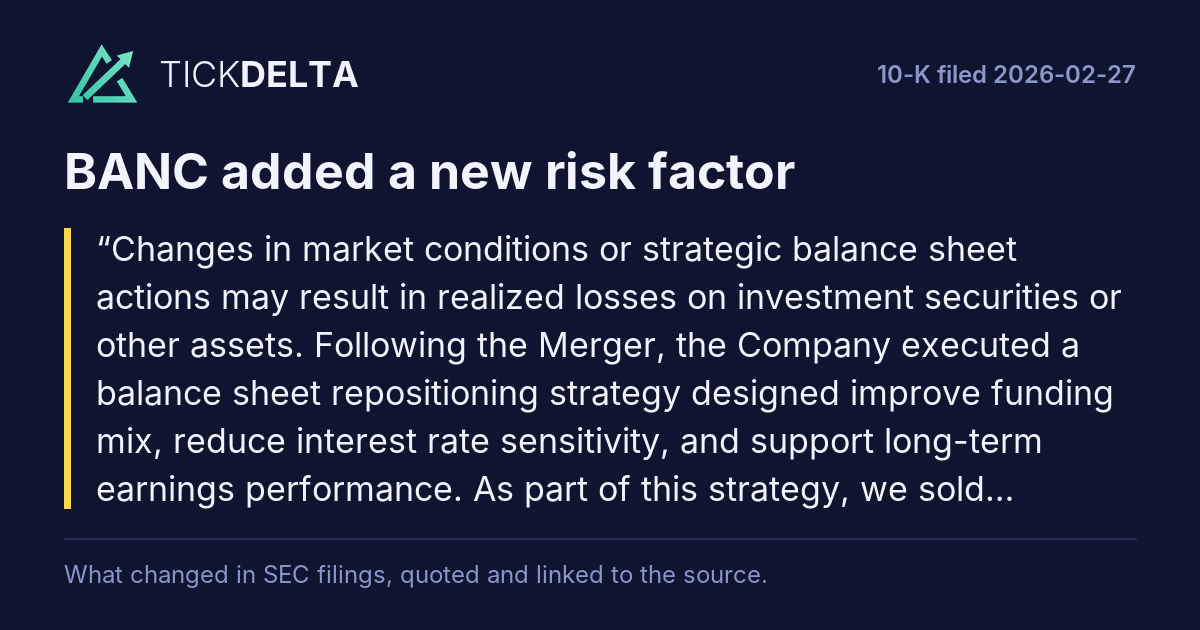
Changes in market conditions or strategic balance sheet actions may result in realized losses on investment securities or other assets.
Following the Merger, the Company executed a balance sheet repositioning strategy designed improve funding mix, reduce interest rate sensitivity, and support long-term earnings performance. As part of this strategy, we sold certain securities portfolios and mortgage loans. These transactions resulted in the recognition of losses, primarily reflecting market conditions and interest rate movements at the time of sale; however, these actions were undertaken as part of our broader efforts to strengthen our balance sheet and reposition the Company for future growth. The fair value of our investment securities, loan portfolios and certain other financial assets is influenced by a variety of factors, including changes in interest rates, credit spreads, market liquidity, prepayment assumptions and overall economic conditions. As a result, these assets may from time to time have a fair value that is below their amortized cost basis. Unrealized losses on AFS securities are reflected in accumulated other comprehensive income (loss), while HTM securities are carried at amortized cost and not adjusted for changes in fair value unless a credit-related impairment is recognized. If we were to sell securities or other assets that are in an unrealized loss position, we may be required to recognize realized losses in earnings.
We regularly evaluate opportunities to improve our asset mix, funding profile, and risk positioning in light of market conditions and strategic objectives. Future asset sales, if any, could result in additional gains or losses depending on market factors, including interest rates, credit spreads, and buyer demand at the time of sale. While such transactions may result in the recognition of losses in the period incurred, they may also improve our long-term liquidity profile, capital position, and earnings stability. Any material losses recognized in future periods, whether from strategic repositioning activities or the realization of previously unrealized losses, could adversely affect our financial condition and results of operations.
We maintain an allowance for credit losses which we believe is appropriate to provide for probable losses inherent in our loan portfolio. Management determines the amount of this allowance through regular reviews and consideration of various factors. These include an ongoing assessment of the quality, size, and diversity of the loan portfolio, as well as evaluations of nonaccrual loans. Historical default, loss, and recovery experiences are also taken into account, along with current and anticipated economic conditions. Additionally, management considers the risk characteristics associated with different loan classifications and the amount and quality of collateral, including guarantees, that secure the loans.
We are regularly examined and inspected by our regulators, including the FRB and DFPI, who possess extensive authority and discretion in their interpretation, implementation, supervision and enforcement of their regulatory agenda.This oversight covers a wide range of matters, such as dividends or capital distributions by the Bank or the Company, and capital and liquidity requirements, which may be more stringent than generally applicable laws. Regulators also influence the types and terms of products we offer, the activities we conduct, our operations, and the investments we make. They may assess the composition, risk characteristics, potential adverse classification, allowance and risk reserves in connection with loans and other assets, including reclassifying assets. Additionally, they evaluate the level of deposit insurance premiums as well as our deposit-gathering and other funding sources. The quality of our board and management oversight, as well as the effectiveness of our risk management and compliance programs, including consumer protection, information technology, cybersecurity, third-party risk management, anti-money laundering, and sanctions compliance are also subject to regulatory review. Furthermore, regulators evaluate our commitment to meeting the credit needs of low and moderate income neighborhoods under the CRA, and their approval is required for applications related to new branches, new activities, mergers, and acquisitions. Finally, they influence our rate of growth and other strategic or expansionary initiatives.
Paragraphs in the 10-Q filed Nov 6, 2026 that were not in the one before
New in the latest 10-Q
16 paragraphs in the 10-Q filed Nov 6, 2026 with nothing like them in the 10-Q filed Aug 7, 2026 (at least half the words must differ; new numbers alone do not count). Quoted exactly, grouped by the item heading above them. This is text that changed, not a judgement of how serious it is.
Financial statements and notes
Nine Months Ended September 30, 2026 ─────────────────────────────────────────────────────────────────────────────────────────────────────────────────────────────────────────────────────────────────────────────────────────────────────────────── Common Stock Non-Voting Preferred Class B Common Stock Stock Voting Non-Voting Equivalents Number of shares, December 31, 2025 513,250 150,039,018 477,321 5,017,064 Restricted stock awarded and earned stock compensation, net of shares forfeited — 723,872 — — Restricted stock surrendered — (291,929) — — Shares purchased under Dividend Reinvestment Plan — 6,634 — — Shares repurchased under Stock Repurchase Program — (709,935) — (1,000,000) Conversion of NVCE to voting common stock — 4,017,064 — (4,017,064) Number of shares, March 31, 2026 513,250 153,784,724 477,321 — Restricted stock awarded and earned stock compensation, net of shares forfeited — 105,265 — — Restricted stock surrendered — (34,634) — — Shares purchased under Dividend Reinvestment Plan — 4,912 — — Warrants exercised — 4,094,932 — — Number of shares, June 30, 2026 513,250 157,955,199 477,321 — Restricted stock awarded and earned stock compensation, net of shares forfeited — 35,200 — — Restricted stock surrendered — (13,271) — — Shares purchased under Dividend Reinvestment Plan — 5,186 — — Number of shares, September 30, 2026 513,250 157,982,314 477,321 —
Read in the 10-Q
Nine Months Ended September 30, 2025 ─────────────────────────────────────────────────────────────────────────────────────────────────────────────────────────────────────────────────────────────────────────────────────────────────────────────── Common Stock Non-Voting Preferred Class B Common Stock Stock Voting Non-Voting Equivalents Number of shares, December 31, 2024 513,250 158,557,735 477,321 9,790,600 Restricted stock awarded and earned stock compensation, net of shares forfeited — 440,587 — — Restricted stock surrendered — (183,480) — — Shares purchased under Dividend Reinvestment Plan — 5,146 — — Shares repurchased under Stock Repurchase Program — (2,684,823) — — Number of shares, March 31, 2025 513,250 156,135,165 477,321 9,790,600 Restricted stock awarded and earned stock compensation, net of shares forfeited — 98,629 — — Restricted stock surrendered — (50,075) — — Shares purchased under Dividend Reinvestment Plan — 5,311 — — Shares repurchased under Stock Repurchase Program — (8,809,814) — — Number of shares, June 30, 2025 513,250 147,379,216 477,321 9,790,600 Restricted stock awarded and earned stock compensation, net of shares forfeited — 34,712 — — Restricted stock surrendered — (15,346) — — Shares purchased under Dividend Reinvestment Plan — 4,366 — — Shares repurchased under Stock Repurchase Program — (1,003,792) — (1,150,000) Options exercised — 5,616 — — Conversion of NVCE to voting common stock — 4,500,000 — (4,500,000) Number of shares, September 30, 2025 513,250 150,904,772 477,321 4,140,600
Read in the 10-Q
Weighted Average for the Three Months Ended September 30, 2025 ───────────────────────────────────────────────────────────────────────────────────────────────────────────────────────────────────────────────── Interest Term Extension Payment Delay Rate Reduction (in months) (in months) (in % points) Real estate mortgage: Commercial 16 — 3.2% Multi-family 12 — — Other residential 9 — — Real estate construction and land: Residential 9 — — Commercial: Asset-based 6 — — Venture capital 7 3 — Other commercial 60 — —
Read in the 10-Q
Less: Earnings and dividends allocated to unvested restricted stock (2) (2) — — (2)
Read in the 10-Q
Weighted average basic shares and unvested restricted stock outstanding 155,296 477 633 156,406
Read in the 10-Q
Show the other 11
• The second quarter strategic balance sheet repositioning contributed to increased third quarter earnings, with diluted earnings per share of $0.46, up 21% from $0.38 for the third quarter of 2025.
Read in the 10-Q
• Total revenue of $303.8 million, up 6% from the third quarter of 2025, and pre-tax pre-provision income(1) of $118.4 million, up 16% from the third quarter of 2025, while noninterest expense of $185.4 million remained flat from the third quarter of 2025.
Read in the 10-Q
• NII increased $21.9 million, or 9%, from the second quarter of 2026, to $272.4 million, and net interest margin expanded 21 basis points to 3.34%, reflecting higher yields on investment securities following the Company's second quarter strategic balance sheet repositioning activities and continued execution across the business.
Read in the 10-Q
• Average deposits increased $565.3 million, or 8% on an annualized basis, supporting reduced wholesale funding.
Read in the 10-Q
Nine Months Ended September 30, 2026 Compared to Nine Months Ended September 30, 2025
Read in the 10-Q
The provision for credit losses was $10.4 million for the third quarter compared to $161.8 million for the second quarter.
Read in the 10-Q
Nine Months Ended September 30, 2026 Compared to Nine Months Ended September 30, 2025
Read in the 10-Q
Nine Months Ended September 30, 2026 Compared to Nine Months Ended September 30, 2025
Read in the 10-Q
Nine Months Ended September 30, 2026 Compared to Nine Months Ended September 30, 2025
Read in the 10-Q
Nine Months Ended September 30, 2026 Compared to Nine Months Ended September 30, 2025
Read in the 10-Q
Balance Sheet Highlights September 30, 2026 December 31, 2025 Increase (Decrease)
Read in the 10-Q
The 10-Q's risk factors against the 10-K
Item 1A of the 10-Q filed Nov 6, 2026 against Item 1A of the 10-K filed Feb 27, 2026.
A 10-Q repeats only the risks that changed, so a 10-K paragraph that is missing from it is not counted as removed.
Added is a paragraph with nothing like it in the 10-K, Reworded a sentence that is in both with several words changed,
Quiet changes a sentence in both where one to four words changed and one is a hedge or a modal
(cut words struck through, new words highlighted).
Text on the page, not a score; each links to the filing at sec.gov.
What the 10-Q itself says about its risk factors:For information regarding factors that could affect the Company's results of operations, financial condition, and liquidity, see the risk factors disclosed in the "Risk Factors" section of our Form 10-K. See also "Forward-Looking Information" disclosed in Part I, Item 2 of this Quarterly Report on Form 10-Q. There have been no material changes to the risk factors previously disclosed in our Form 10-K.
Read in the 10-Q
1 paragraph in the 10-Q's Item 1A, and none of them adds, rewords or quietly edits a paragraph of the 10-K's.
Phrases used for the first time
Two-word phrases in Risk Factors of the 10-K filed Feb 27, 2026 that are in none of the 1 earlier 10-Ks stored, back to Mar 3, 2025
Where each one is used
- third-party service: We rely on communications, information, operating and financial control systems technology from third-party service providers, and we may suffer an interruption in those systems.
- loans hfi: As of December 31, 2025, $3.3 billion, or 14%, of our total loans HFI were loans in the other residential real estate mortgage loan portfolio class, as compared with $2.8 billion, or 12%, of our total loans HFI as of December 31, 2024. This type of lending is particularly sensitive to regional and local economic...
- securities htm: The Company follows a robust credit monitoring process to ensure it has appropriate credit support and, as of December 31, 2025, we believed there was no credit losses and did not have the intent to sell any of our securities in an unrealized loss position and it is likely that we will not be required to sell such...
- realized losses: Changes in market conditions or strategic balance sheet actions may result in realized losses on investment securities or other assets.
- rates credit: Following the Merger, the Company executed a balance sheet repositioning strategy designed improve funding mix, reduce interest rate sensitivity, and support long-term earnings performance. As part of this strategy, we sold certain securities portfolios and mortgage loans. These transactions resulted in the...
- credit spreads: Following the Merger, the Company executed a balance sheet repositioning strategy designed improve funding mix, reduce interest rate sensitivity, and support long-term earnings performance. As part of this strategy, we sold certain securities portfolios and mortgage loans. These transactions resulted in the...
- amortized cost: Following the Merger, the Company executed a balance sheet repositioning strategy designed improve funding mix, reduce interest rate sensitivity, and support long-term earnings performance. As part of this strategy, we sold certain securities portfolios and mortgage loans. These transactions resulted in the...
- industry conditions: As of December 31, 2025, the Company had outstanding indebtedness in the amount of approximately $3.0 billion. Our existing indebtedness, together with any future incurrence of additional indebtedness, could have important consequences for our creditors and stockholders. For example, our indebtedness could limit...
Used at least twice, small words left out. Counted, not picked: a phrase can be new because the company renamed something.
What was taken out
44 paragraphs of last year's Risk Factors with nothing like them now. The longest are quoted.
Sources
Item 1A of each 10-K and 10-Q on EDGAR, quoted exactly. Each paragraph links to the filing at sec.gov.
Also
10-K change: what was reworded or cut, section by section.
Work with it
Excel workbook · CSV. Google Sheet that stays up to date: paste =IMPORTDATA("https://tickdelta.com/company/BANC/export.csv") into a cell.