Banner Corp BANR
New risk paragraphs, branching off last year
Each branch is a paragraph in Risk Factors with nothing like it in the 10-K filed Feb 26, 2025. A box jumps to the paragraph as filed, below.
Paragraphs with nothing like them in last year's 10-K
21 paragraphs in Risk Factors of the 10-K filed Feb 25, 2026 with nothing like them in the 10-K filed Feb 26, 2025. Quoted exactly. Paragraphs that were only edited are under 10-K change.
Broader economic factors such as inflation, unemployment, money supply fluctuations, changes in monetary policy, and volatility in interest rate markets also may adversely affect our profitability. Uncertainty regarding the timing, magnitude or pace of potential interest rate changes by the Federal Reserve, particularly following a prolonged period of elevated rates, may negatively affect borrowing demand, asset yields, deposit pricing, and economic activity in our market areas. Furthermore, trade disputes, tariffs, or shifts in trade policies between the United States and other nations could disrupt supply chains, increase costs for businesses, and reduce export opportunities for our clients. These developments may, in turn, negatively impact our client’s operations and, consequently, our financial performance.
Our financial condition and results of operations are influenced by monetary, fiscal, and trade policies, including those of the Federal Reserve, the U.S. Treasury, and other governmental authorities. Actions by these authorities may lead to inflation, deflation, changes in interest rates, or other economic conditions that could materially adversely affect our results of operations. Tariffs, supply-chain disruptions, or rising costs could reduce the ability of our clients, particularly small- and medium-sized businesses, to repay loans, negatively affecting credit quality and financial performance of our loan portfolios. Prolonged inflation may increase operational costs, including wages and benefits, while fluctuations in interest rates and the yield curve can significantly impact our net interest income. Interest rates may not move in alignment with inflation or deflation, adding uncertainty to the economic environment.
Environmental and climate-related events, including wildfires, flooding, mudslides, hurricanes, or other natural disasters, including recent events in our market regions, may adversely affect borrowers’ ability to repay loans, reduce the value of collateral, and increase uncertainty in estimating credit losses. These factors may require increases to our allowance for credit losses to account for elevated credit risks.
•fluctuation in market condition affecting the prices at which acquisitions can be made;
•complicated or unsuccessful integrations of systems, procedures and personnel of the acquired entity into our company as this integration process is complicated and time-consuming and can also be disruptive to the clients of the acquired business;
•potentially increased leverage, diminished liquidity, or additional capital requirements;
Potential Impact of Regulatory Changes on Corporate Governance and Risk Management
Regulators may adopt new rules or guidance establishing or modifying corporate governance and risk management standards for banks. Any such guidance could materially affect us by:
Show the other 8
•Requiring higher levels of capital or liquidity, limiting financial flexibility;
•Subjecting us to heightened regulatory oversight, potentially affecting reputation and market valuation;
•Creating competitive disadvantages relative to less-regulated institutions; and
•Potentially affecting our ability to attract and retain qualified directors or senior management.
Future changes in corporate governance or risk management requirements could increase operational burdens, restrict financial flexibility, and elevate regulatory risks, which could materially affect our business, financial condition, and results of operations.
Our business is exposed to a broad range of risks, including liquidity, credit, market, interest rate, operational, legal and compliance, reputational and other risks. These risks may arise from internal factors, the actions of third parties, changes in economic conditions, or other unforeseen events. There may be risks that we have not anticipated or identified, and existing or emerging risks could result in substantial and unexpected losses. If our risk management proves ineffective, we may incur significant losses, which could materially and adversely affect our business, financial condition, results of operations, and growth prospects.
We are currently undertaking, or may in the future undertake, significant system conversions and technology upgrades to enhance our operational efficiency, client service capabilities, or regulatory compliance. System conversions, including the implementation of new loan and deposit origination platforms, digital banking solutions, or integration of acquired systems, are inherently complex and present a range of operational, financial, and compliance risks. These risks include, but are not limited to, data migration errors, system downtime, delays in project implementation, and disruptions to ongoing business operations. Inadequate planning, insufficient testing, or ineffective change management could result in the loss or corruption of critical data, interruptions in client-facing services, or failures in transaction processing. Such events could adversely impact our ability to serve clients, result in financial losses, or lead to regulatory scrutiny and reputational harm. Additionally, system conversions may require significant investments of time and resources, and may divert management attention from other strategic initiatives. If we are unable to successfully execute system conversions or promptly resolve any issues that arise, our business, financial condition and results of operations could be materially and adversely affected. Furthermore, as a regulated financial institution, we are subject to heightened expectations regarding data security, business continuity, and internal controls during periods of significant technology change, and any failure to meet these expectations could result in regulatory actions or penalties.
Mitigating these risks requires investments in a robust governance framework, cybersecurity, data privacy, and employee training. Additionally, the fragmented and rapidly evolving legal environment related to AI creates heightened uncertainty and complexity and presents additional compliance and legal risks that could adversely impact our operating results.
Additionally, collateralized public funds (state and local municipal deposits secured by investment-grade securities) reduce contingent liquidity risk by being less credit-sensitive, however, the pledging of collateral to secure these funds limits their availability as a reserve source of liquidity. Their availability may also be affected by the fiscal policies and cash flow needs of individual municipalities, which could further constrain our access to liquidity under certain conditions.
The financial services industry is experiencing rapid change due to technological innovation, evolving customer preferences, and regulatory developments, leading to increased disintermediation. Fintech companies and digital platforms are offering products and services that compete directly with traditional banks, often with lower costs and fewer regulatory constraints. In addition, legislative or regulatory changes could accelerate disintermediation. As a result of recent regulations to provide a regulatory framework for stablecoins, increased competition may emerge from issuers of stablecoins and providers of related technology. If we are unable to adapt through digital investment, new product development, or strategic partnerships, our ability to attract and retain clients and maintain profitability could be adversely affected.
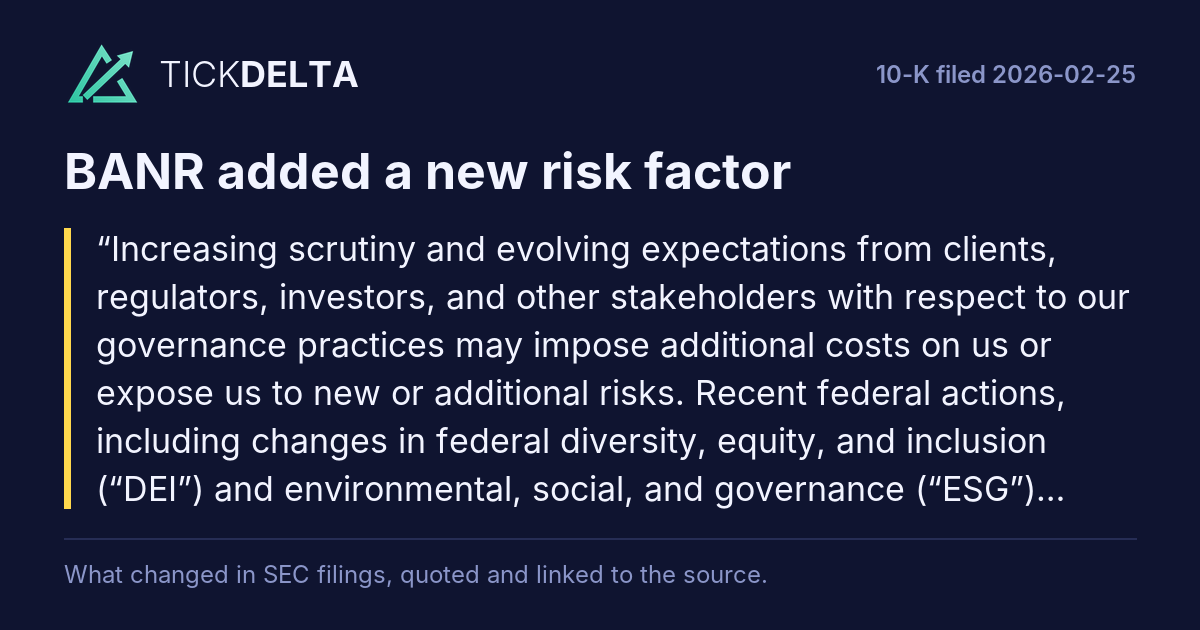
Increasing scrutiny and evolving expectations from clients, regulators, investors, and other stakeholders with respect to our governance practices may impose additional costs on us or expose us to new or additional risks.
Recent federal actions, including changes in federal diversity, equity, and inclusion (“DEI”) and environmental, social, and governance (“ESG”) guidance, have shifted oversight of DEI and ESG practices. These developments alter the regulatory expectations and compliance requirements, and increase compliance risk, for companies with DEI and ESG initiatives. New guidance may restrict voluntary programs and training, potentially requiring policy changes, reporting obligations, and public disclosures, creating operational and compliance challenges. At the same time, state-level requirements remain inconsistent. Some continue to mandate diversity or climate disclosures, while others limit DEI and ESG activities, creating additional operational complexity for multi-state businesses.
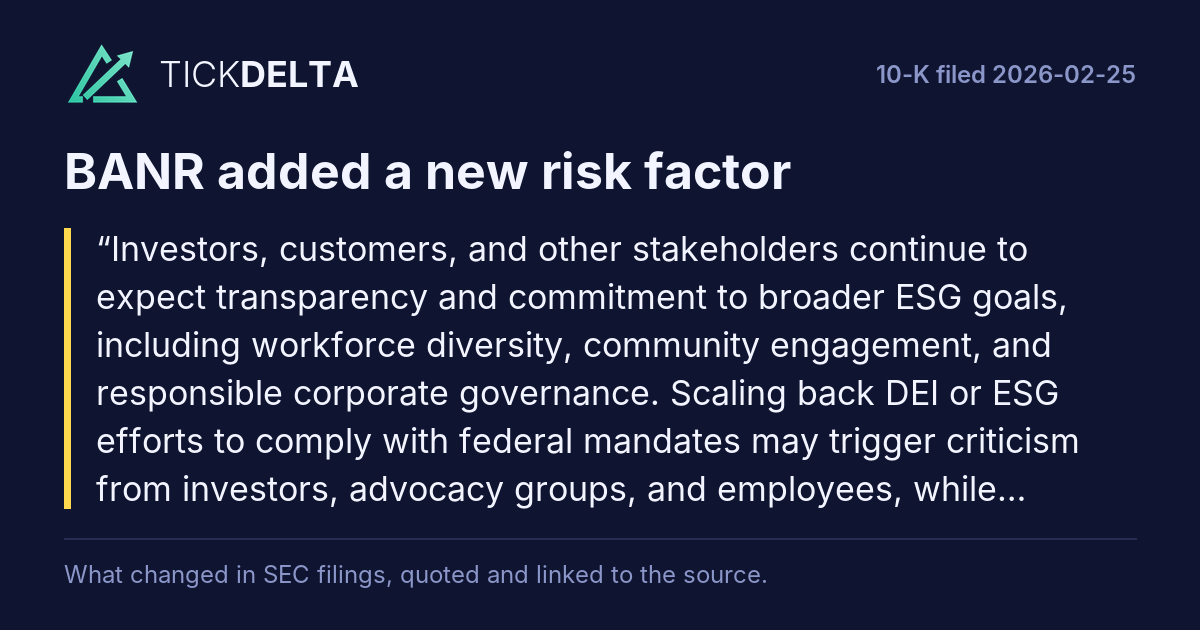
Investors, customers, and other stakeholders continue to expect transparency and commitment to broader ESG goals, including workforce diversity, community engagement, and responsible corporate governance. Scaling back DEI or ESG efforts to comply with federal mandates may trigger criticism from investors, advocacy groups, and employees, while misalignment with state laws or rating agencies could affect market perception and access to capital. The evolving regulatory landscape creates heightened uncertainty and operational challenges. Adapting our policies, disclosures, and risk mitigation strategies is critical to managing legal, reputational, and investor-related risks. Failure to effectively adapt could materially impact our reputation, employee engagement, and financial performance.
Paragraphs in the 10-Q filed Nov 3, 2026 that were not in the one before
New in the latest 10-Q
24 paragraphs in the 10-Q filed Nov 3, 2026 with nothing like them in the 10-Q filed Aug 4, 2026 (at least half the words must differ; new numbers alone do not count). Quoted exactly, grouped by the item heading above them. This is text that changed, not a judgement of how serious it is.
Financial statements and notes
This new guidance makes significant changes to the accounting for certain acquired seasoned loans subject to the current expected credit loss model (CECL). Under the ASU, the initial allowance for credit losses recorded upon the acquisition of loans in scope is recognized as an adjustment to the amortized cost basis of the loan - similar to the model for purchased credit deteriorated assets. For these loans, the "day-one" credit loss estimate does not impact earnings immediately. Subsequent changes in the allowance for credit losses are reported in earnings within provision for credit losses.
Read in the 10-Q
The following significant accounting policies have been updated or added since the Company's 2025 Annual Report on Form 10-K to reflect the adoption of ASU 2025-08.
Read in the 10-Q
Loans acquired in a business combination are recognized on the acquisition date at their estimated fair value based on expected future cash flows discounted at a market-based rate of interest and inclusive of adjustments for credit risk, interest rate risk, liquidity, and other factors. Acquired loans that have experienced more-than-insignificant deterioration in credit quality since origination are classified as PCD loans. An allowance for credit losses is established for the initial estimate of expected credit losses on PCD loans as of the acquisition date and recorded through a gross-up adjustment to the loan’s amortized cost basis.
Read in the 10-Q
Non-PCD loans acquired in a business combination are classified as purchased seasoned loans with an allowance for credit losses established for the initial estimate of expected credit losses as of the acquisition date and recorded through a gross-up adjustment to the loans’ amortized cost basis. See Note 3 “Business Combinations” for additional information on loans acquired in a business combination.
Read in the 10-Q
On September 1, 2026, the Company completed the acquisition of 100 % of the outstanding common shares of Pacific Financial Corporation (Pacific Financial), the holding company for Bank of the Pacific, a Washington state-chartered commercial bank. Pacific Financial was merged into Banner and Bank of the Pacific was merged into Banner Bank. Pursuant to the previously announced terms of the acquisition, Pacific Financial shareholders received 0.2633 shares of Banner common stock in exchange for each share of Pacific Financial common stock, plus cash in lieu of any fractional shares. In addition, outstanding in-the-money Pacific Financial stock options were cancelled in exchange for cash. The primary reason for the acquisition was to expand our presence in Western Washington and Western Oregon markets while offering Bank of the Pacific customers broader product offerings and technology tools, increased commercial lending limits, and an expanded branch network. The acquisition added $ 1.29 billion in assets, $ 1.14 billion in deposits and $ 756.9 million in net loans receivable, at fair value, to Banner as of the acquisition date.
Read in the 10-Q
Show the other 19
The following table presents a summary of the consideration paid and the estimated fair values as of the acquisition date for each major class of assets acquired and liabilities assumed (in thousands):
Read in the 10-Q
Pacific Financial Corporation September 1, 2026 Consideration to Pacific Financial equity holders: Cash paid $982 Fair value of common shares issued 185,864 Total consideration 186,846 Fair value of assets acquired: Cash and cash equivalents 120,605 Securities 322,928 Federal Home Loan Bank stock 768 Loans receivable 756,921 Property and equipment 20,306 Core deposit intangible 28,632 Bank-owned life insurance 28,795 Deferred tax asset 534 Operating lease right-of-use assets 3,126 Other assets 9,537 Total assets acquired 1,292,152 Fair value of liabilities assumed: Deposits 1,140,283 Junior subordinated debentures 11,400 Deferred compensation 2,547 Operating lease liabilities 3,206 Other liabilities 9,032 Total liabilities assumed 1,166,468 Net assets acquired 125,684 Goodwill $61,162
Read in the 10-Q
The estimation of the fair value of the assets acquired and the liabilities assumed resulted in recognition of a Core Deposit Intangible (CDI) asset of $ 28.6 million and goodwill of $ 61.2 million. The CDI has been determined to have an estimated useful life of approximately ten years and will be amortized on an accelerated basis. Goodwill represents the excess of the consideration transferred over the fair value of the net assets acquired and reflects the expected benefits of the acquisition, including growth in the Company’s customer base, expanded presence in existing markets, and expected cost savings. Goodwill is not amortized but is evaluated for impairment at least annually, or more frequently if events or changes in circumstances indicate that it may be impaired. Goodwill is not deductible for income tax purposes because the acquisition was structured as a tax-free reorganization.
Read in the 10-Q
The fair values of the assets acquired and liabilities assumed are preliminary and subject to refinement for up to one year after the acquisition date as additional information about facts and circumstances that existed as of the acquisition date becomes available. Adjustments to the acquisition accounting, if any, would most likely relate to loans, property and equipment, or deferred taxes.
Read in the 10-Q
The Company adopted ASU 2025-08, effective July 1, 2026. Accordingly, the initial estimate of expected credit losses recognized in the allowance for credit losses (ACL) included both PCD loans and non-PCD loans classified as PSLs. The following table includes the principal balance and the fair value of the loans acquired from Pacific Financial (dollars in thousands):
Read in the 10-Q
Principal Balance Acquired Non-Credit Premium/ (Discount) Credit (Discount) Fair Value of Net Loans
Read in the 10-Q
The financial results of the Company include the revenues and expenses produced by the acquired assets and assumed liabilities of Pacific Financial since September 1, 2026. The acquisition of Pacific Financial was determined not to be significant and the disclosure of Pacific Financial’s revenues and net income separately from the Company’s Consolidated Statements of Operations was considered impracticable to be reported due to systems integrations. In addition, the pro forma impact of the acquisition to the historical financial results was determined to not be significant.
Read in the 10-Q
Acquisition-related costs of $ 5.2 million and $ 5.4 million are included in merger and acquisition-related expenses in the accompanying consolidated statements of income for the three and nine months ended September 30, 2026, respectively.
Read in the 10-Q
Nine Months Ended September 30, 2025 Weighted-Average Term Extension (in months) ───────────────────────────────────────────────────────────────────────────────────────────────────────── Multifamily construction 12 One- to four-family construction 21 Agricultural business, including secured by farmland 12
Read in the 10-Q
The following tables provide the amortized cost basis of collateral-dependent loans as of September 30, 2026 and December 31, 2025 (in thousands). One- to four-family residential real estate collateral comprised approximately 49% of the Company’s collateral-dependent loan population at September 30, 2026. These loans are secured by properties located in multiple geographic markets, predominantly within Washington state, with remaining balances distributed across Oregon and California. Given the geographic dispersion of the underlying collateral and the relatively limited size of the collateral-dependent loan portfolio in relation to total loans, management does not believe this exposure constitutes a significant concentration of credit risk.
Read in the 10-Q
At September 1, 2026, the Company recorded $ 61.2 million in goodwill and $ 28.6 million in CDI assets related to the acquisition of Pacific Financial. Additional information on the acquisition and purchase price allocations is provided in Note 3 - Business Combinations.
Read in the 10-Q
(1) The additions to Goodwill and CDI in 2026 relate to the acquisition of Pacific Financial.
Read in the 10-Q
On September 1, 2026, Banner completed the acquisition of Pacific Financial, the holding company for Bank of the Pacific. At closing, Bank of the Pacific had 18 branch locations, including 15 in Washington and three in Oregon. Shareholders of Pacific Financial received 0.2633 shares of Banner common stock for each share of Pacific Financial common stock they owned, plus cash in lieu of any fractional shares, for total consideration paid of $186.8 million.
Read in the 10-Q
The Pacific Financial transaction was accounted for using the acquisition method of accounting. Accordingly, the assets (including identifiable intangible assets) and the liabilities of Pacific Financial were measured at their respective estimated fair values as of the merger date. The excess of the purchase price over the fair value of the net assets acquired was attributed to goodwill. The fair value on the merger date represents management's best estimates based on available information and facts and circumstances in existence on the merger date. The acquisition accounting is subject to adjustment within a measurement period of no longer than one year from the acquisition date. The acquisition brought $1.29 billion of assets, including $756.9 million of net loans receivable, and $1.14 billion of deposits to Banner.
Read in the 10-Q
• Repurchased 200,000 shares of Banner common stock during the third quarter of 2026 at an average price of $71.03 per share.
Read in the 10-Q
Business Combinations and Goodwill. Business combinations are accounted for using the acquisition method, under which assets acquired and liabilities assumed are recorded at their estimated fair values as of the acquisition date. Goodwill represents the excess of the consideration transferred over the fair value of the assets acquired, net of the fair values of liabilities assumed in a business combination, and is not amortized but is evaluated for impairment at least annually, or more frequently if events or changes in circumstances indicate that it may be impaired. Various significant assumptions and judgments are used to determine the fair values of the assets acquired and liabilities assumed, particularly for acquired loans, where key assumptions include expected credit losses, prepayment speeds and discount rates, and for the core deposit intangible, where key assumptions include deposit attrition rates, the alternative cost of funds and discount rates. Because goodwill is the residual of these measurements, it depends directly on these estimates.
Read in the 10-Q
In connection with the Pacific Financial acquisition, the Company recorded a core deposit intangible of $ 28.6 million and goodwill of $ 61.2 million. These fair values are preliminary and may be adjusted for up to one year after the acquisition date as additional information about facts and circumstances that existed as of the acquisition date becomes available. The Company’s most recent annual goodwill impairment assessment, performed as of December 31, 2025, indicated no impairment. As of September 30, 2026, Management did not identify any events or circumstances indicating that it is more likely than not that the fair value of the Company’s reporting unit is below its carrying amount.
Read in the 10-Q
Merger and acquisition-related expenses during the current quarter and the nine months ended September 30, 2026, related to the Pacific Financial acquisition, which was effective September 1, 2026. The merger and acquisition-related expenses consist primarily of legal fees, investment banker fees, contract termination costs, and employee-related severance and retention expenses.
Read in the 10-Q
Risk Factors
On September 1, 2026, Banner completed its acquisition of Pacific Financial Corporation, the holding company of Bank of the Pacific. The anticipated benefits of the acquisition may not be realized to the extent or within the timeframe expected, and the integration of Pacific Financial's business, including the conversion of Bank of the Pacific’s operating systems scheduled for November 2026, may be more difficult, costly or time-consuming than anticipated, and could result in the loss of customers, deposits or key employees. Failure to successfully integrate the acquired business could adversely affect Banner's business, financial condition and results of operations.
Read in the 10-Q
The 10-Q's risk factors against the 10-K
Item 1A of the 10-Q filed Nov 3, 2026 against Item 1A of the 10-K filed Feb 25, 2026.
A 10-Q repeats only the risks that changed, so a 10-K paragraph that is missing from it is not counted as removed.
Added is a paragraph with nothing like it in the 10-K, Reworded a sentence that is in both with several words changed,
Quiet changes a sentence in both where one to four words changed and one is a hedge or a modal
(cut words struck through, new words highlighted).
Text on the page, not a score; each links to the filing at sec.gov.
What the 10-Q itself says about its risk factors:There have been no material changes in the risk factors previously disclosed in Part I, Item 1A of our 2025 Form 10-K, other than as set forth below.
Read in the 10-Q
Phrases used for the first time
Two-word phrases in Risk Factors of the 10-K filed Feb 25, 2026 that are in none of the 1 earlier 10-Ks stored, back to Feb 26, 2025
Where each one is used
- commercial real: •Commercial and Multifamily Real Estate Loans. At December 31, 2025, commercial and multifamily real estate loans were $4.90 billion, or 42% of our total loan portfolio. Many of these loans involve higher principal amounts than other types of loans, and some commercial borrowers maintain multiple loans with us....
- system conversions: We are currently undertaking, or may in the future undertake, significant system conversions and technology upgrades to enhance our operational efficiency, client service capabilities, or regulatory compliance. System conversions, including the implementation of new loan and deposit origination platforms, digital...
- climate-related events: A downturn in economic conditions, whether due to inflation, recessive trends, geopolitical conflicts, or environmental and climate-related events such as wildfires, floods, or other natural disasters, could have a material adverse effect on our business, financial condition, liquidity, and results of operations,...
- increase operational: Our financial condition and results of operations are influenced by monetary, fiscal, and trade policies, including those of the Federal Reserve, the U.S. Treasury, and other governmental authorities. Actions by these authorities may lead to inflation, deflation, changes in interest rates, or other economic...
- rates tighter: •Commercial and Multifamily Real Estate Loans. At December 31, 2025, commercial and multifamily real estate loans were $4.90 billion, or 42% of our total loan portfolio. Many of these loans involve higher principal amounts than other types of loans, and some commercial borrowers maintain multiple loans with us....
- increased competition: •Commercial and Multifamily Real Estate Loans. At December 31, 2025, commercial and multifamily real estate loans were $4.90 billion, or 42% of our total loan portfolio. Many of these loans involve higher principal amounts than other types of loans, and some commercial borrowers maintain multiple loans with us....
- office space: •Commercial and Multifamily Real Estate Loans. At December 31, 2025, commercial and multifamily real estate loans were $4.90 billion, or 42% of our total loan portfolio. Many of these loans involve higher principal amounts than other types of loans, and some commercial borrowers maintain multiple loans with us....
- rate assets: Our net interest margin, the difference between the yield on interest-earning assets and the cost of interest-bearing liabilities, can be adversely affected by interest rate changes. While yields on assets and costs of liabilities tend to move in the same direction, they may do so at different speeds, causing the...
Used at least twice, small words left out. Counted, not picked: a phrase can be new because the company renamed something.
What was taken out
21 paragraphs of last year's Risk Factors with nothing like them now. The longest are quoted.
Sources
Item 1A of each 10-K and 10-Q on EDGAR, quoted exactly. Each paragraph links to the filing at sec.gov.
Also
10-K change: what was reworded or cut, section by section.
Work with it
Excel workbook · CSV. Google Sheet that stays up to date: paste =IMPORTDATA("https://tickdelta.com/company/BANR/export.csv") into a cell.