BLACKBERRY Ltd BB
New risk paragraphs, branching off last year
Each branch is a paragraph in Risk Factors with nothing like it in the 10-K filed Apr 2, 2025. A box jumps to the paragraph as filed, below.
Paragraphs with nothing like them in last year's 10-K
4 paragraphs in Risk Factors of the 10-K filed Apr 9, 2026 with nothing like them in the 10-K filed Apr 2, 2025. Quoted exactly. Paragraphs that were only edited are under 10-K change.
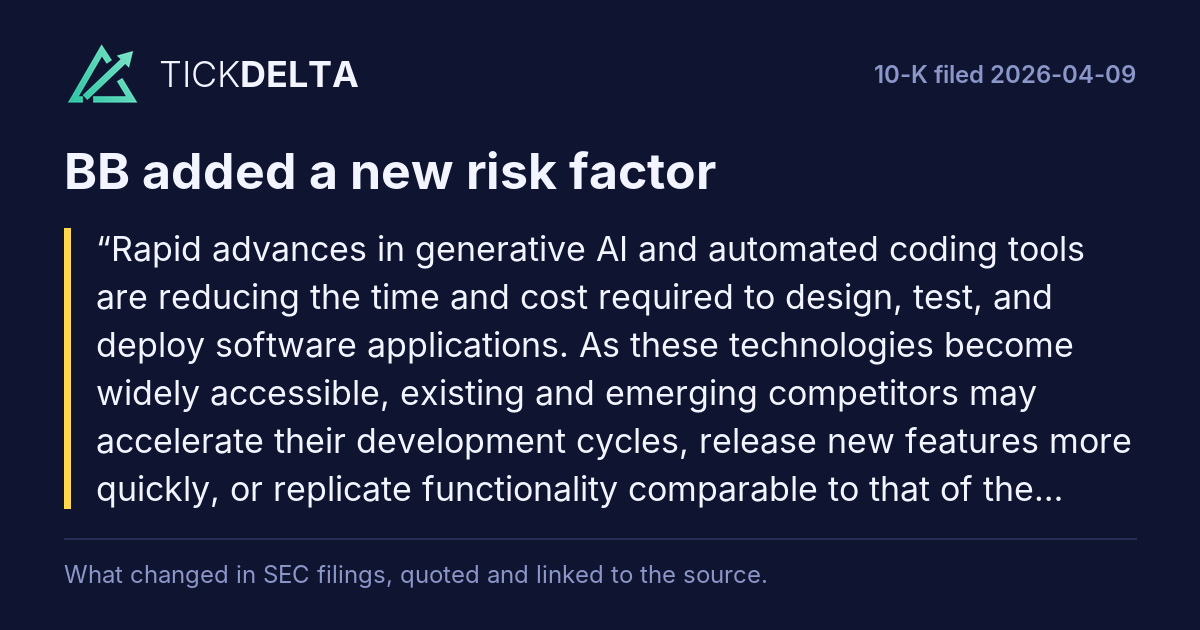
Rapid advances in generative AI and automated coding tools are reducing the time and cost required to design, test, and deploy software applications. As these technologies become widely accessible, existing and emerging competitors may accelerate their development cycles, release new features more quickly, or replicate functionality comparable to that of the Company’s products with materially lower investment. Similarly, the use of AI technologies or increasingly pervasive open source tools by the Company’s customers to support development internally could have a negative impact on the Company’s business, including the revenues derived from the number of user licenses and the provision of professional services. If the Company is unable to integrate AI-enabled development at a competitive pace, its market position, customer acquisition, and renewal rates could be adversely affected.
The successful introduction of new software platforms, such as the Alloy Kore™ platform recently launched by QNX with Vector Informatik, is inherently uncertain and involves numerous costs and risks, including delays in development, unforeseen technical challenges, integration complexities, and lower‑than‑expected customer adoption. If a new platform fails to perform as intended, fails to drive market adoption, or generates unanticipated maintenance and support costs, the Company’s competitive position, brand reputation and financial results could be materially adversely affected.
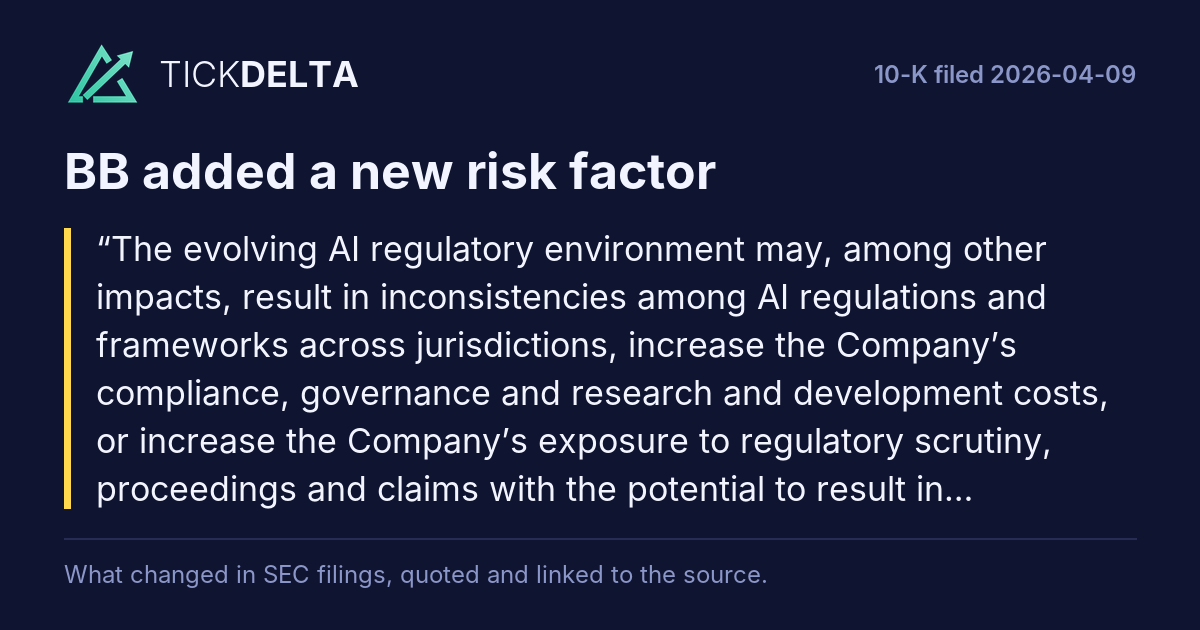
The evolving AI regulatory environment may, among other impacts, result in inconsistencies among AI regulations and frameworks across jurisdictions, increase the Company’s compliance, governance and research and development costs, or increase the Company’s exposure to regulatory scrutiny, proceedings and claims with the potential to result in significant penalties and reputational harm.
The Company has begun to rely on commercial AI models to support elements of its software development lifecycle. Any failure by our employees, contractors, or partners to adhere to our policies regarding the appropriate use of AI in development could result in violations of confidentiality obligations, laws, or regulations, jeopardize the Company’s intellectual property rights, or expose the Company’s products or business systems to defects and malware, any of which could adversely affect the Company’s business, financial condition, results of operations, and prospects. Additionally, the integration of these models into engineering workflows may expose the Company to heightened regulatory scrutiny with respect to products that are classified as high‑risk under emerging global AI and safety‑critical regulations. Failure to demonstrate adequate human review and testing or explainability of AI‑assisted development processes could delay product approvals or impair the Company’s ability to offer solutions in regulated markets. Changes in model performance, licensing terms, training‑data provenance, or vendor compliance with applicable AI regulations may impair the Company’s ability to validate and certify its products.
Paragraphs in the 10-Q filed Sep 24, 2026 that were not in the one before
New in the latest 10-Q
13 paragraphs in the 10-Q filed Sep 24, 2026 with nothing like them in the 10-Q filed Jun 25, 2026 (at least half the words must differ; new numbers alone do not count). Quoted exactly, grouped by the item heading above them. This is text that changed, not a judgement of how serious it is.
Financial statements and notes
Certain of the comparative figures have been reclassified to conform to the current year’s presentation.
Read in the 10-Q
Non-cash consideration received is measured at fair value at contract inception. The estimated fair value is determined utilizing multiple valuation techniques, principally a discounted cash flow model and a market-based approach. Key inputs and assumptions include forecasted cash flows over a projection period and a discount rate applied to those cash
Read in the 10-Q
flows and the market-based approach relies on valuation multiples and quoted prices derived from comparable transactions.
Read in the 10-Q
Judgment is required to determine the fair value of non-cash consideration at contract inception. The Company engages an independent third-party valuation specialist to assist in this determination of the fair value of non-cash consideration.
Read in the 10-Q
delivering, as the case may be, cash, its common shares or a combination of cash and its common shares, at the Company’s election (or, in the case of any Notes called for redemption that are converted during the related redemption period, solely its common shares).
Read in the 10-Q
Show the other 8
2026 NCIB share buyback program has been reached. The Company is not obligated to repurchase any common shares under the 2026 NCIB share buyback program.
Read in the 10-Q
against the Company have merit, those claims could be time-consuming to evaluate and defend, result in costly litigation, divert management’s attention and resources and subject the Company to significant liabilities.
Read in the 10-Q
• QNX and Vector Informatik secured the first Alloy Kore design win, the largest design win in QNX history, with Coretura, the commercial vehicle software joint venture between Volvo Group and Daimler Truck, adding more than $100 million to the QNX royalty backlog;
Read in the 10-Q
• Announced that Momenta and XHEART selected QNX OS for Safety, built on SDP 8.0, as the foundation for a production-ready Physical AI-defined autonomous-driving platform certified to ISO 26262 ASIL D;
Read in the 10-Q
• QNX added support for the Hailo-8 AI Accelerator on SDP 8.0, expanding its Physical AI ecosystem; benchmark testing demonstrated up to 14x greater performance consistency than the real-time Linux environment tested;
Read in the 10-Q
• BlackBerry® SecuSUITE® renewed its NIAP Common Criteria certification, reinforcing its sovereign-grade security credentials and position in government and mission-critical communications; and
Read in the 10-Q
• BlackBerry® AtHoc® added Microsoft Teams and Entra ID integrations, strengthening mission-critical response and operational resilience for enterprise and government customers.
Read in the 10-Q
Judgment is required to determine the fair value of non-cash consideration at contract inception. The Company engages an independent third-party valuation specialist to assist in this determination of the fair value of non-cash consideration.
Read in the 10-Q
The 10-Q's risk factors against the 10-K
Item 1A of the 10-Q filed Sep 24, 2026 against Item 1A of the 10-K filed Apr 9, 2026.
A 10-Q repeats only the risks that changed, so a 10-K paragraph that is missing from it is not counted as removed.
Added is a paragraph with nothing like it in the 10-K, Reworded a sentence that is in both with several words changed,
Quiet changes a sentence in both where one to four words changed and one is a hedge or a modal
(cut words struck through, new words highlighted).
Text on the page, not a score; each links to the filing at sec.gov.
This 10-Q has no Item 1A (Risk Factors) text of its own, so there is nothing to compare. Many companies leave it out when their risks have not changed.
Phrases used for the first time
Two-word phrases in Risk Factors of the 10-K filed Apr 9, 2026 that are in none of the 1 earlier 10-Ks stored, back to Apr 2, 2025
Where each one is used
- national security: Adverse macroeconomic and geopolitical conditions, including trade policies and national security concerns, have had and may in the future have a material adverse effect on the Company’s business, results of operations and financial condition.
- qnx embedded: The Company believes decisions by customers to purchase its products depend and will depend in part on the availability of developers with experience in using the Company’s QNX platform and on the compatibility of software applications and services that are developed and maintained by third-party developers. The...
- hardware platform: The Company’s ability to maintain and expand its market reach depends in part on establishing, developing and maintaining relationships with third party resellers and channel partners, especially silicon providers and hardware platform vendors in its QNX embedded software business. Many resellers and channel...
- platform vendors: The Company’s ability to maintain and expand its market reach depends in part on establishing, developing and maintaining relationships with third party resellers and channel partners, especially silicon providers and hardware platform vendors in its QNX embedded software business. Many resellers and channel...
Used at least twice, small words left out. Counted, not picked: a phrase can be new because the company renamed something.
What was taken out
4 paragraphs of last year's Risk Factors with nothing like them now. The longest are quoted.
Sources
Item 1A of each 10-K and 10-Q on EDGAR, quoted exactly. Each paragraph links to the filing at sec.gov.
Also
10-K change: what was reworded or cut, section by section.
Work with it
Excel workbook · CSV. Google Sheet that stays up to date: paste =IMPORTDATA("https://tickdelta.com/company/BB/export.csv") into a cell.