Screener / SEC EDGAR /CIK 0001743881 /10-K filed Feb 24, 2026, compared with Feb 20, 2025 /Numbers from the XBRL of the 10-Ks
Nasdaq Health care · Pharmaceuticals

BridgeBio Pharma, Inc. BBIO

Compare with peers Embed
New in the 10-K 20 paragraphs with nothing like them in the 10-K filed Feb 20, 2025 New in the 10-Q 26 paragraphs not in the 10-Q filed Aug 10, 2026 10-Q against the 10-K 66 risk factor paragraphs and sentences added or reworded

New risk paragraphs, branching off last year

Each branch is a paragraph in Risk Factors with nothing like it in the 10-K filed Feb 20, 2025. A box jumps to the paragraph as filed, below.

20 new

Paragraphs with nothing like them in last year's 10-K

Quoted exactly

20 paragraphs in Risk Factors of the 10-K filed Feb 24, 2026 with nothing like them in the 10-K filed Feb 20, 2025. Quoted exactly. Paragraphs that were only edited are under 10-K change.

•the timing of market introduction of competitive products, including generics of competing products;

Read in the 10-K

There have been, and likely will continue to be, legislative and regulatory proposals at the foreign, federal and state levels directed at containing or lowering the cost of healthcare. The implementation of cost containment measures or other healthcare reforms may prevent us from being able to generate revenue, attain profitability, or commercialize Attruby and Beyonttra and our product candidates, if approved. Such reforms could have an adverse effect on anticipated revenue from product candidates that we may successfully develop and for which we may obtain regulatory approval and may affect our overall financial condition and ability to develop product candidates. For example, the current administration is pursuing a two-fold strategy to reduce drug costs in the United States. While it is unclear whether and how the current administration’s proposals will be implemented, these policies are likely to have a negative impact on the pharmaceutical industry and on our ability to receive adequate revenues for our products. The current administration has threatened to impose significant tariffs on pharmaceutical manufacturers that do not adopt pricing policies such as most-favored-nation pricing, which would tie the price for drugs in the United States to the lowest price in a group of other countries. While the United States has not implemented these tariffs, the United States could impose them with minimal notice to the public. In response, multiple manufacturers have entered into confidential pricing agreements with the federal government. On the other hand, the current administration is pursuing traditional regulatory pathways to impose drug pricing policies and published two proposed regulations in December 2025, referred to as GLOBE and GUARD. If finalized, these regulations would implement mandatory payment models under which manufacturers of eligible drugs would be required to pay rebates to the federal government on a portion of the units of their drugs that are reimbursed by Medicare, with the rebate amount based on most-favored-nation pricing. Imposing a rebate in the United States that is based on drug prices outside the United States would mark a drastic and unprecedented shift in the U.S. pharmaceutical market, and while the impact of the GLOBE and GUARD proposed regulations, if finalized, cannot yet be determined, it is likely to be significant depending on the final language. Even regulatory proposals or executive actions that are ultimately deemed unlawful could negatively impact the U.S. pharmaceutical sector and our business. We cannot predict the initiatives that may be adopted in the future. The continuing efforts of the government, insurance companies, managed care organizations and other payors of healthcare services to contain or reduce costs of healthcare and/or impose price controls may adversely affect:

Read in the 10-K

Federal legislative and regulatory efforts to implement reference pricing or most-favored-nation pricing models could impact our product revenues and materially harm our business.

On May 12, 2025, the current administration issued an executive order calling on pharmaceutical manufacturers to voluntarily reduce the prices of medicines in the U.S. and directing the Secretary of Health and Human Services (HHS) to communicate most-favored-nation (MFN) price targets to pharmaceutical manufacturers to align prices with those in comparably developed nations and, in the event significant progress towards MFN pricing is not delivered, to propose rulemaking to impose MFN pricing.

Since the May 12, 2025 order, the current administration has continued to exert pressure on drug manufacturers to implement MFN pricing, including by suggesting that the administration may impose significant tariffs on pharmaceuticals if such manufacturers do not reach agreements to implement MFN pricing. Further, in November 2025, the Centers for Medicare & Medicaid Services (“CMS”) introduced the GENEROUS (GENErating cost Reductions fOr U.S. Medicaid) Model, a voluntary Medicaid payment initiative under which participating drug manufacturers may voluntarily offer supplemental rebates to participating state Medicaid programs that are intended to provide such Medicaid programs with an MFN price for the manufacturers’ products. Additionally, in December 2025, CMS announced proposals for new mandatory demonstration payment models through two proposed rules under its Center for Medicare and Medicaid Innovation (“CMMI”) authority, the Global Benchmark for Efficient Drug Pricing (“GLOBE”) for Medicare Part B and Guarding U.S. Medicare Against Rising Drug Costs (“GUARD”) for Medicare Part D. If finalized, these models would impose additional mandatory rebates on manufacturers of certain Medicare Part B and Medicare Part D drugs, for select Medicare populations intended to represent 25% of Medicare patients, if the Medicare prices for such products exceed those paid in economically comparable countries. Both the GLOBE and GUARD models have proposed seven-year testing periods, with the GLOBE model proposed to begin on October 1, 2026 and the GUARD model proposed to begin on January 1, 2027.

If the GLOBE and GUARD models are finalized as proposed under CMMI authority, we could be required to pay additional rebates on products reimbursed by Medicare for the covered populations during the applicable model periods. In addition, if MFN pricing or similar reference pricing policies are enacted or implemented in the U.S. outside of the CMMI framework and applied more broadly, we could be required to pay rebates on products utilization by a broader portion of U.S. patients to align with prices in certain reference countries. We currently derive the substantial portion of our revenue from U.S. sales, and any requirement to pay additional rebates in the U.S. to match international reference prices would impact our overall net product revenue.

MFN pricing models in the U.S. could also affect our international pricing strategy and future decisions on reimbursement and commercialization in certain jurisdictions. If our U.S. pricing becomes tied to international reference prices, especially in light of our licensing agreements with Bayer and Alexion, we may face decisions regarding pricing in foreign markets that could result in reduced patient access internationally, affect our relationships with foreign regulatory authorities and payers, or impact our ability to obtain or maintain reimbursement approvals in ex-U.S. markets. These reforms remain subject to change, potential legal challenges, or expansion through additional rulemaking or sub regulatory guidance, creating uncertainty for our overall pricing strategy. It remains to be seen whether and how these drug pricing initiatives will apply to our products, how they will affect the broader pharmaceutical industry, and whether similar reform measures may be adopted in the future.

Read in the 10-K

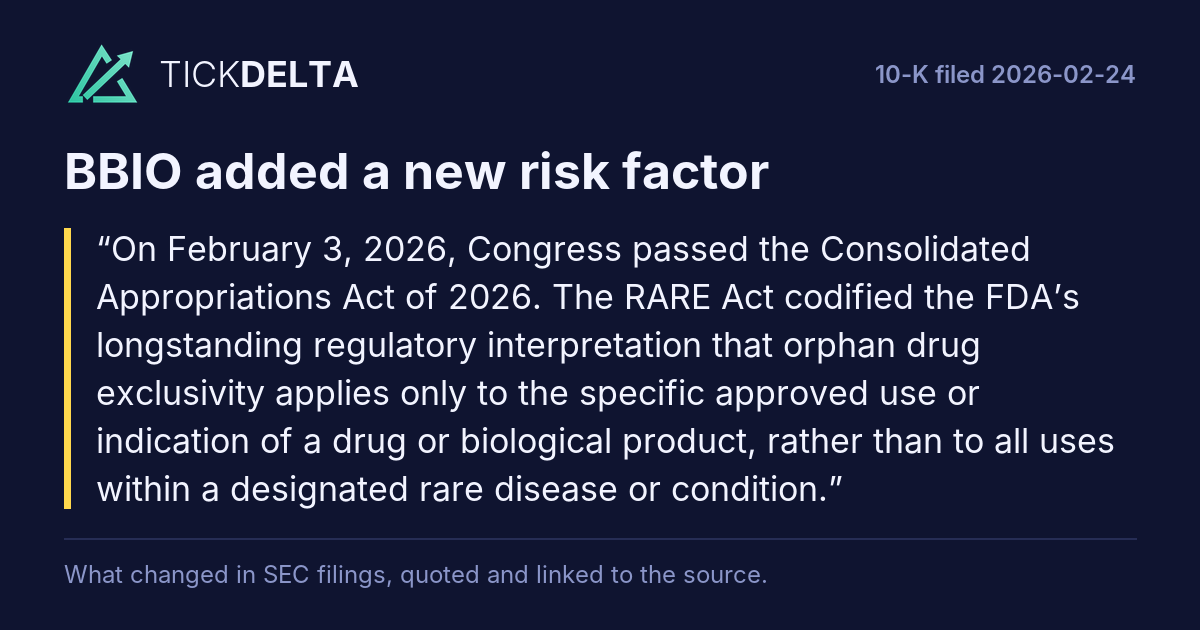
On February 3, 2026, Congress passed the Consolidated Appropriations Act of 2026. The RARE Act codified the FDA’s longstanding regulatory interpretation that orphan drug exclusivity applies only to the specific approved use or indication of a drug or biological product, rather than to all uses within a designated rare disease or condition.

Read in the 10-K

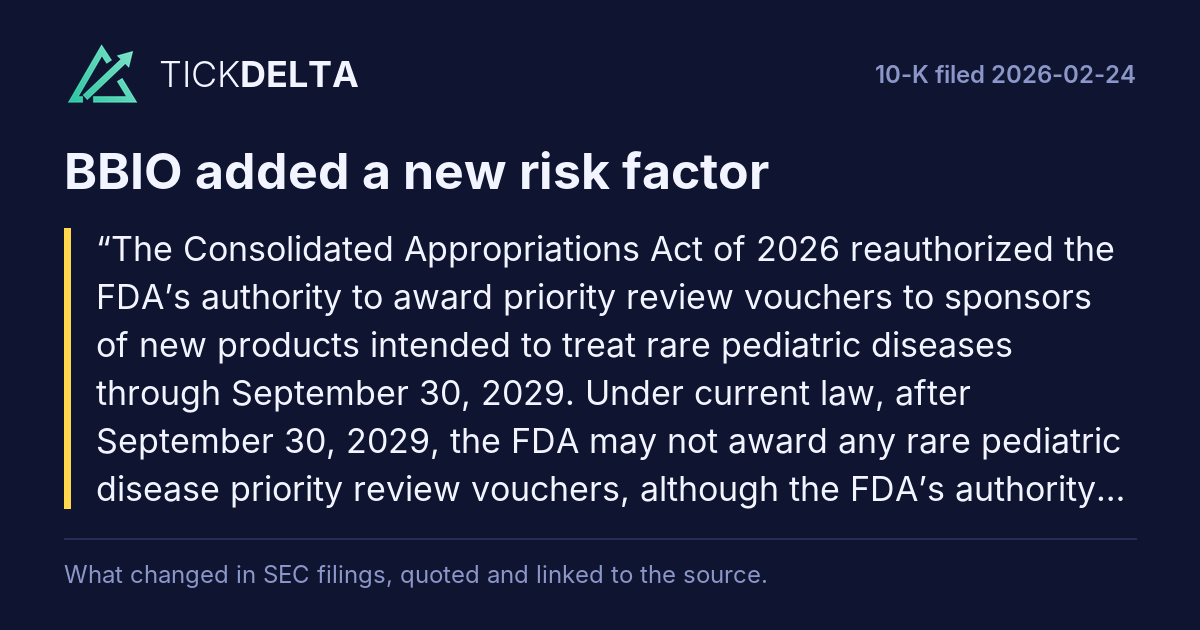
The Consolidated Appropriations Act of 2026 reauthorized the FDA’s authority to award priority review vouchers to sponsors of new products intended to treat rare pediatric diseases through September 30, 2029. Under current law, after September 30, 2029, the FDA may not award any rare pediatric disease priority review vouchers, although the FDA’s authority to do so could be extended by Congress in the future.

Read in the 10-K
Show the other 7

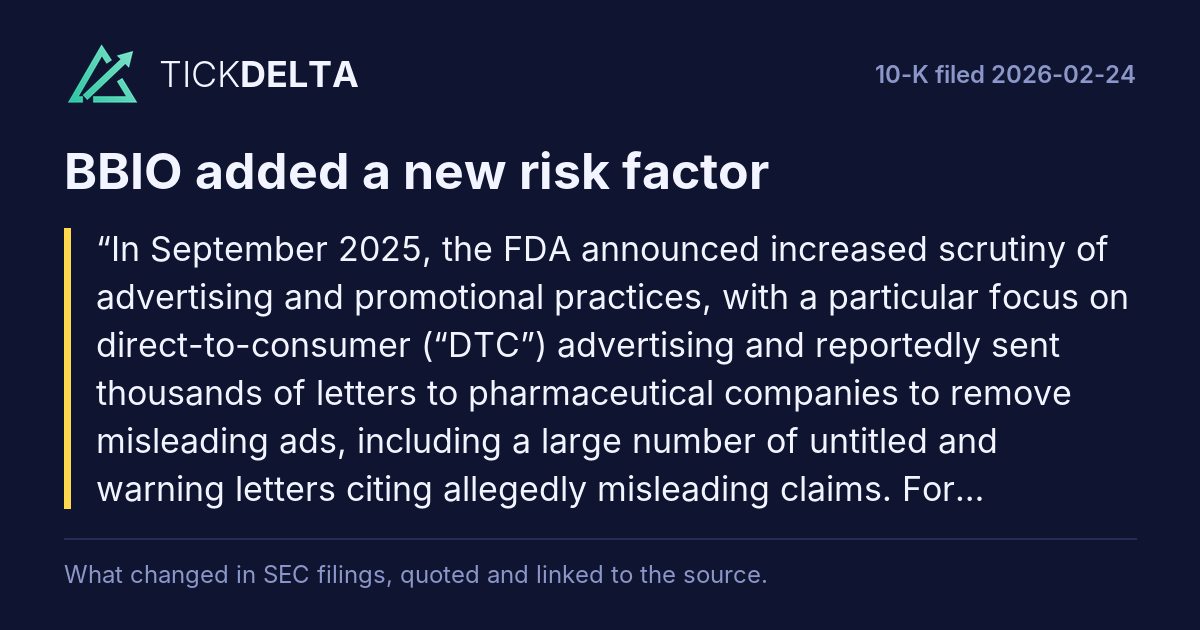
In September 2025, the FDA announced increased scrutiny of advertising and promotional practices, with a particular focus on direct-to-consumer (“DTC”) advertising and reportedly sent thousands of letters to pharmaceutical companies to remove misleading ads, including a large number of untitled and warning letters citing allegedly misleading claims. For example, we received one of these untitled letters citing a DTC broadcast advertisement for Attruby. This heightened enforcement environment increases the risk that our promotional materials, even if we believe them to be compliant, could be challenged by the FDA or by consumers or plaintiffs’ counsel, which could lead us to modify or withdraw certain promotional materials. If we cannot successfully manage the promotion of our products or product candidates, if approved, we could become subject to significant liability, which would materially adversely affect our business and financial condition.

Read in the 10-K

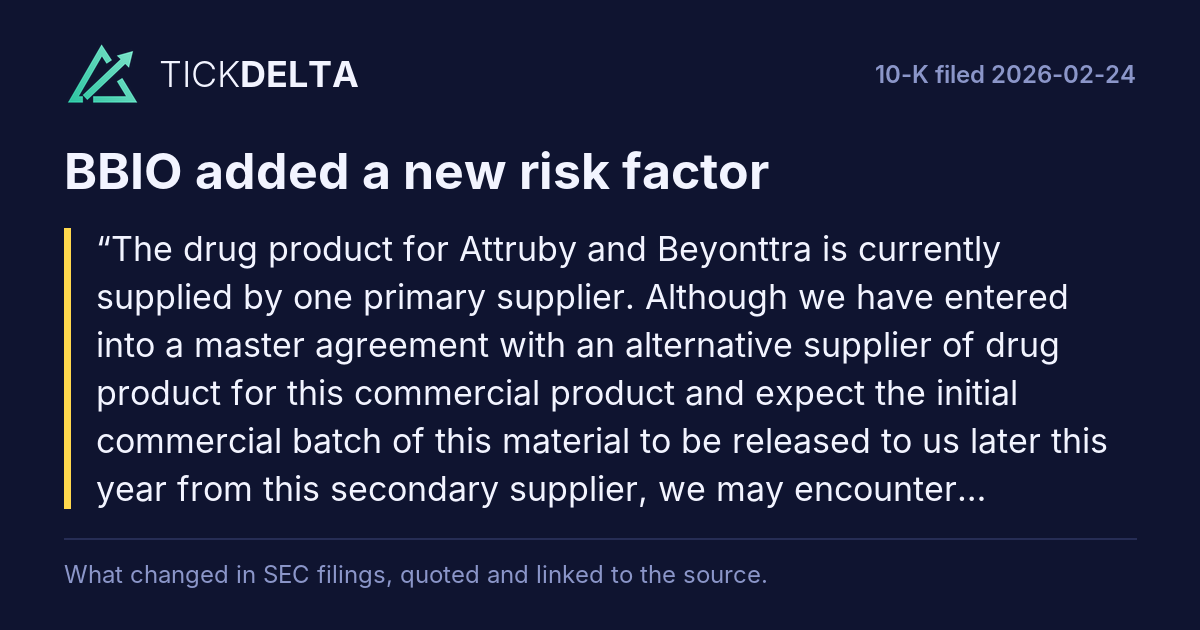
The drug product for Attruby and Beyonttra is currently supplied by one primary supplier. Although we have entered into a master agreement with an alternative supplier of drug product for this commercial product and expect the initial commercial batch of this material to be released to us later this year from this secondary supplier, we may encounter unexpected delays in the manufacture and supply of commercial drug product.

Read in the 10-K

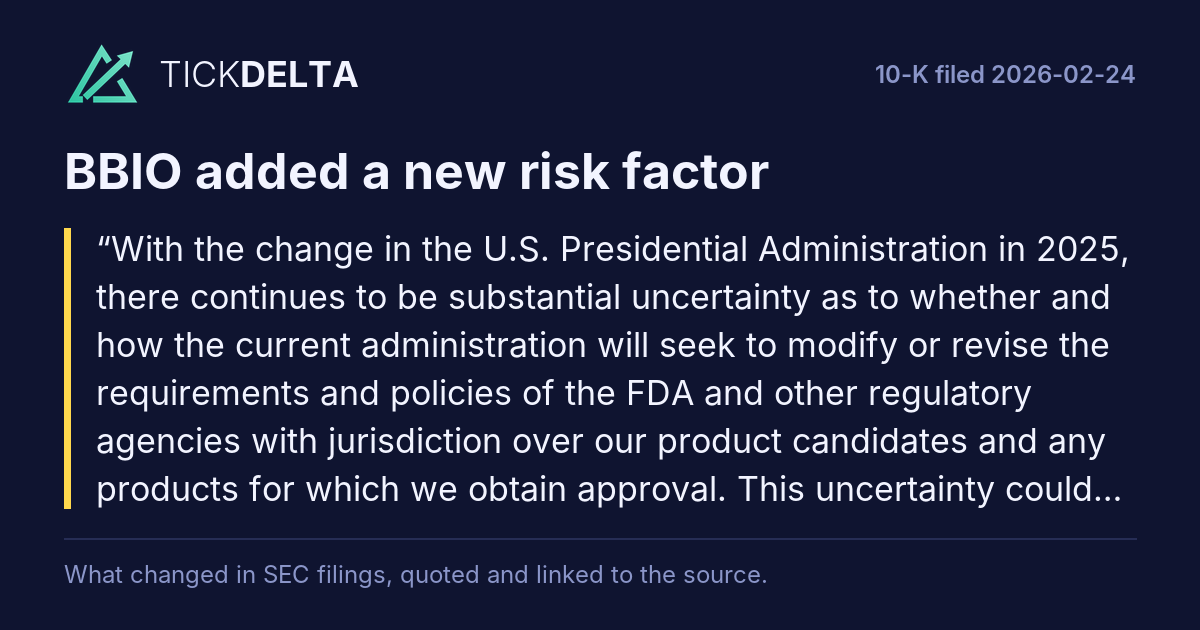
With the change in the U.S. Presidential Administration in 2025, there continues to be substantial uncertainty as to whether and how the current administration will seek to modify or revise the requirements and policies of the FDA and other regulatory agencies with jurisdiction over our product candidates and any products for which we obtain approval. This uncertainty could present new challenges as we navigate development and approval of our product candidates. Some of these efforts have manifested to date in the form of personnel cuts and measures that could impact the FDA’s ability to hire and retain key personnel, which could result in delays or limitations on our ability to obtain guidance from the FDA on our product candidates in development and obtain the requisite regulatory approvals in the future. There remains general uncertainty regarding future activities. The current administration could issue or promulgate executive orders, regulations, policies or guidance that adversely affect us or create a more challenging or costly environment to pursue the development of new therapeutic products. Alternatively, state governments may attempt to address or react to changes at the federal level with changes to their own regulatory frameworks in a manner that is adverse to our operations. If we become negatively impacted by future governmental orders, regulations, policies or guidance as a result of the current Administration, there could be a material adverse effect on us and our business.

Read in the 10-K

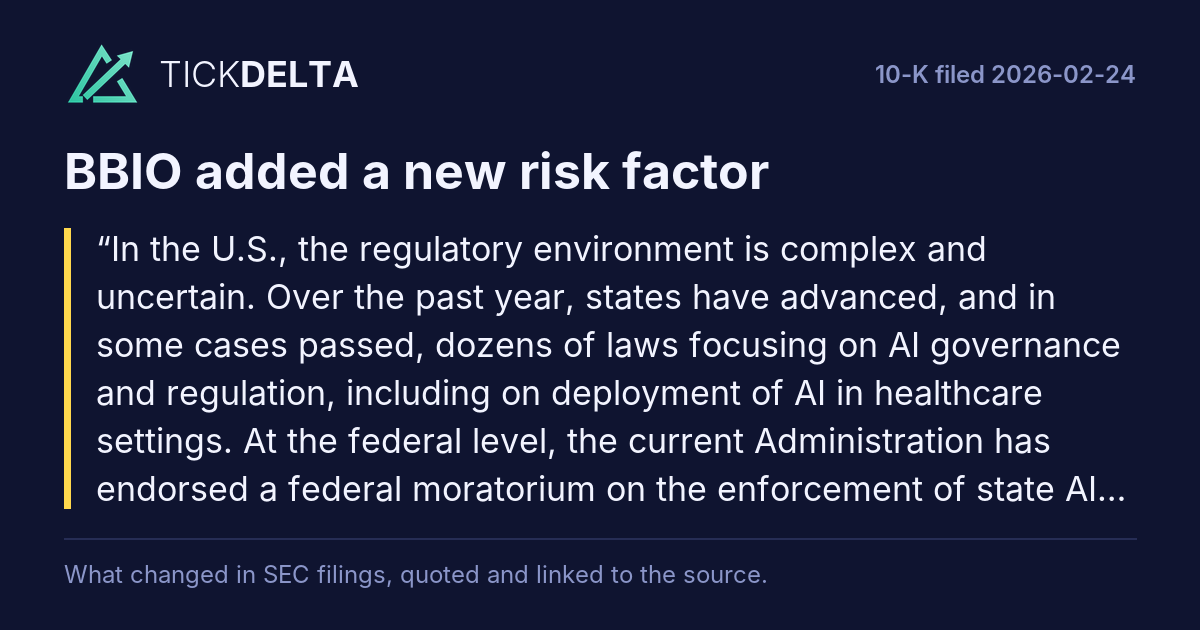
In the U.S., the regulatory environment is complex and uncertain. Over the past year, states have advanced, and in some cases passed, dozens of laws focusing on AI governance and regulation, including on deployment of AI in healthcare settings. At the federal level, the current Administration has endorsed a federal moratorium on the enforcement of state AI laws, including through a December 11, 2025, executive order on “Ensuring a National Policy Framework for Artificial Intelligence.” So far, these efforts have not been successful at curtailing state action on AI regulation, contributing to a complicated legislative patchwork, which may be litigated in state and federal courts. In addition, there is continued uncertainty regarding the application of existing federal and state legal frameworks to uses and development of AI, and legal norms and market standards regarding AI continue to evolve. For example, various federal and state regulators have issued guidance and focused enforcement efforts on the use of AI in regulated sectors. The U.S. Food and Drug Administration, for example, issued guidance on the use of artificial intelligence in medical devices, requiring detailed risk management and review processes to obtain approvals. If we develop or use AI systems that are governed by these laws or regulations, we will need to meet higher standards of data quality, transparency, and human oversight, and we would need to adhere to specific and potentially burdensome and costly ethical, accountability, and administrative requirements.

The rapid evolution of AI may require the application of significant resources to design, develop, test and maintain our products and services to help ensure that AI is implemented in accordance with applicable law and regulation and in a socially responsible manner and to minimize any real or perceived unintended harmful impacts. The use of certain AI technologies can also give rise to intellectual property risks, including by disclosing or otherwise compromising confidential or proprietary intellectual property, or by undermining our ability to assert or defend ownership rights in intellectual property created with the assistance of AI tools.

Read in the 10-K

Refer to the Risk Factor below in this Item 1A for further discussion related to our royalty monetization arrangements.

Read in the 10-K

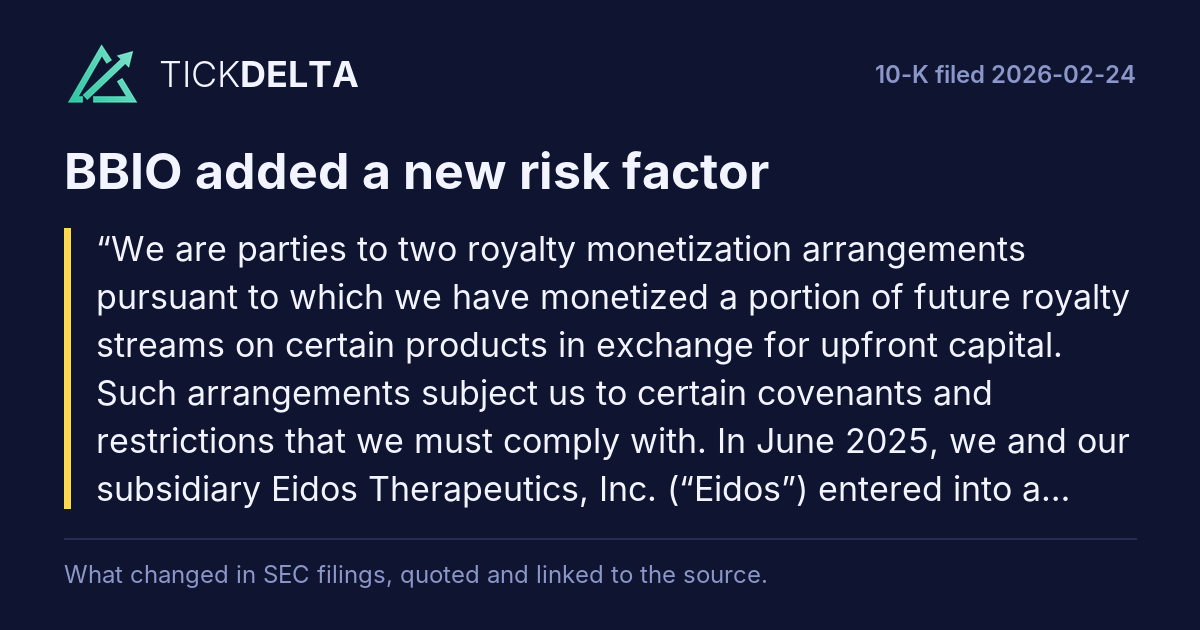
We are parties to two royalty monetization arrangements pursuant to which we have monetized a portion of future royalty streams on certain products in exchange for upfront capital. Such arrangements subject us to certain covenants and restrictions that we must comply with.

In June 2025, we and our subsidiary Eidos Therapeutics, Inc. (“Eidos”) entered into a Royalty Interest Purchase and Sale Agreement (the “Royalty Purchase Agreement”) with Acoramidis Royalty SPV, LP (“ARS”), an affiliate of HealthCare Royalty Management, LLC (“HCRx”), as a purchaser and the purchaser representative (in such capacity, the “Purchaser Representative”), and LSI Financing Fund, LP, an affiliate of Blue Owl Capital Corporation, as a purchaser (together with ARS as a purchaser and any future permitted assignees of a purchaser, the “Royalty Agreement Purchasers”).

Pursuant to the Royalty Purchase Agreement, Eidos sold to the Royalty Agreement Purchasers certain of Eidos’ right to receive certain royalty payments (“Purchased Royalty Payment”) on net sales of certain products containing acoramidis (the “Licensed Products”) made in the EU and all member and extension states of the European Patent Organization (the “Licensed Territory”) under (i) our Bayer License Agreement and (ii) the amended and restated license agreement between Eidos and our other subsidiary, BridgeBio International GmbH. As consideration for the sale of the Purchased Royalty Payment, the Royalty Agreement Purchasers paid Eidos $300.0 million in cash (the “Purchase Price”), which was funded in full upon the closing of the transactions under the Royalty Purchase Agreement.

Under the Royalty Purchase Agreement, the Royalty Agreement Purchasers are entitled to the Purchased Royalty Payment, subject to (a) an annual cap equal to 60% of all royalty payments paid by Bayer to Eidos and its affiliates under the Bayer License Agreement on the first $500.0 million of annual net sales of Licensed Products in the Licensed Territory under the Bayer License Agreement and (b) an initial hard cap equal to 145% of the Purchase Price. In addition, we and our subsidiary, Eidos, granted the Purchaser Representative, for the benefit of the Royalty Agreement Purchasers, a security interest in specific assets related to the Purchased Royalty Payment.

Read in the 10-K

•our quarterly financial results, including net product revenue from sales of Attruby, license and services and royalty revenue from net sales of Beyonttra or revenue from any of our product candidates, if approved;

Read in the 10-K

Paragraphs in the 10-Q filed Oct 29, 2026 that were not in the one before

New in the latest 10-Q

26 paragraphs in the 10-Q filed Oct 29, 2026 with nothing like them in the 10-Q filed Aug 10, 2026 (at least half the words must differ; new numbers alone do not count). Quoted exactly, grouped by the item heading above them. This is text that changed, not a judgement of how serious it is.

10-Q

Unrealized loss on available-for-sale securities — — — — — — — — (20) — (20) — (20)

Read in the 10-Q

Unrealized loss on available-for-sale securities — — — — — — — — (88) — (88) — (88)

Read in the 10-Q

Nine Months Ended September 30, 2026 2025 ──────────────────────────────────────────────────────────────────────────────────────────────────────────────────────────────────────────────────────────────────────────────── Operating activities: Net loss $ (382,942) $ (538,303) Adjustments to reconcile net loss to net cash used in operating activities: Noncash interest expense on deferred royalty obligations (1) 123,500 86,460 Stock-based compensation 117,171 98,385 Net loss from equity method investments 32,030 51,579 Change in fair value of the embedded derivative associated with the deferred royalty obligation (7,098) (11,062) Amortization of debt discount and issuance costs 5,670 4,515 Depreciation and amortization 3,308 3,999 Noncash lease expense 4,714 3,443 Loss on extinguishment of debt — 21,155 Noncash income from an equity method investment — (7,769) Other noncash adjustments, net 2,233 (1,217) Changes in operating assets and liabilities: Accounts receivable, net (235,646) (111,796) Inventories (35,641) (23,356) Prepaid expenses and other current assets (26,872) (17,527) Other assets (5,849) 568 Accounts payable 51,993 9,084 Accrued compensation and benefits (9,049) 3,212 Accrued research and development liabilities 13,583 347 Operating lease liabilities (5,494) (4,757) Deferred revenue (6,558) (9,480) Other liabilities (2) 48,397 53,030 Net cash used in operating activities (312,550) (389,490) Investing activities: Purchases of marketable securities (63,937) (10,876) Maturities of marketable securities 76,500 8,000 Proceeds from special cash dividends received from an investment in equity securities — 2,302 Payment for intangible assets — (8,495) Purchases of property and equipment (802) (1,064) Net cash provided by (used in) investing activities 11,761 (10,133) Financing activities: Proceeds from issuance of 2033 Notes 632,500 — Issuance costs and discounts associated with 2033 Notes (13,227) — Proceeds from issuance of 2031 Notes — 575,000 Issuance costs and discounts associated with 2031 Notes — (12,034) Repayment of term loans — (459,000) Proceeds from royalty obligation under Royalty Purchase Agreement (as described in Note 9) — 300,000 Issuance costs associated with royalty obligation under Royalty Purchase Agreement — (3,010) Repayments of deferred royalty obligations (3) (62,507) (6,896) Proceeds from issuance of preferred stock 933,900 — Issuance costs associated with preferred stock (1,342) — Payment of preferred stock dividends (2,694) — Repurchase of common stock (252,502) (48,276) Proceeds from stock option exercises, net of repurchases 33,712 14,523 Proceeds from common stock issuances under ESPP 9,728 6,414 Repurchase of RSU shares to satisfy tax withholding (13,431) (6,796) Transactions with noncontrolling interests — 1,550 Net cash provided by financing activities 1,264,137 361,475 Net increase (decrease) in cash, cash equivalents, and restricted cash 963,348 (38,148) Cash, cash equivalents, and restricted cash at beginning of period 572,140 683,244 Cash, cash equivalents, and restricted cash at end of period $ 1,535,488 $ 645,096

Read in the 10-Q

In addition, our development portfolio includes three registrational-stage product candidates, each supported by positive Phase 3 results and for which New Drug Applications (“NDAs”) have been filed with the FDA:

Read in the 10-Q

• the expected redemption period of our convertible preferred stock and related discount accretion,

Read in the 10-Q
Show the other 21

In July 2026, the Company issued shares of a newly designated series of convertible preferred stock (see Note 13). The Company accounts for its Series A Cumulative Convertible Participating Preferred Stock, par value $ 0.001 per share (the “Preferred Stock”) as permanent equity. Dividends on the Preferred Stock accrue and accumulate on a daily basis at an initial annual rate of 7.00 % of the accumulated amount per share, initially the $ 1,000 per share original issue price, whether or not declared by the Company’s Board of Directors, and are subject to contractual increases in the dividend rate over time and upon specified events. To the extent not paid in cash (the “PIK Dividends”) on a quarterly dividend payment date, accrued PIK Dividends automatically compound and are added to the accumulated amount of each share. Because PIK Dividends accrue and compound whether or not declared and increase both the number of shares of common stock issuable upon conversion and the amounts payable upon liquidation or redemption, the Company recognizes PIK Dividends as they accumulate as an increase in the carrying value of the Preferred Stock, with a corresponding charge to retained earnings, or additional paid-in capital in the absence of retained earnings. Accumulated and unpaid PIK Dividends are not recognized as a liability at each balance sheet date, as the Company has no obligation to transfer assets until such dividends are declared and paid. Through September 30, 2026, the Company has elected to pay all dividends on the Preferred Stock in cash, and no PIK Dividends have accumulated (see Note 13).

Read in the 10-Q

The Preferred Stock has similar characteristics of an “Increasing Rate Security” as described by SEC Staff Accounting Bulletin Topic 5. Q, Increasing Rate Preferred Stock. The Preferred Stock’s initial carrying value was recorded at a discount to its liquidation preference (i.e., the difference between the issuance price and estimated call price) due to being issued with an increasing rate dividend, in addition to its issuance costs. Such discount is considered an unstated dividend cost and is amortized over the expected redemption period using the effective interest method, by charging the imputed dividend cost against additional paid-in capital in the absence of retained earnings and increasing the carrying amount of the Preferred Stock by a corresponding amount. The amortization in each period is the amount which, together with the stated dividend in the period, results in a constant rate of effective cost with regard to the carrying amount of the Preferred Stock.

Read in the 10-Q

We calculate basic net loss per share using the two-class method as a result of the issuance of the Preferred Stock in July 2026 (see Note 13). The two-class method determines net income (loss) per common share for each class of common stock and participating securities according to dividends declared or accumulated and participation rights in undistributed earnings. The two-class method requires undistributed earnings for the period to be allocated between common stock and participating securities based upon their respective rights to receive dividends as if all income for the period had been distributed. The Preferred Stock contractually entitles the holders of such shares to participate in dividends declared on common stock on an as-converted basis, but does not contractually require the holders of such shares to participate in the Company’s losses. Accordingly, no losses are allocated to the Preferred Stock, and the Preferred Stock is excluded from the computation of basic net loss per share in periods in which the Company reports a net loss. However, the cumulative dividends that accrete on the Preferred Stock for the period, whether or not declared, reduce net income or increase net loss attributable to common stockholders.

Read in the 10-Q

Basic net loss per share attributable to common stockholders of BridgeBio is computed by dividing the net loss attributable to common stockholders of BridgeBio by the weighted-average number of shares of BridgeBio’s common stock outstanding for the period, without consideration for potential dilutive shares of common stock, such as stock options, unvested restricted stock units (“RSUs”), performance-based milestone compensation awards, shares issuable under our employee stock purchase plan (“ESPP”), and assumed conversion of our 2027 Notes, 2029 Notes, 2031 Notes, 2033 Notes, and Preferred Stock. The common stock equivalents of performance-based milestone compensation arrangements are included as potentially dilutive shares only if the performance condition has been met as of the end of the reporting period. Shares of common stock subject to repurchase are excluded from the weighted-average shares. Diluted net loss per share is computed by giving effect to all potentially dilutive securities outstanding for the period, determined using the more dilutive of the treasury stock method, the if-converted method, or the two-class method, as applicable. Because the Company reported a net loss for all periods presented, all potentially dilutive securities were antidilutive, and basic and diluted net loss per share are the same.

Read in the 10-Q

September 30, 2026 December 31, 2025 Weighted-average Amount Weighted-average Amount

Read in the 10-Q

(1) Potential milestone amounts are presented at the maximum potential amounts payable under the respective agreements.

Read in the 10-Q

The 2027 Notes, which mature on March 15, 2027, were classified as current liabilities as of September 30, 2026.

Read in the 10-Q

The Preferred Stock is redeemable solely at the option of the Company and, as such, is classified within permanent equity in our condensed consolidated balance sheet as of September 30, 2026. The holders of the Preferred Stock are entitled to the rights, preferences and privileges, and are subject to the restrictions, described below with respect to voting, dividends, redemption, liquidation, and conversion.

Read in the 10-Q

Through September 30, 2026, the Company has elected to pay all dividends on the Preferred Stock in cash at the initial rate of 7.00 % per annum. The Preferred Stock’s initial carrying value was recorded at a discount to its liquidation preference (i.e., the difference between the issuance price and estimated call price) due to being issued with an increasing rate dividend, in addition to its issuance costs. In accordance with the SEC’s Staff Accounting Bulletin Topic 5. Q, Increasing Rate Preferred Stock, the discount is considered an unstated dividend cost that must be amortized over the expected redemption period using the effective interest method, by charging the imputed dividend cost against additional paid-in capital in the absence of retained earnings and increasing the carrying amount of the Preferred Stock by a corresponding amount. The discount is therefore being amortized over the expected redemption period of six years using an 11.17 % effective interest rate, assuming all dividends during the period are paid in cash. The six-year term represents the expected life of the Preferred Stock as the Company expects the Preferred Stock to be converted by such date and if not, the Company expects to exercise its redemption right with respect to such shares prior to the increase in the dividend rate on the seventh anniversary of the Original Issuance Date. The accretion includes approximately $ 1.3 million of issuance costs paid to third parties. The amortization in each period is the amount which, together with the stated dividend in the period, results in a constant rate of effective cost with regard to the carrying amount of the Preferred Stock. For the period from the Preferred Stock Closing Date to September 30, 2026, the Company recognized dividends of $ 26.3 million, which includes accretion of the implied discount of $ 9.9 million.

Read in the 10-Q

Upon any redemption by the Company, the holders of the Preferred Stock may elect to have such redemption settled by conversion into shares of our Common Stock.

Read in the 10-Q

In the event of any Liquidation Event (as defined in the Certificate of Designations), each holder of Preferred Stock shall be entitled to receive liquidating distributions out of the assets of the Company, before any payment or distribution of any assets of the Company shall be made or set apart for holders of all other classes or series of equity securities of the Company, including any other preferred stock or the Common Stock, for such holder’s shares of Preferred Stock in an amount equal to the Liquidation Preference (as defined in the Certificate of Designations). A Change of Control shall not by itself be deemed a Liquidation Event.

Read in the 10-Q

As of September 30, 2026, based on the initial conversion price of $ 137.79 per share and excluding the accrued cash dividends of $ 13.7 million, which the Company has elected to pay in cash, the 933,900 shares of Preferred Stock were convertible into an aggregate of 6,777,704 shares of our Common Stock.

Read in the 10-Q

The Company’s provision for income tax for the three and nine months ended September 30, 2026 was $ 1.2 million, primarily related to current foreign income tax expense. The Company’s provision for (benefit from) income tax for the three and nine months ended September 30, 2025 was $( 1.5 ) million and $ 0.6 million, respectively, primarily related to the benefit recognized from the OBBBA for the three-month period and current foreign income tax expense for the nine-month period.

Read in the 10-Q

We calculate basic net loss per share using the two-class method as a result of the issuance of the Preferred Stock in July 2026 (see Note 13). The two-class method determines net income (loss) per common share for each class of common stock and participating securities according to dividends declared or accumulated and participation rights in undistributed earnings. The two-class method requires undistributed earnings for the period to be allocated between common stock and participating securities based upon their respective rights to receive dividends as if all income for the period had been distributed. The Preferred Stock contractually entitles the holders of such shares to participate in dividends declared on Common Stock on an as-converted basis, but does not contractually require the holders of such shares to participate in the Company’s losses. Accordingly, no losses are allocated to the Preferred Stock, and the Preferred Stock is excluded from the computation of basic net loss per share in periods in which the Company reports a net loss. However, the cumulative dividends that accrete on the Preferred Stock for the period, whether or not declared, reduce net income or increase net loss attributable to common stockholders. For the period from the Preferred Stock Closing Date to September 30, 2026, the Company recognized dividends of $ 26.3 million, which includes accretion of the implied discount of $ 9.9 million.

Read in the 10-Q

compensation arrangements Estimated shares issuable under the ESPP 39,429 42,842 Assumed conversion of 2027 Notes 12,878,305 12,878,305 Assumed conversion of 2029 Notes 7,702,988 7,702,988 Assumed conversion of 2031 Notes 11,544,448 11,544,448 Assumed conversion of 2033 Notes 5,720,014 — Assumed conversion of Preferred Stock 6,777,704 — 64,461,053 56,673,830

Read in the 10-Q

On July 1, 2026 (the “Preferred Stock Closing Date”), the Company issued shares of a newly designated series of convertible preferred stock (see Note 13). The Company accounts for its Series A Cumulative Convertible Participating Preferred Stock, par value $0.001 per share (the “Preferred Stock”) as permanent equity. Dividends on the Preferred Stock accrue and accumulate on a daily basis at an initial annual rate of 7.00% of the accumulated amount per share, initially the $1,000 per share original issue price, whether or not declared by the Company’s Board of Directors, and are subject to contractual increases in the dividend rate over time and upon specified events. Dividends are payable quarterly in cash or in kind at the Company’s election.

Read in the 10-Q

The Preferred Stock has similar characteristics of an “Increasing Rate Security” as described by SEC Staff Accounting Bulletin Topic 5. Q, Increasing Rate Preferred Stock. The Preferred Stock’s initial carrying value was recorded at a discount to its liquidation preference (i.e., the difference between the issuance price and estimated call price) due to being issued with an increasing rate dividend, in addition to its issuance costs. Such discount is considered an unstated dividend cost and is amortized over the expected redemption period using the effective interest method, by charging the imputed dividend cost against additional paid-in capital in the absence of retained earnings and increasing the carrying amount of the Preferred Stock by a corresponding amount. The amortization in each period is the amount which, together with the stated dividend in the period, results in a constant rate of effective cost with regard to the carrying amount of the Preferred Stock. For the period from the Preferred Stock Closing Date to September 30, 2026, the Company recognized dividends of $26.3 million, which includes accretion of the implied discount of $9.9 million.

Read in the 10-Q

Risk Factors

Healthcare reform efforts have been and may continue to be subject to scrutiny and legal challenge. In 2021, the U.S. Supreme Court dismissed the latest judicial challenge to the ACA brought by several states without specifically ruling on the constitutionality of the ACA. As another example, revisions to regulations under the federal anti-kickback statute would remove protection for traditional Medicare Part D discounts offered by pharmaceutical manufacturers to pharmacy benefit managers and health plans. Pursuant to court order, the removal was delayed and subsequent legislation imposed a moratorium on implementation of the rule until January 2032. The IRA drug price negotiation program has also been challenged in litigation filed by various pharmaceutical manufacturers and industry groups.

Read in the 10-Q

Individual states have also been increasingly active in passing legislation and implementing regulations designed to control pharmaceutical and biological product pricing, including price or patient reimbursement constraints, discounts, restrictions on certain product access and marketing cost disclosure and transparency measures, and, in some cases, designed to encourage importation from other countries and bulk purchasing. In addition, regional health care authorities and individual hospitals are increasingly using bidding procedures to determine what pharmaceutical products and which suppliers will be included in their prescription drug and other health care programs. We expect that additional state and federal healthcare reform measures will be adopted in the future, particularly in light of the current presidential administration, any of which could limit the amounts that federal and state governments will pay for healthcare products and services.

Read in the 10-Q

The costs of prescription pharmaceuticals have also been the subject of considerable discussion in the United States. To date, there have been several recent U.S. congressional inquiries, as well as proposed and enacted federal and state legislation designed to, among other things, bring more transparency to drug pricing, review the relationship between pricing and manufacturer patient programs, reduce the costs of drugs under Medicare and reform government program reimbursement methodologies for drug products.

Read in the 10-Q

• changes in laws or regulations applicable to our current and future products or product candidates;

Read in the 10-Q

The 10-Q's risk factors against the 10-K

Item 1A of the 10-Q filed Oct 29, 2026 against Item 1A of the 10-K filed Feb 24, 2026. A 10-Q repeats only the risks that changed, so a 10-K paragraph that is missing from it is not counted as removed. Added is a paragraph with nothing like it in the 10-K, Reworded a sentence that is in both with several words changed, Quiet changes a sentence in both where one to four words changed and one is a hedge or a modal (cut words struck through, new words highlighted). Text on the page, not a score; each links to the filing at sec.gov.

Added10-Q Oct 29, 2026 vs 10-K Feb 24, 2026
Healthcare reform efforts have been and may continue to be subject to scrutiny and legal challenge. In 2021, the U.S. Supreme Court dismissed the latest judicial challenge to the ACA brought by several states without specifically ruling on the constitutionality of the ACA. As another example, revisions to regulations under the federal anti-kickback statute would remove protection for traditional Medicare Part D discounts offered by pharmaceutical manufacturers to pharmacy benefit managers and health plans. Pursuant to court order, the removal was delayed and subsequent legislation imposed a moratorium on implementation of the rule until January 2032. The IRA drug price negotiation program has also been challenged in litigation filed by various pharmaceutical manufacturers and industry groups.

Read it in the 10-Q at sec.gov

Added10-Q Oct 29, 2026 vs 10-K Feb 24, 2026
Individual states have also been increasingly active in passing legislation and implementing regulations designed to control pharmaceutical and biological product pricing, including price or patient reimbursement constraints, discounts, restrictions on certain product access and marketing cost disclosure and transparency measures, and, in some cases, designed to encourage importation from other countries and bulk purchasing. In addition, regional health care authorities and individual hospitals are increasingly using bidding procedures to determine what pharmaceutical products and which suppliers will be included in their prescription drug and other health care programs. We expect that additional state and federal healthcare reform measures will be adopted in the future, particularly in light of the current presidential administration, any of which could limit the amounts that federal and state governments will pay for healthcare products and services.

Read it in the 10-Q at sec.gov

Added10-Q Oct 29, 2026 vs 10-K Feb 24, 2026
The costs of prescription pharmaceuticals have also been the subject of considerable discussion in the United States. To date, there have been several recent U.S. congressional inquiries, as well as proposed and enacted federal and state legislation designed to, among other things, bring more transparency to drug pricing, review the relationship between pricing and manufacturer patient programs, reduce the costs of drugs under Medicare and reform government program reimbursement methodologies for drug products.

Read it in the 10-Q at sec.gov

Added10-Q Oct 29, 2026 vs 10-K Feb 24, 2026
We may also seek RMAT designation for one or more of our product candidates. This program is intended to facilitate efficient development and expedite review of regenerative medicine therapies, which are intended to treat, modify, reverse, or cure a serious or life-threatening disease or condition and qualify for RMAT designation. A BLA for a product candidate that has received RMAT designation may be eligible for priority review or accelerated approval through use of surrogate or intermediate endpoints reasonably likely to predict long-term clinical benefit, or reliance upon data obtained from a meaningful number of sites. Benefits of RMAT designation also include early interactions with the FDA to discuss any potential surrogate or intermediate endpoint to be used to support accelerated approval.

Read it in the 10-Q at sec.gov

Show the other 17
Added10-Q Oct 29, 2026 vs 10-K Feb 24, 2026
Our outstanding convertible preferred stock has rights, preferences and privileges that are not held by, and are preferential to, the rights of our common stock.

Read it in the 10-Q at sec.gov

Added10-Q Oct 29, 2026 vs 10-K Feb 24, 2026
In July 2026, we issued an aggregate of 933,900 shares of Series A Cumulative Convertible Participating Preferred Stock, par value $0.001 per share (the “Preferred Stock”), to funds managed by Sixth Street Partners, LLC, and funds managed by HealthCare Royalty, pursuant to an investment agreement (the “Investment Agreement”) dated July 1, 2026. The Preferred Stock ranks senior to our common stock with respect to the payment of dividends and rights on liquidation, dissolution or winding up. Holders of the Preferred Stock are also entitled to participate in dividends declared or paid on our common stock on an as-converted basis, and no dividends may be paid on our common stock unless the full participating dividends are paid at the same time to the holders of the Preferred Stock.

Read it in the 10-Q at sec.gov

Added10-Q Oct 29, 2026 vs 10-K Feb 24, 2026
The Preferred Stock may initially be converted at any time at the option of the respective holders into an aggregate of 6,777,704 shares of our common stock. Any conversion of the Preferred Stock may significantly dilute the holders of our common stock. Unless we obtain stockholder approval in accordance with the listing requirements of Nasdaq, the maximum number of shares of common stock into which the Preferred Stock may be converted will be limited such that, upon any conversion of Preferred Stock, the number of shares of our common stock being issued upon conversion will not cause the holder thereof, when taken together with all other shares of our common stock beneficially owned by such holder at the time of conversion, to beneficially own shares of our common stock exceeding 19.9% of the total voting power of our common stock (on an as-converted basis). We are obligated under the Investment Agreement to seek stockholder approval to have such restriction removed. The conversion price of the Preferred Stock is initially $137.79 per share and will increase to $153.10 per share on and after the fifth anniversary of the original issuance date, and is subject to customary anti-dilution adjustments, including in the event of any stock split, stock dividend, recapitalization or similar event. In addition, we may require conversion of all outstanding shares of Preferred Stock on or after the third anniversary of the original issuance date if specified trading price and liquidity conditions are satisfied.

Read it in the 10-Q at sec.gov

Added10-Q Oct 29, 2026 vs 10-K Feb 24, 2026
For additional details about the Preferred Stock, refer to Note 13 to our condensed consolidated financial statements.

Read it in the 10-Q at sec.gov

Reworded10-Q Oct 29, 2026 vs 10-K Feb 24, 2026
Furthermore, under the Drug Supply Chain Security Act, for certain commercial prescription drug products, manufacturers and other parties involved in the supply chain must also meet chain of distribution requirements and build electronic, interoperable systems for product tracking and tracing and for notifying the FDA of counterfeit, diverted, stolen, and intentionally adulterated products or other products that are otherwise unfit for distribution in the United States In addition, the distribution of prescription pharmaceutical products, including samples, is subject to the Prescription Drug Marketing Act (“PDMA”), which regulates the distribution of drugs and drug samples at the federal level, and sets minimum standards for the registration and regulation of drug distributors by the states.

Read it in the 10-Q at sec.govThe 10-K sentence

Reworded10-Q Oct 29, 2026 vs 10-K Feb 24, 2026
Furthermore, under the Drug Supply Chain Security Act, for certain commercial prescription drug products, manufacturers and other parties involved in the supply chain must also meet chain of distribution requirements and build electronic, interoperable systems for product tracking and tracing and for notifying the FDA of counterfeit, diverted, stolen, and intentionally adulterated products or other products that are otherwise unfit for distribution in the United States In addition, the distribution of prescription pharmaceutical products, including samples, is subject to the Prescription Drug Marketing Act (“PDMA”), which regulates the distribution of drugs and drug samples at the federal level, and sets minimum standards for the registration and regulation of drug distributors by the states. U.S.

Read it in the 10-Q at sec.govThe 10-K sentence

Reworded10-Q Oct 29, 2026 vs 10-K Feb 24, 2026
Sales to, under any equity distribution agreements or through, Goldman Sachs and SVB by us under “at-the-market” offering arrangements, including those we may enter into in the ATM Agreement or otherwise pursuant to the registration statement future, could result in substantial dilution to the interests of other holders of our common stock.

Read it in the 10-Q at sec.govThe 10-K sentence

Reworded10-Q Oct 29, 2026 vs 10-K Feb 24, 2026
See the section titled, “Business-Government Regulation-Current “Business - Government Regulation - Current and Future Legislation” in our Annual Report on Form 10-K for the year ended December 31, 2025 filed with the SEC on February 24, 2026 for more information regarding legislative and regulatory changes and proposed changes regarding the healthcare system directed at broadening the availability of healthcare, improving the quality of healthcare, and containing or lowering the cost of healthcare.

Read it in the 10-Q at sec.govThe 10-K sentence

Reworded10-Q Oct 29, 2026 vs 10-K Feb 24, 2026
For example, the 2027 Notes and 2031 Notes became are convertible for a limited period starting on January October 1, 2026 under the conversion condition met and will remain convertible until March December 31, 2026. 2026 because an early conversion condition based on the trading price of BridgeBio’s common stock was satisfied.

Read it in the 10-Q at sec.govThe 10-K sentence

Reworded10-Q Oct 29, 2026 vs 10-K Feb 24, 2026
LLC (“Goldman Sachs”), and SVB Securities LLC (“SVB”) The sale or issuance of our securities, including pursuant to our Equity Distribution Agreement, dated May 4, 2023 (the “ATM Agreement”) “at-the-market” offering arrangements, may cause significant dilution and the sale of such securities, or the perception that such sales may occur, could cause the price of our common stock to fall.

Read it in the 10-Q at sec.govThe 10-K sentence

Reworded10-Q Oct 29, 2026 vs 10-K Feb 24, 2026
Since the May 12, 2025 order, the current administration has continued to exert pressure on drug manufacturers to implement MFN pricing, including by suggesting that the administration may impose significant tariffs on pharmaceuticals if such encouraging manufacturers do not reach to enter into voluntary MFN agreements to implement MFN pricing. and implementing trade measures.

Read it in the 10-Q at sec.govThe 10-K sentence

Reworded10-Q Oct 29, 2026 vs 10-K Feb 24, 2026
On the other hand, the current The administration is also pursuing traditional regulatory pathways to impose drug pricing policies and published two proposed regulations in December 2025, referred to as GLOBE the Global Benchmark for Efficient Drug Pricing (“GLOBE”) for Medicare Part B and GUARD. the Guarding U.S.

Read it in the 10-Q at sec.govThe 10-K sentence

Reworded10-Q Oct 29, 2026 vs 10-K Feb 24, 2026
The collection and use of data (including personal health data) in the EEA and UK are governed by the provisions of the EU GDPR and UK GDPR (together “GDPR” and each as defined in the section titled, “Business - Government Regulation - European EU and UK Data Collection”). Collection” in our Annual Report on Form 10-K for the year ended December 31, 2025 filed with the SEC on February 24, 2026).

Read it in the 10-Q at sec.govThe 10-K sentence

Reworded10-Q Oct 29, 2026 vs 10-K Feb 24, 2026
For example, our acquisition in January 2021 of all of the outstanding shares of common stock of Eidos Merger that were not previously owned by us or our subsidiaries (the “Eidos Merger”) resulted in a reduction of our cash and dilutive issuances of our equity securities to the former Eidos stockholders.

Read it in the 10-Q at sec.govThe 10-K sentence

Reworded10-Q Oct 29, 2026 vs 10-K Feb 24, 2026
Moreover, we may be subject to a third-party preissuance submission of prior art to the United States Patent and Trademark Office (“USPTO”) and from time to time have been or may become involved in opposition, derivation, reexamination, inter partes review, post-grant review or interference proceedings challenging our patent rights or the patent rights of others.

Read it in the 10-Q at sec.govThe 10-K sentence

The first 22 of 66 are shown (at most 12 of each type).

Phrases used for the first time

Two-word phrases in Risk Factors of the 10-K filed Feb 24, 2026 that are in none of the 1 earlier 10-Ks stored, back to Feb 20, 2025

agreement purchasers ×15current administration ×9royalty purchase ×9purchase agreement ×9mfn pricing ×6royalty agreement ×6purchased royalty ×5current administration’s ×3pricing policies ×3most-favored-nation pricing ×3purchaser representative ×3continued commercial ×2negative impact ×2two proposed ×2proposed regulations ×2payment models ×2
Where each one is used
  • agreement purchasers: In June 2025, we and our subsidiary Eidos Therapeutics, Inc. (“Eidos”) entered into a Royalty Interest Purchase and Sale Agreement (the “Royalty Purchase Agreement”) with Acoramidis Royalty SPV, LP (“ARS”), an affiliate of HealthCare Royalty Management, LLC (“HCRx”), as a purchaser and the purchaser representative...
  • current administration: There have been, and likely will continue to be, legislative and regulatory proposals at the foreign, federal and state levels directed at containing or lowering the cost of healthcare. The implementation of cost containment measures or other healthcare reforms may prevent us from being able to generate revenue,...
  • royalty purchase: We are parties to the Royalty Purchase Agreement and the Funding Agreement, which contain certain covenants and restrictions on our operations that, if violated, may adversely affect our financial condition and operating results. The Royalty Purchase Agreement requires us to direct 60% of BridgeBio’s European...
  • purchase agreement: We are parties to the Royalty Purchase Agreement and the Funding Agreement, which contain certain covenants and restrictions on our operations that, if violated, may adversely affect our financial condition and operating results. The Royalty Purchase Agreement requires us to direct 60% of BridgeBio’s European...
  • mfn pricing: On May 12, 2025, the current administration issued an executive order calling on pharmaceutical manufacturers to voluntarily reduce the prices of medicines in the U.S. and directing the Secretary of Health and Human Services (HHS) to communicate most-favored-nation (MFN) price targets to pharmaceutical...
  • royalty agreement: In June 2025, we and our subsidiary Eidos Therapeutics, Inc. (“Eidos”) entered into a Royalty Interest Purchase and Sale Agreement (the “Royalty Purchase Agreement”) with Acoramidis Royalty SPV, LP (“ARS”), an affiliate of HealthCare Royalty Management, LLC (“HCRx”), as a purchaser and the purchaser representative...
  • purchased royalty: Pursuant to the Royalty Purchase Agreement, Eidos sold to the Royalty Agreement Purchasers certain of Eidos’ right to receive certain royalty payments (“Purchased Royalty Payment”) on net sales of certain products containing acoramidis (the “Licensed Products”) made in the EU and all member and extension states of...
  • current administration’s: There have been, and likely will continue to be, legislative and regulatory proposals at the foreign, federal and state levels directed at containing or lowering the cost of healthcare. The implementation of cost containment measures or other healthcare reforms may prevent us from being able to generate revenue,...

The 10-K at sec.gov

Used at least twice, small words left out. Counted, not picked: a phrase can be new because the company renamed something.

What was taken out

22 paragraphs of last year's Risk Factors with nothing like them now. The longest are quoted.

Across all companies
Developing and acting on initiatives within the scope of ESG, and collecting, measuring and reporting ESG-related information and metrics can be costly, difficult and time consuming and is subject to evolving reporting standards. We may also communicate certain initiatives and goals, regarding environmental matters, diversity, social investments and other ESG-related matters, in our SEC filings or in other public disclosures. These initiatives and goals within the scope of ESG could be difficult and expensive to implement, the technologies needed to implement them may not be cost effective...
In the 10-K filed Feb 20, 2025
In January 2024, we entered into the Financing Agreement, pursuant to which the lenders thereunder agreed to extend a senior secured credit facility to us in an aggregate principal amount of up to $750.0 million, comprised of (i) an initial term loan of $450.0 million (the “Initial Term Loan”) and (ii) subject to the satisfaction of certain terms and conditions set forth in the Financing Agreement, one or more incremental term loans in an aggregate principal amount not to exceed $300.0 million. The Initial Term Loan was funded on January 17, 2024. We are required to make principal payments...
In the 10-K filed Feb 20, 2025
As of December 31, 2024, we are required to maintain, under the Amended Financing Agreement, a minimum unrestricted qualified cash balance of $78.0 million, at all times, and to comply with various operating covenants and default clauses that may restrict our ability to finance our operations, engage in business activities or expand or fully pursue our business strategies. As security for the obligations under the Amended Financing Agreement, we and our subsidiaries that are party to the Amended Financing Agreement as guarantors are required to grant to the administrative agent, for the...
In the 10-K filed Feb 20, 2025
We may seek designation for our platform technology as a designated platform technology. A sponsor may request the FDA to designate a platform technology as a designated platform technology concurrently with, or at any time after, submission of an IND application for a drug that incorporates or utilizes the platform technology that is the subject of the request. If so designated, the FDA may expedite the development and review of any subsequent original NDA or BLA for a drug that uses or incorporates the platform technology. Even if we believe our platform technology meets the criteria for...
In the 10-K filed Feb 20, 2025

Sources

Item 1A of each 10-K and 10-Q on EDGAR, quoted exactly. Each paragraph links to the filing at sec.gov.

Also

10-K change: what was reworded or cut, section by section.

Work with it

Excel workbook · CSV. Google Sheet that stays up to date: paste =IMPORTDATA("https://tickdelta.com/company/BBIO/export.csv") into a cell.

Next:10-K change
Esc

Type a ticker such as AAPL, a name, an investor such as Buffett, or a topic such as tariffs. ↑ ↓ to move, Enter to open.