Screener / SEC EDGAR /CIK 0000014930 /10-K filed Feb 13, 2026, compared with Feb 14, 2025 /Numbers from the XBRL of the 10-Ks
NYSE Industrials · Engines

Brunswick Corp BC

Compare with peers Embed
The 10-K against last year's

65 changes: 6 added, 6 removed, 52 reworded, 1 quiet changes

10-K Feb 13, 2026 vs Feb 14, 2025

10-K 0000014930-26-000027 (Feb 13, 2026) vs 10-K 0000014930-25-000025 (Feb 14, 2025)

Every paragraph, and how much of it changed

One bar per paragraph, in the order of the 10-K. Height and colour show the share of its words not in the closest paragraph a year earlier; the tallest bars are new paragraphs.

Risk Factors

116 paragraphs · 4 new · 27 reworded · 3 gone · 10-K Feb 13, 2026 against Feb 14, 2025
New paragraph Reworded (5% of its words or more) Same or nearly
Paragraph 104 · 46% changed Every version of it
Environmental restrictions, boat plant emission restrictions, and permitting and zoning requirements can limit production capacity, access to water for boating (or certain types of boats or propulsion) and marinas, and storage space. While future requirements, including any imposed on recreational boating, are not expected to be unduly restrictive, they may deter potential customers, thereby reducing our sales. Furthermore, regulations allowing the sale of fuel containing higher levels of ethanol for automobiles, which is not appropriate or intended for use in marine engines, may nonetheless result in increased warranty, service costs, customer dissatisfaction with products, and other claims against us if boaters mistakenly use this fuel in marine engines, causing damage to and the degradation of components in their marine engines. Many of our customers use our products for fishing and related recreational activities. Regulatory or commercial policies and practices impacting access to water, including availability of slip locations and/or the ability to transfer boats among different waterways, access to fisheries, or the ability to fish in some areas could negatively affect demand for our products. As we evolve our product electrification strategy, we are potentially subject to emerging regulations and requirements under the proposed European Union Battery Directive or other similar regulations regarding transportation, storage, handling, and use of batteries and the components used in battery manufacturing. These requirements, if adopted, could increase our costs, potentially reducing consumer demand for our products.
Paragraph 22 · 42% changed Every version of it
Over the past several years, we have made strategic capital investments in capacity expansion activities to successfully capture growth opportunities and enhance product offerings, and we also continue to implement manufacturing efficiency enhancements that are important to our success. Conversely, in an uncertain economic environment, we may make decisions to decrease production at existing facilities or reduce our manufacturing footprint in accordance with our business strategy. We must carefully manage these our capital improvement projects, expansions, efficiency enhancements, and any consolidation or decrease in capacity utilization to ensure the projects meet cost targets, comply with applicable environmental, safety, and other regulations, uphold high-quality workmanship, and meet our business goals. Failure to do so could materially and adversely affect our business, financial condition, and results of operations.
Paragraph 18 · 36% changed Every version of it
Successfully managing Failure to successfully manage our manufacturing operations is critical to footprint could affect our operating and financial results.
Paragraph 29 · 32% changed Every version of it
We rely on third parties to supply raw materials used in the manufacturing process, including oil, aluminum, copper, steel, and resins, as well as product parts and components. The prices for these raw materials, parts, and components fluctuate depending on market conditions and, in some instances, commodity prices or trade policies, including tariffs. Substantial increases in the prices of raw materials, parts, and components would increase our operating costs, and could reduce our profitability if we are unable to recoup the increased costs through higher product prices or improved operating efficiencies. Similarly, if a critical supplier were to close its operations, cease manufacturing, or otherwise fail to deliver an essential component necessary to our manufacturing operations, that could detrimentally affect our ability to manufacture and sell our products, resulting in an interruption in business operations and/or a loss of sales.
Paragraph 30 · 29% changed Every version of it
We rely on third parties to supply raw materials used in the manufacturing process, including oil, aluminum, copper, steel, and resins, as well as product parts and components. The prices for these raw materials, parts, and components fluctuate depending on market conditions and, in some instances, commodity prices or trade policies, including tariffs. Substantial increases in the prices of raw materials, parts, and components would increase our operating costs, and could reduce our profitability if we are unable to recoup the increased costs through higher product prices or prices, improved operating efficiencies. efficiencies, or hedging programs. Similarly, if a critical supplier were to close its operations, cease manufacturing, or otherwise fail to deliver an essential component necessary to our manufacturing operations, that could detrimentally affect our ability to manufacture and sell our products, resulting in an interruption in business operations and/or a loss of sales.
Paragraph 110 · 28% changed Every version of it
Our provision for income taxes and cash tax liability may be adversely impacted by changes in tax laws and interpretations in the U.S. or in other countries in which we operate. H.R. 1 (the Act), enacted on July 4, 2025, included multiple changes to business tax and international tax provisions that apply to us. We continue to monitor the impact of the Act and to evaluate the different elections that are available with respect to the timing of deductions. The Inflation Reduction Act of 2022 (IRA) included various tax provisions, including a 15 percent minimum tax on global adjusted financial statement income. While we do did not believe the IRA will have a material negative impact on the our business, it financial statements for the year ended December 31, 2025. It is possible that future interpretations or additional tax law changes could have a material impact on the Company’s our tax rate. In addition, many non-U.S. jurisdictions are implementing local legislation based upon the Organization for Economic Co-operation and Development’s (OECD) base erosion and profit shifting project. These On January 5, 2026, the OECD announced that the Inclusive Framework on Base Erosion and Profit Shifting agreed to a new package of administrative guidance for the global minimum tax rules. We do not expect this package (often referred to as the side-by-side agreement) will have a material impact on our tax provision, and we will continue to evaluate our obligations under these rules as local country legislation continues to evolve. Future changes could negatively impact our tax provision, cash flows, and/or tax-related balance sheet amounts, including our deferred tax asset values, and increase the complexity, burden, and cost of tax compliance.
Paragraph 105 · 15% changed Every version of it
Environmental restrictions, boat plant emission restrictions, and permitting and zoning requirements can limit production capacity, access to water for boating (or certain types of boats or propulsion) and marinas, and storage space. While future requirements, including any imposed on recreational boating, are not expected to be unduly restrictive, they may deter potential customers, thereby reducing our sales. Furthermore, regulations allowing the sale of fuel containing higher levels of ethanol for automobiles, which is not appropriate or intended for use in marine engines, may nonetheless result in increased warranty, service costs, customer dissatisfaction with products, and other claims against us if boaters mistakenly use this fuel in marine engines, causing damage to and the degradation of components in their marine engines. Many of our customers use our products for fishing and related recreational activities. Regulatory or commercial policies and practices impacting access to water, including availability of slip locations and/or the ability to transfer boats among different waterways, access to fisheries, or the ability to fish in some areas could negatively affect demand for our products. As we evolve our product electrification strategy, we are potentially subject to emerging regulations and requirements under the proposed European Union Battery Directive or other similar regulations regarding transportation, storage, handling, and use of batteries and the components used in battery manufacturing. These requirements, if adopted, could increase our costs, potentially reducing consumer demand for our products.
Paragraph 33 · 14% changed Every version of it
•financial pressures on our suppliers due to global tariff regimes, a weakening economy economy, or unfavorable conditions in other end markets;

MD&A

91 paragraphs · 2 new · 37 reworded · 3 gone · 10-K Feb 13, 2026 against Feb 14, 2025
New paragraph Reworded (5% of its words or more) Same or nearly
Paragraph 37 · 47% changed
Navico Group Engine P&A segment's operating earnings decreased increased slightly versus the prior year primarily due to intangible asset impairment charges and the impact from lower increased sales, which were partially offset by cost control measures. the reinstatement of variable compensation and tariffs.
Paragraph 47 · 42% changed
Boat segment operating earnings decreased versus the prior year due to the lower volume, impact of the net sales declines tariffs, and lower absorption from reduced production, partially offset by pricing and cost control measures. reinstatement of variable compensation.
Paragraph 42 · 41% changed
Navico Group segment's operating earnings decreased loss increased versus the prior year primarily due to the impact of non-cash, intangible asset impairment charges and along with the impact from lower sales, partially offset by cost control measures. of tariffs and reinstatement of variable compensation.
Paragraph 29 · 39% changed
Engine P&A Propulsion segment's net sales decreased increased 5 percent in 2024 2025 versus the prior year as a result of softer market conditions. due to pricing actions and strong OEM orders. The components of the Engine P&A Propulsion segment's net sales change were as follows:
Paragraph 44 · 38% changed
Engine P&A Boat segment's net sales slightly decreased in 2024 2025 versus the prior year as a result of softer market conditions. second half growth only partially offset first half cautious wholesale ordering patterns. The components of the Engine P&A Boat segment's net sales change were as follows:
Paragraph 34 · 37% changed
Engine P&A segment's net sales decreased increased 4.9 percent in 2024 2025 versus the prior year as a result of softer market conditions. reflecting strong boater participation and continued share gains in our distribution business line. The components of the Engine P&A segment's net sales change were as follows:
Paragraph 32 · 34% changed
Propulsion segment's operating earnings decreased versus the prior year, primarily due to the impact of lower incremental tariffs and reinstatement of variable compensation slightly offset by increased sales and lower absorption from declines in production, partially offset by cost control measures. higher absorption.
Paragraph 49 · 33% changed
Corporate operating loss decreased increased compared with 2023 2024 driven by lower higher variable compensation costs along with the impact of both the IT security incident and slightly offset by lower restructuring charges in the compared to prior year.

A paragraph is matched with the one last year that shares the most of its words; under half in common makes it new. The paragraphs shown are the 8 reworded the most in each section.

The paragraph that changed most in each section

The redline

Marked against last year's 10-K: cut words struck through, new words highlighted.

Accounting Policies179 words changed in this paragraph; it is 46% similar to last year's version.
Property. Property, including major improvements and product tooling costs, is recorded at cost. Product tooling costs principally comprise the cost to acquire and construct various long-lived molds, dies and other tooling the Company uses in its manufacturing processes. Design and prototype development costs associated with product tooling are expensed as incurred. Maintenance and repair costs are also expensed as incurred. The following table presents the Company's estimated useful lives by asset category: Depreciation is recorded over the estimated service lives of the related assets, principally using the straight-line method. Buildings and improvements are depreciated over a useful life of five to forty years. Equipment is depreciated over a useful life of two to twenty years. Product tooling costs are amortized over the shorter of the useful life of the tooling or the anticipated life of the applicable product, for a period up to eight years. The Company capitalizes interest on qualifying assets during the construction period. Capitalized interest is not material in any period presented. The Company presents capital expenditures on a cash basis within the Consolidated Statements of Cash Flows. There were $18.7 million and $34.1 million of unpaid capital expenditures within Accounts payable method as of December 31, 2024 and 2023, respectively. The Company includes gains and losses recognized on the sale and disposal of property in either Cost of sales, Selling, general and administrative expenses or Restructuring, exit and impairment charges as appropriate. The amount of gains and losses related to the sale of property were not material in any period presented. follows:

Source: 10-K text, Note 1 – Significant Accounting Policies, 10-K 0000014930-26-000027 vs 10-K text, Note 1 – Significant Accounting Policies, 10-K 0000014930-25-000025

Risk Factors171 words changed in this paragraph; it is 42% similar to last year's version.
Environmental restrictions, boat plant emission restrictions, and permitting and zoning requirements can limit production capacity, access to water for boating (or certain types of boats or propulsion) and marinas, and storage space. While future requirements, including any imposed on recreational boating, are not expected to be unduly restrictive, they may deter potential customers, thereby reducing our sales. Furthermore, regulations allowing the sale of fuel containing higher levels of ethanol for automobiles, which is not appropriate or intended for use in marine engines, may nonetheless result in increased warranty, service costs, customer dissatisfaction with products, and other claims against us if boaters mistakenly use this fuel in marine engines, causing damage to and the degradation of components in their marine engines. Many of our customers use our products for fishing and related recreational activities. Regulatory or commercial policies and practices impacting access to water, including availability of slip locations and/or the ability to transfer boats among different waterways, access to fisheries, or the ability to fish in some areas could negatively affect demand for our products. As we evolve our product electrification strategy, we are potentially subject to emerging regulations and requirements under the proposed European Union Battery Directive or other similar regulations regarding transportation, storage, handling, and use of batteries and the components used in battery manufacturing. These requirements, if adopted, could increase our costs, potentially reducing consumer demand for our products.

Source: Item 1A, 10-K 0000014930-26-000027 vs Item 1A, 10-K 0000014930-25-000025

MD&A72 words changed in this paragraph; it is 45% similar to last year's version.
Sales in 2024 were below 2025 increased compared to the prior year as resulting from improved second-half market conditions and resulting stronger wholesale orders together with strong P&A and after market performance that helped overcome the impact impacts of lower wholesale ordering patterns by dealers, OEMs and retailers, coupled with higher discounts in select segments, and unfavorable changes in foreign currency exchange rates, were only partially offset by annual price increases and well received new products. the challenging first-half retail environment. Refer to the Propulsion, Engine P&A, Navico Group and Boat segments for further details on the drivers of net sales changes.

Source: Item 7, 10-K 0000014930-26-000027 vs Item 7, 10-K 0000014930-25-000025

Legal Proceedings51 words changed in this paragraph; it is 67% similar to last year's version.
The Company accrues for litigation exposure when it is probable that future costs will be incurred and such costs can be reasonably estimated. Adjustments to estimates are recorded in the period they are identified. Management does not believe that there is a reasonable possibility that a material loss exceeding the amounts already recognized for the Company's litigation claims and matters, if any, has been incurred. In light of existing accruals, the Company's litigation claims, when finally resolved, are not expected, in the opinion of management, to have a material adverse effect on the Company's consolidated financial position, results of operations or cash flows.

Source: Item 3, via Note 11 – Commitments and Contingencies, 10-K 0000014930-26-000027 vs Item 3, via Note 11 – Commitments and Contingencies, 10-K 0000014930-25-000025

Sentences and paragraphs added, removed or reworded

Every change, by type

Sentences and paragraphs of BC's Risk Factors and MD&A, 10-K Feb 13, 2026 against 10-K Feb 14, 2025. Each links to the text at sec.gov.

Quiet changes are sentences kept from last year with one to four words changed, at least one of them a hedge, a modal or a qualifier (may, could, will, not, significant, material…). A year or date rolling forward is not counted.

The full word list

adverse, adversely, all, although, anticipate, anticipates, any, approximately, believe, believes, can, cannot, certain, could, expect, expects, generally, however, if, intend, intends, largely, likely, many, material, materially, may, might, most, must, never, no, not, possible, primarily, probable, should, significant, significantly, some, substantial, substantially, unlikely, will, would

AddedRisk Factors
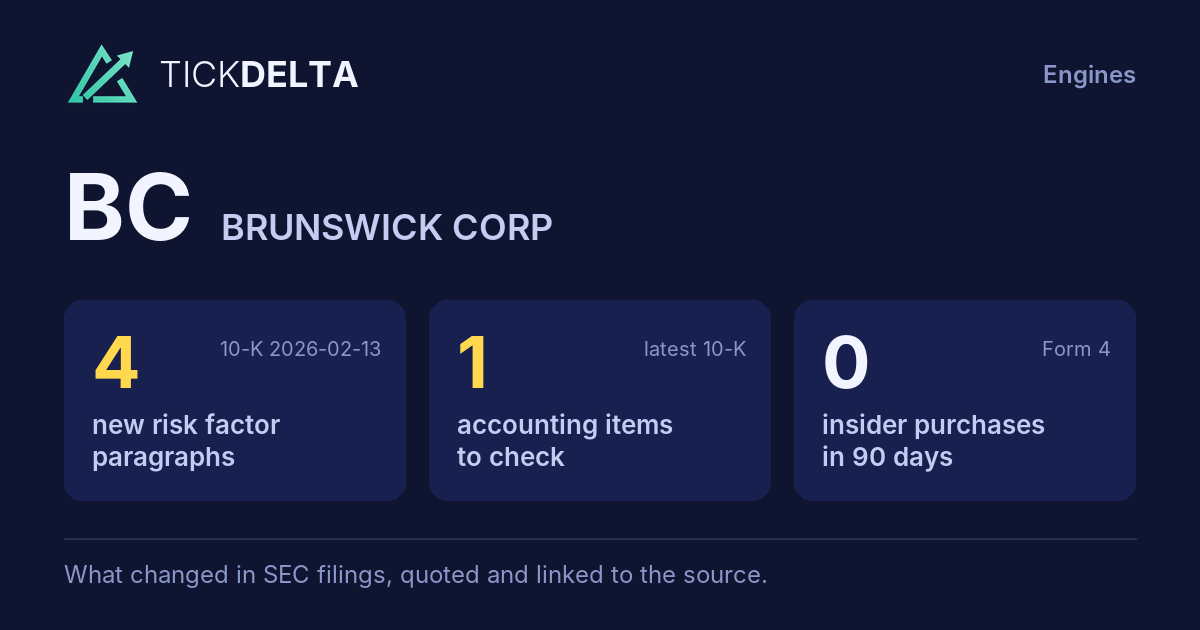
All our businesses are affected by global trade policy. We have been, and continue to be, subject to meaningful tariffs, such as China Section 301 investigation tariffs, Section 232 tariffs on steel and aluminum, and recent tariffs imposed under the International Emergency Economic Powers Act. U.S. trade actions have also prompted retaliatory measures by other countries, including tariffs on U.S.‑origin goods, which can reduce the competitiveness of our products in certain international markets. There may be no opportunity for exclusions from such tariffs, or we may not be granted exclusions. In addition to having to pay the tariffs, the volatile trade policy environment may lead to declining consumer confidence, inflation, lower economic expectations, and ultimately reduced demand for our products and services. This may result in a material adverse effect on our business, financial condition and results of operations as well as future asset impairments.
Read it in 10-K Feb 13, 2026 at sec.gov
AddedRisk Factors
While we continue to attempt to mitigate or avoid some of these increased costs and disruptions, our ability to do so may be limited by operational and supply chain constraints, especially in the short term. In addition, our ability to recover cost increases through price adjustments may be limited by competitive pressures, customer acceptance, and contractual limitations. As a result, these changes could have a material adverse effect on our business, financial condition, and results of operations.
Read it in 10-K Feb 13, 2026 at sec.gov
AddedRisk Factors
Over the past several years, we have made decisions to close certain manufacturing and distribution facilities while also choosing to make strategic capital investments in other facilities to enhance efficiency and support long-term growth. For example, in 2025, we announced the decision to close our Reynosa, Mexico facility, transitioning production to two high-performing U.S.-based manufacturing centers, as well as the Flagler Beach, Florida facility, consolidating production in our Edgewater, Florida operations. While these moves are designed to reduce fixed
Read it in 10-K Feb 13, 2026 at sec.gov
RemovedRisk Factors
Changes in laws and policies governing trade could adversely affect our business and trigger retaliatory actions by affected countries. We continue to be subject to meaningful tariffs, such as China Section 301 investigation tariffs, and there is no assurance that we will be granted exclusions in the future. In addition, given the new administration's orders and policies yet to be determined, we will likely be subject to significant additional future tariffs related to goods from China, Mexico, Canada, or other jurisdictions, for which there may be no available exclusions, or for which we are not granted exclusions. Like many other multinational corporations, we do a significant amount of business that would be affected by changes to the trade policies of the U.S. and foreign countries (including governmental action related to tariffs and international trade agreements). Such changes have the potential to adversely impact the U.S. economy, our industry, our suppliers, and global demand for our products and, as a result, could have a material adverse effect on our business, financial condition, and results of operations.
Read it in 10-K Feb 14, 2025 at sec.gov
RemovedRisk Factors
Although we have remained focused on our strategic priorities, our businesses may experience difficulty in meeting demand, particularly in rapidly changing economic conditions. We may not be able to recruit or retain sufficient skilled labor or our suppliers may not be able to deliver sufficient quantities of parts and components for us to match production with forecasted demand. Competitors may adopt new technologies and technological advancements, such as using artificial intelligence and machine learning to pursue new products, services, and approaches more quickly, successfully and effectively. Consumers may purchase from competitors or pursue other recreational activities if our products are not readily available, or our fixed costs may grow, all of which could adversely impact our results of operations.
Read it in 10-K Feb 14, 2025 at sec.gov
RewordedRisk Factors
Substantial increases in the prices of raw materials, parts, and components would increase our operating costs, and could reduce our profitability if we are unable to recoup the increased costs through higher product prices or improved operating efficiencies.
Read it in 10-K Feb 13, 2026 at sec.gov
Show the other 29
RewordedRisk Factors
Although we have implemented plans to comply with these laws, GDPR, CCPA, privacy authorities and private litigants are active in pursuing investigations and litigation, and these and future laws and regulations could impose even greater compliance burdens and risks with respect to privacy and data security than prior laws. security.
Read it in 10-K Feb 13, 2026 at sec.gov
RewordedRisk Factors
While we do not believe the IRA will have a material negative impact on our business, it It is possible that future interpretations or additional tax law changes could have a material impact on the Company’s our tax rate.
Read it in 10-K Feb 13, 2026 at sec.gov
RewordedRisk Factors
If credit conditions worsen worsen, become unavailable to customers, or if interest rates remain elevated and adversely affect the ability of customers to finance potential purchases at acceptable terms and interest rates, rates or at all, it could result in a decrease in sales or delay improvement in sales.
Read it in 10-K Feb 13, 2026 at sec.gov
RewordedRisk Factors
If demand for recreational boats declines with a weakening economy, if demand for our products declines declines, or if new product introductions are expected to replace existing products, our dealers, retailers, and other distributors could decide to reduce the number of units they hold.
Read it in 10-K Feb 13, 2026 at sec.gov
RewordedRisk Factors
Changes in U.S. policy regarding domestic or foreign trade trade, manufacturing, or manufacturing other policies may create negative sentiment about the U.S. among non-U.S. customers, employees, or prospective employees, which could adversely affect our business, sales, hiring, and employee retention.
Read it in 10-K Feb 13, 2026 at sec.gov
RewordedRisk Factors
Our ability to continue generating strong cash flow and profits depends partly on the sustained successful execution of our strategic plan and growth initiatives, including optimizing our business and product portfolio, continuing to successfully integrate acquisitions, and improving operating efficiency, and expanding into new adjacent markets. efficiency.
Read it in 10-K Feb 13, 2026 at sec.gov
RewordedRisk Factors
If our security measures are breached or fail, unauthorized persons may be able to obtain access to or acquire personal or other confidential data. data and/or disrupt our IT and OT systems.
Read it in 10-K Feb 13, 2026 at sec.gov
RewordedRisk Factors
The EU (through the GDPR) GDPR), all fifty U.S. states, and a growing number of legislative and regulatory bodies elsewhere in the world have adopted consumer data breach notification requirements in the event of unauthorized access to or acquisition of certain types of personal information.
Read it in 10-K Feb 13, 2026 at sec.gov
RewordedRisk Factors
As of December 31, 2024, 2025, the balance of total goodwill and indefinite lived intangible assets for the enterprise was $1,270.3 $976.4 million, which represents approximately 22 18 percent of total assets.
Read it in 10-K Feb 13, 2026 at sec.gov
Quiet changesRisk Factors
In addition, these events could result in future significant volatility in demand, positively or negatively, for one or more of our products and have a negative effect on our business, financial condition, and results of operations.
Read it in 10-K Feb 13, 2026 at sec.gov
AddedMD&A
Sales in 2025 increased compared to the prior year resulting from improved second-half market conditions and resulting stronger wholesale orders together with strong P&A and after market performance that helped overcome the impacts of the challenging first-half retail environment. Refer to the Propulsion, Engine P&A, Navico Group and Boat segments for further details on the drivers of net sales changes.
Read it in 10-K Feb 13, 2026 at sec.gov
RemovedMD&A
Sales in 2024 were below the prior year as the impact of lower wholesale ordering patterns by dealers, OEMs and retailers, coupled with higher discounts in select segments, and unfavorable changes in foreign currency exchange rates, were only partially offset by annual price increases and well received new products. Refer to the Propulsion, Engine P&A, Navico Group and Boat segments for further details on the drivers of net sales changes.
Read it in 10-K Feb 14, 2025 at sec.gov
RemovedMD&A
Engine P&A segment's operating earnings increased versus the prior year, as the impact of the operational efficiencies resulting from the completed transition to the Brownsburg, Indiana distribution center, annual pricing, and lower operating expenses more than offset lower volumes and higher material inflation.
Read it in 10-K Feb 14, 2025 at sec.gov
RemovedMD&A
Boat segment's net sales decreased in 2024 versus the prior year resulting from lower wholesale orders, as dealers continue to manage pipeline levels, along with higher levels of selective discounting, partially offset by the favorable impact of modest model-year pricing.
Read it in 10-K Feb 14, 2025 at sec.gov
RewordedMD&A
Operating (loss) Earnings Diluted (Loss) Earnings Per Share (in millions, except per share data) 2025 2024 2023 2025 2024 2023 GAAP $ (40.7) $ 311.6 $ 734.9 (2.06) $ 2.21 $ 6.13 Restructuring, exit and impairment charges 353.1 121.7 54.7 5.03 1.41 0.61 Purchase accounting amortization 58.6 58.5 57.5 0.84 0.68 0.64 Acquisition, integration, and IT related costs 0.1 3.6 12.1 — 0.04 0.14 IT security incident costs — 10.1 — 0.12 Special tax items (A) — — (0.48) 0.19 0.95 Loss (Gain) loss on early extinguishment of debt — — (0.06) 0.15 — Release of dissolved entity foreign currency translation — — — 0.01 — TN-BC Holdings LLC joint venture impairment — — — 0.21 Gain on sale of business — — — (0.12) — As Adjusted $ 371.1 $ 495.4 $ 869.3 3.27 $ 4.57 $ 8.80 GAAP operating margin (0.8) % 5.9 % 11.5 % Adjusted operating margin 6.9 % 9.5 % 13.6 %
Read it in 10-K Feb 13, 2026 at sec.gov
RewordedMD&A
Selling, general and administrative expenses as a percentage of net sales increased 160 basis points during 2024 2025 when compared with the same prior year period, primarily due to lower sales (280 the reinstatement of variable compensation (194 bps), which was partially offset by cost control measures across the enterprise, including lower employee compensation costs associated with headcount reductions and lower variable compensation (120 higher sales (34 bps).
Read it in 10-K Feb 13, 2026 at sec.gov
RewordedMD&A
Net cash used for investing activities was $168.9 $141.6 million, which included $167.4 $165.8 million of capital expenditures, $80.9 million of purchases of marketable securities and $31.8 million of cash paid for acquisitions, net of cash acquired, partially offset by $82.1 million of sales or maturities of marketable securities and $15.0 $12.6 million of proceeds from sales of property, plant and equipment.
Read it in 10-K Feb 13, 2026 at sec.gov
RewordedMD&A
Navico Group segment's operating earnings decreased loss increased versus the prior year primarily due to the impact of non-cash, intangible asset impairment charges and along with the impact from lower sales, partially offset by cost control measures. of tariffs and reinstatement of variable compensation.
Read it in 10-K Feb 13, 2026 at sec.gov
RewordedMD&A
Net cash used for financing activities was $442.7 $441.2 million, which included $613.2 $412.6 million of payments of long-term debt including current maturities, $200.0 $80.0 million of common stock repurchases, $112.3 $112.6 million of cash dividends paid to common shareholders, and $87.4 million of payments of short-term debt, partially offset by $396.9 million of proceeds from issuances of long-term debt and $201.1 $173.1 million of proceeds from issuances of short-term debt.
Read it in 10-K Feb 13, 2026 at sec.gov
RewordedMD&A
Propulsion segment's operating earnings decreased versus the prior year, primarily due to the impact of lower incremental tariffs and reinstatement of variable compensation slightly offset by increased sales and lower absorption from declines in production, partially offset by cost control measures. higher absorption.
Read it in 10-K Feb 13, 2026 at sec.gov
RewordedMD&A
Boat segment operating earnings decreased versus the prior year due to the lower volume, impact of the net sales declines tariffs, and lower absorption from reduced production, partially offset by pricing and cost control measures. reinstatement of variable compensation.
Read it in 10-K Feb 13, 2026 at sec.gov
RewordedMD&A
Corporate operating loss decreased increased compared with 2023 2024 driven by lower higher variable compensation costs along with the impact of both the IT security incident and slightly offset by lower restructuring charges in the compared to prior year.
Read it in 10-K Feb 13, 2026 at sec.gov
RewordedMD&A
(A) Special tax items during the year ended December 31, 2024 2025 primarily relate relates to the discrete income tax expense recorded benefit associated with an increase in the state valuation allowance. goodwill impairment and 2024 tax return to provision adjustments.
Read it in 10-K Feb 13, 2026 at sec.gov
RewordedMD&A
We recognized Equity earnings (loss) of $7.0 million and $8.6 million in 2025 and $(11.4) million in 2024 2024, respectively, which were mainly related to our marine and 2023, respectively. technology-related joint ventures.
Read it in 10-K Feb 13, 2026 at sec.gov
RewordedMD&A
Net interest expense increased decreased in 2024 2025 compared with 2023 2024 due to an increase a decrease in average daily debt outstanding, which was influenced driven by the timing early extinguishment of debt issuances. debt.
Read it in 10-K Feb 13, 2026 at sec.gov

Sources

The two latest 10-Ks on EDGAR, section by section. Each change links to the text at sec.gov.

Also

New risk factors: paragraphs with nothing like them last year, quoted in full.

Work with it

Excel workbook · CSV. Google Sheet that stays up to date: paste =IMPORTDATA("https://tickdelta.com/company/BC/export.csv") into a cell.

Next:Related parties
Esc

Type a ticker such as AAPL, a name, an investor such as Buffett, or a topic such as tariffs. ↑ ↓ to move, Enter to open.