Screener / SEC EDGAR /CIK 0000913142 /10-K filed Feb 17, 2026, compared with Feb 13, 2025 /Numbers from the XBRL of the 10-Ks
NYSE Materials · Wire & Cable

Belden Inc. BDC

Compare with peers Embed
The 10-K against last year's

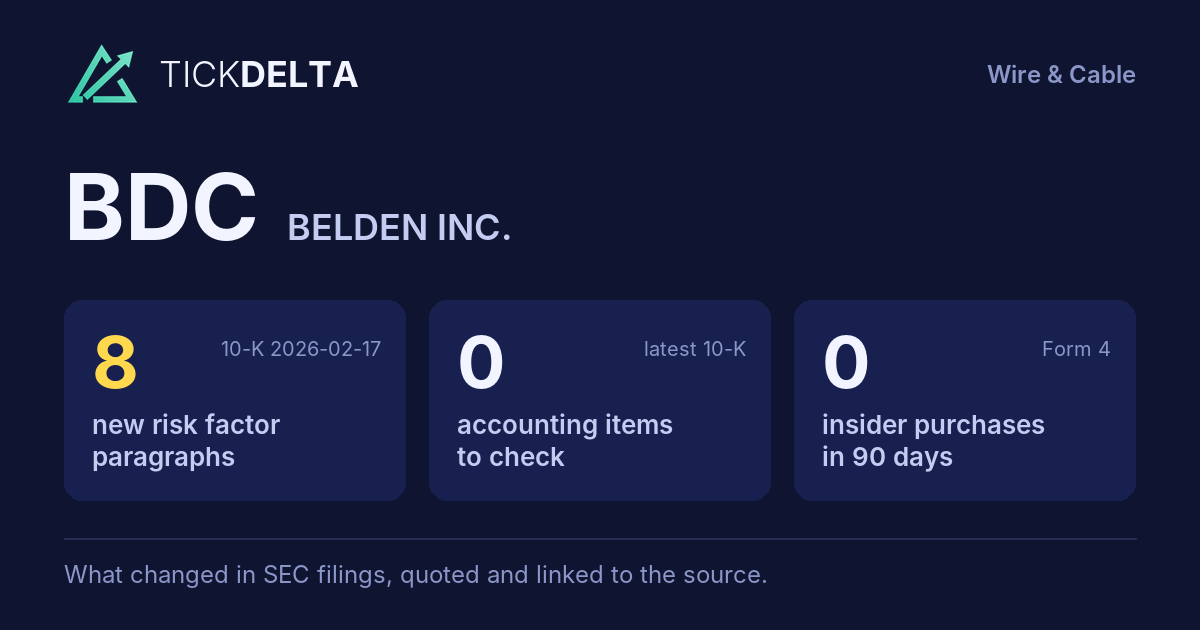
54 changes: 8 added, 14 removed, 32 reworded

10-K Feb 17, 2026 vs Feb 13, 2025

10-K 0000913142-26-000009 (Feb 17, 2026) vs 10-K 0000913142-25-000005 (Feb 13, 2025) Not compared: Legal Proceedings.

Every paragraph, and how much of it changed

One bar per paragraph, in the order of the 10-K. Height and colour show the share of its words not in the closest paragraph a year earlier; the tallest bars are new paragraphs.

Risk Factors

78 paragraphs · 8 new · 19 reworded · 9 gone · 10-K Feb 17, 2026 against Feb 13, 2025
New paragraph Reworded (5% of its words or more) Same or nearly
Paragraph 50 · 39% changed Every version of it
Copper is a significant component of the cost of most of our cable products. Historically, the prices of metals, particularly copper, have been volatile. Prices of other materials we use, such as PVC and other plastics derived from petrochemical feedstocks, have also been volatile. Generally, we have recovered much of the higher cost of raw materials through higher pricing of our finished products. The majority of our products are sold through distribution, and we manage the pricing of these products through published price lists which we update from time to time, with new prices typically taking effect a few weeks after they are announced. Some OEM contracts have provisions for passing through raw material cost changes, generally with a lag of a few weeks to three months. Especially during periods of inflation, if we are unable to raise prices timely and sufficiently to recover our material costs or increases in the cost of internal or external labor, our earnings and margins could decline. If we raise our prices but competitors raise their prices less, we may lose sales, and our earnings could decline. If the price of copper were to decline, we may be compelled to reduce prices to remain competitive, which could have a negative effect on revenues. While we generally believe the supply of raw materials (copper, plastics, and other materials) is adequate, we have experienced instances of limited supply of certain raw materials, resulting in extended lead times and higher prices. If a supply interruption or shortage of materials were to occur (including due to labor or political disputes), this could have a negative effect on revenues and earnings.
Paragraph 11 · 29% changed Every version of it
In addition to manufacturing and other operating facilities in the U.S., we have manufacturing and other operating facilities in Canada, China, India, Mexico, Tunisia and several European countries. We rely on suppliers in many countries, including China. Our foreign operations are subject to economic, social, and political risks inherent in maintaining operations abroad such as economic and political destabilization, land use risks, international conflicts, pandemics and other health-related crises, restrictive actions by foreign governments, and adverse foreign tax laws. In addition to economic and political risk, a risk associated with our European manufacturing operations is the higher relative expense and length of time required to adjust manufacturing employment capacity. We also face political risks in the U.S., including tax or regulatory risks or potential adverse impacts from legislative impasses over, impasses, or significant legislative, regulatory or executive changes in fiscal or monetary policy and other foreign and domestic government policies, including, but not limited to, trade policies and import/export policies.
Paragraph 10 · 26% changed Every version of it
In addition to manufacturing and other operating facilities in the U.S., we have manufacturing and other operating facilities in Canada, China, India, Mexico, Tunisia and several European countries. We rely on suppliers in many countries, including China. Our foreign operations are subject to economic, social, and political risks inherent in maintaining operations abroad such as economic and political destabilization, land use risks, international conflicts, pandemics and other health-related crises, restrictive actions by foreign governments, and adverse foreign tax laws. In addition to economic and political risk, a risk associated with our European manufacturing operations is the higher relative expense and length of time required to adjust manufacturing employment capacity. We also face political risks in the U.S., including tax or regulatory risks or potential adverse impacts from legislative impasses over, or significant legislative, regulatory or executive changes in fiscal or monetary policy and other foreign and domestic government policies, including, but not limited to, trade policies and import/export policies.
Paragraph 5 · 25% changed Every version of it
In February Throughout 2025, the United States government issued orders increasing tariffs on imports from certain countries, including Canada, China and Mexico nearly every country in the world on certain products, including steel products. In some cases, this has led to negotiations of new trade deals and aluminum, and in others, it has discussed increasing tariffs globally, which is likely to lead to resulted in reciprocal tariffs on U.S. exports to those countries. Implementation of orders related to Canada and Mexico was initially deferred until March 2025. exports. Because not all goods can be sourced in all countries, global companies like Belden will experience increased costs in their supply chains that may lead to reduced margins or increased prices. These increased costs and the uncertainty during transition periods could lead to changes in buying behavior, such as decreased demand. These impacts could have a negative effect on our financial results, including our revenue revenue, gross margins, and profitability.
Paragraph 51 · 16% changed Every version of it
Copper is a significant component of the cost of most of our cable products. Historically, the prices of metals, particularly copper, have been volatile. Prices of other materials we use, such as PVC and other plastics derived from petrochemical feedstocks, have also been volatile. Generally, we have recovered much of the higher cost of raw materials through higher pricing of our finished products. The majority of our products are sold through distribution, and we manage the pricing of these products through published price lists which we update from time to time, with new prices typically taking effect a few weeks after they are announced. Some OEM contracts have provisions for passing through raw material cost changes, generally with a lag of a few weeks to three months. Especially during periods of inflation, if we are unable to raise prices timely and sufficiently to recover our material costs or increases in the cost of internal or external labor, our earnings and margins could decline. If we raise our prices but competitors raise their prices less, we may lose sales, and our earnings could decline. If the price of copper were to decline, we may be compelled to reduce prices to remain competitive, which could have a negative effect on revenues. While we generally believe the supply of raw materials (copper, plastics, and other materials) is adequate, we have experienced instances of limited supply of certain raw materials, resulting in extended lead times and higher prices. If a supply interruption or shortage of materials were to occur (including due to labor or political disputes), this could have a negative effect on revenues and earnings.
Paragraph 68 · 14% changed Every version of it
Increasing expectations with respect to Environmental, Social and Governance (ESG) Sustainability matters by our various stakeholders and ESG Sustainability regulation could adversely affect our business and operating results.
Paragraph 27 · 9% changed Every version of it
Changes in foreign currency rates and commodity prices can impact the buying power of our customers. For example, a strengthened U.S. dollar can result in relative price increases for our products for customers outside of the U.S., which can have a negative impact on our revenues and results of operations. Furthermore, customers’ ability to invest in capital expenditures, such as our products, can depend upon proceeds be dependent on their realized profits from commodities, their sales of commodity products, such as occurs in the oil and gas markets. A decline in energy prices, therefore, can have a negative impact on our revenues and results of operations.
Paragraph 40 · 9% changed Every version of it
The inability to attract employees with AI and digital skills, engineers with relevant skills, or the loss of key current employees could have an adverse effect on us. We may not be able to find qualified replacements for these individuals and the integration of potential replacements may be disruptive to our business. More broadly, a key determinant of our success is our ability to attract, develop, and retain talented associates. While this is one of our strategic priorities, we may not be able to succeed in this regard.

MD&A

78 paragraphs · 0 new · 27 reworded · 5 gone · 10-K Feb 17, 2026 against Feb 13, 2025
New paragraph Reworded (5% of its words or more) Same or nearly
Paragraph 48 · 47% changed
Years Ended December 31, 2024 2023 (In thousands) Net cash provided by (used for): Operating activities $ 352,076 $ 319,638 Investing activities (426,755) (200,358) Financing activities (143,718) (211,932) Effects of currency exchange rate changes on cash and cash equivalents 10,730 (8,345) 2,020 Net decrease in cash and cash equivalents (226,742) (90,632) Cash and cash equivalents, beginning of year 597,044 687,676 Cash and cash equivalents, end of year $ 370,302 $ 597,044
Paragraph 49 · 42% changed
Net cash provided by operating activities totaled $354.9 million for 2025 compared to $352.1 million for 2024 compared to $319.6 million for 2023. 2024. The increase is primarily due to a $44.7 million improvement the increase in earnings, partially offset by unfavorable changes in operating assets and liabilities that was primarily driven by favorable changes liabilities. Receivables and inventories were both uses of cash in inventory. Inventory turns improved to 4.9 turns by the end of 2024 2025 compared to 3.8 turns by sources of cash in 2024, primarily due to the end of 2023. We calculate inventory turns by dividing annualized cost of sales for the quarter by the inventory balance at the end of the quarter. increase in revenues in 2025.
Paragraph 17 · 37% changed
Selling, Operating income increased $49.2 million from 2024 to 2025 primarily due to the increase in gross profit, partially offset by the increases in selling, general and administrative expenses increased $1.9 million from 2023 to 2024 primarily due to and research and development expenses from the operations of companies acquired in 2024, partially offset by the benefits realized from our productivity initiatives. See Note 15. discussed above.
Paragraph 16 · 33% changed
Amortization of intangibles increased $8.4 $4.6 million from 2023 2024 to 2024 2025 primarily due to acquisitions. acquisitions, partially offset by certain intangible assets becoming fully amortized.
Paragraph 43 · 33% changed
Automation Solutions revenues decreased $72.1 increased $178.6 million in 2024 2025 as compared to 2023 2024 primarily due to decreases increases in volume and unfavorable currency translation of $80.4 million and $9.0 million, respectively, partially offset by volume, higher copper pass-through prices prices, favorable currency translation, and acquisitions, net acquisitions of disposals of $16.9 $139.1 million, $27.6 million, $10.8 million and $0.4 $1.1 million, respectively.
Paragraph 39 · 31% changed
Smart Infrastructure Solutions revenues increased $21.0 $75.6 million in 2024 2025 as compared to 2023. Revenues 2024. The increase was due to revenues from acquisitions and acquisitions, increases in volume, higher copper pass-through pricing contributed $72.1 million pricing, and $10.7 million, respectively, to the increases in revenues, partially offset by a decline in volume of $60.7 million and unfavorable favorable currency translation of $1.1 million. $49.1 million, $15.0 million, $9.1 million, and $2.4 million, respectively.
Paragraph 36 · 31% changed
Adjusted EBITDA decreased $27.3 increased $48.0 million in 2025 from 2024 from 2023 primarily due to the decline increase in revenues as discussed above, above and favorable mix, partially offset by favorable mix and benefits realized from our productivity improvement initiatives. an increase in strategic investments.
Paragraph 40 · 30% changed
Smart Infrastructure Solutions EBITDA decreased $12.4 increased $7.9 million in 2023 2025 as compared to 2022 2024 primarily due to the decreases changes in revenues discussed above. above and favorable mix, partially offset by strategic investments.

A paragraph is matched with the one last year that shares the most of its words; under half in common makes it new. The paragraphs shown are the 8 reworded the most in each section.

The paragraph that changed most in each section

The redline

Marked against last year's 10-K: cut words struck through, new words highlighted.

Risk Factors237 words changed in this paragraph; it is 30% similar to last year's version.
As a response to growing customer, investor, employee, governmental, and other stakeholder interest in our sustainability practices, we have increased reporting of our sustainability programs and performance and have established and announced our aspirational goals or targets, including those regarding greenhouse gas emissions and other factors. Our ability to achieve such goals and aspirations is subject to numerous risks and uncertainties, many of which rely on the collective efforts of others or may be outside of our control. Such risks include, among others, the availability and adoption of new or additional technologies that reduce carbon or eliminate energy sources on a commercially reasonable basis, competing and evolving economic, policy and regulatory factors, the availability of qualified candidates in our labor markets and our ability to recruit and retain key talent, and customer engagement in our goals. There may be times where actual outcomes vary from those aimed for or expected and sometimes challenges may delay or block progress. As a result, we cannot offer assurances that the results reflected or implied by any such statements will be realized or achieved. Moreover, standards and expectations for ESG matters continue to evolve and may be subject to varying interpretations, which may result in significant revisions to our goals or progress. A failure or perceived failure to meet our aspirational goals or targets within the timelines we announce, or at all, or a failure or perceived failure to meet evolving stakeholders expectations and standards, could damage our reputation, adversely affect employee retention or engagement or support from our various stakeholders and could subject us to government enforcement actions or penalties and private litigation. Such outcomes could negatively impact the Company’s business, capital expenditures, results of operations, financial condition and competitive position.

Source: Item 1A, 10-K 0000913142-26-000009 vs Item 1A, 10-K 0000913142-25-000005

MD&A133 words changed in this paragraph; it is 49% similar to last year's version.
Net cash flows used for financing activities totaled $217.8 million for 2025 compared to $143.7 million for 2024 compared 2024. Financing activities for 2025 included $195.6 million of payments under our share repurchase program, including excise tax; $50.0 million of payments on our revolving credit facility; $20.8 million of payments related to $211.9 share based compensation activities; $8.0 million for 2023. of cash dividend payments; $3.2 million of debt issuance cost payments; and $1.8 million of financing lease payments; partially offset by $50.0 million and $11.6 million of borrowings on our revolving credit facility and proceeds from the issuance of common stock under our Employee Stock Purchase Plan, respectively. Financing activities for 2024 included payments under our share repurchase program of $134.3 million, payments related to share based compensation activities of $9.7 million, cash dividend payments of $8.2 million, financing lease payments of $1.1 million, and proceeds from the issuance of common stock of $8.9 million. Financing activities for 2023 included payments under our share repurchase program of $192.1 million, payments related to share based compensation activities of $17.4 million, cash dividend payments of $8.5 million, financing lease payments of $0.4 million, and proceeds from the issuance of common stock of $6.5 million.

Source: Item 7, 10-K 0000913142-26-000009 vs Item 7, 10-K 0000913142-25-000005

Accounting Policies34 words changed in this paragraph; it is 93% similar to last year's version.
At the time of sale, we establish an estimated reserve for trade, promotion, and other special price reductions such as contract pricing, discounts to meet competitor pricing, and on-time payment discounts. We also adjust receivable balances for, among other things, correction of billing errors, incorrect shipments, and settlement of customer disputes. Customers are allowed to return inventory if and when certain conditions regarding the physical state of the inventory and our approval of the return are met. Certain distribution customers are allowed to return inventory at original cost, in an amount not to exceed three percent of the prior year’s purchases, in exchange for an order of equal or greater value. Until we can process these reductions, corrections, and returns (together, the Changes) through individual customer records, we estimate the amount of outstanding Changes and recognize them by reducing revenues. We base these estimates on historical and anticipated sales demand, trends in product pricing, and historical and anticipated Changes patterns. We make revisions to these estimates in the period in which the facts that give rise to each revision become known. Future market conditions might require us to take actions to further reduce prices and increase customer return authorizations. Unprocessed Changes recognized against our gross accounts receivable, such as price reductions, at December 31, 2025 and 2024 and 2023 totaled $29.1 $33.3 million and $26.0 $29.1 million, respectively. Unprocessed Changes recognized as accrued liabilities, such as product returns, at December 31, 2025 and 2024 and 2023 totaled $16.0 $11.9 million and $15.6 $16.0 million, respectively.

Source: Item 8, Note 2 – Summary of Significant Accounting Policies, 10-K 0000913142-26-000009 vs Item 8, Note 2 – Summary of Significant Accounting Policies, 10-K 0000913142-25-000005

Sentences and paragraphs added, removed or reworded

Every change, by type

Sentences and paragraphs of BDC's Risk Factors and MD&A, 10-K Feb 17, 2026 against 10-K Feb 13, 2025. Each links to the text at sec.gov.

Quiet changes are sentences kept from last year with one to four words changed, at least one of them a hedge, a modal or a qualifier (may, could, will, not, significant, material…). A year or date rolling forward is not counted.

The full word list

adverse, adversely, all, although, anticipate, anticipates, any, approximately, believe, believes, can, cannot, certain, could, expect, expects, generally, however, if, intend, intends, largely, likely, many, material, materially, may, might, most, must, never, no, not, possible, primarily, probable, should, significant, significantly, some, substantial, substantially, unlikely, will, would

AddedRisk Factors
We are increasingly incorporating AI and machine learning technologies into our products, services, and internal operations. While we believe AI offers significant opportunities, its development and deployment involve inherent risks that could materially impact our business. These risks include, but are not limited to (1) operational and performance risks related to the quality of data and sophistication of the algorithms; (2) the evolving legal and regulatory landscape; (3) ethical and reputational risk associated with biased or inaccurate results; (4) cybersecurity and data privacy risk; (5) intellectual property risk; (6) risks related to attracting and retaining AI talent; (7) dependence on third-party AI providers; and (8) speed and quality of adoption.
Read it in 10-K Feb 17, 2026 at sec.gov
AddedRisk Factors
Our reliance on legacy information technology systems and the challenges associated with their maintenance and upgrade could adversely affect our business, financial condition, and results of operations.
Read it in 10-K Feb 17, 2026 at sec.gov
AddedRisk Factors
We rely on a variety of information technology (IT) systems and infrastructure to support our operations, including critical business processes, data management, and customer-facing applications. Some of these systems are legacy technologies that have been in place for a significant period. While we strive to maintain and update our IT infrastructure, our reliance on these legacy systems presents several risks, including performance and reliability issues, security vulnerabilities, integration challenges, increased maintenance costs, and compliance risks.
Read it in 10-K Feb 17, 2026 at sec.gov
AddedRisk Factors
We may undertake significant IT infrastructure upgrade and modernization projects to address these challenges. Such projects, however, involve substantial risks, including significant capital expenditure and resource allocation, disruption to operations, implementation and integration challenges, data loss or corruption, and failure to achieve anticipated benefits.
Read it in 10-K Feb 17, 2026 at sec.gov
AddedRisk Factors
As a response to growing customer, investor, employee, governmental, and other stakeholder interest in our sustainability practices, we have increased reporting of our sustainability programs and performance and have established and announced our aspirational goals or targets, including those regarding greenhouse gas emissions and other factors. Our ability to achieve such
Read it in 10-K Feb 17, 2026 at sec.gov
Show the other 35
RemovedRisk Factors
Furthermore, we rely on our information systems and those of third parties that maintain proprietary company information about our products and intellectual property, as well as for processing customer orders, manufacturing and shipping products, billing our customers, tracking inventory, supporting accounting functions and financial statement preparation, paying our employees, and otherwise running our business. In addition, we may need to enhance our information systems to provide additional capabilities and functionality. The implementation of new information systems and enhancements is frequently disruptive to the underlying business of an enterprise. Any disruptions affecting our ability to accurately report our financial performance on a timely basis could adversely affect our business in a number of respects.
Read it in 10-K Feb 13, 2025 at sec.gov
RemovedRisk Factors
Fiber optic and wireless systems are increasingly substitutable for copper-based cable systems. Customers may shift demand to systems with greater capabilities than copper-based cable systems, leading to a reduction in demand for copper-based cable. We may not be able to offset the effects of a reduction in demand for our copper-based cable systems. Similarly, in our non-cable businesses, customers could rapidly shift the methods by which they capture and transmit signals in ways that could lead to decreased demand for our current or future products. These factors, either together or in isolation, may negatively impact revenue and profitability.
Read it in 10-K Feb 13, 2025 at sec.gov
RemovedRisk Factors
The nature in which many of our products are purchased or used is evolving with the increasing prevalence of cloud computing and other methods of off-premises computing and data storage. This may negatively impact one or more of our businesses in a number of ways, including:
Read it in 10-K Feb 13, 2025 at sec.gov
RewordedRisk Factors
While the impact of the U.S. and Chinese tariff actions prior to 2025 have not been material to us, unanticipated Unanticipated complications in the free movement of goods in North America or Europe, an escalation of tariff activity anywhere in the world, or changes to existing free trade agreements, especially the United States-Mexico-Canada Agreement (USMCA), could materially impact our financial results.
Read it in 10-K Feb 17, 2026 at sec.gov
RewordedRisk Factors
Furthermore, customers’ ability to invest in capital expenditures, such as our products, can depend upon proceeds be dependent on their realized profits from commodities, their sales of commodity products, such as occurs in the oil and gas markets.
Read it in 10-K Feb 17, 2026 at sec.gov
RewordedRisk Factors
Our markets are characterized by the introduction of products with increasing technological capabilities. capabilities, most notable currently is an expectation that AI capabilities will be deployed.
Read it in 10-K Feb 17, 2026 at sec.gov
RewordedRisk Factors
Computer hacking, malware, phishing, and spamming attacks against online networking platforms have become more prevalent. prevalent, more recently enhanced by the use of artificial intelligence (“AI”) tools.
Read it in 10-K Feb 17, 2026 at sec.gov
RewordedRisk Factors
Our largest distributor accounted for approximately 14% of our revenue revenues in 2024 2025 and our top eight distributors accounted for a total of 33% 35% of our revenue revenues in 2024. 2025.
Read it in 10-K Feb 17, 2026 at sec.gov
RewordedRisk Factors
Variability in the mix and profitability of domestic and international activities, identification and resolution of various tax uncertainties, changes in tax laws and rates, such as the One Big Beautiful Bill Act, and the extent to which we are able to realize net operating loss and other carryforwards included in deferred tax assets and avoid potential adverse outcomes included in deferred tax liabilities, among other matters, may significantly affect our effective income tax rate in the future.
Read it in 10-K Feb 17, 2026 at sec.gov
RewordedRisk Factors
Increasing expectations with respect to Environmental, Social and Governance (ESG) Sustainability matters by our various stakeholders and ESG Sustainability regulation could adversely affect our business and operating results.
Read it in 10-K Feb 17, 2026 at sec.gov
RewordedRisk Factors
Our customers use our signal transmission data solutions in a wide variety of IT and OT systems and application environments in order to help reduce security vulnerabilities and demonstrate compliance.
Read it in 10-K Feb 17, 2026 at sec.gov
RemovedMD&A
During 2024, we acquired Precision for $289.6 million, net of cash acquired. Precision, based in New York, is a leading supplier of value-added optical transceivers with proprietary software, firmware configurations, and related components. Precision is reported within the Smart Infrastructure Solutions segment. See Note 4.
Read it in 10-K Feb 13, 2025 at sec.gov
RemovedMD&A
During 2024, we acquired Voleatech for €5.0 million ($5.6 million), net of cash acquired. The acquisition includes a potential earn-out up to €3.0 million based upon certain targets over three years, which will be accounted for as compensation cost. Voleatech, based in Germany, is known for their VT AIR Next Gen Firewall and expands Belden's Firewall product portfolio and overall planning of security in OT networking. Voleatech is reported within the Automation Solutions segment. See Note 4.
Read it in 10-K Feb 13, 2025 at sec.gov
RemovedMD&A
Loss on debt extinguishment decreased $6.4 million from 2022 to 2023 due to the debt refinancing that took place during 2022. The loss on debt extinguishment in 2022 represents the premium paid to the bond holders to retire the 2026 Notes and for the unamortized debt issuance costs on the 2026 Notes that we were required to write-off. See Note 16.
Read it in 10-K Feb 13, 2025 at sec.gov
RemovedMD&A
In December 2023, the FASB issued ASU 2023-09, Income Taxes (Topic 740) Improvements to Income Tax Disclosures (ASU 2023-09) enhancing the transparency and decision usefulness of income tax disclosures. ASU 2023-09 addresses investor requests for more transparency about income tax information through improvements to income tax disclosures primarily related to the rate reconciliation and income taxes paid information. ASU 2023-09 is effective for annual periods beginning after December 15, 2024, with early adoption permitted. The amendments in ASU 2023-09 are applied on a prospective basis, though retrospective application is permitted. We did not early adopt this pronouncement and are in the process of evaluating its impact on our consolidated financial statements and related disclosures. See Note 18, Income Taxes, to the consolidated financial statements for further information regarding income taxes.
Read it in 10-K Feb 13, 2025 at sec.gov
RewordedMD&A
Years Ended December 31, 2025 2024 2023 2022 (In thousands, except percentages) Revenues $ 2,715,194 $ 2,460,979 $ 2,512,084 GAAP net income $ 2,606,485 GAAP income from continuing operations 237,522 $ 198,414 $ 242,556 $ 267,748 Depreciation expense 63,784 56,383 51,379 46,669 Amortization of intangibles 53,356 48,794 40,375 37,860 Interest expense, net 46,355 38,303 33,625 43,554 Income tax expense 29,344 29,528 43,200 49,645 Severance, restructuring, and acquisition integration costs (1) 14,967 22,814 25,152 16,685 Amortization of software development intangible assets 12,293 10,564 7,692 3,875 Adjustments related to acquisitions and divestitures (2) 1,037 4,764 6,177 7,833 Loss related to revolver refinancing 76 — — Non-operating pension settlement loss — 1,208 — 1,189 Loss on debt extinguishment — — 6,392 Gain on sale of assets(3) — — (12,056) (37,891) Adjusted EBITDA $ 458,734 $ 410,772 $ 438,100 $ 443,559 GAAP net income from continuing operations margin 8.7 % 8.1 % 9.7 % 10.3 % Adjusted EBITDA margin 16.9 % 16.7 % 17.4 % 17.0 %
Read it in 10-K Feb 17, 2026 at sec.gov
RewordedMD&A
Automation Solutions revenues decreased $72.1 increased $178.6 million in 2024 2025 as compared to 2023 2024 primarily due to decreases increases in volume and unfavorable currency translation of $80.4 million and $9.0 million, respectively, partially offset by volume, higher copper pass-through prices prices, favorable currency translation, and acquisitions, net acquisitions of disposals of $16.9 $139.1 million, $27.6 million, $10.8 million and $0.4 $1.1 million, respectively.
Read it in 10-K Feb 17, 2026 at sec.gov
RewordedMD&A
Adjusted EBITDA decreased $27.3 increased $48.0 million in 2025 from 2024 from 2023 primarily due to the decline increase in revenues as discussed above, above and favorable mix, partially offset by favorable mix and benefits realized from our productivity improvement initiatives. an increase in strategic investments.
Read it in 10-K Feb 17, 2026 at sec.gov
RewordedMD&A
The effective tax rates were rate in 2025 was primarily impacted by the release of uncertain tax position reserves related to tax credits, the results of tax audits, and by the effect of our foreign operations, including statutory tax rates rate differences and foreign tax credits.
Read it in 10-K Feb 17, 2026 at sec.gov
RewordedMD&A
The increase is primarily due to a $44.7 million improvement the increase in earnings, partially offset by unfavorable changes in operating assets and liabilities that was primarily driven by favorable changes in inventory. liabilities.
Read it in 10-K Feb 17, 2026 at sec.gov
RewordedMD&A
Automation Solutions EBITDA decreased $17.6 increased $43.6 million in 2024 2025 as compared to 2023 2024 primarily as a result of the decrease increase in revenues discussed above, partially offset by benefits realized from our productivity improvement initiatives. an increase in strategic investments.
Read it in 10-K Feb 17, 2026 at sec.gov
RewordedMD&A
Selling, general and administrative expenses increased $1.9 $38.8 million from 2023 2024 to 2024 2025 primarily due to expenses from the operations of companies acquired in 2024, partially offset by the benefits realized from our productivity initiatives. 2024 and strategic investments.
Read it in 10-K Feb 17, 2026 at sec.gov
RewordedMD&A
Income from continuing operations before taxes decreased $57.8 increased $38.9 million from 2023 2024 to 2024 2025 primarily due to the decrease increase in operating income and income, partially offset by the increase in net interest expense discussed above.
Read it in 10-K Feb 17, 2026 at sec.gov
RewordedMD&A
In 2024, we recognized income tax expense of $29.5 million, representing an effective tax rate of 13.0%. 13.0%, and in 2023, we recognized income tax expense of $43.2 million, representing an effective tax rate of 15.1%.
Read it in 10-K Feb 17, 2026 at sec.gov
RewordedMD&A
Smart Infrastructure Solutions EBITDA decreased $12.4 increased $7.9 million in 2023 2025 as compared to 2022 2024 primarily due to the decreases changes in revenues discussed above. above and favorable mix, partially offset by strategic investments.
Read it in 10-K Feb 17, 2026 at sec.gov
RewordedMD&A
Amortization of intangibles increased $8.4 $4.6 million from 2023 2024 to 2024 2025 primarily due to acquisitions. acquisitions, partially offset by certain intangible assets becoming fully amortized.
Read it in 10-K Feb 17, 2026 at sec.gov

Sources

The two latest 10-Ks on EDGAR, section by section. Each change links to the text at sec.gov.

Also

New risk factors: paragraphs with nothing like them last year, quoted in full.

Work with it

Excel workbook · CSV. Google Sheet that stays up to date: paste =IMPORTDATA("https://tickdelta.com/company/BDC/export.csv") into a cell.

Next:Related parties
Esc

Type a ticker such as AAPL, a name, an investor such as Buffett, or a topic such as tariffs. ↑ ↓ to move, Enter to open.