Paragraph 29 · 47% changed
Every version of it
Screener
/
SEC EDGAR
/CIK 0000010795
/10-K filed Nov 25, 2025, compared with Nov 27, 2024
/Numbers from the XBRL of the 10-Ks
NYSE
Health care · Medical Instruments
Becton Dickinson BDX
The 10-K against last year's
211 changes: 38 added, 39 removed, 130 reworded, 4 quiet changes
10-K Nov 25, 2025 vs Nov 27, 2024
Risk Factors
31.7%
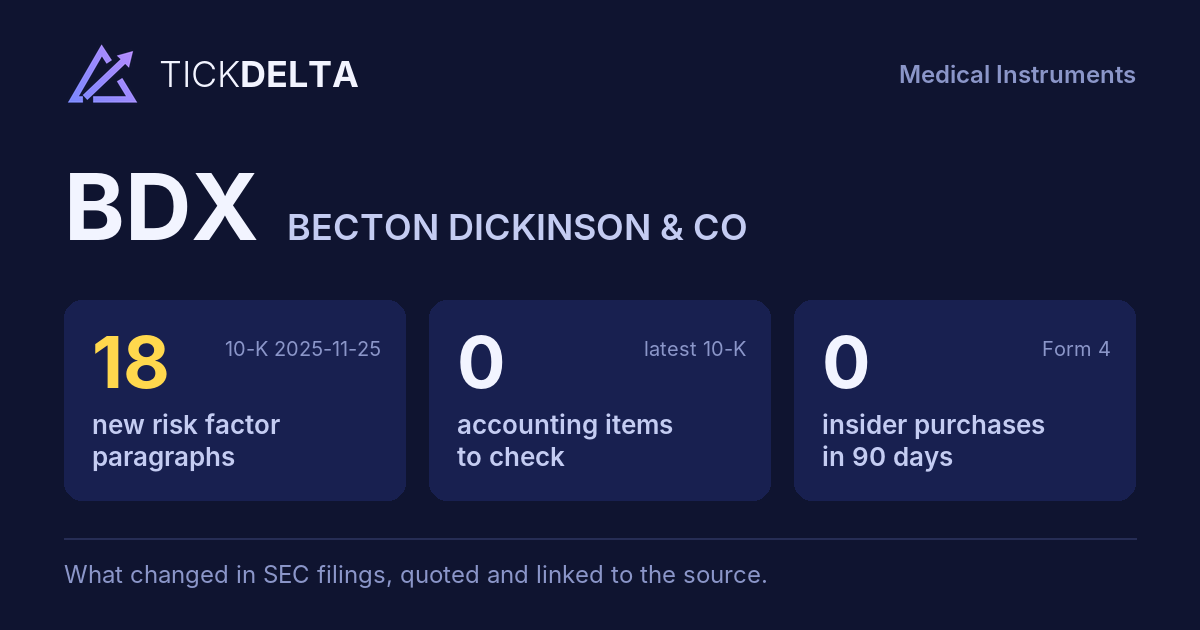
of the text changed · 10,536 words now · 18 new paragraphs, 13 gone
MD&A
27.5%
of the text changed · 11,876 words now · 20 new paragraphs, 26 gone
Legal Proceedings
33.0%
of the text changed · 3,341 words now
Accounting Policies
14.7%
of the text changed · 1,915 words now
10-K 0000010795-25-000099 (Nov 25, 2025) vs 10-K 0000010795-24-000084 (Nov 27, 2024)
Every paragraph, and how much of it changed
One bar per paragraph, in the order of the 10-K. Height and colour show the share of its words not in the closest paragraph a year earlier; the tallest bars are new paragraphs.
Risk Factors
98 paragraphs · 18 new · 58 reworded · 13 gone · 10-K Nov 25, 2025 against Nov 27, 2024
New paragraph
Reworded (5% of its words or more)
Same or nearly
Paragraph 44 · 46% changed
Every version of it
In addition, on April 13, 2023, the EPA published a Pesticide Registration Review: Proposed Interim Decision and Draft Risk Assessment Addendum for Ethylene Oxide. On January 14, 2025, the EPA published the Pesticide Registration Review; Interim Registration Review Decision for Ethylene Oxide (“PID”). The EPA has not yet finalized the PID, (“ID”), which regulates the use of ethylene oxide as a sterilant and is intended to mitigate any human health and environmental risks associated with its use. We cannot predict what Among other things, the final PID adopted ID requires medical device sterilization facilities to comply with a new and stricter occupational ethylene oxide exposure limit, establish engineering controls for worker protection, provide workers with personal protective equipment, conduct continuous stationary indoor monitoring and comply with a maximum concentration limit for ethylene oxide (with higher levels permitted if required and approved by the EPA may require and therefore we FDA). Compliance deadlines for the various mitigation measures required by the ID range from within 60 days to ten years of the effective date. We are not able to assess in the process of assessing the impact of the ID requirements on our sterilization facilities, on the third-party sterilization facilities that BD utilizes we utilize and our operations more generally. We expect to implement certain changes at our facilities to comply with NESHAP and ID requirements, which will require us to incur additional implementation and ongoing operating costs.
Paragraph 30 · 45% changed
Every version of it
Cyberattacks continue to increase in frequency, sophistication and intensity, and are increasingly difficult to detect in real-time and may go undetected for long periods of time, especially as they relate to attacks on third-party vendors. vendors and those utilizing emerging technologies (such as AI). Such attacks are often carried out by motivated and highly skilled actors, who are increasingly well-resourced. Our IT systems and infrastructure, as well as those of various third parties on which we rely, have experienced, and are likely to continue to experience, a variety of cyberattacks, including, but not limited to, unauthorized access, malicious code execution and/or phishing attacks, which has could be further exacerbated by rapid technology evolution, including increased adoption of AI and geopolitical events. For example, AI is increasingly being used by malicious actors to create more targeted cyberattacks and spread misinformation. These cyberattacks have resulted, and could in the future result, in our and our customers’ personal, confidential or proprietary information being accessed, destroyed, lost, stolen or otherwise compromised and could lead to increased costs for cybersecurity measures measures, insurance or remediation. For example, through remediation and adversely affect our cybersecurity monitoring tools and processes, we recently identified incidents of unauthorized activity on a portion of our IT systems, in which certain information relating to BD’s IT infrastructure and service credentials for certain BD Diagnostics Solutions, BD PyxisTM, and Parata products utilized by laboratories, hospitals and pharmacies (the “Product Service Credentials”) were accessed and/or exfiltrated. After becoming aware of the incidents, BD terminated the unauthorized access, applied additional security measures, and is working with customers to update these Product Service Credentials. While an unauthorized party would have to penetrate a customer’s local network and, in some cases, may also need to be physically present at the instrument in order to use these Product Service Credentials, until these credentials are updated, there is a risk of unauthorized access that may impact the confidentiality, integrity and/or availability of the relevant products and associated systems or data. To date, we have not been made aware of any unauthorized use of these Product Service Credentials. As of the date of this filing, the incidents have not had, and we do not expect them to have, a material impact on BD’s overall business operations, reputation, financial condition or condition, results of operations. operations or competitive position in the market and result in other significant negative consequences, including lost revenue, damages or fines, manufacturing challenges or disruption, diversion of management attention, litigation, regulatory action and damage to our relationships with vendors, business partners and customers.
Paragraph 24 · 43% changed
Every version of it
Paragraph 5 · 41% changed
Every version of it
A substantial amount of our sales come from our operations outside the U.S., and we intend to continue to pursue growth opportunities in new and existing foreign markets, especially in emerging markets. Our foreign operations subject us to certain commercial, political and financial risks. In addition to fluctuations in foreign currency exchange (discussed above), our business in these foreign markets is subject to changing political, social, and geopolitical conditions, such as the evolving situations continuation and/or escalation of the situation in Ukraine, the Middle East and Asia. These conditions include instability resulting from war, terrorism, insurrections and civil unrest, political conflict, conflict and changing economic conditions, such as inflation, deflation, interest rate volatility and credit availability. Additionally, a number of factors, including U.S. relations with or among the governments of the foreign countries in which we operate, changes to international trade agreements and treaties, changes in tax laws and regulations, economic sanctions, export controls, restrictions on the ability to transfer capital across borders, tariffs and other increases in trade protectionism and barriers to market participation, or the weakening or loss of certain intellectual property rights in some countries, may affect our business, financial condition and results of operations. Foreign regulatory requirements, including those related to the testing, authorization, and labeling of products and import or export licensing requirements, could affect the availability of our products in these markets. In addition to these broader market conditions, our operations may also be impacted by a variety of local factors, such as competition from local companies, local product preferences and requirements, changes in local healthcare payment systems and healthcare delivery systems, changes resulting from new political administrations, and labor force instability.
Paragraph 69 · 38% changed
Every version of it
Paragraph 49 · 38% changed
Every version of it
There has also been increased shifting focus by federal, international, state and local regulatory and legislative bodies to combat and/or limit the effects of on combating and limiting climate change and to promote sustainability and related efforts through a variety measures such as requiring disclosure of means, including regulating GHG emissions (and requirements to disclose climate-related risks and metrics, including GHG emissions), emissions, conducting risk assessments on sustainability practices, adopting policies mandating or promoting the use of renewable or zero-carbon energy energy, implementing sustainability initiatives and sustainability initiatives, and imposing additional taxes on fuel and energy. There has been, and in the future there may be additional, Additional legislation or regulations enacted or promulgated in the United States and in other jurisdictions in which we do business that and our suppliers operate may impose more stringent restrictions restrictions, and requirements on our operations than our historical legal or regulatory obligations as well as additional disclosure or reporting requirements. obligations. We have experienced, and companies in our supply chain have experienced, and may continue to experience, increased compliance burdens and costs to meet the regulatory these obligations. Such increased compliance burdens If we or our suppliers are unable or unwilling to comply with these obligations, it could be more difficult and/or costly to manufacture and costs could cause disruption in the sourcing, manufacturing and distribution sell certain of our products and we could experience supply chain interruptions, including impacts to sourcing and distribution. In addition, we could be subject to litigation, substantial fines and other damages if we fail to comply with these obligations, which could adversely affect impact our business, financial condition or condition, results of operations. operations and cash flows.
Paragraph 18 · 37% changed
Every version of it
Paragraph 29 · 47% changed
Every version of it
10-K Nov 27, 2024While we are continuing to modernize our IT systems and infrastructure (such as hardware, software and operating systems), there are still technologies in operation that are more vulnerable to risk of failures, interruptions and disruptions. In addition, while we continue to enhance business continuity and disaster recovery plans and strategies, there is no guarantee that such plans and strategies will be effective or account for all eventualities. We have experienced, and could in the future experience, the failure, interruption or disruption of the functionality of our IT systems and infrastructure, or those of third-party vendors upon which we rely, which could impair our ability or that of our customers, suppliers and other business partners to conduct business, result in the loss of BD trade secrets or otherwise compromise personal, confidential or proprietary information of BD or its customers, suppliers and other business partners, or of patients, result in efficacy or safety concerns for certain of our products, result in reputational harm to our business and result in actions by regulatory bodies or civil litigation.
10-K Nov 25, 2025
conduct business. Such a disruption could also result in the loss of our trade secrets or otherwise compromise personal, confidential or proprietary information of ours or our customers, suppliers and other business partners, or of patients. Additionally, depending on the nature of such a disruption, it could result in efficacy or safety concerns for certain of our products, result in reputational harm to our business and result in actions by regulatory bodies or civil litigation.
Paragraph 44 · 46% changed
Every version of it
10-K Nov 27, 2024
In addition, on April 13, 2023, the EPA published a Pesticide Registration Review: Proposed Interim Decision and Draft Risk Assessment Addendum for Ethylene Oxide (“PID”). The EPA has not yet finalized the PID, which regulates the use of ethylene oxide as a sterilant and is intended to mitigate any human health and environmental risks associated with its use. We cannot predict what the final PID adopted by the EPA may require and therefore we are not able to assess the impact on our sterilization facilities, on the third-party sterilization facilities that BD utilizes and our operations more generally.
10-K Nov 25, 2025
In addition, on April 13, 2023, the EPA published a Pesticide Registration Review: Proposed Interim Decision and Draft Risk Assessment Addendum for Ethylene Oxide. On January 14, 2025, the EPA published the Pesticide Registration Review; Interim Registration Review Decision for Ethylene Oxide (“ID”), which regulates the use of ethylene oxide as a sterilant and is intended to mitigate any human health and environmental risks associated with its use. Among other things, the ID requires medical device sterilization facilities to comply with a new and stricter occupational ethylene oxide exposure limit, establish engineering controls for worker protection, provide workers with personal protective equipment, conduct continuous stationary indoor monitoring and comply with a maximum concentration limit for ethylene oxide (with higher levels permitted if required and approved by the FDA). Compliance deadlines for the various mitigation measures required by the ID range from within 60 days to ten years of the effective date. We are in the process of assessing the impact of the ID requirements on our sterilization facilities, the third-party sterilization facilities that we utilize and our operations generally. We expect to implement certain changes at our facilities to comply with NESHAP and ID requirements, which will require us to incur additional implementation and ongoing operating costs.
Paragraph 30 · 45% changed
Every version of it
10-K Nov 27, 2024
Cyberattacks continue to increase in frequency, sophistication and intensity, and are increasingly difficult to detect for periods of time, especially as they relate to attacks on third-party vendors. Such attacks are often carried out by motivated and highly skilled actors, who are increasingly well-resourced. Our IT systems and infrastructure, as well as those of various third parties on which we rely, have experienced, and are likely to continue to experience, a variety of cyberattacks, including, but not limited to, unauthorized access, malicious code execution and/or phishing attacks, which has resulted, and could in the future result, in our and our customers’ personal, confidential or proprietary information being accessed, destroyed, lost, stolen or otherwise compromised and increased costs for cybersecurity measures or remediation. For example, through our cybersecurity monitoring tools and processes, we recently identified incidents of unauthorized activity on a portion of our IT systems, in which certain information relating to BD’s IT infrastructure and service credentials for certain BD Diagnostics Solutions, BD PyxisTM, and Parata products utilized by laboratories, hospitals and pharmacies (the “Product Service Credentials”) were accessed and/or exfiltrated. After becoming aware of the incidents, BD terminated the unauthorized access, applied additional security measures, and is working with customers to update these Product Service Credentials. While an unauthorized party would have to penetrate a customer’s local network and, in some cases, may also need to be physically present at the instrument in order to use these Product Service Credentials, until these credentials are updated, there is a risk of unauthorized access that may impact the confidentiality, integrity and/or availability of the relevant products and associated systems or data. To date, we have not been made aware of any unauthorized use of these Product Service Credentials. As of the date of this filing, the incidents have not had, and we do not expect them to have, a material impact on BD’s overall business operations, financial condition or results of operations.
10-K Nov 25, 2025
Cyberattacks continue to increase in frequency, sophistication and intensity, and are increasingly difficult to detect in real-time and may go undetected for long periods of time, especially as they relate to attacks on third-party vendors and those utilizing emerging technologies (such as AI). Such attacks are often carried out by motivated and highly skilled actors, who are increasingly well-resourced. Our IT systems and infrastructure, as well as those of various third parties on which we rely, have experienced, and are likely to continue to experience, a variety of cyberattacks, including, but not limited to, unauthorized access, malicious code execution and/or phishing attacks, which could be further exacerbated by rapid technology evolution, including increased adoption of AI and geopolitical events. For example, AI is increasingly being used by malicious actors to create more targeted cyberattacks and spread misinformation. These cyberattacks have resulted, and could in the future result, in our and our customers’ personal, confidential or proprietary information being accessed, destroyed, lost, stolen or otherwise compromised and could lead to increased costs for cybersecurity measures, insurance or remediation and adversely affect our reputation, financial condition, results of operations or competitive position in the market and result in other significant negative consequences, including lost revenue, damages or fines, manufacturing challenges or disruption, diversion of management attention, litigation, regulatory action and damage to our relationships with vendors, business partners and customers.
Paragraph 24 · 43% changed
Every version of it
10-K Nov 27, 2024A substantial amount of our revenue is derived from international operations, and we anticipate that a significant portion of our future sales will continue to come from outside the U.S. The revenues we report with respect to our operations outside the U.S. have been and may continue to be adversely affected by fluctuations in foreign currency exchange rates, which are caused by a number of factors, including changes in a country's political and economic policies and inflationary conditions. Furthermore, currency exchange rates have been especially volatile in the recent past, and these currency fluctuations have affected, and may continue to affect, the reported value of our assets and liabilities, as well as our cash flows. A discussion of the financial impact of exchange rate fluctuations and the ways and extent to which we may attempt to address any impact is contained in Item 7. Management’s Discussion and Analysis of Financial Condition and Results of Operations. Any exchange rate hedging activities we engage in may only offset a portion of the adverse financial impact resulting from unfavorable changes in foreign currency exchange rates. We cannot predict with any certainty changes in foreign currency exchange rates or the degree to which we can effectively mitigate these risks.
10-K Nov 25, 2025
in Item 7. Management’s Discussion and Analysis of Financial Condition and Results of Operations. Any foreign currency exchange rate hedging activities we engage in may only offset a portion of the financial impact resulting from changes in foreign currency exchange rates. We cannot predict with any certainty changes in foreign currency exchange rates or the degree to which we can effectively manage these fluctuations.
Paragraph 5 · 41% changed
Every version of it
10-K Nov 27, 2024
A substantial amount of our sales come from our operations outside the U.S., and we intend to continue to pursue growth opportunities in foreign markets, especially in emerging markets. Our foreign operations subject us to certain commercial, political and financial risks. In addition to fluctuations in foreign currency exchange (discussed above), our business in these foreign markets is subject to changing political, social, and geopolitical conditions, such as the evolving situations in Ukraine, the Middle East and Asia. These conditions include instability resulting from war, terrorism, insurrections and civil unrest, political conflict, and changing economic conditions, such as inflation, deflation, interest rate volatility and credit availability. Additionally, a number of factors, including U.S. relations with or among the governments of the foreign countries in which we operate, changes to international trade agreements and treaties, changes in tax laws and regulations, economic sanctions, export controls, restrictions on the ability to transfer capital across borders, tariffs and other increases in trade protectionism and barriers to market participation, or the weakening or loss of certain intellectual property rights in some countries, may affect our business, financial condition and results of operations. Foreign regulatory requirements, including those related to the testing, authorization, and labeling of products and import or export licensing requirements, could affect the availability of our products in these markets. In addition to these broader market conditions, our operations may also be impacted by a variety of local factors, such as competition from local companies, local product preferences and requirements, changes in local healthcare payment systems and healthcare delivery systems, changes resulting from new political administrations, and labor force instability.
10-K Nov 25, 2025
A substantial amount of our sales come from our operations outside the U.S., and we intend to continue to pursue growth opportunities in new and existing foreign markets. Our foreign operations subject us to certain commercial, political and financial risks. In addition to fluctuations in foreign currency exchange (discussed above), our business in these foreign markets is subject to changing political, social, and geopolitical conditions, such as the continuation and/or escalation of the situation in Ukraine, the Middle East and Asia. These conditions include instability resulting from war, terrorism, insurrections and civil unrest, political conflict and changing economic conditions, such as inflation, deflation, interest rate volatility and credit availability.
Paragraph 69 · 38% changed
Every version of it
10-K Nov 27, 2024Many of our businesses rely on patent, trademark and other intellectual property assets. These intellectual property assets, in the aggregate, are of material importance to our business. We can lose the protection afforded by these intellectual property assets through patent expirations, legal challenges or governmental action. Any patent applications we own or license may not result in patents being issued and any issued patents we obtain may not provide us with any competitive advantage. Furthermore, we may fail to accurately predict all of the countries where patent protection will ultimately be desirable, and if we fail to timely file a patent application in any such country, we may be precluded from doing so at a later date. Patents attained by competitors, particularly as patents on our products expire, may also adversely affect our competitive position. Competitors may design around our intellectual property to develop competing technologies and products without infringing our intellectual property rights. In addition, competitors may seek to invalidate patents on our products or claim that our products infringe upon, misappropriate or otherwise violate their intellectual property, which could result in a loss of competitive advantage or the payment of significant legal fees, damage awards and past or future royalties, as well as injunctions against future sales of our products. We also operate in countries that do not protect intellectual property rights to the same extent as in the U.S., which could make it easier for competitors to compete with us in those countries.
10-K Nov 25, 2025
technologies and products without infringing our intellectual property rights. In addition, competitors may seek to invalidate patents on our products or claim that our products infringe upon, misappropriate or otherwise violate their intellectual property, which could result in a loss of competitive advantage or the payment of significant legal fees, damages and past or future royalties, as well as injunctions against future sales of our products. We also operate in countries that do not protect intellectual property rights to the same extent as in the U.S., which could make it easier for competitors to compete with us in those countries. Further, governmental regulation and laws related to AI and other emerging technologies may increase the burden and cost of research and development or require increased transparency that makes it more difficult to protect our intellectual property.
Paragraph 49 · 38% changed
Every version of it
10-K Nov 27, 2024
There has been increased focus by federal, international, state and local regulatory and legislative bodies to combat and/or limit the effects of climate change through a variety of means, including regulating GHG emissions (and requirements to disclose climate-related risks and metrics, including GHG emissions), policies mandating or promoting the use of renewable or zero-carbon energy and sustainability initiatives, and additional taxes on fuel and energy. There has been, and in the future there may be additional, legislation or regulations enacted or promulgated in the United States and in other jurisdictions in which we do business that impose more stringent restrictions and requirements on our operations than our historical legal or regulatory obligations as well as additional disclosure or reporting requirements. We have experienced, and companies in our supply chain may experience, increased compliance burdens and costs to meet the regulatory obligations. Such increased compliance burdens and costs could cause disruption in the sourcing, manufacturing and distribution of our products and adversely affect our business, financial condition or results of operations.
10-K Nov 25, 2025
There has also been shifting focus by federal, international, state and local regulatory and legislative bodies on combating and limiting climate change and to promote sustainability and related efforts through measures such as requiring disclosure of climate-related risks and metrics, including GHG emissions, conducting risk assessments on sustainability practices, adopting policies mandating or promoting the use of renewable or zero-carbon energy, implementing sustainability initiatives and imposing additional taxes on fuel and energy. Additional legislation or regulations in the United States and in other jurisdictions in which we and our suppliers operate may impose more stringent restrictions, and disclosure obligations. We and companies in our supply chain have experienced, and may continue to experience, increased compliance burdens and costs to meet these obligations. If we or our suppliers are unable or unwilling to comply with these obligations, it could be more difficult and/or costly to manufacture and sell certain of our products and we could experience supply chain interruptions, including impacts to sourcing and distribution. In addition, we could be subject to litigation, substantial fines and other damages if we fail to comply with these obligations, which could adversely impact our business, financial condition, results of operations and cash flows.
Paragraph 18 · 37% changed
Every version of it
10-K Nov 27, 2024A global trend towards limiting growth of healthcare costs may also put industry-wide pressure on medical device or clinical diagnostic pricing. In the U.S., these include value-based purchasing and managed care arrangements. Governments in China and other countries continue to use various mechanisms to control healthcare expenditures, including increased use of competitive bidding and tenders, price regulation (such as volume-based procurement programs (“VoBP”)), government imposed payback provisions, and changes in reimbursement practices and policies on average selling prices for our products, which have unfavorably impacted our revenues and may continue to impact our results of operations in certain countries.
10-K Nov 25, 2025
cost-efficiency, which could lead to uncertainty with respect to innovation, quality and patient access challenges or supplier attrition, as seen in prior bidding cycles. In addition, we expect recently enacted and proposed changes under legislative debate to Medicare, Medicaid and the Affordable Care Act to impact healthcare coverage, all of which if implemented could adversely affect both the demand and prices customers are willing to pay for our products. Globally, governments in China and other countries continue to use various mechanisms to control healthcare expenditures, including increased use of competitive bidding and tenders, price regulation (such as volume-based procurement programs (“VoBP”)), government imposed payback provisions, and changes in reimbursement practices and policies on average selling prices for our products, which have unfavorably impacted our revenues and may continue to impact our results of operations in certain countries.
MD&A
220 paragraphs · 20 new · 105 reworded · 26 gone · 10-K Nov 25, 2025 against Nov 27, 2024
New paragraph
Reworded (5% of its words or more)
Same or nearly
Paragraph 92 · 50% changed
growth also reflected a favorable comparison to the prior-period, which was unfavorably impacted by $62 million of accruals related to the Italian government medical device pay back legislation, as further discussed above. International revenue growth in 2023 2025 was particularly driven partially offset by strong sales in the Medical segment’s Medication Management Solutions and Pharmaceutical Systems units, and a decline in the Life Sciences segment’s Biosciences unit, as well as by strong sales in the Interventional segment’s Surgery and Peripheral Intervention units. International revenues in 2023 were unfavorably impacted by a decline in COVID-19-only diagnostic testing sales compared with 2022, as further discussed further above.
Paragraph 32 · 49% changed
Paragraph 214 · 48% changed
•Pending and potential future litigation or other proceedings asserting, and/or investigations concerning and/or subpoenas and requests seeking information with respect to, alleged violations of law (including in connection with federal and/or state healthcare programs (such as Medicare or Medicaid) Medicaid), government contracts and/or sales and marketing practices (such as investigative subpoenas and the civil investigative demands received by BD)), potential anti-corruption and related internal control violations under the Foreign Corrupt Practices Act, antitrust claims, securities law claims, environmental and product liability matters (including pending claims relating to ethlyene oxide, our hernia repair implant products, surgical continence and pelvic organ prolapse products for women, vena cava filter products and implantable ports, which involve, or could involve in the future, lawsuits seeking class action status or seeking to establish multi-district or other consolidated proceedings), data privacy breaches and patent infringement, and the availability or collectability of insurance relating to any such claims.
Paragraph 91 · 47% changed
Paragraph 33 · 47% changed
Paragraph 53 · 46% changed
Paragraph 68 · 46% changed
Paragraph 83 · 46% changed
Paragraph 92 · 50% changed
10-K Nov 27, 2024
International revenue growth in 2023 was particularly driven by strong sales in the Medical segment’s Medication Management Solutions and Pharmaceutical Systems units, and in the Life Sciences segment’s Biosciences unit, as well as by strong sales in the Interventional segment’s Surgery and Peripheral Intervention units. International revenues in 2023 were unfavorably impacted by a decline in COVID-19-only diagnostic testing sales compared with 2022, as discussed further above.
10-K Nov 25, 2025
growth also reflected a favorable comparison to the prior-period, which was unfavorably impacted by $62 million of accruals related to the Italian government medical device pay back legislation, as further discussed above. International revenue growth in 2025 was partially offset by a decline in the Life Sciences segment’s Biosciences unit, as further discussed above.
Paragraph 32 · 49% changed
10-K Nov 27, 2024•As anticipated, market dynamics in China, such as volume-based procurement programs (“VoBP”) and the government’s focus to improve compliance of healthcare practitioners, had an adverse impact on our results of operations and these dynamics could continue to unfavorably impact our results of operations.
10-K Nov 25, 2025
We have been experiencing, and may continue to experience, some adverse impact to our results of operations due to market dynamics in China, such as volume-based procurement programs (“VoBP”) and the government’s focus to improve compliance of healthcare practitioners. Also, reductions or delays in governmental research funding has caused customers for certain of our instruments to delay or forgo purchases of these products. Lower demand for vaccines has also adversely impacted our results of operations. The future demand for our products and services could be impacted by other factors including higher interest rates and the deterioration of healthcare systems’ budgets.
Paragraph 214 · 48% changed
10-K Nov 27, 2024
•Pending and potential future litigation or other proceedings asserting, and/or investigations concerning and/or subpoenas and requests seeking information with respect to, alleged violations of law (including in connection with federal and/or state healthcare programs (such as Medicare or Medicaid) and/or sales and marketing practices (such as investigative subpoenas and the civil investigative demands received by BD)), potential anti-corruption and related internal control violations under the Foreign Corrupt Practices Act, antitrust claims, securities law claims, environmental and product liability matters (including pending claims relating to ethlyene oxide, our hernia repair implant products, surgical continence and pelvic organ prolapse products for women, vena cava filter products and implantable ports, which involve, or could involve in the future, lawsuits seeking class action status or seeking to establish multi-district or other consolidated proceedings), data privacy breaches and patent infringement, and the availability or collectability of insurance relating to any such claims.
10-K Nov 25, 2025
•Pending and potential future litigation or other proceedings asserting, and/or investigations concerning and/or subpoenas and requests seeking information with respect to, alleged violations of law (including in connection with federal and/or state healthcare programs (such as Medicare or Medicaid), government contracts and/or sales and marketing practices (such as investigative subpoenas and the civil
Paragraph 91 · 47% changed
10-K Nov 27, 2024•Overall Medical segment revenue growth in 2024 also reflected the acquired Advanced Patient Monitoring unit’s sales beginning on September 3, 2024.
10-K Nov 25, 2025
International revenue growth in 2025 was largely driven by the acquired Advanced Patient Monitoring unit’s sales. International revenue growth was also driven by sales in the Medical segment’s Medication Delivery Solutions unit, as well as by sales in all of the Interventional segment’s units. International revenue
Paragraph 33 · 47% changed
10-K Nov 27, 2024We have experienced, and may continue to experience, temporary shortages in supply of certain materials or components that are used in our products. The stable flow of global transport is critical to our operations and as such, events affecting the flow of logistics around the globe may adversely impact our supply chain and distribution channels. In general, major disruptions in the sourcing, manufacturing and distribution of our products could adversely impact our results of operations.
10-K Nov 25, 2025
Additionally, we have experienced, and may continue to experience, temporary shortages in supply of certain materials or components that are used in our products. The stable flow of global transport is critical to our operations and as such, events affecting the flow of logistics around the globe may adversely impact our supply chain and distribution channels. In general, major disruptions in the sourcing, manufacturing and distribution of our products could adversely impact our results of operations. Also, tariffs, sanctions or other trade barriers imposed by the United States, or against the United States from countries in which we do business, could adversely impact our supply chain costs, results of operations and our financial condition. Based upon the latest published tariffs that are currently in effect, we expect tariffs to adversely impact our operating expense for fiscal year 2026 and potentially beyond, primarily relating to any products (or components) imported from countries across our global supply chain which have no exemption opportunities. We continue to monitor international trade policy-related developments to assess their potential impacts to our operations. The ultimate impact of any existing or new tariffs or other changes in international trade policies is subject to a number of factors including, but not limited to, the duration of such tariffs, changes in tariff rates, the amount, scope and nature of the tariffs, any countermeasures that target countries may take, or any mitigating actions that may become available. While sourcing optimization and tariff exemptions for qualifying products are key
Paragraph 53 · 46% changed
10-K Nov 27, 2024Additional disclosures regarding the sale and spin-off are provided in Note 2 to the consolidated financial statements contained in Item 8. Financial Statements and Supplementary Data.
10-K Nov 25, 2025
(a) Prior-period segment income amounts have been recast to conform to the current year presentation, as further discussed in Note 8 to the consolidated financial statements contained in Item 8. Financial Statements and Supplementary Data.
Paragraph 68 · 46% changed
10-K Nov 27, 2024Additional disclosures regarding the sale and spin-off are provided in Note 2 to the consolidated financial statements contained in Item 8. Financial Statements and Supplementary Data.
10-K Nov 25, 2025
(a) Prior-period segment income amounts have been recast to conform to the current year presentation, as further discussed in Note 8 to the consolidated financial statements contained in Item 8. Financial Statements and Supplementary Data.
Paragraph 83 · 46% changed
10-K Nov 27, 2024Additional disclosures regarding the sale and spin-off are provided in Note 2 to the consolidated financial statements contained in Item 8. Financial Statements and Supplementary Data.
10-K Nov 25, 2025
(a) Prior-period segment income amounts have been recast to conform to the current year presentation, as further discussed in Note 8 to the consolidated financial statements contained in Item 8. Financial Statements and Supplementary Data.
A paragraph is matched with the one last year that shares the most of its words; under half in common makes it new. The paragraphs shown are the 8 reworded the most in each section.
The paragraph that changed most in each section
The redline
Marked against last year's 10-K: cut words struck through, new words highlighted.
Risk Factors305 words changed in this paragraph; it is 44% similar to last year's version.
Cyberattacks continue to increase in frequency, sophistication and intensity, and are increasingly difficult to detect in real-time and may go undetected for long periods of time, especially as they relate to attacks on third-party vendors. vendors and those utilizing emerging technologies (such as AI). Such attacks are often carried out by motivated and highly skilled actors, who are increasingly well-resourced. Our IT systems and infrastructure, as well as those of various third parties on which we rely, have experienced, and are likely to continue to experience, a variety of cyberattacks, including, but not limited to, unauthorized access, malicious code execution and/or phishing attacks, which has could be further exacerbated by rapid technology evolution, including increased adoption of AI and geopolitical events. For example, AI is increasingly being used by malicious actors to create more targeted cyberattacks and spread misinformation. These cyberattacks have resulted, and could in the future result, in our and our customers’ personal, confidential or proprietary information being accessed, destroyed, lost, stolen or otherwise compromised and could lead to increased costs for cybersecurity measures measures, insurance or remediation. For example, through remediation and adversely affect our cybersecurity monitoring tools and processes, we recently identified incidents of unauthorized activity on a portion of our IT systems, in which certain information relating to BD’s IT infrastructure and service credentials for certain BD Diagnostics Solutions, BD PyxisTM, and Parata products utilized by laboratories, hospitals and pharmacies (the “Product Service Credentials”) were accessed and/or exfiltrated. After becoming aware of the incidents, BD terminated the unauthorized access, applied additional security measures, and is working with customers to update these Product Service Credentials. While an unauthorized party would have to penetrate a customer’s local network and, in some cases, may also need to be physically present at the instrument in order to use these Product Service Credentials, until these credentials are updated, there is a risk of unauthorized access that may impact the confidentiality, integrity and/or availability of the relevant products and associated systems or data. To date, we have not been made aware of any unauthorized use of these Product Service Credentials. As of the date of this filing, the incidents have not had, and we do not expect them to have, a material impact on BD’s overall business operations, reputation, financial condition or condition, results of operations. operations or competitive position in the market and result in other significant negative consequences, including lost revenue, damages or fines, manufacturing challenges or disruption, diversion of management attention, litigation, regulatory action and damage to our relationships with vendors, business partners and customers.
Source: Item 1A, 10-K 0000010795-25-000099 vs Item 1A, 10-K 0000010795-24-000084
Legal Proceedings243 words changed in this paragraph; it is 31% similar to last year's version.
Source: Item 3, via Note 6 – Commitments and Contingencies, 10-K 0000010795-25-000099 vs Item 3, via Note 6 – Commitments and Contingencies, 10-K 0000010795-24-000084
MD&A189 words changed in this paragraph; it is 57% similar to last year's version.
Each reporting period, period and given our worldwide operations, we face currency exposure that arises from translating the to our results of operations from changes in foreign currencies. We calculate translational foreign currency impacts by converting our worldwide operations to current-period local currency financial results using the U.S. dollar at prior-period foreign currency exchange rates that fluctuate from the beginning of such period. and comparing these adjusted amounts to our current-period results, which allows us to compare results between periods as if exchange rates had remained constant period-over-period. The fiscal year 2024 2025 impact of foreign currency translation on our revenues revenues, which is primarily translational, is provided above and the above. The translational impact on our earnings is provided further below. We evaluate our results of operations on both a reported and a foreign currency-neutral basis, which excludes the impact of fluctuations in foreign currency exchange rates. basis. As exchange rates are an important factor in understanding period-to-period comparisons, we believe the presentation of results on a foreign currency-neutral basis basis, excluding translational foreign currency impacts, in addition to reported results helps improve investors’ ability to understand our operating results and evaluate our performance in comparison to prior periods. Foreign currency-neutral ("FXN") information compares results between periods as if exchange rates had remained constant period-over-period. We use results on a foreign currency-neutral basis as one measure to evaluate our performance. We calculate foreign currency-neutral percentages by converting our current-period local currency financial results using the prior-period foreign currency exchange rates and comparing these adjusted amounts to our current-period results. These results should be considered in addition to, not as a substitute for, results reported in accordance with U.S. generally accepted accounting principles ("GAAP"). Results on a foreign currency-neutral basis, as we present them, may not be comparable to similarly titled measures used by other companies and are not measures of performance presented in accordance with U.S. GAAP.
Source: Item 7, 10-K 0000010795-25-000099 vs Item 7, 10-K 0000010795-24-000084
Accounting Policies67 words changed in this paragraph; it is 57% similar to last year's version.
The Company’s unamortized intangible assets include goodwill that arises from acquisitions of businesses. The Company reviews goodwill for impairment using quantitative models. Goodwill is reviewed at least annually for impairment at the reporting unit level, which is defined as an operating segment or one level below an operating segment, referred to as a component. The Company’s reporting units represent one level below reporting segments. The Company reviews goodwill for each reporting unit by comparing the fair value of the reporting unit, estimated using an income approach, with its carrying value. The annual impairment review performed on July 1, 2024 indicated that all identified reporting units’ fair values exceeded their respective carrying values.
Source: Item 8, Note 1 – Summary of Significant Accounting Policies, 10-K 0000010795-25-000099 vs Item 8, Note 1 – Summary of Significant Accounting Policies, 10-K 0000010795-24-000084
Sentences and paragraphs added, removed or reworded
Every change, by type
Sentences and paragraphs of BDX's Risk Factors and MD&A, 10-K Nov 25, 2025 against 10-K Nov 27, 2024. Each links to the text at sec.gov.
AddedRisk Factors
Specifically, recently enacted or any future tariffs imposed by the U.S. government (and countermeasures by non-U.S. governments) may result in adverse impacts to the global economic environment and the stability of global financial markets, which could alter global trade. The tariffs, sanctions or other trade barriers imposed by the U.S. (and countermeasures by non-U.S. governments) could adversely impact our supply chain costs or availability of certain components, demand for our products and our business, financial condition, results of operations and cash flows. Unpredictability of trade policy compounds this risk. Based upon the latest published tariffs that are currently in effect, we expect tariffs to adversely impact our operating expense for fiscal year 2026 and potentially beyond, primarily relating to any products (or components) imported from countries across our global supply chain, for which there are limited mitigation opportunities.
Read it in 10-K Nov 25, 2025 at sec.gov
AddedRisk Factors
Further, the U.S. Department of Commerce recently initiated an investigation under Section 232 of the Trade Expansion Act of 1962, as amended, into (among other things) imports of personal protective equipment, medical consumables and medical equipment (including devices), to determine whether they threaten U.S. national security, which further creates policy uncertainty in terms of tariffs. The ultimate impact of any existing or new tariffs or other changes in international trade policies on our business, financial condition, results of operations and cash flows is subject to a number of factors, including, but not limited to, the duration of such tariffs, changes in tariff rates, the amount, scope and nature of the tariffs, any countermeasures that target countries may take or any mitigating actions that may become available. While sourcing optimization and tariff exemptions for qualifying products are key aspects of our mitigation strategy, the timing of such or the ultimate results we will realize from these efforts are uncertain. In addition, our tariff mitigation strategies may be challenged, rejected or eliminated through legislation or other challenges, or may otherwise not be effective.
Read it in 10-K Nov 25, 2025 at sec.gov
AddedRisk Factors
A global trend towards limiting growth of healthcare costs may also put industry-wide pressure on medical device or clinical diagnostic pricing. In the U.S., the Center for Medicaid Services (“CMS”) has proposed the expansion of its Competitive Bidding Program (“CBP”). This proposed expansion would introduce a pricing model that could significantly influence the cost structure of some medical devices in the U.S. healthcare system; specifically, those reimbursed under CMS’ Durable Medical Equipment, Prosthetic, Orthotic and Supplies payment system. By leveraging supplier competition to establish payment rates, the CBP mirrors purchasing initiatives seen in international markets, where procurement strategies attempt to prioritize
Read it in 10-K Nov 25, 2025 at sec.gov
AddedRisk Factors
While we have made, and expect to continue making, significant investments intended to strengthen our cybersecurity posture—including measures designed to protect our products, systems, and data—we cannot guarantee that these efforts will fully prevent, mitigate or remediate cybersecurity incidents or breaches. We maintain processes designed to monitor, detect and respond to threats and collaborate with government authorities and third-party partners in an effort to reduce risk. However, given the evolving nature, sophistication, scale and frequency of cybersecurity incidents and breaches, no system can be entirely secure. A successful cybersecurity incident or breach could materially adversely affect our business, financial condition, results of operations or cash flows.
Read it in 10-K Nov 25, 2025 at sec.gov
AddedRisk Factors
The development, deployment and use of AI in our products and business operations generally could result in regulatory action, legal liability, operational challenges or reputational harm and our failure to adapt to medical technology industry trends and developments related to AI in a timely manner (or at all) could adversely affect our business, financial condition, results of operations and cash flows.
Read it in 10-K Nov 25, 2025 at sec.gov
AddedRisk Factors
We have integrated (and expect to continue to integrate) AI into our products and business operations generally. We also expect to continue to develop future uses of AI and expand our existing AI capabilities to include agentic solutions, as well as pursue new AI technology partnerships with third parties. The development, deployment and use of AI (particularly generative AI) is in the early stages and presents various
Read it in 10-K Nov 25, 2025 at sec.gov
AddedRisk Factors
risks, including from confidentiality, privacy, data protection, cybersecurity and compliance perspectives, and raises intellectual property issues and legal, regulatory, reputational ethical, operational, technological and other concerns (see, “Our operations are dependent in part on patents and other intellectual property assets” and “Cybersecurity incidents and breaches or breakdowns of our information and technology systems or infrastructure could have a material adverse effect on our operations” elsewhere in this Item 1A, Risk Factors). Additionally, if we do not effectively adopt and integrate AI into innovative, market-differentiated products in a timely manner, our competitive position could be adversely affected.
Read it in 10-K Nov 25, 2025 at sec.gov
AddedRisk Factors
lack adequate staff and resources to meet current review, approval and inspection schedules, which could delay the receipt of or otherwise adversely affect the outcomes of product authorizations we seek.
Read it in 10-K Nov 25, 2025 at sec.gov
Show the other 16
AddedRisk Factors
We are also subject to complex and rapidly evolving privacy and data protection laws, regulations and standards which govern the collection, use, storage, transfer, sharing and processing of personal data (particularly sensitive health information) across the U.S. and a significant number of other countries where we operate. The nature of our technologies and data-driven solutions amplifies privacy and data protection risks, especially as we employ could-based infrastructures, AI and other emerging digital capabilities. These innovations can introduce new vectors for data exposure, algorithmic bias, and regulatory scrutiny. These laws, rules and regulations require, among other things, proactive implementation of comprehensive compliance programs, continuous enhancement of internal policies, business practices, processes, and integration of technical and organizational safeguards across all assets and activities that process personal data. These requirements often entail operational constraints and higher compliance costs and may require us to modify existing or future products, potentially impacting innovation timelines and financial performance.
Read it in 10-K Nov 25, 2025 at sec.gov
AddedRisk Factors
Furthermore, privacy and data protection risks extend beyond our direct operations. Non-compliance by third-party vendors, manufacturers, or service providers (especially those involved in data processing) can expose us to liability indirectly. Cybersecurity incidents, system failures, or breaches involving our own infrastructure or that of our partners may trigger regulatory scrutiny, financial penalties, business interruption, reputational harm, loss of competitive advantage and customer trust, as well as privacy litigation and civil lawsuits with damages.
Read it in 10-K Nov 25, 2025 at sec.gov
AddedRisk Factors
Risks Relating to the Proposed Combination of Our Biosciences and Diagnostics Solutions Business with Waters
Read it in 10-K Nov 25, 2025 at sec.gov
AddedRisk Factors
The proposed combination of our Biosciences and Diagnostic Solutions business with Waters may not be completed, on the currently contemplated timeline or at all.
Read it in 10-K Nov 25, 2025 at sec.gov
AddedMD&A
As further discussed in Note 8 to the consolidated financial statements contained in Item 8. Financial Statements and Supplementary Data, effective October 1, 2025, we reorganized our organizational units into five distinct, separately-managed segments, based on the nature of our product and service offerings. BD’s new organizational structure is based upon the following five segments: Medical Essentials, Connected Care, BioPharma Systems, Interventional and Life Sciences, which remains a critical part of BD until the separation and combination of our Biosciences and Diagnostic Solutions business with Waters Corporation (“Waters”) is completed. Additional disclosures regarding the agreement to combine our Biosciences and Diagnostic Solutions business with Waters are provided in Note 1 to the consolidated financial statements contained in Item 8. Financial Statements and Supplementary Data.
Read it in 10-K Nov 25, 2025 at sec.gov
AddedMD&A
Proposed Combination of Our Biosciences and Diagnostic Solutions Business with Waters
Read it in 10-K Nov 25, 2025 at sec.gov
AddedMD&A
As noted above and as further discussed in Note 1 to the consolidated financial statements contained in Item 8. Financial Statements and Supplementary Data, we entered into a definitive agreement on July 13, 2025 to combine our Biosciences and Diagnostic Solutions business with Waters in a transaction that is expected to create an innovative life science and diagnostics leader with pioneering technologies.
Read it in 10-K Nov 25, 2025 at sec.gov
AddedMD&A
aspects of our mitigation strategy, the timing of such or the ultimate results we will realize from these efforts are uncertain. In addition, our tariff mitigation strategies may be challenged, rejected or eliminated through legislation or other challenges, or may otherwise not be effective.
Read it in 10-K Nov 25, 2025 at sec.gov
AddedMD&A
For additional information on risk factors that may impact our business, results of operations, financial condition and cash flows, see Part I, Item 1A. Risk Factors.
Read it in 10-K Nov 25, 2025 at sec.gov
AddedMD&A
principles (“GAAP”). Results on a foreign currency-neutral basis, as we present them, may not be comparable to similarly titled measures used by other companies and are not measures of performance presented in accordance with U.S. GAAP.
Read it in 10-K Nov 25, 2025 at sec.gov
AddedMD&A
•Growth in the Medication Management Solutions unit driven by continued strength in sales of infusion systems, partially offset by the timing of dispensing and pharmacy automation installations, based upon customer readiness, in the current year.
Read it in 10-K Nov 25, 2025 at sec.gov
AddedMD&A
(a) During the first quarter of fiscal year 2025, Life Sciences split its former Integrated Diagnostic Solutions organizational unit into two units to better align BD resources with the distinct needs of each business.
Read it in 10-K Nov 25, 2025 at sec.gov
AddedMD&A
•Growth in the Specimen Management unit’s BD VacutainerTM portfolio, partially offset by a decline in China.
Read it in 10-K Nov 25, 2025 at sec.gov
AddedMD&A
•A decline in the Diagnostic Solutions unit driven by lower sales of BD BACTECTM blood culture products as customer utilization continues to improve following the resolution of a supply disruption, as well as by lower sales of point-of-care products, partially offset by continued double-digit growth in sales of BD MAXTM IVD.
Read it in 10-K Nov 25, 2025 at sec.gov
AddedMD&A
•A decline in the Biosciences unit due to continued market dynamics impacting sales of instruments, partially offset by strong sales of the recently launched BD FACSDiscoverTM A8 Cell Analyzer.
Read it in 10-K Nov 25, 2025 at sec.gov
AddedMD&A
•Sales driven by broad volume growth attributable to the Specimen Management unit’s portfolio.
Read it in 10-K Nov 25, 2025 at sec.gov
Sources
The two latest 10-Ks on EDGAR, section by section. Each change links to the text at sec.gov.
Also
New risk factors: paragraphs with nothing like them last year, quoted in full.
Work with it
Excel workbook · CSV. Google Sheet that stays up to date: paste =IMPORTDATA("https://tickdelta.com/company/BDX/export.csv") into a cell.