Form 10-K
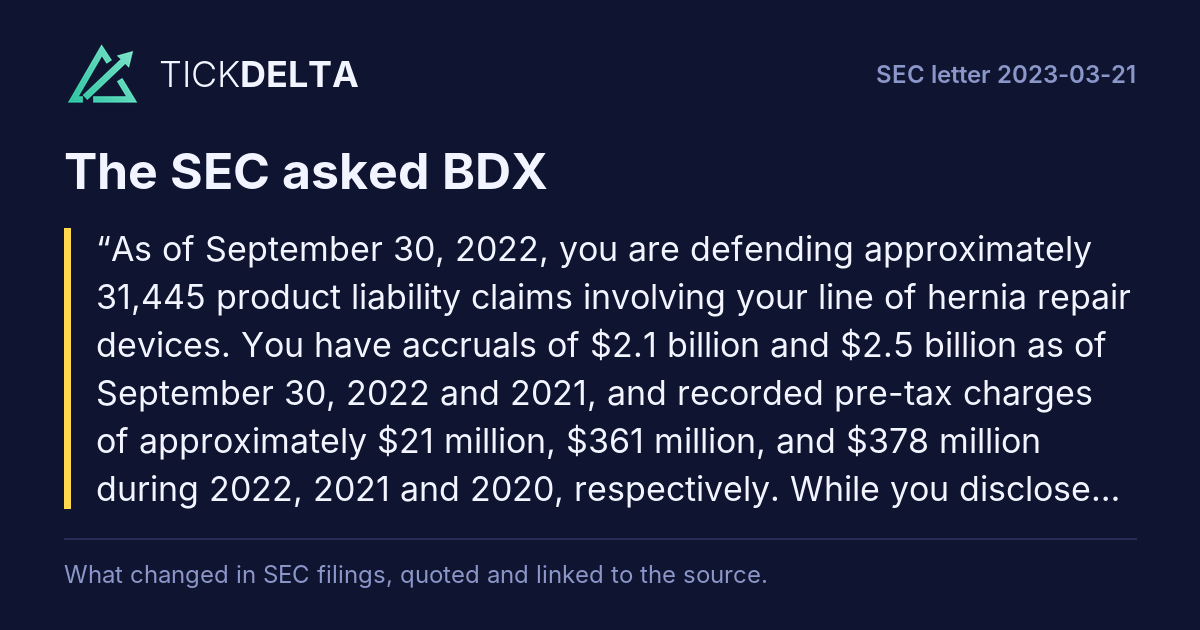
As of September 30, 2022, you are defending approximately 31,445 product liability claims involving your line of hernia repair devices. You have accruals of $2.1 billion and $2.5 billion as of September 30, 2022 and 2021, and recorded pre-tax charges of approximately $21 million, $361 million, and $378 million during 2022, 2021 and 2020, respectively.Rest of the question
While you disclose a list of “additional information obtained during fiscal years 2022, 2021 and 2021,” you do not provide the specific factors that impacted your accrual. For example, your claims significantly increased from 25,030 product liability claims as of September 31, 2021, but your accrual decreased and your pre-tax charge in 2022 was significantly less than in 2021. Given the significance of the recorded liability and your cautionary disclosures that you could incur material charges in excess of currently established accruals, please provide a fuller description of your critical accounting estimates that considers key judgments made in applying ASC 450 and more specifically explains the volatility of the assumptions and changes in the recorded liability. For example: • Explain why your estimates and assumptions bear risk of change. To this end, consider disclosing the information you evaluate as part of your legal review and the approach you apply to develop your estimates. Address the potential impact on your accrual of changes in significant qualitative factors and material underlying quantitative assumptions, including changes in the number of estimated new claim filings, the time period over which claims may be asserted, average settlements per claim, average costs per claim, and stage of litigation. Include quantification where possible; • Explain the specific reasons for changes in estimates that materially impact the financial statements. Clarify whether your accrual and related charges have been impacted by claims related to your line of inferior vena cava filter products and/or pelvic mesh products; • Address the impact the three bellwether trials you discuss in Note 6 had on your accrual, with particular emphasis on the $4.8 million verdict in August 2022; • Please quantify the extent of your insurance coverage and disclose and discuss the impact of any insurance proceeds on your results of operations; and • Explain the basis for the significant assumptions you use in any sensitivity analysis you provide and address how the assumptions compare with both your historical experience and the broader approach you use to estimate your accrual.
In response to the Staff’s comment, the Company respectfully advises the Staff that, in accordance with Accounting Standards Codification 450 (“ASC 450”), it establishes accruals for future losses which are both probable and reasonably estimable. As noted in Note 6 Commitments and Contingencies of the 2022 Form 10-K, on page 74, the Company considers the following information (the “accrual support information”) to estimate its product liability accrual:
…including, but not limited to: the nature, quantity, and quality of unfiled and filed claims; the continued rate of claims being filed inRead in the reply ↗Rest of the answer
certain product liability matters; the status of certain settlement discussions with plaintiffs’ counsel; the allegations and documentation supporting or refuting such allegations; publicly available information regarding similar medical device mass tort settlements; historical information regarding other product liability settlements involving the Company; and the stage of litigation.
The Company also disclosed the following on page 72 of the 2022 Form 10-K regarding the consideration of the information described above for purposes of adjusting its product liability accruals:
In most product liability litigations like those described above, plaintiffs allege a wide variety of claims, ranging from allegations of serious injury caused by the products to efforts to obtain compensation notwithstanding the absence of any injury. In many of these cases, the Company has not yet received and reviewed complete information regarding the plaintiffs and their medical conditions and, consequently, is unable to fully evaluate the claims. The Company expects that it will receive and review additional information regarding any remaining unsettled product liability matters.
The Company respectfully acknowledges and addresses the Staff’s more specific questions and comments regarding its product liability accruals and related disclosures in the discussion below.
Changes in Estimates
The Company’s product liability accrual is estimated with the assistance of outside counsel and a third-party actuarial specialist. The estimated accrual is derived from quantitative and qualitative assumptions and information relating to the status of claims, including historical claims experience, the number of filed claims, estimates of the number of unfiled claims, the quality of filed and unfiled claims, the stage of the litigation, and the Company’s legal strategy. As per our excerpted disclosure above, the information the Company has available to estimate this liability is incomplete and estimating probable losses from litigation matters is inherently difficult. As such, our assumptions and the Company’s product liability accrual are subject to change as new information regarding claims and other data become available. The Company adjusts its product liability accrual as it receives and reviews additional information regarding outstanding unsettled product liability matters. For example, the decrease in the Company’s product liability accrual as of September 30, 2022 as compared with September 30, 2021 largely reflected the impact of settlements paid during fiscal year 2022, in addition to the various impacts associated with other accrual support information as described above. Notably, the estimated accrual as of September 30, 2022 reflected the determination that the quality of the hernia repair device claims has diminished over time. As noted by the Staff, the number of outstanding claims relating to our hernia repair devices as of September 30, 2022 compared with September 30, 2021 increased and this increase reflects new claims that were filed in 2022 as well as unfiled claims that the Company was made aware of in 2022. However, these additional claims did not impact our overall product liability accrual as of September 30, 2022 because the underlying actuarial estimate of our liability includes and already accounts for unfiled claims. As further discussed in greater detail below, filings of new claims relating to the pelvic mesh device and IVC filter matters did not materially impact our product liability accrual as of September 30, 2022.
The Company provided quantitative context regarding ongoing claim activity in Note 6 Commitments and Contingencies of the 2022 Form 10-K, on page 71, by disclosing the outstanding number of hernia repair device claims as of the reporting date. For the reasons discussed below, the Company does not believe that detailed disclosure regarding pelvic mesh and IVC filter product liability matters is useful for investors given the late stage of the litigation for such matters. In response to the Staff’s request to quantify information such as the time over which claims may be asserted, average settlements per claim and the average costs per claim, the Company respectfully advises the Staff that, as per our disclosure excerpted above, product liability accruals can represent projected product liability claims in different litigation environments and with different fact patterns. Given the nonhomogeneous nature of product liability claim populations, the Company respectfully submits that specific information regarding claim activity would not be useful to investors as such information may not necessarily be indicative of the Company’s ultimate liability under a mass tort matter.
Impact of Pelvic Mesh and IVC Filter Product Liability Matters on the Product Liability Accrual
In Note 5 Commitments and Contingencies of the Company’s Form 10-K for the Year Ended September 30, 2021, on pages 68 and 69, we disclosed the following regarding outstanding product liability claims relating to pelvic mesh devices and IVC filters:
As of September 30, 2021, the Company is defending approximately 405 product liability claims involving the Company’s line of pelvic mesh devices.
As of September 30, 2021, the Company is defending approximately 275 product liability claims involving the Company’s line of inferior vena cava (“IVC”) filters (collectively, the “Filter Product Claims”).
In Note 6 Commitments and Contingencies of the Company’s 2022 Form 10-K, the Company adjusted its disclosures relating to pelvic mesh devices and IVC filter products to reflect the diminution of the risks posed by these mass torts. Not only has there been significant progress with settlements, but new filings of both pelvic mesh device and IVC filter product claims have slowed, such that in fiscal year 2022, there were less than approximately 35 and 10 new filings, respectively, indicating that these matters are near the end of their lifecycle. Further, we respectfully advise the Staff that the recorded liability associated with pelvic mesh devices and IVC filter products is no longer material to the overall financial position of the Company when taken as a whole. Accordingly, the Company does not believe that more detailed disclosure regarding these cases would be useful for investors.
Impact of Bellwether Trials on Product Liability Accrual
In response to the Staff’s comment, the Company respectfully submits that it believes its current disclosure in Note 6 Commitments and Contingencies of the 2022 Form 10-K, on page 75, appropriately and adequately reports the status and outcomes of the bellwether trials:
From time to time, the Company engages in resolution discussions with plaintiffs’ law firms regarding certain of the Hernia Product Claims, but the Company also intends to vigorously defend Hernia Product Claims that do not settle, including through litigation.
•The first bellwether trial in the hernia MDL resulted in a complete defense verdict in favor of the Company in September 2021.
•The second hernia MDL bellwether resulted in a $255 thousand verdict in April 2022.
•The first bellwether trial in RI resulted in a $4.8 million verdict in August 2022, which the Company plans to appeal.
Trials involving our product liability claims have resulted in both favorable and unfavorable judgments for the Company. The outcome in any one trial, including the trials specifically disclosed as per above, is not representative or indicative of potential outcomes of all cases or claims involving the subject product. We further respectfully advise the Staff that our product liability accruals are estimated in accordance with ASC 450 and as such, our product liability accrual reflects product liabilities for which a future loss has been determined to be probable and estimable. Accordingly, our product liability accrual as of September 30, 2022 reflected the matters noted above.
Insurance Coverage and Related Impact on Results of Operations
The Company respectfully advises the Staff that it does not maintain or has limited insurance coverage and as such, the Company’s insurance liability coverage, as well as the cost relating to such insurance, is not material to the Company’s operating results or financial condition. In Item 1A Risk factors, page 20 of our 2022 Form 10-K, we disclose the following regarding our insurance coverage, specifically with regards to product liability insurance.
Also, for certain product liability claims or lawsuits, BD does not maintain or has limited remaining insurance coverage, and we may not be able to obtain additional insurance on acceptable terms or at all that will provide adequate protection against potential liabilities.
Based upon the immaterial impact of product liability insurance on our operating results or financial condition, we believe our existing disclosure regarding such coverage is appropriate.
Significant Assumptions Underlying Sensitivity Analysis Performed
In the Critical Accounting Policies – Contingencies section within Management’s Discussion and Analysis of Financial Condition and Results of Operations of our 2022 Form 10-K, on page 46, we disclose the following as it relates to our process in estimating accruals for certain mass tort litigation:
When appropriate, the accrual is developed with the consultation of outside counsel and, as in the case of certain mass tort litigation, the expertise of an actuarial specialist regarding the nature, timing and extent of each matter. The accruals may change in the future due to new developments in each matter or changes in our litigation strategy.
As discussed above, the Company engages a third-party actuarial specialist to assist in estimating the overall liability of certain mass tort litigation, which includes the hernia repair device mass tort litigation. In developing the actuarial assessment, we, outside counsel and the actuary consider quantitative and qualitative data including, but not limited to, the number of filed claims and the claims filing rate, advertising spend, historical settlement amounts (to the extent relevant based upon the quality of settled claims), stage of litigation, and the Company’s legal strategy.
For purposes of providing the Staff additional insight regarding the Company’s internal controls relating to product liability matters, the actuarial analysis is updated on an annual basis at a minimum, or more often as needed. To determine if an interim actuarial analysis is required at each quarter-end, the Company examines the actual experience during the quarter, which includes, among other items, actual new claim filings and settlement activity. The Company compares such information to the assumptions and estimates included within the results of the actuarial study, so as to determine if there have been any changes to facts and circumstances that could have a significant impact to our product liability accruals. In addition, our quarterly assessment also includes consideration of any changes to the overall legal landscape and/or our legal strategy.
Enhancement of Disclosures in Future Filings
To further enhance our disclosures in future filings, we hereby advise the Staff that going forward, we will expand our disclosure to include language similar to the underlined, added text in the extract from pages 72 and 74 of the 2022 Form 10-K below. We believe that this expanded disclosure will help investors better understand the inherent uncertainty and volatility that underlies these estimations.
From time to time, the Company engages in resolution discussions with plaintiffs’ law firms regarding certain of the Hernia Product Claims, but the Company also intends to vigorously defend Hernia Product Claims that do not settle, including through litigation. The outcome in any one trial is not representative of potential outcomes of all cases or claims related to our product liability claims.
The Company considers the following information when estimating its product liability accruals, including, but not limited to: the nature, quantity, and quality of unfiled and filed claims; the continued rate of claims being filed in certain product liability matters; the status of certain settlement discussions with plaintiffs’ counsel; the allegations and documentation supporting or refuting such allegations; publicly available information regarding similar medical device mass tort settlements; historical information regarding other product liability settlements involving the Company; and the stage of litigation. Because the information that is currently available regarding product liability matters is often limited, there is inherent uncertainty and volatility relating to the Company’s estimate of product liability. As additional information becomes available, the Company records adjustments to its product liability accruals as required. During fiscal years 2022, 2021, and 2020, the Company recorded pre-tax charges to Other operating expense, net, of approximately $21 million, $361 million, and $378 million, respectively, related to certain of the product liability matters discussed above under the heading “Product Liability Matters,” including the related legal defense costs.
First report after the company's reply of 2023-04-19: 10-Q filed 2023-05-04 ↗, against the 10-Q filed 2023-02-02 ↗.
Tickdelta does not hold the text of both reports, so they are not compared here.
Please provide herein, or elsewhere in MD&A, a roll forward of your outstanding hernia repair device claims, including the number of claims pending at each balance sheet date, the number of claims filed each period presented, the number of claims dismissed, settled, or otherwise resolved for each period, and the average settlement amount per claim. See Question 3 to SAB Topic 5Y.Rest of the question
To the extent material, address this comment as it relates to your line of pelvic mesh products and inferior vena cava filter products.
In response to the Staff’s comment, the Company respectfully submits that in developing our disclosures, we considered Question 3 to SAB Topic 5Y with respect to the Product Liability Matters, as well as the requirements of Item 101 (Description of Business), Item 103 (Legal Proceedings), and Item 303 (Management's discussion and analysis of financial condition and results of operations) of Regulation S-K.Read in the reply ↗Rest of the answer
The interpretive response to Question 3 to SAB Topic 5Y states that “[d]isclosures [regarding loss contingencies] should be sufficiently specific to enable a reader to understand the scope of the contingencies affecting the registrant.” Further, in addition to certain specific disclosure items, Item 303 of Regulation S-K requires that registrants provide “information that the registrant believes to be necessary to an understanding of its financial condition, changes in financial condition and results of operations.” Finally, the specific disclosure items of Regulation S-K are all subject to a materiality threshold. In light of these disclosure requirements, contingency-related disclosures should provide investors with material information that is sufficiently specific to understand the scope of an entity’s contingencies and the potential impact that future losses may have on the entity’s operating results and financial condition.
Based upon our consideration of these disclosure requirements, the Company believes that it has provided disclosure which complies with the requirements referenced above. For example, in Note 6 Commitments and Contingencies of the 2022 Form 10-K, we included the number of claims in the hernia repair device mass tort litigation as of the balance sheet date, a description of various proceedings related to these matters, the results of the hernia repair device bellwether trials, and the adjustments recorded to our product liability accrual based upon our review of the accrual support information. We believe that our disclosure is appropriate based on the nature and stage of the hernia repair device mass tort litigation and encompasses the material information that is necessary to understand the scope of the related contingencies and its potential impact on our financial condition and results of operations.
With regard to the Staff’s request for a roll forward of our outstanding hernia repair device claims, we note that Question 3 to SAB Topic 5Y cites this disclosure example as being relevant for a contingency which involves a large number of relatively small individual claims of a similar type, such as personal injury from exposure to asbestos. We respectfully advise the Staff that the quality of the claims filed by plaintiffs’ attorneys in the hernia repair device mass tort litigation varies by claimant. Further, the value of each individual claim may differ due to many factors, including the quality of each underlying claim and the hernia repair device used, as the products subject to various claims are different. Given the nonhomogeneous nature and population of the hernia repair device claims, information regarding claims filed or resolved during the period is not indicative of the Company’s ultimate liability and therefore the Company respectfully submits is not material to an understanding of the related contingencies. Therefore, the Company respectfully submits that providing a roll forward to include the number of claims filed for each period presented and the number of claims dismissed, settled, or otherwise resolved for each period does not provide sufficient context to investors. Based upon these considerations, we believe our existing disclosures provide investors with the best estimate and description of the Company’s estimated liability and material factors that may impact that exposure.
As discussed above, due to the wide variety of the facts associated with each case and the nonhomogeneous population of hernia repair device claims, providing an average settlement amount would also not provide helpful information to an investor as such information is generally not indicative of the Company’s ultimate liability. Additionally, we respectfully advise the Staff that we consider the settlement data to be proprietary information and this data is also confidential as per the contractual terms of settlement arrangements.
With respect to our consideration of your request relative to our pelvic mesh products and IVC filter products, we respectfully advise the Staff that such product liability matters are not material to the Company’s operating results or financial condition, as more fully discussed above in our response to comment 1 in the Comment Letter.
Financial Statements
Note 6 Contingencies, page 71
1. To the extent material, please disclose how you account for your liability insurance.
Response:
In response to the Staff’s comment, we respectfully advise the Staff that the Company either does not maintain or has limited insurance coverage. As such, the Company’s liability coverage, as well as the cost relating to this insurance, is not material to the Company’s operating results or financial condition. The Company has included disclosure to this effect in Item 1A. Risk Factors of our 2022 Form 10-K, on page 20:
Also, for certain product liability claims or lawsuits, BD does not maintain or has limited remaining insurance coverage, and we may not be able to obtain additional insurance on acceptable terms or at all that will provide adequate protection against potential liabilities.
In the Critical Accounting Policies section of Item 7. Management’s Discussion and Analysis of Financial Condition and Results of Operations of our 2022 Form 10-K, on page 46 we additionally provide the disclosure below:
We record expected recoveries from product liability insurance carriers or other parties when realization of recovery is deemed probable.
We respectfully advise the Staff that in accordance with ASC 450, all our contingent liabilities are estimated independently from any possible claim for recovery. Based upon the immaterial impact of liability insurance on our operating results or financial condition, we believe our existing disclosure regarding insurance coverage is appropriate.
* * *
In connection with our response to the Staff’s comment, we acknowledge that the Company and our management are responsible for the accuracy and adequacy of our disclosures, notwithstanding any review, comments, action or absence of action by the Staff.
First report after the company's reply of 2023-04-19: 10-Q filed 2023-05-04 ↗, against the 10-Q filed 2023-02-02 ↗.
Tickdelta does not hold the text of both reports, so they are not compared here.
To the extent material, please disclose how you account for your liability insurance.
No numbered answer found in the reply. Read the reply ↗
First report after the company's reply of 2023-04-19: 10-Q filed 2023-05-04 ↗, against the 10-Q filed 2023-02-02 ↗.
Tickdelta does not hold the text of both reports, so they are not compared here.
We have reviewed your response to comment 1. We continue to believe that additional expanded disclosures are necessary for a reader's full understanding of the factors that impacted and/or could impact your product liability accrual.Rest of the question
Please address the following additional comments: • Expand your disclosures to provide the information you presented under the Changes in Estimates section of your response letter as it provides meaningful information that would assist readers in understanding why, even though the number of claims increased, your accrual decreased. This information would also be appropriate within your discussion of your results of operations; • We note that you provided quantitative context regarding ongoing claim activity in Note 6 Commitments and Contingencies of the 2022 Form 10-K by disclosing the outstanding number of hernia repair device claims as of the reporting date. However, this information provides limited insight into your product liability contingencies without the comparative information for the prior period and a discussion of the underlying reason for the change in outstanding claims period to period. Please expand your disclosures to provide this information; • We note your belief that your product liability claims are nonhomogeneous and that specific information regarding claim activity would not be useful to investors as such information may not necessarily be indicative of your ultimate liability under a mass tort matter. However, given the nature of this contingency and magnitude of the claims outstanding, we continue to believe this information is meaningful. Also, see our additional comments below regarding Question 3 to SAB Topic 5Y; and • With regard to impact of bellwether trials on your product liability, we note that while you disclose such trials you do not address whether or not these trials impact your accrual. Expand your proposed disclosures to address whether or not the discussed bellwether trials impacted your accrual and if not, why not.
Expansion of Disclosures Regarding Changes in the Product Liability Accrual
We respectfully acknowledge the Staff’s request included in the first bullet point of Comment No. 1 to expand disclosures relating to our product liability accrual. In future filings, we will expand the disclosures in the “Commitments and Contingencies” Note to our consolidated financial statements.
The underlined text below represents an example of the language that we propose to include therein. This text expands upon the disclosures we outlined in our response to your initial comment letter dated April 19, 2023.Read in the reply ↗Rest of the answer
Solely for illustrative purposes, the proposed language represents a revision of the disclosures provided in the 2022 Form 10-K. We will adjust the language and disclosed amounts in future filings as necessary to accurately reflect the actual claim activity in the applicable period.
Litigation Accruals
The Company regularly monitors and evaluates the status of product liability and other litigated matters, and may, from time-to-time, engage in settlement discussions and mediation, taking into consideration, among other things, developments in the litigation and the risks and uncertainties associated therewith. These activities have resulted in confidential settlements and going forward could result in further settlements, the terms of which would be confidential. A determination of the accrual amounts for these contingencies is made after analysis of each litigation matter. When appropriate, the accrual is developed with the consultation of outside counsel and, in the case of certain mass tort litigation, actuarial specialists regarding the nature, timing, and extent of each matter.
The Company considers relevant information when estimating its product liability accruals, including, but not limited to: the nature, number, and quality of unfiled and filed claims; the rate of claims being filed; the status of settlement discussions with plaintiffs’ counsel; the allegations and documentation supporting or refuting such allegations; publicly available information regarding similar medical device mass tort settlements; historical information regarding other product liability settlements involving the Company; and the stage of litigation. Because currently available information regarding product liability matters is often limited, there is inherent uncertainty and volatility relating to the Company’s estimate of product liability. As additional information becomes available, the Company records adjustments to its product liability accruals as required. During fiscal years 2022, 2021, and 2020, the Company recorded pre-tax charges to Other operating expense, net, of approximately $21 million, $361 million, and $378 million, respectively, related to certain of the product liability matters discussed above under the heading “Product Liability Matters,” including the related legal defense costs.
Accruals for the Company's product liability claims which are discussed above, as well as the related legal defense costs, amounted to approximately $2.1 billion and $2.5 billion on September 30, 2022 and 2021, respectively. These accruals, which are generally long-term in nature, are largely recorded within Deferred Income Taxes and Other Liabilities on the Company's consolidated balance sheets. The decrease in the Company’s product liability accrual as of September 30, 2022, as compared with September 30, 2021, largely reflected the payment of settlements and legal fees during the fiscal year 2022, which reduced the amount of the accrual. The increase in the number of outstanding hernia repair device claims discussed above did not materially impact the Company’s product liability accrual because the underlying estimate of the Company’s liability includes and already accounts for unfiled claims. Moreover, the accrual reflects the determination that the quality of new hernia repair device claims has generally diminished over time. Claim activity during the fiscal year 2022 relating to the pelvic mesh device and IVC filter matters did not materially impact our product liability accrual as of September 30, 2022.
Additionally, while the outcomes in the bellwether trials are noted above, the particular outcome in any one product liability trial is typically not representative of potential outcomes of all cases or claims. Because the accrual already contemplates a wide range of possible outcomes, including those with a de minimis value, individual outcomes generally do not impact the value of other cases in the total case inventory or the overall product liability accrual.
We respectfully submit to the Staff that, under the heading “Contingencies” in the Management’s Discussion and Analysis of Financial Condition and Results of Operations ("MD&A") section of our periodic filings, we describe the process that we utilize for establishing accruals, including the fact that, when appropriate, the accrual is developed with the consultation of outside counsel and actuarial specialists. We also note that due to developments in each litigation or changes in our litigation strategy and also, given the uncertain nature of litigation generally, our accruals are subject to change. We also refer readers to relevant disclosures, within the “Commitments and Contingencies” Note to our consolidated financial statements for further information regarding such charges, and our disclosure in future filings will be revised to reflect the additional detail described above. Accordingly, we believe our current disclosure under the heading “Contingencies” in the MD&A section of our periodic filings is responsive to the applicable requirements of Regulation S-K.
Expansion of Disclosures Regarding Claim Activity
We acknowledge the Staff’s request included in the second and third bullet points of Comment No. 1 regarding additional disclosures relating to claim activity during the relevant reporting period. However, we respectfully maintain our position that providing a roll forward detailing claim activity each period would not be useful to investors. Our inventory of hernia device repair claims does not represent a large number of relatively small individual claims of a similar type, as described under Question 3 to SAB Topic 5Y. Rather, our hernia device repair claims represent a nonhomogeneous population of claims which vary widely based upon various factors, most notably the quality of the claims. As noted in our proposed expanded disclosures, because of the manner in which our accrual is calculated, the filing of new claims does not necessarily impact the amount of our accrual. In addition, because the entry into agreements or agreements in principle to settle inventories of claims (which reduces the number of claims outstanding) and the related settlement payments (which reduce the accrual) generally do not occur in full within the same reporting period, settlement activity does not necessarily correlate to changes in our accrual within the period.
Because our claim activity in any given period would not facilitate investors’ understanding of our accrual and its likely effects on operating results and liquidity, we would need to accompany any disclosure of claim activity details with disclosures describing the limited usefulness of such data for investors. Additionally, we respectfully advise the Staff to consider that our disclosure of specific hernia repair device claim and settlement activity details in a given period may provide plaintiffs with insights into recent settlement values and therefore, may disadvantage us in ongoing and future negotiations with plaintiffs. The disclosure of limited or no settlement activity in a given period could result in pressure from various stakeholders to settle cases and the disclosure of significant settlement activity in a given period could lead to an increase in case filings.
To address the Staff’s comment and to provide investors with additional information that facilitates an understanding of how claim activity in a given period should be considered in assessing potential impacts on our operating results and financial condition, we will expand our future disclosures relating to hernia repair device mass tort litigation to include language similar to the underlined text below. Please note that this proposed language will precede the “Litigation Accruals” section of the “Commitments and Contingencies” Note to our consolidated financial statements.
As of September 30, 2022, the Company is defending approximately 31,445 product liability claims involving the Company’s line of hernia repair devices (collectively, the
“Hernia Product Claims”). The Company’s outstanding Hernia Product Claims as of September 30, 2021 were approximately 25,030. The Company’s outstanding product liability claims represent nonhomogeneous populations of claims which vary widely based upon various factors, most notably the quality of the claims. As such, claim activity during any given period may not necessarily be indicative of the Company’s ultimate liability under a mass tort matter. As further discussed below, the Company’s underlying estimate of its product liability includes and already accounts for unfiled claims and as such, the net change in the number of outstanding Hernia Product Claims during fiscal year 2022 did not materially impact the Company’s product liability accrual as of September 30, 2022.
Expansion of Disclosures Regarding the Impact of the Bellwether Trials on the Accrual
We acknowledge the Staff’s comment included in the fourth bullet point of Comment No. 1 regarding the impact of the bellwether trials on our product liability accrual. In response to this comment, we respectfully advise the Staff that we plan to include the expanded disclosures proposed above under “Expansion of Disclosures Regarding Changes in the Product Liability Accrual” in future filings.
First report after the company's reply of 2023-05-17: 10-Q filed 2023-08-03 ↗, against the 10-Q filed 2023-02-02 ↗.
Tickdelta does not hold the text of both reports, so they are not compared here.
We note your response to comment 2. Notwithstanding your response, we believe that the disclosures set forth in Question 3 of SAB Topic 5Y relevant to a reader's understanding of your hernia product liabilities and therefore reissue this comment. To the extent certain settlement data is confidential as per the contractual terms of the settlement agreements, disclose as such.Rest of the question
To the extent factors such as the nonhomogeneous nature of claims affect your consideration of the claims, appropriate textual disclosures can supplement the rollforward.
We acknowledge the Staff’s comment requesting additional quantitative information regarding our hernia repair device mass tort litigation, including a roll forward of claim activity. In response to this comment, we respectfully advise the Staff that we plan to include the expanded disclosures as proposed above under “Expansion of Disclosures Regarding Claim Activity” in our future filings.
We also acknowledge the Staff’s comment regarding the nature and relevancy of settlement data, such as an average settlement amount.Read in the reply ↗Rest of the answer
We respectfully submit that settlement data relating to our hernia repair device mass tort litigation represents confidential information. The Company’s negotiations with plaintiffs’ counsel and discussions with mediators, if any, are confidential, as are term sheets, master settlement agreements, releases and related papers memorializing settlement terms and discussions. In addition, settlement data are otherwise confidential and proprietary. Mass tort settlements require dynamic negotiations with multiple stakeholders, often over long timeframes. The disclosure of settlement data in our public filings, including but not limited to settlement amounts, per case averages and the like would put the Company at a competitive disadvantage in ongoing and prospective negotiations with plaintiffs. We note that we included a statement regarding the confidential nature of this data in the language we proposed in response to Comment No. 1 in the Comment Letter.
* * *
In connection with our response to the Staff’s comment, we acknowledge that the Company and our management are responsible for the accuracy and adequacy of our disclosures, notwithstanding any review, comments, action or absence of action by the Staff.
First report after the company's reply of 2023-05-17: 10-Q filed 2023-08-03 ↗, against the 10-Q filed 2023-02-02 ↗.
Tickdelta does not hold the text of both reports, so they are not compared here.
Also in this review: closing letter, 2023-06-06