Form 10-K for the Fiscal Year Ended April 30, 2021
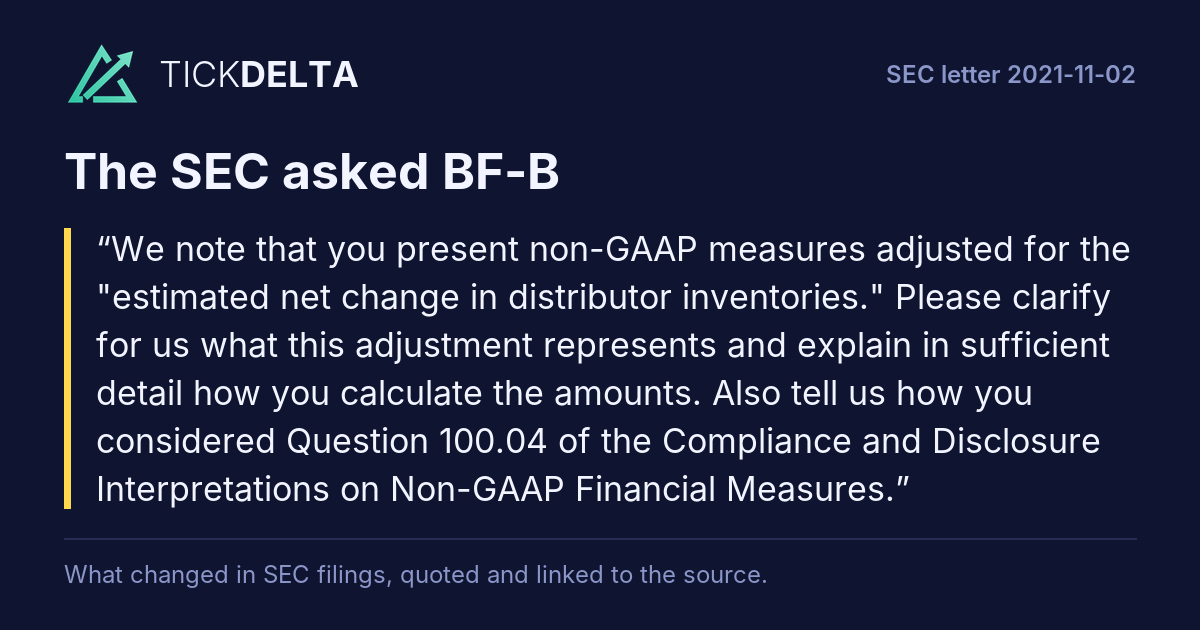
We note that you present non-GAAP measures adjusted for the "estimated net change in distributor inventories." Please clarify for us what this adjustment represents and explain in sufficient detail how you calculate the amounts. Also tell us how you considered Question 100.04 of the Compliance and Disclosure Interpretations on Non-GAAP Financial Measures.
BROWN-FORMAN CORPORATION 850 DIXIE HIGHWAY, LOUISVILLE, KY 40210 WWW.BROWN-FORMAN.COM
The “estimated net change in distributor inventories” adjustment represents the period over period effect of changes in distributor inventories on changes in certain line items of the statements of operations. “Depletions” is a term commonly used in the beverage alcohol industry to describe volume. In this context, depletion means a shipment from our distributor customers to retailers and wholesalers.Read in the reply ↗Rest of the answer
We believe that depletions measure volume in a way that more closely reflects consumer demand than our shipments to distributor customers.
We utilize volumetric shipment information and depletion information from our distributors to estimate the effect of distributor inventory changes. We believe this adjustment isolates the effect of fluctuating levels of distributor inventories on the statements of operations, which allows for a better understanding of our underlying sales to the end customer and known trends in our business.
We sell our products under contracts with different types of customers, depending on the market. Under GAAP (reported results), we recognize revenue when control of the product is transferred to the customer. Depending on the specific arrangement with each customer, control is transferred when the products are either shipped to or delivered to the customer. In the United States, which largely prohibits spirits and wine manufacturers from selling their products directly to consumers, and in certain other markets, we rely on third parties to distribute our brands. In those instances, that shipment does not immediately make its way to our consumers; therefore, there can be a lag between our GAAP sales and the actual demand for our product by consumers, while those goods remain in third-party distributor inventories. This adjustment provides the Company the ability to compare year-over-year changes in our results on a basis that adjusts for the implied year-over-year changes in distributor inventories. By isolating the effect of changes in distributor inventories on our results, we can better understand the underlying sales to the end customer and known trends in our business. For example, if shipments to distributors substantially exceed our distributors’ downstream depletions in a given period, our GAAP net sales growth rate would likely be higher than the continuing trend. That is, we would generally expect our near-term, future GAAP net sales growth rate to decline (a known change in trend) as distributors reduce future orders in light of their elevated inventory position. In this way, we systematically adjust for, and provide a basis for explaining, a typical source of “noise” that affects our trends.
In order to calculate this adjustment, we perform the calculation outlined below on the relevant line items of the statement of operations to determine the dollar amounts that would have been presented if sales transactions were recognized at the time of depletion rather than at the time of shipment. We perform this calculation for the current period and the comparative prior year period. The difference in these two calculations are adjusted out of our reported (GAAP) numbers as the “estimated net change in distributor inventories.” These calculations are performed at a very detailed level, but this simplified example explains the concepts.
Using the monthly result for each particular line item of the P&L that is directly related to the sale of a unit of goods (for example, gross sales, discounts, variable cost) and performed at each brand market level (Germany Woodford Reserve, USA Jack Daniel’s, etc.), the calculation starts with the reported (GAAP) amount, divides that by the number of volumetric shipments (the basis for recording the GAAP amount) to arrive at a per case amount. That per case amount is then multiplied by the number of volumetric depletions in that brand market combination to determine the “depletion-based” number. The difference between the reported GAAP number and the depletion-based number is compared to the same calculation for the prior year period to determine the “estimated net change in distributor inventories”.
We have considered Question 100.04 of the Compliance and Disclosure Interpretations on Non-GAAP Financial Measures; however, we do not believe it applies in this context as we are not substituting individually tailored revenue recognition and measurement methods. Instead, as discussed above, we are identifying the component of the change in reported (GAAP) results that does not accurately reflect known trends. It is important to note that the “estimated net change in distributor inventory” adjustment cannot represent an acceleration of revenue recognition because a case must be shipped by the Company (the basis for revenue recognition) before it can be depleted by a third-party distributor. In any given period, the reported (GAAP) growth could be higher or lower than the underlying results. However, if accumulated over time, the underlying numbers cannot be larger than the reported (GAAP) results. The cumulative difference represents the goods that remain in distributors inventories.
First report after the company's reply of 2021-11-15: 10-Q filed 2021-12-08 ↗, against the 10-Q filed 2021-09-01 ↗.
Tickdelta does not hold the text of both reports, so they are not compared here.
Please expand your disclosure to include discussion and analysis, with equal or greater prominence, of the most directly comparable GAAP financial measure to underlying measures. We note that your results of operations discussions primarily focus on the yearover-year changes in the underlying measures as opposed to movements in the GAAP measures.Rest of the question
Refer to Item 10(e)(1)(i)(A) of Regulation S-K and Question 102.10 of the Compliance and Disclosure Interpretations on Non-GAAP Financial Measures. Notes to Consolidated Financial Statements 1. Accounting Policies
We acknowledge the Staff’s comment and advise the Staff that in future filings that contain a discussion of changes in non-GAAP financial measures we will include, with equal or greater prominence, a discussion of changes in the most directly comparable GAAP financial measures.
Notes to Consolidated Financial Statements
1. Accounting Policies Read in the reply ↗
First report after the company's reply of 2021-11-15: 10-Q filed 2021-12-08 ↗, against the 10-Q filed 2021-09-01 ↗.
Tickdelta does not hold the text of both reports, so they are not compared here.
You disclose that inventories are valued at the lower of cost or net realizable value. Please clarify if you recognize your LIFO inventories at the lower of cost or market or lower of cost or net realizable value and revise your disclosures accordingly. See ASC 330-10-35-1B through -7.
We acknowledge the Staff’s comment and advise the Staff that in future filings we will revise our disclosures to clarify that we recognize our LIFO inventories at the lower of cost or market value. Our proposed revised disclosure (using data from our Form 10-K for the fiscal year ended April 30, 2021, filed with the SEC on June 21, 2021) is as follows:
“Approximately 51% of our consolidated inventories are valued at the lower of cost, using the last-in, first-out (LIFO) cost method, or market value. These inventories include the majority of the U.S. inventories.Read in the reply ↗Rest of the answer
We value the remainder of our inventories at the lower of cost, using the first-in, first-out (FIFO) method, or net realizable value. FIFO cost approximates current replacement cost. If we had used the FIFO method for all inventories, they would have been $311 and $353 higher than reported at April 30, 2020 and 2021, respectively.”
We note your response to prior comment 1. The adjustment for “estimated net change in distributor inventories” appears to change the recognition method of your GAAP measures from a sell-in approach to a sell-through approach, and therefore, appears to substitute individually tailored recognition and measurement methods for those of GAAP.Rest of the question
Please remove this adjustment from future filings or explain why you do not believe it represents a tailored accounting measure.
Brown-Forman Corporation (the “Company”) acknowledges receipt of the letter dated November 18, 2021 (the “Comment Letter”) of the staff of the Division of Corporation Finance (the “Staff”) of the U.S. Securities and Exchange Commission regarding the above referenced filing.
As discussed on the telephone on November 23, 2021, the Company is working to respond to the Comment Letter. However, the Company will require additional time to consider and respond to the Staff’s comment due to the holiday week and the imminent due date for the filing of our Form 10-Q.Read in the reply ↗Rest of the answer
Accordingly, the Company respectfully requests an extension of ten business days to respond to the Comment Letter, such that the Company would respond on or before December 17, 2021.
The Company is grateful for the Staff’s accommodation in this matter. If you have any questions or require any additional information, please contact me at 502-774-7287 or via e-mail at Leanne_Cunningham@B-F.com.
First report after the company's reply of 2021-11-26: 10-Q filed 2021-12-08 ↗, against the 10-Q filed 2021-09-01 ↗.
Tickdelta does not hold the text of both reports, so they are not compared here.
We note your response to comment 1. As part of the description of the “estimated net change in distributor inventories,” please clearly disclose how the percentages are calculated and how to interpret positive and negative changes.
We acknowledge the Staff’s comment and advise the Staff that in future filings we will add, substantially in this form, the following description of the “estimated net change in distributor inventories” (e.g., Definitions section on page 32 of our 2021 Form 10-K).
“Estimated net change in distributor inventories.” We generally recognize revenue when our products are shipped or delivered to customers (See Note 1 to the Consolidated Financial Statements for details on our accounting policies, including revenue recognition).Read in the reply ↗Rest of the answer
In the United States and certain other markets, our customers are distributors that sell downstream to retailers and consumers. We believe that our distributors’ downstream sales more closely reflect actual consumer demand than do our shipments to distributors. Our shipments increase distributors’ inventories, while distributors’ depletions (as described above) reduce their inventories. Therefore, it is possible that our shipments do not coincide with distributors’ downstream depletions and merely reflect changes in distributors’ inventories. Because changes in distributors’ inventories could affect our trends, we believe it is useful for investors to understand those changes in the context of our operating results.
We perform the following calculation to determine the “estimated net change in distributor inventories:”
•For both the current-year period and the comparable prior-year period, we calculate a “depletion-based” amount by (a) dividing the organic* dollar amount (e.g. organic net sales) by the corresponding shipment volumes to arrive at a shipment per case amount, and (b) multiplying the resulting shipment per case amount by the corresponding depletion volumes. We subtract the year-over-year percentage change of the “depletion-based” amount from the year-over-year percentage change of the organic amount to calculate the “estimated net change in distributor inventories”.
•A positive difference is interpreted as a net increase in distributors’ inventories, which implies that organic trends could decrease as distributors’ reduce inventories; whereas, a negative difference is interpreted as a net decrease in distributors’ inventories, which implies that organic trends could increase as distributors rebuild inventories.
*As noted in our previous response, we will cease using the term “underlying” and instead use the term “organic.” We will define “organic” in Presentation Basis “Non-GAAP Financial Measures” similar to how we previously described “underlying” (but without adjusting for the estimated net change in distributor inventories).
First report after the company's reply of 2022-01-31: 10-Q filed 2022-03-03 ↗, against the 10-Q filed 2021-09-01 ↗.
Tickdelta does not hold the text of both reports, so they are not compared here.
Also in this review: company letter, 2021-12-21, closing letter, 2022-02-01