Screener / SEC EDGAR /CIK 0001437578 /10-K filed Feb 26, 2026, compared with Feb 27, 2025 /Numbers from the XBRL of the 10-Ks
NYSE Consumer discretionary · Child Day Care Services

Bright Horizons Family Solutions Inc. BFAM

Compare with peers Embed
SEC comment letters, last 20 years

3 reviews of BFAM's filings by SEC staff

UPLOAD and CORRESP
Reviews 3 latest letter Sep 29, 2025
Questions asked 9 each answered in the company's own letter
No closing letter 0 reviews without a letter saying the staff completed it

When the SEC's staff reviews a filing, it writes to the company with numbered questions, and the company answers each one in a letter. SEC publishes the exchange once the review is over, at least 20 business days later. A question is not an accusation; most reviews end with the company adding detail to its next filing.

How the reviews went

Every review on EDGAR, from the first staff letter to the letter that closes it

  1. 1. Staff letters 4 UPLOAD
  2. 2. Questions in them 9 numbered comments
  3. 3. Company replies 4 CORRESP
  4. 4. Reviews closed 3 of 3 closing letter

Half the closed reviews took 55 days or less from the first letter to the closing letter.

Form 10-K

2025-09-29 to 2025-11-24 · 1 question · 1 letter from the SEC, 1 from the company
Review closed 2025-11-24
RevenueSegments
Item 8. Financial Statements and Supplementary Data
SEC asked
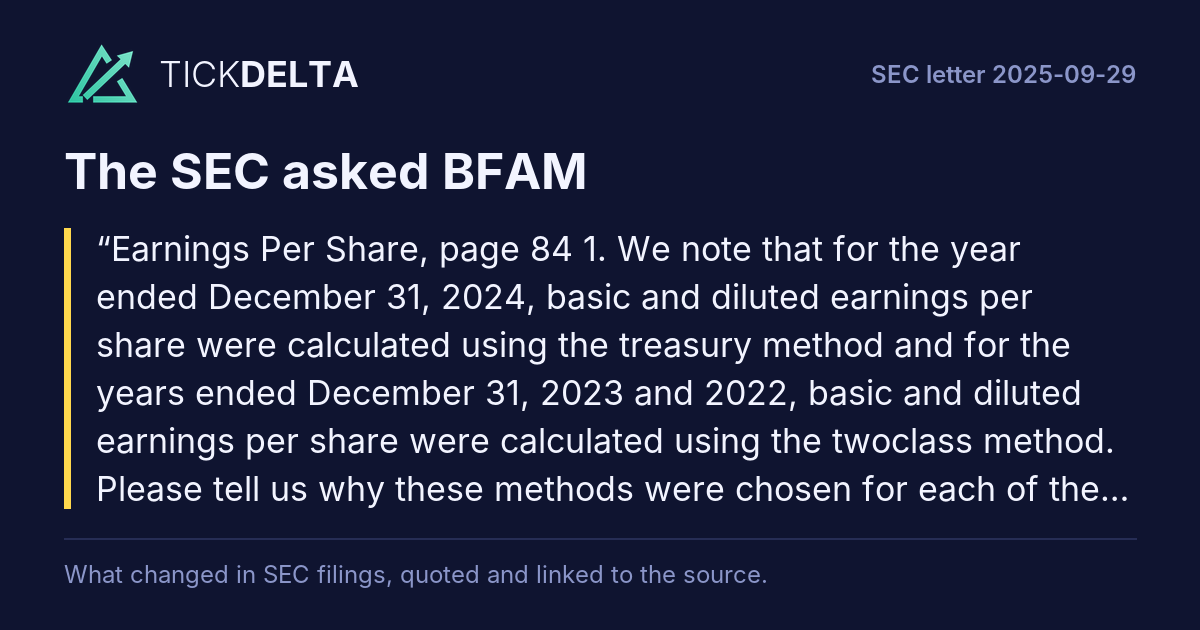
Earnings Per Share, page 84 1. We note that for the year ended December 31, 2024, basic and diluted earnings per share were calculated using the treasury method and for the years ended December 31, 2023 and 2022, basic and diluted earnings per share were calculated using the twoclass method. Please tell us why these methods were chosen for each of the years presented. 18.
Rest of the question

Segment and Geographic Information , page 85 2. Please tell us what consideration you gave to identifying, labeling and presenting significant segment expenses separately with your tabular disclosure here of revenue, cost of services, other expenses and income from operations by reportable segment. Please refer to ASC 280-10-50-26A for further guidance.

BFAM answered
In response to the Staff’s comment, we respectfully advise that we stopped granting awards of Participating Securities (as defined below) in the first quarter of the fiscal year ended December 31, 2022, and this shift in the Company’s practice warranted a change in the methodology used to calculate earnings per share subsequent to the fiscal year ended December 31,

2023.
Rest of the answer

The Company’s 2012 Omnibus Long-Term Incentive Plan, as amended and restated, allows for the issuance of equity awards, including awards of restricted stock with participating rights, which contain non-forfeitable dividend rights and participate equally with our common stock with respect to dividends issued or declared (“Participating Securities”). In accordance with ASC 260-10-45-61A, the Company used the two-class method to calculate basic and diluted earnings per share when such Participating Securities were outstanding. However, as noted above, the Company has not granted Participating Securities since the first quarter of fiscal year ended December 31, 2022 and, at this time, none are expected to be granted in the future. Our other equity awards do not contain participating dividend rights. As a result, the number of unvested shares of Participating Securities has decreased each year as the prior awards vest and the impact of Participating

Securities on earnings per share was de minimis for the fiscal year ended December 31, 2024. Weighted average unvested shares of Participating Securities were 54,476 for the fiscal year ended December 31, 2024, or 0.09% of total weighted average shares outstanding, and as of March 31, 2025, there were no unvested Participating Securities outstanding. In an effort to streamline the Company’s 2024 financial statements and footnote disclosures, the Company no longer presented the two-class method for basic and diluted earnings per share, and instead, used one single class of common stock for calculating basic earnings per share and the treasury method to calculate diluted earnings per share. The reported basic earnings per share of $2.42 and diluted earnings per share of $2.40 for the fiscal year ended December 31, 2024, was the same under both methods.

18. Segment and Geographic Information, page 85

2. Please tell us what consideration you gave to identifying, labeling and presenting significant segment expenses separately with your tabular disclosure here of revenue, cost of services, other expenses and income from operations by reportable segment. Please refer to ASC

280-10-50-26A for further guidance.

Response:

We acknowledge the Staff’s comment regarding the identification, labeling and presentation of significant segment expenses in our tabular segment disclosure. In preparing our segment disclosure, we compiled and reviewed information regularly provided to our Chief Operating Decision Maker (CODM) that includes segment-level financial information. Based on the guidance in ASC 280-10-50-26A, we identified the segment expense data that is either directly presented in or easily computable from these reports, which includes cost of services, overhead (defined as selling, general and administrative expense on our consolidated statements of income), and amortization expense.

Of these categories, we determined that cost of services is a significant segment expense, representing 88%, 73% and 64% of total segment expense for the Full Service, Backup Care and Educational Advisory Services reportable segments, respectively, for the fiscal year ended December 31, 2024. Overhead and amortization expense are the other segment expense items that are directly presented in or are easily computable from the information provided to the CODM, representing approximately 15% and 1%, respectively, of total expense for the fiscal year ended December 31, 2024. We considered both qualitative and quantitative factors, including the percentage and dollar amount of such expenses, the relevance of the expense items to the reportable segment’s operations, and the variability in the size and components of the expense items from period to period, among other factors, and concluded that these items were not significant. We presented these expense items as other expenses in our tabular segment disclosure with the appropriate qualitative footnote disclosure explaining what was included therein. To clarify that such expense items were not considered significant, we will change our labeling of “Other expenses” in our segment disclosure to “Other Segment Items” in future filings.

We hope the foregoing has been responsive to the Staff’s comments. If you have any questions or would like to discuss our response in this letter, please feel free to contact me at (617) 673-8125 at your earliest convenience.

Read in the reply
In its next report

First report after the company's reply of Oct 9, 2025: 10-Q filed Nov 5, 2025 ↗, against the 10-Q filed Aug 7, 2025 ↗.

Tickdelta does not hold the text of both reports, so they are not compared here.

Also in this review: closing letter, 2025-11-24
Form 10-K

2023-06-05 to 2023-06-16 · 1 question · 1 letter from the SEC, 1 from the company
Review closed 2023-06-16
Results discussion (MD&A)
SEC asked
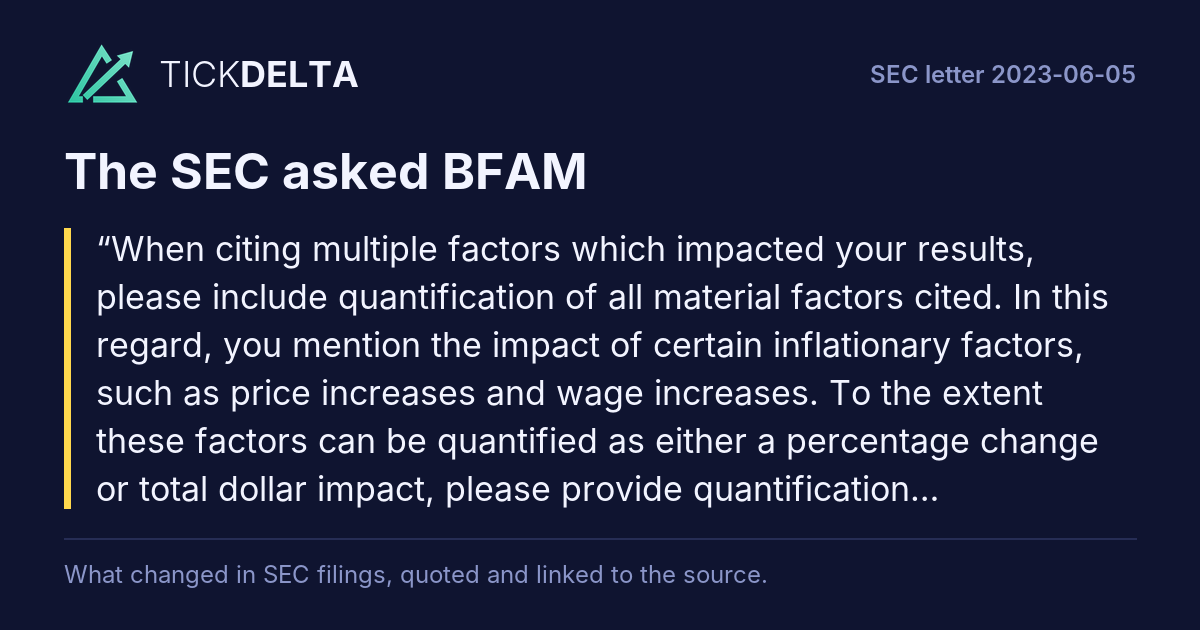
When citing multiple factors which impacted your results, please include quantification of all material factors cited. In this regard, you mention the impact of certain inflationary factors, such as price increases and wage increases. To the extent these factors can be quantified as either a percentage change or total dollar impact, please provide quantification accordingly.
Rest of the question

Additionally, we note from your quarterly earnings calls, the Company regularly discusses utilization and utilization by cohort, and the impact it has on the Company’s results. Please consider including your period over period center utilization to allow investors to understand the impact utilization had on your results. Refer to Item 303(c) of Regulation S-K.

BFAM answered
We acknowledge the Staff’s comment regarding the quantification of material factors impacting our results when multiple factors are cited.

We currently provide qualitative and quantitative disclosures in our quarterly and annual filings to highlight the average tuition rates for different age groups (infants, toddlers and preschoolers) and trends in personnel costs in order to demonstrate the impact of general market and industry trends, including inflationary factors. We note that such inflationary factors can be difficult to distinguish separately from overall market and industry trends.
Rest of the answer

In response to the Staff’s comment, we will supplement our current qualitative and quantitative disclosures related to tuition and wages in future filings, beginning with our Quarterly Report on Form 10-Q for the quarter ended

June 30, 2023, to also include quantitative information regarding average tuition increases and average wage rate increases. We further acknowledge that, to the extent inflation continues to have a material impact on our business and results of operations, we will continue to evaluate our related disclosures and include, in future periodic filings, additional quantitative information when possible and helpful to investors.

We also acknowledge the Staff’s comment regarding utilization. We currently disclose the overall percentage change in enrollment, which we believe is the most important driver of our full service center-based child care segment results. In response to the Staff’s comment, we will supplement our disclosures in future filings, beginning with our Quarterly Report on Form 10-Q for the quarter ended June 30, 2023, with additional comparative center utilization (for example, percentage of full-service centers open since the beginning of Q3 2021 that are operating at utilization levels above 70%, between 40% and 70%, and less than 40%, with commentary about significant changes during the period) to help investors understand the financial performance of the full service center-based child care segment during this continued period of enrollment recovery.

We hope the foregoing has been responsive to the Staff’s comments. If you have any questions or would like to discuss our response in this letter, please feel free to contact me at (617) 673-8125 at your earliest convenience.

Read in the reply

Also in this review: closing letter, 2023-06-16

Form 10-K

2020-12-29 to 2021-02-22 · 7 questions · 2 letters from the SEC, 2 from the company
Review closed 2021-02-22
RevenueSegmentsResults discussion (MD&A)AcquisitionsCritical estimatesDerivatives and hedging
After reviewing your response to these comments, we may have additional comments. MD&A · Results of Operations, page 30
SEC asked (1)
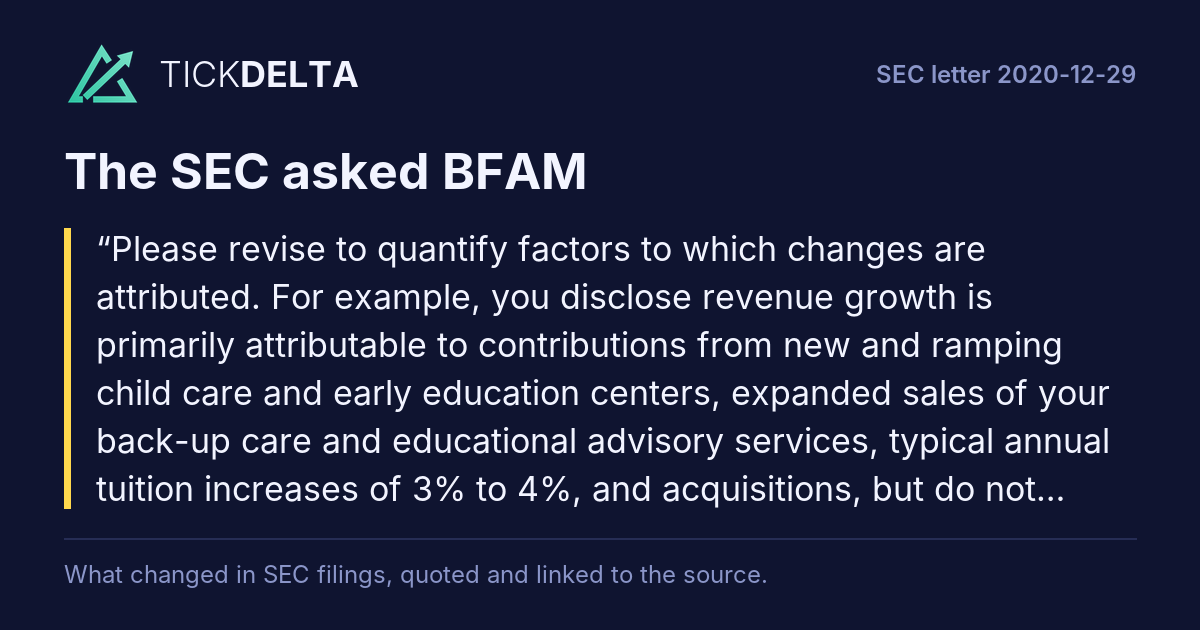
Please revise to quantify factors to which changes are attributed. For example, you disclose revenue growth is primarily attributable to contributions from new and ramping child care and early education centers, expanded sales of your back-up care and educational advisory services, typical annual tuition increases of 3% to 4%, and acquisitions, but do not quantify these factors.
Rest of the question

Please consider providing such quantification of factors in tabular form with the remaining written narrative focused on analyzing the reasons for such changes. Please also tell us your consideration of discussing and analyzing results of operations for each of your reportable segments. Refer to Item 303(a) of Regulation S-K.

BFAM answered
We acknowledge the Staff’s comment with respect to factors contributing to changes in our revenue and results of operations and will provide additional disclosure in our upcoming Annual Report on Form 10-K for the year ended December 31, 2020 (the “2020 Form 10-K”) to quantify the material components of revenue and to enhance the narrative analyzing changes in our revenue and results of operations and the material factors contributing to such changes.
Rest of the answer

By way of illustration, please refer to the sample MD&A discussion of our results of operations for the year ended December 31, 2019 compared to the prior year as redlined to show the Company’s proposed changes (the “Sample MD&A”) attached as Exhibit 1.

With respect to our results of operations for each of our reportable segments, we respectfully advise the Staff that in our previous consideration of Item 303(a) of Regulation S-K, we determined that a discussion and analysis of our results of operations by financial statement line item enhances the reader’s understanding of our consolidated financial statements while providing insight as to the contributions from each reportable segment. We believe this presentation best reflects how we manage and analyze our business, and aligns with our consolidated financial statements and footnotes while providing the reader with an understanding of our business drivers and financial condition. We manage and measure performance for our segments at the income from operations level and discuss the drivers of operating performance by reportable segment under the caption Income from Operations in MD&A. In light of the Staff’s comment, in addition to our existing disclosure, we will add a table summarizing income from operations for each reportable segment to enhance the narrative description of material factors and performance drivers impacting the changes in our results of operations for each of our reportable segments. Please refer to the Sample MD&A attached as Exhibit 1.

Read in the reply
In its next report

First report after the company's reply of Jan 19, 2021: 10-K filed Mar 1, 2021 ↗, against the 10-K filed Feb 27, 2020 ↗.

Tickdelta does not hold the text of both reports, so they are not compared here.

After reviewing your response to these comments, we may have additional comments. MD&A · Results of Operations, page 30
SEC asked (2)
We note that under your profit and loss models you retain the financial risk of operating child care centers and that under your cost-plus model you receive a fee from the employer sponsor for managing/operating their center and may also receive an operating subsidy to supplement tuition paid by parents.
Rest of the question

Based on this, it appears your revenue for the full service center-based child care segment consists of tuition from parents, management/operating fees from employer sponsors, and operating subsidies from employer sponsors. We note from your Form 10-Q for the fiscal quarter ended September 30, 2020 that you have experienced the impact of the COVID-19 pandemic on your business, which has substantially disrupted your global operations and resulted in a 46% decrease in full service center-based child care segment revenue. The extent to which your revenue for this segment changed, or is at risk of fluctuation, due to changes in enrollment (i.e., tuition) is not clear. Please expand MD&A to present a separate table quantifying the amounts of each significant component of revenues for this segment and to discuss and analyze the reasons for material changes in each component. Refer to the requirements of Item 303(a)(3) of Regulation S-K.

BFAM answered
We acknowledge the Staff’s comment with respect to revenue in our full service center-based child care segment and will expand the

MD&A section of our 2020 Form 10-K to present tabular disclosure quantifying the material components of revenue and will include a narrative discussion analyzing the reasons for material changes for each component. By way of illustration, please refer to the Sample MD&A attached as Exhibit 1.
Read in the reply
In its next report

First report after the company's reply of Jan 19, 2021: 10-K filed Mar 1, 2021 ↗, against the 10-K filed Feb 27, 2020 ↗.

Tickdelta does not hold the text of both reports, so they are not compared here.

Note 1. Organization and Significant Accounting Policies · Revenue Recognition and Deferred Revenue, page 52
SEC asked (3)
Your disclosure here primarily explains the general accounting model for revenue recognition under ASC 606. Your disclosure in Note 2 - Revenue Recognition primarily explains the nature of your service offerings.
Rest of the question

Please consider combining these revenue policy disclosures and refocusing them to explain how you measure and recognize revenue for your various types of contracts with customers so that the disclosure is specific to you. For example, in your disclosure on page 55 on full service center-based child care, you state revenue from fixed and variable fees for full service center-based child care is recognized over time as services are rendered. However, it is not clear from this disclosure to what fixed and variable fees you refer and what specifically you mean by over time (e.g., each month). Please also consider similar changes to your critical accounting estimates disclosure on page 38 and also include there the significant judgments and estimates involved in your accounting for contracts with customers, if any.

BFAM answered
We acknowledge the Staff’s comment with respect to the disclosure of our revenue recognition policies in Note 1 - Organization and Significant Accounting Policies and Note 2 - Revenue Recognition and will revise the notes in the 2020 Form 10-K to combine the disclosure of the policies into Note 1, and further describe how we measure and recognize revenue for our various types of contracts with customers.
Rest of the answer

Additionally, in response to the Staff’s comment, we will expand our disclosure in Note 1 to specify the significant judgments and estimates involving our accounting for contracts with customers. By way of illustration, please refer to the revenue recognition policies in the sample Note 1 - Organization and Significant Accounting Policies disclosure for the year ended

December 31, 2019 (modified for Staff comments and expected updates for fiscal year 2020 activity) attached as Exhibit 2. We will also make similar proposed changes to our critical accounting policies disclosure within MD&A.

Read in the reply
In its next report

First report after the company's reply of Jan 19, 2021: 10-K filed Mar 1, 2021 ↗, against the 10-K filed Feb 27, 2020 ↗.

Tickdelta does not hold the text of both reports, so they are not compared here.

Note 1. Organization and Significant Accounting Policies · Revenue Recognition and Deferred Revenue, page 52
SEC asked (4)
We note from your disclosure on page 28 that under both the sponsor and cost-plus business models, the sponsor or employer funds development of the facility, preopening/start-up capital equipment, and ongoing maintenance and repair costs. Please tell us the accounting consequence to you from these transactions, if any.
BFAM answered
In response to the Staff’s comment, we respectfully advise the Staff that we enter into contracts with employer clients to manage and operate their child care centers that include a management fee (which we refer to as cost-plus model), or to provide child care services to their employees on either an exclusive or priority basis (which we refer to as sponsor model).

In both the sponsor and cost-plus business models, the employer sponsor generally funds the development of the child care center (which is owned or leased by the sponsor), funds the pre-opening/start-up capital equipment, and
Rest of the answer

retains responsibility for ongoing maintenance and repair costs. As a result, the capital assets associated with the facility are owned by the employer sponsor and are not included in our financial statements or results of operations. While we use the assets in conjunction with providing the specified services, the right to use the assets is typically linked to the revenue arrangement for the applicable term and is restricted for the use defined by the employer sponsor (we therefore do not account for the use of assets owned by the employer sponsor as a lease). We are responsible under our contracts with the employer sponsor to provide child care services to the applicable parents, and to staff, operate and maintain the child care center. Accordingly, we incur center operating expenses, including on-going maintenance and repair costs, as part of our operations. For cost-plus centers, to the extent that center operating costs exceed revenues from tuition paid by parents, employers pay us operating subsidies in addition to the management fee to cover the deficiency, which subsidies are included in revenue.

Read in the reply
In its next report

First report after the company's reply of Jan 19, 2021: 10-K filed Mar 1, 2021 ↗, against the 10-K filed Feb 27, 2020 ↗.

Tickdelta does not hold the text of both reports, so they are not compared here.

Note 1. Organization and Significant Accounting Policies · Revenue Recognition and Deferred Revenue, page 52
SEC asked (5)
We note from your disclosure on page 28 that under the cost-plus business model, you receive a fee from the employer sponsor for managing and operating their center and may also receive an operating subsidy to supplement tuition paid by parents. We also note that these contracts have a typical term of three to five years.
Rest of the question

Please tell us how you account for the management/operating fee and the potential operating subsidy. In your response, please address whether the contractual rates for any of these amounts vary over time under the term of the contracts. Please also tell us what generally causes operating subsidies to be due to you, how such amounts are generally determined, and how you determine the amount and timing of recognition of such amounts.

BFAM answered
In response to the Staff’s comment, we respectfully advise the Staff that under the cost-plus business model, we enter into contracts with employer sponsors to manage and operate their child care centers. We are responsible for staffing and managing the child care center, and are therefore the principal in the arrangement. Accordingly, we manage and incur the center operating expenses and receive revenues from tuition paid by parents and from a management fee.
Rest of the answer

In certain arrangements, a subsidy from the employer sponsor is received if center operating costs exceed parent tuition revenues.

The full-service child care offering provided to parents and the employer sponsor is a series of distinct services that are substantially the same and have the same pattern of transfer to the customer over time, which transfers daily. The tuition paid by parents and the management fee is recognized on a daily basis, but for convenience is recorded on a monthly basis (i.e., the same monthly amount within the contract year using the time-elapsed method). As discussed above, certain arrangements provide that the employer sponsor pay operating subsidies in lieu of, or to supplement, parent tuition. The employer subsidy, which consists of variable consideration, is typically calculated as the difference between parent tuition revenue and the operating costs for the center for each respective month and is recognized as revenue in the month the services are provided. The variable consideration relates specifically to our efforts to transfer each distinct daily service, and the allocation of the variable consideration earned to that distinct day in which those activities are performed is consistent with the overall allocation objective described in ASC

606-10-32-28.

The management fee included in these contracts is typically a monthly amount and generally includes an annual escalator that is intended to reflect expected future cost increases. Annual escalators are generally stated as a percentage or as a reference to a consumer price index. The contracts also generally include a termination right with a notice period. Accordingly, we would not be entitled to any escalated fees unless the termination right is not exercised (i.e., the contact is renewed). We allocate revenue for contracts with an accounting term in excess of one year to the applicable contract year based on the rates applicable for that annual period, which is commensurate with the expected increases to the cost of providing the service, our standard pricing practices, as well as the overall allocation objective of ASC

Read in the reply
In its next report

First report after the company's reply of Jan 19, 2021: 10-K filed Mar 1, 2021 ↗, against the 10-K filed Feb 27, 2020 ↗.

Tickdelta does not hold the text of both reports, so they are not compared here.

General
SEC asked (6)
We note that your certificate of incorporation provides that the Court of Chancery of the State of Delaware is the sole and exclusive forum for “any derivative action or proceeding brought on behalf of the Corporation.” Please tell us, and disclose in future filings, whether this provision applies to actions arising under the Exchange Act and/or the Securities Act.
Rest of the question

In this regard, we note that Section 27 of the Exchange Act creates exclusive federal jurisdiction over all suits brought to enforce any duty or liability created by the Exchange Act or the rules and regulations thereunder. We also note that Section 22 of the Securities Act creates concurrent jurisdiction for federal and state courts over all suits brought to enforce any duty or liability created by the Securities Act or the rules and regulations thereunder. If the provision applies to federal securities law claims, please also disclose in future filings that that investors cannot waive compliance with the federal securities laws and the rules and regulations thereunder.

BFAM answered
response to the Staff’s comment, we respectfully advise the Staff that our forum selection provision provides that the Court of Chancery of the State of Delaware has exclusive jurisdiction over only certain matters to the “fullest extent permitted by applicable law.” Accordingly, this provision is not intended to apply to (1) claims arising under the Securities Exchange Act of 1934, as amended, for which federal courts have exclusive jurisdiction, and (2) claims arising under the Securities Act of 1933, as amended, for which federal and states courts have concurrent jurisdiction.
Rest of the answer

In response to the Staff’s comment, we will add the following disclosure to the relevant risk factor in our 2020 Form 10-K to clarify that the forum selection provision in our certificate of incorporation will not apply to actions arising under the Exchange Act and Securities Act and we will include similar disclosure in other future filings, as applicable.

“The exclusive forum provision in the Company’s certificate of incorporation will not preclude or contract the scope of exclusive federal or concurrent jurisdiction for actions brought under the federal securities laws including the Securities Exchange Act of 1934, as amended, or the Securities Act of 1933, as amended, or the respective rules and regulations promulgated thereunder.”

We hope the foregoing has been responsive to the Staff’s comments. If you have any questions or would like to discuss our response in this letter, please feel free to contact me at (617) 673-8125 at your earliest convenience.

Read in the reply
General
SEC asked
We note your response to prior comment 6. Please revise to clarify what you mean by the statement that the provision does not "preclude or contract" the scope of exclusive federal or concurrent jurisdiction for any actions brought under the Securities Act or the Exchange Act.
Rest of the question

If you mean that the provision does not apply to claims arising under the federal securities laws, as stated in your response, please confirm that you will include disclosure in future filings stating this directly.

BFAM answered
In response to the Staff’s comment, we respectfully advise the Staff that our forum selection provision does not apply to claims arising under the federal securities laws. We propose to revise the following risk factor in our Annual Report for the fiscal year ended December 31, 2020 as redlined to show the Company’s proposed changes and we will include similar disclosure in other future filings, as applicable:

Our certificate of incorporation designates the Court of Chancery of the State of Delaware as the sole and exclusive forum for certain types of actions and proceedings that may be
Rest of the answer

initiated by our stockholders, which could limit our stockholders’ ability to obtain a favorable judicial forum for disputes with us or our directors, officers or employees.

Our certificate of incorporation provides that, subject to limited exceptions, the Court of Chancery of the

State of Delaware will be the sole and exclusive forum for (i) any derivative action or proceeding brought on our behalf, (ii) any action asserting a claim of breach of a fiduciary duty owed by any of our directors, officers or other employees to us or our stockholders, (iii) any action asserting a claim against us arising pursuant to any provision of the Delaware General Corporation Law, our certificate of incorporation or our bylaws, or (iv) any other action asserting a claim against us that is governed by the internal affairs doctrine. Any person or entity purchasing or otherwise acquiring any interest in shares of our capital stock shall be deemed to have notice of and to have consented to the provisions of our certificate of incorporation described above. This choice of forum provision may limit a stockholder’s ability to bring a claim in a judicial forum that it finds favorable for disputes with us or our directors, officers or other employees, which may discourage such lawsuits against us and our directors, officers and employees. Alternatively, if a court were to find these provisions of our certificate of incorporation inapplicable to, or unenforceable in respect of, one or more of the specified types of actions or proceedings, we may incur additional costs associated with resolving such matters in other jurisdictions, which could adversely affect our business and financial condition.

The exclusive forum provision in our certificate of incorporation does not apply to claims brought pursuant to United States federal securities laws including the Securities Exchange Act of 1934, as amended or the Securities Act of 1933, as amended. The exclusive forum provision in our certificate of incorporation will not relieve us of our duty to comply with the federal securities laws and the rules and regulations thereunder, and stockholders will not be deemed to have waived our compliance with these laws, rules and regulations.

We hope the foregoing has been responsive to the Staff’s comment. If you have any questions or would like to discuss our response in this letter, please feel free to contact me at (617) 673-8125 at your earliest convenience.

Read in the reply

Also in this review: closing letter, 2021-02-22

From the SEC's correspondence on EDGAR: staff letters (form UPLOAD) and company letters (form CORRESP), 11 letters filed since 2020-12-29. Questions and answers are matched by their numbers; topics come from words in each question. The reports are compared word for word (same form, before the first SEC letter against the first report after the company's reply). No AI.

Sources

The SEC's correspondence on EDGAR: staff letters (form UPLOAD) and company letters (form CORRESP), matched question by question. No AI.

Also

Filings: the letters in the filing list.

Work with it

Excel workbook · CSV. Google Sheet that stays up to date: paste =IMPORTDATA("https://tickdelta.com/company/BFAM/export.csv") into a cell.

Next in Owners and insiders:Insider trades
Esc

Type a ticker such as AAPL, a name, an investor such as Buffett, or a topic such as tariffs. ↑ ↓ to move, Enter to open.