Bread Financial Holdings, Inc. BFH
New risk paragraphs, branching off last year
Each branch is a paragraph in Risk Factors with nothing like it in the 10-K filed Feb 14, 2025. A box jumps to the paragraph as filed, below.
Paragraphs with nothing like them in last year's 10-K
30 paragraphs in Risk Factors of the 10-K filed Feb 13, 2026 with nothing like them in the 10-K filed Feb 14, 2025. Quoted exactly. Paragraphs that were only edited are under 10-K change.
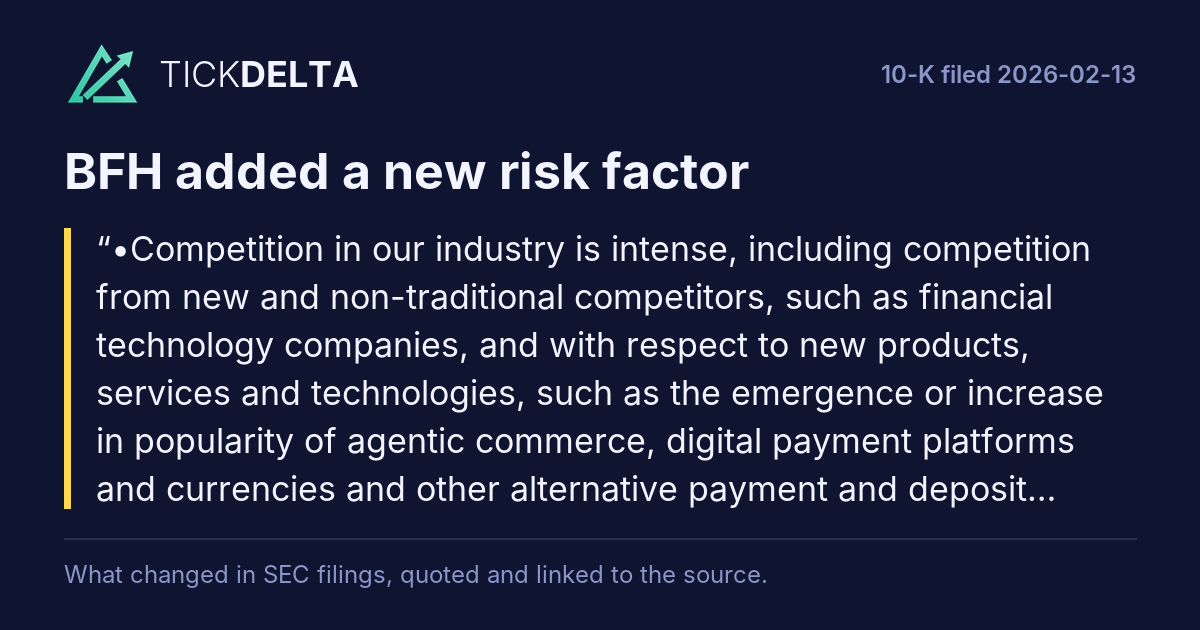
•Competition in our industry is intense, including competition from new and non-traditional competitors, such as financial technology companies, and with respect to new products, services and technologies, such as the emergence or increase in popularity of agentic commerce, digital payment platforms and currencies and other alternative payment and deposit solutions.
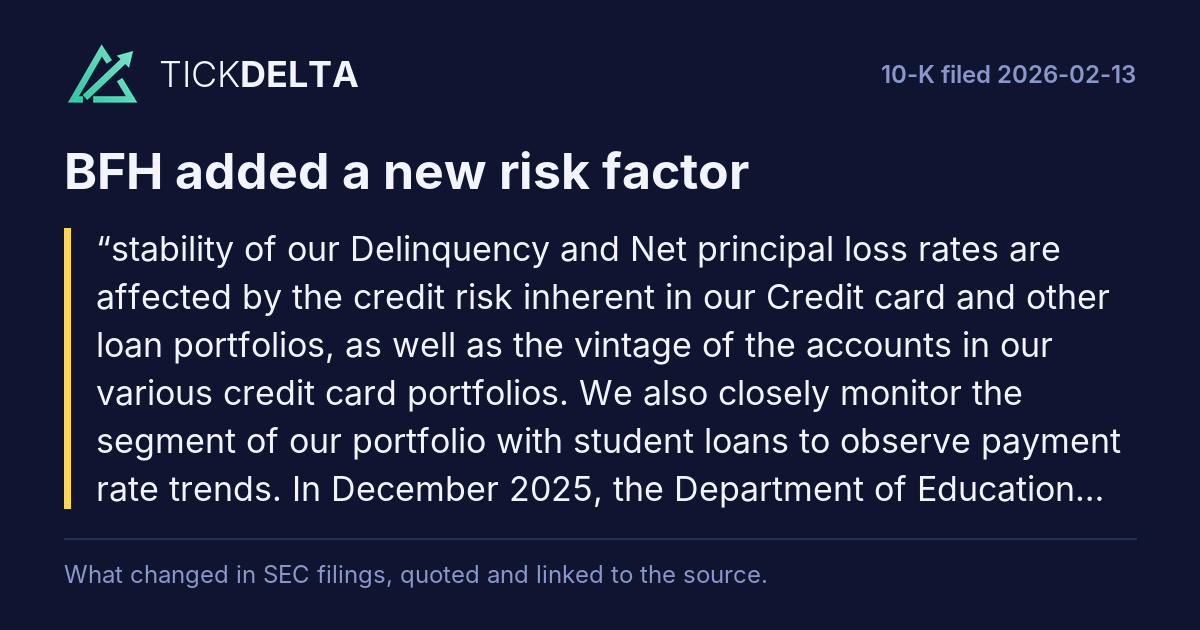
stability of our Delinquency and Net principal loss rates are affected by the credit risk inherent in our Credit card and other loan portfolios, as well as the vintage of the accounts in our various credit card portfolios. We also closely monitor the segment of our portfolio with student loans to observe payment rate trends. In December 2025, the Department of Education announced that, beginning in early 2026, the federal government would begin garnishing wages of student loan borrowers that are in default on federal student loans; provided that the Department of Education subsequently announced that it was indefinitely postponing any such garnishments. The impact of this policy change, to the extent it becomes effective, on our customers’ ability to repay us remains uncertain.
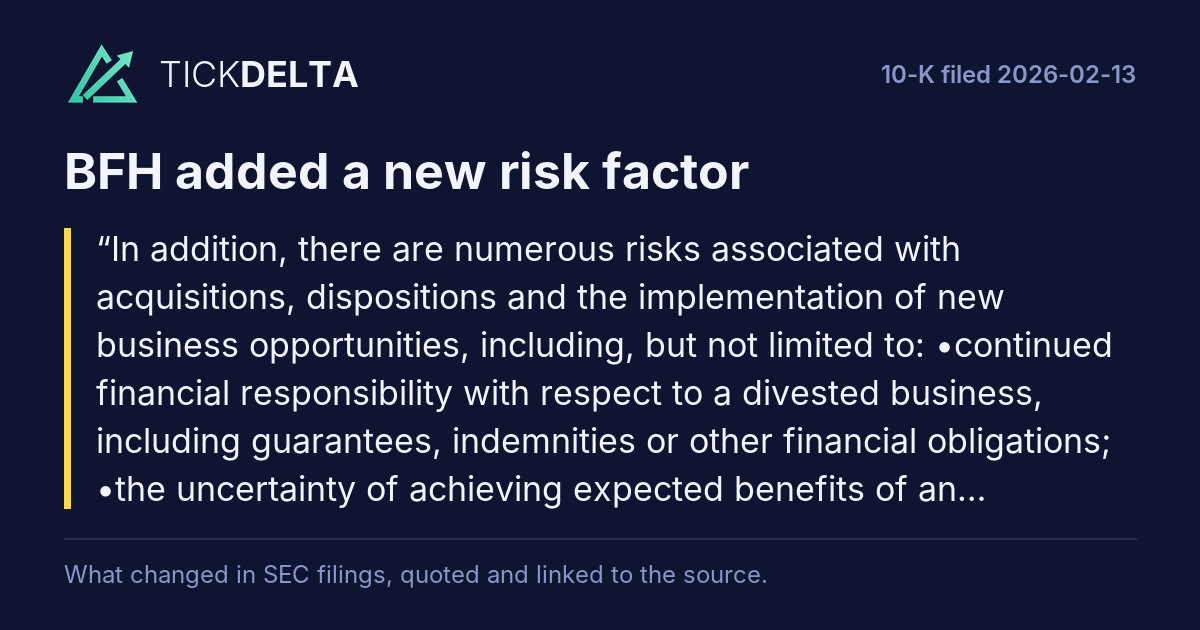
In addition, there are numerous risks associated with acquisitions, dispositions and the implementation of new business opportunities, including, but not limited to:
•continued financial responsibility with respect to a divested business, including guarantees, indemnities or other financial obligations;
•the uncertainty of achieving expected benefits of an acquisition or disposition, including revenue, human resources, technological or other cost savings, operating efficiencies or synergies;
•the inability to integrate systems, personnel or technologies from our acquisitions and strategic investments;
•unforeseen legal, regulatory or other challenges that we may not be able to manage effectively; and
•the reduction of cash available for operations, payment of dividends, stock repurchase programs or other uses and potentially dilutive issuances of equity securities or incurrence of additional debt.
The court’s ruling against the plaintiffs will be appealed. Unless the plaintiffs obtain a stay or injunction during the appeal process or the legislature otherwise intervenes, the prohibition on charging interchange fees on sales tax and gratuities in Illinois will become effective July 1, 2026. Similar legislation has been introduced in other states and, absent a successful legal challenge, these bills would have a number of adverse impacts on us, including negatively impacting our interchange revenue and creating operational challenges. In addition, in November 2025, a proposed settlement was announced in the long-standing Visa/Mastercard litigation, which began in 2005 when a class of merchant plaintiffs alleged that Visa and Mastercard, along with their member banks, engaged in anti-competitive practices by collectively setting excessive interchange fees and imposing other restrictive rules on merchants. The proposed settlement would, among other items, reduce interchange fees and give merchants greater choice in accepting credit cards in various categories, which could have various adverse impacts on our business, including reduced interchange revenue and decreased acceptance of certain of our cards by retailers. The proposed settlement remains subject to court approval, and we can provide no assurance with respect to the timing or outcome of the court approval process or the effects on us of the settlement if approved.
result of these hurricanes, we froze delinquency progression for cardholders in Federal Emergency Management Agency (FEMA) identified impact zones for one billing cycle, which resulted in modestly lower Net principal losses and Net principal loss rate in the fourth quarter of 2024, and consequently negatively impacted Net principal losses and the Net principal loss rate in the second quarter of 2025.
Show the other 9
Maintaining a positive reputation is critical to attracting and retaining partners, customers, investors and employees. Damage to our reputation can therefore cause significant harm to our business and prospects. Harm to our reputation can arise from numerous sources, including, among others:
•the use of our, or our partners’ products to facilitate legal, but controversial, products and services; and
Further, while the current Presidential Administration and the congressional majorities in the U.S. Senate and House of Representatives have supported reducing the regulatory burden, the scope of legislation, executive action and regulation and the intensity of supervision will likely remain uncertain in the current regulatory and political environments at both the
federal and state levels, including with respect to late fees and credit card interest rates. Moreover, in certain cases, uncertainty at the federal level has prompted a rise in state lawmakers, regulators and attorneys general taking more active roles in consumer finance regulation and enforcement, potentially creating a complex regulatory patchwork in areas such as interchange fees, credit card reward programs and other matters. Such changes could subject us to additional costs, limit the types of financial services and products we may offer, and/or limit what we may charge for certain banking services, among other things.
Examples of federal and state legislation that we track include legislation intended to place caps on the interest rates that we and other financial institutions are permitted to charge. For instance, in 2023, Colorado passed a law (initially scheduled to be effective July 2024) to “opt out” of the national standard interest rate for interstate loans by state-chartered banks as provided by federal law in the Depository Institutions Deregulation and Monetary Control Act (DIDMCA). By opting out of DIDMCA, Colorado would have the ability to regulate and limit interest rates on loans “made in” Colorado, and the Colorado law would generally cap interest rates at 21% and late fees at $15 with a 10-day grace period. In June 2024, the U.S. District Court for the District of Colorado preliminarily enjoined Colorado from enforcing the interest rates in the Colorado Uniform Consumer Credit Code with respect to any loan made by the plaintiffs’ members to the extent the loan is not made by a lender in Colorado and the applicable interest rate in 12 U.S.C. 1831d(a) exceeds the rate that would otherwise be permitted. In November 2025, the U.S. Court of Appeals for the Tenth Circuit reversed the District Court’s preliminary injunction, concluding that “made in” encompasses loans in which either the lender or the borrower is located in Colorado, meaning that Colorado could impose interest-rate caps on loans made by out-of-state banks to Colorado borrowers. The plaintiffs in the litigation (who are opposing the Colorado law) are challenging this ruling.
Legislatures in other states have proposed similar laws in the past and may again in the future. We cannot provide any assurance as to the final outcome of this or other similar proposed or future legislation in other states, any of which would have an adverse effect on our business and results of operations. While still subject to potential reversal, the recent Tenth Circuit decision could also encourage other states to adopt similar legislation. In addition, President Trump and various federal legislators have also made public statements regarding potential efforts to place caps on credit card interest rates, and a bill was introduced in the U.S. Senate in February 2025 proposing to cap credit card interest rates at 10% for a period of five years. Most recently, in January 2026, President Trump made public statements on social media and elsewhere in support of placing a cap of 10% on credit card interest rates for a one-year period. The likelihood of any such cap being effectuated in any new executive action, legislation or regulation remains uncertain, but any such cap on interest rates would significantly limit our ability to extend credit to certain of our customers and would have a material adverse effect on our business, results of operations and financial condition.
We may not realize the expected benefits of the pending merger of our subsidiary Banks.
Realization of the potential benefits contemplated by the planned internal merger of CCB and CB, with CCB as the surviving entity, depend on a number of factors, including regulatory approval of state and federal banking agencies, as well as our ability to timely and successfully integrate the operations of the merging subsidiaries into a single bank operation. As a result, we may not be successful in realizing the expected operational and financial benefits of the pending merger of our subsidiary Banks, and we may experience other adverse consequences, including the diversion of management’s attention from other business concerns and unforeseen legal, regulatory or other challenges that we may not be able to manage effectively.
Information security risks for large financial institutions have increased with the adoption of new technologies to conduct financial and other business transactions, including those used on mobile devices, and the increased sophistication and
We face numerous and evolving cybersecurity risks that threaten the confidentiality, integrity and availability of our IT Systems and Confidential Information. Our ability, and that of our third-party service providers and brand partners, to protect our IT Systems and Confidential Information against damage, loss or performance degradation from power loss, network failure, cyber-attacks, including ransomware or denial of service attacks, social engineering/phishing, use of AI technologies by bad actors, deepfakes, insider threats, state-sponsored threats, hardware and software defects or malfunctions, human error, computer viruses or other malware, misconfigurations, bugs or other vulnerabilities, malicious code embedded in open-source software, disruptions in telecommunications services, fraud, fires and other disasters and other events, is critical. Because the tactics, techniques and procedures used to obtain unauthorized access, or to disable or degrade systems, change frequently, have become increasingly more complex and sophisticated, and may be difficult to detect for periods of time, we may not anticipate these acts or respond adequately or timely. For example, cybercriminals have increasingly demonstrated advanced capabilities, such as use of zero-day vulnerabilities, and rapid integration of new technology such as GenAI are being used by threat actors to create sophisticated attacks that are increasingly automated, targeted and more difficult to defend against.
wide-reaching consequences, including the potential to disrupt the overall financial system and other key systems in the global economy.
In addition, the adoption of agentic commerce, in which autonomous AI agents initiate and execute transactions on behalf of users, presents novel and complex regulatory, privacy and cybersecurity risks, as well as risks relating to potential integrations with other agentic commerce applications. Legal frameworks governing such autonomous agents remain nascent, with limited direct guidance specific to payments. The interplay between payments regulations, data privacy laws and evolving AI regulations may create uncertainty around compliance and disclosure obligations and potential liability exposure as more participants (including retailers, fintechs and AI developers) enter the agentic commerce ecosystem. The market is still assessing how regulators may apply existing consumer protection and other laws in the context of AI. As agentic commerce solutions scale, we may also see increased instances of erroneous or disputed payments and other adverse impacts.
While we believe that each of these suits and any other claims in connection with the spinoff are without merit and we will defend ourselves vigorously, the damages being sought are significant, and litigation is complex with inherently uncertain outcomes. In the event we are found liable or reach a settlement in one or more of these actions, we may be required to pay significant awards or judgments, settlements, costs or fines, and/or we may lose entitlement to certain tax refunds that are currently recorded as other assets on our audited Consolidated Balance Sheets. Moreover, any litigation or dispute arising out of or relating to the spinoff could distract management, result in significant legal and other costs, result in downgrades to our credit ratings and otherwise adversely impact our liquidity, capital resources, access to financing, results of operations and financial condition. We cannot provide any assurance that the insurance coverage that we maintain would be adequate to cover any settlements or liabilities actually incurred in these matters or that our insurers would not seek to deny coverage as to any or all of any such amounts.
We operate several internal management committees to oversee risk governance and management across the enterprise. The Enterprise Risk Management Committee (ERMC), established in 2025 as part of our initiatives to enhance our enterprise-level risk oversight, is the highest-level risk management committee at the enterprise level. The ERMC is chaired by our CRO and is responsible for overseeing the design and implementation of the ERM Framework, as well as reviewing and monitoring our enterprise risk profile against the defined risk appetite, including making recommendations on such risk appetite and reviewing or escalating matters from, or referred to by, other management-level risk committees. At each of our Banks, we also operate an equivalent risk management committee, along with other management committees for oversight of specific risk categories.
At the enterprise level, we also maintain an Operating Committee (OC), Asset & Liability Management Committee (ALCO) and Capital Management Committee (CMC).
The OC is a management committee composed of senior officers and is chaired by the Senior Vice President of Business Strategy. The OC is responsible for assisting our executive leadership team in overseeing the strategic direction, operational performance and risk management of the Company. With respect to risk management, the OC’s responsibilities include monitoring and evaluating the Company’s operational performance, key financial metrics and risk profile, setting an appropriate risk culture, seeking to resolve risks impacting the achievement of organizational goals and improving risk management discipline.
The ALCO is a management committee comprised of senior officers and is chaired by the Treasurer. The ALCO is responsible for assisting our Board of Directors and our executive leadership team in overseeing, reviewing and monitoring consolidated funding and liquidity, capital, market and investment risks. The ALCO’s responsibilities also include assisting
our executive leadership team in its management of our capital, funding and liquidity resources, interest rate sensitivity and our balance sheet more broadly.
The CMC is a management committee comprised of senior officers and is chaired by the Head of Corporate & Capital Planning. The CMC is responsible for assisting our Board of Directors and our executive leadership team with capital planning and oversight by monitoring our capital and providing guidance and recommendations on the use and distribution of capital. The CMC’s responsibilities also include review of the capital plan, annual budget and long-range plan, stress testing and making recommendations for capital thresholds and tolerances, capital buffers, capital targets and significant capital decisions.
During 2025 we made various enhancements to our risk management practices, completing the establishment of eight enterprise-level risk pillars equivalent to the risk pillars that historically have already been in place at our Banks. Each risk pillar includes Board of Directors approved risk appetites, regular management monitoring and oversight, and at a minimum quarterly, and more frequently as appropriate, reporting to the Risk & Technology Committee.
Paragraphs in the 10-Q filed Oct 27, 2026 that were not in the one before
New in the latest 10-Q
13 paragraphs in the 10-Q filed Oct 27, 2026 with nothing like them in the 10-Q filed Jul 28, 2026 (at least half the words must differ; new numbers alone do not count). Quoted exactly, grouped by the item heading above them. This is text that changed, not a judgement of how serious it is.
10-Q
resilient consumer, combined with stable macroeconomic conditions, our disciplined credit management and continued risk and product mix shifts.
Read in the 10-Q
• Information processing and communication increased primarily due to new software investments and increased technology-related service contract costs.
Read in the 10-Q
• Depreciation and amortization decreased primarily due to lower amortization related to capitalized and acquired software.
Read in the 10-Q
In October 2026 two of our credit rating agencies refreshed their credit ratings and related outlooks for our Parent Company. Moody’s upgraded their credit ratings of our Parent Company’s senior unsecured debt, subordinated debt and preferred stock and changed their outlook from “Positive” to “Stable” in conjunction with their upgrades. Fitch affirmed their credit ratings for our senior unsecured debt and preferred stock, and upgraded their credit ratings of our subordinated debt; they also affirmed their “Stable” outlook in conjunction with this refresh of their credit ratings. S&P has not published updated ratings as of the date of this report.
Read in the 10-Q
In September 2026, we entered into an amendment to our Credit Agreement in connection with our previously-disclosed merger of CB with and into CCB, with CCB being the surviving entity. The merger was approved by the applicable regulators on July 31, 2026, and was consummated on October 1, 2026.
Read in the 10-Q
Show the other 8
(3) 2026-VFN1 Conduit issued under Bread Financial Card Issuance Trust (BFCIT) on September 1, 2026. With the merger of CB with and into CCB, BFCIT will serve as our principal revolving master trust vehicle for the issuance of VFNs and other asset-backed funding arrangements going forward.
Read in the 10-Q
Financial statements and notes
(1)For information regarding dividends declared during the periods presented, refer to Note 10, “Preferred Stock and Common Stock - Dividends” to our unaudited Consolidated Financial Statements.
Read in the 10-Q
(1)For information regarding dividends declared during the periods presented, refer to Note 10, “Preferred Stock and Common Stock - Dividends” to our unaudited Consolidated Financial Statements.
Read in the 10-Q
customer exits the program, which is either when all payments have been made in accordance with the program, or when the customer defaults out of the program.
Read in the 10-Q
Our business is subject to extensive federal and state laws and regulations, as well as related regulation and supervision, including by the FDIC, Consumer Financial Protection Bureau (CFPB) and other federal and state authorities. Pending and
Read in the 10-Q
denying any violations of law or regulation set forth in the order. The consent order did not contain any monetary penalties or fines. The consent order was terminated by the FDIC on March 31, 2026.
Read in the 10-Q
The plaintiffs appealed the District Court’s ruling in the Newtyn Partners matter, and the United States Court of Appeals for the Sixth Circuit affirmed the dismissal of the suit in January 2026.
Read in the 10-Q
Other information
(c) (i) On August 31, 2026, Ralph Andretta, our President and Chief Executive Officer, entered into a “Rule 10b5-1 trading arrangement,” as defined in Item 408(a) of Regulation S-K, providing for the sale from time to time of an aggregate of up to 75,000 shares of our common stock. The duration of the trading arrangement is until June 30, 2027 or earlier if all transactions under the trading arrangement are complete. (ii) On August 19, 2026, Valerie
Read in the 10-Q
The 10-Q's risk factors against the 10-K
Item 1A of the 10-Q filed Oct 27, 2026 against Item 1A of the 10-K filed Feb 13, 2026.
A 10-Q repeats only the risks that changed, so a 10-K paragraph that is missing from it is not counted as removed.
Added is a paragraph with nothing like it in the 10-K, Reworded a sentence that is in both with several words changed,
Quiet changes a sentence in both where one to four words changed and one is a hedge or a modal
(cut words struck through, new words highlighted).
Text on the page, not a score; each links to the filing at sec.gov.
1 paragraph in the 10-Q's Item 1A, and none of them adds, rewords or quietly edits a paragraph of the 10-K's.
Phrases used for the first time
Two-word phrases in Risk Factors of the 10-K filed Feb 13, 2026 that are in none of the 1 earlier 10-Ks stored, back to Feb 14, 2025
Where each one is used
- agentic commerce: •Competition in our industry is intense, including competition from new and non-traditional competitors, such as financial technology companies, and with respect to new products, services and technologies, such as the emergence or increase in popularity of agentic commerce, digital payment platforms and currencies...
- technology transformation: •Our industry is subject to rapid and significant technological changes, and we may be unable to successfully develop and commercialize new or enhanced products and services. Moreover, technology transformation projects are complex undertakings, which may result in unanticipated adverse consequences.
- transformation projects: •Our industry is subject to rapid and significant technological changes, and we may be unable to successfully develop and commercialize new or enhanced products and services. Moreover, technology transformation projects are complex undertakings, which may result in unanticipated adverse consequences.
- executive leadership: The OC is a management committee composed of senior officers and is chaired by the Senior Vice President of Business Strategy. The OC is responsible for assisting our executive leadership team in overseeing the strategic direction, operational performance and risk management of the Company. With respect to risk...
- leadership team: The OC is a management committee composed of senior officers and is chaired by the Senior Vice President of Business Strategy. The OC is responsible for assisting our executive leadership team in overseeing the strategic direction, operational performance and risk management of the Company. With respect to risk...
- moreover technology: •Our industry is subject to rapid and significant technological changes, and we may be unable to successfully develop and commercialize new or enhanced products and services. Moreover, technology transformation projects are complex undertakings, which may result in unanticipated adverse consequences.
- complex undertakings: •Our industry is subject to rapid and significant technological changes, and we may be unable to successfully develop and commercialize new or enhanced products and services. Moreover, technology transformation projects are complex undertakings, which may result in unanticipated adverse consequences.
- proposed settlement: The court’s ruling against the plaintiffs will be appealed. Unless the plaintiffs obtain a stay or injunction during the appeal process or the legislature otherwise intervenes, the prohibition on charging interchange fees on sales tax and gratuities in Illinois will become effective July 1, 2026. Similar...
Used at least twice, small words left out. Counted, not picked: a phrase can be new because the company renamed something.
What was taken out
23 paragraphs of last year's Risk Factors with nothing like them now. The longest are quoted.
Sources
Item 1A of each 10-K and 10-Q on EDGAR, quoted exactly. Each paragraph links to the filing at sec.gov.
Also
10-K change: what was reworded or cut, section by section.
Work with it
Excel workbook · CSV. Google Sheet that stays up to date: paste =IMPORTDATA("https://tickdelta.com/company/BFH/export.csv") into a cell.