Screener / SEC EDGAR /CIK 0001094831 /10-K filed Mar 2, 2026, compared with Mar 3, 2025 /Numbers from the XBRL of the 10-Ks
Nasdaq Financials · Exchanges & Brokers

BGC Group, Inc. BGC

Compare with peers Embed
SEC comment letters, last 20 years

6 reviews of BGC's filings by SEC staff

UPLOAD and CORRESP
Reviews 6 latest letter Apr 30, 2025
Questions asked 16 each answered in the company's own letter
No closing letter 2 reviews without a letter saying the staff completed it

When the SEC's staff reviews a filing, it writes to the company with numbered questions, and the company answers each one in a letter. SEC publishes the exchange once the review is over, at least 20 business days later. A question is not an accusation; most reviews end with the company adding detail to its next filing.

How the reviews went

Every review on EDGAR, from the first staff letter to the letter that closes it

  1. 1. Staff letters 7 UPLOAD
  2. 2. Questions in them 16 numbered comments
  3. 3. Company replies 6 CORRESP
  4. 4. Reviews closed 4 of 6 closing letter

Half the closed reviews took 55 days or less from the first letter to the closing letter.

Form 10-K

2025-04-30 to 2025-06-04 · 1 question · 1 letter from the SEC, 1 from the company
Review closed 2025-06-04
Income taxes
Notes to Consolidated Financial Statements · Note 20. Income Taxes, page 190
SEC asked
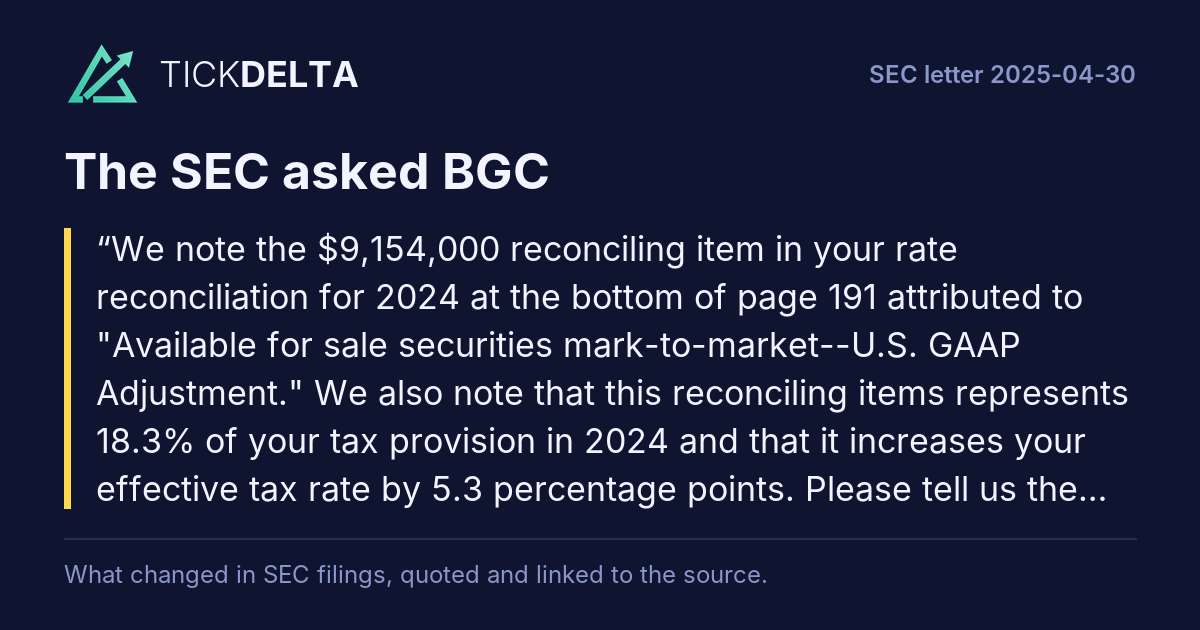
We note the $9,154,000 reconciling item in your rate reconciliation for 2024 at the bottom of page 191 attributed to "Available for sale securities mark-to-market--U.S. GAAP Adjustment." We also note that this reconciling items represents 18.3% of your tax provision in 2024 and that it increases your effective tax rate by 5.3 percentage points.
Rest of the question

Please tell us the nature of this reconciling item and explain why it impacts your rate reconciliation. In your response, specifically explain: • why you characterize the reconciling item as related to available for sale securities when it appears from your Financial Instruments Owned, at Fair Value policy note on page 146 that these investments are classified as trading securities; and • why the attributes of this reconciling item are apparently not temporary differences that result in no net impact on your effective rate and rate reconciliation.

BGC answered
#1

The $9.154 million reconciliation item within note 20, Income Taxes (“note 20”), to the financial statements contained in the Form

10-K relates to certain equity interests held at a foreign subsidiary of the Company. These equity interests are accounted for under the measurement alternative methodology pursuant to ASC Topic 321, Investments -

Equity Securities.
Rest of the answer

These equity interests are included within “Other assets” in the Company’s consolidated statement of financial condition and are remeasured to fair value, with changes recorded in net income during the period, when observable price changes occur.

However, legal title to these equity interests is held at a foreign subsidiary of the Company. The foreign subsidiary separately records, for local reporting purposes, the unrealized gain and corresponding deferred tax liability under local accounting rules, which differ from U.S. GAAP and include an element comparable to “available-for-sale.” In preparing the reconciliation table included within note 20, the Company carried over the terminology “AFS MTM” from the records of the foreign subsidiary. The Company acknowledges that such terminology is confusing and will not use that term in future filings.

For the year ended December 31, 2024, the Company properly recorded a $36.6 million unrealized gain relating to an increase in fair value of these equity interests, which was recorded in “Other income (loss)” in the Company’s consolidated statement of operations. The related deferred tax liability was properly provided for as a temporary difference in the “tax expense at federal statutory rate” line item within note 20 in the Form 10-K. The presentation in note 20 may have given the appearance that the $9.154 million reconciling item represented a permanent difference in the Company’s rate reconciliation. This is not the case.

In preparing the reconciliation table included within note 20, the Company presented offsetting reconciling items as a result of the local presentation of the financial statements. Specifically, the $9.154 million tax liability presented in the “AFS MTM - U.S. GAAP Adjustment” line is offset by a $9.154 million tax benefit presented within the “Other permanent differences” line item, which line item is presented on a net basis, obscuring the presence of the $9.154 million tax benefit. Rather than representing 18.3% of our tax provision in 2024 and increasing our effective tax rate by 5.3 percentage points, as the Staff’s comment notes, the $9.154 million reconciling item had no net effect on the effective rate, rate reconciliation, or reported provision for income taxes.

In future filings, to clarify the matter, presentation of similar items within the Company’s effective tax rate reconciliation disclosure will be presented in a single line item, which will help avoid potential confusion regarding the temporary nature of these items. We believe this will more clearly present the tax accounting for changes in the fair value of these equity interests.

Any questions or comments regarding the foregoing should be directed to the undersigned at (646) 346-6869.

BGC GROUP, INC.

By: /s/ Jason W. Hauf

Name: Jason W. Hauf

Title: Chief Financial Officer cc:

Read in the reply
In its next report

First report after the company's reply of May 13, 2025: 10-Q filed Aug 11, 2025 ↗, against the 10-Q filed Nov 8, 2024 ↗.

Tickdelta does not hold the text of both reports, so they are not compared here.
Also in this review: closing letter, 2025-06-04
Form 10-K for the fiscal year ended December 31, 2014

2015-07-29 to 2015-09-22 · 5 questions · 1 letter from the SEC, 1 from the company
Review closed 2015-09-22
Legal and contingenciesAcquisitionsCritical estimatesIncome taxesResults discussion (MD&A)Liquidity and cash
Item 7A. Quantitative and Qualitative Disclosure About Market Risk · Foreign Currency Risk, page 125
SEC asked (1)
Please tell us what consideration you gave to providing a sensitivity analysis for each currency (e.g., British Pounds and Euro) that may have an individually significant impact on future earnings. 20. Commitments, Contingencies and Guarantees
BGC answered
#1

In consideration of your comments received on July 29, 2015, we advise the Staff that, in future filings, we will enhance our disclosure related to foreign currency risk to discuss the effects of exchange rates on our results of operations. The following represents our proposed enhanced disclosure, using the six months ended June 30, 2015 for illustrative purposes:

Foreign Currency Risk

BGC Partners is exposed to risks associated with changes in foreign exchange rates. Changes in foreign exchange rates create volatility in the U.S.
Rest of the answer

Dollar equivalent of the Company’s revenues and expenses. In addition, changes in the remeasurement of BGC Partners’ foreign currency denominated financial assets and liabilities are recorded as part of its results of operations and fluctuate with changes in foreign currency rates. BGC monitors the net exposure in foreign currencies on a daily basis and hedges its exposure as deemed appropriate with highly rated major financial institutions.

The majority of the Company’s foreign currency exposure is related to the U.S. Dollar versus the British Pound and the Euro. While our international results of operations, as measured in U.S. Dollars, are subject to foreign exchange fluctuations, we do not consider the related risk to be material to our results of operations. For the financial assets and liabilities denominated in the British Pound and Euro, including foreign currency hedge positions related to these currencies, we evaluated the effects of a 10% shift in exchange rates between those currencies and the U.S. Dollar, holding all other assumptions constant. The analysis identified the worst case scenario as the Euro strengthening against the U.S. Dollar and the British Pound weakening against the U.S. Dollar. If as of June 30, 2015 the Euro had strengthened against the U.S. Dollar by 10% and the British Pound had weakened against the U.S. Dollar by 10%, the currency movements would have had an aggregate negative impact on our net income of approximately $1.4 million.

20. Commitments, Contingencies and Guarantees

Read in the reply
In its next report

First report after the company's reply of Aug 27, 2015: 10-Q filed Nov 9, 2015 ↗, against the 10-Q filed May 11, 2015 ↗.

Tickdelta does not hold the text of both reports, so they are not compared here.

Employment, Competitor-Related and Other Litigation, page 168
SEC asked (2)
We note that on January 13, 2015 you agreed to a settlement with Tullett Prebon plc wherein you paid $100 million in aggregate to resolve all ten outstanding lawsuits. With respect to the settlement, please tell us how you have complied with ASC 450-20 in periodic filings prior to your Form 10-K for the fiscal year ended December 31, 2014.
Rest of the question

Specifically, tell us when the loss met the probable and reasonably estimable criteria described in paragraph 2 of ASC 450-20-25. Additionally, tell us how you determined that the loss contingency was not at least reasonably possible and that it was not necessary to disclose an estimate of the possible loss or range of loss in prior periodic filings in accordance with paragraph 4 of ASC 450-20-50. Your response should include, but not be limited to, a discussion of the exact timeline of this settlement and the dates of your prior periodic filings. Form 10-Q for the quarterly period ended March 31, 2015 Notes to Condensed Consolidated Financial Statements 4. Acquisitions, page 16

BGC answered
#2

In preparing its quarterly financial statements, the Company evaluates each litigation, regulatory matter or other contingency to determine whether or not it is probable, reasonably possible or remote that a liability has been incurred, and, if it is probable, whether a loss or range of loss can reasonably be estimated, under the provisions of ASC 450-20-50.
Rest of the answer

Reserves are established or adjusted and further disclosure and estimates of potential loss are provided as information becomes available.

The Company’s policy is to include specific disclosure in notes to its financial statements about a litigation or regulatory matter if there is at least a reasonable possibility that a material loss will be incurred. Consistent with ASC 450-20-50, the Company includes information about the nature of the matter and either an estimate of the potential loss or range of loss or, in the event a reasonable estimate cannot be made, a statement that the Company is unable to estimate its potential liability or range of potential liability.

As described below, the Company disclosed and updated the disclosure related to the disputes with Tullett, a competitor of the Company, in the

Company’s periodic filings and recorded liabilities when potential losses became probable and reasonably estimable.

As detailed on the enclosed timeline, the Company established reserves with respect to potential liabilities related to the Tullett disputes in the applicable quarters which the Company believed were appropriate in light of the information available at the time. The Company reviewed these reserves on a quarterly basis throughout 2014.

In its periodic disclosures, the Company disclosed the amounts claimed in the Tullett matters and stated that it was unable to estimate a possible loss or range of loss in connection with specific matters beyond the current accrual and any other amounts disclosed. It further noted in such filings that Company management believed that, based on then-currently available information, the final outcome of the pending Tullett disputes would not have a material adverse effect on the

Company’s consolidated financial statements and disclosures taken as a whole. The Company recorded liabilities in the appropriate periods when potential losses became probable and reasonably estimable. It was not until the Company reached the final settlement with Tullett on January 13, 2015 that the Tullett disputes were settled and the full amount of the loss was determined.

Separate from the disputes with Tullett, the Company had commenced a tender offer to acquire all of the outstanding common stock of another of its competitors, GFI Group Inc. (“GFI”), on October 22, 2014. In late December 2014 and early January 2015, the Company was aware of news reports and market intelligence regarding potential broker departures at GFI and potential broker hiring by other industry competitors of the Company and GFI, including Tullett. At the same time, management of the Company understood that GFI was contemplating a potential settlement agreement regarding claims with another competitor that would include various non-solicitation or non-hire provisions related to GFI’s brokers. In addition, an adverse judgment well in excess of the ultimate settlement amount, even if it were reversed on appeal (however probable), might have affected the Company’s ability to complete the GFI tender offer (which management believed was becoming more likely). Further, a non-hire provision including GFI employees in a potential settlement became more useful to the Company in light of the GFI tender offer. These factors contributed to management’s decision to settle all of the pending Tullett matters. A proposed Tullett settlement would resolve all ten matters, including the pending arbitrations and smaller state court matters brought against individual managers and brokers, and contain a non-hire provision that would benefit the Company.

In light of the facts and circumstances, both in the Tullett matters and separately relating to the GFI tender offer, on January 13, 2015 the Company entered into a settlement agreement with Tullett to resolve all of the ten disputes. The settlement agreement contained a one-year non-hire provision in which the Company and Tullett agreed not to hire the senior employees, including desk heads, of the other party and its subsidiaries. The non-hire provision specifically included employees of GFI in the event that the Company closed on its proposed acquisition of GFI.

Following the Tullett settlement, since the amount of the loss was finally and fully determined prior to the Company issuing its Form 10-K for the year ended 2014, in that Form 10-K the Company disclosed the $100 million settlement amount and the fact that, as of December 31, 2014, the Company had accrued the settlement amount and all related expenses in accordance with GAAP. On February 19, 2015, the Company entered into a tender offer agreement with GFI and closed on its acquisition of majority control of GFI on February 26, 2015.

We have attached as Exhibit A to this letter an exact timeline of the filing dates of the Company’s Form 10-Qs for 2014 and the events surrounding the Tullett disputes and GFI tender offer.

Form 10-Q for the quarterly period ended March 31, 2015

Notes to Condensed Consolidated Financial Statements

4. Acquisitions, page 16

Read in the reply
In its next report

First report after the company's reply of Aug 27, 2015: 10-Q filed Nov 9, 2015 ↗, against the 10-Q filed May 11, 2015 ↗.

Tickdelta does not hold the text of both reports, so they are not compared here.

Employment, Competitor-Related and Other Litigation, page 168
SEC asked (3)
We note that you have recorded an intangible asset not subject to amortization in connection with the acquisition of GFI. Please tell us more about the trade name and the factors you considered in determining that it has an indefinite life.
Rest of the question

In this regard, please tell us how you determined there are no legal, regulatory, contractual, competitive, economic, or other factors that limit the useful life of the trade name. See ASC 350-3035-1 through -5. 20. Income Taxes, page 42

BGC answered
#3

We advise the Staff that the intangible asset not subject to amortization primarily consists of the trade name, GFI Group Inc. As noted in ASC 350-30-35-4, if no legal, regulatory, contractual, competitive, economic, or other factors limit the useful life of an intangible asset to the reporting entity, the useful life of the asset shall be considered to be indefinite.
Rest of the answer

ASC 350-30-35-4 further states that the useful life of an intangible asset is indefinite if that life extends beyond the foreseeable horizon – that is, there is no foreseeable limit on the period of time over which it is expected to contribute to the cash flows of the reporting entity. GFI has built a strong reputation as a leading intermediary and provider of trading technologies and support services to the global over-the-counter and listed markets, and provides brokerage and trade execution services to institutional customers in markets for a range of fixed income, financial, equity and commodity instruments. The GFI trade name, which was established in 1987, is very well recognized in the industry and clearly adds value to the Company’s wholesale brokerage business.

As previously announced and disclosed in our prior filings, GFI is expected to remain a separately branded division of the Company for the foreseeable future. We further advise the Staff that we have not identified any legal, regulatory or contractual limitations related to the trade name, GFI. GFI, in common with BGCP and the industry in general, has recovered from several economic downturns since GFI’s inception, which we believe is a strong indicator that there are no foreseeable competitive, economic or other factors that would limit the useful life of the name. Based on these factors, we have concluded that there is no foreseeable limit on the period of time over which the trade name is expected to contribute to our cash flows and have concluded that it has an indefinite life.

20. Income Taxes, page 42

Read in the reply
In its next report

First report after the company's reply of Aug 27, 2015: 10-Q filed Nov 9, 2015 ↗, against the 10-Q filed May 11, 2015 ↗.

Tickdelta does not hold the text of both reports, so they are not compared here.

Employment, Competitor-Related and Other Litigation, page 168
SEC asked (4)
Please tell us how you complied with paragraph 2 of ASC 740-30-50, or tell us how you determined it was not necessary to disclose the amount of additional tax that may be payable in the event that your undistributed foreign pre-tax earnings are repatriated.
BGC answered
#4

In consideration of your comment received July 29, 2015, we added the following disclosure to the note “20. Income Taxes” in our fiscal year 2015 second quarter Form 10-Q filed August 10, 2015, and will include similar disclosure, as appropriate, in future filings:

As of June 30, 2015, the Company had $287.7 million of undistributed foreign pre-tax earnings; it is our intention to permanently reinvest them in the Company’s foreign operations.
Rest of the answer

It is not practicable to determine the amount of additional tax that may be payable in the event these earnings are repatriated due to the fluctuation of the relative ownership percentages of the foreign subsidiaries between the Company and BGC Holdings, L.P.

Read in the reply
In its next report

First report after the company's reply of Aug 27, 2015: 10-Q filed Nov 9, 2015 ↗, against the 10-Q filed May 11, 2015 ↗.

Tickdelta does not hold the text of both reports, so they are not compared here.

Operations · Liquidity Analysis, page 67
SEC asked (5)
Please provide liquidity disclosures to discuss the potential tax impact associated with the repatriation of undistributed earnings of foreign subsidiaries in future periodic filings. In this regard, please disclose the amount of cash that is currently held by your foreign subsidiaries and disclose the impact of repatriating the undistributed earnings of foreign subsidiaries.
Rest of the question

Please provide us with the disclosure you intend to include in future periodic filings. Please refer to Item 303(A)(1) of Regulation S-K and Section IV of our Release 33-8350.

BGC answered
#5

In consideration of your comment received on July 29, 2015, we advise the Staff that, in future filings, we will include disclosures regarding the potential tax impact associated with the repatriation of undistributed earnings of foreign subsidiaries in our Liquidity Analysis. The following represents our proposed disclosure, using June 30, 2015 for illustrative purposes:

As of June 30, 2015, the Company had $364.0 million of cash and cash equivalents, and included in this amount was $204.6 million of cash and cash equivalents held by foreign subsidiaries.
Rest of the answer

In addition, it is our intention to permanently reinvest undistributed foreign pre-tax earnings in the Company’s foreign operations. It is not practicable to determine the amount of additional tax that may be payable in the event these earnings are repatriated due to the fluctuation of the relative ownership percentages of the foreign subsidiaries between the Company and BGC Holdings, L.P.

* * * *

The Company hereby acknowledges that (1) the Company is responsible for the adequacy and accuracy of the disclosure in the filing; (2) Staff comments or changes to disclosure in response to Staff comments do not foreclose the Securities and Exchange

Commission (the “Commission”) from taking any action with respect to the filing; and (3) the Company may not assert Staff comments as a defense in any proceeding initiated by the Commission or any person under the federal securities laws of the United States.

Any questions or comments regarding the foregoing should be directed to the undersigned at

011 44 207 894 7473.

Read in the reply
In its next report

First report after the company's reply of Aug 27, 2015: 10-Q filed Nov 9, 2015 ↗, against the 10-Q filed May 11, 2015 ↗.

Tickdelta does not hold the text of both reports, so they are not compared here.

Also in this review: closing letter, 2015-09-22

Form 10-K for the Year Ended December 31, 2013

2014-08-01 to 2014-11-04 · 4 questions · 2 letters from the SEC, 2 from the company
Review closed 2014-11-04
Non-GAAP measuresLiquidity and cashRevenue
Cash Position Analysis, page 119
SEC asked (1)
Please tell us how you have determined that your measure cash position is not a non- GAAP measure.
BGC answered
#1

We do not view our

Cash Position Analysis as a non-GAAP measure because it is based on the aggregation of three separate line items on our Consolidated Statement of Financial Condition which is prepared in accordance with GAAP. Our Cash Position Analysis is a measure of our liquidity and is comprised of Cash and cash equivalents, Securities owned, and Marketable securities.
Rest of the answer

As of December 31, 2013, our Cash Position was $795.0 million as follows (in millions):

Cash and cash equivalents

$

716.9

Securities owned

33.1

Marketable securities

45.0

Cash Position

795.0

Due to the fact that our Cash Position Analysis is based on the aggregation of three line items from our GAAP

Consolidated Statement of Financial Condition, we do not believe that it represents a non-GAAP measure. See CDIs 102.12; 104.05.

Read in the reply
In its next report

First report after the company's reply of Aug 28, 2014: 10-Q filed Nov 7, 2014 ↗, against the 10-Q filed May 12, 2014 ↗.

Tickdelta does not hold the text of both reports, so they are not compared here.

Consolidated Statements of Operations, page 140
SEC asked (2)
Please present interest income, earn-outs, gain on divestitures and sale of investments and losses on equity investments below operating expenses in future filings, or tell us why you believe your current presentation complies with Rule 5-03 of Regulation S-X.
BGC answered
#2

We believe that our current presentation of Interest income, Earn-outs, Gain on divestiture and sale of investments, and Losses on equity investments complies with Rule 5-03 of Regulation S-X as follows:

Interest Income

Financial institutions such as banks and broker-dealers (in accordance with the AICPA Broker-Dealer Guide), typically present interest income as part of their operating results.

Since we hold certain interest-bearing instruments in the normal course of our operations (e.g., employee loans and U.S.
Rest of the answer

Treasuries held for liquidity purposes), we present interest income as a component of our total revenues in our Income from operations. We believe that this presentation is appropriate and consistent with our (financial services) industry.

Earn-outs and Gain on divestiture and sale of investments

On June 28, 2013, we completed the sale of certain assets to The NASDAQ OMX Group, Inc., including the eSpeed brand name and various assets comprising the fully electronic portion of our benchmark on-the-run U.S. Treasury brokerage, market data and co-location service businesses (“eSpeed”). We concluded that under FASB ASC 205-20 our sale of eSpeed did not meet the definition of a discontinued operation, and therefore the associated gains (inclusive of the earn-out and gain on divestiture) should be accounted for as part of our Income from operations in accordance with FASB ASC 360-10-45 “Long-Lived

Assets Classified as Held and Used”.

This guidance states that:

A gain or loss recognized on the sale of a long-lived asset (disposal group) that is not a discontinued operation shall be included in income from continuing operations before income taxes in the income statement of a business entity. If a subtotal such as income from operations is presented, it shall include the amounts of those gains or losses.

Based on this guidance, for the year ended December 31, 2013, we presented both the $723.1 million gain on divestiture and the $39.5 million of revenue associated with the earn-out related to the sale of eSpeed as Income from operations.

During the year ended

December 31, 2012, we included a $52.5 million gain, related to the sale of some of our shares in the London Metals Exchange (the “LME”), as part of our Income from operations. Our shares were initially acquired as a requirement of our membership on the LME, which is an integral part of our operating business. When the Hong Kong Exchange & Clearing Limited acquired the LME in December 2012, we sold a portion of our shares and recognized the gain. As part of our ongoing business, we continue to hold the remaining shares as required for membership on the exchange. We view this item as a gain on the sale of an operating asset that was a required part of our operations, and we therefore believe that it was properly included in Income from operations.

Losses on equity investments

Our equity method investments represent investments in entities in which we have a significant influence but not a controlling interest. These investments engage in similar business activities to the business lines that we engage in. In certain cases, we engage in business activities through the entities that comprise these investments. Based on the similarities in business activities and our activities through such entities, we view these investments as part of our overall operations, and we therefore include the Losses on equity investments as part of our Income from operations.

In addition, we view Losses on equity investments as immaterial to our overall results. As a percentage of total revenues, Losses on equity investment were 0.38% and 0.67% for the years ended December 31, 2013 and 2012, respectively.

*

* * *

The Company hereby acknowledges that (1) the Company is responsible for the adequacy and accuracy of the disclosure in the filing; (2) Staff comments or changes to disclosure in response to Staff comments do not foreclose the Securities and Exchange Commission (the “Commission”) from taking any action with respect to the filing; and (3) the Company may not assert Staff comments as a defense in any proceeding initiated by the Commission or any person under the federal securities laws of the United States.

Any questions or comments regarding the foregoing should be directed to the undersigned at 011 44 207 894 7473.

Read in the reply
In its next report

First report after the company's reply of Aug 28, 2014: 10-Q filed Nov 7, 2014 ↗, against the 10-Q filed May 12, 2014 ↗.

Tickdelta does not hold the text of both reports, so they are not compared here.

Cash Position Analysis, page 119
SEC asked (1)
We have reviewed your response to comment 1 and the references to the non-GAAP CDI, and we continue to believe that the measure cash position is a non-GAAP measure. In future filings, please provide the disclosures required by Item 10(e) of Regulation S-K related to this non-GAAP liquidity measure.
Rest of the question

Additionally, in future filings, please revise or exclude your table showing changes in cash position, as it appears to be a modified statement of cash flows, and may attach undue prominence to the non-GAAP information. Refer by analogy to question 102.10 of the CDI Non-GAAP Financial Measures. In your response, please show us the disclosure you intend to include in future filings.

BGC answered
#1

In consideration of your comments received on September 18, 2014, in future filings, we will present a revised Liquidity Analysis, as shown below (using the first six months of 2014 and 2013 for illustrative purposes):

LIQUIDITY ANALYSIS

We consider our liquidity to be comprised of the sum of Cash and cash equivalents plus Marketable securities and Securities owned for liquidity purposes.
Rest of the answer

The discussion below describes the key components of our liquidity analysis, including earnings, dividends and distributions, net investing and funding activities including repurchases and redemptions of Class A common stock and partnership units, security settlements, changes in securities held and marketable securities, and changes in our working capital.

We consider the following in analyzing changes in our liquidity.

A comparison of consolidated net income adjusted for certain non-cash items

(e.g., grants of exchangeability) as presented on the cash flow statement. Dividends and distributions are payments made to our holders of common shares and limited partnership interests and are related to earnings from prior periods. These timing differences will impact our cash flows in a given period.

Our investing and funding activities represent a combination of our capital raising activities, including short-term borrowings and repayments, issuances of shares under our controlled equity offerings (net), Class A common stock repurchases and partnership unit redemptions, purchases and sales of securities, dispositions, and other investments (e.g. acquisitions, forgivable loans to new brokers and capital expenditures—all net of depreciation and amortization).

Our securities settlement activities primarily represent deposits with clearing organizations. In addition, when advantageous, we may elect to facilitate the settlement of matched principal transactions by funding failed trades, which results in a temporary secured use of cash and is economically beneficial to us.

Other net changes in working capital represent changes primarily in receivables and payables and accrued liabilities that impact our liquidity.

Changes in Securities owned and Marketable securities may result from additional cash investments or sales, which will be offset by a corresponding change in Cash and cash equivalents and accordingly will not result in a change in our liquidity. Conversely, changes in the market value of such securities and the receipt of the NASDAQ earn-out in the form of additional

NASDAQ shares are reflected in our earnings or other comprehensive income and will result in changes in our liquidity.

The following is an analysis which describes the key components of changes in our liquidity.

Discussion of six months ended June 30, 2014

The table below presents our Liquidity as of June 30, 2014 and December 31, 2013:

Liquidity as of

(in millions)

June 30,

2014

December 31,

2013

Cash and cash equivalents

$

558.2

716.9

Securities owned

35.8

33.1

Marketable securities

50.2

45.0

Total

644.2

795.0

The $150.8 million decrease in our liquidity from $795.0 million to $644.2 million as of June 30, 2014 was primarily driven by a) $67.4 million related to repurchases and redemptions during the period b) $50.0 million in net changes in working capital and other uses of cash primarily driven by the timing of tax payments and c) Securities settlement activities which used $28.3 million of cash during the period primarily related to fail transactions, which results in a temporary decrease in cash.

Discussion of six months ended June 30, 2013

The table below presents our Liquidity as of June 30, 2013 and December 31, 2012:

2012

1,070.4

388.4

32.0

1,102.4

420.4

The $682.0 million increase in our liquidity from $420.4 million to $1,102.4 million as of June 30, 2013 was primarily driven by the cash received from the sale of eSpeed to NASDAQ OMX in June 2013. The net proceeds from the divestiture of eSpeed was approximately $747.7 million. This increase in our liquidity was partially offset by $71.9 million of dividends and distributions paid to our shareholders and limited partners.

Read in the reply
In its next report

First report after the company's reply of Oct 10, 2014: 10-Q filed Nov 7, 2014 ↗, against the 10-Q filed May 12, 2014 ↗.

Tickdelta does not hold the text of both reports, so they are not compared here.

Consolidated Statements of Operations, page 140
SEC asked (2)
We have reviewed your response to comment 2. Please explain to us why you believe the gains recognized on the sale of your eSpeed business, electronic benchmark U.S. Treasury platform and LME investment and losses on equity method investments meet the definition of revenue contemplated in ASC 605-10-20.
BGC answered
#2

In consideration of your comments received on September 18, 2014, in future filings, we will present Gain on divestiture and sale of investments, Losses on equity investments and Other income in a separate section of our Consolidated Statements of Operations captioned “Other income (losses), net,” as shown below:

BGC PARTNERS, INC.

CONDENSED CONSOLIDATED STATEMENTS OF OPERATIONS

(in thousands, except per share data)

(unaudited)

Three Months Ended September 30,

Nine Months Ended September 30,

Revenues:

Commissions

XXXX

Principal transactions

XX

Real estate management
Rest of the answer

services

Fees from related parties

Market data

Software solutions

Interest income

Other revenues

Total revenues

—

Expenses:

Compensation and employee benefits

Allocations of net income and grant of exchangeability to limited partnership units and FPUs

Total compensation and employee benefits

Occupancy and equipment

Fees to related parties

Professional and consulting fees

Communications

Selling and promotion

Commissions and floor brokerage

Interest expense

Other expenses

Total expenses

Other income (losses), net:

Gain on divestiture and sale of investments

Losses on equity investments

Other income

Total other income (losses), net

Income from operations before income taxes

Provision for income taxes

Consolidated net income

Less: Net income attributable to non-controlling interest in subsidiaries

Net income available to common stockholders

Per share data:

Basic earnings per share

Basic weighted-average shares of common stock outstanding

Fully diluted earnings per share

Net income for fully diluted shares

Fully diluted weighted-average shares of common stock outstanding

Dividends declared per share of common stock

Dividends declared and paid per share of common stock

*

* * *

The Company hereby acknowledges that (1) the

Company is responsible for the adequacy and accuracy of the disclosure in the filing; (2) Staff comments or changes to disclosure in response to Staff comments do not foreclose the Securities and Exchange Commission (the “Commission”) from taking any action with respect to the filing; and (3) the Company may not assert Staff comments as a defense in any proceeding initiated by the Commission or any person under the federal securities laws of the United States.

Any questions or comments regarding the foregoing should be directed to the undersigned at 011 44 207 894 7473.

Read in the reply
In its next report

First report after the company's reply of Oct 10, 2014: 10-Q filed Nov 7, 2014 ↗, against the 10-Q filed May 12, 2014 ↗.

Tickdelta does not hold the text of both reports, so they are not compared here.

Also in this review: closing letter, 2014-11-04

Form 10-K for the fiscal year ended December 31, 2012

2013-08-20 to 2013-09-20 · 2 questions · 1 letter from the SEC, 1 from the company
Review closed 2013-09-20
Results discussion (MD&A)Legal and contingencies
Form 10-Q for the Quarter Ended June 30, 2013 · Share Count Reduction and Modifications/Extensions of Employment Agreements, page 13
SEC asked (1)
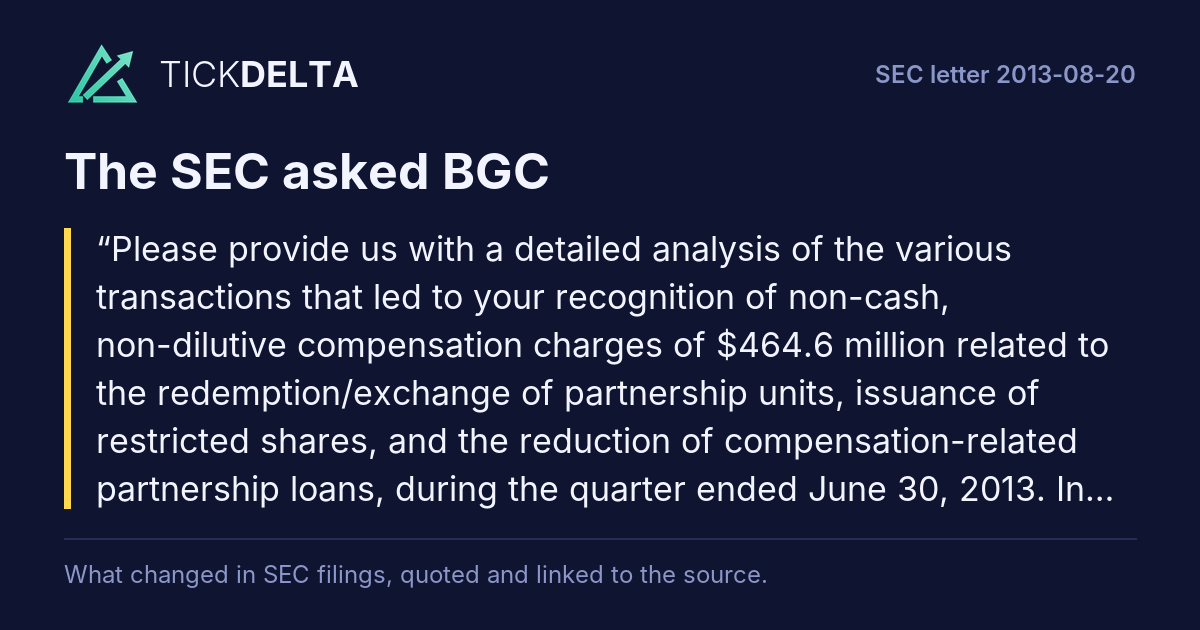
Please provide us with a detailed analysis of the various transactions that led to your recognition of non-cash, non-dilutive compensation charges of $464.6 million related to the redemption/exchange of partnership units, issuance of restricted shares, and the reduction of compensation-related partnership loans, during the quarter ended June 30, 2013.
Rest of the question

In your response, please quantify the impact that each transaction had on your operations for the quarter ended June 30.

BGC answered
#1

The $464.6 million compensation charge is composed of the following two charges:

•

A $304.1 million charge related to the redemption/exchange of limited partnership units and the grant of shares of stock; and

A $160.5 million reserve, recorded as a result of the Company’s determination that the collectability of a portion of its partner/employee compensatory loan balances is not expected, due to the redemption/exchange of the limited partnership units.

$304.1 Million Charge Related to Redemption/Exchange of Limited Partnership Units and Grant of Shares of Stock

The Company
Rest of the answer

redeemed/exchanged approximately 77.4 million limited partnership units from the Company’s partners, and replaced them with grants of approximately 59.7 million shares of the Company’s Class A common stock. In accordance with ASC 718, the Company accounted for these transactions as cancellation of awards accompanied by the concurrent grant of replacement awards and recognized the incremental compensation expense as the excess of the current value of the replacement awards over the current value of the cancelled awards.

Page |

In summary, the Company recognized the compensation charge as follows:

Approximately 59.7 million shares of stock granted to replace limited partnership units x $5.89 BGC Partners, Inc. stock price on the grant date: $351.5 million

Less current value of redeemed/exchanged limited partnership units: $47.4 million

Equals: $304.1 million

The stock is not subject to continued employment or service with the Company or any affiliate of the Company (although it is subject to certain non-compete obligations that have been deemed to not represent in-substance service conditions). Accordingly, the Company recorded the entire expense for the grants of stock at current value on the grant date.

Of the approximately 59.7 million shares of the Company’s Class A common stock, approximately 14.5 million shares were considered repurchased to fund tax withholding obligations, leaving 45.2 million shares that were issued to replace the limited partnership units.

$160.5 Million Charge Related to Partner/Employee Compensatory Loan Balances

The Company has outstanding compensatory loans to partners/employees that were to be repaid from the earnings distributions that the individuals received on their limited partnership units. While the loans have not been forgiven, and the Company expects any distributions on remaining (or future awards of) partnership units and dividends on restricted shares to continue to pay down the loans, due to the redemption/exchange of limited partnership units and their replacement with a fewer number of shares, the Company determined that a portion of these loans are doubtful of collection. As a consequence, the Company has established a reserve and recorded $160.5 million additional compensation expense.

Read in the reply
In its next report

First report after the company's reply of Sep 4, 2013: 10-Q filed Nov 7, 2013 ↗, against the 10-Q filed Aug 8, 2013 ↗.

Tickdelta does not hold the text of both reports, so they are not compared here.

Commitments, Contingencies and Guarantees, page 35
SEC asked (2)
In future filings, for any contingencies where there is at least a reasonable possibility that a loss or an additional loss may have been incurred, please provide an estimate of the possible loss or range of loss or a statement that such an estimate cannot be made.
BGC answered
#2

The Company is unable to estimate a possible loss or range of loss in connection with its contingencies beyond its current accruals and any other amounts disclosed. In accordance with ASC 450, the Company will include a statement to that effect in future filings, beginning with its Form 10-Q for the period ending September 30, 2013, under “Employment, Competitor-Related and

Other Litigation” in the Company’s “Commitments, Contingencies and Guarantees” footnote.

Further, we hereby acknowledge that (1) the Company is responsible for the adequacy and accuracy of the disclosure in the
Rest of the answer

filing; (2) staff comments or changes to disclosure in response to staff comments do not foreclose the Securities and Exchange

Commission (the “Commission”) from taking any action with respect to the filing; and (3) the Company may not assert staff comments as a defense in any proceeding initiated by the Commission or any person under the federal securities laws of the United States.

Any questions or comments regarding the foregoing should be directed to George E. Moorehouse,

Global Controller, at (212) 294-7849 or the undersigned at 011 44 207 894 7473.

Read in the reply
In its next report

First report after the company's reply of Sep 4, 2013: 10-Q filed Nov 7, 2013 ↗, against the 10-Q filed Aug 8, 2013 ↗.

Tickdelta does not hold the text of both reports, so they are not compared here.

Also in this review: closing letter, 2013-09-20

Form S-3

2013-04-25 to 2013-04-26 · 2 questions · 1 letter from the SEC, 1 from the company
No closing letter
General
SEC asked (1)
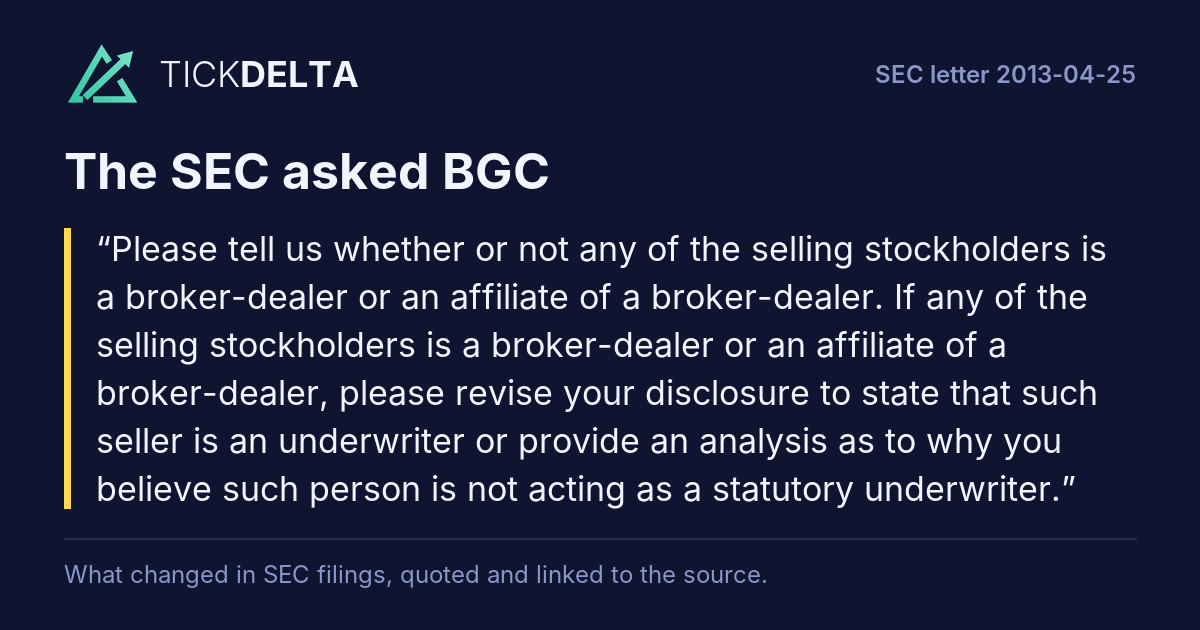
Please tell us whether or not any of the selling stockholders is a broker-dealer or an affiliate of a broker-dealer. If any of the selling stockholders is a broker-dealer or an affiliate of a broker-dealer, please revise your disclosure to state that such seller is an underwriter or provide an analysis as to why you believe such person is not acting as a statutory underwriter.
BGC answered

No numbered answer found in the reply. Read the reply ↗

Documents Incorporated by Reference, page 19
SEC asked (2)
We note that you incorporate by reference your Annual Report filed on Form 10-K for the year ended December 31, 2012 and, on page 19, you reference your Definitive Proxy Statement on Schedule 14A to be filed. As the Form 10-K incorporates information from your proxy which has not yet been filed, please note that we will not be in a position to declare your filing effective until such time as the complete disclosure
Rest of the question

required by Form 10-K has been filed. Please refer to Compliance and Disclosure Interpretations, Securities Act Forms, Question 123.01, which can be found on our website, for guidance.

BGC answered
Please be advised that the Registrant filed its Definitive Proxy Statement on Schedule 14A on April 25, 2013. Since the Registrant included in the Documents Incorporated by Reference section of the Registration Statement (page 19) a statement specifically incorporating “all documents filed by us with the SEC pursuant to Section 13(a), 13(c), 14 or 15(d) of the

Exchange Act (Commission File Numbers 0-28191 and 1-35591) after (i) the date of this registration statement and prior to effectiveness of this registration statement...,” with the filing of the Definitive Proxy Statement the complete
Rest of the answer

disclosure required by Form 10-K was deemed incorporated by reference into the Registration Statement. In addition, in the first prospectus used after effectiveness of the Registration Statement, a copy of which is required to be filed under Rule

424(b) under the Securities Act of 1933, as amended, the Registrant will identify (by type, date and Commission file numbers) all reports filed under the Securities Exchange Act of 1934, as amended, prior to effectiveness of the Registration

Statement. See Compliance and Disclosure Interpretations, Securities Act Forms, Question 123.05. Accordingly, the Registrant will not be filing a pre-effective amendment to the Registration Statement to specifically incorporate the Definitive

Proxy Statement.

*****

The Company would like to take this opportunity, pursuant to Rule 461 under the Securities Act of 1933, as amended, to request acceleration of the effective date of the Registration Statement, referred to in this letter so that the Registration Statement becomes effective as soon as practicable.

The Company acknowledges that

(1) should the Securities and Exchange Commission (the “Commission”) or the staff, acting pursuant to delegated authority, declare the filing effective, it does not foreclose the Commission from taking any action with respect to the filing; (2) the action of the Commission or the staff, acting pursuant to delegated authority, in declaring the filing effective, does not relieve the Company from its full responsibility for the adequacy and accuracy of the disclosure in the fling; and (3) the Company may not assert the declaration of effectiveness as a defense in any proceeding initiated by the Commission or any person under the federal securities laws of the United States.

Any questions or comments regarding the foregoing should be directed to the undersigned at 212.294.7824. Thank you.

BGC PARTNERS, INC.

By:

/s/ Patrick J. Egan

Patrick J. Egan

Vice President and

Assistant General Counsel cc:

Read in the reply

Form S-3

2011-07-19 to 2011-07-19 · 2 questions · 1 letter from the SEC, 0 from the company
No closing letter
SEC letter of Jul 19, 2011 ↗ no reply letter on EDGAR (the company may have answered in an amended filing)
General
SEC asked (1)
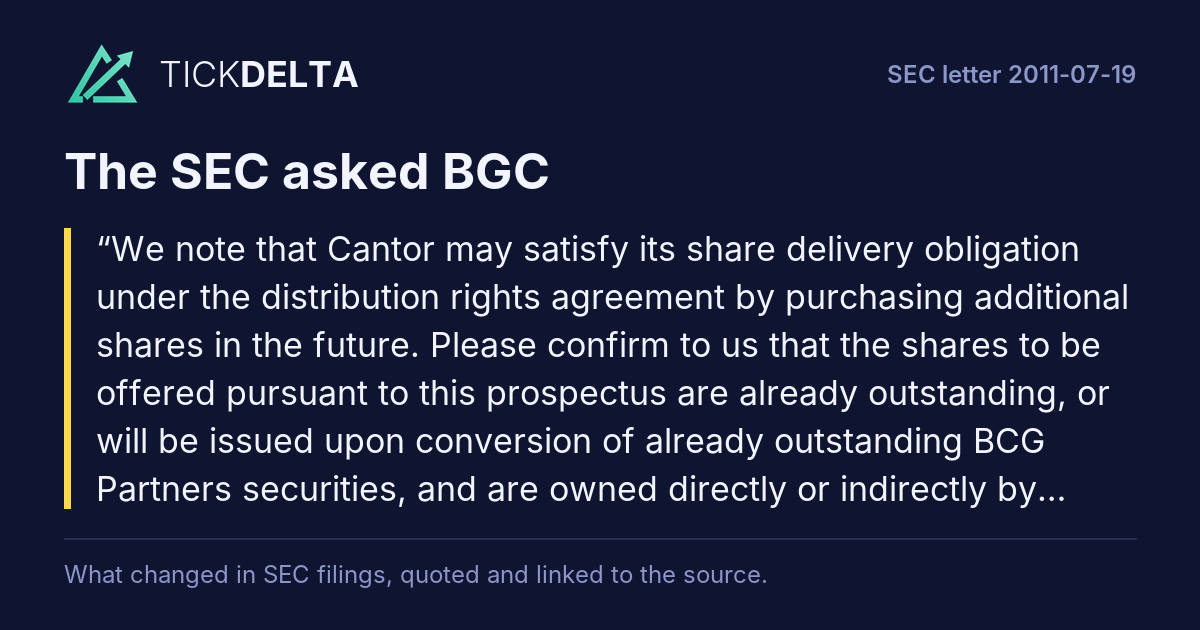
We note that Cantor may satisfy its share delivery obligation under the distribution rights agreement by purchasing additional shares in the future. Please confirm to us that the shares to be offered pursuant to this prospectus are already outstanding, or will be issued upon conversion of already outstanding BCG Partners securities, and are owned directly or indirectly by Cantor or the individual selling
Rest of the question

stockholders.

BGC answered

No reply letter found.

General
SEC asked (2)
Please revise the prospectus to clarify that you will name in a prospectus supplement any additional individual selling stockholders to the extent they direct Cantor, pursuant to the terms of the distribution rights agreement, to sell Class A common stock on their behalf pursuant to this registration statement.
BGC answered

No reply letter found.

SEC enforcement releases naming BGC

Litigation releases and accounting and auditing enforcement releases (AAER) · sec.gov

1

A release is listed only when SEC's list names BGC Group, Inc. (or a name it had before) among those the action is against. The page does not say what the release found: open it on sec.gov. A release against a person at the company, or one that names the company under another spelling, is not matched, so this list can be shorter than SEC's.

Letters without questions

Other letters

UPLOAD and CORRESP
35 other letters: notices that a filing will not be reviewed, requests to declare a registration effective, and the like

From the SEC's correspondence on EDGAR: staff letters (form UPLOAD) and company letters (form CORRESP), 52 letters filed since 2011-07-19. Questions and answers are matched by their numbers; topics come from words in each question. The reports are compared word for word (same form, before the first SEC letter against the first report after the company's reply). No AI.

Sources

The SEC's correspondence on EDGAR: staff letters (form UPLOAD) and company letters (form CORRESP), matched question by question. No AI.

Also

Filings: the letters in the filing list.

Work with it

Excel workbook · CSV. Google Sheet that stays up to date: paste =IMPORTDATA("https://tickdelta.com/company/BGC/export.csv") into a cell.

Next in Owners and insiders:Insider trades
Esc

Type a ticker such as AAPL, a name, an investor such as Buffett, or a topic such as tariffs. ↑ ↓ to move, Enter to open.