Screener / SEC EDGAR /CIK 0001685040 /10-K filed Feb 24, 2026, compared with Feb 28, 2025 /Numbers from the XBRL of the 10-Ks
Nasdaq Financials · Life Insurance

Brighthouse Financial, Inc. BHF

Compare with peers Embed
SEC comment letters, last 20 years

2 reviews of BHF's filings by SEC staff

UPLOAD and CORRESP
Reviews 2 latest letter Jul 6, 2023
Questions asked 40 each answered in the company's own letter
No closing letter 0 reviews without a letter saying the staff completed it

When the SEC's staff reviews a filing, it writes to the company with numbered questions, and the company answers each one in a letter. SEC publishes the exchange once the review is over, at least 20 business days later. A question is not an accusation; most reviews end with the company adding detail to its next filing.

How the reviews went

Every review on EDGAR, from the first staff letter to the letter that closes it

  1. 1. Staff letters 5 UPLOAD
  2. 2. Questions in them 40 numbered comments
  3. 3. Company replies 5 CORRESP
  4. 4. Reviews closed 2 of 2 closing letter

Half the closed reviews took 245 days or less from the first letter to the closing letter.

Form 10-K

2023-07-06 to 2023-10-19 · 5 questions · 1 letter from the SEC, 1 from the company
Review closed 2023-10-19
Non-GAAP measuresIncome taxes
Note 10. Equity - Statutory Financial Information, page 174
SEC asked (1)
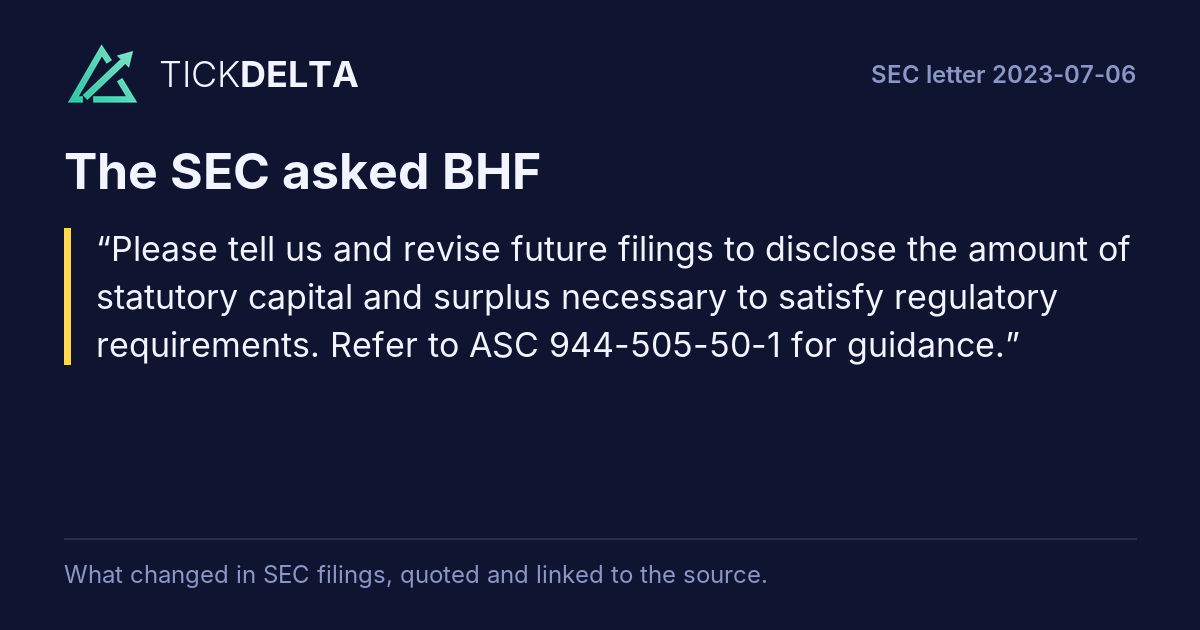
Please tell us and revise future filings to disclose the amount of statutory capital and surplus necessary to satisfy regulatory requirements. Refer to ASC 944-505-50-1 for guidance.
BHF answered
to the Staff’s comment, the Company will revise future annual reports, commencing with the Company’s annual report on Form 10-K for the year ending December 31, 2023 (the “2023 Form 10-K”), as described below. Please note that the Company’s proposed disclosure for inclusion within future annual reports on Form 10-K is marked to show the changes from the 2022 Form 10-K disclosure on page 174.

“The states of domicile of the Company’s insurance subsidiaries impose RBC requirements that were developed by the National Association of Insurance Commissioners (“NAIC”).
Rest of the answer

The Such requirements are used by regulators to assess the minimum amount of statutory capital and surplus needed for an insurance company to support its operations, based on its size and risk profile (referred to as “company action level RBC”). RBC is based on the statutory financial statements and is calculated in a manner prescribed by the NAIC,. with the The RBC ratio, which is the basis for determining regulatory compliance, is equal to the total adjusted capital (“TAC”) divided by the applicable company action level RBC. Companies below 100% of their company action level RBC minimum RBC ratios are subject to corrective action. The RBC ratios As of December 31, 20XX, the annual RBC ratios for the Company’s insurance subsidiaries were each in excess of such minimums for all periods presented XXX%.”

Read in the reply
In its next report

First report after the company's reply of Aug 24, 2023: 10-Q filed Nov 8, 2023 ↗, against the 10-Q filed May 9, 2023 ↗.

Tickdelta does not hold the text of both reports, so they are not compared here.

Note 10. Equity - Statutory Financial Information, page 174
SEC asked (2)
We note the disclosure throughout your filing related to your use of combined RBC. Please tell us and revise future filings to discuss how combined RBC is used by your regulators. If it is not used, please revise to expand on why you use the measure.
BHF answered
Combined RBC ratio (“Combined RBC Ratio”) reflects the aggregate RBC ratio of our insurance subsidiaries, defined as the aggregate TAC of our insurance subsidiaries divided by the total of their respective company action level RBCs. Combined RBC Ratio is an internal metric used by the Company to manage the risk associated with its insurance products through our capital and exposure risk management program; it is not a metric required or used by regulators. As described on page 63 of the 2022 Form 10-K, the Company targets a Combined RBC Ratio of 400%-450% in normal market conditions.
Rest of the answer

In response to the Staff’s comment, we will revise future annual filings, commencing with the 2023 Form 10-K, to define Combined RBC Ratio, describe why we use Combined RBC Ratio and clarify that it is not a metric used by regulators.

See below for the Company’s proposed disclosure to be added under the heading “Management’s Discussion and Analysis of Financial Condition and Results of Operations — Risk Management Strategies” in future annual reports on Form 10-K:

“Combined RBC ratio (“Combined RBC Ratio”) reflects the aggregate RBC ratio of our insurance subsidiaries, defined as aggregate total adjusted capital of our insurance subsidiaries divided by the total of their respective company action level RBCs. Combined RBC Ratio is an internal metric used by the Company to manage the risk associated with its insurance products through our capital and exposure risk management program; it is not a metric required or used by regulators.”

Read in the reply
In its next report

First report after the company's reply of Aug 24, 2023: 10-Q filed Nov 8, 2023 ↗, against the 10-Q filed May 9, 2023 ↗.

Tickdelta does not hold the text of both reports, so they are not compared here.

Non-GAAP Financial Disclosures, page 63
SEC asked (3)
We note your reconciliation of net income/(loss) available to shareholders to adjusted earnings on page 66. Please provide us detail of the underlying adjustments in the “Other adjustments” reconciling item for each quarter presented and provide us relevant facts and circumstances to explain what the items represent and why you adjust for them.
BHF answered
to the Staff’s comment, on page 70 of its second quarter Form 10-Q filed on August 9, 2023 (the “Second Quarter Form 10-Q”), the Company presented Investment Hedge Adjustments as an adjustment to NDGL and Market Value Adjustments as an individual line item within our reconciliation of Net Income/(Loss) Available to Shareholders to Adjusted Earnings instead of presenting these adjustments as “Other Adjustments” within the reconciliations included in Management’s Discussion and Analysis of Financial Condition and Results of Operations of such filing and, accordingly, the Company deleted the
Rest of the answer

line item “Less: Other Adjustments” from the reconciliation table (see the excerpt from the Second Quarter Form 10-Q below). Investment Hedge Adjustments and Market Value Adjustments are defined within the “Non-GAAP and Other Financial Disclosures” on page 66 of the Second Quarter Form 10-Q. We will continue to present these revised disclosures in our future quarterly reports on Form 10-Q and annual reports on Form 10-K.

Reconciliation of Net Income (Loss) Available to Shareholders to Adjusted Earnings

Three Months Ended June 30, 2023

Annuities

Life

Run-off

Corporate & Other

Total

Net income (loss) available to shareholders

$ (221) $ 14 $ 253 $ (246) $ (200)

Add: Provision for income tax expense (benefit)

(368)

236

(62)

Income (loss) available to shareholders before provision for income tax

(154)

(115) (10) (262)

Less: Net investment gains (losses)

(56) (4) (7)

(64)

Less: Net derivative gains (losses), excluding investment hedge adjustments of $23

(1,755)

(89)

(1,834)

Less: Change in market risk benefits

1,300 — — — 1,300

Less: Market value adjustments

— —

—

Pre-tax adjusted earnings, less net income (loss) attributable to noncontrolling interests and preferred stock dividends

357

(21) (20)

334

Less: Provision for income tax expense (benefit)

(5) (1)

Read in the reply
In its next report

First report after the company's reply of Aug 24, 2023: 10-Q filed Nov 8, 2023 ↗, against the 10-Q filed May 9, 2023 ↗.

Tickdelta does not hold the text of both reports, so they are not compared here.

Non-GAAP Financial Disclosures, page 63
SEC asked (4)
Please tell us and revise future filings to disclose how you calculate the provision for income tax related to your adjusted earnings Non-GAAP measure.
BHF answered
The provision for income tax related to our Non-GAAP adjusted earnings measure is calculated using the statutory tax rate of 21%, net of impacts related to the dividends received deduction, tax credits and current period non-recurring items. In response to the Staff’s comment, within the “Non-GAAP Financial Disclosures” on pages 66 and 67 of the Second Quarter Form 10-Q, the Company disclosed how the provision for income tax for adjusted earnings is determined as described above (see the excerpt from the Second Quarter Form 10-Q below).

“The provision for income tax related to adjusted
Rest of the answer

earnings is calculated using the statutory tax rate of 21%, net of impacts related to the dividends received deduction, tax credits and current period non-recurring items.”

We will continue to present such revised disclosure within our future quarterly reports on Form 10-Q and annual reports on Form 10-K.

Read in the reply
In its next report

First report after the company's reply of Aug 24, 2023: 10-Q filed Nov 8, 2023 ↗, against the 10-Q filed May 9, 2023 ↗.

Tickdelta does not hold the text of both reports, so they are not compared here.

Non-GAAP Financial Disclosures, page 63
SEC asked (5)
Please tell us how you considered whether each of the change in market risk benefits adjustments and the other adjustments used to calculate adjusted earnings have the effect of changing the recognition and measurement principles required to be applied in accordance with GAAP.
Rest of the question

Additionally, please tell us if you believe the resulting consolidated measure of adjusted earnings is misleading and violates Rule 100(b) of Regulation G. Please refer to Questions 100.04 and 104.04 of the Compliance and Disclosure Interpretations on Non-GAAP Financial Measures for guidance. In closing, we remind you that the company and its management are responsible for the accuracy and adequacy of their disclosures, notwithstanding any review, comments, action or absence of action by the staff.

BHF answered
The Company has considered Question 100.04 of the Compliance and Disclosure Interpretations on Non-GAAP Financial Measures (“Non-GAAP C&DIs”) and does not believe the Change in Market Risk Benefits adjustments and the other adjustments used to calculate adjusted earnings have the effect of changing the recognition and measurement principles required to be applied in accordance with GAAP. As described in our response to Comment 3 above, Other Adjustments is comprised of Market Value Adjustments and Investment Hedge Adjustments.
Rest of the answer

The adjustments related to Net Investment Gain/Loss, Net Derivative Gain/Loss, Change in Market Risk Benefits and Market Value Adjustments remove the effects of market volatility from Net Income/(Loss) Available to Shareholders and do not replace GAAP fair value recognition or measurement principles. Investment Hedge Adjustments add back investment income accruals for certain non-qualified hedging instruments that are removed as part of the Net Derivative Gain/Loss adjustment, as described in our response to Comment 3 above. Net Investment Gains/Loss, Net Derivative Gain/Loss, Market Risk Benefits and Market Value Adjustments can vary significantly from period to period based on market conditions. The Company therefore believes that adjusting for these items to calculate adjusted earnings does not result in a consolidated financial measure that is misleading. Rather, the Company believes these adjustments allow adjusted earnings to reflect the underlying profitability drivers of the Company’s business by removing the effects of market volatility.

The Company also considered Question 104.04 of the Non-GAAP C&DIs and does not believe the presentation of the consolidated measure of adjusted earnings, considered together with the accompanying reconciliation and disclosures within the “Non-GAAP Financial Disclosures” section of the First Quarter Form 10-Q, is misleading and violates Rule 100(b) of Regulation G. The Company believes the presentation of the consolidated adjusted earnings, as the Company measures it for management purposes, enhances investors’ understanding of the Company’s performance by highlighting the results of operations and the underlying profitability drivers of the Company’s business. The Company discloses that total segment adjusted earnings is a Non-GAAP measure, as well as how management uses the measure and why management believes this measure is helpful to investors. Additionally, a reconciliation to Net Income/(Loss) Available to Shareholders, which is the most directly comparable GAAP financial measure, is included. Net Income/(Loss) Available to Shareholders is also presented with equal or greater prominence. Accordingly, the Company believes the resulting consolidated measure of adjusted earnings is not misleading and does not violate Rule 100(b) of Regulation G.

Read in the reply
In its next report

First report after the company's reply of Aug 24, 2023: 10-Q filed Nov 8, 2023 ↗, against the 10-Q filed May 9, 2023 ↗.

Tickdelta does not hold the text of both reports, so they are not compared here.

Also in this review: closing letter, 2023-10-19
Form 10-12B

2016-11-03 to 2017-07-06 · 35 questions · 4 letters from the SEC, 4 from the company
Review closed 2017-07-06
Results discussion (MD&A)Risk factorsLiquidity and cashIncome taxesCritical estimatesReserves and insuranceDerivatives and hedgingRevenueSegmentsDebtNon-GAAP measuresLegal and contingencies
Summary · The Distribution, page 13
SEC asked (1)
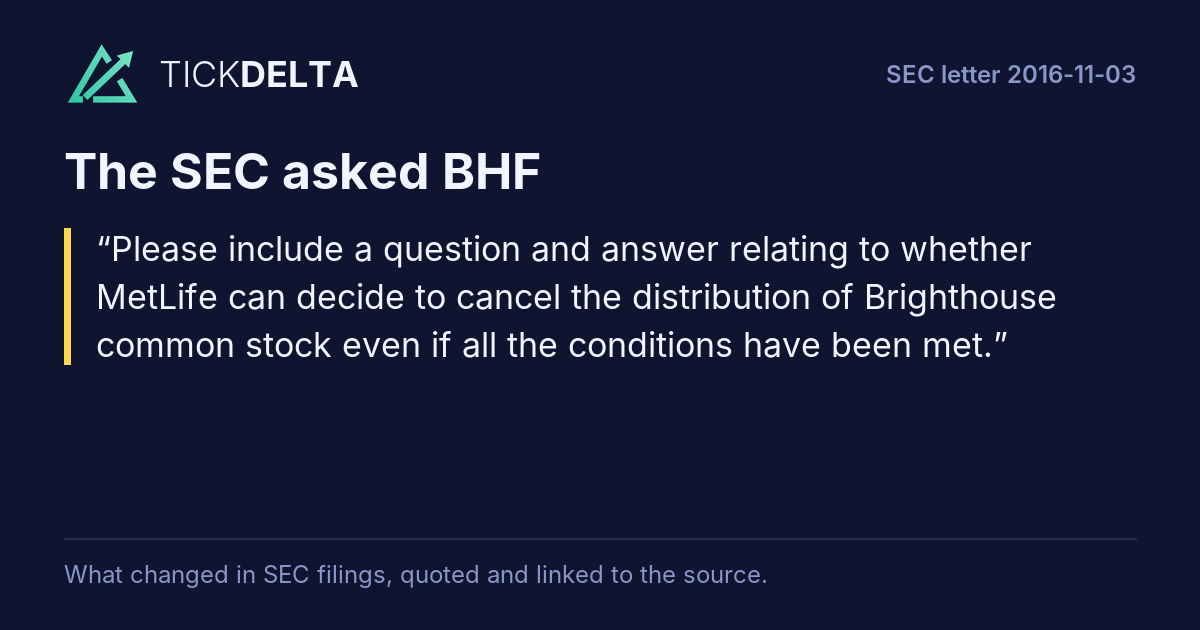
Please include a question and answer relating to whether MetLife can decide to cancel the distribution of Brighthouse common stock even if all the conditions have been met.
BHF answered
The Company has provided the requested disclosure in the Amendment. Please see page 17 of the Information Statement in response to the Staff’s comment.
Read in the reply
Summary · The Distribution, page 13
SEC asked (2)
We note your disclosures on pages 64 and 85 that you intend to incur substantial indebtedness in connection with the separation and will use a significant portion of the proceeds to pay a dividend to MetLife. Please provide information about this financing arrangement including the amount you intend to borrow and the amount that you intend to pay to MetLife.
BHF answered
The Company expects to borrow a substantial amount of funds in connection with the separation in the form of bank debt or debt securities issued to third-party lenders or investors. The amount of borrowing will allow the Company to achieve the following goals at the time of the distribution:

• adequate liquidity at the holding company;

a debt-to-capital ratio of approximately 20%; and

$3.0 billion of assets in excess of CTE95 to support the Company’s variable annuity contracts.

Consistent with these goals, the Company expects to use the proceeds of the borrowing to provide additional
Rest of the answer

capital to the Company’s operating subsidiaries and liquidity to its holding company. Any borrowing in excess of the amounts needed to satisfy the Company’s goals will be paid to MetLife either as a dividend or as partial consideration for MetLife’s transfer of assets to the Company.

On December 2, 2016, the Company entered into a $3.0 billion three-year senior unsecured delayed draw term loan agreement with a bank syndicate. Amounts under the term loan agreement are available, subject to certain conditions, after the completion of the contribution by MetLife of entities to Brighthouse Intermediate Company (the “Initial

Contribution”) and the completion of the contribution by MetLife of Brighthouse Intermediate Company to the Company. Alternatively, after the Initial Contribution, the Company may, subject to certain conditions, draw down amounts from available commitments provided that

Brighthouse Intermediate Company provides a guaranty of repayment of such obligations. There were no outstanding borrowings as of December 5, 2016. On December 2, 2016, the Company also entered into a $2.0 billion five-year senior unsecured revolving credit facility with a bank syndicate. Borrowings and issuances of letters of credit may commence after completion of the distribution, and shortly prior to the distribution if certain conditions are satisfied.

Response: The Company has provided the requested disclosure in the Amendment. Please see pages 15, 34, 67, 89,

174 and 175 of the Information Statement in response to the Staff’s comment.

Read in the reply
Summary Risk Factors, page 18
SEC asked (3)
Please revise the description of your strengths, strategy and risks factors to ensure a balanced presentation. The risk factor discussion should be as prominent in detail and presentation as the discussion of your strengths and strategy.
Rest of the question

Please relocate the risk factor discussion to immediately follow the discussion of your strengths, expand each bullet to provide additional detail and highlight any risks relating to the spin-off and changes to your business by addressing them first.

BHF answered
The Company has provided the requested revised disclosure in the Amendment. Please see pages 9 and 10 of the Information Statement in response to the Staff’s comment.
Read in the reply
Risk Factors · We will incur significant indebtedness in connection with the separation…, page 31
SEC asked (4)
Please quantify the significant indebtedness. Similarly, revise “We will incur substantial indebtedness in connection with the separation, and the degree to which we will be leveraged following completion of the distribution and separation may materially and adversely affect our results of operations and financial condition.”
BHF answered
The Company expects to borrow a substantial amount of funds in connection with the separation in the form of bank debt or debt securities issued to third-party lenders or investors. The amount of borrowing will allow the Company to achieve the following goals at the time of the distribution:

Consistent with these goals, the Company expects to use the proceeds of the borrowing to provide additional capital to the Company’s operating subsidiaries and liquidity to its holding company.
Rest of the answer

Any borrowing in excess of the amounts needed to satisfy the Company’s goals will be paid to MetLife either as a dividend or as partial consideration for MetLife’s transfer of assets to the Company.

On December 2, 2016, the Company entered into a $3.0 billion three-year senior unsecured delayed draw term loan agreement with a bank syndicate. Amounts under the term loan agreement are available, subject to certain conditions, after the completion of the Initial Contribution and the completion of the contribution by MetLife of Brighthouse Intermediate Company to the Company. Alternatively, after the Initial Contribution, the Company may, subject to certain conditions, draw down amounts from available commitments provided that Brighthouse

Intermediate Company provides a guaranty of repayment of such obligations. There were no outstanding borrowings as of December 5, 2016. On December 2, 2016, the Company also entered into a $2.0 billion five-year senior unsecured revolving credit facility with a bank syndicate. Borrowings and issuances of letters of credit may commence after completion of the distribution, and shortly prior to the distribution if certain conditions are satisfied.

Response: The Company has provided the requested disclosure in the Amendment. Please see pages 15, 34, 67, 89, 174 and 175 of the Information

Statement in response to the Staff’s comment.

Read in the reply
Risk Factors · We will incur significant indebtedness in connection with the separation…, page 31
SEC asked (5)
If you do not have a loan commitment, please disclose the possibility that you might not be able to enter into an unsecured credit facility on acceptable terms. We may experience difficulty in marketing and distributing products through our distribution channels, page 57
BHF answered
The Company now has a loan commitment as discussed in the responses to comments 2. and 4.

We may experience difficulty in marketing and distributing products through our distribution channels, page 57
Read in the reply
Risk Factors · We will incur significant indebtedness in connection with the separation…, page 31
SEC asked (6)
We note your statement that a significant distributor has elected to suspend their distribution relationships with you. Please identify the distributor and provide additional disclosure about the impact that this has had or is expected to have on your operations.
BHF answered
The Company has provided the requested disclosure in the

Amendment. Please see page 60 of the Information Statement in response to the Staff’s comment.
Read in the reply
The Separation and Distribution · Reasons for the Distribution, page 68
SEC asked (7)
Please revise your disclosure to discuss how the distribution will impact MetLife’s potential redesignation as a non-bank systemically important financial institution and the applicability of the DOL Fiduciary Rule.
BHF answered
In evaluating the efficacy of a potential separation transaction MetLife considered several business, operational and economic factors. The principal factors considered included (1) facilitating investors’ ability to independently value the Company and MetLife based on their respective operational and financial characteristics,

(2) increasing the predictability of MetLife’s cash flows over time and (3) enabling the Company to take advantage of a retail dedicated platform to increase responsiveness to the U.S. retail market.
Rest of the answer

While the separation will result in MetLife becoming a smaller and less complex organization, the principal Federal regulatory factor considered by MetLife was that the separation would mitigate the impact of a potential redesignation of MetLife as a non-bank systemically important financial institution (“SIFI”).

If MetLife were so re-designated as a non-bank SIFI prior to the distribution or while

MetLife is deemed to control the Company, and the Federal Reserve Board implements rules that require insurers that are non-bank SIFIs to comply with capital standards or regimes that do not take into account the insurance business model and the differences between banks and insurers, the business conducted by the Company could subject MetLife to enhanced capital requirements that could put MetLife at a significant competitive disadvantage compared to its peer insurers that are not non-bank

SIFIs. The Company, as a part of MetLife, could be required to raise the price of the products it offers, reduce the amount of risk it takes on, or stop offering certain products altogether. Separating the Company from MetLife would reduce the impact of any such enhanced capital requirements on MetLife, and potentially the Company, if MetLife were re-designated as a non-bank SIFI. However, the Company, because of its size, could be separately evaluated by the FSOC and designated as a non-bank SIFI and there can be no assurance that the Company will not be so designated. This is discussed on pages 48, 249, and 250 of the Information Statement.

The final DOL Fiduciary Rule on investment advice and related exemptions, which was released by the DOL on April 8, 2016, has many provisions that relate specifically to the sale of annuity products to qualified retirement plans and IRAs. Contracts entered into prior to April 10, 2017, the applicability date of the final regulations, are generally “grandfathered” and as such are not subject to the requirements of the rule and related exemptions. To retain “grandfathered” status, no investment recommendations may be made after the applicability date of the final regulations with respect to such annuity products that were sold to plans or IRAs.

MetLife sold its former Retail segment’s proprietary distribution channel, MetLife

Premier Client Group, in July 2016 to Massachusetts Mutual Life Insurance Company to complete a transition to an independent third party distribution model. By ceasing to distribute retail IRA products and/or retail annuities sold into ERISA plans and IRAs through a proprietary distribution channel, MetLife and the Company believe that the applicability of the vast majority of the rule provisions targeted at those products under the DOL Fiduciary Rule will be reduced. The separation and distribution of the Company does not itself implicate the applicability of the DOL Fiduciary Rule.

Read in the reply
Conditions to the Distribution, page 71
SEC asked (8)
Please clarify if you are able to waive any of the conditions. If you are, please identify the conditions that are subject to waiver.
BHF answered
The Company has the ability to waive the conditions to the distribution to the extent described in the Information Statement. The

Company has updated the disclosure in the Amendment to reflect this point. Please see pages 74 and 75 of the Information Statement in response to the Staff’s comments.
Read in the reply
Brighthouse, page 82
SEC asked (9)
Please expand your discussion to identify and quantify the MetLife liabilities you intend to assume
BHF answered
The Company has provided the requested revised disclosure in the Amendment. Please see page 86 of the Information Statement in response to the Staff’s comment.
Read in the reply
Recapitalization, page 85
SEC asked (10)
We note the tabular presentation of your planned financing and other capital transactions expected to occur before or at the time of the distribution. Please tell us your consideration of including unaudited pro forma financial statements in your filing to give effect to these transactions, as well as the eventual distribution of Brighthouse common stock. Refer to Article 11 of Regulation S-X.
BHF answered
As of the date of the initial filing of the Registration Statement and the filing of the Amendment, none of the conditions in

Regulation S-X Rule 11-01 were met and, therefore, no pro forma financial information relating to the transactions highlighted under Recapitalization were included in the filing. Specifically, as of the initial filing and the filing of the

Amendment, none of the transactions occurred or were deemed probable since management was still developing the strategy for the Company’s financing and capital transactions, some of which also require regulatory approval.
Rest of the answer

Once the conditions are met, the Company will include pro forma information as required under Regulation S-X Rule 11-02 in subsequent amendments to the Registration Statement.

Read in the reply
Summary of Critical Accounting Estimates · Liability for Future Policy Benefits, page 94
SEC asked (11)
You disclose that during the second quarter of 2016, MetLife accelerated its annual review of actuarial assumptions for its U.S. retail variable annuity business in light of the availability of a larger body of cumulative actual experience data than had been previously available. As a result of this review, you made changes to certain contract holder behavior and long-term economic assumptions.
Rest of the question

These updates resulted in a substantial charge ($1.7 billion, net of DAC and income tax) to earnings as well as shift in your accounting treatment for certain variable annuity guarantees from accrual-based insurance liabilities to fair value-based embedded derivatives. Please provide us with the following additional information:  Describe the new data that became available to you and explain why this data was unavailable prior to the second quarter of 2016;  Explain why the new data only accelerated the review of your variable annuities and no other products;  Describe in greater detail the changes you made to contract holder behavior and longterm economic assumptions and the drivers of those changes (i.e. what specific consumer behavior/long-term economic outlook changed from your prior actuarial review and how did those changes specifically impact your assumptions concerning annuitization, lapses and withdrawals and risk margins);  Provide us with an analysis, citing relevant accounting guidance, supporting your determination that fair value-based embedded derivative accounting is now appropriate for these types of contracts, considering the changes in assumptions; and  Tell us why you refer to this as a shift in your accounting. Provide us an analysis as to whether or not it represents an accounting change pursuant to ASC 250 and, if so, the type of change and how your accounting and disclosure complies with ASC 250.

BHF answered
The following provides additional information regarding the data availability, the changes made to certain assumptions, and the accounting treatment relating to the accelerated annual actuarial assumption review during the second quarter of 2016.

Description of New Data and When Available

Recognizing that variable annuity assumptions would impact many aspects of its planned separation of its former Retail segment, MetLife accelerated a review of its U.S. variable annuities experience in the second quarter of 2016.
Rest of the answer

While the Company first offered its guaranteed minimum income benefit (“GMIB”) products in 2001, only the Company’s newer versions launched in 2005 have additional product features that contract holders may select. It is these newer versions that make up a substantial portion of the Company’s GMIB block and, given the ten year waiting period before these features can be selected by contract holders, the Company has only since 2015 begun to observe “sufficient and credible” evidence of policyholder behavior relating to these various features.

In the first half of 2016, MetLife participated in an industry annuitization experience study conducted by an independent consultant (the

“Study”). The Study was based on data from twelve companies, including MetLife, representing those with GMIB contracts that were eligible for annuitization from January 2008 through December 2015. Upon its completion we were given access to the Study. According to the Study, expirations of the required waiting period, at which time options are exercisable, on this block nearly tripled since 2014 increasing credibility over previous studies. The Study noted that GMIB annuitization rates are low and getting lower and, more specifically, that those that allow dollar-for-dollar withdrawals are much lower. The Company believed that this additional industry annuitization information corroborated the credibility of the Company’s annuitization data.

Why New Data Accelerated the Review of Only Variable Annuities

This emerging data, as supplemented by the Study, was only pertinent to variable annuities since GMIB features are only available on variable annuities. The annual assumption review for the Company’s remaining products was completed as originally scheduled during the third quarter of 2016 and the impact of that review is included in the presentation on page 113 of the Information

Statement.

Changes Made to Contract holder Behavior and Long-term Economic Assumptions and the Drivers of Those Changes

Key Features of the GMIB

The 2016 second quarter assumption changes primarily related to the following features of the GMIBs:

Elective Annuitization Guarantee Option (“EAGO”). Provides a lifetime annual payment (including a period for a specified number of years) based on applying a guaranteed rate to the guaranteed income benefit base to determine the income benefit.

Automatic Annuitization. If, at any time during the accumulation phase, the account value drops to zero through a combination of withdrawals, fees and market performance, the contract will automatically annuitize.

Dollar-for-Dollar. Contract holders may in any one year withdraw, without penalty and regardless of the underlying account value, a portion of their account value up to a percentage of the benefit base.

Guaranteed Principal Option (“GPO”). First introduced in 2005, this feature, which is unique to the Company’s GMIBs, provides the contract holder with an option to take a lump sum in lieu of annuitizing. The GPO allows contract holders to receive a return of their original purchase payments if the account value has dropped below that level after 10 years. The GPO does not step-up or roll-up and is only available if the account value is less than the purchase payments made in the first 120 days.

Key 2016 Second Quarter Assumption Changes

The major GMIB assumption changes during the second quarter of 2016 were:

Elective annuitization rates. GMIB claims are largely driven by if and when contract holders elect to use the EAGO. When this benefit was originally priced there was sparse utilization experience. An accumulation of the Company’s own experience, as further supported by the Study, provided evidence that indicated a lower emerging utilization of the EAGO than was originally used in its pricing. As a result, the Company reduced its assumptions for elective annuitization.

Partial withdrawal rates. The GMIB also allows contract holders to take income via partial dollar-for-dollar withdrawals. The commencement of partial withdrawals is driven by attained age and Federal income tax required minimum distribution requirements. The Company reviews partial dollar-for-dollar experience each year and adjusts assumptions periodically based on emerging experience. In the second quarter of 2016, the Company further increased its expected dollar-for-dollar withdrawals assumption rates at higher attained ages.

Ultimate lapse rates. Since inception, the Company has assumed that the more valuable a contract is (i.e., the more the contract is “in the money”), the less likely the contract holder would lapse or terminate the contract. Although the Company had changed lapse assumptions in prior years, based on its experience since its last review, the Company further lowered its assumption of ultimate lapse rates.

GPO Utilization. The Company has recently observed lower GPO utilization than was originally considered in pricing. This experience is based on limited Company specific data, and there is no industry data for this specific and unique feature. As such, the Company considered competitor annuity “buy-out” programs, which the Company believes are analogous to the GPO contractual features for purposes of projecting contract holder behavior. These buy-out programs also showed low acceptance or utilization. Therefore, the Company reduced its GPO assumed utilization rate, which is applied to all age groups.

Risk Margin. As part of the assumption review, the Company refined its method for determining a margin for risks that cannot be hedged, which risks primarily include uncertainty with respect to policyholder behavior. Specifically, the Company refined its method to incorporate the present value of the cost of required capital held for such behavior risks, including those related to GMIB annuitization and GPO utilization assumptions. This refinement resulted in an increase in the embedded derivative fair values primarily related to the GMIBs.

Relevant Accounting

Guidance Considering the Changes in Assumptions

As disclosed in Footnote 1 Business, Basis of Presentation and Summary of

Significant Accounting Policies of the Company’s December 31, 2015 financial statements on page F-18 of the Information Statement, the Company accounts for the GMIBs either as insurance liabilities (under ASC 944) or as embedded derivatives (under ASC 815-15) based on whether the payments of the guarantees are dependent on (i) the occurrence of a specific insurable event (ASC 815-10-15-13 “insurance” scope exception) and (ii) whether the guarantee meets the “net settlement” requirement under ASC 815-10-15-83(c) embedded derivative guidance.

The EAGO is not in the scope of ASC

815-15 because it lacks net settlement as contract holders must give up their account value to receive the guarantee. The EAGO is accounted for as a UL-type insurance contract with liabilities established under ASC 944 (formerly SOP 03-1) based on expected annuitizations.

When contract holders do not elect the EAGO or the GPO but do take dollar-for-dollar withdrawals, the account value may eventually be reduced to zero. If that occurs, contract holders automatically receive a fixed income annuity with a period certain payout lasting from five to ten years followed by life contingent payments. In this scenario, the period certain payout represents an embedded derivative under ASC 815-15 accounted for at fair value since it meets the net settlement criterion (e.g., the contract is net settled through a period-certain annuity with no consideration paid by the contract holder) and is not life contingent. Any payments beyond the guaranteed period are not embedded derivatives and are accounted for under ASC 944 since they are life contingent.

All of the assumption changes highlighted above increase the likelihood that a greater number of contract holders will have their account values eventually reduce to zero before the election of the EAGO or GPO and thus be automatically annuitized into fixed annuities with guaranteed payout periods. The resulting increase in contracts with features accounted for as embedded derivatives during the second quarter of 2016 is what the Company has described as a “shift in accounting” on page 99 of the Information Statement.

ASC 250 Analysis and Reference as a Shift in Accounting

As indicated above, the change in the measurement of the Guarantees was based on the Company’s accounting policy for GMIBs and not by a change in accounting principle pursuant to ASC 250-10-45-1 through 16. The change in the GMIB assumptions represents a change in accounting estimate pursuant to ASC 250-1-45-17 through 18 and, therefore, the impact of the change in measurement of the liability was recognized during the second quarter of 2016. The Company has used the terminology “shift in accounting” to simplify the discussion of the change in the accounting measurement model of GMIBs given the increase in contract features now accounted for as embedded derivatives.

Read in the reply
Six Months Ended June 30, 2016 Compared with the Six Months Ended June 30, 2015 · GMLB Riders Liabilities, page 139
SEC asked (12)
You disclose the unfavorable change in the carrying value of the GMLB Rider liabilities decreased income (loss) before provision for income tax by $4.9 billion ($3.2 billion net of tax) primarily due to 1) changes in actuarial assumptions related to rider utilization 2) the impact from a decline in long-term interest rates during the period and 3) a favorable change from the impact of adjustments related to
Rest of the question

nonperformance risk and risk margin. Please revise to separately quantify the impact each of these items had on your results of operations. Refer to Item 303(a)(3) of Regulation S-K.

BHF answered
The Company has revised the disclosure on page 143 of the Information Statement to quantify the changes in actuarial assumptions related to the rider utilization, market risk factors and the related changes from the impact of adjustments to nonperformance risk and risk margins.
Read in the reply
GMLB Riders Actuarial Assumption Review, page 140
SEC asked (13)
You disclose in this section that the annual assumption review is included in the amounts discussed above. However, you disclose under GMLB Riders Liabilities that the related amounts exclude the impact of the actuarial assumption review. Please revise for clarification.
BHF answered
The discussion is intended to explain the impact of all changes, including the actuarial assumptions. However, the Company also discloses the impact to the GMLB Rider liabilities for business factors other than the assumption updates. To make this distinction more evident, the Company has clarified the discussion of GMLB Rider liabilities on page 143 of the Information Statement to first present the change to net income (loss) including the effects of the actuarial assumption review and then disclose the impact to net income (loss) excluding the impact of the review.

Please note the Company
Rest of the answer

used a similar approach in the segment operating earnings discussions. Accordingly, the Company will make conforming edits to all applicable references regarding effects excluding assumption updates.

Read in the reply
GMLB Riders Actuarial Assumption Review, page 140
SEC asked (14)
Please tell us your consideration of disclosing the changes in your contract holder behavior/long-term economic assumptions and aforementioned accounting shift, as a known trend that is reasonably expected to have a material unfavorable impact on total revenues. Refer to Item 303(a)(3) of Regulation S-K.
BHF answered
The Company refers to contract holder behavior and long-term economic assumptions within Industry Trends and Uncertainties on page 97 of the Information Statement since the Company’s current assumptions may change in the future as additional contract holder behavioral data becomes available over time and/or when economic conditions change. As indicated in the response to Comment No. 11, the Company has only recently begun to observe sufficient and credible data supporting significant GMIB contract holder assumption changes.
Rest of the answer

GMIB annuitization rates as well as other behavior assumptions are subject to change as company specific and/or industry experience emerges over time and economic factors change. Future changes in assumptions and market conditions could have a material unfavorable or favorable impact on net income including (i) shifts between the accounting measurement models described in the response to Comment No. 11 and changes in the fair value of the GMIB embedded derivatives recorded in net derivative gains (losses).

The Company has expanded the disclosure within

Industry Trends and Uncertainties on page 97 and Summary of Critical Accounting Estimates – Liability for Future Policy Benefits on page 99 of the Information Statement, respectively, as highlighted below. The objective is to both clarify the potential future impact of additional changes in policyholder behavior assumptions as well as the potential increase in income statement volatility subsequent to the accounting shift reported in the second quarter of 2016.

Industry Trends and Uncertainties –Financial and Economic Environment

Revised Disclosure (changes from the previous disclosure in bold, underlined text)

The above factors affect our expectations regarding future margins, which in turn affect the amortization of certain of our intangible assets such as DAC and VOBA. Significantly lower expected margins may cause us to accelerate the amortization of DAC and VOBA, thereby reducing net income in the affected reporting period. We review our long-term assumptions about capital market returns and interest rates, along with other assumptions such as contract holder behavior, as part of our actuarial assumption review. As additional Company specific and/or industry information on contract holder behavior becomes available, related assumptions may change and may potentially have a material impact to liability valuations and net income. In addition, the accounting shift from insurance to fair value accounting that occurred in the second quarter of 2016 may result in greater income statement volatility in the future.

Summary of Critical Accounting Estimates – Liability for Future Policy Benefits

During the second quarter of 2016, MetLife accelerated the annual review of actuarial assumptions for its U.S. Retail variable annuity business in light of the availability of a larger body of cumulative actual experience data than had been previously available. This data provided greater insight into contract holder behavior for GMIB riders passing the initial 10-year waiting period. As a result of this review, we made changes to contract holder behavior and long-term economic assumptions, primarily relating to annuitization, lapses and withdrawals, as well as risk margins. These assumption updates, principally involving contract holder behavior associated with GMIB riders, resulted in a shift in accounting treatment for certain of the variable annuity guarantees from accrual-based insurance liabilities to fair value-based embedded derivatives. This shift and the resulting charge to earnings were primarily due to an increase in the anticipated level of forced annuitizations at the time of account value depletion. Expected cash outflows related to the non-life contingent portion of forced annuities available in many GMIB riders are reported as embedded derivatives. This shift and the resulting charge to earnings were primarily due to an increase in the anticipated level of forced annuitizations where the non-life contingent portion is now reported as an embedded derivative. With more of the estimated future cash outflows being accounted for as embedded derivatives, the GMIB rider liabilities are more sensitive to market changes and thus may result in greater income statement volatility.

Read in the reply
Rating Agencies, page 176
SEC asked (15)
We note your statement that in connection with the separation, rating agencies are expected to update the insurer financial strength ratings of your insurance company subsidiaries and assign credit ratings to your parent company.
Rest of the question

To the extent that you have experienced any rating changes or there are outstanding credit alerts or watches that may precede a rating change, please expand your disclosure to describe these events and discuss how these could affect liquidity, collateral calls on reinsurance or derivative contracts and the ability to write new policies. Please also include such information in the risk factor captioned, “A downgrade or a potential downgrade in our financial strength or credit ratings could result in a loss of business and materially affect our financial condition and results of operations.”

BHF answered
Following the Company’s filing of the Registration Statement on October 5, 2016, the following rating agencies announced the following rating actions.

On October 5, 2016 – Moody’s Investor Service (“Moody’s”) downgraded the insurance financial strength ratings of MetLife Insurance Company USA (“MetLife USA”) and

New England Life Insurance Company (“NELICO”) from “Aa3” to “A3”. The ratings outlook was revised to stable from negative.
Rest of the answer

Moody’s does not currently rate First MetLife Investors Insurance Company

(“FMLI”).

On October 5, 2016 – S&P Global Ratings affirmed its “A+” insurance financial strength ratings on MetLife USA, NELICO and FMLI. The ratings outlook remains negative.

On October 6, 2016 – Fitch Ratings downgraded the insurance financial strength ratings of MetLife USA and NELICO from “AA-” to “A+”. The ratings outlook was revised to stable from negative.

Fitch Ratings does not currently rate FMLI.

On October 7, 2016 – A.M. Best downgraded the insurance financial strength ratings of MetLife USA, NELICO and FMLI from “A+” to “A”. The ratings outlook was revised to stable from negative.

In response to the Staff’s comment, the Company has included disclosure regarding these insurance financial strength rating downgrades in the Liquidity and Capital Resources section on page 181 and the Risk Factor entitled “A downgrade or a potential downgrade in our financial strength or credit ratings could result in a loss of business and materially affect our financial condition and results of operations” on page 35 of the Information Statement.

Read in the reply
Business · Third-Party Reinsurance, page 232
SEC asked (16)
To the extent you are substantially dependent on any of your reinsurance agreements, please file them as exhibits.
BHF answered
The Company uses reinsurance primarily in connection with its ordinary course prudent risk management practices. Based on its current product offerings and capital position the Company does not depend on reinsurance to manage surplus strain from the sale of new products or as a surrogate source of capital. In addition, the Company’s reinsurance is diversified with a group of highly rated reinsurers. Accordingly, the Company does not believe it is substantially dependent on any of its reinsurance agreements.
Read in the reply
Compensation of Executive Officers and Directors, page 253
SEC asked (17)
We note your disclosure on page F-137 that your employees participate in MetLife’s stock compensation plans, the costs of which have been allocated to you and recorded in your statement of income. Please expand your disclosure to describe the effect that the separation and distribution will have on these stock compensation plans. Financial Statements Notes to Combined Financial Statements 1.
Rest of the question

Business, Basis of Presentation, and Summary of Significant Accounting Policies, page F-12

BHF answered
We anticipate that the Company’s separation from MetLife will constitute the end of our employees’ employment with MetLife,

Inc. and its affiliates, and that their MetLife, Inc. stock compensation awards will be retained or forfeited according to their terms. We also anticipate that, in accordance with the requirements of the plans, the MetLife, Inc.
Rest of the answer

Board or appropriate committees will determine what adjustments, if any, to make to outstanding awards and the number of shares reserved for issuance under the stock compensation plans in order to prevent the dilution or enlargement of participants’ rights under the plans.

The Company has updated the disclosure in the Amendment accordingly. Please see page 259 of the Information Statement.

Financial Statements

Notes to Combined Financial

Statements

1. Business, Basis of Presentation, and Summary of Significant Accounting Policies, page F-12

Read in the reply
Compensation of Executive Officers and Directors, page 253
SEC asked (18)
It appears from your disclosures on pages 79 and 91 that the formation of Brighthouse as the eventual standalone parent company will be effective upon completion of the spin-off from MetLife and the newly-formed Brighthouse entity has no business transactions or activities and does not yet hold any of the certain assets and liabilities of the MetLife’s Retail and Corporate Benefit Funding segments.
Rest of the question

As such, tell us:  Why it is appropriate to label the combined financial statements as Brighthouse Financial Inc. and Related Companies;  Why it is appropriate to refer to the historical results presented in the summary and selected combined historical financial information/data as Brighthouse; and  Why it is appropriate to include the results of operations, financial condition, and cash flows of Brighthouse Inc. in the combined historical financial statements, when it was not incorporated until August 1, 2016.

BHF answered
The formation of Brighthouse Financial, Inc. as the eventual standalone parent company is expected to occur prior to the completion to the Company’s separation from MetLife. Once the related companies, which are defined in Note 1 to the Combined Financial Statements, are contributed by MetLife to Brighthouse Financial, Inc., the

Company will include consolidated financial statements, summary and selected historical financial information/data in subsequent filings.

The Company believes that it was appropriate to label the combined financial statements as Brighthouse Financial, Inc.
Rest of the answer

and related companies and refer to the historical results presented in the summary and selected combined historical financial information/data as Brighthouse since:

as of the date of the filing and issuance of the financial statements Brighthouse Financial, Inc. was incorporated;

the Company did not think it would be misleading to a reader especially given the transparent disclosures about Brighthouse and the related companies; and the basis of presentation is comparable to the consolidated presentation once the related companies are contributed to Brighthouse Financial, Inc.

Read in the reply
Investments, Fixed Maturity and Equity Securities, page F-19
SEC asked (19)
You disclose that interest income is recognized using an effective yield method, giving effect to amortization of premiums and accretion of discounts. Please revise your amortization policy to clarify the period over which you amortize (ex: contractual or estimated lives of securities).
BHF answered
The Company has included the following disclosure in Footnote No. 4

Investments – Net Investment Income in its September 30, 2016 Interim Financial Statements on page F-170 of the Information Statement as shown below.

Revised Disclosure (changes from the disclosure in the December 31, 2015 Company financial statements in bold, underlined text)

F-170 Disclosure - Fixed Maturity and Equity Securities

Interest income and prepayment fees are recognized when earned.
Rest of the answer

Interest income is recognized using an effective yield method giving effect to amortization of premiums and accretion of discounts based on the estimated economic life of the securities, which for mortgage-backed and asset-backed securities considers the estimated timing and amount of prepayments of the underlying loans. (See “Investments - Fixed Maturity and Equity Securities AFS - Methodology for Amortization of Premium and Accretion of Discount on Structured Securities”.) The amortization of premium and accretion of discount of fixed maturity securities also takes into consideration call and maturity dates. Dividends on equity securities are recognized when declared.

Similar disclosure will be made in Footnote No. 1 Business, Basis of Presentation and Summary of Significant Accounting Policies -

Investments, Fixed Maturity and Equity Securities beginning with the Company’s December 31, 2016 financial statements.

Read in the reply
Summary · The Distribution, page 15
SEC asked (1)
We note your responses to our prior comments two and four. Please revise your disclosure here and elsewhere, as appropriate, to provide information about the amount you will need to ensure that you have adequate liquidity, to achieve a 20% debt to capital ratio and to ensure that you have $3 billion in assets in excess of CTE95.
BHF answered
As disclosed in the Amendment, we will incur substantial indebtedness in connection with the separation, and we will use a significant portion of the proceeds of such indebtedness to make a distribution to MetLife as partial consideration for MetLife’s transfer of assets to the Company.

The amount of indebtedness we currently expect to incur is $3.5 billion, $3.0 billion of which we anticipate will be drawn from our existing term loan capacity and $0.5 billion of which we expect will be funded from additional third-party indebtedness.
Rest of the answer

This amount of indebtedness will allow us to achieve the following goals at the time of the distribution: (i) adequate liquidity at the Brighthouse holding company level; (ii) a debt-to-capital ratio of approximately 25%; and (iii) $2.0 billion to $3.0 billion of assets in excess of CTE95 to support our variable annuity contracts.

Please see pages 15, 16, 37, 74, 97, 170 and 171 of the Information Statement in response to the Staff’s comment.

Read in the reply
Summary · The Distribution, page 15
SEC asked (2)
With respect to the “borrowings in excess of the amounts needed to satisfy the Company’s goals,” is it your intention to draw down the entire $5 billion available and pay the excess to MetLife as a dividend or partial consideration for MetLife’s transfer of assets? What factors will you consider in determining whether the payment will be a dividend or consideration?
Rest of the question

If you consider this a dividend, will you still be obligated to pay MetLife consideration for the transfer of assets? Please quantify the consideration you are obligated to pay MetLife for the transfer of assets. Risk Factors We may experience difficulty in marketing and distributing products through our distribution channels, page 59

BHF answered
As discussed in the response to Comment 1 above, we currently expect to incur indebtedness of $3.5 billion, $3.0 billion of which we anticipate will be drawn from our existing term loan capacity and $0.5 billion of which will be funded from additional third-party indebtedness. This amount of indebtedness will allow us to make distributions to MetLife prior to the separation in an amount of $3.3 billion to $3.8 billion and achieve the following goals at the time of the distribution: (i) adequate liquidity at the Brighthouse holding company level; (ii) a debt-to-capital ratio of approximately
Rest of the answer

25%; and (iii) $2.0 billion to $3.0 billion of assets in excess of CTE95 to support our variable annuity contracts.

The amount of cash being distributed by the Company to MetLife and the amount of property (the common equity interests in Brighthouse

Intermediate Company) being transferred by MetLife to the Company are not impacted by the form of the payment. Pursuant to the contribution agreement, MetLife will contribute the common equity interests in Brighthouse Intermediate Company to

Brighthouse, and in consideration for the interests received, Brighthouse will (i) issue shares of Brighthouse common stock to MetLife, (ii) assume certain liabilities of MetLife pursuant to the Master Separation Agreement and the Tax Receivables

Agreement and (iii) pay, or agree to pay, any amount of cash that may be due to MetLife pursuant to the contribution agreement and the Tax Receivables Agreement (the value of Brighthouse Intermediate Company will be significantly greater than the amount of cash distributed to MetLife).

Risk Factors

We may experience difficulty in marketing and distributing products through our distribution channels, page 59

Read in the reply
Summary · The Distribution, page 15
SEC asked (3)
We note your revised disclosure in response to our prior comment six and reissue the comment in part. Please identify the significant distributor that has elected to suspend its distribution relationship with you.
BHF answered
The Company has agreed to identify the significant distributor in a subsequent pre-effective amendment to the Registration Statement.
Read in the reply
The Separation and Distribution · Reasons for the Distribution, page 71
SEC asked (4)
We note your response to our prior comment seven. Please revise your disclosure to clarify your belief that the sale of the former Retail segment’s proprietary distribution channel to Massachusetts Mutual Life Insurance Company reduced the applicability of the vast majority of the DOL Fiduciary Rule provisions.
Rest of the question

To the extent that there are any provisions that continue to apply, please provide further explanation of their potential impact on your business.

BHF answered
The Company has provided the requested revised disclosure in the Amendment. Please see pages 258 and

259 of the Information Statement in response to the Staff’s comment.
Read in the reply
Material U.S. Federal Income Tax Consequences of the Distribution, page 76
SEC asked (5)
We note your disclosure on pages 18 and 66 that you could have an indemnification obligation to MetLife if certain steps that are part of the separation do not qualify for their intended tax treatment. Please clarify if you are referring to steps that are not covered by the private letter ruling from the IRS; the possibility that that you are unable to obtain a private letter ruling from the IRS; or the possibility
Rest of the question

that it is determined you are not in compliance with representations, assumptions and covenants. If the restructuring transactions are not covered by the private letter ruling, please expand your discussion to explain that the private letter ruling does not apply to these restructuring transactions and discuss the expected tax treatment and potential liability. If you expect that the restructuring transactions are not taxable, provide the basis for your belief.

BHF answered
The indemnification obligation referred to on pages 20, 72 and 87 of the Information Statement refer to restrictions placed on the

Company after separation. These restrictions will be reduced to representations and warranties made by the Company in the Tax Separation Agreement and are intended to prevent the Company from engaging in activities or taking steps that, in

MetLife’s view, may endanger (i) the tax-free nature of the distribution or (ii) the taxable status of two preparatory steps prior to the distribution including the reinsurance subsidiary restructuring.
Rest of the answer

The latter gives rise to certain tax assets, including those that are the subject of the Tax Receivables Agreement. Breach of these representations and warranties would give rise to the indemnity obligation. MetLife’s private letter ruling is still pending with the IRS but MetLife anticipates a favorable ruling to be issued in 2017 (including with respect to (i) those preparatory steps and (ii) certain significant issues relating to the distribution).

Read in the reply
Formation of Brighthouse and the Restructuring · Brighthouse, page 86
SEC asked (6)
We note your revised disclosure in response to our prior comment nine. Please quantify the MetLife liabilities you intend to assume.
BHF answered
The MetLife liabilities to be assumed by the Company in connection with the separation will consist primarily of contractual indemnification rights and other contractual and contingent liabilities which do not constitute indebtedness for borrowed money. If these liabilities had been assumed in the year ended December 31, 2016, no additional reserves for these liabilities would have been required to be reflected in the Company’s financial statements for the year ended and as of December 31, 2016.
Read in the reply
Summary of Critical Accounting Estimates · Liability for Future Policy Benefits, page 98
SEC asked (7)
We continue to evaluate your response to prior comment 11. In your response, you indicate that that the change in GMIB assumptions represents a change in accounting estimate pursuant to ASC 250 that results in a change in your accounting measurement model for GMIBs.
Rest of the question

Please:  Provide us a detailed explanation of how your accounting change meets each component of the definition of a change in estimate in ASC 250-10-20.  To the extent you have fully supported your accounting, revise your disclosure to characterize the change as a change in estimate and remove all references to an accounting shift. Financial Statements Notes to Combined Financial Statements 1.Business, Basis of Presentation, and Summary of Significant Accounting Policies, page F-12

BHF answered
The Company has concluded that the change in measurement of GMIB liabilities in the second quarter of 2016 relating to the accelerated assumption review meets the definition of a change in accounting estimate pursuant to ASC 250-10-20 as follows:

The revised assumptions had the effect of adjusting the carrying amount of certain of the Company’s existing GMxB liabilities by altering the subsequent accounting for the liabilities as certain of the expected future guaranteed annuitization cash flows that were previously included in an accrual-based insurance liabilities model are now included in
Rest of the answer

a fair value-based derivatives model.

This change was based on new information obtained in the second quarter of 2016 increasing the amount of the annuitizations the Company estimates will be settled via forced annuitizations, thus deemed to have net settlement.

The new information included the receipt of the results of an industry annuitization experience study that corroborated the creditability of the Company’s own recently updated annuitization data.

The Company has made revisions to characterize the change in GMIB assumptions as a change in estimate in the following sections:

Summary of Critical Accounting Estimates - Liability for Future Policy Benefits, page 107

Summary of Critical Accounting Estimates - Derivatives - Embedded Derivatives pages 111 and 112

Business

Variable

Annuity Risk Management - Reserves, page 230

Financial Statements

Notes to Combined Financial Statements

1. Business,

Read in the reply
Summary of Critical Accounting Estimates · Liability for Future Policy Benefits, page 98
SEC asked (8)
We have reviewed your response to prior comment 18. Since Brighthouse was not incorporated until August 1, 2016, we do not believe it is appropriate, for periods as of or ended before August 1, 2016, to label the historical financial statements and notes as Brighthouse or including Brighthouse, or to refer to the historical financial results presented in the summary and selected combined financial data and MD&A as
Rest of the question

Brighthouse or including Brighthouse. Likewise, we do not believe Brighthouse should be referenced as a combined entity in your independent auditor’s report on page F- 5. Please revise accordingly.

BHF answered
The Company has changed the labeling of the combined financial statements and notes and references to the historical financial results presented in the summary and selected combined financial data and MD&A to “MetLife’s U.S. Retail Separation Business”. The financial statements referenced in the Report of the

Independent Registered Public Accounting Firm on the combined financial statements have also been similarly changed.
Read in the reply
Exhibit 99.1 – Information Statement · Unaudited Pro Forma Condensed Combined Financial Statements, page 186
SEC asked (1)
Upon separation, we note that as part of the unwinding of MetLife Reinsurance Company of South Carolina (“MRSC”) $2.8 billion collateral funding arrangement obligation, trust assets in excess of MSRC’s obligation will support the early termination payment due to an unaffiliated financial institution.
Rest of the question

Please expand your disclosure to quantify and explain your accounting for this early termination fee and any related future impacts, if material.

BHF answered
The

Company’s accounting for the unwinding of the MRSC $2.8 billion collateral financing arrangement with an unaffiliated financial institution and the consequent early termination fee will, by analogy, follow the guidance provided in Staff

Accounting Bulletin Topic 5-: Miscellaneous Accounting, Section T –Accounting for Expenses or Liabilities Paid by Principal Stockholder(s).

In connection with the entry by MetLife, Inc.
Rest of the answer

(“MetLife”) into such collateral financing arrangement, MetLife agreed to make payments to the unaffiliated financial institution for, among other things, early termination of such collateral financing arrangement. Further, because the collateral financing arrangement refinancing was a result of MetLife’s decision to initiate the separation of the MetLife Retail Business and not as a result of MRSC’s current business operation, MetLife will incur the expense and payment for the early termination payment resulting from the unwinding of the collateral financing arrangement. MRSC has distributed the trust assets in excess of MRSC’s principal obligation to MetLife in the form of a dividend.

The Company has revised the pro forma disclosure on page 204 of the Information Statement as highlighted below.

Revised Disclosure (changes from the previous disclosure in bold, underlined text):

As part of the unwinding of the collateral financing arrangement, trust assets in excess of MRSC’s principal obligation were distributed to MetLife and will partially fund [will support the early termination payment due to an unaffiliated financial institution as well as] the distributions we expect to pay to MetLife prior to separation.

Read in the reply
Exhibit 99.1 – Information Statement · Unaudited Pro Forma Condensed Combined Financial Statements, page 186
SEC asked (2)
Please tell us what consideration was given to reflecting any incremental costs associated with your Master Separation Agreement as well as other agreements with MetLife in your pro forma financial information pursuant to Rule 11-02(b)(6) of Regulation S-X. We note discussion of a post-separation license for the use of the “MetLife” name discussed on page 287.
BHF answered
As part of the separation, the Company expects to enter into the Master Separation Agreement and several other agreements (including, among others, the Transition Services Agreement, the Investment Management Agreements, and the Registration Rights Agreement) with MetLife to effect the separation and to provide a framework for the Company’s relationship with MetLife after the distribution.

The Master Separation Agreement will set forth the Company’s agreements with MetLife relating to the ownership of certain assets and the allocation of certain liabilities in connection with the separation
Rest of the answer

of the Company from MetLife. It will also set forth other agreements governing the Company’s relationship with MetLife after the distribution, including certain payment obligations between the parties.

Payment obligations under the Master Separation Agreement and the other agreements fall into three broad categories:

Ongoing payment obligations for services provided to the Company under the Transition Services Agreement and the Investment Management Agreements, which initiated on January 1, 2017 under these agreements,

One-time payment obligations (e.g., costs related to the transfer of certain books and records to the Company, expenses incurred in the connection with the sale of the Company’s shares owned by MetLife as contemplated in the Registration Rights Agreement, and the cost to purchase run-off tail insurance policies for certain liability coverages), and

Read in the reply
Non-GAAP and Other Financial Disclosures, page 192
SEC asked (3)
You disclose that you provide reconciliations of your non-GAAP measures to the most directly comparable GAAP measures in the Results of Operations and Business sections of your filing. We are unable to locate reconciliations for Operating ROE and Operating EPS. Please tell us why these reconciliations were not provided.
BHF answered
Historical Operating ROE and Operating EPS are not presented in the Information Statement and are only used in highlighting prospective financial goals in the Select Financial Targets section. Reconciliations of these non-GAAP measures to the most directly comparable GAAP measures are not accessible on a forward-looking basis because the Company believes it is not possible without unreasonable efforts to provide, other than a range, net investment gains and losses and net derivative gains and losses, which can fluctuate significantly within or outside the range and from period to period and
Rest of the answer

may have a material impact on net income (loss). However, definitions of Operating ROE and Operating EPS are included on page 119 to explain these future financial measures.

The Company has expanded the disclosure in the non-GAAP financial measures table on page 117 of the Information Statement as highlighted below.

See “— Results of Operations” and “Business — Description of our Segments, Products and Operations” for reconciliations of [these measures to the most directly comparable historical GAAP measures] operating earnings to net income (loss). Operating ROE and Operating EPS are only presented in this information statement as future financial targets post-separation. A reconciliation of these non-GAAP measures to the most directly comparable GAAP measures is not accessible on a forward-looking basis because we believe it is not possible without unreasonable efforts to provide other than a range of net investment gains and losses and net derivative gains and losses, which can fluctuate significantly within or outside the range and from period to period and may have a material impact on net income

(loss).

Read in the reply
Non-GAAP and Other Financial Disclosures, page 192
SEC asked (4)
You disclose that operating revenues and operating expenses exclude certain amounts related to securitization entities that are VIEs consolidated under GAAP. Please tell us the reason(s) for excluding these amounts and quantify the amounts excluded from operating revenues and operating expenses for each period presented.
Rest of the question

Tell us the specific line items that reflect the exclusion of such amounts on your reconciliations to the most directly comparable GAAP measures. MetLife U.S. Retail Separation Business Notes to Combined Financial Statements 1. Business, Basis of Presentation and Summary of Significant Accounting Policies

BHF answered
Revenues and expenses relating to consolidated securitization entities (“CSEs”) are included in net investment income and other expenses on the Company’s combined statements of operations and comprehensive income (loss). CSE net investment income amounts are disclosed in footnote 4 to the investment yield table on page 162 with equal amounts included in other expenses on the Company’s combined statements of operations.
Rest of the answer

Amounts relating to CSEs are excluded in determining investment yields and operating earnings since CSEs are not managed by the Company and are not profitability drivers of the Company’s business. Since CSE amounts are insignificant, they are included in the Other Adjustment component of the Company’s combined results of operations discussion and, since the net investment income and other expense amounts net to zero in determining net income (loss), they are not referenced in the applicable discussions.

MetLife U.S. Retail Separation

Business

Notes to Combined Financial Statements

1. Business, Basis of Presentation and Summary of Significant Accounting Policies

Read in the reply
Employee Benefit Plans, page F-32
SEC asked (5)
Your combined statements of operations include expenses for employee benefit plans sponsored by Metropolitan Life Insurance Company. Please tell us if there is a corresponding payable to MLIC recorded related to these expense amounts, if you have an obligation to repay any of the benefits your employees received under these plans, and how any payables will be settled in the separation.
BHF answered
The Company historically has incurred employee benefit plan expenses on a monthly basis. Such expenses have been recorded as an intercompany payable to MLIC, with the payable settled in cash in the following accounting period. Beyond this monthly expense billing process, the Company incurred no additional charges from MLIC based on employee utilization of benefits or plan funding needs.

Beginning January 1, 2017, the Company established its separate employee benefit plans and its active employees no longer participate in MLIC’s employee benefit plans.
Rest of the answer

The Company settled its final monthly billing for MLIC employee benefit plans in January 2017. Therefore, at separation, the Company will not have any payables related to MLIC sponsored employee benefit plans.

Read in the reply
Stock-Based Compensation, page F-32
SEC asked (6)
We note your stock-compensation expense included in your combined statements of operations as determined by MetLife, Inc.’s accounting policy. Please expand your disclosure to discuss the impact of the separation on incentive compensation plans that your employees previously participated in.
BHF answered
The Company’s participation in these plans ceased December 31, 2016, in that MetLife, Inc. did not grant Company employees new MetLife, Inc. stock-based long-term incentive awards as part of its 2017 process of determining total compensation for 2016 performance and in expectation of contributions to future performance, to the extent that Company employees had been identified prior to MetLife, Inc.
Rest of the answer

completing that process.

The Company has expanded the disclosures in the Information Statement as highlighted below.

Executive Compensation Program – Page 291

We are currently a wholly owned subsidiary of MetLife consisting of various portions of MetLife’s business. Our executive officers are currently officers or employees of MetLife, and some or all of the work they perform relate to us or our subsidiaries. [Our executive officers have been compensated by MetLife under their compensation programs.]

Effective January 1, 2017, Brighthouse established its own benefit plans. Our executive officers are participants in these Brighthouse benefit plans.

Our executive officers have participated in MetLife stock-based compensation plans, the costs of which have been allocated to the Company and recorded in the combined statements of operations. We anticipate that our separation from MetLife will constitute the end of our employees’ employment with MetLife and its affiliates, and that their MetLife stock compensation awards will be retained or forfeited according to their terms. Accordingly, as of the separation those awards will have either been forfeited or fully expensed. We also anticipate that, in accordance with the requirements of the plans, the MetLife Board or an appropriate committee will determine what adjustments, if any, to make to outstanding awards and the number of shares reserved for issuance under MetLife’s stock compensation plans in order to prevent the dilution or enlargement of participants’ rights under the plans.

The

Company’s participation in MetLife, Inc.’s stock compensation plans ceased December 31, 2016, in that MetLife, Inc. did not grant Company employees new MetLife, Inc. stock-based long-term incentive awards as part of its 2017 process of determining total compensation for 2016 performance and in expectation of contributions to future performance, to the extent that Company employees had been identified prior to MetLife, Inc. completing that process.

While we have determined the general principles and practices that will inform our executive compensation program, neither we nor the companies that will be our affiliates after we are no longer affiliated with MetLife have yet separately determined the compensation and benefits that will apply to our executive officers after that date.

Other Related Person Transactions – Page 310

Stock-Based Compensation Plans

Our employees [currently] have participated in MetLife, Inc.

stock-based compensation plans, the costs of which have been allocated to us and recorded in the combined statements of operations. We anticipate that our separation from MetLife will constitute the end of our employees’ employment with MetLife and its affiliates, and that their MetLife stock compensation awards will be retained or forfeited according to their terms. Accordingly, as of the separation those awards will have either been forfeited or fully expensed. We also anticipate that, in accordance with the requirements of the plans, the MetLife Board or an appropriate committee will determine what adjustments, if any, to make to outstanding awards and the number of shares reserved for issuance under

MetLife’s stock compensation plans in order to prevent the dilution or enlargement of participants’ rights under the plans.

The Company’s participation in MetLife, Inc.’s stock compensation plans ceased December 31, 2016, in that MetLife, Inc. did not grant Company employees new MetLife, Inc. stock-based long-term incentive awards as part of its 2017 process of determining total compensation for 2016 performance and in expectation of contributions to future performance, to the extent that

Company employees had been identified prior to MetLife, Inc. completing that process.

MetLife U.S. Retail Separation Business

Notes to the Interim Condensed Combined Financial Statements (Unaudited)

9. Related Party Transactions – Page F-226

Additional Disclosure:

The Company’s employees have participated in MetLife, Inc. stock-based compensation plans, the costs of which have been allocated to the Company and recorded in the combined statements of operations. The Company anticipates that its separation from MetLife will constitute the end of its employees’ employment with MetLife and its affiliates, and that their MetLife stock compensation awards will be retained or forfeited according to their terms. Accordingly, as of the separation those awards will have either been forfeited or fully expensed. The Company also anticipates that, in accordance with the requirements of the plans, the MetLife Board or an appropriate committee will determine what adjustments, if any, to make to outstanding awards and the number of shares reserved for issuance under MetLife’s stock compensation plans in order to prevent the dilution or enlargement of participants’ rights under the plans.

The Company’s participation in MetLife, Inc.’s stock compensation plans ceased December 31, 2016, in that MetLife, Inc. did not grant Company employees new MetLife, Inc. stock-based long-term incentive awards as part of its 2017 process of determining total compensation for 2016 performance and in expectation of contributions to future performance, to the extent that Company employees had been identified prior to MetLife, Inc. completing that process.

Read in the reply
Exhibit 99.1 – Information Statement · Forward-Looking Statements
SEC asked (1)
Please note that the safe harbor for forward-looking statements provided by the Private Securities Litigation Reform Act of 1995 (PSLRA) applies to issuers that are subject to the reporting requirements of section 13(a) or section 15(d) of the Securities Exchange Act of 1934 at the time the statements are made.
Rest of the question

Please revise to remove the implication that the statements in both letters to shareholders are within the protection of the PSLRA or tell us why you believe that the safe harbor is available to you. MetLife U.S. Retail Separation Business Notes to Combined Financial Statements 1. Business, Basis of Presentation and Summary of Significant Accounting Policies

BHF answered
The Company has revised the text of each of the Chief Executive Officers’ letters to shareholders as highlighted below (changes from the previous text in bold, underlined or struckthrough text):

Letter from

Steven A. Kandarian to MetLife shareholders:

This letter may contain or incorporate by reference information that includes or is based upon forward-looking statements [within the meaning of the Private Securities Litigation Reform Act of 1995]. Forward-looking statements give expectations or forecasts of future events.
Rest of the answer

These statements can be identified by the fact that they do not relate strictly to historical or current facts. They use words such as “will,” “expect,” “become,” “remain,” “believe,” “plan,” and other words and terms of similar meaning, or are tied to future periods, in connection with a discussion of future operating or financial performance. In particular, these include statements relating to future actions, prospective services or products, future performance or results of current and anticipated services or products, sales efforts, expenses, the outcome of contingencies such as legal proceedings, trends in operations and financial results.

Any or all forward-looking statements may turn out to be wrong. They can be affected by inaccurate assumptions or by known or unknown risks and uncertainties. Many such factors will be important in determining the actual future results of MetLife, Inc., its subsidiaries and affiliates. These statements are based on current expectations and the current economic environment. They involve a number of risks and uncertainties that are difficult to predict. These statements are not guarantees of future performance. Actual results could differ materially from those expressed or implied in the forward-looking statements. Risks, uncertainties, and other factors that might cause such differences include the risks, uncertainties and other factors identified in MetLife, Inc.’s most recent Annual Report on Form 10-K (the “Annual Report”) filed with the U.S. Securities and Exchange Commission (the “SEC”), any Quarterly Reports on Form 10-Q filed by MetLife, Inc. with the SEC after the date of the Annual Report under the captions “Note Regarding Forward-Looking Statements” and “Risk Factors,” and other filings MetLife, Inc. makes with the SEC. MetLife, Inc. does not undertake any obligation to publicly correct or update any forward-looking statement if MetLife, Inc. later becomes aware that such statement is not likely to be achieved. Please consult any further disclosures MetLife, Inc. makes on related subjects in reports to the SEC.

Letter from Eric T. Steigerwalt to Future Brighthouse Financial Shareholders:

This letter may contain or incorporate by reference information that includes or is based upon forward-looking statements [within the meaning of the Private Securities Litigation Reform Act of 1995]. Forward-looking statements give expectations or forecasts of future events. These statements can be identified by the fact that they do not relate strictly to historical or current facts. They use words such as “will,” “seek,” “intend,”

“over time,” “aim,” “believe,” and other words and terms of similar meaning, or are tied to future periods, in connection with a discussion of future operating or financial performance. In particular, these include statements relating to future actions, prospective services or products, future performance or results of current and anticipated services or products, sales efforts, expenses, the outcome of contingencies such as legal proceedings, trends in operations and financial results.

Any or all forward-looking statements may turn out to be wrong. They can be affected by inaccurate assumptions or by known or unknown risks and uncertainties. Many such factors will be important in determining the actual future results of Brighthouse Financial, Inc., its subsidiaries and affiliates. These statements are based on current expectations and the current economic environment. They involve a number of risks and uncertainties that are difficult to predict. These statements are not guarantees of future performance. Actual results could differ materially from those expressed or implied in the forward-looking statements. Risks, uncertainties, and other factors that might cause such differences include the risks, uncertainties and other factors identified in Brighthouse Financial, Inc.’s disclosures filed with the

U.S. Securities and Exchange Commission (the “SEC”). Brighthouse Financial, Inc. does not undertake any obligation to publicly correct or update any forward-looking statement if Brighthouse Financial, Inc. later becomes aware that such statement is not likely to be achieved. Please consult any further disclosures Brighthouse Financial, Inc. makes on related subjects in reports to the SEC.

MetLife U.S. Retail Separation Business

Notes to Combined Financial Statements

1. Business,

Read in the reply
Stock-Based Compensation, page F-32
SEC asked (2)
We note your response to revised comment 6, as provided to you by the staff on a call on May 23, 2017, and the revised disclosures in the filing. Regarding stock-compensation expense, please tell us the expected impact on your financial statements upon the separation and, if material, quantify in the notes to the pro forma information and elsewhere as appropriate pursuant to Rule 11-02(b)(5) of Regulation S-X.
BHF answered
The separation will not lapse, accelerate, or waive any Company employee service requirements for MetLife stock compensation awards.

Rather, the separation, being the disaffiliation of the Company from MetLife, will constitute the end of the Company’s employees’ employment with MetLife and its affiliates.
Rest of the answer

Accordingly, Company employees who have satisfied MetLife service requirements on or before that date will retain their awards or otherwise will forfeit those awards according to their terms.

The Company intends to establish arrangements to pay cash compensation to its employees related to their forfeiture of certain MetLife stock compensation caused by the separation. The Company service requirements for such compensation would mirror the service requirements for their forfeited MetLife stock compensation that remain unfulfilled as of the separation. Accordingly, the Company would incur costs for such compensation over time if and as employees satisfied such service requirements. The Company does not expect such costs to be material.

The Company has expanded the disclosures in the Information Statement as highlighted below

(changes from the previous text in bold, underlined or struckthrough text):

Executive Compensation Program – Page 292

Our executive officers have participated in MetLife stock-based compensation plans, the costs of which have been allocated to the Company and recorded in the combined statements of operations. The separation will not lapse, accelerate, or waive any Company employee service requirements for MetLife stock compensation awards. Rather, [W]we anticipate that our separation from MetLife, being the disaffiliation of the Company from MetLife, will constitute the end of our employees’ employment with MetLife and its affiliates, and that their MetLife stock compensation awards will be retained or forfeited according to their terms. Accordingly, as of the separation those awards will have either been forfeited or fully expensed.

The Company intends to establish arrangements to pay cash compensation to its employees related to their forfeiture of certain MetLife stock compensation caused by the separation. The Company service requirements for such compensation would mirror the service requirements for their forfeited MetLife stock compensation that remain unfulfilled as of the separation. The Company does not expect such costs to be material.

We also anticipate that, in accordance with the requirements of the plans, the MetLife Board or an appropriate committee will determine what adjustments, if any, to make to outstanding awards and the number of shares reserved for issuance under MetLife’s stock compensation plans in order to prevent the dilution or enlargement of participants’ rights under the plans.

Other Related Person Transactions – Page 311

Stock-Based Compensation Plans

Our employees have participated in MetLife, Inc. stock-based compensation plans, the costs of which have been allocated to us and recorded in the combined statements of operations. The separation will not lapse, accelerate, or waive any Company employee service requirements for MetLife stock compensation awards. Rather, [W]we anticipate that our separation from MetLife, being the disaffiliation of the Company from MetLife, will constitute the end of our employees’ employment with MetLife and its affiliates, and that their MetLife stock compensation awards will be retained or forfeited according to their terms. Accordingly, as of the separation those awards will have either been forfeited or fully expensed.

The Company intends to establish arrangements to pay cash compensation to its employees related to their forfeiture of certain MetLife stock compensation caused by the separation. The Company service requirements for such compensation would mirror the service requirements for their forfeited MetLife stock compensation that remain unfulfilled as of the separation. The Company does not expect such costs to be material.

We also anticipate that, in accordance with the requirements of the plans, the MetLife Board or an appropriate committee will determine what adjustments, if any, to make to outstanding awards and the number of shares reserved for issuance under MetLife’s stock compensation plans in order to prevent the dilution or enlargement of participants’ rights under the plans.

Notes to the Interim Condensed Combined Financial Statements (Unaudited)

9. Related Party Transactions – Page F-226

The Company’s employees have participated in MetLife, Inc. stock-based compensation plans, the costs of which have been allocated to the

Company and recorded in the combined statements of operations. The separation will not lapse, accelerate, or waive any Company employee service requirements for MetLife stock compensation awards. Rather, [T]the

Company anticipates that its separation from MetLife, being the disaffiliation of the Company from MetLife, will constitute the end of its employees’ employment with MetLife and its affiliates, and that their MetLife stock compensation awards will be retained or forfeited according to their terms. Accordingly, as of the separation those awards will have either been forfeited or fully expensed.

The Company intends to establish arrangements to pay cash compensation to its employees related to their forfeiture of certain MetLife stock compensation caused by the separation. The Company service requirements for such compensation would mirror the service requirements for their forfeited MetLife stock compensation that remain unfulfilled as of the separation.

The Company also anticipates that, in accordance with the requirements of the plans, the MetLife Board or an appropriate committee will determine what adjustments, if any, to make to outstanding awards and the number of shares reserved for issuance under MetLife’s stock compensation plans in order to prevent the dilution or enlargement of participants’ rights under the plans.

Read in the reply

Also in this review: closing letter, 2017-07-06

Letters without questions

Other letters

UPLOAD and CORRESP
6 other letters: notices that a filing will not be reviewed, requests to declare a registration effective, and the like

From the SEC's correspondence on EDGAR: staff letters (form UPLOAD) and company letters (form CORRESP), 18 letters filed since 2016-11-04. Questions and answers are matched by their numbers; topics come from words in each question. The reports are compared word for word (same form, before the first SEC letter against the first report after the company's reply). No AI.

Sources

The SEC's correspondence on EDGAR: staff letters (form UPLOAD) and company letters (form CORRESP), matched question by question. No AI.

Also

Filings: the letters in the filing list.

Work with it

Excel workbook · CSV. Google Sheet that stays up to date: paste =IMPORTDATA("https://tickdelta.com/company/BHF/export.csv") into a cell.

Next in Owners and insiders:Insider trades
Esc

Type a ticker such as AAPL, a name, an investor such as Buffett, or a topic such as tariffs. ↑ ↓ to move, Enter to open.