Screener / SEC EDGAR /CIK 0001786352 /10-K filed Aug 20, 2026, compared with Aug 28, 2025 /Numbers from the XBRL of the 10-Ks
NYSE Technology · Software

BILL Holdings, Inc. BILL

Compare with peers Embed
New in the 10-K 17 paragraphs with nothing like them in the 10-K filed Aug 28, 2025 New in the 10-Q 32 paragraphs not in the 10-Q filed May 8, 2026 10-Q against the 10-K 56 risk factor paragraphs and sentences added or reworded

New risk paragraphs, branching off last year

Each branch is a paragraph in Risk Factors with nothing like it in the 10-K filed Aug 28, 2025. A box jumps to the paragraph as filed, below.

17 new

Paragraphs with nothing like them in last year's 10-K

Quoted exactly

17 paragraphs in Risk Factors of the 10-K filed Aug 20, 2026 with nothing like them in the 10-K filed Aug 28, 2025. Quoted exactly. Paragraphs that were only edited are under 10-K change.

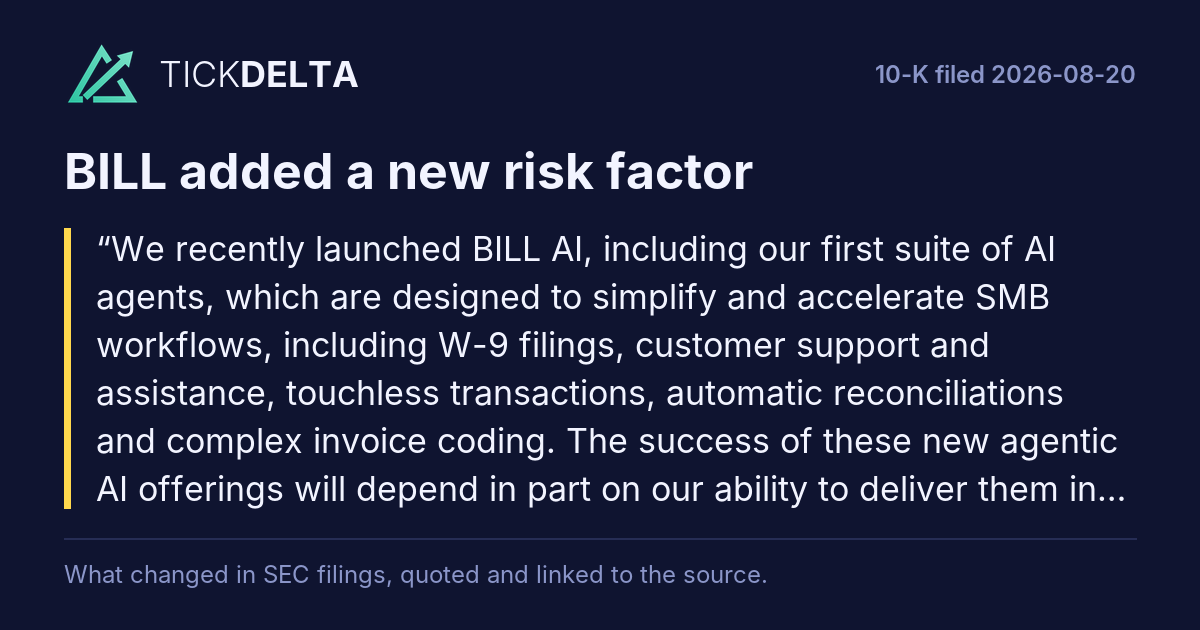
We recently launched BILL AI, including our first suite of AI agents, which are designed to simplify and accelerate SMB workflows, including W-9 filings, customer support and assistance, touchless transactions, automatic reconciliations and complex invoice coding. The success of these new agentic AI offerings will depend in part on our ability to deliver them in a way that is both compelling to our customers and cost-effective, and if new or existing customers do not use our AI agents, our business, operating results and financial condition could be adversely affected.

Read in the 10-K

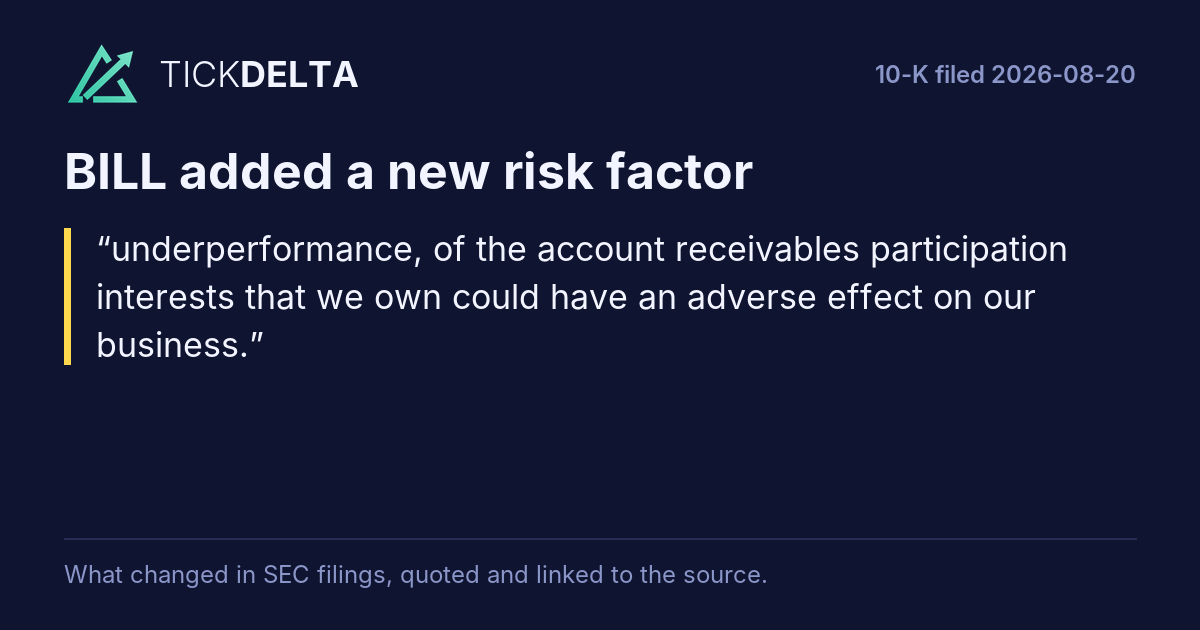
underperformance, of the account receivables participation interests that we own could have an adverse effect on our business.

Read in the 10-K

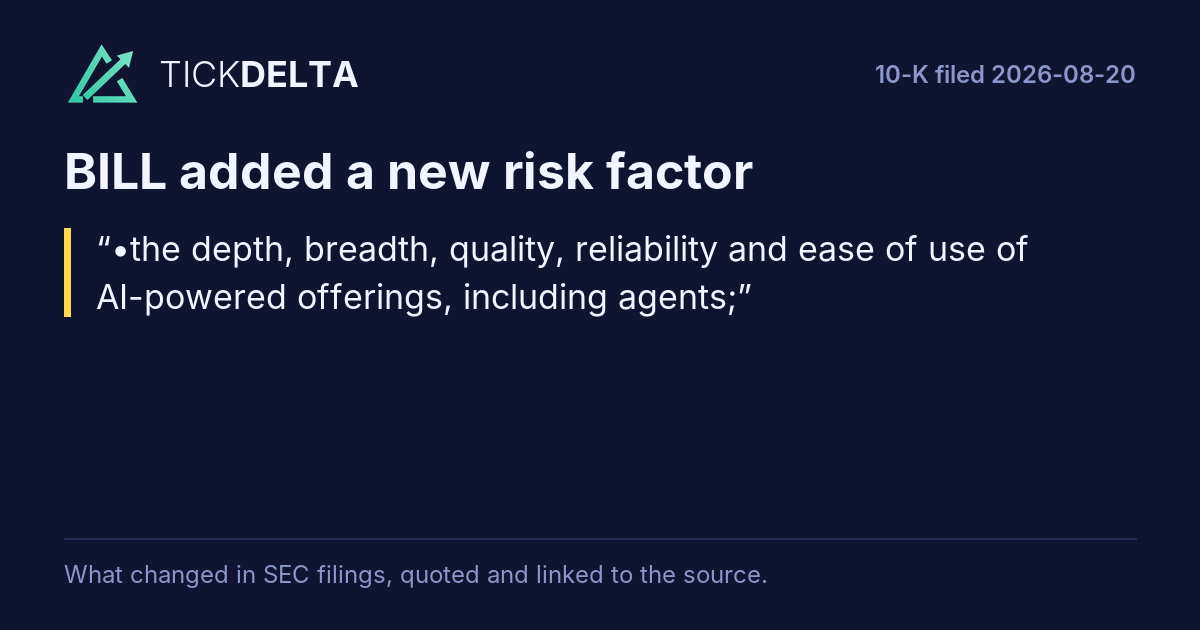
•the depth, breadth, quality, reliability and ease of use of AI-powered offerings, including agents;

Read in the 10-K

•drive adoption and achieve market recognition of the strengths of our AI agents;

Read in the 10-K

entry and provides the basis for managing cash-flow through an integrated solution for accounts payable, accounts receivable, spend and expense management, and payments.

Read in the 10-K
Show the other 10

Our use of AI in financial services applications may also subject us to fair lending, consumer protection, and anti-discrimination requirements. If AI models used in credit underwriting, fraud detection, or other decision-making processes produce discriminatory outcomes, even unintentionally, we could face regulatory enforcement actions, litigation, and reputational harm. In addition, some of our AI-powered features rely on third-party AI models and services, and any disruption, degradation, or discontinuation of such third-party services could adversely affect our platform's functionality and our customers' experience. We may also face intellectual property claims related to our use of AI, including claims that training data or AI-generated outputs infringe third-party intellectual property rights.

Read in the 10-K

using our card products as a result of merchant policies, new surcharges or reduced attractiveness of rewards programs, our business, financial condition, and operating results could be adversely impacted.

Read in the 10-K

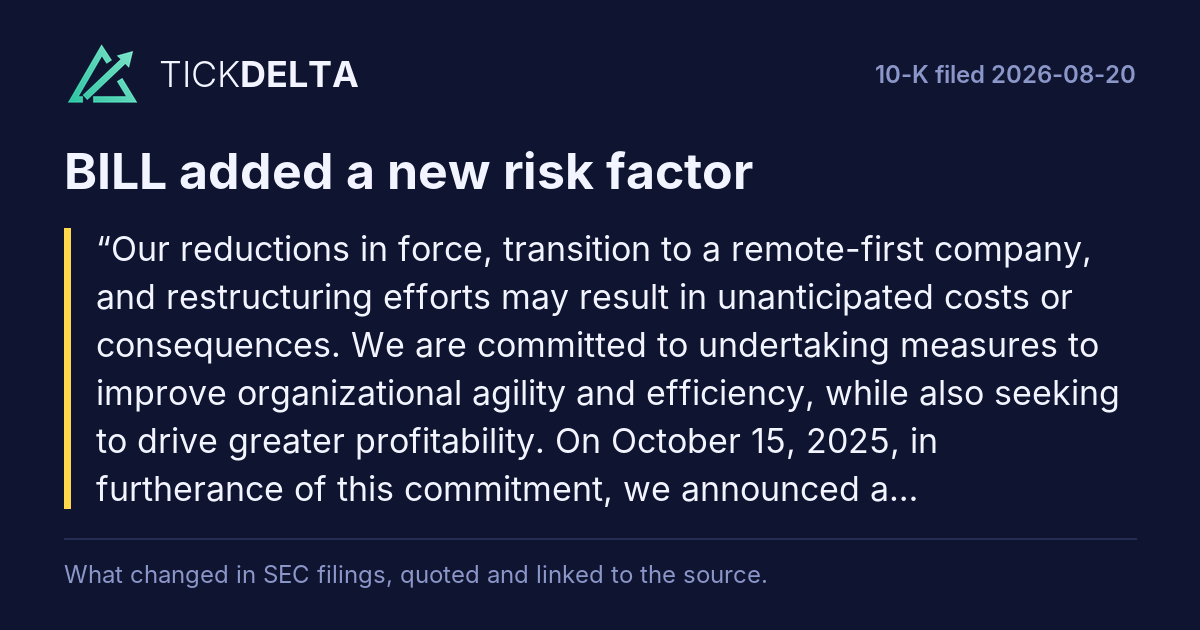
Our reductions in force, transition to a remote-first company, and restructuring efforts may result in unanticipated costs or consequences.

We are committed to undertaking measures to improve organizational agility and efficiency, while also seeking to drive greater profitability. On October 15, 2025, in furtherance of this commitment, we announced a reduction-in-force (RIF) impacting approximately 6% of employees. In March 2026, we undertook a smaller RIF

and incurred additional restructuring charges. In May 2026, we announced another RIF impacting approximately 30% of our workforce. In connection with such RIFs, we have incurred and expect to incur certain costs in the near term, including cash expenditures related to severance payments, certain retention payments, employee benefits and employee transition costs. In addition, as part of our new operating strategy, we are transitioning to a remote-first company and expect to reduce our real property footprint in the near-term. The RIFs, the transition to operating as a remote-first company and other restructuring measures we may undertake may result in other unintended consequences, including further employee attrition, damage to our corporate culture and decreased employee morale among our remaining employees, diversion of management attention, adverse effects to our reputation as an employer, loss of institutional knowledge and expertise, and potential failure or delays to meet operational and growth targets due to the loss of qualified employees. If we experience any of these adverse consequences, the RIFs, the transition to a remote-first company and other restructuring measures may not achieve their intended benefits, or the benefits, even if achieved, may not be adequate to meet our long-term profitability and operational expectations, which could adversely affect our business, operating results and financial condition.

Read in the 10-K

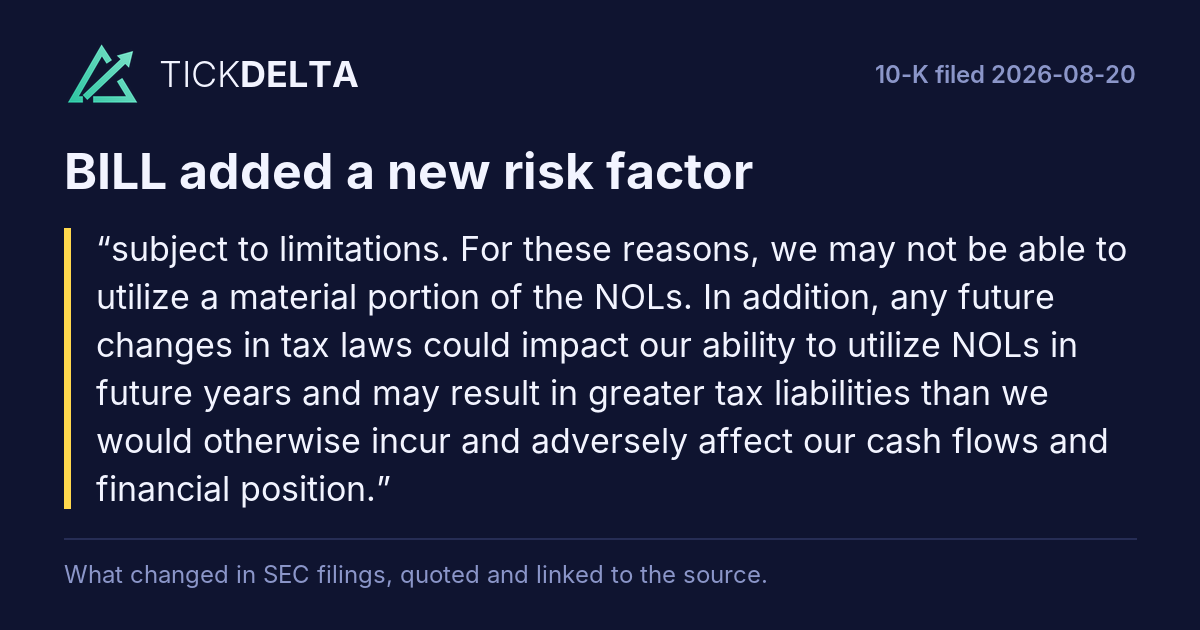
subject to limitations. For these reasons, we may not be able to utilize a material portion of the NOLs. In addition, any future changes in tax laws could impact our ability to utilize NOLs in future years and may result in greater tax liabilities than we would otherwise incur and adversely affect our cash flows and financial position.

Read in the 10-K

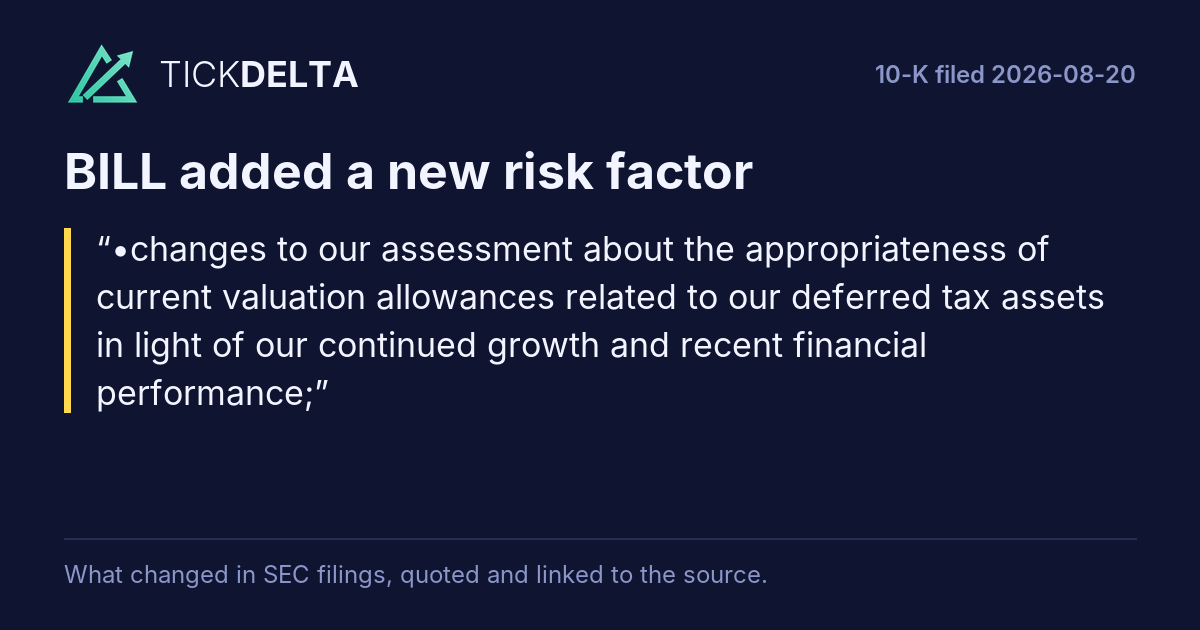
•changes to our assessment about the appropriateness of current valuation allowances related to our deferred tax assets in light of our continued growth and recent financial performance;

Read in the 10-K

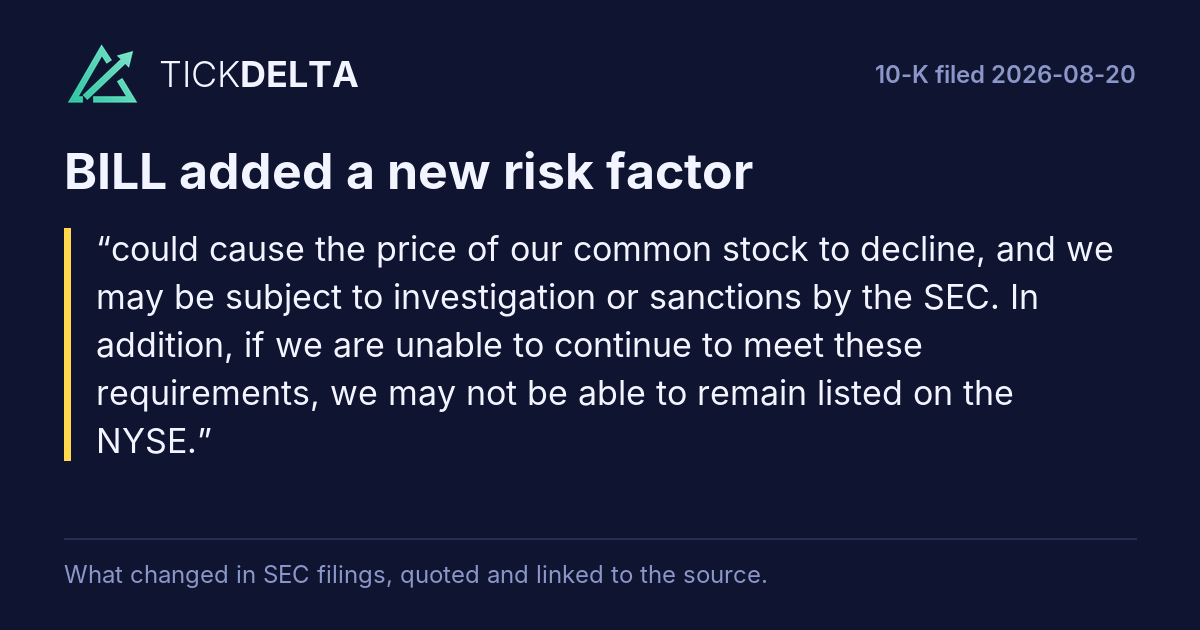
could cause the price of our common stock to decline, and we may be subject to investigation or sanctions by the SEC. In addition, if we are unable to continue to meet these requirements, we may not be able to remain listed on the NYSE.

Read in the 10-K

Cybersecurity incidents and malicious internet-based activity continue to increase generally, and providers of cloud-based services have frequently been targeted by such attacks. These cybersecurity

Read in the 10-K

As a company that facilitates financial transactions and maintains customer funds, we may also be an attractive target for ransomware attacks. Ransomware attacks have become increasingly sophisticated and prevalent, and threat actors may seek to extort payment by encrypting our systems or threatening to disclose sensitive customer data. A successful ransomware attack could result in significant operational disruption, data loss, ransom payments, remediation costs, regulatory scrutiny, litigation, and reputational harm.

Read in the 10-K

unauthorized third parties to copy our products and use information that we regard as proprietary to create products and services that compete with ours.

Read in the 10-K

discussion about our share repurchase program activity during the period and shares available for future repurchases, refer to Note 10 to our consolidated financial statements included elsewhere in this Annual Report on Form 10-K.

Read in the 10-K

Paragraphs in the 10-Q filed Nov 6, 2026 that were not in the one before

New in the latest 10-Q

32 paragraphs in the 10-Q filed Nov 6, 2026 with nothing like them in the 10-Q filed May 8, 2026 (at least half the words must differ; new numbers alone do not count). Quoted exactly, grouped by the item heading above them. This is text that changed, not a judgement of how serious it is.

10-Q

• our ability to release a significant portion of our valuation allowance in the U.S. in the next 12 months; and

Read in the 10-Q

Financial statements and notes

(1) Prior period amounts have been retrospectively adjusted to reflect a change in accounting principle adopted in the first quarter of fiscal 2027 related to the presentation of rewards. Refer to Note 1 for additional information.

Read in the 10-Q

Certain accounts in the prior period consolidated statements of cash flows were reclassified to conform with the current year presentation.

Read in the 10-Q

The Company evaluates long-lived assets, including operating lease right-of-use (ROU) assets, property and equipment and finite-lived intangible assets, for possible impairment whenever events or changes in circumstances indicate that the carrying amount of such assets may not be recoverable, including, but not limited to, significant adverse changes in business climate, market conditions, or other events that indicate an asset's carrying amount may not be recoverable. The evaluation is performed at the asset group level, which represents the lowest level of identifiable cash flows. Recoverability is measured by comparing the carrying amount of each asset group to the future undiscounted cash flows the asset is expected to generate. If the undiscounted cash flows are less than the carrying amount, the carrying amount of such assets is reduced to fair value.

Read in the 10-Q

Effective July 1, 2026, the Company voluntarily changed its accounting principle related to the presentation of rewards paid to spending businesses using its card products. Previously, the Company classified rewards as sales and marketing expenses within operating expenses. Under the new accounting principle, these rewards are classified as a reduction of interchange revenue within subscription and transaction fees. The Company believes this change is preferable as it better reflects the economic substance of the card rewards program and aligns the Company's financial reporting with the financial information used internally by the Company. Furthermore, the net presentation aligns the Company’s financial reporting with prevalent industry practice among fintech and card-issuing peers, enhancing comparability for investors and analysts. This change in classification had no impact on the Company’s operating income, net income (loss), net income (loss) per share, net assets, or cash flows for any period presented.

Read in the 10-Q
Show the other 27

The Company applied this change retrospectively to the prior periods presented to conform with the current period presentation. The following table summarizes the effects of the change on the Company’s condensed consolidated statements of operations:

Read in the 10-Q

accounts receivable and contract assets. The Company adopted ASU 2025-05 on July 1, 2026 on a prospective basis. The adoption did not have a material impact on the condensed consolidated financial statements.

Read in the 10-Q

(1) Prior period amounts have been retrospectively adjusted to reflect a change in accounting principle adopted in the first quarter of fiscal 2027 related to the presentation of rewards. Refer to Note 1 for additional information.

Read in the 10-Q

During the three months ended September 30, 2026, the Company recorded non-cash impairment charges of $ 25.8 million, which are included in restructuring in the accompanying condensed consolidated statements of operations, for operating lease ROU assets and property and equipment as part of the Company's transition to a remote-first company. The fair values of the impaired assets were estimated using discounted cash flow models (income approach) based on market participant assumptions. The significant inputs used in the fair value measurement of the operating lease ROU assets were expected downtime prior to the commencement of future subleases, projected sublease income over the remaining lease periods and discount rates to reflect the level of risk associated with receiving future cash flows. As these inputs are not based on observable market data, the assets represent a Level 3 measurement within the fair value hierarchy. Refer to Note 12 for additional information.

Read in the 10-Q

The 2030 Notes have an initial conversion rate of 8.3718 shares of common stock per $1,000 principal amount, which is equivalent to an initial conversion price of $ 119.45 per share of the Company’s common stock

Read in the 10-Q

Under each of the Revolving Credit Facilities, the Company is required to comply with certain restrictive covenants, including liquidity requirements. As of September 30, 2026, the Company was in compliance with such covenants.

Read in the 10-Q

While the financial statements of Divvy Peach and Odin are consolidated with those of the Company in the accompanying condensed consolidated financial statements, each of Divvy Peach and Odin are separate legal entities from the Company. The respective assets of Divvy Peach (including the Divvy Peach Receivables) and Odin (including the Odin Receivables) are owned by Divvy Peach and Odin, respectively, and are solely available to satisfy their respective creditors.

Read in the 10-Q

On July 4, 2025, President Trump signed the One Big Beautiful Bill Act of 2025 (OBBBA) into law, which extends and modifies various domestic and international business tax frameworks originally enacted under the Tax Cuts and Jobs Act. The legislation includes multiple effective dates, with certain provisions that took effect in fiscal 2026 and others taking effect through fiscal 2028. The Company has reflected the impact of the OBBBA in its condensed consolidated financial statements and will continue to evaluate any changes needed when additional guidance becomes available.

Read in the 10-Q

Based on the Company's assessment of current income and anticipated future earnings, there is a reasonable possibility that the Company will have sufficient evidence to release a significant portion of the valuation allowance in the U.S. within the next 12 months. However, the Company's judgment regarding future earnings and the exact timing and amount of any valuation allowance release are subject to change due to many factors, including future market conditions, the ability to successfully execute the Company's business plans, and the amount of stock-based compensation tax deductions available in the future.

Read in the 10-Q

In August 2026, the Company announced its decision to transition to a remote-first company and reduce its real property footprint. During the three months ended September 30, 2026, in connection with this transition, the Company exited a portion of its leased office spaces, which it intends to sublease, and reassessed the related operating lease ROU assets and property and equipment for recoverability. As of the measurement date of September 30, 2026, the Company determined that the carrying amount of the asset exceeded its estimated fair value and recorded a non-cash impairment charge of $ 25.8 million for operating lease ROU assets and property and equipment, which is included in restructuring in the accompanying condensed consolidated statements of operations.

Read in the 10-Q

We offer a rewards program to spending businesses using our card products. Rewards are earned based on transaction volume and are recorded as a reduction of interchange revenue within subscription and transaction fees.

Read in the 10-Q

September 30, 2026 2025 ───────────────────────────────────────────────────────────────────────────────────── Revenue Subscription and transaction fees (1) 89% 88% Interest on funds held for customers 11% 12% Total revenue (1) 100% 100% Cost of revenue Service costs 19% 21% Depreciation and amortization 4% 3% Total cost of revenue 23% 24% Gross profit (1) 77% 76% Operating expenses Research and development 14% 26% Sales and marketing (1) 16% 22% General and administrative 19% 24% Provision for expected credit losses 4% 5% Depreciation and amortization 2% 3% Restructuring 7% 3% Total operating expenses (1) 62% 83% Income (loss) from operations 15% (7)% Other income, net 3% 6% Income (loss) before provision for income taxes 18% (1)% Provision for income taxes 0% 0% Net income (loss) 18% (1)%

Read in the 10-Q

$600.0 million from our Revolving Credit Facilities, and have drawn $330.0 million under the Revolving Credit Facilities as of September 30, 2026. Our principal uses of cash are funding our operations and other working capital requirements, including the contractual and other obligations discussed below.

Read in the 10-Q

We assess the impairment of long-lived assets whenever events or changes in business circumstances indicate that the carrying amounts of the asset group may not be fully recoverable. We determine whether there has been an impairment by comparing the carrying value of the asset group to the anticipated undiscounted net cash flows associated with the asset. If such cash flows are less than the carrying value, we write down the asset to its fair value, which may be measured as anticipated discounted net cash flows associated with the asset. For more information, see The Company and its Significant Accounting Policies” in Note 1 to our condensed consolidated financial statements included elsewhere in this Quarterly Report on Form 10-Q.

Read in the 10-Q

Risk Factors

We may from time to time determine it is in our interest to strategically exit certain customer segments to focus our sales and marketing efforts, engineering resources and management attention where we believe they will provide the greatest return. For example, we recently announced a transition away from certain of our traditional bank partnerships to focus our resources on our direct, accounting and Embed 2.0 customer acquisition channels, resulting in a net decrease in the number of businesses using our solutions as of September 30, 2026. While we believe this decision will lead to greater growth and efficiency in our operations over time, there can be no assurance that the revenue we generate from our targeted customer segments will match or exceed revenue lost from former customers.

Read in the 10-Q

cards may also be affected by legal or regulatory requirements, competitors’ actions, changes in consumer behavior, changes in the economic environment, policies of our card-issuing partner banks (Issuing Banks), and other factors.

Read in the 10-Q

losses related to these products due to fraudulent activity with limited ability to directly strengthen relevant controls.

Read in the 10-Q

• the depth, breadth, quality, reliability and ease of use of AI-powered offerings, including agents;

Read in the 10-Q

We are licensed as a money transmitter in all required U.S. states and registered as a Money Services Business with FinCEN. In certain jurisdictions where we operate, we are required to hold eligible liquid assets,

Read in the 10-Q

adverse impact on our business, financial position, and operating results. Moreover, if our partners or their customers experience problems with the operation of our platform, such as service outages or interruptions or security breaches or incidents, our relationship with the partner and our reputation could be harmed and our operating results may suffer.

Read in the 10-Q

should not rely on our revenue from any prior quarterly or annual periods as any indication of our future revenue or revenue or payment growth.

Read in the 10-Q

Our use of AI in financial services applications may also subject us to fair lending, consumer protection, and anti-discrimination requirements. If AI models used in credit underwriting, fraud detection, or other decision-making processes produce discriminatory outcomes, even unintentionally, we could face regulatory enforcement actions, litigation, and reputational harm. In addition, some of our AI-powered features rely on third-party AI models and services, and any disruption, degradation, or discontinuation of such third-party services could adversely affect our platform's functionality and our customers' experience. We may also face intellectual property claims related to our use of AI, including claims that training data or AI-generated outputs infringe third-party intellectual property rights. The allocation of liability among us, our customers, our partners, and third-party AI providers for errors or harms caused by AI is uncertain and evolving, and our contractual protections may not be enforceable or sufficient. Further, our insurance may not extend to all AI-related risks and may not cover all losses for errors or omissions caused by AI.

Read in the 10-Q

We host our platform using third-party cloud infrastructure services, including certain co-location facilities. We also use public cloud hosting with Amazon Web Services (AWS). All of our products utilize resources operated by us through these providers. We therefore depend on our third-party cloud providers’ ability to protect their data centers against damage or interruption from natural disasters, power or

Read in the 10-Q

results, and financial condition. In addition, data centers depend on predictable and reliable energy and networking capabilities, which could be affected by a variety of factors, including climate change.

Read in the 10-Q

As a company that facilitates financial transactions and maintains customer funds, we may also be an attractive target for ransomware attacks. Ransomware attacks have become increasingly sophisticated and prevalent, and threat actors may seek to extort payment by encrypting our systems or threatening to disclose sensitive customer data. A successful ransomware attack could result in significant operational disruption, data loss, ransom payments, remediation costs, regulatory scrutiny, litigation, and reputational harm.

Read in the 10-Q

The option counterparties and/or their respective affiliates may modify their hedge positions by entering into or unwinding various derivatives with respect to our common stock and/or purchasing or selling our

Read in the 10-Q

In addition, our amended and restated certificate of incorporation and our second amended and restated bylaws provide that the Court of Chancery of the State of Delaware, to the fullest extent permitted by

Read in the 10-Q

The 10-Q's risk factors against the 10-K

Item 1A of the 10-Q filed Nov 6, 2026 against Item 1A of the 10-K filed Aug 20, 2026. A 10-Q repeats only the risks that changed, so a 10-K paragraph that is missing from it is not counted as removed. Added is a paragraph with nothing like it in the 10-K, Reworded a sentence that is in both with several words changed, Quiet changes a sentence in both where one to four words changed and one is a hedge or a modal (cut words struck through, new words highlighted). Text on the page, not a score; each links to the filing at sec.gov.

Added10-Q Nov 6, 2026 vs 10-K Aug 20, 2026
We may from time to time determine it is in our interest to strategically exit certain customer segments to focus our sales and marketing efforts, engineering resources and management attention where we believe they will provide the greatest return. For example, we recently announced a transition away from certain of our traditional bank partnerships to focus our resources on our direct, accounting and Embed 2.0 customer acquisition channels, resulting in a net decrease in the number of businesses using our solutions as of September 30, 2026. While we believe this decision will lead to greater growth and efficiency in our operations over time, there can be no assurance that the revenue we generate from our targeted customer segments will match or exceed revenue lost from former customers.

Read it in the 10-Q at sec.gov

Added10-Q Nov 6, 2026 vs 10-K Aug 20, 2026
cards may also be affected by legal or regulatory requirements, competitors’ actions, changes in consumer behavior, changes in the economic environment, policies of our card-issuing partner banks (Issuing Banks), and other factors.

Read it in the 10-Q at sec.gov

Added10-Q Nov 6, 2026 vs 10-K Aug 20, 2026
losses related to these products due to fraudulent activity with limited ability to directly strengthen relevant controls.

Read it in the 10-Q at sec.gov

Added10-Q Nov 6, 2026 vs 10-K Aug 20, 2026
We are licensed as a money transmitter in all required U.S. states and registered as a Money Services Business with FinCEN. In certain jurisdictions where we operate, we are required to hold eligible liquid assets,

Read it in the 10-Q at sec.gov

Added10-Q Nov 6, 2026 vs 10-K Aug 20, 2026
adverse impact on our business, financial position, and operating results. Moreover, if our partners or their customers experience problems with the operation of our platform, such as service outages or interruptions or security breaches or incidents, our relationship with the partner and our reputation could be harmed and our operating results may suffer.

Read it in the 10-Q at sec.gov

Show the other 19
Added10-Q Nov 6, 2026 vs 10-K Aug 20, 2026
should not rely on our revenue from any prior quarterly or annual periods as any indication of our future revenue or revenue or payment growth.

Read it in the 10-Q at sec.gov

Added10-Q Nov 6, 2026 vs 10-K Aug 20, 2026
results, and financial condition. In addition, data centers depend on predictable and reliable energy and networking capabilities, which could be affected by a variety of factors, including climate change.

Read it in the 10-Q at sec.gov

Added10-Q Nov 6, 2026 vs 10-K Aug 20, 2026
The option counterparties and/or their respective affiliates may modify their hedge positions by entering into or unwinding various derivatives with respect to our common stock and/or purchasing or selling our

Read it in the 10-Q at sec.gov

Added10-Q Nov 6, 2026 vs 10-K Aug 20, 2026
In addition, our amended and restated certificate of incorporation and our second amended and restated bylaws provide that the Court of Chancery of the State of Delaware, to the fullest extent permitted by

Read it in the 10-Q at sec.gov

Reworded10-Q Nov 6, 2026 vs 10-K Aug 20, 2026
Pursuant to this authorization, we may purchase repurchase such shares from time to time, using a variety of methods, time through open market purchases or purchases, in privately negotiated transactions, or by other means, including through the use of trading plans intended to qualify under Rule 10b5-1 plans, under the Securities Exchange Act of 1934, as amended, in compliance accordance with the rules of the SEC applicable securities laws and other applicable legal requirements. restrictions.

Read it in the 10-Q at sec.govThe 10-K sentence

Reworded10-Q Nov 6, 2026 vs 10-K Aug 20, 2026
In addition, we previously launched AI agents to enable automatic W-9 collection, receipt reconciliation and invoice coding, among other capabilities. capabilities, and we announced a new suite of AI features, including risk intelligence and AI-assisted onboarding capabilities, as well as a pilot program in which AI agents execute approved buyer invoice payments through supplier portals.

Read it in the 10-Q at sec.govThe 10-K sentence

Reworded10-Q Nov 6, 2026 vs 10-K Aug 20, 2026
The accuracy of these risk models and the ability to manage credit risk related to our cards may also be affected by legal or regulatory requirements, competitors’ actions, changes in consumer behavior, changes in the economic environment, policies of our card-issuing partner banks (Issuing Banks), and other factors.

Read it in the 10-Q at sec.govThe 10-K sentence

Reworded10-Q Nov 6, 2026 vs 10-K Aug 20, 2026
As of June September 30, 2026, we had approximately 479,300 475,300 businesses using our solutions and TPV total payment volume (TPV) processed was approximately $371.3 billion, $329.8 billion, $101.8 billion and $292.4 $89.3 billion during fiscal 2026, the three months ended September 30, 2026 and 2025, and 2024, respectively.

Read it in the 10-Q at sec.govThe 10-K sentence

Reworded10-Q Nov 6, 2026 vs 10-K Aug 20, 2026
For example, several U.S. states have enacted AI governance laws that impose transparency, impact assessment, and other requirements on deployers of high-risk AI systems. systems, and the status of such state laws is uncertain as the federal government has taken steps toward broad federal regulation of AI that could preempt state law.

Read it in the 10-Q at sec.govThe 10-K sentence

Reworded10-Q Nov 6, 2026 vs 10-K Aug 20, 2026
For example, in March 2024, Visa and Mastercard reached a proposed settlement to pending antitrust litigation, that would have provided savings to merchants by reducing interchange fees on card transactions by setting a five year cap on interchange fee rates and permitting merchants to pass along surcharges for credit card use to cardholders or reject cards altogether, among other changes.

Read it in the 10-Q at sec.govThe 10-K sentence

Reworded10-Q Nov 6, 2026 vs 10-K Aug 20, 2026
These exclusive forum provisions will not apply to claims that are vested in the exclusive jurisdiction of a court or forum other than the Court of Chancery of the State of Delaware, or for which the Court of Chancery of the State of Delaware does not have subject matter jurisdiction.

Read it in the 10-Q at sec.govThe 10-K sentence

Reworded10-Q Nov 6, 2026 vs 10-K Aug 20, 2026
For fiscal 2026, the three months ended September 30, 2026 and 2025, and 2024, we generated $148.4 million, $161.8 million, $37.4 million and $167.4 $37.7 million, respectively, in revenue from interest earned on funds held in trust on behalf of customers while payment transactions were clearing, or approximately 9%, 11%, 11% and 13% 12% of our total revenue for such periods, respectively.

Read it in the 10-Q at sec.govThe 10-K sentence

Reworded10-Q Nov 6, 2026 vs 10-K Aug 20, 2026
We have made and expect to continue to make significant investments in developing and deploying our AI technology. technology, including costs associated with third-party AI models, computing power, and specialized personnel, which may increase and may not be offset by corresponding revenue.

Read it in the 10-Q at sec.govThe 10-K sentence

Reworded10-Q Nov 6, 2026 vs 10-K Aug 20, 2026
This two-way sync saves time for our customers by reducing duplicative manual data entry and provides the basis for managing cash-flow through an integrated solution for accounts payable, accounts receivable, spend and expense management, and payments.

Read it in the 10-Q at sec.govThe 10-K sentence

Reworded10-Q Nov 6, 2026 vs 10-K Aug 20, 2026
If we are unable to assert that our internal control over financial reporting is effective, or if our independent registered public accounting firm issues an adverse opinion on the effectiveness of our internal control, we could lose investor confidence in the accuracy and completeness of our financial reports, which could cause the price of our common stock to decline, and we may be subject to investigation or sanctions by the SEC.

Read it in the 10-Q at sec.govThe 10-K sentence

The first 24 of 56 are shown (at most 12 of each type).

Phrases used for the first time

Two-word phrases in Risk Factors of the 10-K filed Aug 20, 2026 that are in none of the 1 earlier 10-Ks stored, back to Aug 28, 2025

government shut ×4shut downs ×4restructuring efforts ×3pci dss ×3potentially augmented ×2institutions software ×2force transition ×2net loss ×2rapid development ×2supply chain ×2government budget ×2budget cuts ×2bill cash ×2invoice coding ×2embed partners ×2rif impacting ×2
Where each one is used
  • government shut: More broadly, the U.S. and other key international economies have experienced and may in the future experience significant economic and market changes and downturns in which economic activity is impacted by falling demand for a variety of goods and services, restricted credit, poor liquidity, reduced corporate...
  • shut downs: More broadly, the U.S. and other key international economies have experienced and may in the future experience significant economic and market changes and downturns in which economic activity is impacted by falling demand for a variety of goods and services, restricted credit, poor liquidity, reduced corporate...
  • restructuring efforts: •A substantial portion of our revenue is derived from interchange fees, which exposes us to potential variability in income and other risks; Our reductions in force, transition to a remote-first company, and restructuring efforts may result in unanticipated costs or consequences.
  • pci dss: The local, state, and federal laws, rules, regulations, licensing requirements, and industry standards that govern our business include, or may in the future include, those relating to banking, deposit-taking, cross-border and domestic money transmission, foreign exchange, payments services (such as licensed money...
  • potentially augmented: •Our risk management efforts may not be effective to prevent fraudulent activities by our customers, subscribers, spending businesses, or their counterparties, or other third parties which, potentially augmented by AI, could expose us to material financial losses and liabilities and otherwise harm our business;
  • institutions software: •Our business depends, in part, on our relationships with accounting firms, financial institutions, software providers and other partners;
  • force transition: •A substantial portion of our revenue is derived from interchange fees, which exposes us to potential variability in income and other risks; Our reductions in force, transition to a remote-first company, and restructuring efforts may result in unanticipated costs or consequences.
  • net loss: We were incorporated in 2006 and historically have experienced net losses in most periods since inception. We generated a net loss of $11.2 million, net income of $23.8 million, and a net loss of $28.9 million for fiscal 2026, 2025, and 2024, respectively. As of June 30, 2026, we had an accumulated deficit of $2.1...

The 10-K at sec.gov

Used at least twice, small words left out. Counted, not picked: a phrase can be new because the company renamed something.

What was taken out

8 paragraphs of last year's Risk Factors with nothing like them now. The longest are quoted.

Across all companies
We may not be able to attract new financial institution partners if our potential partners favor our competitors’ products or services over our platform or choose to compete with our products directly. Further, many of our existing financial institution partners have greater resources than we do and could choose to develop their own solutions to replace ours. Moreover, certain financial institutions may elect to focus on other market segments and decide to terminate their SMB-focused services. If we are unsuccessful in establishing, growing, or maintaining our relationships with financial...
In the 10-K filed Aug 28, 2025
Our agreements with our financial institution partners typically contain service level commitments evaluated on a monthly basis. If we are unable to meet the stated service level commitments or suffer extended periods of unavailability for our platform, we may be contractually obligated to provide these partners with service credits, up to 10% of the partner’s subscription fees for the month in which the service level was not met. In addition, we could face contract terminations, in which case we would be subject to refunds for prepaid amounts related to unused subscription services. Our...
In the 10-K filed Aug 28, 2025
Our management team has limited experience managing a publicly traded company, interacting with public company investors and securities analysts, and complying with the increasingly complex laws pertaining to public companies. These new obligations and constituents require significant attention from our management team and could divert their attention away from the day-to-day management of our business, which could harm our business, operating results, and financial condition.
In the 10-K filed Aug 28, 2025
We typically provide service level commitments under our financial institution partner agreements. If we fail to meet these contractual commitments, we could be obligated to provide credits or refunds for prepaid amounts related to unused subscription services or face contract terminations, which could adversely affect our revenue.
In the 10-K filed Aug 28, 2025

Sources

Item 1A of each 10-K and 10-Q on EDGAR, quoted exactly. Each paragraph links to the filing at sec.gov.

Also

10-K change: what was reworded or cut, section by section.

Work with it

Excel workbook · CSV. Google Sheet that stays up to date: paste =IMPORTDATA("https://tickdelta.com/company/BILL/export.csv") into a cell.

Next:10-K change
Esc

Type a ticker such as AAPL, a name, an investor such as Buffett, or a topic such as tariffs. ↑ ↓ to move, Enter to open.