Paragraph 328 · 50% changed
Every version of it
Screener
/
SEC EDGAR
/CIK 0001763415
/10-K filed Mar 2, 2026, compared with Mar 18, 2025
/Numbers from the XBRL of the 10-Ks
NYSE
Financials · Commodity Contracts Brokers & Dealers
Bitwise Bitcoin ETF BITB
The 10-K against last year's
98 changes: 15 added, 23 removed, 57 reworded, 3 quiet changes
10-K Mar 2, 2026 vs Mar 18, 2025
Risk Factors
11.1%
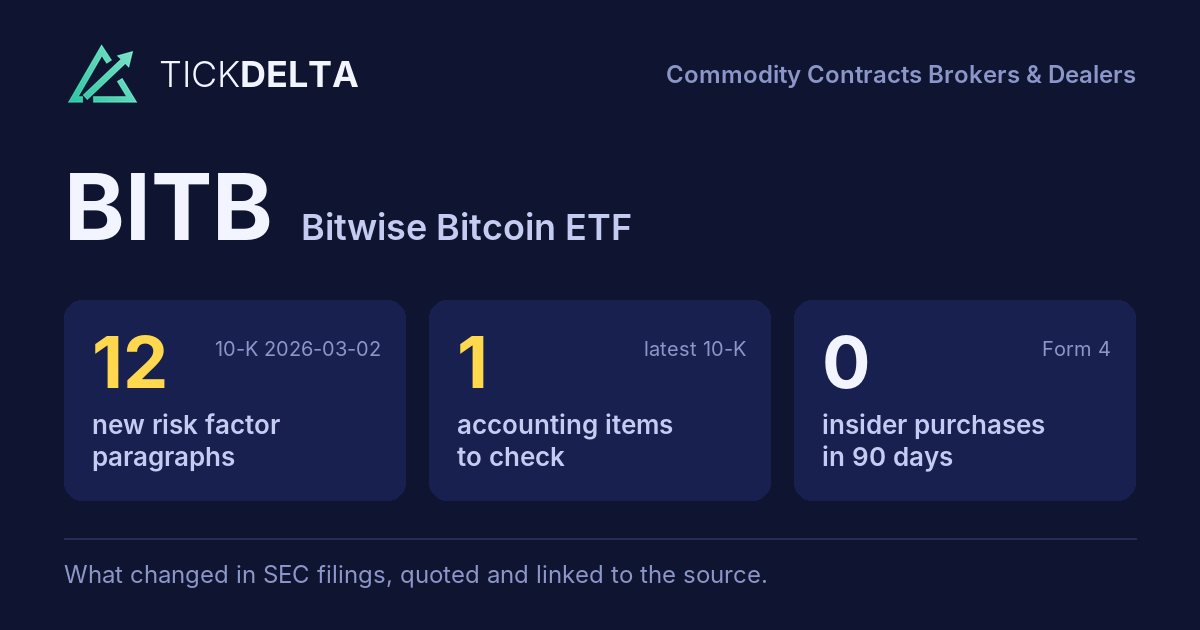
of the text changed · 42,551 words now · 12 new paragraphs, 17 gone
MD&A
37.2%
of the text changed · 2,334 words now · 3 new paragraphs, 6 gone
Accounting Policies
35.0%
of the text changed · 1,667 words now
10-K 0001193125-26-085335 (Mar 2, 2026) vs 10-K 0000950170-25-040572 (Mar 18, 2025) Not compared: Legal Proceedings.
Every paragraph, and how much of it changed
One bar per paragraph, in the order of the 10-K. Height and colour show the share of its words not in the closest paragraph a year earlier; the tallest bars are new paragraphs.
Risk Factors
430 paragraphs · 12 new · 120 reworded · 17 gone · 10-K Mar 2, 2026 against Mar 18, 2025
New paragraph
Reworded (5% of its words or more)
Same or nearly
Paragraph 59 · 50% changed
Every version of it
Blockchain participants, including miners, maintain the record of ownership of digital assets. If these entities suffer from cyberattacks or other security incidents (whether from hacking, which involves efforts to gain unauthorized access to information or systems, or to cause intentional malfunctions or the loss or corruption of data, software, hardware, or other computer equipment, or from the inadvertent transmission of computer viruses or other malware, other forms of malicious attacks, malfeasance, or negligent acts of their personnel, or via other means, including phishing attacks and other forms of social engineering), or if for financial or other reasons they cease to perform these functions, the functioning of the blockchains on which the ownership of digital assets is recorded and their valuation based may be jeopardized. Any such interruption could result in impermissible transfers of digital assets and/or the loss of digital assets and/or their value.
Paragraph 105 · 49% changed
Every version of it
Paragraph 143 · 48% changed
Every version of it
Paragraph 82 · 43% changed
Every version of it
Certain jurisdictions have implemented regulations regarding the energy consumption of the Bitcoin network, which could result in a significant reduction in mining activity and adversely affect the security of the Bitcoin network. Certain localities, such as China, have banned mining altogether, while others have imposed temporary suspensions until environmental impact studies can be conducted. Various countries, states and cities have implemented, or are considering implementing, moratoriums on bitcoin mining in their jurisdictions. Such moratoriums would impede bitcoin mining and/or limit the broader use of bitcoin. For example, in November 2022, New York imposed a two-year moratorium on new proof-of-work mining permits at fossil fuel plants in the state, in July 2023, Sweden eliminated tax incentives for Bitcoin mines, essentially ending the industry there, and in April 2024, Angola passed a law criminalizing crypto mining to protect its electrical grid.
Paragraph 241 · 42% changed
Every version of it
Bitcoin is a relatively novel asset with a limited trading history compared to more established financial instruments. This limited history, combined with its volatility, means that the markets for bitcoin may be less liquid and more susceptible to price swings. Unlike traditional commodities or securities markets, the bitcoin market can experience wide fluctuations due to the relatively small volume of buy and sell orders, particularly during periods of market stress or low liquidity. This lack of liquidity can make it challenging to execute trades at specific prices, increasing the difficulty of liquidating positions or finding suitable counterparties at reasonable costs during market disruptions.
Paragraph 355 · 40% changed
Every version of it
Singapore, have adopted a more nuanced approach. As a result, digital assets may be considered securities in one country but not in another. The European Union’s MiCA regulation seeks to establish a comprehensive framework for digital assets, including stablecoins and crypto-asset service providers. Beyond the EU, the United Kingdom’s Financial Services and Markets Act expands the Financial Conduct Authority’s (“FCA”) oversight of crypto activities, enabling further regulation of stablecoins and other digital assets. The Monetary Authority of Singapore ("MAS") has also introduced stablecoin regulations under its Payment Services Act, and China has maintained strict scrutiny of digital assets following its 2021 prohibition of mining.
Paragraph 151 · 40% changed
Every version of it
The SEC has identified possible sources of fraud and manipulation in the cryptocurrency markets generally, including bitcoin, such as (i) “wash trading”; (ii) persons with a dominant position in one type of digital assets manipulating its pricing; (iii) hacking of the digital asset network and trading platforms; (iv) malicious control of the digital asset network; (v) trading based on material, non-public information (for example, plans of market participants to significantly increase or decrease their holdings in a digital asset, new sources of demand for such digital asset, etc.) or based on the dissemination of false and misleading information; (vi) manipulative activity involving purported “stablecoins,” including Tether; and (vii) fraud and manipulation at the trading platforms of such digital asset.
Paragraph 328 · 50% changed
Every version of it
10-K Mar 18, 2025The Trust relies heavily on critical service providers such as the Bitcoin Custodian, Cash Custodian, Prime Execution Agent, and other intermediaries, whose stability and effective operations are essential to the Trust’s functionality and the safekeeping of its assets. The Trust’s reliance on Coinbase Custody for the custody of its bitcoin and on BNY Mellon as the Cash Custodian for cash holdings exposes it to unique risks related to digital asset security, operational disruptions, and the potential insolvency or business failure of these providers. As of the date hereof, Coinbase Global, the parent company of both the Bitcoin Custodian and Prime Execution Agent, is the largest publicly traded digital asset company in the world by market capitalization and is also the largest digital asset custodian in the world by assets under custody. By virtue of its leading market position and capabilities, and the relatively limited number of institutionally capable providers of digital asset brokerage and custody services, the Bitcoin Custodian serves as the bitcoin custodian and the Prime Execution Agent serves as the prime broker for several competing exchange-traded bitcoin products. Given Coinbase Global’s considerable size and market share, a failure to adequately allocate resources to support all such products that use its services, including the Trust, could create operational disruptions and potential conflicts of interest. For example, if the Trust needed to utilize the Agent Execution Model to buy or sell bitcoin because no Bitcoin Trading Counterparties were willing or able to effectuate the Trust’s transactions, and the Prime Execution Agent were to favor the interests of certain products over others, it could result in inadequate attention or comparatively unfavorable commercial terms to less favored products, which could adversely affect the Trust’s operations and ultimately the value of the Shares.
10-K Mar 2, 2026
Trust needed to utilize the Agent Execution Model to buy or sell bitcoin because no Bitcoin Trading Counterparties were willing or able to effectuate the Trust’s transactions, and the Prime Execution Agent were to favor the interests of certain products over others, it could result in inadequate attention or comparatively unfavorable commercial terms to less favored products, which could adversely affect the Trust’s operations and ultimately the value of the Shares.
Paragraph 59 · 50% changed
Every version of it
10-K Mar 18, 2025
Blockchain participants, including miners, maintain the record of ownership of digital assets. If these entities suffer from cyberattacks or other security incidents (whether from hacking, which involves efforts to gain unauthorized access to information or systems, or to cause intentional malfunctions or the loss or corruption of data, software, hardware, or other computer equipment, or from the inadvertent transmission of computer viruses or other malware, other forms of malicious attacks, malfeasance, or negligent acts of their personnel, or via other means, including phishing attacks and other forms of social engineering), or if for financial or other reasons they cease to perform these functions, the functioning of the blockchains on which the ownership of digital assets is recorded and their valuation based may be jeopardized. Any such interruption could result in impermissible transfers of digital assets and/or the loss of digital assets and/or their value.
10-K Mar 2, 2026
Blockchain participants, including miners, maintain the record of ownership of digital assets. If these entities suffer from cyberattacks or other security incidents (whether from hacking, which involves efforts to gain unauthorized access to
Paragraph 105 · 49% changed
Every version of it
10-K Mar 18, 2025The scheduled creation of newly mined bitcoin and their subsequent sale may cause the price of bitcoin to decline, which could negatively affect the value of an investment in the Shares.
10-K Mar 2, 2026
providers; or suffer disruptions to their operations, any of which could negatively affect the Trust’s ability to operate or could cause losses in value of the Shares.
Paragraph 143 · 48% changed
Every version of it
10-K Mar 18, 2025A malicious actor may also obtain control over the Bitcoin network through its influence over core developers by gaining direct control over a core developer or another influential programmer. To the extent that the bitcoin ecosystem does not grow, the possibility that a malicious actor may be able to obtain control of the processing power on the Bitcoin network in this manner will remain heightened. Additionally, some academics and market participants believe the applicable threshold required to exert authority over the Bitcoin network could be less than 50%, which would increase the chances of a malicious actor exerting authority over the Bitcoin network.
10-K Mar 2, 2026
required to exert authority over the Bitcoin network could be less than 50%, which would increase the chances of a malicious actor exerting authority over the Bitcoin network.
Paragraph 82 · 43% changed
Every version of it
10-K Mar 18, 2025
Certain jurisdictions have implemented regulations regarding the energy consumption of the Bitcoin network, which could result in a significant reduction in mining activity and adversely affect the security of the Bitcoin network. Certain localities, such as China, have banned mining altogether, while others have imposed temporary suspensions until environmental impact studies can be conducted. Various countries, states and cities have implemented, or are considering implementing, moratoriums on bitcoin mining in their jurisdictions. Such moratoriums would impede bitcoin mining and/or limit the broader use of bitcoin. For example, in November 2022, New York imposed a two-year moratorium on new proof-of-work mining permits at fossil fuel plants in the state, in July 2023, Sweden eliminated tax incentives for Bitcoin mines, essentially ending the industry there, and in April 2024, Angola passed a law criminalizing crypto mining to protect its electrical grid.
10-K Mar 2, 2026
Certain jurisdictions have implemented regulations regarding the energy consumption of the Bitcoin network, which could result in a significant reduction in mining activity and adversely affect the security of the Bitcoin network. Certain localities, such as China, have banned mining altogether, while others have imposed temporary suspensions until environmental impact
Paragraph 241 · 42% changed
Every version of it
10-K Mar 18, 2025
Bitcoin is a relatively novel asset with a limited trading history compared to more established financial instruments. This limited history, combined with its volatility, means that the markets for bitcoin may be less liquid and more susceptible to price swings. Unlike traditional commodities or securities markets, the bitcoin market can experience wide fluctuations due to the relatively small volume of buy and sell orders, particularly during periods of market stress or low liquidity. This lack of liquidity can make it challenging to execute trades at specific prices, increasing the difficulty of liquidating positions or finding suitable counterparties at reasonable costs during market disruptions.
10-K Mar 2, 2026
Bitcoin is a relatively novel asset with a limited trading history compared to more established financial instruments. This limited history, combined with its volatility, means that the markets for bitcoin may be less liquid and more susceptible to
Paragraph 355 · 40% changed
Every version of it
10-K Mar 18, 2025
of crypto activities, enabling further regulation of stablecoins and other digital assets. The Monetary Authority of Singapore ("MAS") has also introduced stablecoin regulations under its Payment Services Act, and China has maintained strict scrutiny of digital assets following its 2021 prohibition of mining.
10-K Mar 2, 2026
Singapore, have adopted a more nuanced approach. As a result, digital assets may be considered securities in one country but not in another. The European Union’s MiCA regulation seeks to establish a comprehensive framework for digital assets, including stablecoins and crypto-asset service providers. Beyond the EU, the United Kingdom’s Financial Services and Markets Act expands the Financial Conduct Authority’s (“FCA”) oversight of crypto activities, enabling further regulation of stablecoins and other digital assets. The Monetary Authority of Singapore has also introduced stablecoin regulations under its Payment Services Act, and China has maintained strict scrutiny of digital assets following its 2021 prohibition of mining.
Paragraph 151 · 40% changed
Every version of it
10-K Mar 18, 2025
The SEC has identified possible sources of fraud and manipulation in the cryptocurrency markets generally, including bitcoin, such as (i) “wash trading”; (ii) persons with a dominant position in one type of digital assets manipulating its pricing; (iii) hacking of the digital asset network and trading platforms; (iv) malicious control of the digital asset network; (v) trading based on material, non-public information (for example, plans of market participants to significantly increase or decrease their holdings in a digital asset, new sources of demand for such digital asset, etc.) or based on the dissemination of false and misleading information; (vi) manipulative activity involving purported “stablecoins,” including Tether; and (vii) fraud and manipulation at the trading platforms of such digital asset.
10-K Mar 2, 2026
The SEC has identified possible sources of fraud and manipulation in the cryptocurrency markets generally, including bitcoin, such as (i) “wash trading”; (ii) persons with a dominant position in one type of digital assets manipulating its pricing; (iii)
MD&A
30 paragraphs · 3 new · 17 reworded · 6 gone · 10-K Mar 2, 2026 against Mar 18, 2025
New paragraph
Reworded (5% of its words or more)
Same or nearly
Paragraph 13 · 48% changed
Net realized and unrealized gain loss on investment in bitcoin sold for redemptions for the period from January 10, 2024 to year ended December 31, 2024, 2025 was approximately $1,590,268 which includes a net realized gain of $1,288 on the sale of bitcoins $42,062, compared to pay the Sponsor Fee, net realized loss on investment in bitcoin sold for redemptions of $50,869 and net change in unrealized appreciation on investment in bitcoin of approximately $1,639,849. Net realized and unrealized gain on investment in bitcoin for the period was driven by bitcoin price appreciation from $46,144.39 per bitcoin as of January 10, 2024 to $93,393.01 per bitcoin as of December 31, 2024. Net increase in net assets resulting from operations was approximately $1,586,597 for the period from January 10, 2024 (commencement of operations) to December 31, 2024, which consisted of the net realized and unrealized gain on investment in bitcoin of $1,590,268, less the Sponsor Fee of $3,671. Net assets increased to approximately $3,762,039 on December 31, 2024, a 103.4% increase in NAV for the period. The increase in net assets primarily resulted from the aforementioned bitcoin price appreciation, net capital share transactions 2024 of approximately $2,175,442, and a net increase resulting from operations $50,869. This change was primarily due to the decrease in the fair value of $1,586,597. bitcoin held by the Trust.
Paragraph 12 · 44% changed
Net realized and unrealized gain on investment in the sale of bitcoin to pay the Sponsor Fee for the year ended December 31, 2025 was approximately $5,019, compared to net realized gain on the sale of bitcoin to pay the Sponsor Fee for the period from January 10, 2024 (commencement of operations) to December 31, 2024, was approximately $1,590,268 which includes a net realized gain of $1,288 on the sale of bitcoins to pay the Sponsor Fee, net realized loss on investment in bitcoin sold for redemptions of $50,869 and net change in unrealized appreciation on investment in bitcoin 2024 of approximately $1,639,849. Net realized and unrealized gain on investment in bitcoin for $1,288. This change was primarily due to the period was driven by bitcoin price appreciation from $46,144.39 per bitcoin as expiration of January 10, 2024 to $93,393.01 per bitcoin as of December 31, 2024. Net increase in net assets resulting from operations was approximately $1,586,597 for the period from January 10, 2024 to December 31, 2024, which consisted of the net realized and unrealized gain on investment in bitcoin of $1,590,268, less the Sponsor Fee waiver as of $3,671. Net assets increased to approximately $3,762,039 on December 31, 2024, a 103.4% July 11, 2024 and an increase in NAV for the period. The increase in net assets primarily resulted from fair value of bitcoin held by the aforementioned bitcoin price appreciation, net capital share transactions of approximately $2,175,442, and a net increase resulting from operations of $1,586,597. Trust.
Paragraph 8 · 43% changed
For the year ended December 31, 2025 For the period January 10, 2024 (commencement of operations) through December 31, 2024 Investment income Investment income $ — $ — Expenses Sponsor Fee 8,132 4,577 Total Expenses 8,132 4,577 Less: Waivers and Reimbursement - (906) Net Expenses 8,132 3,671 Net investment loss (8,132) (3,671) Net realized and unrealized gain (loss) Net realized gain (loss) on investment in bitcoin for the period from January 10, 2024 transferred to December 31, 2024, was approximately $1,590,268 which includes a net pay Sponsor Fee 5,019 1,288 Net realized gain of $1,288 on the sale of bitcoins to pay the Sponsor Fee, net realized loss (loss) on investment in bitcoin sold for redemptions of $50,869 and net (42,062) (50,869) Net change in unrealized appreciation (depreciation) on investment in bitcoin of approximately $1,639,849. (299,207) 1,639,849 Net realized and unrealized gain on investment in bitcoin for the period was driven by bitcoin price appreciation from $46,144.39 per bitcoin as of January 10, 2024 to $93,393.01 per bitcoin as of December 31, 2024. (loss) (336,250) 1,590,268 Net increase (decrease) in net assets resulting from operations was approximately $1,586,597 for the period from January 10, 2024 to December 31, 2024, which consisted of the net realized and unrealized gain on investment in bitcoin of $1,590,268, less the Sponsor Fee of $3,671. Net assets increased to approximately $3,762,039 on December 31, 2024, a 103.4% increase in NAV for the period. The increase in net assets primarily resulted from the aforementioned bitcoin price appreciation, net capital share transactions of approximately $2,175,442, and a net increase resulting from operations of $1,586,597. $ (344,382) $ 1,586,597
Paragraph 18 · 42% changed
Net realized and unrealized gain on investment assets decreased to approximately $3,367,050 at December 31, 2025, with a 6.45% decrease in bitcoin Principal Market NAV per Share for the period from January 10, 2024 to year ended December 31, 2024, was approximately $1,590,268 which includes a net realized gain of $1,288 on the sale of bitcoins to pay the Sponsor Fee, net realized loss on investment in bitcoin sold for redemptions of $50,869 and net change in unrealized appreciation on investment in bitcoin of approximately $1,639,849. Net realized and unrealized gain on investment in bitcoin for the period was driven by bitcoin price appreciation from $46,144.39 per bitcoin as of January 10, 2024 to $93,393.01 per bitcoin as of December 31, 2024. Net increase in net assets resulting from operations was approximately $1,586,597 for the period from January 10, 2024 to December 31, 2024, which consisted of the net realized and unrealized gain on investment in bitcoin of $1,590,268, less the Sponsor Fee of $3,671. Net assets increased to approximately $3,762,039 on December 31, 2024, a 103.4% increase in NAV for the period. 2025. The increase decrease in net assets primarily resulted from the aforementioned bitcoin price appreciation, depreciation, the net decrease resulting from capital share transactions of approximately $2,175,442, $50,607, and a net increase decrease resulting from operations of $1,586,597. $344,382.
Paragraph 16 · 39% changed
Paragraph 15 · 35% changed
Net realized and unrealized gain on investment decrease in bitcoin net assets resulting from operations for the year ended December 31, 2025 was approximately $344,382, compared to net increase in net assets resulting from operations for the period from January 10, 2024 (commencement of operations) to December 31, 2024, 2024 of approximately $1,586,597. This change was approximately $1,590,268 which includes primarily due to an increase in net realized loss and a decrease in unrealized appreciation on investments in bitcoin, with a net realized gain of $1,288 on the sale of bitcoins to pay the Sponsor Fee, net realized and unrealized loss on investment in bitcoin sold for redemptions of $50,869 and net change in unrealized appreciation on investment in bitcoin of approximately $1,639,849. Net realized and unrealized gain on investment in bitcoin $336,250, less the Sponsor Fee of $8,132, for the period was driven by bitcoin price appreciation from $46,144.39 per bitcoin as of January 10, 2024 to $93,393.01 per bitcoin as of year ended December 31, 2024. Net increase in net assets resulting from operations was approximately $1,586,597 for the period from January 10, 2024 2025, compared to December 31, 2024, which consisted of the a net realized and unrealized gain on investment in bitcoin of $1,590,268, approximately $1,590,268 less the Sponsor Fee of $3,671. Net assets increased $3,671, for the period from January 10, 2024 (commencement of operations) to approximately $3,762,039 on December 31, 2024, a 103.4% increase in NAV for the period. The increase in net assets primarily resulted from the aforementioned bitcoin price appreciation, net capital share transactions of approximately $2,175,442, and a net increase resulting from operations of $1,586,597. 2024.
Paragraph 7 · 33% changed
Paragraph 20 · 33% changed
Net realized and unrealized gain on investment assets increased to approximately $3,762,039 at December 31, 2024, with a 103.4% increase in bitcoin Principal Market NAV per Share for the period from January 10, 2024 (commencement of operations) to December 31, 2024, was approximately $1,590,268 which includes a net realized gain of $1,288 on the sale of bitcoins to pay the Sponsor Fee, net realized loss on investment in bitcoin sold for redemptions of $50,869 and net change in unrealized appreciation on investment in bitcoin of approximately $1,639,849. Net realized and unrealized gain on investment in bitcoin for the period was driven by bitcoin price appreciation from $46,144.39 per bitcoin as of January 10, 2024 to $93,393.01 per bitcoin as of December 31, 2024. Net increase in net assets resulting from operations was approximately $1,586,597 for the period from January 10, 2024 to December 31, 2024, which consisted of the net realized and unrealized gain on investment in bitcoin of $1,590,268, less the Sponsor Fee of $3,671. Net assets increased to approximately $3,762,039 on December 31, 2024, a 103.4% increase in NAV for the period. The increase in net assets primarily resulted from the aforementioned bitcoin price appreciation, the net increase resulting from capital share transactions of approximately $2,175,442, and a net increase resulting from operations of $1,586,597.
Paragraph 13 · 48% changed
10-K Mar 18, 2025
Net realized and unrealized gain on investment in bitcoin for the period from January 10, 2024 to December 31, 2024, was approximately $1,590,268 which includes a net realized gain of $1,288 on the sale of bitcoins to pay the Sponsor Fee, net realized loss on investment in bitcoin sold for redemptions of $50,869 and net change in unrealized appreciation on investment in bitcoin of approximately $1,639,849. Net realized and unrealized gain on investment in bitcoin for the period was driven by bitcoin price appreciation from $46,144.39 per bitcoin as of January 10, 2024 to $93,393.01 per bitcoin as of December 31, 2024. Net increase in net assets resulting from operations was approximately $1,586,597 for the period from January 10, 2024 to December 31, 2024, which consisted of the net realized and unrealized gain on investment in bitcoin of $1,590,268, less the Sponsor Fee of $3,671. Net assets increased to approximately $3,762,039 on December 31, 2024, a 103.4% increase in NAV for the period. The increase in net assets primarily resulted from the aforementioned bitcoin price appreciation, net capital share transactions of approximately $2,175,442, and a net increase resulting from operations of $1,586,597.
10-K Mar 2, 2026
Net realized loss on investment in bitcoin sold for redemptions for the year ended December 31, 2025 was approximately $42,062, compared to net realized loss on investment in bitcoin sold for redemptions for the period from January 10, 2024 (commencement of operations) to December 31, 2024 of approximately $50,869. This change was primarily due to the decrease in the fair value of bitcoin held by the Trust.
Paragraph 12 · 44% changed
10-K Mar 18, 2025
Net realized and unrealized gain on investment in bitcoin for the period from January 10, 2024 to December 31, 2024, was approximately $1,590,268 which includes a net realized gain of $1,288 on the sale of bitcoins to pay the Sponsor Fee, net realized loss on investment in bitcoin sold for redemptions of $50,869 and net change in unrealized appreciation on investment in bitcoin of approximately $1,639,849. Net realized and unrealized gain on investment in bitcoin for the period was driven by bitcoin price appreciation from $46,144.39 per bitcoin as of January 10, 2024 to $93,393.01 per bitcoin as of December 31, 2024. Net increase in net assets resulting from operations was approximately $1,586,597 for the period from January 10, 2024 to December 31, 2024, which consisted of the net realized and unrealized gain on investment in bitcoin of $1,590,268, less the Sponsor Fee of $3,671. Net assets increased to approximately $3,762,039 on December 31, 2024, a 103.4% increase in NAV for the period. The increase in net assets primarily resulted from the aforementioned bitcoin price appreciation, net capital share transactions of approximately $2,175,442, and a net increase resulting from operations of $1,586,597.
10-K Mar 2, 2026
Net realized gain on the sale of bitcoin to pay the Sponsor Fee for the year ended December 31, 2025 was approximately $5,019, compared to net realized gain on the sale of bitcoin to pay the Sponsor Fee for the period from January 10, 2024 (commencement of operations) to December 31, 2024 of approximately $1,288. This change was primarily due to the expiration of the Sponsor Fee waiver as of July 11, 2024 and an increase in the fair value of bitcoin held by the Trust.
Paragraph 8 · 43% changed
10-K Mar 18, 2025
Net realized and unrealized gain on investment in bitcoin for the period from January 10, 2024 to December 31, 2024, was approximately $1,590,268 which includes a net realized gain of $1,288 on the sale of bitcoins to pay the Sponsor Fee, net realized loss on investment in bitcoin sold for redemptions of $50,869 and net change in unrealized appreciation on investment in bitcoin of approximately $1,639,849. Net realized and unrealized gain on investment in bitcoin for the period was driven by bitcoin price appreciation from $46,144.39 per bitcoin as of January 10, 2024 to $93,393.01 per bitcoin as of December 31, 2024. Net increase in net assets resulting from operations was approximately $1,586,597 for the period from January 10, 2024 to December 31, 2024, which consisted of the net realized and unrealized gain on investment in bitcoin of $1,590,268, less the Sponsor Fee of $3,671. Net assets increased to approximately $3,762,039 on December 31, 2024, a 103.4% increase in NAV for the period. The increase in net assets primarily resulted from the aforementioned bitcoin price appreciation, net capital share transactions of approximately $2,175,442, and a net increase resulting from operations of $1,586,597.
10-K Mar 2, 2026
For the year ended December 31, 2025 For the period January 10, 2024 (commencement of operations) through December 31, 2024 Investment income Investment income $ — $ — Expenses Sponsor Fee 8,132 4,577 Total Expenses 8,132 4,577 Less: Waivers and Reimbursement - (906) Net Expenses 8,132 3,671 Net investment loss (8,132) (3,671) Net realized and unrealized gain (loss) Net realized gain (loss) on investment in bitcoin transferred to pay Sponsor Fee 5,019 1,288 Net realized gain (loss) on investment in bitcoin sold for redemptions (42,062) (50,869) Net change in unrealized appreciation (depreciation) on investment in bitcoin (299,207) 1,639,849 Net realized and unrealized gain (loss) (336,250) 1,590,268 Net increase (decrease) in net assets resulting from operations $ (344,382) $ 1,586,597
Paragraph 18 · 42% changed
10-K Mar 18, 2025
Net realized and unrealized gain on investment in bitcoin for the period from January 10, 2024 to December 31, 2024, was approximately $1,590,268 which includes a net realized gain of $1,288 on the sale of bitcoins to pay the Sponsor Fee, net realized loss on investment in bitcoin sold for redemptions of $50,869 and net change in unrealized appreciation on investment in bitcoin of approximately $1,639,849. Net realized and unrealized gain on investment in bitcoin for the period was driven by bitcoin price appreciation from $46,144.39 per bitcoin as of January 10, 2024 to $93,393.01 per bitcoin as of December 31, 2024. Net increase in net assets resulting from operations was approximately $1,586,597 for the period from January 10, 2024 to December 31, 2024, which consisted of the net realized and unrealized gain on investment in bitcoin of $1,590,268, less the Sponsor Fee of $3,671. Net assets increased to approximately $3,762,039 on December 31, 2024, a 103.4% increase in NAV for the period. The increase in net assets primarily resulted from the aforementioned bitcoin price appreciation, net capital share transactions of approximately $2,175,442, and a net increase resulting from operations of $1,586,597.
10-K Mar 2, 2026
Net assets decreased to approximately $3,367,050 at December 31, 2025, with a 6.45% decrease in Principal Market NAV per Share for the year ended December 31, 2025. The decrease in net assets primarily resulted from the aforementioned bitcoin price depreciation, the net decrease resulting from capital share transactions of approximately $50,607, and a net decrease resulting from operations of $344,382.
Paragraph 16 · 39% changed
10-K Mar 18, 2025Net realized and unrealized gain on investment in bitcoin for the period from January 10, 2024 to December 31, 2024, was approximately $1,590,268 which includes a net realized gain of $1,288 on the sale of bitcoins to pay the Sponsor Fee, net realized loss on investment in bitcoin sold for redemptions of $50,869 and net change in unrealized appreciation on investment in bitcoin of approximately $1,639,849. Net realized and unrealized gain on investment in bitcoin for the period was driven by bitcoin price appreciation from $46,144.39 per bitcoin as of January 10, 2024 to $93,393.01 per bitcoin as of December 31, 2024. Net increase in net assets resulting from operations was approximately $1,586,597 for the period from January 10, 2024 to December 31, 2024, which consisted of the net realized and unrealized gain on investment in bitcoin of $1,590,268, less the Sponsor Fee of $3,671. Net assets increased to approximately $3,762,039 on December 31, 2024, a 103.4% increase in NAV for the period. The increase in net assets primarily resulted from the aforementioned bitcoin price appreciation, net capital share transactions of approximately $2,175,442, and a net increase resulting from operations of $1,586,597.
10-K Mar 2, 2026
The change in net realized and unrealized gain (loss) was primarily due to fluctuations in the bitcoin price during the respective period. For the year ended December 31, 2025, the net realized and unrealized loss on investment in bitcoin was driven by bitcoin BRRNY price depreciation from $93,730.35 per bitcoin as of December 31, 2024 to $87,315.53 per bitcoin as of December 31, 2025. For the period from January 10, 2024 (commencement of operations) to December 31, 2024, the net realized and unrealized gain on investment in bitcoin was driven by bitcoin BRRNY price appreciation from $45,852.66 per bitcoin as of January 10, 2024 (commencement of operations) to $93,730.35 per bitcoin as of December 31, 2024.
Paragraph 15 · 35% changed
10-K Mar 18, 2025
Net realized and unrealized gain on investment in bitcoin for the period from January 10, 2024 to December 31, 2024, was approximately $1,590,268 which includes a net realized gain of $1,288 on the sale of bitcoins to pay the Sponsor Fee, net realized loss on investment in bitcoin sold for redemptions of $50,869 and net change in unrealized appreciation on investment in bitcoin of approximately $1,639,849. Net realized and unrealized gain on investment in bitcoin for the period was driven by bitcoin price appreciation from $46,144.39 per bitcoin as of January 10, 2024 to $93,393.01 per bitcoin as of December 31, 2024. Net increase in net assets resulting from operations was approximately $1,586,597 for the period from January 10, 2024 to December 31, 2024, which consisted of the net realized and unrealized gain on investment in bitcoin of $1,590,268, less the Sponsor Fee of $3,671. Net assets increased to approximately $3,762,039 on December 31, 2024, a 103.4% increase in NAV for the period. The increase in net assets primarily resulted from the aforementioned bitcoin price appreciation, net capital share transactions of approximately $2,175,442, and a net increase resulting from operations of $1,586,597.
10-K Mar 2, 2026
Net decrease in net assets resulting from operations for the year ended December 31, 2025 was approximately $344,382, compared to net increase in net assets resulting from operations for the period from January 10, 2024 (commencement of operations) to December 31, 2024 of approximately $1,586,597. This change was primarily due to an increase in net realized loss and a decrease in unrealized appreciation on investments in bitcoin, with a net realized and unrealized loss on investment in bitcoin of approximately $336,250, less the Sponsor Fee of $8,132, for the year ended December 31, 2025, compared to a net realized and unrealized gain on investment in bitcoin of approximately $1,590,268 less the Sponsor Fee of $3,671, for the period from January 10, 2024 (commencement of operations) to December 31, 2024.
Paragraph 7 · 33% changed
10-K Mar 18, 2025For the Period from January 10, 2024 (Commencement of Operations) to December 31, 2024*^
10-K Mar 2, 2026
The following table sets forth statements of operations data for the year ended December 31, 2025 and the period from January 10, 2024 (commencement of operations) to December 31, 2024.
Paragraph 20 · 33% changed
10-K Mar 18, 2025
Net realized and unrealized gain on investment in bitcoin for the period from January 10, 2024 to December 31, 2024, was approximately $1,590,268 which includes a net realized gain of $1,288 on the sale of bitcoins to pay the Sponsor Fee, net realized loss on investment in bitcoin sold for redemptions of $50,869 and net change in unrealized appreciation on investment in bitcoin of approximately $1,639,849. Net realized and unrealized gain on investment in bitcoin for the period was driven by bitcoin price appreciation from $46,144.39 per bitcoin as of January 10, 2024 to $93,393.01 per bitcoin as of December 31, 2024. Net increase in net assets resulting from operations was approximately $1,586,597 for the period from January 10, 2024 to December 31, 2024, which consisted of the net realized and unrealized gain on investment in bitcoin of $1,590,268, less the Sponsor Fee of $3,671. Net assets increased to approximately $3,762,039 on December 31, 2024, a 103.4% increase in NAV for the period. The increase in net assets primarily resulted from the aforementioned bitcoin price appreciation, net capital share transactions of approximately $2,175,442, and a net increase resulting from operations of $1,586,597.
10-K Mar 2, 2026
Net assets increased to approximately $3,762,039 at December 31, 2024, with a 103.4% increase in Principal Market NAV per Share for the period from January 10, 2024 (commencement of operations) to December 31, 2024. The increase in net assets primarily resulted from the aforementioned bitcoin price appreciation, the net increase resulting from capital share transactions of approximately $2,175,442, and a net increase resulting from operations of $1,586,597.
A paragraph is matched with the one last year that shares the most of its words; under half in common makes it new. The paragraphs shown are the 8 reworded the most in each section.
The paragraph that changed most in each section
The redline
Marked against last year's 10-K: cut words struck through, new words highlighted.
Risk Factors365 words changed in this paragraph; it is 55% similar to last year's version.
Source: Item 1A, 10-K 0001193125-26-085335 vs Item 1A, 10-K 0000950170-25-040572
MD&A215 words changed in this paragraph; it is 33% similar to last year's version.
Net realized and unrealized gain on investment decrease in bitcoin net assets resulting from operations for the year ended December 31, 2025 was approximately $344,382, compared to net increase in net assets resulting from operations for the period from January 10, 2024 (commencement of operations) to December 31, 2024, 2024 of approximately $1,586,597. This change was approximately $1,590,268 which includes primarily due to an increase in net realized loss and a decrease in unrealized appreciation on investments in bitcoin, with a net realized gain of $1,288 on the sale of bitcoins to pay the Sponsor Fee, net realized and unrealized loss on investment in bitcoin sold for redemptions of $50,869 and net change in unrealized appreciation on investment in bitcoin of approximately $1,639,849. Net realized and unrealized gain on investment in bitcoin $336,250, less the Sponsor Fee of $8,132, for the period was driven by bitcoin price appreciation from $46,144.39 per bitcoin as of January 10, 2024 to $93,393.01 per bitcoin as of year ended December 31, 2024. Net increase in net assets resulting from operations was approximately $1,586,597 for the period from January 10, 2024 2025, compared to December 31, 2024, which consisted of the a net realized and unrealized gain on investment in bitcoin of $1,590,268, approximately $1,590,268 less the Sponsor Fee of $3,671. Net assets increased $3,671, for the period from January 10, 2024 (commencement of operations) to approximately $3,762,039 on December 31, 2024, a 103.4% increase in NAV for the period. The increase in net assets primarily resulted from the aforementioned bitcoin price appreciation, net capital share transactions of approximately $2,175,442, and a net increase resulting from operations of $1,586,597. 2024.
Source: Item 7, 10-K 0001193125-26-085335 vs Item 7, 10-K 0000950170-25-040572
Accounting Policies198 words changed in this paragraph; it is 32% similar to last year's version.
Source: Item 8, Note 2 – Significant Accounting Policies, 10-K 0001193125-26-085335 vs Item 8, Note 2 – Significant Accounting Policies, 10-K 0000950170-25-040572
Sentences and paragraphs added, removed or reworded
Every change, by type
Sentences and paragraphs of BITB's Risk Factors and MD&A, 10-K Mar 2, 2026 against 10-K Mar 18, 2025. Each links to the text at sec.gov.
Quiet changes are sentences kept from last year with one to four words changed, at least one of them a hedge, a modal or a qualifier (may, could, will, not, significant, material…). A year or date rolling forward is not counted.
The full word list
adverse, adversely, all, although, anticipate, anticipates, any, approximately, believe, believes, can, cannot, certain, could, expect, expects, generally, however, if, intend, intends, largely, likely, many, material, materially, may, might, most, must, never, no, not, possible, primarily, probable, should, significant, significantly, some, substantial, substantially, unlikely, will, would
AddedRisk Factors
and other punishments, as well as potential liability to or cessation of services by the Prime Execution Agent and its affiliates, including the Bitcoin Custodian, under the Prime Execution Agreement and Bitcoin Custody Agreement. Any of the foregoing could result in losses to the Shareholders or negatively affect the Trust’s ability to operate.
Read it in 10-K Mar 2, 2026 at sec.gov
AddedRisk Factors
the chosen network will end up being the most valuable, and the Sponsor’s decision may adversely affect the value of the Shares as a result. The Sponsor may also disagree with Shareholders, the Bitcoin Custodian, security vendors and the Benchmark Provider on what is generally accepted as bitcoin and should therefore be considered “bitcoin” for the Trust’s purposes, which may also adversely affect the value of the Shares as a result.
Read it in 10-K Mar 2, 2026 at sec.gov
AddedRisk Factors
Although patches were quickly released, concerns about the effectiveness of these solutions remain, underscoring the governance challenges in resolving security risks. To the extent lack of clarity in corporate governance of the Bitcoin network leads to ineffective decision-making that slows development and growth, the value of the Shares may be adversely affected.
Read it in 10-K Mar 2, 2026 at sec.gov
AddedRisk Factors
While the Trust does not invest in stablecoins, it may nonetheless be exposed to risks that stablecoins pose for the bitcoin market and other digital asset markets. Stablecoins are digital assets designed to have a stable value over time compared to typically volatile digital assets, and are typically marketed as being pegged to a fiat currency, such as the U.S. dollar, at a
Read it in 10-K Mar 2, 2026 at sec.gov
AddedRisk Factors
More recently, in April 2025, the SEC’s Division of Corporation Finance staff issued a statement regarding “Covered Stablecoins,” expressing the staff view that the offer and sale of Covered Stablecoins does not involve the offer and sale of securities and that persons participating in the “minting” and redemption of Covered Stablecoins do not need to register such transactions with the Commission under the 1933 Act. This staff statement is not a rule, does not bind the SEC or courts, and may be modified or withdrawn, and it does not address all stablecoin structures (including stablecoins offered with yield, profit-sharing, governance rights, or other investment-like features).
Read it in 10-K Mar 2, 2026 at sec.gov
AddedRisk Factors
If a widely used stablecoin were determined not to qualify for (or otherwise to fall outside) the statutory and staff positions described above, or a stablecoin-related product or program were legally determined to be a security, this could trigger mass redemptions and broader instability in the digital asset market, negatively impacting the value of the Shares.
Read it in 10-K Mar 2, 2026 at sec.gov
AddedRisk Factors
platform disruptions, maintaining continuous liquidity could become particularly challenging for Authorized Participants, causing trading in the Shares to deviate significantly from their NAV.
Read it in 10-K Mar 2, 2026 at sec.gov
AddedRisk Factors
expenses not assumed by the Sponsor, any interest payable on the Trade Credits will be borne by the Trust, further diminishing the bitcoin holdings.
Read it in 10-K Mar 2, 2026 at sec.gov
Show the other 50
AddedRisk Factors
On November 10, 2025, the IRS issued Revenue Procedure 2025-31, providing formal guidance addressing how trusts that qualify as investment trusts under Treas. Reg. § 301.7701-4(c) and grantor trusts for Federal income tax purposes can engage in digital asset staking without jeopardizing their favorable tax treatment. The Revenue Procedure does not provide a substantive rule of law but does provide a safe harbor for grantor trust that include staking as a permitted activity. The Revenue Procedure provides that if the safe harbor is met, a trust’s authorization, pursuant to its trust agreement, to stake its digital assets and the resulting staking of the trust’s digital assets do not prevent the trust from qualifying for Federal income tax purposes as a trust classified as an investment trust under Treas. Reg. § 301.7701-4(c) and as a grantor trust. The Trust may not be able to satisfy all of the requirements of the safe harbor provided in the Revenue Procedure but intends to come as close as possible within the Trust’s organizational documents. The Trust is relying upon an opinion of tax counsel concluding that, without regard to the Revenue Procedure, the Trust should be classified as a grantor trust and an investment trust under Treas. Reg. § 301.7701-4(c).
Read it in 10-K Mar 2, 2026 at sec.gov
AddedRisk Factors
The Trust is not a banking institution and is not a member of the FDIC or Securities Investor Protection Corporation (“SIPC”) and, therefore, investments in the Trust are not subject to the protections enjoyed by depositors with FDIC or SIPC member institutions. Likewise, the Bitcoin Custodian is not a depository institution and is not a member of the FDIC or SIPC and, therefore, the Trust’s assets held with the Bitcoin Custodian are not subject to FDIC or SIPC insurance coverage. In addition,
Read it in 10-K Mar 2, 2026 at sec.gov
AddedRisk Factors
Additionally, the Trust’s reliance on these financing mechanisms and the corresponding security arrangements with its service providers may introduce additional complexities and risks. The Bitcoin Custodian and Prime Execution Agent, under the
Read it in 10-K Mar 2, 2026 at sec.gov
AddedRisk Factors
Bank, N.A., to acquire the substantial majority of the assets and assume certain liabilities of First Republic Bank from the FDIC. In August 2023, federal agencies introduced new rules that would require large banks with assets over $100 billion to issue long-term debt sufficient to recapitalize the bank in case of a resolution.
Read it in 10-K Mar 2, 2026 at sec.gov
RemovedRisk Factors
RemovedRisk Factors
RemovedRisk Factors
RemovedRisk Factors
RemovedRisk Factors
RemovedRisk Factors
RemovedRisk Factors
RemovedRisk Factors
RemovedRisk Factors
RemovedRisk Factors
RemovedRisk Factors
RemovedRisk Factors
RewordedRisk Factors
RewordedRisk Factors
In August 2022, OFAC banned all transactions by U.S. persons or in the United States U.S. involving Tornado Cash, a digital asset protocol designed to obfuscate blockchain transactions, by adding Tornado Cash and certain Ethereum wallet addresses associated with the protocol to its Specially Designated Nationals and Blocked Persons List A large portion of validators globally, as well as notable industry participants such as Centre, the issuer of the USDC stablecoin, have reportedly complied with the sanctions and blacklisted the sanctioned addresses from interacting with their networks. List.
Read it in 10-K Mar 2, 2026 at sec.gov
RewordedRisk Factors
Under the Trust Agreement and agreements with service providers, including the Trustee, Administrator, Transfer Agent, Bitcoin Custodian, Prime Execution Agent, Cash Custodian, and Sponsor, these parties have a right to be indemnified by the Trust for any liability or expense it incurs, absent gross negligence or willful misconduct on their part, which could necessitate the sale of Trust assets to cover these costs.
Read it in 10-K Mar 2, 2026 at sec.gov
RewordedRisk Factors
If the Authorized Participants or Bitcoin Trading Counterparties have inadequate policies, procedures and controls for complying with applicable anti-money laundering and applicable sanctions laws or the Trust’s procedures or diligence prove to be ineffective, violations of such laws could result, which could result in regulatory liability for the Trust or the Sponsor under such laws, including governmental fines, penalties, and other punishments, as well as potential liability to or cessation of services by the Prime Execution Agent and its affiliates, including the Bitcoin Custodian, under the Prime Execution Agreement and Bitcoin Custody Agreement.
Read it in 10-K Mar 2, 2026 at sec.gov
RewordedRisk Factors
In particular, the Prime Execution Agent has disclosed that customer cash held by the Prime Execution Agent, including the cash associated with the Trust’s Trading Balance, is held in one (1) or more bank accounts for the benefit of the Prime Execution Agent’s customers, or in money market funds in compliance with Rule 2a-7 under the Investment Company Act and rated “AAA” by S&P (or the equivalent from any eligible rating service), provided that such investments are held in accounts in Coinbase’s name for the benefit of customers and are permitted and held in accordance with state money transmitter laws (“Money Market Funds”).
Read it in 10-K Mar 2, 2026 at sec.gov
RewordedRisk Factors
In addition, while the Prime Execution Agent has policies and procedures to help mitigate the Prime Execution Agent’s risks related to routing orders through third-party trading venues, if any of these third-party trading venues experience any technical, legal, regulatory or other adverse events, such as shutdowns, delays, system failures, suspension of withdrawals, illiquidity, insolvency, or loss of customer assets, the Prime Execution Agent might not be able to fully recover the customer’s bitcoin that the Prime Execution Agent has deposited with these third parties.
Read it in 10-K Mar 2, 2026 at sec.gov
RewordedRisk Factors
If such risks materialize, the Trust, the Sponsor or their respective affiliates could face civil or criminal liability, fines, penalties, or other punishments; be subject to investigation, have their assets frozen, lose access to banking services or services provided by other service providers; or suffer disruptions to their operations, any of which could negatively affect the Trust’s ability to operate or could cause losses in value of the Shares.
Read it in 10-K Mar 2, 2026 at sec.gov
RewordedRisk Factors
While the Sponsor will determine which network is considered the Bitcoin network for the Trust’s purposes, there is no guarantee that the chosen network will end up being the most valuable, and the Sponsor’s decision may adversely affect the value of the Shares as a result.
Read it in 10-K Mar 2, 2026 at sec.gov
RewordedRisk Factors
Conversely, when U.S. equity markets are closed but digital asset trading platforms are open, significant changes in the price of bitcoin could result in a difference in performance between the price of bitcoin and the most recent Share price.
Read it in 10-K Mar 2, 2026 at sec.gov
RewordedRisk Factors
In particular, with laws and regulations imposing new and increasingly burdensome obligations and with substantial uncertainty over the interpretation and application of these and other laws and regulations, the Trust and Sponsor may face challenges in maintaining their compliance and making necessary changes to applicable policies and practices and may incur significant costs and expenses in an effort to do so.
Read it in 10-K Mar 2, 2026 at sec.gov
RewordedRisk Factors
In the very rare event that Trade Credits are utilized in connection with the payment of Trust expenses not assumed by the Sponsor, any interest payable on the Trade Credits will be borne by the Trust, further diminishing the bitcoin holdings.
Read it in 10-K Mar 2, 2026 at sec.gov
RewordedRisk Factors
In general, both the Bitcoin Custodian and the Prime Execution Agent are not liable under the Bitcoin Custody Agreement or the Prime Execution Agreement unless except in the event of their negligence, fraud, material violation of applicable law or willful misconduct.
Read it in 10-K Mar 2, 2026 at sec.gov
Quiet changesRisk Factors
Certain localities, such as China, have banned mining altogether, while others have imposed temporary suspensions until environmental impact studies can be conducted.
Read it in 10-K Mar 2, 2026 at sec.gov
Quiet changesRisk Factors
Decentralized governance of the Bitcoin network and potential amendments to the Bitcoin network’s protocols and software could, if accepted and authorized by the Bitcoin network community, could have a negative impact on the performance of the Trust.
Read it in 10-K Mar 2, 2026 at sec.gov
Quiet changesRisk Factors
AddedMD&A
The following provides a discussion of the material items that impacted the Trust’s financial condition during the applicable period:
Read it in 10-K Mar 2, 2026 at sec.gov
AddedMD&A
The Trust pays a unitary Sponsor Fee of 0.20% per annum of the Trust’s bitcoin holdings. The Sponsor contractually waived the Sponsor Fee on the first $1 billion of the Trust assets through July 10, 2024, and has been accruing at an annual rate of 0.20% of the Trust’s net assets since then. The Sponsor Fee for the year ended December 31, 2025 was approximately $8,132, compared to the Sponsor Fee for the period from January 10, 2024 (commencement of operations) through December 31, 2024 of approximately $4,577, of which $906 was contractually waived, resulting in a net Sponsor Fee of approximately $3,671. The increase in Sponsor Fee was primarily related to an increase in the Trust’s NAV due to an increase in the fair value of bitcoin held by the Trust and the expiration of the Sponsor Fee waiver as of July 11, 2024.
Read it in 10-K Mar 2, 2026 at sec.gov
AddedMD&A
Net change in unrealized depreciation on investment in bitcoin for the year ended December 31, 2025 was approximately $299,207, compared to net change in unrealized appreciation on investment in bitcoin for the period from January 10, 2024 (commencement of operations) to December 31, 2024 of approximately $1,639,849. This change was primarily due to a decrease in the fair value of bitcoin held by the Trust.
Read it in 10-K Mar 2, 2026 at sec.gov
RemovedMD&A
RemovedMD&A
RemovedMD&A
RemovedMD&A
RemovedMD&A
RemovedMD&A
RewordedMD&A
RewordedMD&A
RewordedMD&A
RewordedMD&A
RewordedMD&A
As of December 31, 2024, 2025, the Trust has not used, nor does it expect to use in the future, special purpose entities to facilitate off‑balance sheet financing arrangements and have no loan guarantee arrangements or off‑balance sheet arrangements of any kind other than agreements entered into in the normal course of business, which may include indemnification provisions related to certain risks service providers undertake in performing services which are in the best interests of the Trust.
Read it in 10-K Mar 2, 2026 at sec.gov
RewordedMD&A
Net assets increased to approximately $3,762,039 on at December 31, 2024, with a 103.4% increase in Principal Market NAV per Share for the period. period from January 10, 2024 (commencement of operations) to December 31, 2024.
Read it in 10-K Mar 2, 2026 at sec.gov
RewordedMD&A
The increase decrease in net assets primarily resulted from the aforementioned bitcoin price appreciation, depreciation, the net decrease resulting from capital share transactions of approximately $2,175,442, $50,607, and a net increase decrease resulting from operations of $1,586,597. $344,382.
Read it in 10-K Mar 2, 2026 at sec.gov
RewordedMD&A
RewordedMD&A
As of December 31, 2024*, 2025, the Trust held a net closing balance of 40,289.1335 38,468.0468 bitcoin with a total market value of $3,776,314,581 $3,358,858 based on the BRRNY price of $93,730.35, $87,315.53 used to determine the Trust's NAV.
Read it in 10-K Mar 2, 2026 at sec.gov
RewordedMD&A
No material changes have occurred during the year ended December 31, 2025 or for the period from January 10, 2024 (commencement of operations) to December 31, 2024.
Read it in 10-K Mar 2, 2026 at sec.gov
Sources
The two latest 10-Ks on EDGAR, section by section. Each change links to the text at sec.gov.
Also
New risk factors: paragraphs with nothing like them last year, quoted in full.
Work with it
Excel workbook · CSV. Google Sheet that stays up to date: paste =IMPORTDATA("https://tickdelta.com/company/BITB/export.csv") into a cell.