Schedule 14A
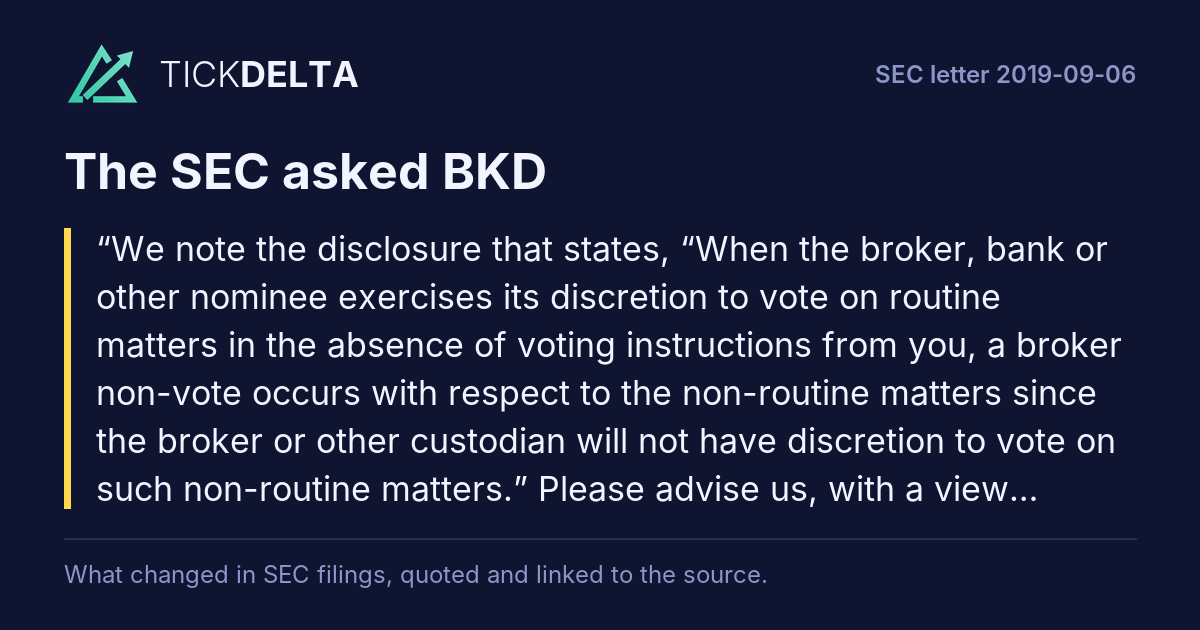
We note the disclosure that states, “When the broker, bank or other nominee exercises its discretion to vote on routine matters in the absence of voting instructions from you, a broker non-vote occurs with respect to the non-routine matters since the broker or other custodian will not have discretion to vote on such non-routine matters.” Please advise us, with a view toward revised disclosure, of the support onRest of the question
which the Company relied to conclude that nonbroker nominees may remain eligible to submit “broker non-votes,” and the extent to which such nominees would be considered “brokers” within the meaning of the term as used in Item 21(b) of Schedule 14A.
In response to the Staff’s comment, the broker non-vote disclosure on page 2 of the Preliminary Proxy Statement has been revised to remove references to other nominees.Read in the reply
In this section, please clarify that the Corporate Governance Guidelines policy regarding majority voting is not legally binding, as distinguished from provisions included in the Company’s Certificate of Incorporation and Bylaws.
The Company’s Corporate Governance Guidelines policy regarding majority voting requires all directors to submit an irrevocable resignation letter, contingent on not receiving a majority of votes cast in an uncontested election, which the Company’s board of directors (the “Board”) may accept or reject in its discretion. The irrevocable resignation letter would legally bind directors to resign from the Board, in the event that the Board decided to accept their resignation even though the Corporate Governance Guidelines’ majority voting policy itself is not legally binding.Read in the replyRest of the answer
However, if the amendment to the Company’s Certificate of Incorporation in Proposal 5 starting on page 75 of the Preliminary Proxy Statement is approved by a majority of the Company’s stockholders represented at the Company’s 2019 annual meeting of stockholders, then the majority voting standard in the Company’s Bylaws will be made effective and become legally binding.
In response to the Staff’s comment, the majority voting policy disclosure on page 7 of the Preliminary Proxy Statement has been revised as follows to clarify the effect of the Corporate Governance Guidelines’ Majority Voting Policy:
“Our Corporate Governance Guidelines include a majority voting policy that is applicable to uncontested director elections. Since the majority voting policy is not included in our Certificate of Incorporation or Bylaws, it is not legally binding. The Corporate Governance Guidelines’ majority voting policy requires that in an uncontested director election, all directors submit an irrevocable resignation letter, contingent on not receiving a majority of votes cast, which the Board may accept or reject in its discretion.”
Please revise to clarify whether the disclosure in this section refers to the Existing 2014 Plan, the Amended and Restated 2014 Plan, or both, and explain the impact of the proposed amendments to the Existing 2014 Plan on the “change in control” analysis presented.
In response to the Staff’s comment, the disclosure in the section entitledRead in the reply
“Certain Potential Consequences of Threatened Proxy Contest” beginning on page 92 of the Preliminary Proxy Statement has been revised as follows to clarify that: (i) the disclosure in such section refers to both the Existing 2014 Plan and the Amended and Restated 2014 Plan and (ii) the proposed amendments to the Existing 2014 Plan described in the section entitled “Proposal 6: Approval of Amended and Restated Brookdale Senior Living Inc.Rest of the answer
2014 Omnibus Incentive
Plan” beginning on page 77 of the Preliminary Proxy Statement will have no impact on the “change in control” analysis presented in such section:
“For purposes of our 2014 Omnibus Incentive Plan, a “change in control” will be deemed to have occurred if the following individuals (“incumbent directors”) cease for any reason to constitute a majority of the number of directors then serving on the Board: individuals who were directors on June 5, 2014 and any new director (other than a director whose initial assumption of office is in connection with an actual or threatened election contest relating to the election of directors) whose appointment or election by the Board or nomination for election by the Company’s stockholders was approved or recommended by a vote of at least two-thirds of the directors then still in office who either were directors on June 5, 2014 or whose appointment, election or nomination for election was previously so approved or recommended. For the avoidance of doubt, references in this section to the “2014 Omnibus Incentive Plan” include both the Existing 2014 Plan and the Amended and Restated 2014 Plan, and the proposed amendments to the Existing
2014 Plan described above under “Proposal 6: Approval of Amended and Restated Brookdale Senior Living Inc. 2014 Omnibus Incentive Plan” will have no impact on the “change in control” analysis described herein.”
We note the disclosure on page 12 that refers to Brookdale’s “closest peers.” Please revise to disclose the companies to which this phrase refers.
No reply letter found.
Please advise as to why the defined term “Proxy Peers” is tied to the Company’s 2018 proxy statement, rather than, for example, to the more recent preliminary proxy statement filed by the Company on August 28, 2019.
No reply letter found.
We note the disclosure that states, “We believe the terms of two (2) Class II directors expire at the Annual Meeting.” Please explain why this has been phrased as a belief rather than a fact, or otherwise rephrase the disclosure to clarify the statement.
No reply letter found.
Please reconcile the disclosure in the opening paragraph of this section with disclosure that appears elsewhere in the proxy statement.
No reply letter found.