BankUnited, Inc. BKU
New risk paragraphs, branching off last year
Each branch is a paragraph in Risk Factors with nothing like it in the 10-K filed Feb 28, 2025. A box jumps to the paragraph as filed, below.
Paragraphs with nothing like them in last year's 10-K
5 paragraphs in Risk Factors of the 10-K filed Feb 26, 2026 with nothing like them in the 10-K filed Feb 28, 2025. Quoted exactly. Paragraphs that were only edited are under 10-K change.
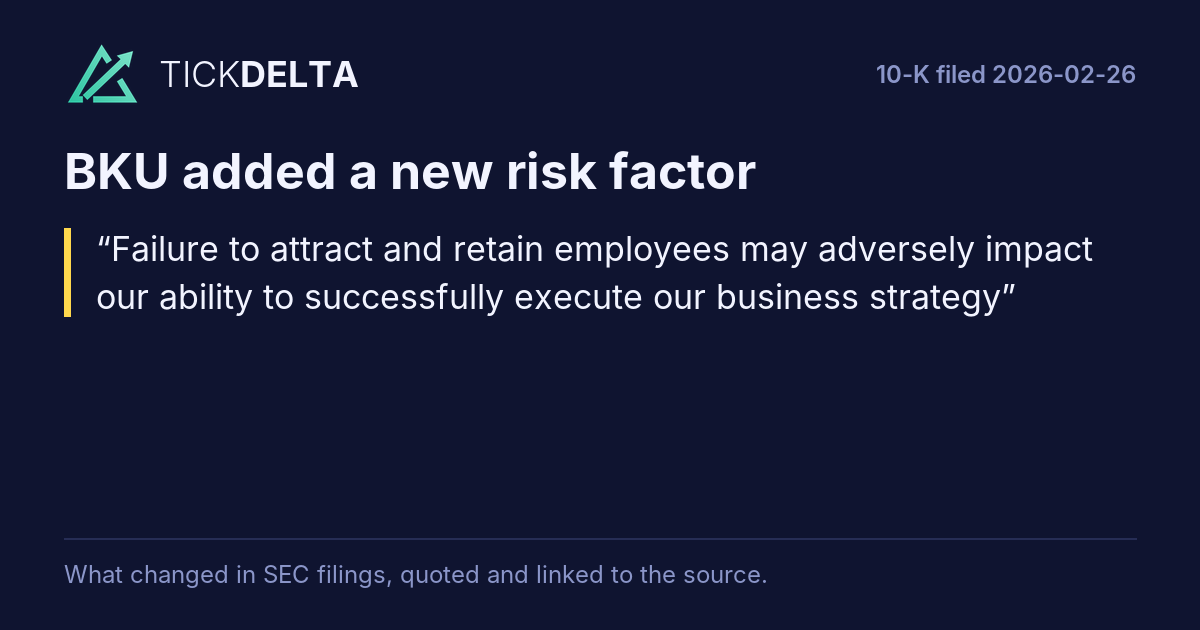
Failure to attract and retain employees may adversely impact our ability to successfully execute our business strategy
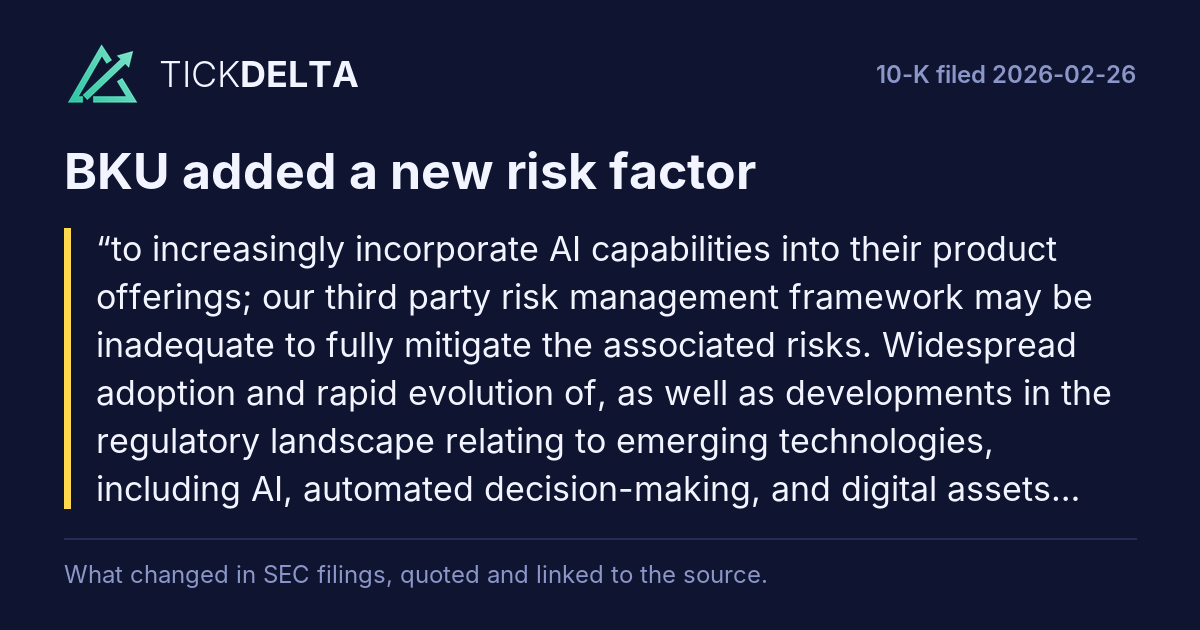
to increasingly incorporate AI capabilities into their product offerings; our third party risk management framework may be inadequate to fully mitigate the associated risks.
Widespread adoption and rapid evolution of, as well as developments in the regulatory landscape relating to emerging technologies, including AI, automated decision-making, and digital assets, such as cryptocurrencies, including stablecoins, tokens and other crypto assets that utilize distributed ledger technology, create additional strategic risks, could negatively impact our ability to compete and require substantial expenditures to the extent we were to modify or adapt our existing products and services. As new technologies evolve and mature, our businesses and results of operations could be adversely impacted, including as a result of new competitors and increased volatility in deposits and/or significant long-term reduction in deposits. Our failure to keep pace with technological innovation, to successfully implement enhanced and emerging technologies or to fully realize their benefits could have a material adverse impact on our business, financial condition and results of operations.
Our business requires the collection and retention of large volumes of customer data, including personally identifiable information in various information systems that we maintain and in those maintained by third party service providers. We are
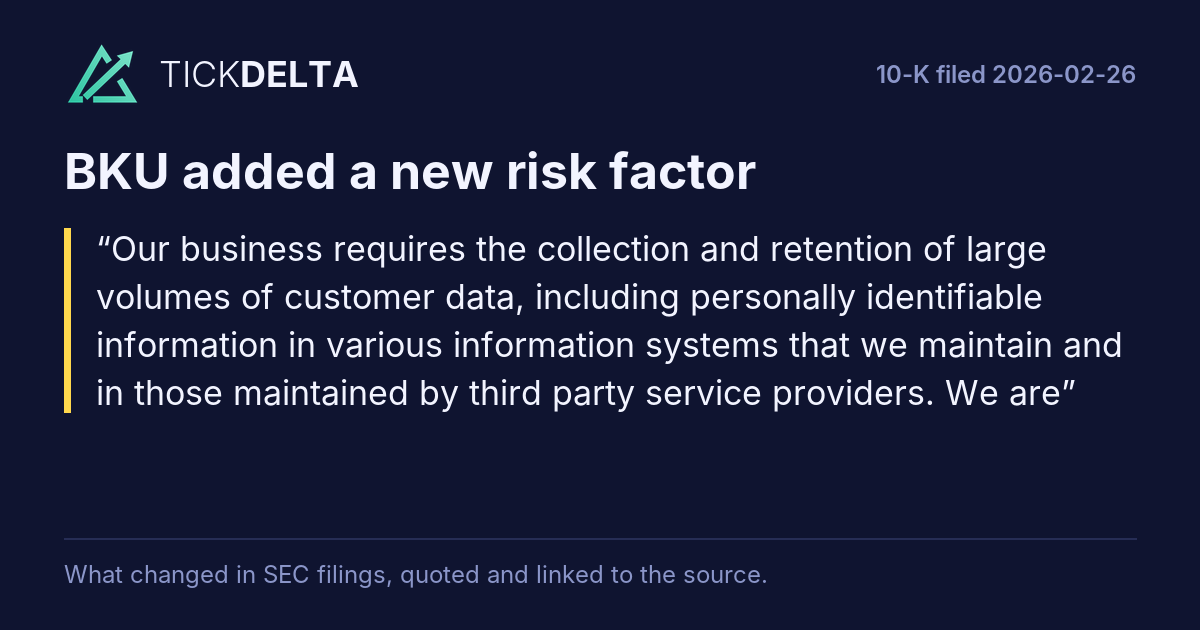
the emergence of previously unknown or unanticipated risks may result in our incurring losses in the future that could adversely impact our financial condition and results of operations.
Paragraphs in the 10-Q filed Nov 5, 2026 that were not in the one before
New in the latest 10-Q
8 paragraphs in the 10-Q filed Nov 5, 2026 with nothing like them in the 10-Q filed Aug 6, 2026 (at least half the words must differ; new numbers alone do not count). Quoted exactly, grouped by the item heading above them. This is text that changed, not a judgement of how serious it is.
Financial statements and notes
Certain amounts presented for prior periods have been reclassified to conform to the current period presented.
Read in the 10-Q
During the third quarter of 2026, the Company entered into multiple receive-fixed, pay-variable interest rate swaps with an aggregate notional amount of $ 539 million and designated the swaps as fair value hedges of benchmark interest rate risk associated with certain fixed-rate brokered certificates of deposit. The swaps became effective during the third quarter of 2026 and mature in 2027.
Read in the 10-Q
The following table presents the carrying amount of hedged liabilities and the cumulative amount of fair value hedge basis adjustments included in the carrying amount of such liabilities as of September 30, 2026 (in thousands):
Read in the 10-Q
Beginning in the third quarter of 2026, we present certain non-interest expenses associated with obtaining, retaining and supporting some of our industry vertical commercial relationships within a separate income statement caption, "Deposit-related costs." Deposit-related costs include deposit rebate and commission programs and other costs associated with deposit sourcing and customer acquisition activities.
Read in the 10-Q
Increases and decreases in interest income, calculated on a tax-equivalent basis, and interest expense result from changes in average balances (volume) of interest earning assets and liabilities, as well as changes in average interest rates. The following table shows the effect that these factors had on the interest earned on our interest earning assets and the interest incurred on our interest bearing liabilities for the periods indicated. The effect of changes in volume is determined by multiplying the change in volume by the previous period's average rate. Similarly, the effect of rate changes is calculated by multiplying the change in average rate by the previous period's volume. Changes applicable to both volume and rate have been allocated to volume (in thousands):
Read in the 10-Q
Show the other 3
Change Due to Volume Change Due to Rate Increase (Decrease) Change Due to Volume Change Due to Rate Increase (Decrease) Change Due to Volume Change Due to Rate Increase (Decrease)
Read in the 10-Q
We may sell securities in the ordinary course of business for a variety of reasons, including liquidity management, interest rate risk management, concentration management and optimization of the risk and return profile of the investment portfolio.
Read in the 10-Q
Net income and EPS excluding the impact of gains and losses on the sale of investment securities are non-GAAP financial measures. Management believes that these measures are useful in evaluating core operating performance in removing the effect of gains or losses on the sale of investment securities, which are subject to fluctuate depending on market conditions in a given period. Disclosure of these non-GAAP financial measures also enhances the reader’s ability to compare the Company’s financial performance for the periods presented.
Read in the 10-Q
The 10-Q's risk factors against the 10-K
Item 1A of the 10-Q filed Nov 5, 2026 against Item 1A of the 10-K filed Feb 26, 2026.
A 10-Q repeats only the risks that changed, so a 10-K paragraph that is missing from it is not counted as removed.
Added is a paragraph with nothing like it in the 10-K, Reworded a sentence that is in both with several words changed,
Quiet changes a sentence in both where one to four words changed and one is a hedge or a modal
(cut words struck through, new words highlighted).
Text on the page, not a score; each links to the filing at sec.gov.
What the 10-Q itself says about its risk factors:There have been no material changes in the risk factors disclosed by the Company in its 2025 Annual Report on Form 10-K filed with the Securities and Exchange Commission on February 26, 2026.
Read in the 10-Q
1 paragraph in the 10-Q's Item 1A, and none of them adds, rewords or quietly edits a paragraph of the 10-K's.
What was taken out
10 paragraphs of last year's Risk Factors with nothing like them now. The longest are quoted.
Sources
Item 1A of each 10-K and 10-Q on EDGAR, quoted exactly. Each paragraph links to the filing at sec.gov.
Also
10-K change: what was reworded or cut, section by section.
Work with it
Excel workbook · CSV. Google Sheet that stays up to date: paste =IMPORTDATA("https://tickdelta.com/company/BKU/export.csv") into a cell.