Blackbaud Inc BLKB
New risk paragraphs, branching off last year
Each branch is a paragraph in Risk Factors with nothing like it in the 10-K filed Feb 21, 2025. A box jumps to the paragraph as filed, below.
Paragraphs with nothing like them in last year's 10-K
15 paragraphs in Risk Factors of the 10-K filed Feb 18, 2026 with nothing like them in the 10-K filed Feb 21, 2025. Quoted exactly. Paragraphs that were only edited are under 10-K change.
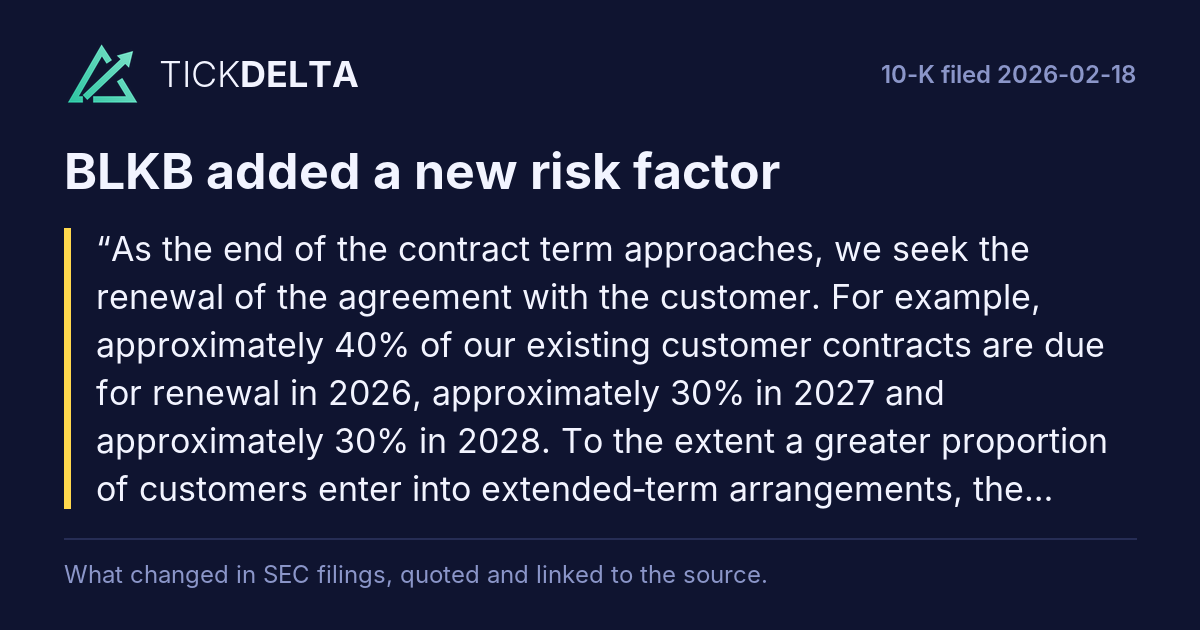
As the end of the contract term approaches, we seek the renewal of the agreement with the customer. For example, approximately 40% of our existing customer contracts are due for renewal in 2026, approximately 30% in 2027 and approximately 30% in 2028. To the extent a greater proportion of customers enter into extended‑term arrangements, the timing of renewals may become more concentrated in later periods, and while our extended-term arrangements typically include embedded price increases and other contractual terms designed to support economics over the contract term, we may have fewer opportunities in any given year to comprehensively re‑price or renegotiate customer relationships.
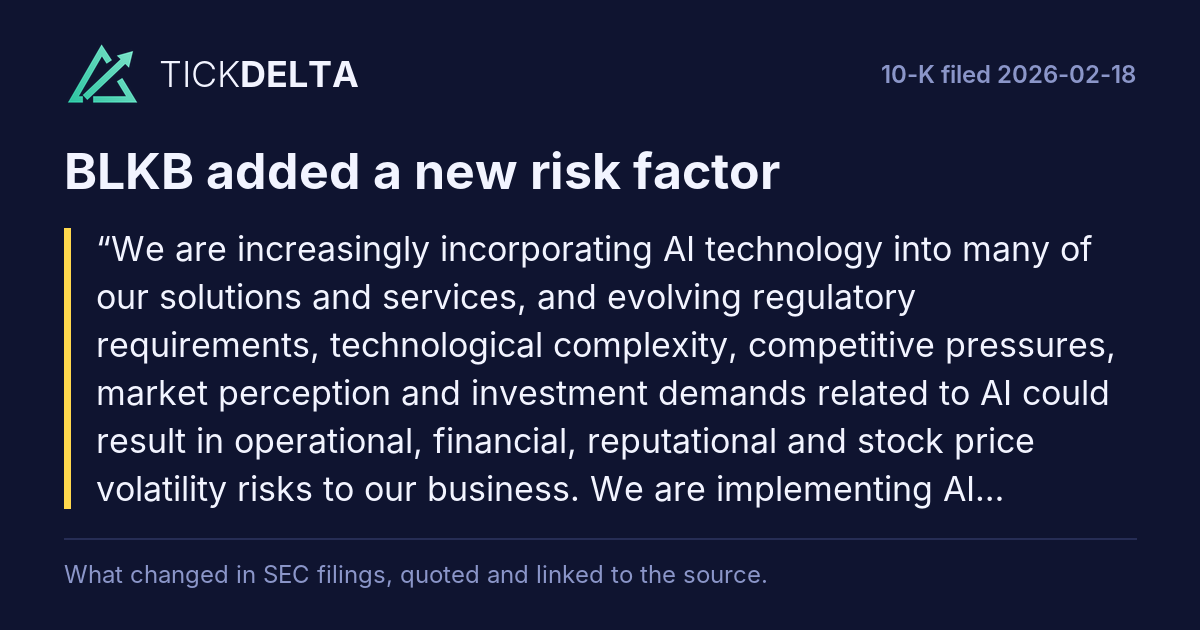
We are increasingly incorporating AI technology into many of our solutions and services, and evolving regulatory requirements, technological complexity, competitive pressures, market perception and investment demands related to AI could result in operational, financial, reputational and stock price volatility risks to our business.
We are implementing AI features, including generative, predictive, interactive and agentic AI technologies, in many of our solutions and services. The technologies underpinning these features are evolving rapidly and exist in an emerging regulatory environment, which presents regulatory, litigation, ethical, reputational, operational and financial risks, some of which are still unknown.
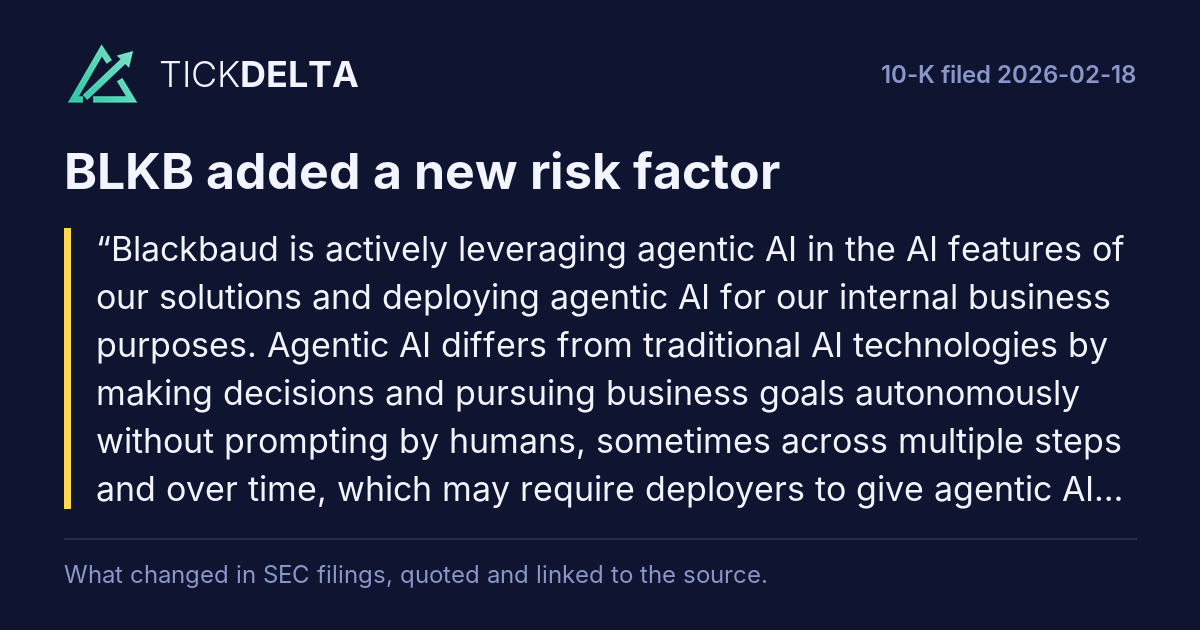
Blackbaud is actively leveraging agentic AI in the AI features of our solutions and deploying agentic AI for our internal business purposes. Agentic AI differs from traditional AI technologies by making decisions and pursuing business goals autonomously without prompting by humans, sometimes across multiple steps and over time, which may require deployers to give agentic AI access to systems for the purpose of taking such initiative. This presents additional risks, including the possibility of opaque decision making, unique security concerns due to agent permissioning, challenges with monitoring actions and assigning and enforcing accountability.
We face significant competition from other companies that are developing their own AI-enhanced products and services. Such AI features and technologies may be similar or superior to ours and may be more cost-effective. Furthermore, other parties could have proprietary rights that would interfere with our ability to implement our own AI features. Our AI features also may require access to specific third-party equipment or infrastructure, which availability or pricing we may not be able to control.
Market perception of the role and impact of AI on technology companies may adversely affect our stock price, regardless of our actual operating performance. Investor sentiment regarding artificial intelligence has become a significant driver of valuation for technology companies, and perceptions about whether a company is effectively developing, deploying, or monetizing AI technologies may materially influence market expectations and our stock price. If investors, analysts, customers or other market participants believe that our AI strategy, capabilities, pace of innovation or competitive positioning are insufficient, less differentiated than those of our competitors, or fail to keep pace with rapidly evolving AI technologies, our stock price could decline, even if our business performance and financial results remain strong. Conversely, heightened expectations regarding the benefits of AI could result in increased volatility in our stock price if our actual AI‑related results, timelines, adoption rates, or financial returns differ from market expectations. Shifts in broader market sentiment regarding AI technologies, including changes in investor confidence, regulatory developments, high‑profile failures or controversies involving AI, or a reassessment of the economic value of AI investments across the technology sector, could also negatively impact our valuation and increase stock price volatility independent of our operating results.
•general business disruptions caused by geopolitical situations and developments including, for example, in India, which has experienced in the past, and may again experience, civil unrest and terrorism and has, and may again, been involved in conflicts with other countries, such as the recent conflict with Pakistan.
Show the other 6
A material example of the foregoing risks is the ransomware attack that in May 2020 during which a cybercriminal removed a copy of a subset of data from our self-hosted environment (the “Security Incident”).
which two cases remain active and unresolved. We also were a defendant in putative consumer class action cases in U.S. and Canadian courts alleging harm from the Security Incident, all of which have now been resolved.
Furthermore, significant management time and Company resources have been, and are expected to continue to be, devoted to the Security Incident.
consuming, involve significant technical complexity and risk, may divert our resources from new features and products and may ultimately not be effective.
As part of our capital allocation strategy and stock repurchase program, we incurred a substantial amount of indebtedness to fund the ASR Transaction in March 2024 and other stock repurchases. As a result of this indebtedness and other borrowings, our interest payment obligations increased and our leverage ratio (as defined in our 2024 Credit Facilities) rose during 2024 and continued to increase into early 2025, reaching a peak of 2.91 to 1.00 as of March 31, 2025. Although our leverage ratio declined modestly during the remainder of 2025, it remained elevated at 2.52 to 1.00 as of December 31, 2025. Absent our ongoing repurchase activity, our leverage ratio would have declined further, as such activity continues to contribute to maintaining a higher level of leverage. In addition, we incurred certain operating expenses associated with our Security Incident, some of which were funded through borrowings.
We currently expect to qualify for at least one of the OECD Transitional Safe Harbors, which include the simplified effective tax rate ("ETR") test, routine profits test, and de minimis test. If we qualify, this would reduce or defer Pillar Two exposure during the transition period. However, qualification depends on jurisdiction‑level financial data, ongoing interpretations, and annual testing requirements. Safe‑harbor eligibility may change from year to year based on operating performance, local statutory developments, or new administrative guidance. Accordingly, there can be no assurance that we will qualify for one or more safe harbors in future periods.
In addition, the United States has entered into “side‑by‑side” agreements with other Inclusive Framework members, under which each jurisdiction may apply its domestic minimum‑tax regime (such as the U.S. corporate alternative minimum tax ["CAMT"] under the Inflation Reduction Act) in parallel with Pillar Two rules. These agreements do not provide an exemption from Pillar Two for U.S.‑headed multinational groups; instead, they increase the likelihood that U.S. rules and foreign QDMTTs will apply concurrently. This new regime goes into effect for years starting in 2026.
Because Pillar Two calculations rely on jurisdiction‑specific adjusted financial statement income, deferred‑tax adjustments, substance‑based exclusions, and intercompany‑transaction rules, the application of these rules may significantly increase the complexity of our global tax computations. Future guidance, data‑requirements, safe‑harbor expirations, or differences in local implementation may result in additional tax expense, increased volatility in our effective tax rate, or new compliance and reporting obligations. Any such developments could materially impact our provision for income taxes, cash flows, and overall financial results.
Paragraphs in the 10-Q filed Oct 28, 2026 that were not in the one before
New in the latest 10-Q
12 paragraphs in the 10-Q filed Oct 28, 2026 with nothing like them in the 10-Q filed Jul 29, 2026 (at least half the words must differ; new numbers alone do not count). Quoted exactly, grouped by the item heading above them. This is text that changed, not a judgement of how serious it is.
Financial statements and notes
Adjustments to reconcile net income to net cash provided by operating activities:
Read in the 10-Q
Changes in operating assets and liabilities, net of acquisition and disposal of businesses:
Read in the 10-Q
Employee taxes paid for withheld shares upon equity award settlement (25,696) (39,669)
Read in the 10-Q
Effect of exchange rate on cash, cash equivalents and restricted cash (939) 5,768
Read in the 10-Q
Certain of our UK subsidiaries are under audit by His Majesty's Revenue and Customs ("HMRC") regarding the value-added tax ("VAT") treatment of certain services provided by those subsidiaries. HMRC has issued an assessment in an immaterial amount for one fiscal quarter (Q3 2022), which we are contesting. We dispute HMRC's position and are pursuing available administrative and legal remedies. We have not recorded a liability related to this audit because we do not believe a loss is probable. A loss is reasonably possible; however, this matter is in its early stages, and therefore, we are unable to provide a reasonable estimate of any possible loss or range of loss relating to this matter at this time or regarding the materiality of such possible loss. Depending on the scope and ultimate resolution of the audit, this matter could have a material adverse impact on our results of operations, cash flows, or financial position in the period in which it is resolved.
Read in the 10-Q
Show the other 7
Tax expense (benefit) included in provision for income taxes 130 — (420) (2,763)
Read in the 10-Q
During the third quarter, we announced Platform for Good™, our unified platform designed to connect our products, data, AI and expertise across the social impact sector. Platform for Good brings together our differentiated data assets, intelligence capabilities and AI-enabled assistants, agents and workflows, while allowing customers to continue working within the Blackbaud solutions and workflows they use today. We believe this approach provides a significant opportunity to deliver increasingly intelligent and connected capabilities across our portfolio while maintaining appropriate human oversight and control.
Read in the 10-Q
We also introduced Lantern™, a domain-specific language model purpose-built for fundraising and developed through a strategic collaboration with Databricks. Lantern combines leading open-weight models with more than 40 years of Blackbaud fundraising experience and is being developed under our Responsible AI principles. We expect Lantern to begin powering select Raiser’s Edge NXT® and Agents for Good™ capabilities in 2027, with broader availability across Platform for Good to follow.
Read in the 10-Q
Our Agents for Good offerings also continued to expand during the quarter. The fundraising Development Agent, our first agentic AI offering, became generally available earlier in 2026 and is designed to help fundraising teams identify and engage prospective and dormant donors within existing workflows and under human supervision. During the third quarter, we announced additional advancements to the Development Agent and introduced the Data Health Agent, which is designed to identify and address data quality issues through review-and-approve workflows. We also previewed additional agentic capabilities for financial management and education.
Read in the 10-Q
Alongside these AI initiatives, we continued to invest in and modernize our core products. During the third quarter, we announced significant enhancements to Raiser’s Edge NXT, including embedded intelligence, automation and connected data capabilities, as well as Blackbaud Marketing™. We also announced new capabilities across our financial management, payments and education solutions, including our next-generation Payment Assistant™, Deposit Connect™ and higher education Connected Campus solution. These investments reflect our strategy of continuing to enhance the products our customers rely on while integrating new intelligence and automation capabilities into existing solutions and workflows.
Read in the 10-Q
As part of our ongoing efforts to improve operating efficiency and optimize our global workforce and operating model, we currently expect to incur pre-tax global workforce transition costs of approximately $8 million to $10 million in 2026, consisting primarily of severance and other employee transition-related expenses. This estimate has increased from the $6 million to $8 million of workforce transition costs previously disclosed, reflecting additional workforce transition actions undertaken during 2026. Because planning for later phases of our multi-year global workforce strategy remains ongoing, our current estimate relates only to expected costs in 2026. We expect to provide updates as planning progresses.
Read in the 10-Q
• an increase in accruals related to commissions, salaries and payroll-related expenses; partially offset by
Read in the 10-Q
The 10-Q's risk factors against the 10-K
Item 1A of the 10-Q filed Oct 28, 2026 against Item 1A of the 10-K filed Feb 18, 2026.
A 10-Q repeats only the risks that changed, so a 10-K paragraph that is missing from it is not counted as removed.
Added is a paragraph with nothing like it in the 10-K, Reworded a sentence that is in both with several words changed,
Quiet changes a sentence in both where one to four words changed and one is a hedge or a modal
(cut words struck through, new words highlighted).
Text on the page, not a score; each links to the filing at sec.gov.
This 10-Q has no Item 1A (Risk Factors) text of its own, so there is nothing to compare. Many companies leave it out when their risks have not changed.
Phrases used for the first time
Two-word phrases in Risk Factors of the 10-K filed Feb 18, 2026 that are in none of the 1 earlier 10-Ks stored, back to Feb 21, 2025
Where each one is used
- pillar two: Global tax developments applicable to multinational businesses may have a material impact to our business, cash flow from operating activities, or financial results. Such developments, for example, may include certain United States’ proposals as well as the Organization for Economic Co-operation and Development’s...
- minimum tax: Global tax developments applicable to multinational businesses may have a material impact to our business, cash flow from operating activities, or financial results. Such developments, for example, may include certain United States’ proposals as well as the Organization for Economic Co-operation and Development’s...
- leverage ratio: As part of our capital allocation strategy and stock repurchase program, we incurred a substantial amount of indebtedness to fund the ASR Transaction in March 2024 and other stock repurchases. As a result of this indebtedness and other borrowings, our interest payment obligations increased and our leverage ratio...
- market perception: We are increasingly incorporating AI technology into many of our solutions and services, and evolving regulatory requirements, technological complexity, competitive pressures, market perception and investment demands related to AI could result in operational, financial, reputational and stock price volatility risks...
- price volatility: We are increasingly incorporating AI technology into many of our solutions and services, and evolving regulatory requirements, technological complexity, competitive pressures, market perception and investment demands related to AI could result in operational, financial, reputational and stock price volatility risks...
- item risk: Our use of AI technology may also present additional security risks due to embedded security vulnerabilities. Furthermore, many of our AI features may rely on third-party developers and other service providers, and any improper processing of personal data by these service providers could harm our reputation,...
- risk factors: Our use of AI technology may also present additional security risks due to embedded security vulnerabilities. Furthermore, many of our AI features may rely on third-party developers and other service providers, and any improper processing of personal data by these service providers could harm our reputation,...
- factors operational: Our use of AI technology may also present additional security risks due to embedded security vulnerabilities. Furthermore, many of our AI features may rely on third-party developers and other service providers, and any improper processing of personal data by these service providers could harm our reputation,...
Used at least twice, small words left out. Counted, not picked: a phrase can be new because the company renamed something.
What was taken out
14 paragraphs of last year's Risk Factors with nothing like them now. The longest are quoted.
Sources
Item 1A of each 10-K and 10-Q on EDGAR, quoted exactly. Each paragraph links to the filing at sec.gov.
Also
10-K change: what was reworded or cut, section by section.
Work with it
Excel workbook · CSV. Google Sheet that stays up to date: paste =IMPORTDATA("https://tickdelta.com/company/BLKB/export.csv") into a cell.