Screener / SEC EDGAR /CIK 0001610250 /10-K filed May 14, 2026, compared with May 15, 2025 /Numbers from the XBRL of the 10-Ks
NYSE Consumer discretionary · Shoe Stores

Boot Barn Holdings, Inc. BOOT

Compare with peers Embed
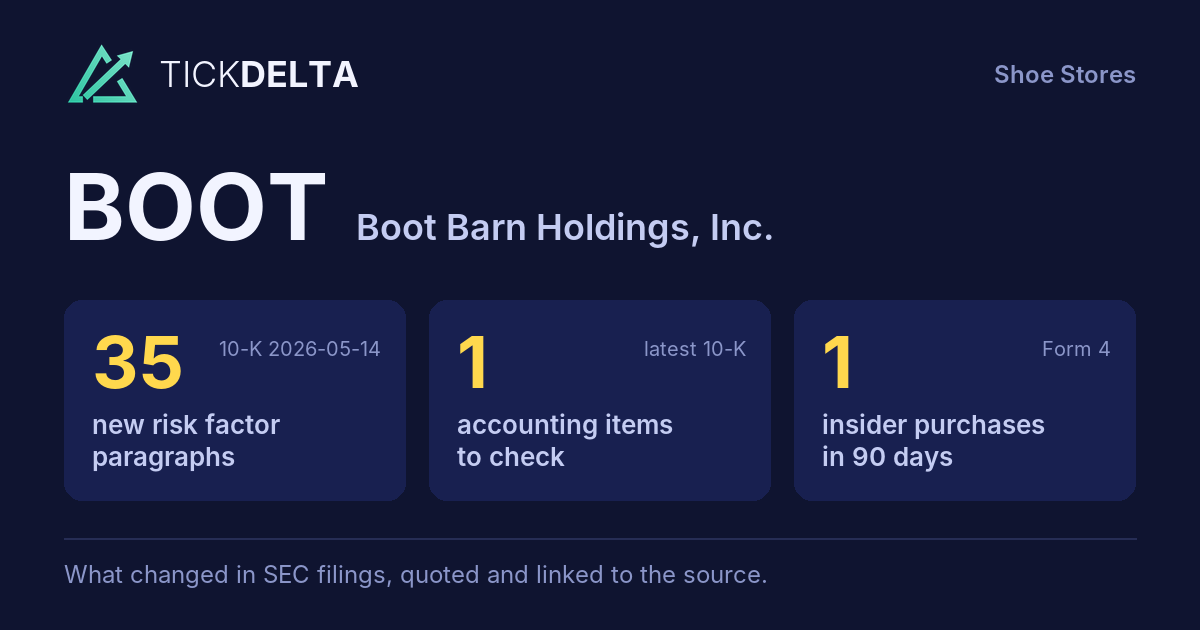
New in the 10-K 35 paragraphs with nothing like them in the 10-K filed May 15, 2025 New in the 10-Q 8 paragraphs not in the 10-Q filed Jul 29, 2026 10-Q against the 10-K 1 risk factor paragraphs and sentences added or reworded

New risk paragraphs, branching off last year

Each branch is a paragraph in Risk Factors with nothing like it in the 10-K filed May 15, 2025. A box jumps to the paragraph as filed, below.

35 new

Paragraphs with nothing like them in last year's 10-K

Quoted exactly

35 paragraphs in Risk Factors of the 10-K filed May 14, 2026 with nothing like them in the 10-K filed May 15, 2025. Quoted exactly. Paragraphs that were only edited are under 10-K change.

While we historically have not been materially impacted by changes in consumer preferences, the retail footwear and apparel business can fluctuate according to changes in consumer preferences.

Read in the 10-K

The rapid development and adoption of AI technologies, including AI-driven search tools, may adversely affect our product visibility, competitive position and results of operations.

Failure to protect our inventory from theft and loss may adversely affect our results of operations.

Read in the 10-K

We rely on third parties to drive traffic to our platform, and these providers may change their algorithms or pricing, or may be subject to new laws and regulations, in ways that could negatively affect our business, financial condition, cash flows, and results of operations.

Changes in tariff policy regarding merchandise produced in, and raw materials sourced from, certain countries have and could continue to adversely affect our business.

Read in the 10-K

During fiscal 2026, interest rates continued to be volatile, coupled with risks relating to a potential recession, contributed to softness in consumer confidence. Continuation of these factors could lead to a decrease in consumer spending.

We may be unable to access financing in the credit and capital markets at reasonable rates.

Continued volatility in the availability and prices for commodities and raw materials we use in our products and in our supply chain (such as cotton) and related inflationary pressures could have a material adverse effect on our costs, gross margins and profitability.

If our suppliers or other participants in our supply chain experience difficulty obtaining financing needed for their operations in the capital and credit markets, it may result in delays or non-delivery of our products.

The current domestic and international political environment, including volatile trade relations, conflicts in multiple locations, and the related disruption to shipping lanes and civil unrest have resulted in uncertainty surrounding the future state of the global economy. There is uncertainty with respect to potential further changes in trade policy and regulations, sanctions and export controls, which increase volatility in the global economy. This environment has affected and may continue to affect production and distribution lead times, increasing our costs and potentially affecting our ability to meet customer demand. If these disruptions persist, they may require us to modify our current sourcing practices, which may impact our product costs, and, correspondingly, could have a material adverse effect on our business and results of operations.

Trade policies and regulations, such as new, increased, or continuing uncertainty concerning tariffs or other trade restrictions may also increase the costs for imported materials and finished goods. Any resulting increase

in prices we charge for our goods could negatively impact demand for our products, our sales and results of operations. Further, increases in consumer expenses more generally may reduce discretionary spending and heighten price sensitivity, which could similarly negatively impact the demand for our products, our sales, and results of operations.

Read in the 10-K

Additionally, the existence or threat of any unforeseen interruption of commerce, including as a result of geopolitical or armed conflict and the possible interference with international trade, supplier deliveries, freight costs, or tariffs, could negatively impact our business by interfering with the availability of raw materials or our ability to obtain merchandise from foreign manufacturers. With a substantial portion of our merchandise being imported from foreign countries, failure to obtain merchandise from our foreign manufacturers or substitute other manufacturers, at similar costs and in a timely manner, could adversely affect our operating results and financial condition.

Read in the 10-K
Show the other 12

The retail industry for western and work wear is highly fragmented and characterized by primarily regional competitors. We estimate that there are thousands of independent specialty stores scattered across the country. We

Read in the 10-K

Additionally, our competitors may outpace us in incorporating new technologies, such as artificial intelligence (“AI”), into their product offerings and engagement with customers, which could affect our competitiveness and operational outcomes. See “The rapid development and adoption of artificial intelligence technologies, including AI-driven search tools, may adversely affect our product visibility, competitive position and results of operations.” below for a description of competitive risks associated with AI.

Read in the 10-K

While we historically have not been materially impacted by changes in consumer preferences, the retail footwear and apparel business can fluctuate according to changes in consumer preferences.

Read in the 10-K

We attempt to open new stores in prominent locations within high visibility, power and large neighborhood shopping centers, and we compete with other retailers for such prominent locations. If we fail to open our new stores in prominent locations, or if locations which were prominent when we opened our stores lose favor over time, the anticipated benefits of our expansion plans may not be realized. For example, our expected sales at our new stores may be dependent upon the volume of traffic in those shopping centers and the surrounding areas. Our new stores may benefit from the ability of a shopping center’s other tenants and area attractions to generate consumer traffic in the vicinity of our stores and the continuing popularity of the shopping center. We cannot control the loss of an “anchor” tenant or other significant tenant in any shopping center or area attraction, the availability or cost of appropriate locations, or the increasing impact of digital channels on shopping center traffic.

Read in the 10-K

Social media platforms, including blogs, social media websites and other forms of internet-based communication, provide access to a broad audience of consumers and other interested persons. Negative commentary

Read in the 10-K

In addition, actions taken, allegations of wrongdoing or statements made by our endorsers, associated with our products or brand or otherwise, that harm the reputations of those endorsers or our decisions to cease collaborating with certain endorsers in light of actions taken, allegations of wrongdoing or statements made by them, could also seriously harm our brand image with consumers and, as a result, could have an adverse effect on our business. Any of these failures by us or the endorsers that we partner with could adversely affect our business and revenues.

Read in the 10-K

maintain our brand image in new and existing markets could harm our business, results of operations and financial condition.

Read in the 10-K

The rapid development and adoption of AI technologies, including AI-driven search tools, may adversely affect our product visibility, competitive position and results of operations.

The rapid development and adoption of AI technologies are transforming the retail, consumer products and e-commerce industries. Retailers, online marketplaces and search platforms are increasingly utilizing AI-driven search and recommendation tools that influence how consumers discover and evaluate products. Changes in these technologies may affect the visibility, ranking and prominence of our products on third-party e-commerce platforms or in online search results. If AI-driven search or recommendation systems reduce traffic to our product listings or favor competitors’ products, our sales volumes, brand visibility and results of operations could be adversely affected.

We and our third-party service providers may also use AI tools in areas such as marketing content, demand forecasting, inventory management and product development. AI systems may produce inaccurate, biased or otherwise flawed outputs due to deficiencies in algorithms or training data, which could result in inaccurate forecasts, operational disruptions, excess inventory or stockouts, increased costs, lost sales opportunities or reputational harm.

In addition, the use of AI presents legal, regulatory, intellectual property, cybersecurity and data privacy risks. AI-generated outputs may infringe third-party rights or incorporate proprietary information in unintended ways, and the legal and regulatory landscape governing AI is rapidly evolving. Compliance with new or changing requirements may increase our costs or limit our ability to deploy AI technologies effectively. If our use of AI, or that of retailers,

marketplaces or other business partners, results in operational, legal or reputational harm, our business, financial condition and results of operations could be adversely affected.

Failure to protect our inventory from theft and loss may adversely affect our results of operations.

Risk of loss or theft of assets, including inventory shortage, is inherent in the retail business. Loss may be caused by error or misconduct of employees, customers, vendors, or other third parties including through organized retail crime and professional theft, which may be further impacted by macroeconomic factors, including the enforcement environment. In addition, retail theft may impact guest perceptions regarding the safety of our stores. We are also vulnerable to other risks that could result in loss of inventory, such as loss related to natural disasters, unanticipated climate patterns and events, and theft of inventory in transit. Our inability to effectively prevent or minimize the loss or theft of assets, or to accurately predict and accrue for the impact of those losses, could adversely affect our results of operations.

Read in the 10-K

Our information technology systems may be vulnerable, from time to time, to damage or interruption from computer viruses, power interruptions or outages or other system failures, third-party intrusions, inadvertent or intentional breaches by our associates, third-party service providers or business partners, or threat actors, and other technical malfunctions. Further, the sophistication, availability and use of AI by threat actors present an increased level of risk. If our systems are damaged, fail to function properly, or are outdated in comparison to those of our competition, we may have to make monetary investments to repairs or replace the systems and our store operations and e-commerce businesses could be severely disrupted.

Read in the 10-K

compare prices and make purchase decisions. Use of these AI tools could affect our ability to efficiently attract potential customers to our digital platforms and retain our customer base.

We rely on third parties to drive traffic to our platform, and these providers may change their algorithms or pricing, or may be subject to new laws and regulations, in ways that could negatively affect our business, financial condition, cash flows, and results of operations.

We continue to invest in digital marketing to drive qualified traffic to our websites. Our success with these efforts depends on an ability to attract customers cost effectively and, to do so, we rely heavily on relationships with providers of online services, search engines, social media and other websites and e-commerce businesses to provide content, advertising banners and other links that direct customers to our websites. We also use social media, including Facebook, Instagram, TikTok and others, as well as affiliate marketing, email, SMS, and direct mail, as part of our multi-channel approach to marketing, and we expect that our use of social media for marketing purposes will increase over time. We rely on these relationships to provide significant traffic to our websites and as important marketing channels and sources of information regarding potential customers. If digital platforms change or penalize us with their algorithms, terms of service, display and featuring of search results , we may be unable to cost-effectively attract customers. Additionally, as competition for online advertising has increased, the cost for some of these services can also increase. A significant increase in the cost of the marketing providers upon which we rely could adversely impact our ability to attract customers cost effectively and harm our business, financial condition, results of operations and prospects.

Read in the 10-K

Changes in tariff policy regarding merchandise produced in, and raw materials sourced from, certain countries have and could continue to adversely affect our business.

Recent trade policies and uncertainty related thereto, including with respect to tariffs and other restrictions on countries from which we source our merchandise and raw materials, have created a dynamic and unpredictable trade landscape. This has and may continue to adversely impact our business and operations. For example, effective in April 2025, the U.S. imposed, pursuant to the International Emergency Economic Powers Act (“IEEPA”), a universal baseline tariff of 10%, plus an additional country-specific tariff for select countries, including the countries from which we source a predominant portion of our merchandise, on all U.S. imports. On February 20, 2026, the U.S. Supreme Court held that the U.S. administration’s imposition of tariffs unlawful pursuant to IEEPA was unlawful, striking down the 10% global baseline tariff, as well as the higher tariffs imposed on certain U.S. trading partners. The U.S. Supreme Court’s ruling did not affect all of the recently imposed tariffs, including those imposed following trade remedy investigations by the Department of Commerce or the U.S. Trade Representative. Nor does it prohibit the imposition of future tariffs through alternative trade authorities available to the U.S. administration. On February 20, 2026, shortly after the announced U.S. Supreme Court decision, the U.S. administration announced that it would be imposing a new 10% global tariff for a period of 150 days pursuant to a balance-of-payments provision in Section 122 of the Trade Act of 1974, to become effective February 24, 2026. That tariff program is currently subject to legal challenge in the Court of International Trade (“CIT”) on an expedited basis. The U.S. administration further announced that it would begin additional trade remedy investigations into unidentified trading partners pursuant to Section 301 of the Trade Act of 1974 and with respect to certain product sectors pursuant to Section 232 of the Trade Expansion Act of 1962. The U.S. Supreme Court decision invalidating the IEEPA tariffs did not address a remedy or refunds, which instead have been addressed in cases in front of the CIT. The CIT has ordered the U.S. Customs and Border Protection (“CBP”) to issue refunds for all IEEPA tariffs, plus interest, and has been requiring periodic updates on the process for issuing refunds. On April 20, 2026, CBP launched a tariff refund portal for electronic submission of tariff refund claims, though no refunds have yet been made to importers.

Read in the 10-K

Increases in labor costs, including wages, could adversely impact our operational results, financial condition and results of operations.

Our store and distribution center operations are subject to laws governing such matters as minimum wages, working conditions and overtime pay. As minimum wage rates increase or related laws and regulations change, we may need to increase not only the wage rates of our minimum wage employees, but also the wages paid to our other hourly or salaried employees. Any increase in the cost of our labor could have an adverse effect on our financial condition and results of operations. In addition, we operate in a competitive labor market, in which wage actions by other retailers and companies may require us to increase salary and wage rates, bonuses and other incentives in order to attract and retain talented employees across all of our retail store, distribution and fulfillment center, and home office operations. Labor shortages and increased employee turnover could also increase our labor costs. This in turn could lead us to increase prices, which could adversely impact our sales. We are also subject to risks related to other store and distribution center expenses and operational costs. Conversely, if competitive pressures or other factors prevent us from offsetting increased labor costs by increases in prices, our profitability may decline.
Read in the 10-K

Paragraphs in the 10-Q filed Oct 28, 2026 that were not in the one before

New in the latest 10-Q

8 paragraphs in the 10-Q filed Oct 28, 2026 with nothing like them in the 10-Q filed Jul 29, 2026 (at least half the words must differ; new numbers alone do not count). Quoted exactly, grouped by the item heading above them. This is text that changed, not a judgement of how serious it is.

Financial statements and notes

Approximately 0.3% and 0.4% of the Company’s consolidated net sales for the thirteen weeks ended September 26, 2026 and September 27, 2025, respectively, and 0.4% of the Company’s consolidated net sales for each of the twenty-six weeks ended September 26, 2026 and September 27, 2025, were generated from customers outside of the United States. Substantially all of the Company’s long-lived assets are held in the United States.

Read in the 10-Q

77,875 RSUs, respectively, to non-employee directors and various employees under the 2020 Plan. The RSUs granted vest in periods ranging from one to three years, provided that the respective award recipient continues to be employed by the Company through the vesting period (subject to certain exceptions). The grant date fair value of the RSUs granted during the twenty-six weeks ended September 26, 2026 and September 27, 2025 totaled $12.0 million and $12.2 million, respectively.

Read in the 10-Q

The Company is involved, from time to time, in litigation that is incidental to its business. The Company has reviewed these matters to determine if reserves are required for losses that are probable and reasonable to estimate in accordance with FASB ASC Topic 450, Contingencies. The Company evaluates such reserves, if any, based upon several criteria, including the merits of each claim, settlement discussions, and advice from outside legal counsel, as well as indemnification of amounts expended by the Company’s insurers or others, if any.

Read in the 10-Q

The Company is also subject to certain other pending or threatened litigation matters incidental to its business. In management’s opinion, as of the date of this Quarterly Report on Form 10-Q, none of these legal matters, individually or in the aggregate, will have a material effect on the Company’s financial position, results of operations, or liquidity.

Read in the 10-Q

During the normal course of its business, the Company has made certain indemnifications and commitments under which the Company may be required to make payments for certain transactions. These indemnifications include those given to various lessors in connection with facility leases for certain claims arising from such facility leases, and indemnifications to directors and officers of the Company to the maximum extent permitted under the laws of the State of Delaware. The majority of these indemnifications and commitments do not provide for any limitation of the maximum potential future payments the Company could be obligated to make, and their duration may be indefinite. The Company has not recorded any liability for these indemnifications and commitments in the condensed consolidated balance sheets as the impact is expected to be immaterial.

Read in the 10-Q
Show the other 3

Share sales and buybacks

On May 8, 2025, the Company’s Board of Directors (the “Board”) authorized the Company to repurchase up to $200 million of shares of its common stock (the “Repurchase Program”). On October 21, 2026, the Board authorized the Company to repurchase an additional $400 million of shares of its common stock under the Repurchase Program. For additional information, see Note 11, “Subsequent Events.”

Read in the 10-Q

The following table summarizes our purchases during the thirteen weeks ended September 26, 2026.

Read in the 10-Q

Item 6

10.1 Boot Barn Holdings, Inc. 2026 Equity Incentive Plan (Incorporated by reference to Exhibit 10.1 to the Registrant’s Current Report on Form 8-K filed on August 27, 2026).

Read in the 10-Q

The 10-Q's risk factors against the 10-K

Item 1A of the 10-Q filed Oct 28, 2026 against Item 1A of the 10-K filed May 14, 2026. A 10-Q repeats only the risks that changed, so a 10-K paragraph that is missing from it is not counted as removed. Added is a paragraph with nothing like it in the 10-K, Reworded a sentence that is in both with several words changed, Quiet changes a sentence in both where one to four words changed and one is a hedge or a modal (cut words struck through, new words highlighted). Text on the page, not a score; each links to the filing at sec.gov.

Added10-Q Oct 28, 2026 vs 10-K May 14, 2026
We operate in a rapidly changing environment that involves a number of risks that could materially and adversely affect our business, financial condition, prospects, operating results or cash flows, including the risks contained in “Item 1A - Risk Factors” in our Fiscal 2026 10-K. As of September 26, 2026, there were no material changes to the risks described in our Fiscal 2026 10-K.

Read it in the 10-Q at sec.gov

Phrases used for the first time

Two-word phrases in Risk Factors of the 10-K filed May 14, 2026 that are in none of the 1 earlier 10-Ks stored, back to May 15, 2025

ai-driven search ×5rapid development ×4retail footwear ×3fluctuate according ×3search tools ×3product visibility ×3visibility competitive ×3tariff policy ×3policy regarding ×3regarding merchandise ×3merchandise produced ×3materials sourced ×3shopping center ×3data privacy ×3attract customers ×3supreme court ×3
Where each one is used
  • ai-driven search: The rapid development and adoption of AI technologies, including AI-driven search tools, may adversely affect our product visibility, competitive position and results of operations.
  • rapid development: The rapid development and adoption of AI technologies, including AI-driven search tools, may adversely affect our product visibility, competitive position and results of operations.
  • retail footwear: While we historically have not been materially impacted by changes in consumer preferences, the retail footwear and apparel business can fluctuate according to changes in consumer preferences.
  • fluctuate according: While we historically have not been materially impacted by changes in consumer preferences, the retail footwear and apparel business can fluctuate according to changes in consumer preferences.
  • search tools: The rapid development and adoption of AI technologies, including AI-driven search tools, may adversely affect our product visibility, competitive position and results of operations.
  • product visibility: The rapid development and adoption of AI technologies, including AI-driven search tools, may adversely affect our product visibility, competitive position and results of operations.
  • visibility competitive: The rapid development and adoption of AI technologies, including AI-driven search tools, may adversely affect our product visibility, competitive position and results of operations.
  • tariff policy: Changes in tariff policy regarding merchandise produced in, and raw materials sourced from, certain countries have and could continue to adversely affect our business.

The 10-K at sec.gov

Used at least twice, small words left out. Counted, not picked: a phrase can be new because the company renamed something.

What was taken out

23 paragraphs of last year's Risk Factors with nothing like them now. The longest are quoted.

Across all companies
Additionally, our competitors may outpace us in incorporating new technologies, such as artificial intelligence (“AI”), into their product offerings and engagement with customers, which could affect our competitiveness and operational outcomes. Our efforts to utilize these technological advancements may not be successful, may result in substantial integration and maintenance costs, and may expose us to additional risks. Personal information within any dataset collected from our business for AI purposes may be vulnerable to unauthorized acquisition or access, compromise or loss, which could...
In the 10-K filed May 15, 2025
We rely on UPS and the United States Postal Service to deliver our e-commerce merchandise to our customers. Relying on these third-party delivery services puts us at risk from disruptions in their operations, such as employee strikes, inclement weather, shutdowns or other delays and their inability to meet our shipping demands. If we are forced to use other delivery services, our costs could increase and we may be unable to meet shipment deadlines. Moreover, we may be unable to obtain terms as favorable as those received from the transportation providers we currently use, which would...
In the 10-K filed May 15, 2025
We maintain a senior secured asset-backed revolving credit facility for which Wells Fargo, National Association, is agent (the “Wells Fargo Revolver”), and any debt outstanding thereunder bears interest at a variable rate of interest. Increases in these variable rates have occurred and may continue in the future, which increases our interest costs, which would likely reduce our cash flows. As of March 29, 2025, we did not have any outstanding indebtedness under the Wells Fargo Revolver. We may incur debt in the future under the Wells Fargo Revolver. Our obligation to pay interest under the...
In the 10-K filed May 15, 2025
Additionally, in response to the ongoing conflict between Russia and Ukraine, the United States has imposed and may further impose, and other countries may additionally impose, broad sanctions or other restrictive actions against governmental and other entities in Russia or other associated countries. While the existing sanctions do not materially impact our business or operations, additional sanctions may be imposed in the future that could impact our supply chain. Additionally, further escalation of geopolitical tensions could have a broader impact that extends into other markets where...
In the 10-K filed May 15, 2025

Sources

Item 1A of each 10-K and 10-Q on EDGAR, quoted exactly. Each paragraph links to the filing at sec.gov.

Also

10-K change: what was reworded or cut, section by section.

Work with it

Excel workbook · CSV. Google Sheet that stays up to date: paste =IMPORTDATA("https://tickdelta.com/company/BOOT/export.csv") into a cell.

Next:10-K change
Esc

Type a ticker such as AAPL, a name, an investor such as Buffett, or a topic such as tariffs. ↑ ↓ to move, Enter to open.