Grayscale Bitcoin Mini Trust ETF BTC
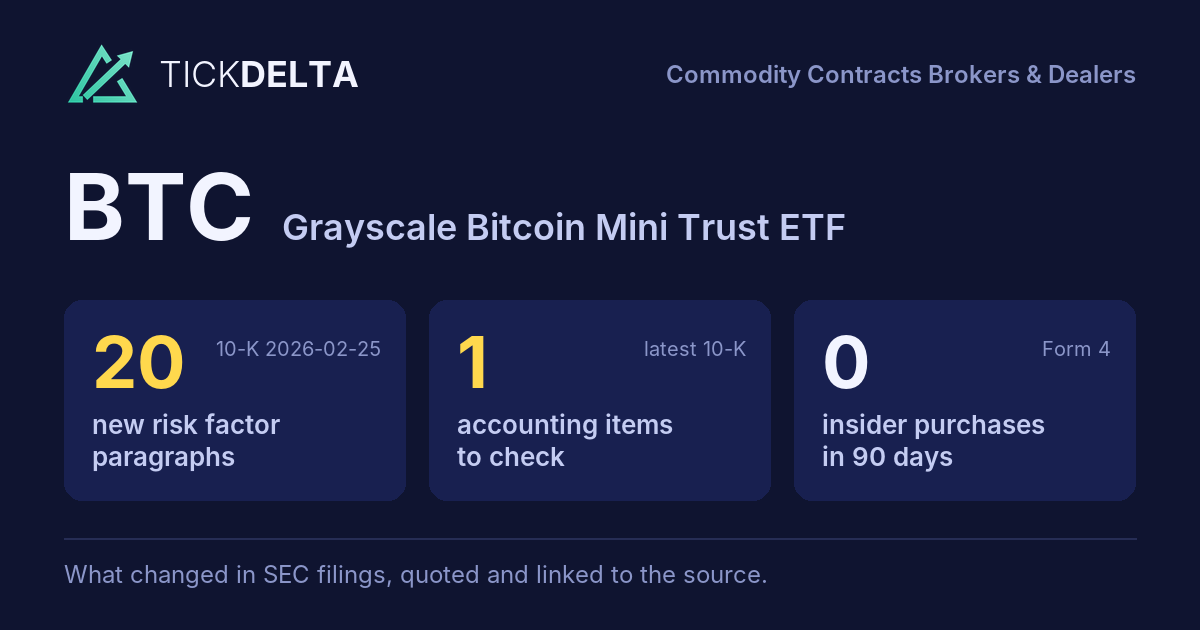
New risk paragraphs, branching off last year
Each branch is a paragraph in Risk Factors with nothing like it in the 10-K filed Feb 28, 2025. A box jumps to the paragraph as filed, below.
Paragraphs with nothing like them in last year's 10-K
20 paragraphs in Risk Factors of the 10-K filed Feb 25, 2026 with nothing like them in the 10-K filed Feb 28, 2025. Quoted exactly. Paragraphs that were only edited are under 10-K change.
Furthermore, changes in U.S. political leadership and economic policies may create uncertainty that materially affects the price of Bitcoin and the Trust’s Shares. For example, on March 6, 2025, President Trump signed an Executive Order to establish a Strategic Bitcoin Reserve and a United States Digital Asset Stockpile. Pursuant to this Executive Order, the Strategic Bitcoin Reserve will be capitalized with Bitcoin owned by the U.S. Department of the Treasury that was forfeited as part of criminal or civil asset forfeiture proceedings, and the Secretaries of Treasury and Commerce are authorized to develop budget-neutral strategies for acquiring additional Bitcoin, provided that those strategies impose no incremental costs on American taxpayers. Conversely, the Digital Asset Stockpile will consist of all digital assets other than Bitcoin owned by the U.S. Department of the Treasury that were forfeited in criminal or civil asset forfeiture proceedings, but the U.S. government will not acquire additional assets for the U.S. Digital Asset Stockpile beyond those obtained through such proceedings. The anticipation of a U.S. government-funded strategic cryptocurrency reserve had motivated large-scale purchases of Bitcoin in the expectation of the U.S. government acquiring such assets to fund such reserve, and the market price of Bitcoin decreased significantly as a result of the ultimate content of the Executive Order. Any similar action or omission by the U.S. federal administration or other government authorities with respect to Bitcoin or other digital assets may negatively and significantly impact the price of Bitcoin and the Trust’s Shares.
Shares. Further, the Bitcoin Network may also be adversely affected if core developers become aligned with, or culturally or organizationally captured by, particular companies, foundations, interest groups, or other coordinated constituencies whose priorities diverge from those of the broader community, as such influence may shape protocol development, governance outcomes, or upgrade decisions in ways that negatively affect the network or the market price of the related digital asset. For example, historically, perceptions—whether accurate or not—that certain core developers were aligned with or influenced by specific organizations, such as concerns voiced by some regarding Blockstream’s relationship with core developers during the Bitcoin scaling debates, contributed to community division, reduced consensus around protocol direction, and ultimately played a role in the network split that resulted in Bitcoin Cash. Similar perceptions in the future could impede protocol development, fragment the community, or otherwise negatively affect the growth, utility, or market price of Bitcoin, which may adversely affect the value of the Shares.
A hard fork may adversely affect the price of Bitcoin at the time of announcement or adoption. For example, the announcement of a hard fork could lead to increased demand for the pre-fork digital asset, in anticipation that ownership of the pre-fork digital asset would entitle holders to a new digital asset following the fork. The increased demand for the pre-fork digital asset may cause the price
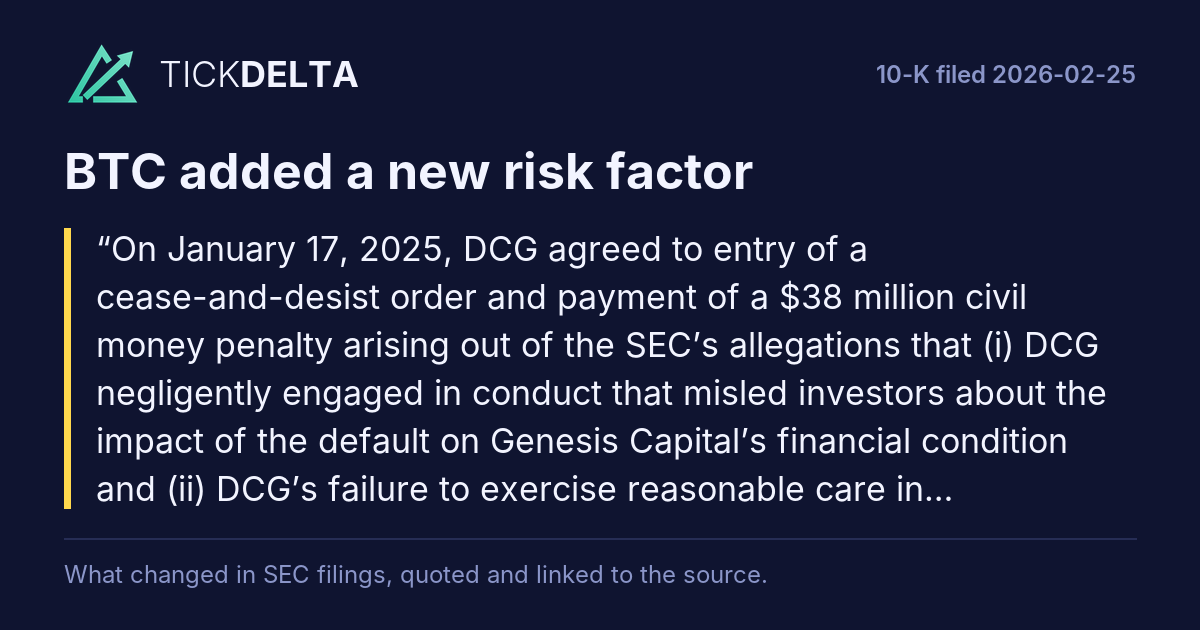
On January 17, 2025, DCG agreed to entry of a cease-and-desist order and payment of a $38 million civil money penalty arising out of the SEC’s allegations that (i) DCG negligently engaged in conduct that misled investors about the impact of the default on Genesis Capital’s financial condition and (ii) DCG’s failure to exercise reasonable care in connection with certain statements concerning Genesis Capital’s financial condition created a materially false impression to the public regarding Genesis Capital’s financial health.
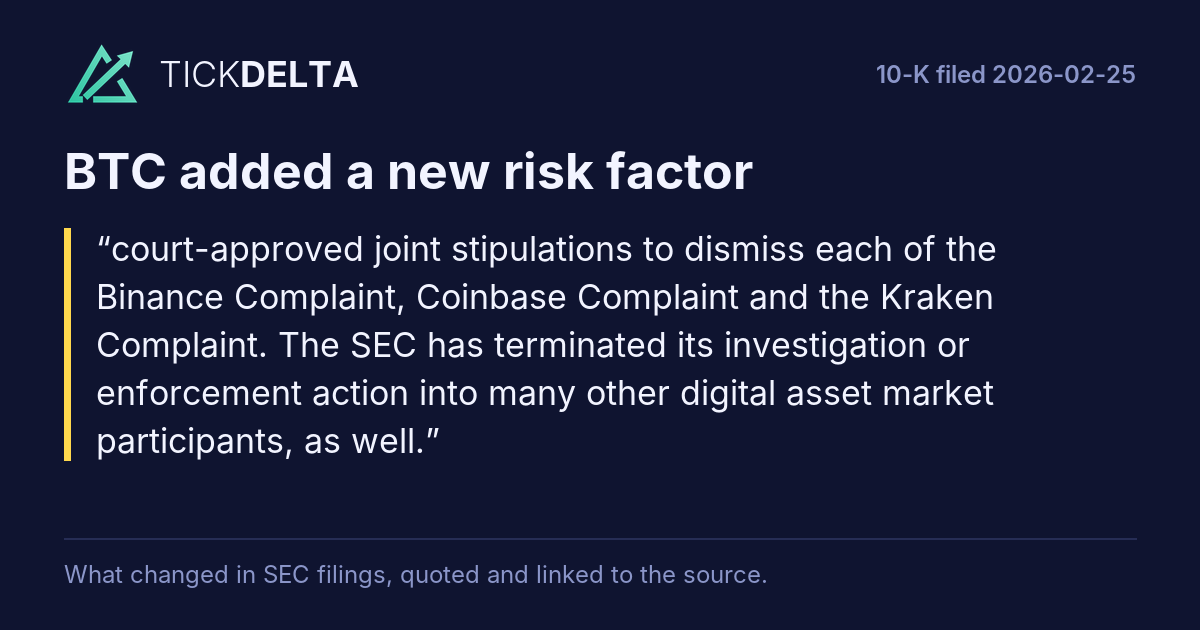
court-approved joint stipulations to dismiss each of the Binance Complaint, Coinbase Complaint and the Kraken Complaint. The SEC has terminated its investigation or enforcement action into many other digital asset market participants, as well.
Show the other 10
•an increase in the global Bitcoin supply that is publicly available for trading;
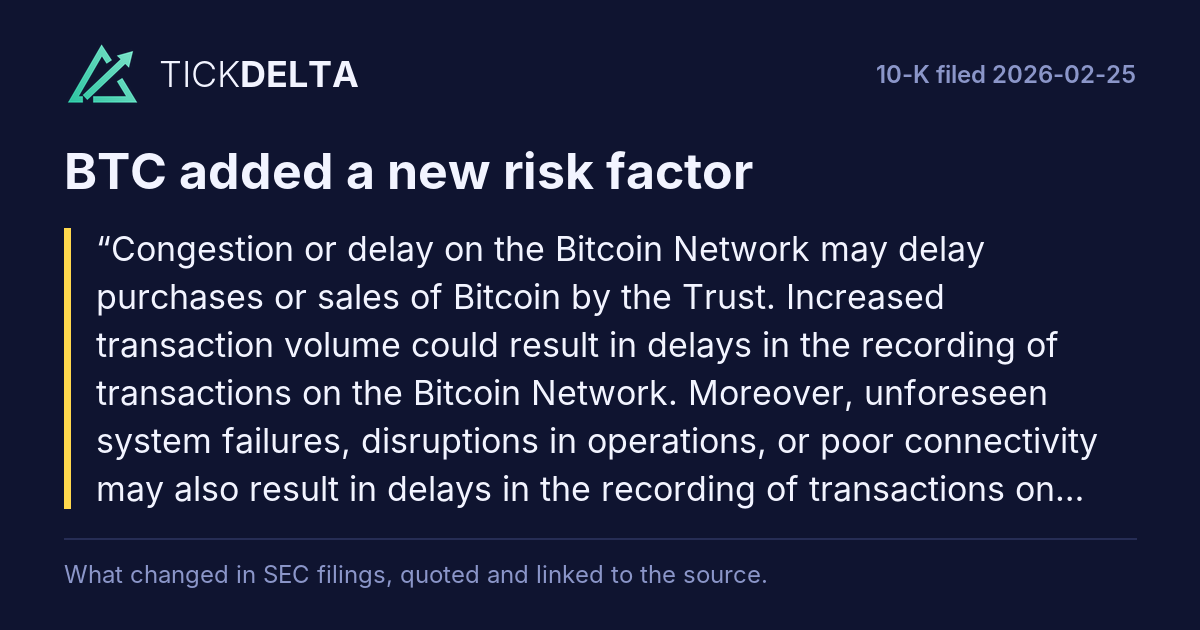
Congestion or delay on the Bitcoin Network may delay purchases or sales of Bitcoin by the Trust.
Increased transaction volume could result in delays in the recording of transactions on the Bitcoin Network. Moreover, unforeseen system failures, disruptions in operations, or poor connectivity may also result in delays in the recording of transactions on the Blockchain. Any delay in the Blockchain could affect an Authorized Participant’s ability to buy or sell Bitcoin at an advantageous price resulting in decreased confidence in the Blockchain. Over the longer term, delays in confirming transactions could reduce the attractiveness to merchants and other commercial parties as a means of payment. As a result, the Bitcoin Network and the value of the Trust would be adversely affected.
Central banks in various countries have introduced digital forms of legal tender (“CBDCs”). China’s CBDC project, known as Digital Currency Electronic Payment, has reportedly been tested in a live pilot program conducted in multiple cities in China. Central banks representing at least 130 countries have published retail or wholesale CBDC work ranging from research to pilot projects. Whether or not they incorporate blockchain or similar technology, CBDCs, as legal tender in the issuing jurisdiction, could have an advantage in competing with, or replace, Bitcoin and other cryptocurrencies as a medium of exchange or store of value. Central banks and other governmental entities have also announced cooperative initiatives and consortia with private sector entities, with the goal of leveraging blockchain and other technology to reduce friction in cross-border and interbank payments and settlement, and commercial banks and other financial institutions have also recently announced a number of initiatives of their own to incorporate new technologies, including blockchain and similar technologies, into their payments and settlement activities, which could compete with, or reduce the demand for, Bitcoin. As a result of any of the foregoing factors, the price of Bitcoin could decrease, which could adversely affect an investment in the Trust.
In addition, recent federal legislation establishing a regulatory framework for fully reserved payment stablecoins, such as the GENIUS Act, may increase the adoption of regulated stablecoins as digital payment instruments, which could reduce the use of Bitcoin for transactional purposes and thereby adversely affect the price of Bitcoin and the value of the Shares.
If the Shares trade on NYSE Arca in the future at a premium, investors who purchase Shares on NYSE Arca will pay more for their Shares than investors who purchase Shares directly from Authorized Participants. In contrast, if the Shares trade on NYSE Arca in the future at a discount, investors who purchase Shares directly from Authorized Participants will pay more for their Shares than investors who purchase Shares on NYSE Arca.
Shareholders that are not Authorized Participants may only purchase or sell their Shares in secondary trading markets, and the conditions associated with trading in secondary markets may adversely affect investors’ investment in the Shares.
Only Authorized Participants may purchase or redeem Baskets. All other investors that desire to purchase or sell Shares must do so through NYSE Arca or in other markets, if any, in which the Shares may be traded. Shares may trade at a premium or discount to the NAV per Share.
announced “Project Crypto,” a Commission-wide initiative to modernize securities rules for digital assets, reshore innovation in the United States, and implement the recommendations of the working group report. Chairman Atkins had directed the SEC’s policy divisions to work with the Crypto Task Force to draft “clear and simple rules of the road for crypto asset distributions, custody, and trading,” and the Commission and SEC staff will also consider using interpretive, exemptive, and other authorities with respect to digital asset markets. However, the efforts of the crypto task force and Project Crypto have only just begun, and how or whether the SEC regulates digital asset activity in the future remains to be seen.
regulatory actions with respect to digital assets generally or Bitcoin in particular may alter, perhaps to a materially adverse extent, the nature of an investment in the Shares or the ability of the Trust to continue to operate.
On January 23, 2025, President Trump issued an executive order titled “Strengthening American Leadership in Digital Financial Technology” aimed at supporting “the responsible growth and use of digital assets, blockchain technology, and related technologies across all sectors of the economy.” The Executive Order also established an interagency working group that is tasked with “proposing a Federal regulatory framework governing the issuance and operation of digital assets” in the United States. Pursuant to this Executive Order, the working group released a report in July 2025 outlining the administration's recommendations to Congress and various agencies reflecting the administration’s “pro-innovation mindset toward digital assets and blockchain technologies.” In particular, the report recommends that Congress enact legislation regarding self custody of digital assets, clarifying the applicability of Bank Secrecy Act obligations with respect to digital asset service providers, granting the CFTC authority to regulate spot markets in non-security digital assets, prohibiting the adoption of a CBDC, and clarifying tax laws as relevant to digital assets. In addition, the report recommends that agencies reevaluate existing guidance on digital asset activities, use existing authorities to enable the trading of digital assets at the federal level, embrace DeFi, launch or relaunch crypto innovation efforts, and promote U.S. private sector leadership in the responsible development of cross-border payments and financial markets technologies, among others.
There have also been several bills introduced in Congress that propose to establish additional regulation and oversight of the digital asset markets. For example, the CLARITY Act was passed by the House of Representatives in July 2025, which would, if enacted, regulate digital asset markets and digital asset trading platforms in the United States. In addition, also in July 2025, the Guiding and Establishing National Innovation for U.S. Stablecoins Act of 2025 (the “GENIUS Act”) became the first federal law specifically regulating the issuance, custody and other stablecoin-related matters in the United States. It is difficult to predict whether, or when, the CLARITY Act or another bill that would regulate digital asset markets and digital asset trading platforms may become law or what any such bill may entail.
Because Bitcoin is a new technological innovation, the tax treatment of Bitcoin for state and local tax purposes, including, without limitation state and local income and sales and use taxes, is not settled. It is uncertain what guidance, if any, on the treatment of Bitcoin for state and local tax purposes may be issued in the future. A state or local government authority’s treatment of Bitcoin may have negative consequences, including the imposition of a greater tax burden on investors in Bitcoin or the imposition of a greater cost on the acquisition and disposition of Bitcoin generally. Any such treatment may have a negative effect on prices of Bitcoin and may adversely affect the value of the Shares.
•While the Index Provider does not currently utilize data from over-the-counter markets or derivatives platforms, it may decide to include pricing from such markets or platforms in the future;
•The Sponsor may appoint an agent to act on behalf of the shareholders, and such agent may be the Sponsor or an affiliate of the Sponsor; and
Paragraphs in the 10-Q filed Nov 5, 2026 that were not in the one before
New in the latest 10-Q
12 paragraphs in the 10-Q filed Nov 5, 2026 with nothing like them in the 10-Q filed Aug 4, 2026 (at least half the words must differ; new numbers alone do not count). Quoted exactly, grouped by the item heading above them. This is text that changed, not a judgement of how serious it is.
10-Q
Number of Shares of the registrant outstanding as of November 2, 2026: 142,399,963
Read in the 10-Q
Financial statements and notes
CSC Delaware Trust Company is the trustee of the Trust (the “Trustee”), The Bank of New York Mellon is the transfer agent (in such capacity, the “Transfer Agent”) and the administrator (in such capacity, the “Administrator”) of the Trust, Continental Stock Transfer & Trust Company is the co-transfer agent of the Trust (the “Co-Transfer Agent”), Coinbase, Inc. is the prime broker (the “Prime Broker”) of the Trust, Coinbase Custody Trust Company, LLC is the custodian of the Trust (the “Custodian”), Anchorage Digital Bank N.A. (the “Additional Custodian”) is an available alternative custodian of the Trust, and Foreside Fund Services, LLC is the marketing agent of the Trust (the “Marketing Agent”).
Read in the 10-Q
5. Income Taxes The Sponsor takes the position that the Trust is properly treated as a grantor trust for U.S. federal income tax purposes. Assuming that the Trust is a grantor trust, the Trust will not be subject to U.S. federal income tax. Rather, if the Trust is a grantor trust, each beneficial
Read in the 10-Q
owner of Shares will be treated as directly owning its pro rata Share of the Trust’s net assets and a pro rata portion of the Trust’s income, gains, losses and deductions will “flow through” to each beneficial owner of Shares.
Read in the 10-Q
On November 5, 2026, the Sponsor, on behalf of the Trust, and Grayscale Securities, LLC (the “Advertising Review and Filing Agent”), an affiliate of the Sponsor, entered into an advertising review and filing agent agreement (the “Advertising Review and Filing Agent Agreement”), pursuant to which, effective November 5, 2026, the Advertising Review and Filing Agent reviews and approves marketing materials for compliance with applicable SEC and Financial Industry Regulatory Authority, Inc. (“FINRA”) advertising rules, files applicable marketing materials with FINRA, and provides certain additional marketing-related services. The fees of the Advertising Review and Filing Agent under the Advertising Review and Filing Agent Agreement are paid on behalf of the Trust by the Sponsor.
Read in the 10-Q
Show the other 7
Also on November 5, 2026, the Sponsor, on behalf of the Trust, and the Marketing Agent entered into Amendment No. 1 (the “Marketing Agent Amendment”) to the Marketing Agent Agreement, dated as of May 14, 2024 (as amended, the “Marketing Agent Agreement”). Pursuant to the Marketing Agent Amendment, effective November 5, 2026, the Marketing Agent no longer reviews marketing materials or files marketing materials with FINRA on behalf of the Trust. The Marketing Agent continues to provide its other services under the Marketing Agent Agreement, including working with the Transfer Agent to review and approve orders placed by Authorized Participants for the creation or redemption of Baskets.
Read in the 10-Q
Financial Highlights for the Three and Nine Months Ended September 30, 2026 and 2025
Read in the 10-Q
Net realized and unrealized gain for the nine months ended September 30, 2025 was $860,171, which includes a realized gain of
Read in the 10-Q
Item 6
10.1 Marketing Agent Agreement, dated as of May 14, 2024, between the Sponsor and the Marketing Agent (incorporated by reference to Exhibit 10.5 of the Registration Statement on Form S-1 filed by the Registrant on July 29, 2024).
Read in the 10-Q
10.2† Amendment No. 1 to the Marketing Agent Agreement, dated as of November 5, 2026, between the Sponsor and Foreside Fund Services, LLC.
Read in the 10-Q
10.3† Advertising Review and Filing Agent Agreement, dated as of November 5, 2026, by and between each entity listed on Appendix I thereto, Grayscale Investments Sponsors, LLC, and Grayscale Securities, LLC.
Read in the 10-Q
† Portions of this exhibit (indicated by asterisks) have been omitted as the Registrant has determined that (i) the omitted information is not material and (ii) the omitted information is of the type that the Registrant treats as private or confidential.
Read in the 10-Q
The 10-Q's risk factors against the 10-K
Item 1A of the 10-Q filed Nov 5, 2026 against Item 1A of the 10-K filed Feb 25, 2026.
A 10-Q repeats only the risks that changed, so a 10-K paragraph that is missing from it is not counted as removed.
Added is a paragraph with nothing like it in the 10-K, Reworded a sentence that is in both with several words changed,
Quiet changes a sentence in both where one to four words changed and one is a hedge or a modal
(cut words struck through, new words highlighted).
Text on the page, not a score; each links to the filing at sec.gov.
What the 10-Q itself says about its risk factors:There have been no material changes to the Risk Factors last reported under “Part I, Item 1A. Risk Factors” of our Annual Report.
Read in the 10-Q
1 paragraph in the 10-Q's Item 1A, and none of them adds, rewords or quietly edits a paragraph of the 10-K's.
Phrases used for the first time
Two-word phrases in Risk Factors of the 10-K filed Feb 25, 2026 that are in none of the 1 earlier 10-Ks stored, back to Feb 28, 2025
Where each one is used
- clarity act: There have also been several bills introduced in Congress that propose to establish additional regulation and oversight of the digital asset markets. For example, the CLARITY Act was passed by the House of Representatives in July 2025, which would, if enacted, regulate digital asset markets and digital asset...
- asset stockpile: Furthermore, changes in U.S. political leadership and economic policies may create uncertainty that materially affects the price of Bitcoin and the Trust’s Shares. For example, on March 6, 2025, President Trump signed an Executive Order to establish a Strategic Bitcoin Reserve and a United States Digital Asset...
- bitcoin owned: Furthermore, changes in U.S. political leadership and economic policies may create uncertainty that materially affects the price of Bitcoin and the Trust’s Shares. For example, on March 6, 2025, President Trump signed an Executive Order to establish a Strategic Bitcoin Reserve and a United States Digital Asset...
- protocol development: As of December 31, 2025, the largest 100 Bitcoin wallets held approximately 15% of the Bitcoin in circulation. Moreover, it is possible that other persons or entities control multiple wallets that collectively hold a significant amount of Bitcoin, even if they individually only hold a small amount, and it is...
- central banks: Central banks in various countries have introduced digital forms of legal tender (“CBDCs”). China’s CBDC project, known as Digital Currency Electronic Payment, has reportedly been tested in a live pilot program conducted in multiple cities in China. Central banks representing at least 130 countries have published...
- working group: announced “Project Crypto,” a Commission-wide initiative to modernize securities rules for digital assets, reshore innovation in the United States, and implement the recommendations of the working group report. Chairman Atkins had directed the SEC’s policy divisions to work with the Crypto Task Force to draft...
- leveraged positions: The trading prices of many digital assets, including Bitcoin, have experienced extreme volatility throughout their existence and may continue to do so. For instance, following significant increases throughout the majority of 2020, digital asset prices, including Bitcoin, experienced significant volatility...
- strategic bitcoin: Furthermore, changes in U.S. political leadership and economic policies may create uncertainty that materially affects the price of Bitcoin and the Trust’s Shares. For example, on March 6, 2025, President Trump signed an Executive Order to establish a Strategic Bitcoin Reserve and a United States Digital Asset...
Used at least twice, small words left out. Counted, not picked: a phrase can be new because the company renamed something.
What was taken out
9 paragraphs of last year's Risk Factors with nothing like them now. The longest are quoted.
Sources
Item 1A of each 10-K and 10-Q on EDGAR, quoted exactly. Each paragraph links to the filing at sec.gov.
Also
10-K change: what was reworded or cut, section by section.
Work with it
Excel workbook · CSV. Google Sheet that stays up to date: paste =IMPORTDATA("https://tickdelta.com/company/BTC/export.csv") into a cell.