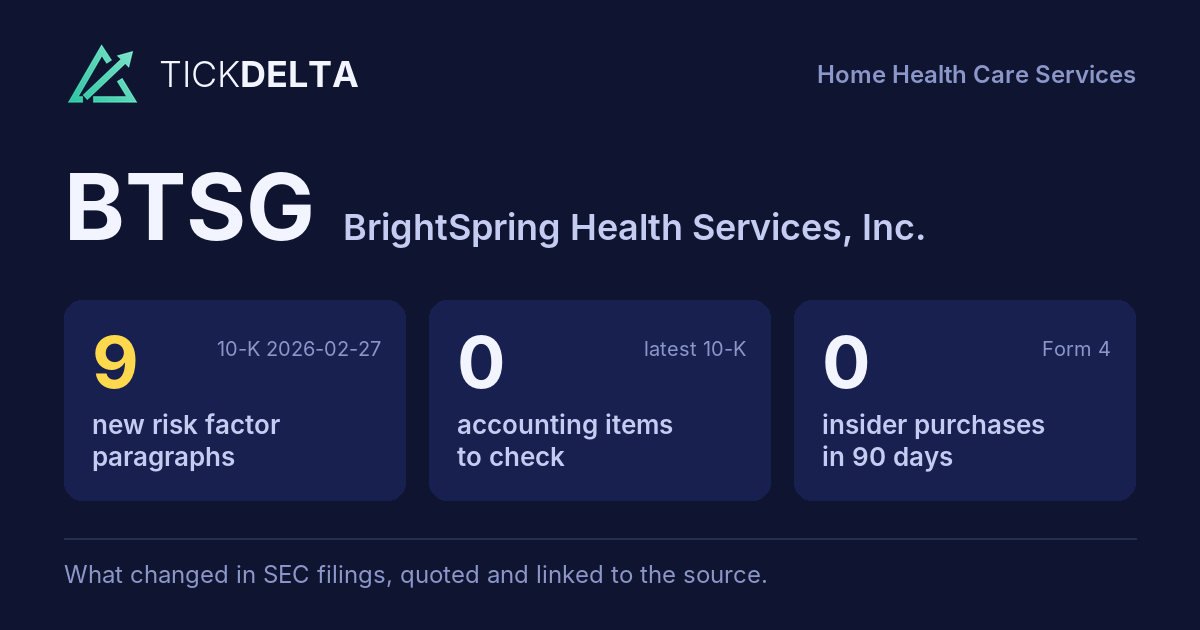
Screener / SEC EDGAR /CIK 0001865782 /10-K filed Feb 27, 2026, compared with Mar 6, 2025 /Numbers from the XBRL of the 10-Ks
Nasdaq Health care · Home Health Care Services

BrightSpring Health Services, Inc. BTSG

Compare with peers Embed
The 10-K against last year's

183 changes: 20 added, 41 removed, 121 reworded, 1 quiet changes

10-K Feb 27, 2026 vs Mar 6, 2025

10-K 0001193125-26-079454 (Feb 27, 2026) vs 10-K 0000950170-25-034196 (Mar 6, 2025)

Every paragraph, and how much of it changed

One bar per paragraph, in the order of the 10-K. Height and colour show the share of its words not in the closest paragraph a year earlier; the tallest bars are new paragraphs.

Risk Factors

249 paragraphs · 9 new · 105 reworded · 16 gone · 10-K Feb 27, 2026 against Mar 6, 2025
New paragraph Reworded (5% of its words or more) Same or nearly
Paragraph 54 · 45% changed Every version of it
The pipeline of new drugs includes many products that over the long term may replace older, more expensive therapies. As a result of such older drugs losing patent protection and being replaced by generic substitutes, new and less expensive delivery methods (such as when an infusion or injectable drug is replaced with an oral drug) or additional products may be added to a therapeutic class, thereby increasing price competition in that therapeutic category. Much of the branded and generic drug product that we dispense is manufactured in whole or in substantial part outside of the United States and imported by our suppliers. As a result, significant changes in tax or trade policies, tariffs, or trade relations between the United States and other countries, such as the imposition of unilateral tariffs on imported products, could result in significant increases in our costs, restrict our access to suppliers, depress economic activity, and have a material adverse effect on our business, financial condition, and results of operations. In addition, other countries may change their business and trade policies and such changes, as well as any negative sentiments towards the United States in response to increased import tariffs and other changes in U.S. trade regulations, could adversely affect our businesses.
Paragraph 193 · 45% changed Every version of it
Despite our high level of indebtedness, we may be able to incur significant additional indebtedness in the future, including off-balance sheet financings, trade credit, contractual obligations, and general and commercial liabilities. Although the credit agreements governing the First Lien Facilities contain restrictions on the incurrence of additional indebtedness, these restrictions are subject to a number of qualifications and exceptions, and the additional indebtedness incurred in compliance with these restrictions could be substantial. These restrictions also will not prevent us from incurring obligations that do not constitute indebtedness, and additionally we have further borrowing capacity under the Revolving Credit Facility. As of December 31, 2024, we had $63.3 million outstanding under the Revolving Credit Facility, with an available borrowing capacity under the Revolving Credit Facility of approximately $411.7 million, and $61.8 million of letters of credit outstanding under the LC Facility.
Paragraph 89 · 42% changed Every version of it
Many of our service users have complex medical conditions or special needs, are vulnerable, and often require a substantial level of care and supervision. There is a risk that one or more service users could be harmed by one or more of our employees, workforce members, or other service users, either intentionally, by accident, or through negligence, neglect, error, poor performance, mistreatment, failure to provide proper care or medication or carry out physician’s orders, failure to properly document or monitor or report information, failure to address risks to service users’ health or safety, failure to maintain appropriate staffing, failure to implement appropriate interventions or other actions or inaction. Employees and workforce members have engaged in conduct (including failing to take action) that has impacted, and may in the future engage in conduct that impacts, our service users or their health, safety, welfare, or clinical treatment. Further, individuals cared for by us have in the past engaged, and may in the future engage, in behavior that results in harm to themselves, our employees or workforce members or to one or more other individuals, including members of the public and other service users. In addition, we have experienced staff shortages and if we experience staff shortages, or are unable to meet any applicable regulatory staffing requirements, it could impact our quality of care. In the past, regulators have taken measures against certain of our facilities and locations as a result of non-compliance with applicable laws and regulations. For regulations (for example, admissions bans) and may do so in July 2020, the West Virginia Department for Health and Human Resources issued a statewide admissions ban for all ResCare facilities that applied to new admissions and readmissions, and the state later issued separate admissions ban orders for other state operations. future. In addition, our facilities and locations have been subject to other regulatory inquiries and matters, such as recoupments as a result of alleged insufficient documentation, overpayments, audits, removals of clients as a result of staffing and incidents identified during a monitoring visit, contract terminations, suspensions or revocations of licenses, home closures, vendor holds, which may occur as a result of our failure to submit an acceptable report under state law, and administrative penalties issued as a result of staffing issues and incidents found during monitoring visits.
Paragraph 73 · 42% changed Every version of it
We have experienced, and may continue to experience, rapid growth, and organizational change, which has placed, and may continue to place, significant demands on our management and our operational and financial resources. Additionally, our organizational structure may become more complex as we expand our operational, financial, and management controls, as well as our reporting systems and procedures as a public company. We may require significant capital expenditures and the allocation of valuable management resources to grow and evolve in these areas. We must effectively increase our headcount, ensure our personnel have the necessary licenses and competencies, and continue to effectively train and manage our employees. We will be unable to manage our business effectively if we are unable to alleviate the strain on resources caused by growth in a timely and successful manner. If we fail to effectively manage our anticipated growth and change or fail to ensure that the level of care and services provided by our employees complies with regulatory and contractual requirements, the quality of our services may suffer, which could negatively affect our brand and reputation, harm our ability to attract and retain patients, customers, referral sources, and employees, and lead to the need for corrective actions.
Paragraph 245 · 40% changed Every version of it
Our second amended and restated certificate of incorporation provides that unless we consent to the selection of an alternative forum, the Court of Chancery of the State of Delaware (or if such court does not have jurisdiction, another state or the federal courts (as appropriate) located within the State of Delaware) will will, to the fullest extent permitted by law, be the sole and exclusive forum for substantially all disputes between us and our stockholders and the federal district courts will be the exclusive forum for Securities Act and Exchange Act claims, which could limit our stockholders’ ability to bring a suit in a different judicial forum than they may otherwise choose for disputes with us or our directors, officers, team members or stockholders.
Paragraph 24 · 39% changed Every version of it
post-payment audits which can result in recoupments. Additionally, private third-party payors may be successful in negotiating reduced reimbursement schedules for our services. Fixed fee schedules, capitation payment arrangements, exclusion from participation in or inability to reach agreements with private insurance organizations or government funded programs, reduction, or elimination of payments or an increase in the payments at a rate that is less than the increase in our costs, or other factors affecting payments for healthcare services over which we have no control, could have a material adverse effect on our business, financial condition, results of operations, and prospects. Further, we cannot assure you that our services will be considered cost-effective by third-party payors, that third-party payor reimbursement will continue to be available or that changes to third-party payor reimbursement policies will not have a material adverse effect on our ability to provide our services on a profitable basis, if at all.
Paragraph 162 · 39% changed Every version of it
could increase our liabilities, harm our reputation, cannot predict what, if any, reform proposals will be adopted, healthcare reform and legislation may have a material adverse effect on our business, financial condition, and results of operations.
Paragraph 204 · 38% changed Every version of it
Additionally, at certain times, the Revolving Credit Facility requires maintenance of a certain minimum fixed charge coverage ratio. Our ability to comply with the covenants and restrictions contained in our credit agreements may be affected by events beyond our control. If market or other economic conditions deteriorate, our ability to comply with these covenants and restrictions may be impaired.

MD&A

169 paragraphs · 11 new · 85 reworded · 25 gone · 10-K Feb 27, 2026 against Mar 6, 2025
New paragraph Reworded (5% of its words or more) Same or nearly
Paragraph 34 · 50% changed
The following tables summarize the percentage of set forth revenue generated by each payor type for each of our service offerings the years ended December 31, 2025 and reportable segments: 2024 (in millions):
Paragraph 165 · 49% changed
The Company’s self-insured liabilities contain uncertainties because management must make assumptions and apply judgment to estimate the ultimate cost of reported claims and claims incurred but not reported as of the balance sheet date. The Company’s provisions for losses for workers’ compensation and health benefit risks are based upon actuarially determined estimates and include an amount determined from reported claims and an amount based on past experiences for losses incurred but not reported. The Company’s provisions for general and professional and automobile liabilities are recorded on a claims-made basis, which includes estimates of fully developed losses for both reported and unreported claims. Accruals for general and professional and automobile liabilities are based on analyses performed internally by management.
Paragraph 19 · 48% changed
We opportunistically provide pharmacy services when and where demanded and as required to customers and patients in their homes and communities, often in coordination with our provider services. The Company filled over 41 million prescriptions in 2024 from over 180 pharmacies across all 50 states, with services delivered to approximately 7,100 customer locations, more than 60,000 individual or group homes, and over 400,000 patients, all through over 4,700 unique customer and payor contracts. Our leading pharmacy support across customer and patient settings is achieved through a focus on medication availability and reliability, cost containment, customer staff and patient support programs, clinical and regulatory education and support, and leading customer service. Infusion and Specialty Pharmacy prescriptions and Home and Community Pharmacy prescriptions have grown at more than 22% and 11%, respectively, from December 2023 to December 2024. We have a unique opportunity to increasingly provide more pharmacy services in the future to provider patients and patients transitioning across settings of care. Almost every one of the Company’s patients who receive provider services from us have a significant medication support need given their polypharmacy profile, which we have the opportunity to further address.
Paragraph 76 · 47% changed
•an increase •a decrease of $44.1 $22.7 million, or 3.4% growth 2.0%, on consolidated 2023 2024 selling, general, and administrative expenses, as a result of our the termination fees incurred at the time of the IPO Offerings and are therefore not expected to reoccur. These expenses include $22.7 million in connection with the termination of termination our Monitoring Agreement for which there is no comparable expense in 2025.
Paragraph 30 · 47% changed
We Our Personal Care services provide patient-centric, highly skilled, and compassionate clinical home care to support that assist with activities of daily living. These services allow Seniors and others in their homes. For Seniors and other patients recovering from surgery or illness or living with chronic diseases, we provide clinical home health care in the home. We also provide physical, emotional, and spiritual comfort and support primarily for Senior patients with terminal illnesses and their families through our hospice services. Like patients receiving home health care, our interdisciplinary hospice teams tailor individualized plans for patients and their families based on a comprehensive understanding of their needs. Our hospice patients require important daily pharmacy support, which we deliver through our pharmacy services. Additionally, for Seniors and others who require supportive long-term care and assistance with activities of daily living support that to maintain their independence at home with their families. These supportive care activities address social determinants of health, including dietary and nutrition management and cognitive and social engagement, among others, and we offer these daily or weekly services.
Paragraph 125 · 47% changed
•a $55.0 $41.1 million increase in cash outflows due operating income from discontinued operations in 2025 as compared to an increase in strategic inventory purchases from 2023; 2024;
Paragraph 153 · 46% changed
is more-likely-than-not that the fair value of a reporting unit was less than its carrying amount. If after assessing the totality of events and circumstances, we were to determine that it is more-likely-than-not that the fair value of a reporting unit is less than its carrying amount, then we would perform quantitative impairment testing. The quantitative impairment test is a single-step process. The process requires the Company to estimate and compare the fair value of a reporting unit to its carrying amount, including goodwill. If the fair value exceeds the carrying amount, the goodwill is not considered impaired. To the extent a reporting unit’s carrying amount exceeds its fair value, the reporting unit’s goodwill is deemed impaired, and an impairment charge is recognized based on the excess of a reporting unit’s carrying amount over its fair value.
Paragraph 59 · 45% changed
Refer to See Note 1 “Significant Accounting Policies” 2 “Discontinued Operations” within our audited the consolidated financial statements and related notes notes, included elsewhere in this Annual Report on Form 10-K for further discussion. 10-K.

A paragraph is matched with the one last year that shares the most of its words; under half in common makes it new. The paragraphs shown are the 8 reworded the most in each section.

The paragraph that changed most in each section

The redline

Marked against last year's 10-K: cut words struck through, new words highlighted.

Risk Factors359 words changed in this paragraph; it is 60% similar to last year's version.
Our systems and those of our third-party service providers and business partners may be vulnerable to, and have experienced, data or security breaches, cyberattacks (including ransomware), acts of vandalism, computer viruses, misplaced or lost data, human errors, or other similar events. While we have safeguards in place designed to defend our systems against intrusions and attacks and to protect our data, we cannot be certain that these measures are sufficient to counter all current and emerging technology threats, including those that adopt evolving AI technologies. Emerging technologies may increase our operational, privacy, cybersecurity, and intellectual property risks, including errors, bias, data leakage, and claims related to training data and generated outputs, and may increase expenses. We may also be dependent on third-party AI models and vendors, whose availability, reliability, performance, or terms of use may change. If unauthorized parties gain access to our networks or data, or those of our employees, third-party service providers or business partners, they may be able to access, steal, publish, delete, use in an unauthorized manner or modify confidential and sensitive information, including personal information, PHI, trade secrets or other confidential information, intellectual property, and proprietary business information. In addition, employees may intentionally or inadvertently cause data or security breaches that result in destruction, loss, alteration, unauthorized disclosure of, or access to such information. Further, the techniques used to obtain unauthorized access, disable or degrade service, or sabotage systems change frequently and are often difficult to detect. Threats to our systems and associated third-party systems can originate from human error, fraud, or malice on the part of employees or third parties or simply from accidental technological failure. Computer viruses and other malware can be distributed and could infiltrate our systems or those of associated third parties. Because the techniques used to circumvent security systems can be highly sophisticated, change frequently, are often not detected until launched against a target and may originate from less regulated and remote areas around the world, we, and our third-party service providers, may be unable to effectively detect or proactively address all possible techniques, implement adequate preventive measures for all situations or respond to any breach or security incident. The administrative, physical, and technological safeguards we or our third-party service providers implement to address these risks may not address applicable laws and regulations or address situations that could lead to increased privacy or security risks. The businesses we have acquired, or may acquire in the future, may not have in place all of the required safeguards and may have experienced breaches or security incidents. It may take significant time and expense to integrate such businesses to our policies and procedures. To the extent we terminate contracts with our third-party service providers, we may not be able to ensure that the relevant personal information of our patients and employees is maintained in compliance with the required safeguards. In the normal course of business, we are and have been the target of malicious cyberattack attempts and have experienced ransomware attacks and other security incidents that have disrupted our operations. For example, We have previously experienced, and may in March 2023, we experienced a the future experience, ransomware attack attacks that resulted could result in a breach of more than 6 million individuals’ individuals' personal information (including PHI). While we do not currently expect this incident PHI), which has, and in the future, could require us to have a material impact on our business, we notified notify the impacted individuals and applicable regulators and are currently could subject us to a HHS Office for Civil Rights investigation, various state regulatory investigations, and various lawsuits in connection with this incident. or other legal proceedings. There can be no assurance that any present or future cyberattacks will not be material or significant.

Source: Item 1A, 10-K 0001193125-26-079454 vs Item 1A, 10-K 0000950170-25-034196

Accounting Policies184 words changed in this paragraph; it is 31% similar to last year's version.
We regularly review intangible assets for impairment at least annually, and more frequently if impairment indicators arise. If the carrying value amount of an intangible asset exceeds its fair value, an impairment loss is recognized. We elected to perform a qualitative assessment for all intangible assets for our annual impairment test in the fourth quarter of 2025, 2024, and 2023. As a result of our right-of-use qualitative analyses, we determined that it was more-likely-than-not that the fair values of our indefinite-lived intangible assets with respect to any events or circumstances that indicate a possible inability to recover were greater than their carrying amount. Indicators of impairment include, but are not limited to, loss of contracts, significant census declines, reductions in reimbursement levels, significant litigation, and impact of economic conditions on service demands and levels. Our evaluation is based on undiscounted cash flows, operating results, as well as significant events or changes in the reimbursement or regulatory environment. If the undiscounted cash flows suggest the recorded amounts cannot be recovered, the carrying values of such assets are reduced to fair value. values. We recorded a right-of-use asset impairment related to definite-lived intangible licenses of $3.6 $10.8 million, $2.3 million $1.7 million, and $2.5 $1.5 million for the years ended December 31, 2025, 2024, 2023 and 2022, 2023, respectively, included within selling, general, and administrative expenses on the consolidated statements of operations.

Source: Item 8, Note 1 – Significant Accounting Policies, 10-K 0001193125-26-079454 vs Item 8, Note 1 – Significant Accounting Policies, 10-K 0000950170-25-034196

MD&A171 words changed in this paragraph; it is 52% similar to last year's version.
Income tax expense was $33.1 million for the year ended December 31, 2025, as compared with an income tax benefit was $14.2 of $26.4 million for the year ended December 31, 2024, as compared with $20.6 million an increase in the income tax expense of $59.5 million. The increase in the income tax expense is primarily driven by the increase in pre-tax book income for the year ended December 31, 2023, 2025 as compared to the year ended December 31, 2024, and a change of $6.4 million which corresponds with a change decrease in the effective tax rate from 11.6% for the year ended December 31, 2023 2025 of 24.0% compared to 40.9% 27.7% for the year ended December 31, 2024. The increase decrease in the effective tax rate is primarily due to as a result of $4.9 million in tax benefits resulting from the net impact of the recognition of excess tax benefits from stock-based compensation partially offset by limitations on the deductibility of certain executive compensation that now apply to as a percentage of estimated pre-tax book income for the Company upon completion of its IPO in January 2024, partially offset by year ended December 31, 2025. In addition, the discrete tax benefit related to the Silver legal settlement. The terms of matter increased the settlement agreement, including partial deductibility effective tax rate on pre-tax book loss for tax purposes, were finalized in 2024 and resulted in favorable treatment for tax purposes. the year ended December 31, 2024. See Note 14 “Commitments 15 "Commitments and Contingencies” Contingencies" within the consolidated financial statements and related notes, included elsewhere in this Annual Report on Form 10-K.

Source: Item 7, 10-K 0001193125-26-079454 vs Item 7, 10-K 0000950170-25-034196

Legal Proceedings77 words changed in this paragraph; it is 74% similar to last year's version.
The District Court issued an order dismissing the case in full in 2016. In 2018, however, the Third Circuit Court of Appeals issued an order reinstating the case. In April 2023, the District Court issued an order denying Relator’s motion seeking to strike portions of the opinions of PharMerica’s experts and granted in part PharMerica’s motions to exclude Relator’s experts. On June 28, 2023, the District Court issued an order setting a trial date of December 4, 2023. On November 6, 2023, the District Court denied our motion for summary judgment. On November 18, 2023, the Company agreed to settle the matter without admitting liability. On May 29, 2024, the parties entered into a final settlement agreement, which was approved by both the United States Department of Justice and the District Court. The total financial impact of the settlement was $120.0 million; $110.0 million was paid during the year ended December 31, 2024, and the remaining $10.0 million was paid during the year ended December 31, 2025. The District Court entered an order dismissing the Silver action in its entirety, with prejudice, on July 3, 2024.

Source: Item 3, via Note 15 – Commitments and Contingencies, 10-K 0001193125-26-079454 vs Item 3, via Note 14 – Commitments and Contingencies, 10-K 0000950170-25-034196

Sentences and paragraphs added, removed or reworded

Every change, by type

Sentences and paragraphs of BTSG's Risk Factors and MD&A, 10-K Feb 27, 2026 against 10-K Mar 6, 2025. Each links to the text at sec.gov.

Quiet changes are sentences kept from last year with one to four words changed, at least one of them a hedge, a modal or a qualifier (may, could, will, not, significant, material…). A year or date rolling forward is not counted.

The full word list

adverse, adversely, all, although, anticipate, anticipates, any, approximately, believe, believes, can, cannot, certain, could, expect, expects, generally, however, if, intend, intends, largely, likely, many, material, materially, may, might, most, must, never, no, not, possible, primarily, probable, should, significant, significantly, some, substantial, substantially, unlikely, will, would

AddedRisk Factors
While participation in such APMs, including ACOs, has historically been voluntary, CMS and certain other payers have indicated that participation in future programs may be required, and any changes to or elimination of VBC arrangements by CMS or
Read it in 10-K Feb 27, 2026 at sec.gov
AddedRisk Factors
We receive fixed payments at predetermined reimbursement rates established through federal and state legislation from Medicare and Medicaid, our most significant payors, for our services. Consequently, our profitability largely depends upon our ability to manage the costs of providing these services. We cannot be assured that reimbursement payments under Medicare and Medicaid will be sufficient to cover the costs allocable to patients eligible for reimbursement pursuant to these programs. Commercial payors
Read it in 10-K Feb 27, 2026 at sec.gov
AddedRisk Factors
changes which, in turn, may result in disruptions in payment for services, and in some cases an inability to bill and generate revenue for post-acquisition services for a period of time.
Read it in 10-K Feb 27, 2026 at sec.gov
AddedRisk Factors
In addition to our acquisition growth strategy, we seek opportunities for increasing revenue from our existing operations through organic growth, such as applying for certificates of need, or CONs, in certain jurisdictions in our home health and hospice businesses which is a hyper-competitive process and can be difficult to obtain. We may not be able to successfully execute our organic growth strategies. Certain of our organic growth strategies may involve risks and uncertainties similar to those for our acquisition strategy. See above. In addition, we may not be able to expand the services into the new location, we may not be able to attract referrals to that new location, we may not be able to execute new contractual arrangements with patients and referral sources, and we may not accurately project organic growth performance, including projections of revenue, operating expenses, and margins.
Read it in 10-K Feb 27, 2026 at sec.gov
AddedRisk Factors
Our company is increasingly integrating Artificial Intelligence (AI) technologies into our operations to enhance efficiency, decision-making, and customer experience. While AI offers significant benefits, it also introduces new risks, including potential biases in decision-making, data privacy concerns, and reliance on complex algorithms. We are committed to mitigating these risks through rigorous testing, continuous monitoring, and adherence to ethical guidelines. However, any failure to manage these risks effectively could adversely impact on our business operations and reputation.
Read it in 10-K Feb 27, 2026 at sec.gov
AddedRisk Factors
In addition, denial of service or other cyberattacks could be launched against us for a variety of purposes, including to interfere with our services or create a diversion for other malicious activities. Our defensive measures may not prevent unplanned downtime, or
Read it in 10-K Feb 27, 2026 at sec.gov
AddedRisk Factors
The nature of our business subjects us to inherent risk of wrongful death, personal injury, product liability, professional malpractice and other potential claims, liabilities, and substantial damage awards. In addition, the pharmaceutical products we dispense could become subject to contamination, product tampering, mislabeling, recall or other damage. In addition, errors in the compounding, dispensing, and packaging of drugs and consuming drugs in a manner that is not prescribed could lead to serious injury or death. Healthcare providers have become subject to an increasing number of legal actions alleging malpractice or related legal
Read it in 10-K Feb 27, 2026 at sec.gov
AddedRisk Factors
Moreover, we could also be subject to potential litigation associated with compliance with various laws and governmental regulations at the federal or state levels, such as those relating to the protection of older adults and persons with disabilities or those related to employment, health, safety, security, and other regulations under which we operate. We are currently subject to class actions, employee-related claims, and other lawsuits and proceedings in connection with our operations, including, but not limited to, those related to alleged violations of federal and state wage and hour laws, wrongful discharge, retaliation, and illegal discrimination.
Read it in 10-K Feb 27, 2026 at sec.gov
Show the other 61
AddedRisk Factors
Although our insurance coverage reflects deductibles, self-insured retentions, limits of liability, and similar provisions that we believe are reasonable based on our operations, the coverage under our insurance programs may not be adequate to protect us in all
Read it in 10-K Feb 27, 2026 at sec.gov
RemovedRisk Factors
and on acceptable terms, or at all. Should a supply disruption result in the inability to obtain pharmaceutical solutions necessary for patient care, our business, financial condition, and results of operations could be negatively impacted.
Read it in 10-K Mar 6, 2025 at sec.gov
RemovedRisk Factors
adverse effect on our business, financial condition, and results of operation.” Furthermore, our third-party providers’ existing safety systems, data backup, access protection, user management, information technology emergency planning, and other security measures may not be sufficient to prevent data loss or long-term network outages.
Read it in 10-K Mar 6, 2025 at sec.gov
RemovedRisk Factors
Regulatory agencies may initiate administrative proceedings alleging violations of statutes and regulations arising from our services, or reimbursement of those services, and seek to impose monetary penalties on us. We could be required to pay substantial
Read it in 10-K Mar 6, 2025 at sec.gov
RemovedRisk Factors
amount of our voting power, even if such amount is less than 50%, it is able to strongly influence or effectively control our decisions, and KKR Stockholder has the right to nominate individuals to our board of directors under the existing stockholders agreement.
Read it in 10-K Mar 6, 2025 at sec.gov
RemovedRisk Factors
In addition, KKR Stockholder and its affiliates are able to determine the outcome of all matters requiring stockholder approval and are able to cause or prevent a change of control of the Company or a change in the composition of our board of directors and could preclude any acquisition of the Company. This concentration of voting control could deprive you of an opportunity to receive a premium for your shares of common stock as part of a sale of the Company and ultimately might affect the market price of our common stock.
Read it in 10-K Mar 6, 2025 at sec.gov
RemovedRisk Factors
Further, in Canada, the Personal Information Protection and Electronic Documents Act, or PIPEDA, and similar provincial laws may impose obligations with respect to processing personal information. PIPEDA requires companies to obtain an individual’s consent when collecting, using, or disclosing that individual’s personal information. Individuals have the right to access and challenge the accuracy of their personal information held by an organization, and personal information may only be used for the purposes for which it was collected. If an organization intends to use personal information for another purpose, it must again obtain that individual’s consent.
Read it in 10-K Mar 6, 2025 at sec.gov
RemovedRisk Factors
As of December 31, 2024, we had approximately $2,546.8 million outstanding under the First Lien Term Loan Facility. As of December 31, 2024, we had $63.3 million outstanding under the Revolving Credit Facility, with an available borrowing capacity
Read it in 10-K Mar 6, 2025 at sec.gov
RemovedRisk Factors
we were unable to repay the amounts due and payable under the First Lien Facilities, those lenders could proceed against the collateral granted to them to secure that indebtedness, and we could be forced into bankruptcy or liquidation.
Read it in 10-K Mar 6, 2025 at sec.gov
RemovedRisk Factors
On June 30, 2023, we entered into amendments to our First Lien Facilities, and as part of those amendments we transitioned from the use of London Interbank Offered Rate, or LIBOR, to Secured Overnight Financing Rate, or SOFR.
Read it in 10-K Mar 6, 2025 at sec.gov
RemovedRisk Factors
We are a “controlled company” within the meaning of the rules of Nasdaq and the rules of the SEC and, as a result, qualify for, and rely on, exemptions from certain corporate governance requirements. You do not have the same protections afforded to stockholders of other companies that are subject to such requirements.
Read it in 10-K Mar 6, 2025 at sec.gov
RemovedRisk Factors
KKR Stockholder beneficially owns approximately 54.2% of the voting power of common stock. As a result, we are a “controlled company” within the meaning of the corporate governance standards of Nasdaq. Under these rules, a company of which more than 50% of the voting power is held by an individual, group or another company is a “controlled company” and may elect not to comply with certain corporate governance requirements, including the requirement that:
Read it in 10-K Mar 6, 2025 at sec.gov
RewordedRisk Factors
Our second amended and restated certificate of incorporation provides that unless we consent to the selection of an alternative forum, the Court of Chancery of the State of Delaware (or if such court does not have jurisdiction, another state or the federal courts (as appropriate) located within the State of Delaware) will will, to the fullest extent permitted by law, be the sole and exclusive forum for substantially all disputes between us and our stockholders and the federal district courts will be the exclusive forum for Securities Act and Exchange Act claims, which could limit our stockholders’ ability to bring a suit in a different judicial forum than they may otherwise choose for disputes with us or our directors, officers, team members or stockholders.
Read it in 10-K Feb 27, 2026 at sec.gov
RewordedRisk Factors
As of December 31, 2024, 2025, we had $63.3 $475.0 million outstanding of borrowing capacity available under the Revolving Credit Facility, with an available borrowing capacity Revolver as there were no borrowings under the Revolving Credit Facility Revolver or letters of approximately $411.7 million, credit outstanding, and $61.8 $62.8 million of letters of credit outstanding under the LC Facility.
Read it in 10-K Feb 27, 2026 at sec.gov
RewordedRisk Factors
Our future effective tax rates and the value of our deferred tax assets could be adversely affected by changes in tax laws, including impacts of the Tax Cuts and Jobs Act of Public Law No. 115-97, or the TCJA, and the Coronavirus Aid, Relief and Economic Security One Big Beautiful Bill Act, or the CARES Act. enacted July 4, 2025.
Read it in 10-K Feb 27, 2026 at sec.gov
RewordedRisk Factors
The sale is subject to customary closing conditions, including the expiration or termination of the waiting periods under the Hart-Scott-Rodino Antitrust Improvements Act of 1976, as amended, and certain other antitrust laws. laws and other laws (such as the State of California Office of Healthcare Affordability requiring a cost and market impact review).
Read it in 10-K Feb 27, 2026 at sec.gov
RewordedRisk Factors
Termination of one or more of our facilities from the Medicare program for failure to satisfy the program’s conditions of participation, or the imposition of alternative sanctions, could disrupt operations, require significant attention by management, or have a material adverse effect on our reputation, business, financial condition, and results of operations.
Read it in 10-K Feb 27, 2026 at sec.gov
RewordedRisk Factors
Inclement weather, natural disasters, acts of terrorism, riots, civil insurrection, social unrest or other acts of violence, looting, protests, strikes, or street demonstrations demonstrations, or pandemics, may prevent or hinder our employees from providing authorized goods and services and our patients and customers from receiving those goods and services.
Read it in 10-K Feb 27, 2026 at sec.gov
RewordedRisk Factors
More recently, in June 2022, the Federal Trade Commission, or FTC, announced an inquiry regarding the role of PBMs and stated its intent to closely scrutinize the impact of PBM rebates and fees on patients and payers. payers, the FTC issued an interim report in June 2024.
Read it in 10-K Feb 27, 2026 at sec.gov
RewordedRisk Factors
Existing laws and regulations are constantly evolving, and new laws and regulations that apply to our business are being introduced at every level of government in the United States. States, as well as in foreign jurisdictions where we currently operate or may in the future operate.
Read it in 10-K Feb 27, 2026 at sec.gov
RewordedRisk Factors
Any inability to offset increased brand name or generic drug acquisition costs or to modify our activities to lessen the financial impact of such increased costs could have a significant adverse effect on our operating results.
Read it in 10-K Feb 27, 2026 at sec.gov
RewordedRisk Factors
If we are unable to prevent our competitors from using names, logos, slogans, and domain names similar to ours, or if we are prevented by our competitors from using certain names, logos, slogans and domain names, consumer confusion could result, the perception of our brands and services could be negatively affected, and our revenue and profitability could suffer as a result.
Read it in 10-K Feb 27, 2026 at sec.gov
RewordedRisk Factors
Our growth strategy is partially dependent upon our ability to identify and successfully complete acquisitions, joint ventures, and other strategic initiatives. initiatives, including the pending sale of our Community Living business, as well as organic growth.
Read it in 10-K Feb 27, 2026 at sec.gov
RewordedRisk Factors
During the past several years, third-party Third-party healthcare payors, such as federal and state governments, insurance companies and employers, have undertaken undertaken, and will likely continue to undertake, cost containment initiatives.
Read it in 10-K Feb 27, 2026 at sec.gov
Quiet changesRisk Factors
We maintain general liability insurance to provide coverage to us and our subsidiaries against certain of these non-governmental litigation claims and potential litigation risks.
Read it in 10-K Feb 27, 2026 at sec.gov
AddedMD&A
The Company has determined the divestiture of the Community Living business represents a strategic shift that will have a major effect on its business and therefore met the criteria for classification as discontinued operations. As a result, the financial results of the Community Living business, which were previously reported as part of our Provider Services segment, have been classified as discontinued operations in the audited consolidated statements of operations, and its assets and liabilities have been classified as held for sale for all periods presented. Unless otherwise noted, amounts and disclosures throughout this Management’s Discussion and Analysis relate to our continuing operations. Refer to Part II, Item 8. Note 2 for additional information regarding discontinued operations.
Read it in 10-K Feb 27, 2026 at sec.gov
AddedMD&A
•Completed two underwritten secondary offerings of our common stock by affiliates of Kohlberg Kravis Roberts & Co. L.P. and certain members of management, which were completed in June 2025 and October 2025. As a result of these offerings, we are no longer a “controlled company” within the meaning of the corporate governance standards of Nasdaq
Read it in 10-K Feb 27, 2026 at sec.gov
AddedMD&A
On January 17, 2025, the Company entered into a definitive agreement to sell its Community Living business to National Mentor Holdings, Inc., for $835.0 million in cash upon closing, subject to certain post-closing adjustments. We entered into the transaction in order to streamline our service offerings and further focus on the senior and specialty populations. The transaction is currently expected to close in the first fiscal quarter of 2026, subject to receipt of customary regulatory approvals and satisfaction of other closing conditions.
Read it in 10-K Feb 27, 2026 at sec.gov
AddedMD&A
The Company has determined the divestiture of the Community Living business represents a strategic shift that will have a major effect on its business and has concluded the criteria for classification as discontinued operations were met during the first fiscal quarter of 2025. Accordingly, the Community Living business is reported as discontinued operations in accordance with Accounting Standards Codification (“ASC”) 205-20, Discontinued Operations. The related assets and liabilities of the Community Living business are classified as assets and liabilities held for sale in the accompanying consolidated balance sheets, and the results of operations from the Community Living business are classified as discontinued operations in the consolidated statements of operations. Applicable amounts in prior years have been recast to conform to this discontinued operations presentation. The Community Living business was historically presented as a part of the Provider Services reportable segment.
Read it in 10-K Feb 27, 2026 at sec.gov
AddedMD&A
Our 2025 and 2024 goodwill impairment analyses concluded that the fair value of each reporting unit was in excess of the carrying amount of each reporting unit. Subsequent to completing each goodwill impairment test, no indicators of impairment were identified.
Read it in 10-K Feb 27, 2026 at sec.gov
RemovedMD&A
•Net loss decreased by $136.3 million from $156.8 million to $20.5 million; when excluding the approximately $30 million quality incentive payment (“QIP”) received in 2023, net loss decreased by $166.5 million
Read it in 10-K Mar 6, 2025 at sec.gov
RemovedMD&A
•Adjusted EBITDA(1) increased by $50.3 million, or 9.3%, to $588.1 million; when excluding the approximately $30 million QIP received in 2023, Adjusted EBITDA increased by $80.5 million or 15.9%
Read it in 10-K Mar 6, 2025 at sec.gov
RemovedMD&A
are positioned to identify potential medical problems and avoid adverse events due to our highly proximate position to patients and attentive care protocols, as evidenced by these quality metrics.
Read it in 10-K Mar 6, 2025 at sec.gov
RemovedMD&A
On January 30, 2024, we completed our IPO of 53,333,334 shares of common stock at a price of $13.00 per share and a concurrent offering of 8,000,000 6.75% tangible equity units (“TEUs”) with a stated amount of $50.00 per Unit (collectively, the “IPO Offerings”). The net proceeds from the IPO Offerings amounted to $656.5 million and $389.0 million for the common stock and TEUs, respectively, after deducting underwriting discounts, commissions, and offering-related expenses. The shares of common stock and TEUs began trading on the Nasdaq Global Select Market on January 26, 2024 under the ticker symbols “BTSG” and “BTSGU,” respectively.
Read it in 10-K Mar 6, 2025 at sec.gov
RemovedMD&A
We used a portion of the net proceeds received from the IPO Offerings to (i) repay all indebtedness outstanding under the Second Lien Facility, (ii) repay all indebtedness outstanding under the Revolving Credit Facility, (iii) repay $343.3 million outstanding aggregate amount under the First Lien Facility, and (iv) pay certain expenses in the offering. We retained the remaining proceeds for general corporate purposes. Additionally, we paid $22.7 million of termination fees in connection with the termination of our monitoring agreement with Kohlberg Kravis Roberts & Co. L.P. (“KKR”) and Walgreens Boots Alliance, Inc. (together with KKR, the “Managers”) (the “Monitoring Agreement”).
Read it in 10-K Mar 6, 2025 at sec.gov
RemovedMD&A
We granted approximately $63.3 million in non-cash share-based compensation with equity awards to our management and certain other full-time employees in January 2024 at the time of the IPO Offerings. Additionally, as previously disclosed in connection with the IPO, we granted approximately $100.0 million in non-cash share-based compensation equity awards, which equates to approximately 7.7 million restricted stock units, to certain full-time employees in the second quarter of fiscal year 2024.
Read it in 10-K Mar 6, 2025 at sec.gov
RemovedMD&A
As discussed under Part I, Item 1. “Business”, the Company was eligible to receive incentive payments in connection with a payor contract based on the Company's Net Promoter Score (“NPS”) achieved from surveys performed directly by the payor. During the second fiscal quarter of 2023, our Infusion and Specialty Pharmacy services earned a quality incentive payment (“QIP”) of approximately $30 million. The Company did not receive a QIP during the year ended December 31, 2024. The QIP program has reached its conclusion.
Read it in 10-K Mar 6, 2025 at sec.gov
RewordedMD&A
($ in thousands) Rate Long-term obligation and note payable Interest Expense December 31, December 31, December 31, December 31, Fiscal Year Fiscal Year 2025 2024 2023 2025 2024 2023 2025 2024 2023 First Lien - payable to lenders at SOFR plus — 8.72% — $ — $ 1,719,360 — $ 21,217 — $ 146,167 18,151 applicable margin First Lien Tranche B-2 and B-3 - payable to lenders at — 8.97% — 1,189,975 15,106 104,190 — — — 12,923 SOFR plus applicable margin First Lien Incremental Term Loan Tranche B-4 - — — — — 176,223 — 150,759 payable to lenders at SOFR plus applicable margin First Lien Incremental Term Loan Tranche B-5 - 6.22% 6.86% — 2,521,255 2,546,787 — 10,353 — 146,482 8,857 payable to lenders at SOFR plus applicable margin Second Lien - payable to lenders at SOFR plus — 13.97% — 450,000 5,239 62,012 — — — 4,482 applicable margin Revolving Credit Loans - payable to lenders at SOFR 6.47% 7.61% 9.59% — 50,000 387 3,988 — — 331 plus applicable margin Swingline Loans and Base Rate Loans - payable to 8.50% 9.75% 11.75% — 63,300 700 12,392 12,243 6,996 10,602 lenders at ABR plus applicable margin Amortizing Notes 31,360 53,804 — 5,726 — 4,183 4,899 Notes payable and other 17,129 19,428 4,356 886 316 2 Amortization of deferred financing costs & other, net — — (18,573) (4,009) (1,236) (20,774) of interest income from cash flow hedges Total debt $ 2,569,744 $ 2,683,319 $ 3,414,391 157,311 $ 228,386 $ 324,593 190,546 Less: debt issuance costs, net 62,200 72,736 50,177 Total debt, net of debt issuance costs 2,507,544 2,610,583 3,364,214 Less:
Read it in 10-K Feb 27, 2026 at sec.gov
RewordedMD&A
($ in thousands) For the The Years Ended December 31, 2025 2024 2023 Net loss income (loss) from continuing operations $ (20,521) 104,796 $ (156,835) (68,931) Income tax benefit (14,217) (20,578) expense (benefit) 33,145 (26,387) Interest expense, net 228,386 324,593 157,311 190,546 Depreciation and amortization 204,482 202,336 162,948 162,144 EBITDA $ 398,130 458,200 $ 349,516 257,372 Non-cash share-based compensation (1) 69,174 3,917 59,164 61,336 Acquisition, integration, and transaction-related costs (2) 34,869 20,734 40,424 31,953 Restructuring and divestiture-related and other costs (3) 38,031 21,848 59,782 61,688 Legal costs and settlements (4) — 21,886 127,695 Significant projects (5) — 2,604 8,379 Management fees (6) — 23,381 5,631 Unreimbursed COVID-19 related costs — 88 Total adjustments $ 189,945 159,370 $ 188,292 202,848 Adjusted EBITDA $ 588,075 617,570 $ 537,808 460,220
Read it in 10-K Feb 27, 2026 at sec.gov
RewordedMD&A
(shares in thousands) For the The Years Ended December 31, 2025 2024 2023 Diluted EPS $ (0.09) 0.48 $ (1.31) (0.34) Non-cash share-based compensation (1) 0.34 0.03 0.27 0.30 Acquisition, integration, and transaction-related costs (1) 0.17 0.18 0.16 Restructuring and divestiture-related and other costs (1) 0.19 0.17 0.27 0.31 Legal costs and settlements (1) — 0.11 1.01 Significant projects (1) — 0.01 0.07 Management fee (1) — 0.12 0.04 Unreimbursed COVID-19 related costs (1) — 0.00 Income tax impact on adjustments (2)(3) (0.29) (0.10) (2) (0.20) (0.32) Adjusted EPS $ 0.56 1.00 $ 0.07 0.35 Weighted average common shares outstanding used in calculating diluted U.S.
Read it in 10-K Feb 27, 2026 at sec.gov
RewordedMD&A
For information of regarding our results of operations for the year ended December 31, 2023 2024 compared to the year ended December 31, 2022, 2023, refer to Exhibit 99.1 of our Current Report on Form 8-K, filed with the SEC on June 10, 2025, which contains retrospective revisions for the changes resulting from the discontinued operations, where applicable, to Item 7.
Read it in 10-K Feb 27, 2026 at sec.gov
RewordedMD&A
Revenue attributable to Home and Community Pharmacy was $2,349.9 million for the year ended December 31, 2025, as compared with $2,228.3 million for the year ended December 31, 2024, as compared with $1,921.6 million for the year ended December 31, 2023, an increase of $306.7 $121.6 million or 16.0% 5.5% attributable to volume growth. mix changes in prescriptions dispensed.
Read it in 10-K Feb 27, 2026 at sec.gov
RewordedMD&A
($ in thousands) For the Years Ended December 31, 2025 2024 2023 Revolving Credit Facility Rollforward Beginning Revolving Credit Facility balance $ 63,300 $ 50,700 $ 74,800 Borrowings (repayments) (Repayments) borrowings of swingline debt, net (63,300) 12,600 (24,100) Ending Revolving Credit Facility balance $ — $ 63,300 $ 50,700 Calculation of Revolving Credit Facility and LC Facility availability Revolving Credit Facility and LC Facility limit $ 540,000 $ 530,000 540,000 Less: outstanding Revolving Credit Facility balance — 63,300 50,700 Less: outstanding letters of credit subject to LC Sublimit — 6,632 — Less: outstanding letters of credit under the LC Facility 62,790 61,821 54,279 End of period Revolving Credit Facility and LC Facility availability 477,210 414,879 418,389 End of period cash balance 61,253 13,071 88,370 60,954 Total Liquidity, end of period $ 476,132 565,580 $ 431,460 475,833
Read it in 10-K Feb 27, 2026 at sec.gov
RewordedMD&A
Net cash used in financing activities was $76.9 $157.9 million for the year ended December 31, 2023, 2025, primarily attributable to repayments on our long-term debt of $30.4 $50.3 million, net repayments on our Revolving Credit Facility of $24.1 $63.3 million, repurchase of shares of common stock of $43.2 million in connection with the October 2025 secondary offering, and payment of finance lease obligations of $11.6 million, and other financing activities.
Read it in 10-K Feb 27, 2026 at sec.gov
RewordedMD&A
Revenue attributable to Home Health Personal Care was $1,041.3 $402.2 million for the year ended December 31, 2025, as compared with $385.9 million for the year ended December 31, 2024, as compared with $921.4 million for the year ended December 31, 2023, an increase of $119.9 $16.3 million or 13.0%. 4.2%.
Read it in 10-K Feb 27, 2026 at sec.gov
RewordedMD&A
The decrease primarily resulted from a decrease in both the variable-rate and applicable margin for the year ended December 31, 2025 as compared to the prior periods and lower outstanding term debt as compared to the prior period and period, offset by a $3.9 $20.1 million increase decrease in interest income related to cash flow hedges of interest rate risk.
Read it in 10-K Feb 27, 2026 at sec.gov
RewordedMD&A
Revenue attributable to Community and Rehab Care was $1,470.9 $294.7 million for the year ended December 31, 2025, as compared with $276.6 million for the year ended December 31, 2024, as compared with $1,382.3 million for the year ended December 31, 2023, an increase of $88.6 $18.1 million or 6.4%. 6.5%.
Read it in 10-K Feb 27, 2026 at sec.gov
RewordedMD&A
Revenues were $11,266.5 $12,910.6 million for the year ended December 31, 2025, as compared with $10,072.2 million for the year ended December 31, 2024, as compared with $8,826.2 million for the year ended December 31, 2023, an increase of $2,440.3 $2,838.4 million or 27.6%. 28.2%.
Read it in 10-K Feb 27, 2026 at sec.gov
RewordedMD&A
Interest expense, net was $228.4 $157.3 million for the year ended December 31, 2025, as compared with $190.5 million for the year ended December 31, 2024, as compared with $324.6 million for the year ended December 31, 2023, a decrease of $96.2 $33.2 million or 29.6%. 17.4%.
Read it in 10-K Feb 27, 2026 at sec.gov

Sources

The two latest 10-Ks on EDGAR, section by section. Each change links to the text at sec.gov.

Also

New risk factors: paragraphs with nothing like them last year, quoted in full.

Work with it

Excel workbook · CSV. Google Sheet that stays up to date: paste =IMPORTDATA("https://tickdelta.com/company/BTSG/export.csv") into a cell.

Next:Related parties
Esc

Type a ticker such as AAPL, a name, an investor such as Buffett, or a topic such as tariffs. ↑ ↓ to move, Enter to open.