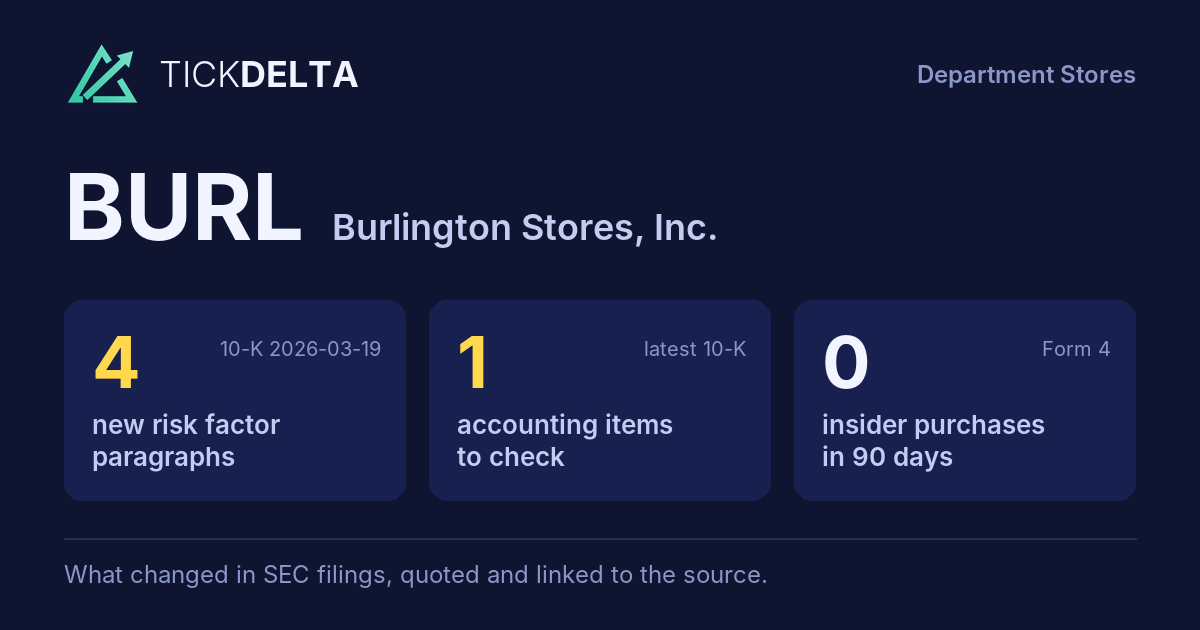
Screener / SEC EDGAR /CIK 0001579298 /10-K filed Mar 19, 2026, compared with Mar 17, 2025 /Numbers from the XBRL of the 10-Ks
NYSE Consumer discretionary · Department Stores

Burlington Stores, Inc. BURL

Compare with peers Embed
The 10-K against last year's

143 changes: 28 added, 20 removed, 94 reworded, 1 quiet changes

10-K Mar 19, 2026 vs Mar 17, 2025

10-K 0001193125-26-116001 (Mar 19, 2026) vs 10-K 0000950170-25-040472 (Mar 17, 2025)

Every paragraph, and how much of it changed

One bar per paragraph, in the order of the 10-K. Height and colour show the share of its words not in the closest paragraph a year earlier; the tallest bars are new paragraphs.

Risk Factors

134 paragraphs · 4 new · 21 reworded · 4 gone · 10-K Mar 19, 2026 against Mar 17, 2025
New paragraph Reworded (5% of its words or more) Same or nearly
Paragraph 72 · 37% changed Every version of it
Like most major corporations, we, our customers we and our third-party services third‑party service providers face an evolving, increasing increasingly complex threat landscape in which cybercriminals, among others, employ a complex array of landscape, with cybercriminals using techniques designed to disrupt operations and/or access personal and other sensitive information, including, for example, the use of fraudulent or such as stolen access credentials, malware, ransomware, phishing, denial of service and other types of attacks. denial‑of‑service attacks to disrupt operations or access sensitive information. Hardware, software or applications (including AI capabilities) we develop or obtain from third parties may contain defects in design or manufacture or other problems that are not presently known and could unexpectedly compromise information security. In addition, our employees, contractors contractors, or third parties with which we do business or to which we outsource business operations may attempt to circumvent our security measures in order to misappropriate such information, and may purposefully intentionally or inadvertently cause a breach involving such information circumvent security controls, which could result in data breaches or become subject to various other cyber-crimes. cybersecurity incidents. Further, our computer systems and the third-party third‑party systems of our vendors are may also subject to damage experience non‑malicious disruptions, such as power outages, telecommunications failures, software defects, or interruption from a number of non-criminal causes, including power outages; computer and telecommunications failures; computer viruses; and design or usage errors by our employees or contractors. human error. Moreover, the rapid evolution and increased adoption of artificial intelligence, machine learning, Software as a Service (SaaS) (SaaS), and cloud technologies may intensify our cybersecurity risks. risks, especially as threat actors use AI to enhance attacks that are harder to detect and defend against.
Paragraph 82 · 17% changed Every version of it
We accept payments using a variety of methods, including cash, checks, credit and debit cards, buy now pay later, and gift cards, and we may offer new payment options over time. Acceptance of these payment methods subjects us to rules, regulations, contractual obligations and compliance requirements, including payment network rules and operating guidelines, data security standards and certification requirements, and rules governing electronic funds transfers. These requirements may change over time or be reinterpreted, making compliance more difficult or costly.
Paragraph 64 · 17% changed Every version of it
Over the past few years, uncertainty has increased with respect to tax and trade policies, tariffs and government regulations affecting trade between the U.S. and other countries. Although we source the majority of our merchandise from third party vendors located in the U.S., the production of that merchandise occurs primarily overseas. As a result, we continue to evaluate have been impacted by the impact of currently volatility in effective tariffs, as well as any additional proposed tariffs, including new tariffs that commenced in 2025, retaliatory tariffs and other restrictions on our supply chain, costs, sales trade that have resulted and profitability. may result in the future. We can provide no assurance that any strategies we implement to mitigate the impact of such tariffs or other trade actions will be successful.
Paragraph 3 · 17% changed Every version of it
Consumer spending levels and shopping behaviors are affected by various economic conditions, which can affect our business or the retail industry generally as a result. These factors include, among other things, prevailing global economic conditions, inflation (including the costs of basic necessities and other goods), levels of employment, salaries and wage rates, prevailing interest rates, housing and food costs, energy and fuel costs, commodities pricing, income tax rates and policies, immigration policies (including enforcement practices, particularly in regions with a relatively high concentration of Hispanic customers, which is an important demographic group within our customer base), consumer confidence and consumer perception of economic conditions. In addition, consumer purchasing patterns may be influenced by consumers’ disposable income, credit availability and debt levels. Slowdown in the U.S. economy, an uncertain global economic outlook, interest rate volatility, or a credit crisis could adversely affect consumer spending habits, resulting in lower net sales and profits than expected on a quarterly or annual basis. Consumer confidence is also affected by the domestic and international political situation and periods of social unrest. The occurrence of terrorist acts or other hostilities in or affecting the U.S. could lead to a decrease in spending by consumers. In addition, natural disasters, industrial accidents, acts of war or global international conflicts (such as the conflict in Ukraine or the conflict in the Middle East), and public health issues (such as pandemics or epidemics) have in the past and may in the future have the effect of disrupting supplies and raising prices globally which, in turn, may have adverse effects on the world and U.S. economies and lead to a downturn in consumer confidence and spending. Certain of these risks, such as risks arising from economic volatility, may be enhanced in light of the U.S. administration’s trade and tariff policies. General uncertainty regarding the future political and economic environment and potential adverse economic changes could reduce consumer confidence and could negatively affect our operating results. We cannot predict when macroeconomic uncertainty may arise, whether or when such circumstances may improve or worsen or what impact such circumstances could have on our business.
Paragraph 113 · 15% changed Every version of it
assets or operations or raising additional debt or equity capital. We may not be able to successfully carry out any of these actions on a timely basis, on commercially reasonable terms or at all, or be assured that these actions would be sufficient to meet our capital requirements. In addition, the terms of our existing or future debt agreements may restrict us from affecting any of these alternatives.
Paragraph 65 · 12% changed Every version of it
In addition, other major developments in tax policy or trade relations, such as the disallowance of tax deductions for imported merchandise or the imposition of additional unilateral tariffs on imported products, could increase the cost of products purchased from suppliers in such countries or restrict the importation of products from such countries, which countries. It remains unclear how tax or trade policies, tariffs or trade relations may change in the future, and additional changes in turn could have a material adverse effect on our business, results of operations and liquidity.
Paragraph 122 · 12% changed Every version of it
The market price of our common stock has fluctuated substantially in the past and may continue to fluctuate significantly. For example, in Fiscal 2024, 2025, our stock price fluctuated from a high of $298.89 $315.14 to a low of $174.64. $212.92. Future announcements or disclosures concerning us or any of our competitors, our strategic initiatives, our sales and profitability, our financial condition, any quarterly variations in actual or anticipated operating results or comparable sales, any failure to meet analysts’ expectations and sales of large blocks of our common stock, among other factors, could cause the market price of our common stock to fluctuate substantially. In addition, the stock market has experienced price and volume fluctuations that have affected the market price of many retail and other stocks that have often been unrelated or disproportionate to the operating performance of these companies.
Paragraph 44 · 11% changed Every version of it
In addition, because of the distinctive nature of our off-price model, we must provide significant internal training and development for key employees across the company, including within our buying organization. Similar to other retailers, we face challenges in securing and retaining sufficient talent in management and other key areas for many reasons, including competition in the retail industry generally and for talent in various geographic markets. If we do not continue to attract qualified individuals, train them in our business model, support their development and retain them, our performance could be adversely affected or our growth could be limited.

MD&A

148 paragraphs · 24 new · 62 reworded · 16 gone · 10-K Mar 19, 2026 against Mar 17, 2025
New paragraph Reworded (5% of its words or more) Same or nearly
Paragraph 84 · 50% changed
Interest expense decreased $8.9 increased $1.5 million to $69.5 $71.0 million. This decrease was primarily The increase is related to accumulated other comprehensive income on our previous interest rate swap, which was fully amortized as of the end of Fiscal 2023. Additionally, we had a lower average balance of 2025 Convertible Notes, and a lower interest rate on the 2027 Convertible Notes compared to the 2025 Convertible Notes that were extinguished, partially offset by a higher average balance due to the September 2024 extension and upsize of the Term Loan Facility Facility, partially offset by increased capitalized interest as a result of the ongoing construction of a distribution center and paydown of the 2025 Convertible Notes during the third first quarter of Fiscal 2024. 2025.
Paragraph 116 · 50% changed
On September 24, 2024, July 25, 2025, we entered into an amendment to the Term Loan Facility dated as ABL Line of February 24, 2011 (the "Amendment"), which Credit in order to, among other things, (i) refinanced increase the outstanding $933 million principal amount of Term B-6 Loans with Term B-7 Loans in an aggregate principal amount of $1,250 million, which includes incremental term loans in an aggregate principal amount of $317 million, the commitments from $900.0 million to $1,000.0 million and (ii) extended extend the maturity date of the commitments and loans from June 24, 2028 December 22, 2026 to September 24, 2031, and (iii) reduced the interest rate margins applicable to our term loan facility from 1.00% to 0.75%, in the case of prime rate loans, and from 2.00% to 1.75%, in the case of SOFR loans, with a 0.00% SOFR floor, and removed the SOFR adjustment. The Term B-7 Loans were issued with an original issue discount of 99.5. July 25, 2030.
Paragraph 111 · 47% changed
On September 24, 2024, we entered into an amendment to the Term Loan Facility dated as of February 24, 2011 (the "Amendment"), which among other things, (i) refinanced the outstanding $933 million principal amount of Term B-6 Loans with Term B-7 Loans in an aggregate principal amount of $1,250 million, which includes incremental term loans in an aggregate principal amount of $317 million, (ii) extended the maturity date from June 24, 2028 to September 24, 2031, and (iii) reduced the interest rate margins applicable to our term loan facility from 1.00% to 0.75%, in the case of prime rate loans, and from 2.00% to 1.75%, in the case of SOFR loans, with a 0.00% SOFR floor, and removed the SOFR adjustment. The Term B-7 Loans were issued with an original issue discount of 99.5.
Paragraph 112 · 47% changed
On September 24, 2024, June 11, 2025, we entered into an amendment to the Term Loan Facility dated as of February 24, 2011 (the "Amendment"), Facility, which among other things, (i) refinanced the outstanding $933 provided for $500.0 million principal amount of Term B-6 Loans with Term B-7 Loans in an aggregate principal amount of $1,250 million, which includes incremental term loans in an aggregate principal amount of $317 million, (ii) extended under the maturity date from June 24, 2028 to September 24, 2031, and (iii) reduced the interest rate margins applicable to our term loan facility from 1.00% to 0.75%, in the case of prime rate loans, and from 2.00% to 1.75%, in the case of SOFR loans, with a 0.00% SOFR floor, and removed the SOFR adjustment. The Term Loan Credit Agreement as additional Term B-7 Loans Loans. The incremental term loans were issued with an original issue discount of 99.5. 99.0 and are otherwise on terms identical to, and fungible with, the existing Term B-7 Loans.
Paragraph 83 · 42% changed
Other income, net improved $7.3 Interest income decreased $10.6 million to $48.2 million during Fiscal 2024. $20.9 million. The improvement in other income decrease was primarily driven by increased interest income from higher cash balance and interest rates. more investments in Fiscal 2024 compared to Fiscal 2025.
Paragraph 27 · 41% changed
A broad, protracted slowdown or downturn in the U.S. economy, an extended period of high unemployment or inflation rates, an uncertain domestic or global economic outlook or a financial crisis could adversely affect consumer spending habits resulting in lower net sales and profits than expected on a quarterly or annual basis. Conversely, if inflation continues to decline, it could benefit our core customers who have been impacted by the higher cost of living since early 2022, and if economic growth slows, it could cause moderate and higher-income shoppers to become more value conscious. Either of these developments, if they occur, would be expected to improve our business. Consumer confidence is also affected by the domestic and international political situation. Our financial condition and operations could be impacted by changes in government regulations, initiatives or programs in areas including, but not limited to, trade and tariffs, taxes, healthcare, and immigration. In addition, trade and tariff regulations could have an indirect impact on consumer prices. We will continue to monitor changes in tariff policy and the impact of these changes on our industry and the economy and seek to adjust to these changes as efficiently as possible. The outbreak or escalation of war, or the occurrence of terrorist acts or other hostilities in or affecting the U.S., or public health issues such as pandemics or epidemics, could lead to a decrease in spending by consumers. In addition, natural disasters, public health issues, industrial accidents and acts of war or conflicts in various parts of the world (such as the conflict in Ukraine or the conflict in the Middle East), could have the effect of disrupting supplies and raising prices globally which, in turn, may have adverse effects on the world and U.S. economies and lead to a downturn in consumer confidence and spending.
Paragraph 124 · 38% changed
During the first quarter of Fiscal 2023, On March 12, 2026 and March 13, 2026, we entered into separate, privately negotiated exchange agreements with certain holders of the 2025 2027 Convertible Notes. Under the terms of the exchange agreements, Exchange Agreements, the holders exchanged $110.3 have agreed to exchange $111.0 million in aggregate principal amount of 2025 2027 Convertible Notes held by them for $133.3 a combination of an aggregate of $128.6 million in cash. cash and 150,831 shares of our common stock. These exchanges resulted in aggregate pre-tax debt extinguishment charges exchange transactions are expected to close on or around March 19, 2026, subject to the satisfaction of $24.6 million. customary closing conditions.
Paragraph 118 · 32% changed
On April 16, 2020, we issued 2025 Convertible Notes, which matured on April 15, 2025. The 2025 Convertible Notes are were general unsecured obligations of the Company. The 2025 Convertible Notes bear Company and bore interest at a rate of 2.25% per year, payable semi-annually in cash, in arrears arrears, on April 15 and October 15 of each year, beginning on October 15, 2020. The 2025 Convertible Notes will mature on April 15, 2025, unless earlier converted, redeemed or repurchased. year.

A paragraph is matched with the one last year that shares the most of its words; under half in common makes it new. The paragraphs shown are the 8 reworded the most in each section.

The paragraph that changed most in each section

The redline

Marked against last year's 10-K: cut words struck through, new words highlighted.

Risk Factors194 words changed in this paragraph; it is 48% similar to last year's version.
Like most major corporations, we, our customers we and our third-party services third‑party service providers face an evolving, increasing increasingly complex threat landscape in which cybercriminals, among others, employ a complex array of landscape, with cybercriminals using techniques designed to disrupt operations and/or access personal and other sensitive information, including, for example, the use of fraudulent or such as stolen access credentials, malware, ransomware, phishing, denial of service and other types of attacks. denial‑of‑service attacks to disrupt operations or access sensitive information. Hardware, software or applications (including AI capabilities) we develop or obtain from third parties may contain defects in design or manufacture or other problems that are not presently known and could unexpectedly compromise information security. In addition, our employees, contractors contractors, or third parties with which we do business or to which we outsource business operations may attempt to circumvent our security measures in order to misappropriate such information, and may purposefully intentionally or inadvertently cause a breach involving such information circumvent security controls, which could result in data breaches or become subject to various other cyber-crimes. cybersecurity incidents. Further, our computer systems and the third-party third‑party systems of our vendors are may also subject to damage experience non‑malicious disruptions, such as power outages, telecommunications failures, software defects, or interruption from a number of non-criminal causes, including power outages; computer and telecommunications failures; computer viruses; and design or usage errors by our employees or contractors. human error. Moreover, the rapid evolution and increased adoption of artificial intelligence, machine learning, Software as a Service (SaaS) (SaaS), and cloud technologies may intensify our cybersecurity risks. risks, especially as threat actors use AI to enhance attacks that are harder to detect and defend against.

Source: Item 1A, 10-K 0001193125-26-116001 vs Item 1A, 10-K 0000950170-25-040472

MD&A121 words changed in this paragraph; it is 71% similar to last year's version.
A broad, protracted slowdown or downturn in the U.S. economy, an extended period of high unemployment or inflation rates, an uncertain domestic or global economic outlook or a financial crisis could adversely affect consumer spending habits resulting in lower net sales and profits than expected on a quarterly or annual basis. Conversely, if inflation continues to decline, declines, it could benefit our core customers who have been impacted by the higher cost of living since early 2022, living, and if economic growth slows, it could cause moderate and higher-income shoppers to become more value conscious. Either of these developments, if they occur, would be expected to improve our business. Consumer confidence is also affected by the domestic and international political situation. Our financial condition and operations could be impacted by changes in government regulations, initiatives or programs in areas including, but not limited to, trade and tariffs, taxes, healthcare, and immigration. In addition, trade and tariff regulations could have an indirect impact on consumer prices. The outbreak or escalation of war, or the occurrence of terrorist acts or other hostilities in or affecting the U.S., or public health issues such as pandemics or epidemics, could lead had and are expected to a decrease in spending by consumers. In addition, natural disasters, public health issues, industrial accidents and acts of war or conflicts in various parts of the world (such as the conflict in the Middle East), could have the effect of disrupting supplies and raising prices globally which, in turn, may have adverse effects on the world and U.S. economies and lead continue to a downturn in consumer confidence and spending.

Source: Item 7, 10-K 0001193125-26-116001 vs Item 7, 10-K 0000950170-25-040472

Accounting Policies80 words changed in this paragraph; it is 60% similar to last year's version.
Other income, net, consists of interest income, gains and losses on insurance proceeds, net gains and losses on disposition of assets, gift card breakage, and other miscellaneous items. The During Fiscal 2025 the Company recognized $3.0 million had a one-time write-off of gain on insurance recoveries during Fiscal 2022, and none during Fiscal 2023 and Fiscal 2024. certain layaway liabilities, resulting in a one-time gain, which is included in other income, net. The Company also recognized $5.0 million during Fiscal 2023 related to the sale of certain state tax credits. There were no sales of tax credits during Fiscal 2025 and Fiscal 2024. Interest income was disaggregated from the financial statement line item other income, net on the Company’s Consolidated Statement of Income beginning in Fiscal 2025. The amounts for Fiscal 2024 and Fiscal 2022. 2023 were retrospectively adjusted for comparability purposes.

Source: Item 8, Note 1 – Summary of Significant Accounting Policies, 10-K 0001193125-26-116001 vs Item 8, Note 1 – Summary of Significant Accounting Policies, 10-K 0000950170-25-040472

Legal Proceedings9 words changed in this paragraph; it is 96% similar to last year's version.
Letters of credit outstanding as of January 31, 2026 and February 1, 2025 and February 3, 2024 amounted to $51.9 $49.8 million and $75.8 $51.9 million, respectively, guaranteeing performance under various lease agreements, insurance contracts, and utility agreements. The Company also had outstanding letters of credit arrangements in the aggregate amount of $0.6 $0.5 million at February 1, 2025, January 31, 2026, related to certain merchandising agreements, and none $0.6 million at February 3, 2024. 1, 2025. Based on the terms of the agreement governing the ABL Line of Credit, the Company had the ability to enter into letters of credit up to $147.5 $149.6 million and $174.2 $147.5 million as of January 31, 2026 and February 1, 2025 and February 3, 2024, 2025, respectively.

Source: Item 3, via Note 14 – Commitments and Contingencies, 10-K 0001193125-26-116001 vs Item 3, via Note 14 – Commitments and Contingencies, 10-K 0000950170-25-040472

Sentences and paragraphs added, removed or reworded

Every change, by type

Sentences and paragraphs of BURL's Risk Factors and MD&A, 10-K Mar 19, 2026 against 10-K Mar 17, 2025. Each links to the text at sec.gov.

Quiet changes are sentences kept from last year with one to four words changed, at least one of them a hedge, a modal or a qualifier (may, could, will, not, significant, material…). A year or date rolling forward is not counted.

The full word list

adverse, adversely, all, although, anticipate, anticipates, any, approximately, believe, believes, can, cannot, certain, could, expect, expects, generally, however, if, intend, intends, largely, likely, many, material, materially, may, might, most, must, never, no, not, possible, primarily, probable, should, significant, significantly, some, substantial, substantially, unlikely, will, would

AddedRisk Factors
The imposition of significant tariffs on imports from certain countries by the U.S. have heightened uncertainty in the global trade environment. These tariffs, along with retaliatory measures by other countries, may increase inflationary pressure and raise the
Read it in 10-K Mar 19, 2026 at sec.gov
AddedRisk Factors
costs of our merchandise. Additionally, on February 20, 2026, the U.S. Supreme Court issued a ruling limiting the authority to impose tariffs under the International Emergency Economic Powers Act (“IEEPA”), creating uncertainty regarding the potential recovery of tariffs previously assessed under that statute. The availability, timing, and amount of any such refunds remain uncertain and depend on further legal, regulatory, and administrative actions. There remains substantial uncertainty regarding the impacts of the U.S. Supreme Court’s decision on the availability, timing, and amount of potential refunds, if any, as well as the scope and duration of any newly announced tariffs or retaliatory actions.
Read it in 10-K Mar 19, 2026 at sec.gov
AddedRisk Factors
adverse effect on our business, financial condition, profitability and cash flows. We may respond by increasing markdowns or transferring product to other stores to reduce excess inventory, which would further decrease our gross profits and net income.
Read it in 10-K Mar 19, 2026 at sec.gov
AddedRisk Factors
of compliance as a result; however, claimants have sought to permanently enjoin the two laws and there remains much uncertainty with respect to the final outcome of these and other climate-related laws.
Read it in 10-K Mar 19, 2026 at sec.gov
RemovedRisk Factors
downturn in consumer confidence and spending. Certain of these risks, such as risks arising from political volatility, may be enhanced in 2025 in light of the U.S. administration’s change in trade and tariff policies.
Read it in 10-K Mar 17, 2025 at sec.gov
RemovedRisk Factors
Public health crises, epidemics or pandemics have had, and could in the future have, a negative impact on our business and operations, including Company sales and cash flow. Such public health crises, epidemics and pandemics have the potential to create significant volatility, uncertainty and worldwide economic disruption, resulting in an economic slowdown of potentially extended duration, as seen with the COVID-19 pandemic. Such public health crises, epidemics and pandemics, could adversely affect our business and financial results, they may also have the effect of heightening many of the other risks described throughout this Annual Report.
Read it in 10-K Mar 17, 2025 at sec.gov
Show the other 49
RewordedRisk Factors
Our The 2027 Convertible Notes may from time to time in the future be convertible at the option of their holders prior to their scheduled terms under certain circumstances and our 2025 Convertible Notes are now convertible at any time until the close of business on the second scheduled trading day immediately preceding the maturity date of April 15, 2025. circumstances.
Read it in 10-K Mar 19, 2026 at sec.gov
RewordedRisk Factors
As of February 1, 2025, January 31, 2026, our obligations include (i) $1,238.9 $1,719.4 million, inclusive of original issue discount, under our senior secured term loan facility (Term Loan Facility) and (ii) $156.2 million under our 2.25% Convertible Notes due April 15, 2025 (our “2025 Convertible Notes”) and $297.1 million under our 1.25% Convertible Notes due December 15, 2027 (our “2027 Convertible Notes” and, together with our 2025 Convertible Notes, our “Convertible Notes”).
Read it in 10-K Mar 19, 2026 at sec.gov
RewordedRisk Factors
These factors include, among other things, prevailing global economic conditions, inflation (including the costs of basic necessities and other goods), levels of employment, salaries and wage rates, prevailing interest rates, housing and food costs, energy and fuel costs, commodities pricing, income tax rates and policies, immigration policies (including enforcement practices, particularly in regions with a relatively high concentration of Hispanic customers, which is an important demographic group within our customer base), consumer confidence and consumer perception of economic conditions.
Read it in 10-K Mar 19, 2026 at sec.gov
RewordedRisk Factors
Moreover, the rapid evolution and increased adoption of artificial intelligence, machine learning, Software as a Service (SaaS) (SaaS), and cloud technologies may intensify our cybersecurity risks. risks, especially as threat actors use AI to enhance attacks that are harder to detect and defend against.
Read it in 10-K Mar 19, 2026 at sec.gov
RewordedRisk Factors
In addition, other major developments in tax policy or trade relations, such as the disallowance of tax deductions for imported merchandise or the imposition of additional unilateral tariffs on imported products, could increase the cost of products purchased from suppliers in such countries or restrict the importation of products from such countries, which in turn could have a material adverse effect on our business, results of operations and liquidity. countries.
Read it in 10-K Mar 19, 2026 at sec.gov
RewordedRisk Factors
Such a reduction in customer traffic would reduce our sales and leave us with excess inventory, which could have a material adverse effect on our business, financial condition, profitability and cash flows.
Read it in 10-K Mar 19, 2026 at sec.gov
RewordedRisk Factors
If we are unable to generate sufficient cash flow to service our debt and meet our other commitments, we will be required to adopt one or more alternatives, such as refinancing all or a portion of our debt, selling material assets or operations or raising additional debt or equity capital.
Read it in 10-K Mar 19, 2026 at sec.gov
RewordedRisk Factors
For example, the State of California recently passed the Climate Corporate Data Accountability Act and the Climate-Related Financial Risk Act that will would impose broad climate-related disclosure obligations on companies doing business in California and may increase our costs of compliance as a result.
Read it in 10-K Mar 19, 2026 at sec.gov
RewordedRisk Factors
If we experience a decline in performance or lease payment landlord allowances from our lessors become unavailable, we may slow or discontinue store openings, relocations, refreshes downsizes and/or remodels.
Read it in 10-K Mar 19, 2026 at sec.gov
RewordedRisk Factors
Additionally, existing competitors may consolidate with other retailers, expand their merchandise offerings, expand their e-commerce capabilities, and/or add new sales channels, change their pricing strategies, or use technology more effectively than we do, including the use of artificial intelligence. intelligence (“AI”) or other emerging technologies.
Read it in 10-K Mar 19, 2026 at sec.gov
AddedMD&A
We continue to focus on several ongoing strategic initiatives aimed at operating with flexibility, responsiveness, and efficiency in everything we do, while delivering great value to our customers through continued improvement in the execution of our off-price model. These initiatives are outlined below.
Read it in 10-K Mar 19, 2026 at sec.gov
AddedMD&A
We remain focused on delivering a neat, clean, easy-to-shop, organized, and consistent shopping experience for our customers while maintaining disciplined cost and inventory controls. Key initiatives include:
Read it in 10-K Mar 19, 2026 at sec.gov
AddedMD&A
•redesigning our stores with new interior layouts, signage and fixtures to better highlight our selection of trend-right, branded merchandise, and create an inviting environment for customers that accentuates the thrill of the treasure hunt;
Read it in 10-K Mar 19, 2026 at sec.gov
RemovedMD&A
•More Effectively Chasing the Sales Trend. We plan sales using conservative comparable store sales growth, holding and controlling liquidity, closely analyzing the sales trend by business, and remaining ready to chase that trend. We believe that these actions will also allow us to take more advantage of great opportunistic buys.
Read it in 10-K Mar 17, 2025 at sec.gov
RemovedMD&A
•Operating with Leaner Inventories. We are planning to carry less inventory in our stores going forward compared to historical levels, which we believe should result in the customer finding a higher mix of fresh receipts and great merchandise values. We believe that this should drive faster turns and lower markdowns, while simultaneously improving our customers’ shopping experience.
Read it in 10-K Mar 17, 2025 at sec.gov
RemovedMD&A
•Investment in Merchandising Capabilities. We plan to continue investing in training and coaching, improved tools and reporting, incremental headcount, especially in growing or under-developed businesses, and other forms of
Read it in 10-K Mar 17, 2025 at sec.gov
RemovedMD&A
merchant support. We believe that these investments should improve our ability to strengthen vendor relationships, source great merchandise buys, more accurately assess value, and better forecast and chase the sales trend.
Read it in 10-K Mar 17, 2025 at sec.gov
RemovedMD&A
•Enhancing Existing Categories and Introducing New Categories. We have opportunities to expand our offerings in certain existing categories, such as ladies’ and junior apparel, beauty, and home merchandise, and maintain the flexibility to introduce new categories as we expand our merchandising capabilities.
Read it in 10-K Mar 17, 2025 at sec.gov
RemovedMD&A
•Adhering to a Market Focused and Financially Disciplined Real Estate Strategy. We have grown our store base consistently since our founding in 1972. We believe there is significant opportunity to expand our retail store base in the United States. As a result of our smaller store prototype, we have identified numerous market opportunities that we believe will allow us to operate 2,000 stores over the long term. We expect to average about 100 net new stores per year, for a total of 500 net new stores over the five-year period from Fiscal 2024 through Fiscal 2028.
Read it in 10-K Mar 17, 2025 at sec.gov
RemovedMD&A
•Enhancing the Store Experience. We continue to invest in select store relocations and downsizes to improve the customer experience, taking into consideration the age, size, sales, and location of a store. Relocations provide an opportunity, upon lease expirations, to right-size our stores, improve our competitive positioning, incorporate our new prototype store designs and reduce occupancy costs. Downsizes provide an opportunity to right-size our stores, within our existing space, improve co-tenancy, incorporate our new store designs and reduce occupancy costs.
Read it in 10-K Mar 17, 2025 at sec.gov
RemovedMD&A
•Improving Operational Flexibility. Our store and supply chain teams must continue to respond to the sales chase, enhancing their ability at flexing up and down based on trends, and allowing us to maximize leverage on sales.
Read it in 10-K Mar 17, 2025 at sec.gov
RemovedMD&A
•Optimizing Markdowns. We believe that our markdown system allows us to maximize sales and gross margin dollars based on forward-looking sales forecasts, sell-through targets and exit dates. Additionally, as we plan to carry less inventory in our stores compared to historical levels, we expect to drive faster turns, which should reduce the amount of markdowns taken compared to historical levels.
Read it in 10-K Mar 17, 2025 at sec.gov
RemovedMD&A
•Optimizing the Supply Chain. Our transportation initiatives have led to lower freight costs compared to recent levels, and we believe our efficiency and labor productivity initiatives will continue to result in lower supply chain costs over the next several years. We also believe there are longer-term supply chain opportunities through investments in automation and new purpose built processing buildings, and owning (rather than leasing) a larger portion of our warehouse network going forward.
Read it in 10-K Mar 17, 2025 at sec.gov
RewordedMD&A
BCFWC and certain of its subsidiaries and holding companies are party to a Second Amended and Restated Credit Agreement (as amended, supplemented and otherwise modified, the ABL Line of Credit) that provides for $900.0 $1,000.0 million of revolving commitments (subject to a borrowing base limitation) maturing on December 22, 2026, July 25, 2030, and, subject to the satisfaction of certain conditions, BCFWC can increase the aggregate amount of commitments up to $1,200 million. an amount not to exceed the sum of (i) the greater of (x) $300.0 million and (y) the amount by which the Borrowing Base exceeds the aggregate Commitments, plus (iii) the amount of all permanent reductions in commitments after July 25, 2025.
Read it in 10-K Mar 19, 2026 at sec.gov
RewordedMD&A
Percentage of Net Sales Fiscal Year Ended January 31, February 1, February 3, January 28, 2026 2025 2024 2023 Net sales 100.0% 100.0% 100.0% Other revenue 0.2 0.1 0.2 0.2 Total revenue 100.2 100.1 100.2 100.2 Cost of sales 56.2 56.8 57.5 59.6 Selling, general and administrative expenses 33.1 33.4 33.9 33.1 Costs related to debt amendments 0.0 0.0 — 0.0 Depreciation and amortization 3.6 3.3 3.2 3.1 Impairment charges - long-lived assets 0.1 0.1 0.2 0.1 Other income - net (0.5) (0.4) (0.3) (0.2) (0.2) Loss on extinguishment of debt — 0.0 0.4 0.2 Interest income (0.2) (0.3) (0.2) Interest expense 0.6 0.7 0.8 0.8 Total costs and expenses 93.1 93.8 95.5 96.7 Income before income tax expense 7.0 6.4 4.7 3.5 Income tax expense 1.8 1.6 1.3 0.9 Net income 5.2% 4.8% 3.4% 2.6%
Read it in 10-K Mar 19, 2026 at sec.gov
RewordedMD&A
The increase in working capital was primarily driven by increased inventory, increased cash balance, balance and increased prepaid assets, a decrease in current maturity of long term debt, partially offset by increased current maturities of long term debt related to the 2025 Convertible Notes and increased accounts payable. a decrease in prepaid assets.
Read it in 10-K Mar 19, 2026 at sec.gov
RewordedMD&A
Net sales improved $907.8 $932.9 million, or 9.3%, 8.8%, to $10,616.7 $11,549.6 million, primarily driven by 101 both an increase in net sales of $691.4 million from our new stores since the end of Fiscal 2023 and non-comparable stores as well as an increase of 4% 2%, or $241.5 million, in comparable store sales during Fiscal 2024. 2025.
Read it in 10-K Mar 19, 2026 at sec.gov
RewordedMD&A
In addition, we estimate that we will spend approximately $460 $290 million to support our supply chain initiatives, largely related to a purchase agreement for completing the Cactus Ave. build-out of the distribution center in Riverside, California, which was negotiated during Fiscal 2024. Georgia and beginning construction on a distribution center in Arizona.
Read it in 10-K Mar 19, 2026 at sec.gov
RewordedMD&A
Under the terms of the exchange agreements, Exchange Agreements, the holders exchanged $110.3 have agreed to exchange $111.0 million in aggregate principal amount of 2025 2027 Convertible Notes held by them for $133.3 a combination of an aggregate of $128.6 million in cash. cash and 150,831 shares of our common stock.
Read it in 10-K Mar 19, 2026 at sec.gov
RewordedMD&A
Fiscal 2024 2025 included 52 weeks, the fiscal year ended February 1, 2025 (Fiscal 2024) included 52 weeks, and the fiscal year ended February 3, 2024 (Fiscal 2023) included 53 weeks, and the fiscal year ended January 28, 2023 (Fiscal 2022) included 52 weeks.
Read it in 10-K Mar 19, 2026 at sec.gov
RewordedMD&A
Prior year amounts relate Fiscal 2023 amount relates to the partial repurchases of the 2.25% Convertible Senior Notes due 2025 (the “2025 Convertible Notes in Fiscal 2023 and Fiscal 2022, Notes”) and the exchange of a portion of the 2025 Convertible Notes in Fiscal 2023. Notes.
Read it in 10-K Mar 19, 2026 at sec.gov
RewordedMD&A
The effective tax rate was 25.2% related to pretax income of $816.1 million for Fiscal 2025, and 25.4% related to pretax income of $674.8 million for Fiscal 2024, and 27.1% related to pretax income of $465.8 million for Fiscal 2023. 2024.
Read it in 10-K Mar 19, 2026 at sec.gov
RewordedMD&A
This change was primarily the result of an increase investments in capital expenditures related to our supply chain initiatives resulting from the purchase of the distribution center in Ellabell, Georgia, infrastructure, as well as increased new store openings. construction.
Read it in 10-K Mar 19, 2026 at sec.gov
RewordedMD&A
Selling, general and administrative expenses as a percentage of net sales decreased to 33.1% during the fiscal year ended January 31, 2026, compared to 33.4% during the fiscal year ended February 1, 2025, compared to 33.9% during the fiscal year ended February 3, 2024. 2025.
Read it in 10-K Mar 19, 2026 at sec.gov
RewordedMD&A
On September 24, 2024, we entered into an amendment to the Term Loan Facility dated as of February 24, 2011 (the "Amendment"), which among other things, (i) refinanced the outstanding $933 $933.0 million principal amount of Term B-6 Loans with Term B-7 Loans in an aggregate principal amount of $1,250 $1,250.0 million, which includes incremental term loans in an aggregate principal amount of $317 $317.0 million, (ii) extended the maturity date from June 24, 2028 to September 24, 2031, and (iii) reduced the interest rate margins applicable to our term loan facility from 1.00% to 0.75%, in the case of prime rate loans, and from 2.00% to 1.75%, in the case of SOFR loans, with a 0.00% SOFR floor, and removed the SOFR adjustment.
Read it in 10-K Mar 19, 2026 at sec.gov
Quiet changesMD&A
There remains a high level of uncertainty in the current macroeconomic and geopolitical environments, and prolonged inflationary pressures could continue to negatively impact the discretionary spending of the low-income shopper, our core customer.
Read it in 10-K Mar 19, 2026 at sec.gov

Sources

The two latest 10-Ks on EDGAR, section by section. Each change links to the text at sec.gov.

Also

New risk factors: paragraphs with nothing like them last year, quoted in full.

Work with it

Excel workbook · CSV. Google Sheet that stays up to date: paste =IMPORTDATA("https://tickdelta.com/company/BURL/export.csv") into a cell.

Next:Related parties
Esc

Type a ticker such as AAPL, a name, an investor such as Buffett, or a topic such as tariffs. ↑ ↓ to move, Enter to open.