Added10-Q Nov 5, 2026 vs 10-K Feb 26, 2026
ITEM 2. UNREGISTERED SALES OF EQUITY SECURITIES, USE OF PROCEEDS, AND ISSUER PURCHASES OF EQUITY SECURITIES
Each branch is a paragraph in Risk Factors with nothing like it in the 10-K filed Feb 27, 2025. A box jumps to the paragraph as filed, below.
71 paragraphs in Risk Factors of the 10-K filed Feb 26, 2026 with nothing like them in the 10-K filed Feb 27, 2025. Quoted exactly. Paragraphs that were only edited are under 10-K change.
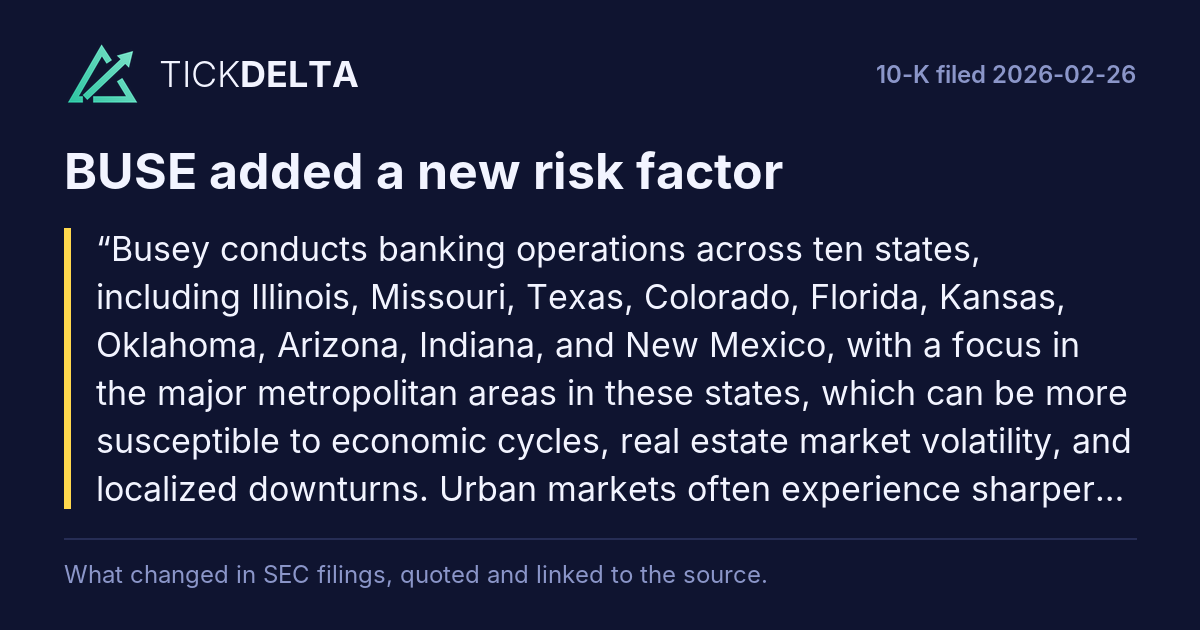
Busey conducts banking operations across ten states, including Illinois, Missouri, Texas, Colorado, Florida, Kansas, Oklahoma, Arizona, Indiana, and New Mexico, with a focus in the major metropolitan areas in these states, which can be more susceptible to economic cycles, real estate market volatility, and localized downturns. Urban markets often experience sharper volatility in employment, housing demand, and commercial development, which can affect credit quality and loan demand. These regional and metropolitan exposures could adversely impact Busey’s financial condition and results of operations.
Changes in interest rates and yield‑curve dynamics may compress net interest margin, affect asset valuations, and create liquidity pressures.
Busey’s financial performance depends heavily on the level, direction, and volatility of interest rates. Movements in short‑term or long‑term rates—and changes in the shape of the yield curve—may materially affect net interest income and the value of interest‑earning assets and funding sources. Rising rates can increase funding costs faster than earning‑asset yields reprice, compressing net interest margin, reducing fair values of fixed‑rate assets, and slowing loan demand. Conversely, declining rates may reduce yields on loans and securities more quickly than deposit costs decline, accelerate prepayments on fixed‑rate loans and securities, and require reinvestment at lower rates. In addition, inverted or flattened yield curves may limit opportunities to profitably deploy funds and can discourage borrowers from seeking longer‑term credit. Busey’s interest‑rate risk management strategies may not fully mitigate these impacts. Sustained interest‑rate volatility, rapid shifts in the yield curve, or an inability to effectively manage interest‑rate sensitivity could materially and adversely affect Busey’s net interest income, liquidity position, financial condition, and results of operations.
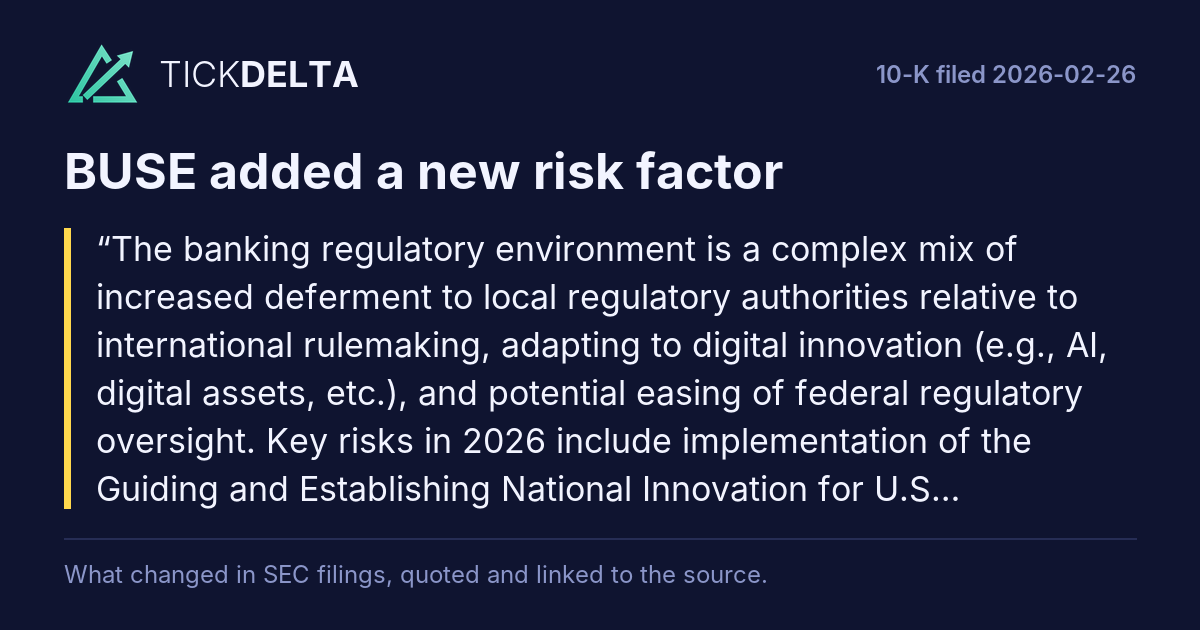
The banking regulatory environment is a complex mix of increased deferment to local regulatory authorities relative to international rulemaking, adapting to digital innovation (e.g., AI, digital assets, etc.), and potential easing of federal regulatory oversight. Key risks in 2026 include implementation of the Guiding and Establishing National Innovation for U.S. Stablecoins (GENIUS) Act, managing fintech/crypto risks, and evolving technological, geopolitical, and economic pressures, all requiring an agile regulatory management system.
More specifically, Busey Bank's focus on commercial banking and wealth management increases risk for customers to seek out opportunities in digital assets and real time payments, requiring enhanced risk oversight and compliance practices to ensure rapid adoption when appropriate.
In addition, the geopolitical risk from global conflicts increases the operational burden of complying with dynamic sanctions placed and eased on various foreign countries, foreign nationals, and foreign companies despite limited exposure to foreign customers and transactions. These evolving regulatory, technological, and geopolitical dynamics could increase compliance costs, operational complexity, and strategic risk for the Company, which in turn could adversely affect Busey’s financial condition and results of operations.
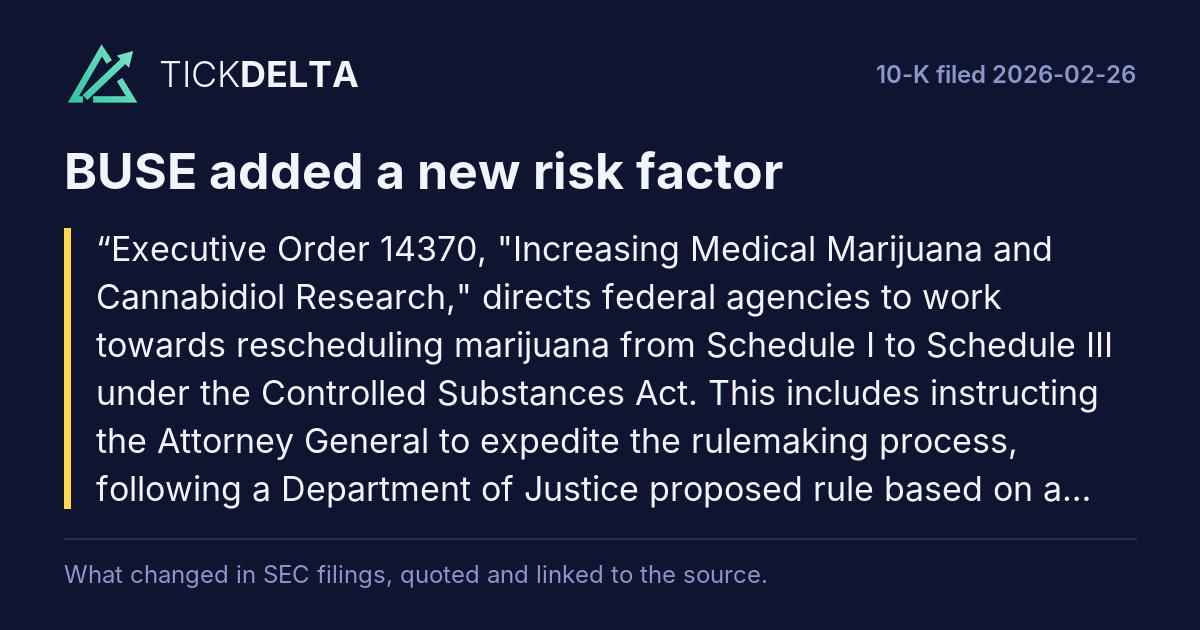
Executive Order 14370, "Increasing Medical Marijuana and Cannabidiol Research," directs federal agencies to work towards rescheduling marijuana from Schedule I to Schedule III under the Controlled Substances Act. This includes instructing the Attorney General to expedite the rulemaking process, following a Department of Justice proposed rule based on a Health and Human Services recommendation that marijuana has an accepted medical use. The executive order itself does not change cannabis's legal status under the Controlled Substances Act; it only directs the Attorney General to expedite the formal rulemaking process. The outlook is encouraging more commercial investment into cannabis related businesses with anticipation of rescheduling of cannabis.
•Owner occupied CRE: Repayment of owner occupied CRE loans depends on the financial performance and operational stability of the business occupying the property. Financial stress, cash flow constraints, or operational disruptions at the borrower level may impair repayment capacity. However, these loans may benefit from the borrower’s incentive to maintain the property to support its ongoing business operations.
If concentrations within the loan portfolio are not effectively monitored and managed, Busey could face heightened credit losses, increased earnings volatility, and reduced capital flexibility, which could materially and adversely affect its financial condition and results of operations.
Busey’s commercial lending activities expose it to repayment risks that may increase during periods of economic stress.
Failure to effectively manage these risks could lead to higher credit losses, reduced asset quality, and increased operational costs, any of which could materially and adversely affect Busey’s financial condition and results of operations.
Construction, land acquisition, and development loans involve heightened risks that could adversely affect Busey’s credit performance.
Construction, land acquisition, and development lending carries additional risk because loan proceeds are advanced based on the projected value of a property that will not be realized until the project is completed. In periods of declining real estate markets conditions, construction costs may exceed expected values, resulting in diminished collateral coverage. Due to uncertainties in estimating total construction costs, timelines, and the ultimate market value of the completed property—and given the potential impact of zoning, permitting, environmental requirements, and other governmental regulations—accurately assessing required funding levels and the resulting loan‑to‑value ratio can be difficult.
Repayment of these loans is often dependent on the successful completion and stabilization of the project, including the borrower’s ability to sell or lease the property, rather than solely on the borrower’s or guarantor’s financial capacity. If Busey’s appraisal of the completed project proves overstated, or if market values or rental rates decline, the collateral securing the loan may be insufficient at completion. In the event of default, foreclosure prior to or at completion may not result in full recovery of principal, interest, or associated foreclosure and holding costs, and Busey may be required to advance additional funds to complete the project or retain the property for an extended period.
Failure to effectively manage these risks could result in increased nonperforming assets, elevated expenses, and higher credit losses, which could materially and adversely affect Busey’s financial condition and results of operations.
Credit exposure to the energy industry may increase Busey’s vulnerability to sector-specific volatility.
Busey has limited credit exposure to energy-related loans across its western markets and throughout the United States. A downturn or prolonged stagnation in the energy sector could adversely affect borrowers engaged in energy production, services, and related activities, potentially resulting in higher delinquencies and increased charge‑offs. Pricing pressures on oil and natural gas may also contribute to elevated credit stress within the energy portfolio, higher loss expectations, greater utilization of unfunded commitments, and reduced demand for new energy-related credit.
Sustained uncertainty and price volatility in the energy sector may produce additional adverse effects that are difficult to quantify, and responses to climate change—whether through regulation, market shifts, or technological transition—may further weaken the financial condition of Busey’s energy‑sector clients, thereby increasing associated credit risk.
Failure to effectively manage these exposures could lead to increased nonperforming assets, greater operational costs, and higher credit losses, any of which could materially and adversely impact Busey’s financial condition and results of operations.
Failure to effectively manage capital and liquidity levels could result in higher funding costs, reduced operational flexibility, and diminished competitive positioning, any of which could materially and adversely affect Busey’s financial condition and results of operations.
Maintaining sufficient liquidity is essential to Busey’s business model and ongoing operations. Busey relies on a variety of funding sources—including deposits, borrowings, sales or maturities of securities, loan sales, and operating cash flows—to support lending activity, meet obligations, and manage daily liquidity needs. Additional liquidity is available through repurchase agreements, brokered deposits, and borrowing capacity with the FHLB and the Federal Reserve Bank. An inability to access these funding sources in adequate amounts or on acceptable terms could materially impair liquidity.
Access to funding may be negatively affected by factors specific to Busey, as well as broader conditions in the banking industry or the economy, many of which are beyond Busey’s control. Increasing competition from large banks and fintech firms for retail deposits may further pressure Busey’s ability to attract and retain deposits, which could adversely affect liquidity.
A reduction in available funding or capital could constrain Busey’s ability to originate new loans, purchase investment securities, meet operating expenses, satisfy deposit withdrawal demands, or pay dividends to stockholders. Failure to effectively manage liquidity needs could materially and adversely affect Busey’s liquidity position, overall financial condition, and results of operations.
Busey may face challenges accessing contingent liquidity during times of market stress.
Busey’s ability to access contingent liquidity during periods of market stress depends on its operational readiness to utilize central‑bank and other secured funding facilities. Operational readiness includes maintaining current and complete legal documentation, ensuring proper internal controls and procedures, and pre-positioning eligible collateral with the Federal Reserve Banks or other liquidity providers. The Federal Reserve periodically updates collateral requirements, valuation methodologies, and margin schedules, which can affect the type and value of assets considered eligible for borrowing. Institutions that regularly pre‑pledge collateral and test operational access have been observed to access the Federal Reserve’s discount window more promptly during periods of financial stress, thereby reducing liquidity pressures and stabilizing funding profiles. Failure to maintain adequate preparedness—including insufficient collateral, incomplete documentation, or inadequate operational testing—could limit Busey’s ability to access these facilities when needed, increase the cost of contingent funding, and heighten the risk of liquidity shortfalls. Any such limitations could materially and adversely affect Busey’s liquidity position, financial condition, results of operations, and ability to meet its obligations as they come due.
Busey faces significant competition from traditional financial institutions and emerging non‑bank competitors threatening market share.
Innovations including digital wallets, peer‑to‑peer lending platforms, and blockchain‑enabled financial services continue to reshape customer expectations and may increase the risk of disintermediation. To remain competitive, Busey must continue to invest in technology, enhance digital capabilities, and respond to evolving customer preferences.
Failure to effectively manage competitive pressures could result in reduced loan and deposit balances, lower fee income, and diminished profitability, any of which could materially and adversely affect Busey’s financial condition and results of operations.
Rapid technological change, digital innovation, and emerging artificial intelligence capabilities present competitive, operational, and compliance risks.
The financial services industry is undergoing significant digital transformation, requiring continual investment to meet evolving customer expectations for convenience, personalization, security, and speed. Failure to effectively adopt, integrate, or govern new technologies—including generative AI—may impair Busey’s ability to attract and retain customers, compete with technologically advanced financial firms, or achieve anticipated efficiencies. The increasing use of artificial intelligence across the industry also introduces risks related to cybersecurity, data privacy, intellectual property, fraud prevention, model governance, and evolving regulatory requirements. Generative AI, in particular, enables more sophisticated impersonation, social‑engineering, and fraud schemes, increasing the need for robust controls, monitoring, and oversight.
Busey relies on third‑party technology providers for critical functions, and deficiencies in their performance, security practices, or Busey’s oversight could result in operational disruptions, service interruptions, or compliance failures. Inadequate management of these technology‑related risks—including risks arising from rapid adoption of artificial intelligence—could lead to operational inefficiencies, elevated costs, regulatory exposure, diminished competitiveness, or cybersecurity incidents, and could materially and adversely affect Busey’s financial condition and results of operations.
Acquisitions and strategic combinations are important to Busey’s growth strategy, but they involve significant regulatory, operational, financial, and strategic risks.
Acquisitions and strategic combinations offer opportunities to expand market presence, diversify revenue streams, and enhance operational scale. However, acquisitions inherently involve significant uncertainties and risks. Each transaction requires extensive evaluation of financial, operational, cultural, and regulatory factors, and Busey must successfully integrate acquired operations while maintaining service quality, customer relationships, and internal controls. The execution and integration challenges associated with acquisitions can affect multiple areas of the business. These risks may be heightened by differences in business models, product offerings, compliance programs, or organizational cultures between Busey and the acquired institution.
•Bank mergers and acquisitions require approvals from multiple regulators and may be delayed, conditioned, or denied.
•Approvals may impose restrictions on operations, capital, or business practices that reduce expected benefits.
•Timing uncertainty around regulatory processes can increase integration costs and execution risk.
•Pre‑closing diligence has inherent limits and may not identify all credit, operational, legal, tax, compliance, Bank Secrecy Act and Anti-Money Laundering regulations, fair lending, environmental, or cybersecurity issues.
•Post‑closing discovery of legacy risks, including litigation, contractual obligations, off‑balance‑sheet exposures, or regulatory remediation, can increase costs and reduce anticipated returns.
•Integrating systems, data, processes, models, and vendors is complex and may create operational disruptions or control gaps.
•Data conversions and core or digital platform migrations present risks related to data integrity, customer experience, and business continuity.
•Integration periods can heighten vulnerability to cyber incidents, fraud, and third‑party risk, including from new or inherited vendors.
•Harmonizing organizational cultures and compensation structures is challenging and may affect morale and productivity.
•Loss of key personnel or relationship managers, or deterioration in customer experience, can lead to client attrition and reduced business volumes.
•Retention and severance arrangements may increase expenses and dilute near‑term results.
•Acquired portfolios may perform below expectations due to borrower‑specific, collateral, or concentration risks, among others.
•Fair value marks, credit loss allowances, and other purchase accounting adjustments may be larger than expected and affect earnings.
•Subsequent adverse performance could require additional provisions, write‑downs, or other valuation adjustments.
•Transactions may require new debt or equity financing, increasing leverage, reducing liquidity, or diluting existing stockholder positions.
•Use of capital for acquisitions may reduce flexibility for other strategic investments or stockholder returns.
•Financing terms, covenants, or market conditions may limit post‑closing operating discretion.
•Change‑of‑control provisions in customer, vendor, or employment contracts may trigger renegotiations, terminations, or penalties.
•Disputes, litigation, or claims related to the transaction or legacy activities may arise.
•Missteps in execution can damage brand and stakeholder trust, affecting customer acquisition and retention.
•Integrating control environments, policies, and risk management frameworks—including compliance with the Sarbanes-Oxley Act of 2002 and model risk management—may expose gaps or require material remediation efforts.
•Misalignment in risk appetite or governance practices can impair decision‑making and oversight.
•Cost savings, revenue synergies, and strategic benefits may be smaller than projected, take longer to realize, or not materialize.
•Management distraction during the transaction and integration phases can adversely affect ongoing operations and strategic execution.
•Market availability and pricing of targets may limit opportunities or require terms that reduce expected returns.
•Acquisitions typically result in goodwill and other intangibles, which are subject to periodic assessments and potential impairment.
The risks above can lead to higher operating and integration costs, reduced revenue, credit losses, increased provisions, system and control remediation expenses, customer attrition, litigation, regulatory burdens, capital strain, and dilution. Individually or in the aggregate, these factors could disrupt operations, reduce profitability, and impair capital and liquidity, any of which could materially and adversely affect Busey’s financial condition and results of operations.
The rapid evolution of digital assets and emerging regulatory frameworks introduces new competitive, compliance, and operational risks for Busey.
The rapid evolution of digital assets and emerging regulatory frameworks introduces new competitive, compliance, and operational risks for Busey. While Busey does not currently offer digital asset products such as cryptocurrencies or stablecoins, increasing global adoption of digital assets and distributed‑ledger technologies continues to influence customer expectations and competitive dynamics. Recent U.S. legislative and regulatory initiatives—including the enactment of the Guiding and Establishing National Innovation for U.S. Stablecoins (GENIUS) Act in 2025, which establishes federal standards for payment stablecoin issuers, and ongoing Congressional efforts to finalize broader crypto‑market structure legislation such as the Digital Asset Market Clarity Act—signal a shift toward more comprehensive oversight of digital‑asset activities.
These regulatory developments may affect Busey even without offering digital‑asset products, including through increased expectations related to cybersecurity, anti‑money‑laundering controls, sanctions compliance, custody arrangements, data governance, and vendor‑risk management.
The competitive landscape is also evolving as traditional financial institutions, fintech companies, and technology firms leverage innovations such as stablecoin‑based payments, blockchain settlements, and digital‑wallet ecosystems. These developments may accelerate disintermediation risks or shift customer behavior toward alternative financial platforms that offer new capabilities, higher transaction speeds, or programmable payment features. To remain competitive, Busey must assess emerging technologies, invest in modern infrastructure, and maintain the flexibility to scale operational capabilities in response to changing market demand. Failure to do so could impede Busey’s ability to offer competitive products, attract and retain customers, or respond to strategic opportunities.
Inadequate oversight or adaptation to these developments could lead to increased operational complexity, reduced competitiveness, and financial impacts that materially and adversely affect Busey’s financial condition and results of operations.
Busey’s ability to attract and retain customers, investors, employees, and business partners depends significantly on the trust placed in its brand, business practices, and commitment to responsible conduct. Negative public opinion may arise from actual or alleged issues across a wide range of activities, including employee misconduct, customer service failures, loan origination or servicing practices, compliance or regulatory violations, cybersecurity incidents, data‑protection lapses, corporate governance concerns, product suitability issues, or perceived shortfalls in Busey’s community and stakeholder engagement. Even isolated incidents—whether substantiated or not—can be rapidly amplified through social media, news outlets, or regulatory commentary, increasing the speed and scale at which reputational harm may occur.
Reputation risk is heightened by Busey’s relationship‑based operating model, in which customer loyalty and business development rely heavily on personal trust and perceived service quality. Busey is also exposed to reputational impacts arising from its third‑party relationships, including vendors, fintech partners, and other service providers, whose failures or misconduct may be attributed to Busey.
Reputational harm can lead to customer attrition, reduced deposit and loan growth, lower fee income, diminished employee morale or retention challenges, increased regulatory scrutiny, delays in obtaining regulatory approvals, reduced investor confidence, and exposure to litigation or enforcement actions. These effects may also limit Busey’s ability to pursue strategic initiatives or partnerships. Any failure to effectively identify, monitor, and manage reputational risks could result in lost business opportunities, elevated costs, and operational disruptions, and could materially and adversely affect Busey’s financial condition and results of operations.
Severe weather, natural disasters, pandemics or other health crises, acts of war or terrorism and other external events could significantly impact Busey’s business.
Adverse external events—including severe weather, natural disasters, wildfires, pandemics or other public‑health crises, acts of war or terrorism, and other large‑scale disruptions—could significantly affect Busey’s operations and the ability of customers, counterparties, and third‑party providers to conduct business. Such events may interrupt business activity, damage physical assets, disrupt supply chains, reduce demand for financial services, impair borrowers’ repayment capacity, increase vacancy rates in commercial properties, and reduce the value of collateral supporting Busey’s loan portfolio. They may also lead to financial‑market volatility, elevated credit losses, and operational challenges stemming from facility closures, evacuations, or interruptions in access to banking channels. Geopolitical conflicts can further influence energy prices, commodity markets, and financial‑market stability, while regulatory responses to these events may impose additional compliance or operational requirements.
Although Busey maintains business‑continuity plans and risk‑management processes, the occurrence of one or more such adverse events could disrupt operations, increase costs, reduce revenue, and materially and adversely affect Busey’s financial condition and results of operations.
New in the latest 10-Q
15 paragraphs in the 10-Q filed Nov 5, 2026 with nothing like them in the 10-Q filed Aug 6, 2026 (at least half the words must differ; new numbers alone do not count). Quoted exactly, grouped by the item heading above them. This is text that changed, not a judgement of how serious it is.
Loans held for sale are loans which Busey has the intent and ability to sell to investors and/or in the secondary mortgage market. A portfolio loan is reclassified to held for sale when management decides to sell it in the near term. As of September 30, 2026, loans held for sale included $ 3.0 million of mortgage loans and $ 65.1 million of commercial loans.
Read in the 10-Q
Busey accounts for loans held for sale at LOCOM, which is determined on an individual loan basis. Loans held for sale are carried at amortized historical cost less loan write-offs and downward fair value adjustments, as may be applicable. Net unrealized losses, if any, are recognized through a valuation allowance by charges to income. When a portfolio loan is transferred to held for sale, any ACL previously recorded on the loan is reversed through the provision for credit losses, and the loan is transferred at the lower of amortized cost or fair value. Gain or loss on sale is recognized at the settlement date and is determined by the difference between the sales proceeds and the carrying amount, net of the value of any servicing asset retained.
Read in the 10-Q
A pool of lender finance commercial loans acquired in the acquisition of CrossFirst was reclassified to held for sale during the three months ended September 30, 2026. The loans, which were included in the C&I and other commercial lending activity within the commercial loans portfolio segment, had an amortized cost basis of $ 65.4 million on the transfer date. As a result of the transfer, Busey recognized both: (1) a $ 0.7 million LOCOM adjustment (measured at the transfer date and updated as of September 30, 2026) as a reduction to other noninterest income, primarily attributable to the purchase premium assigned to these loans at acquisition; and (2) a $ 0.7 million release of allowance for credit losses as a reduction to provision expense. The loans were subsequently sold in the fourth quarter of 2026.
Read in the 10-Q
Busey reclassified a pool of lender finance loans with an amortized cost basis of $ 65.4 million from the C&I and other commercial lending segment to loans held for sale during the three and nine months ended September 30, 2026. In connection with the reclassification of this pool of loans, Busey released $ 0.7 million of ACL through the provision for credit losses. For additional information, see “Loan s Held for Sale” in “Note 1. Si gnificant Accounting Policies.”
Read in the 10-Q
The following table summarizes the reduction in weighted average interest rates for loans modified for borrowers experiencing financial difficulty:
Read in the 10-Q
The following table summarizes the extension in weighted average loan terms for loans modified for borrowers experiencing financial difficulty:
Read in the 10-Q
1. Includes a $ 0.7 million provision release on C&I and other commercial loans reclassified to loans held for sale.
Read in the 10-Q
1. Includes a $ 0.7 million provision release on C&I and other commercial loans reclassified to loans held for sale.
Read in the 10-Q
1. Short-term lease costs were reported on the Statements of Income (Unaudited) in the locations noted on the table below:
Read in the 10-Q
Commercial loans held for sale are measured at LOCOM, determined on an individual loan basis. Loans with a fair value below amortized cost are measured at fair value on a nonrecurring basis. Loans with a fair value above amortized cost are carried at amortized cost and are not included in the table below. During the three months ended September 30, 2026, Busey transferred a pool of lender finance commercial loans acquired in the acquisition of CrossFirst from portfolio loans to loans held for sale. Busey measured the loans at LOCOM on the transfer date and again as of September 30, 2026. LOCOM adjustments for the three and nine months ended September 30, 2026, totaled $ 0.7 million. LOCOM adjustments were recognized in other noninterest income, and were primarily attributable to the purchase premium assigned to the loans at acquisition. Fair value was based on the price in the agreement under which the loans were sold on October 1, 2026. Because this price is an observable input, the fair value measurement has been classified as Level 2.
Read in the 10-Q
1. Includes $ 65.1 million of lender finance commercial loans held for sale as of September 30, 2026. Of this amount, $ 43.8 million was measured at fair value on a nonrecurring basis (see the non recurring fair value table above), reflecting a LOCOM valuation allowance of $ 0.7 million as of September 30, 2026, and $ 21.3 million was carried at amortized cost. The September 30, 2026, fair value of these loans was based on the price in the agreement under which the loans were sold on October 1, 2026.
Read in the 10-Q
Results of Busey’s operations, by operating segment, are presented in the table below. Reconciling items consist of amounts attributable to the parent company and the elimination of intercompany transactions.
Read in the 10-Q
The Federal Open Market Committee raised rates by 25 bps during the third quarter of 2026. Rising rates initially have a positive impact on net interest margin, as assets, in particular commercial loans, reprice more quickly and to a greater extent than liabilities. As deposit and funding costs increase in response to the tightening rate cycle, and Busey experiences deposit migration into higher cost offerings and funding alternatives, some of the net interest margin expansion is reversed.
Read in the 10-Q
Calculation of Pre-Provision Net Revenue and Related Measures Three Months Ended September 30, Nine Months Ended September 30, (dollars in thousands) 2026 2025 2026 2025 Net interest income (GAAP) $ 153,145 $ 155,137 $ 459,516 $ 412,051 Total noninterest income (GAAP) 40,402 41,198 126,978 107,284 Net security (gains) losses (GAAP) 703 288 (802) 10,059 Total noninterest expense (GAAP) (111,398) (120,018) (353,552) (359,881) Pre-provision net revenue (Non-GAAP) [a] 82,852 76,605 232,140 169,513 Acquisition and restructuring (income) expenses, excluding initial provision expenses 1,101 7,251 20,927 49,877 Adjusted pre-provision net revenue (Non-GAAP) [b] $ 83,953 $ 83,856 $ 253,067 $ 219,390 Average total assets [c] $ 18,470,939 $ 18,662,449 $ 18,140,923 $ 17,534,644 Pre-provision net revenue to average total assets (Non-GAAP)1 [a÷c] 1.78 % 1.63 % 1.71 % 1.29 % Adjusted pre-provision net revenue to average total assets (Non-GAAP)1 [b÷c] 1.80 % 1.78 % 1.87 % 1.67 %
Read in the 10-Q
Number Herewith 10.1† Letter Agreement, dated July 13, 2026, by and among First Busey Corporation, Busey Bank and Van A. Dukeman BUSE 8-K 10.1 07/14/2026
Read in the 10-Q
Item 1A of the 10-Q filed Nov 5, 2026 against Item 1A of the 10-K filed Feb 26, 2026.
A 10-Q repeats only the risks that changed, so a 10-K paragraph that is missing from it is not counted as removed.
Added is a paragraph with nothing like it in the 10-K, Reworded a sentence that is in both with several words changed,
Quiet changes a sentence in both where one to four words changed and one is a hedge or a modal
(cut words struck through, new words highlighted).
Text on the page, not a score; each links to the filing at sec.gov.
What the 10-Q itself says about its risk factors:There have been no material changes to the factors discussed in “Part I - Item 1A. Risk Factors ” of Busey’s 2025 Annual Report.
Read in the 10-Q
Two-word phrases in Risk Factors of the 10-K filed Feb 26, 2026 that are in none of the 1 earlier 10-Ks stored, back to Feb 27, 2025
Used at least twice, small words left out. Counted, not picked: a phrase can be new because the company renamed something.
43 paragraphs of last year's Risk Factors with nothing like them now. The longest are quoted.
Item 1A of each 10-K and 10-Q on EDGAR, quoted exactly. Each paragraph links to the filing at sec.gov.
10-K change: what was reworded or cut, section by section.
Excel workbook · CSV. Google Sheet that stays up to date: paste =IMPORTDATA("https://tickdelta.com/company/BUSE/export.csv") into a cell.