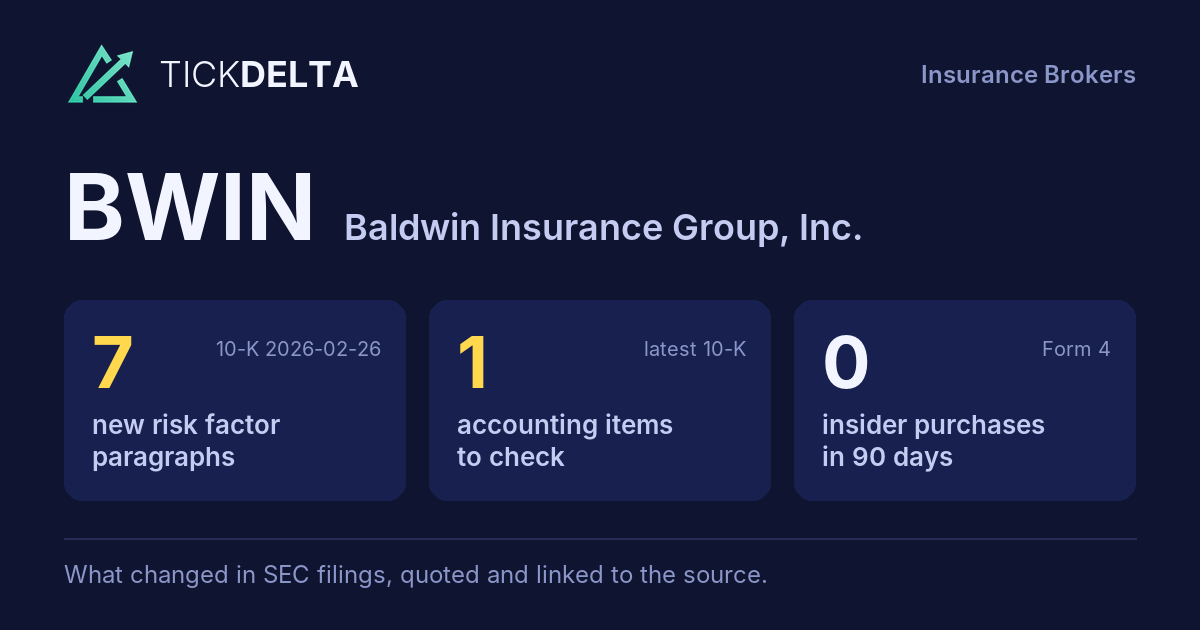
Baldwin Insurance Group, Inc. BWIN
New risk paragraphs, branching off last year
Each branch is a paragraph in Risk Factors with nothing like it in the 10-K filed Feb 25, 2025. A box jumps to the paragraph as filed, below.
Paragraphs with nothing like them in last year's 10-K
7 paragraphs in Risk Factors of the 10-K filed Feb 26, 2026 with nothing like them in the 10-K filed Feb 25, 2025. Quoted exactly. Paragraphs that were only edited are under 10-K change.
•We utilize artificial intelligence, which could expose us to liability or adversely affect our business.
We utilize artificial intelligence, which could expose us to liability or adversely affect our business.
We utilize artificial intelligence, machine learning, and similar tools and technologies that collect, aggregate, analyze or generate data or other materials or content (collectively, “AI”) in connection with our business. There are significant risks involved in utilizing AI and no assurance can be provided that our use of such AI will enhance our products or services or produce the intended results. For example, AI algorithms may be flawed, insufficient, of poor quality, reflect unwanted forms of bias, or contain other errors or inadequacies, any of which may not be easily detectable; AI has been known to produce false or “hallucinatory” inferences or outputs; AI can present ethical issues and may subject us to new or heightened legal, regulatory, ethical, or other challenges; and inappropriate or controversial data practices by developers and end-users, or other factors adversely affecting public opinion of AI, could impair the acceptance of AI solutions, including those incorporated in our products and services. If the AI tools that we use are deficient, inaccurate or controversial, we could incur operational inefficiencies, competitive harm, legal liability, brand or reputation harm, or other adverse impacts on our business and financial results. If we do not have sufficient rights to use the data or other material or content on which the AI tools we use rely, or the output of such AI tools, we also may incur liability through the violation of applicable laws and regulations, third-party intellectual property, privacy or other rights, or contracts to which we are a party.
In addition, regulation of AI is rapidly evolving as legislators and regulators are increasingly focused on these powerful emerging technologies and as they remain the object of intense geostrategic competition. The technologies underlying AI and its uses are subject to a variety of laws and regulations, including intellectual property, data privacy and cybersecurity, client protection, trade and export controls, competition, and equal opportunity laws, and are expected to be subject to increased regulation and new laws or new applications of existing laws and regulations. AI is the subject of ongoing review by various U.S. governmental and regulatory agencies, and various U.S. states are applying, or are considering applying, their platform moderation, data privacy and cybersecurity laws and regulations to AI or are considering general legal frameworks for AI. We may not be able to anticipate how to respond to these rapidly evolving frameworks, and we may need to expend resources to adjust our operations or offerings in certain jurisdictions if the legal frameworks are inconsistent across jurisdictions.
Strategic acquisitions to complement and further expand our business, which we refer to as partnerships, have been an important part of our competitive strategy. For example, on January 1, 2026, we completed the previously announced partnership with CAC Group, a nationally recognized specialty and middle-market insurance brokerage firm.
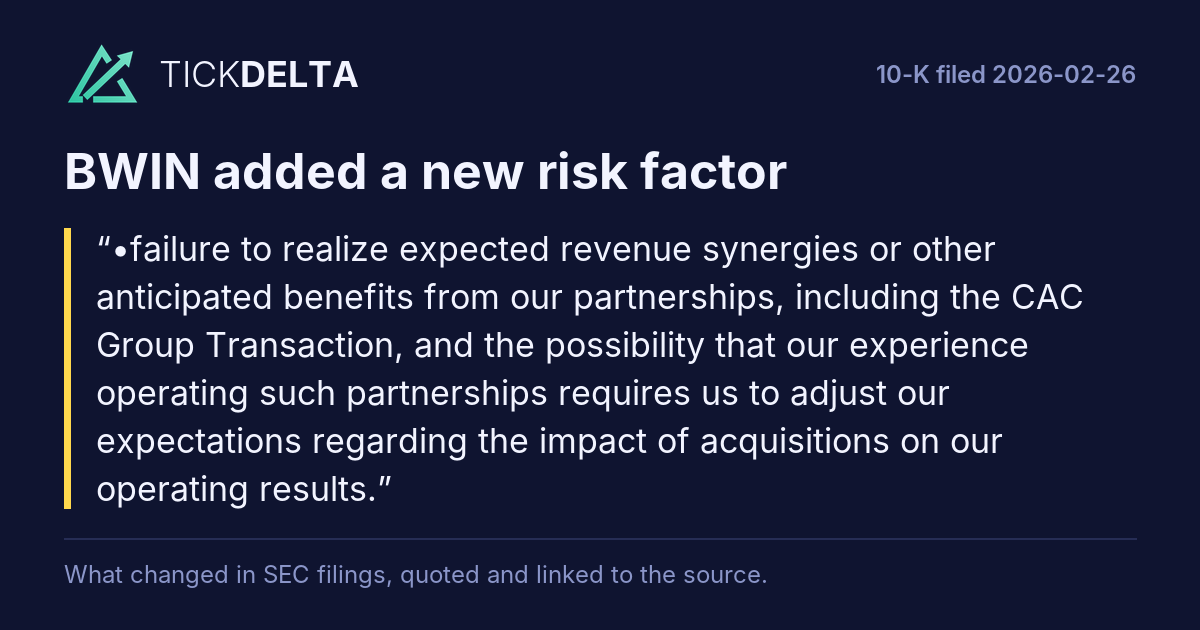
•failure to realize expected revenue synergies or other anticipated benefits from our partnerships, including the CAC Group Transaction, and the possibility that our experience operating such partnerships requires us to adjust our expectations regarding the impact of acquisitions on our operating results.
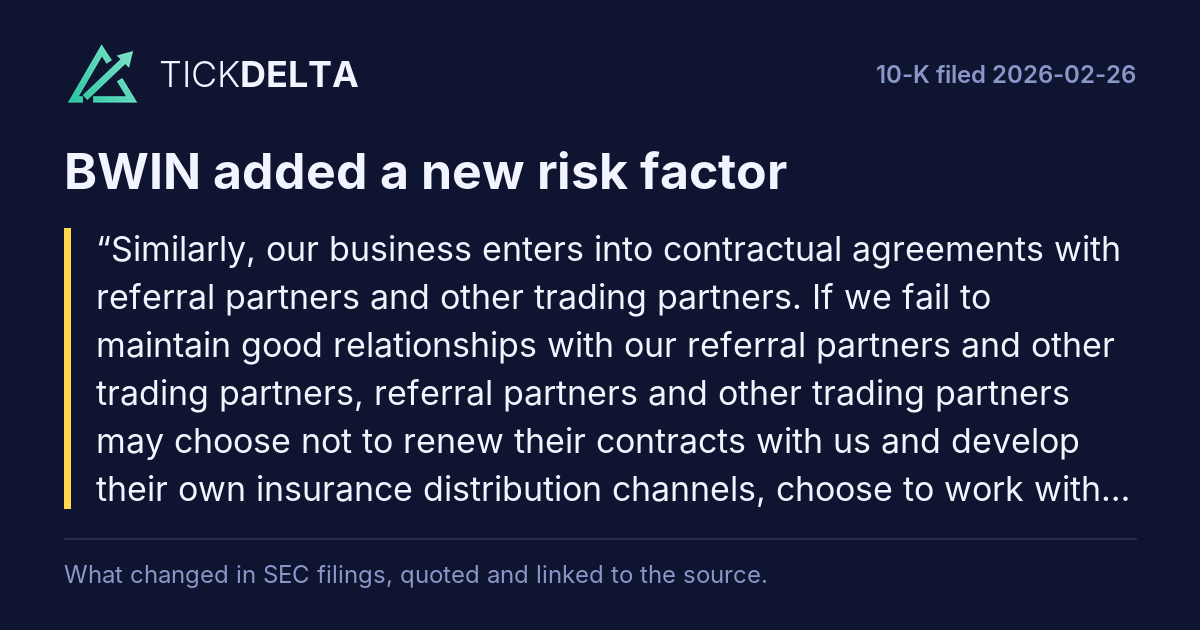
Similarly, our business enters into contractual agreements with referral partners and other trading partners. If we fail to maintain good relationships with our referral partners and other trading partners, referral partners and other trading partners may choose not to renew their contracts with us and develop their own insurance distribution channels, choose to work with another insurance broker and/or work directly with insurance carriers.
Paragraphs in the 10-Q filed Nov 9, 2026 that were not in the one before
New in the latest 10-Q
15 paragraphs in the 10-Q filed Nov 9, 2026 with nothing like them in the 10-Q filed Jul 30, 2026 (at least half the words must differ; new numbers alone do not count). Quoted exactly, grouped by the item heading above them. This is text that changed, not a judgement of how serious it is.
Financial statements and notes
On September 14, 2026, the Company entered into a definitive merger agreement (“Merger Agreement”) pursuant to which an investor group led by Sequence AI Holdings, Inc. and DFO Management, LLC has agreed to acquire the Company in an all-cash take-private transaction. Under the terms of the Merger Agreement, the Company’s stockholders will receive $ 32.50 per share in cash, subject to the terms and conditions of the Merger Agreement. The transaction (the “Go-Private Transaction”) is expected to close during the first quarter of 2027, subject to stockholder approval, regulatory approvals and other customary closing conditions. Upon completion of the Go-Private Transaction, the Company’s common stock will cease trading on Nasdaq and the Company will become privately held.
Read in the 10-Q
(1) Reflects annual GAAP revenue/net loss, plus revenue/net income (loss) from partnerships in the unowned portion of the period based on a quality of earnings review and not an audit, in each case, at the time the due diligence was conducted and may not include full revenue run rate for partial period impacts in the quality of earnings review and revenue growth between the quality of earnings review and the period close date, which may be three to six months delayed.
Read in the 10-Q
On September 14, 2026, concurrently with the execution of the Merger Agreement, the Company, Baldwin Holdings and certain LLC Members entered into Amendment No. 1 to the Tax Receivable Agreement (the “TRA Amendment”), pursuant to which, upon consummation of the Go-Private Transaction, the Company will pay the LLC Members aggregate cash payments of up to $ 298.5 million in full satisfaction of all amounts payable under the Tax Receivable Agreement, which will then terminate. If the Merger Agreement is terminated, the TRA Amendment will terminate and the Tax Receivable Agreement will remain in full force and effect.
Read in the 10-Q
On November 4, 2026, the waiting period under the Hart-Scott-Rodino Antitrust Improvements Act of 1976, as amended (the “HSR Act”), applicable to the Go-Private Transaction expired. As a result, the closing condition relating to the expiration or termination of the HSR Act waiting period has been satisfied. Completion of the Go-Private Transaction remains subject to stockholder approval, the receipt of other required regulatory approvals and the satisfaction or waiver of other customary closing conditions.
Read in the 10-Q
On September 14, 2026, we entered into the Merger Agreement pursuant to which, upon the terms and subject to the conditions therein, an investor group led by Sequence AI Holdings, Inc. and DFO Management, LLC has agreed to acquire Baldwin in an all-cash take-private transaction. Under the terms of the Merger Agreement, our stockholders will receive $32.50 per share in cash, subject to the terms and conditions of the Merger Agreement. The Go-Private Transaction is expected to close during the first quarter of 2027, subject to stockholder approval, regulatory approvals and other customary closing conditions. Upon completion of the Go-Private Transaction, our common stock will cease trading on Nasdaq and Baldwin will become privately held. We continue to operate in the ordinary course of business pending completion of the Go-Private Transaction.
Read in the 10-Q
Show the other 10
On September 14, 2026, concurrently with the execution of the Merger Agreement, we, Baldwin Holdings and certain LLC Members entered into Amendment No. 1 to the Tax Receivable Agreement (the “TRA Amendment”), pursuant to which, upon consummation of the Go-Private Transaction, we will pay the LLC Members aggregate cash payments of up to $298.5 million in full satisfaction of all amounts payable under the Tax Receivable Agreement, which will then terminate. If the Merger Agreement is terminated, the TRA Amendment will terminate and the Tax Receivable Agreement will remain in full force and effect.
Read in the 10-Q
Risk Factors
We may not complete the proposed Go-Private Transaction within the anticipated timeframe, or at all, which could adversely affect our business, financial condition, results of operations and stock price.
Read in the 10-Q
On September 14, 2026, we entered into the Merger Agreement, pursuant to which, upon the terms and subject to the conditions therein, we will survive as a wholly owned subsidiary of Square Acquisition Parent, Inc. (“Square Acquisition”). Upon consummation of the Go-Private Transaction, we will become a privately held company, our Class A common stock will be delisted from Nasdaq and deregistered under the Exchange Act, and we will cease to be a reporting company.
Read in the 10-Q
The applicable waiting period under the Hart-Scott-Rodino Antitrust Improvements Act of 1976, as amended, expired on November 4, 2026. Completion of the Go-Private Transaction remains subject to a number of conditions, including (i) the adoption of the Merger Agreement by the requisite vote of our stockholders; (ii) the receipt of other regulatory approvals; (iii) the absence of any order prohibiting the Go-Private Transaction; and (iv) other customary closing conditions. Many of these conditions are outside our control, and we cannot predict whether or when they will be satisfied or waived. Either party may terminate the Merger Agreement if the Go-Private Transaction has not been completed by June 14, 2027 (which date will automatically be extended to September 14, 2027 if all conditions other than those relating to regulatory approvals have been satisfied or waived), and in certain other circumstances.
Read in the 10-Q
If the Go-Private Transaction is not completed within the expected timeframe, or at all, the trading price of our Class A common stock may decline to the extent it reflects an assumption that the Go-Private Transaction will be completed. We may also be subject to additional risks, including (i) the requirement, under certain circumstances, that we pay Square Acquisition a termination fee, (ii) substantial costs related to the Go-Private Transaction, such as financial advisory, legal, accounting and other professional fees, which we have incurred and will continue to incur whether or not the Go-Private Transaction is completed, (iii) difficulties retaining and hiring key personnel, (iv) reputational harm and damage to our relationship with clients, insurance company partners and investors, (v) stockholder litigation, and (vi) disruption to our business and distraction of our management and colleagues from pursuing other opportunities, including partnerships, that could have benefited us.
Read in the 10-Q
Even if the Go-Private Transaction is completed, the merger consideration of $32.50 per share payable to holders of our Class A common stock whose shares are converted into the right to receive cash consideration is fixed and will not be adjusted to reflect changes in our business, financial condition or results of operations. Such holders of our Class A common stock will no longer participate in any future earnings or growth of the Company.
Read in the 10-Q
The pendency of the Go-Private Transaction, and restrictions under the Merger Agreement on the conduct of our business, could adversely affect our business, financial condition and results of operations.
Read in the 10-Q
Uncertainty about the effect of the Go-Private Transaction on our business may affect our relationships with clients, insurance company partners, partners and colleagues while it is pending. Current and prospective clients may delay or defer purchasing or renewal decisions or move their business to competitors, and insurance company partners and other counterparties may seek to change or renegotiate existing arrangements. Current and prospective colleagues, including producers and the leadership of our partners, may be uncertain about their future roles, compensation and incentives, and competitors may seek to recruit them during the pendency of the Go-Private Transaction. Any of these effects could reduce our commissions and fees and organic revenue growth, regardless of whether the Go-Private Transaction is completed.
Read in the 10-Q
In addition, the Merger Agreement generally requires us to conduct our business in the ordinary course until the Go-Private Transaction is completed or the Merger Agreement is terminated, and restricts us from taking certain specified actions without Square Acquisition’s consent, subject to certain exceptions. These restrictions may prevent us from pursuing partnerships, incurring indebtedness, making capital expenditures or pursuing other business opportunities or strategic initiatives that arise during that period, even if we believe they would be advantageous to us.
Read in the 10-Q
The Merger Agreement also restricts our ability, subject to certain exceptions, to solicit or engage in discussions regarding alternative acquisition proposals. It requires us to give Square Acquisition notice and an opportunity to propose revisions to the Merger Agreement before our Board of Directors may change its recommendation in connection with a superior proposal or an intervening event, or terminate the Merger Agreement to accept a superior proposal. These provisions, together with the termination fee described above, could discourage a third party from making a competing proposal, including one that might be more favorable to our stockholders.
Read in the 10-Q
The 10-Q's risk factors against the 10-K
Item 1A of the 10-Q filed Nov 9, 2026 against Item 1A of the 10-K filed Feb 26, 2026.
A 10-Q repeats only the risks that changed, so a 10-K paragraph that is missing from it is not counted as removed.
Added is a paragraph with nothing like it in the 10-K, Reworded a sentence that is in both with several words changed,
Quiet changes a sentence in both where one to four words changed and one is a hedge or a modal
(cut words struck through, new words highlighted).
Text on the page, not a score; each links to the filing at sec.gov.
What the 10-Q itself says about its risk factors:The following risk factors update and supplement the risk factors outlined under Part I, Item 1A. Risk Factors in our Annual Report on Form 10-K for the year ended December 31, 2025 filed with the SEC on February 26, 2026. Except as set forth below, there have been no material changes with regard to the risk factors previously disclosed in such report.
Read in the 10-Q
Show the other 3
Phrases used for the first time
Two-word phrases in Risk Factors of the 10-K filed Feb 26, 2026 that are in none of the 1 earlier 10-Ks stored, back to Feb 25, 2025
Where each one is used
- jpm credit: •We may incur significant additional indebtedness, which may affect our ability to satisfy our obligations under the JPM Credit Agreement and indenture governing our Senior Secured Notes.
- trading partners: •Our business may be harmed if we lose our relationships with insurance and reinsurance company partners, referral partners or other trading partners, fail to maintain good relationships with insurance and reinsurance company partners, referral partners or other trading partners, become dependent upon a limited...
- referral partners: •Our business may be harmed if we lose our relationships with insurance and reinsurance company partners, referral partners or other trading partners, fail to maintain good relationships with insurance and reinsurance company partners, referral partners or other trading partners, become dependent upon a limited...
- partners referral: •Our business may be harmed if we lose our relationships with insurance and reinsurance company partners, referral partners or other trading partners, fail to maintain good relationships with insurance and reinsurance company partners, referral partners or other trading partners, become dependent upon a limited...
- cac group: As of December 31, 2025, our cash and cash equivalents were $123.7 million and we had $477.0 million of available borrowing capacity on the Revolving Facility under the JPM Credit Agreement. We will continue to expend substantial cash resources for the foreseeable future for servicing our debt obligations and...
- group transaction: As of December 31, 2025, our cash and cash equivalents were $123.7 million and we had $477.0 million of available borrowing capacity on the Revolving Facility under the JPM Credit Agreement. We will continue to expend substantial cash resources for the foreseeable future for servicing our debt obligations and...
- utilize artificial: •We utilize artificial intelligence, which could expose us to liability or adversely affect our business.
- partner referral: •Our business may be harmed if we lose our relationships with insurance and reinsurance company partners, referral partners or other trading partners, fail to maintain good relationships with insurance and reinsurance company partners, referral partners or other trading partners, become dependent upon a limited...
Used at least twice, small words left out. Counted, not picked: a phrase can be new because the company renamed something.
Sources
Item 1A of each 10-K and 10-Q on EDGAR, quoted exactly. Each paragraph links to the filing at sec.gov.
Also
10-K change: what was reworded or cut, section by section.
Work with it
Excel workbook · CSV. Google Sheet that stays up to date: paste =IMPORTDATA("https://tickdelta.com/company/BWIN/export.csv") into a cell.