Form 10-K for the year ended December 31, 2023
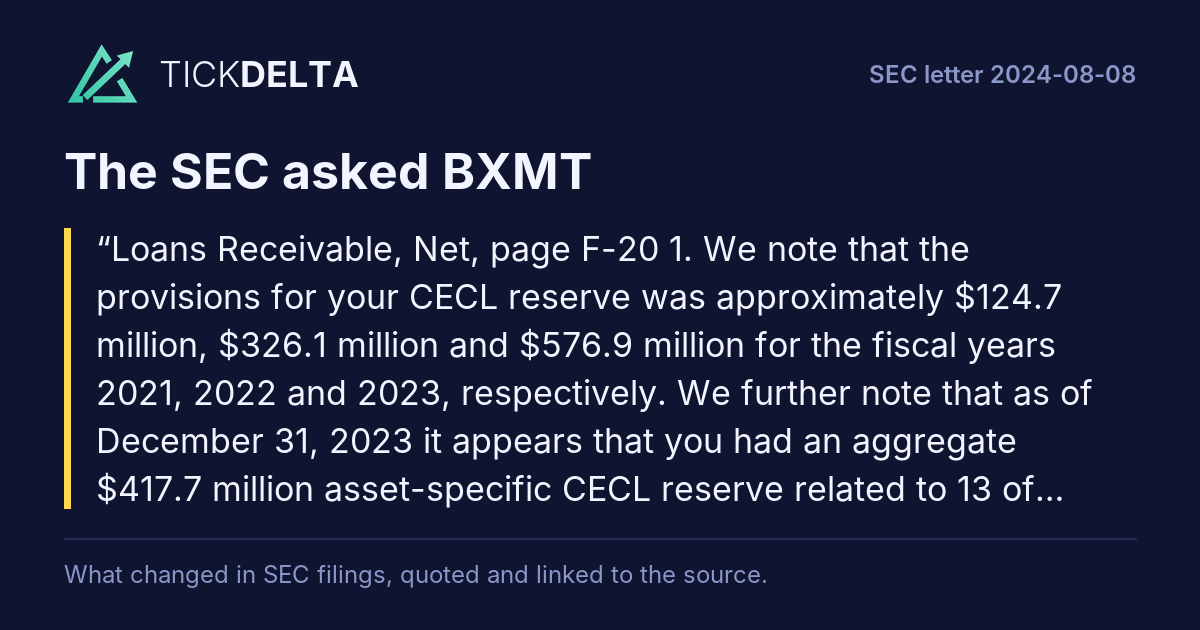
Loans Receivable, Net, page F-20 1. We note that the provisions for your CECL reserve was approximately $124.7 million, $326.1 million and $576.9 million for the fiscal years 2021, 2022 and 2023, respectively. We further note that as of December 31, 2023 it appears that you had an aggregate $417.7 million asset-specific CECL reserve related to 13 of your loans receivable which have a risk rating of a "5" and forRest of the question
which you have identified such loans as being impaired. This represents a significant increase from the 5 and 1 loan(s) with such classification as of December 31, 2022 and December 31, 2021 respectively. Please further expand your disclosures to discuss the factors that led to the significant increase in the provision which appears to be driven by an increase in the number of impaired loans. In that regard, please ensure that your disclosures highlight whether such an increase in impaired loans is driven by the general macroeconomic conditions or whether there were other specific circumstances contributing to the increase in the number of impaired loans. Finally, please ensure your disclosures address whether you expect the disproportionate fluctuations and increase in trends to recur. See Item 303(b)(2)(i) and (ii) of Regulation S-K.
We respectfully acknowledge the Staff’s comment and note that the increases in CECL reserves and the number of impaired loans were primarily driven by asset-specific considerations, concentrated in loans secured by office buildings, which is a property type generally facing reduced tenant and capital markets demand across the real estate industry in recent years, compounded by the impact of higher interest rates.Read in the replyRest of the answer
These asset-specific reserve increases are generally not driven by changes in broad macroeconomic conditions or assumptions, however our general reserves are more closely correlated with such assumptions. As of December 31, 2023, only $159.3 million of our aggregate $576.9 million CECL reserves related to such general reserves. We update our CECL reserves and loan risk ratings each quarter to provide disclosure throughout the year as our credit assessment of each loan evolves based on the then-current relevant facts and circumstances for such loan.
We also acknowledge that with the current dynamic commercial real estate market conditions, in particular for loans secured by office buildings, changes in our CECL reserves are difficult to predict, and such reserves may fluctuate materially from period-to-period as a result of adjustments following our robust risk rating and CECL reserve process to reflect the updated performance of the assets securing each of our loans.
We confirm that in future filings, we will include disclosures substantially similar to those below from the “Current Expected Credit Loss Reserve” section of Note 3. Loans Receivable, Net and the “Results of Operations” section of
Management’s Discussion and Analysis of Financial Condition and Results of Operations of our 2023 Form 10-K (marked to show proposed additional disclosures in response to the Staff’s comment).
“Current Expected Credit Loss Reserve
During the year ended December 31, 2023, we recorded an aggregate increase of $250.8 million in the CECL reserves against our loans receivable portfolio, bringing our total loans receivable CECL reserve to $576.9 million as of December 31, 2023. This increase primarily relates to eight loans impaired during the year ended December 31, 2023, concentrated in loans secured by office buildings, which is a sector generally facing reduced tenant and capital markets demand in recent years. These impairments are each determined individually as a result of changes in the specific credit quality factors for such loans. These factors included, among others, (i) the underlying collateral performance, (ii) discussions with the borrower,
(iii) borrower events of default, and (iv) other facts that impact the borrower’s ability to pay the contractual amounts due under the terms of the loan. In addition, our general CECL reserves increased as a result of changes in our portfolio composition and performance, portfolio risk ratings, and macroeconomic conditions. These CECL reserves reflect certain impaired loans in our portfolio, as well as an additional increase in our CECL reserves due to macroeconomic conditions.
Results of Operations
During the year ended December 31, 2023, we recorded a $249.8 million increase in our CECL reserves, as compared to a
$211.5 million increase during the year ended December 31, 2022. These incremental CECL reserves primarily reflect a $227.9 million increase in the specific reserves related to certain impaired loans in our portfolio, as well as an additional
$21.9 million increase in our general CECL reserves due to changes in macroeconomic conditions.
During the year ended December 31, 2022, we recorded a $211.5 million increase in our CECL reserves, as compared to a
$39.9 million decrease during the year ended December 31, 2021. These incremental CECL reserves primarily reflect a $134.9 million increase in the specific reserves related to certain impaired loans in our portfolio, as well as an additional
$76.6 million
We may be required to record further increases to our CECL reserves in the future, depending on the performance of our portfolio and broader market conditions, and there may be volatility in the level of our CECL reserves. In particular, our loans secured by office buildings have experienced higher levels of CECL reserves and may continue to do so if market conditions relevant to office buildings do not improve. Any such reserve increases are difficult to predict, but are expected to be primarily the result of incremental loan impairments resulting from changes in the specific credit quality factors of such loans and to be concentrated in our loans receivable with a risk rating of “4” as of December 31, 2023.”
Also in this review: closing letter, 2024-08-19