Blackstone Secured Lending Fund BXSL
New risk paragraphs, branching off last year
Each branch is a paragraph in Risk Factors with nothing like it in the 10-K filed Feb 26, 2025. A box jumps to the paragraph as filed, below.
Paragraphs with nothing like them in last year's 10-K
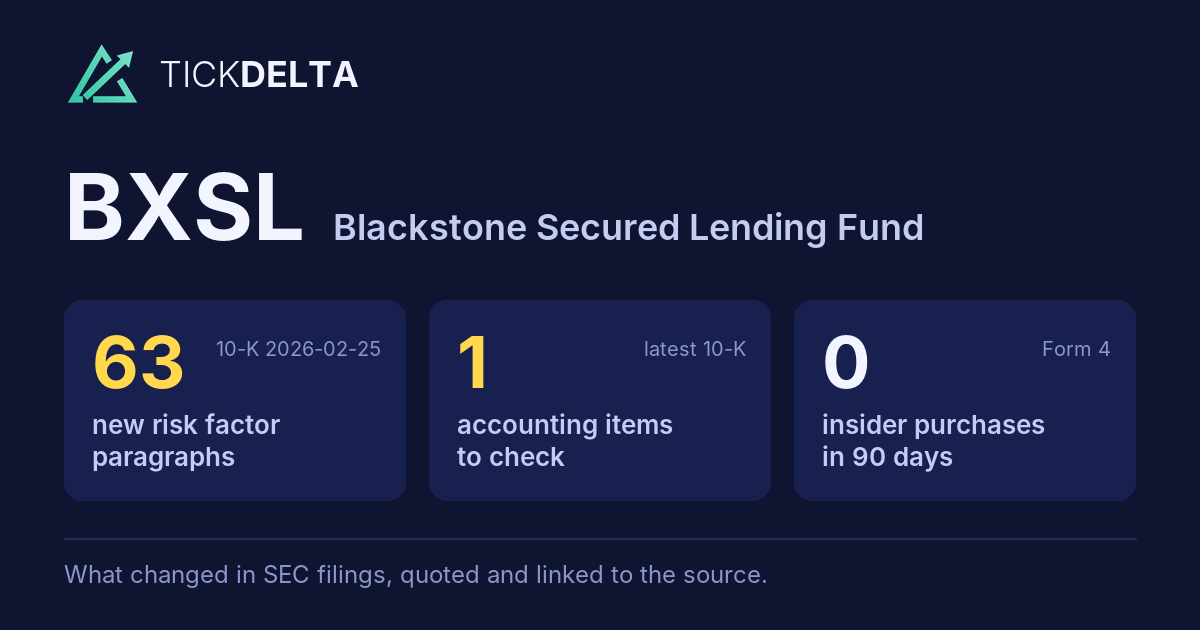
63 paragraphs in Risk Factors of the 10-K filed Feb 25, 2026 with nothing like them in the 10-K filed Feb 26, 2025. Quoted exactly. Paragraphs that were only edited are under 10-K change.
shares. Distributions from the proceeds of our prior offerings or from borrowings also could reduce the amount of capital we ultimately invest in our portfolio companies.
operating results, financial condition, results of operations and cash flows and the fair values of our debt and equity investments.
Challenges facing a single, concentrated sector or industry can have far-reaching implications for the broader economy, including the private credit market. For example, although the U.S. economy has demonstrated strength and resiliency underpinned by the ongoing technology investment boom, there can be no assurance that such trend will continue. In recent years, there has been growing concern about the sustainability of the private credit industry, particularly due to its significant exposure to the expanding technology sector, which includes artificial intelligence infrastructure investments. Market analysts, journalists and other stakeholders have increasingly questioned whether the rapidly developing artificial intelligence market, which includes companies focused on the design and manufacture of semiconductors, data center construction and the expansion of power generation, is fueling inflated valuations and unsustainable price appreciation. This concern is compounded by the sector’s increasing interconnectivity, as private credit supports cross-investments among artificial intelligence- and data center-focused firms, potentially creating an overvalued and tightly linked ecosystem that may lack solid long-term economic fundamentals. If these concerns are validated or perceived as credible by the public, a significant global market correction or downturn could occur, which could result in a material adverse effect on the Company and its portfolio companies. In particular, market devaluations in the software sector may impair companies’ ability to refinance existing private credit loans and restrict merger and acquisition activity in the sector. Consequently, these dynamics could lead to extended holding periods for our assets.
Economic and trade sanctions laws in the United States and other jurisdictions may prohibit the Company and the Company’s professionals from transacting with or in certain countries and with certain individuals and companies.
In the United States, the U.S. Department of the Treasury’s Office of Foreign Assets Control (“OFAC”) administers and enforces laws, Executive Orders and regulations establishing U.S. economic and trade sanctions. Such sanctions prohibit, among other things, transactions with, and the provision of services to, certain foreign countries, territories, entities and individuals. These entities and individuals include specially designated nationals, sanction evaders, specially designated narcotics traffickers and other parties subject to OFAC sanctions and embargo programs. The lists of OFAC prohibited countries, territories, persons and entities, including the List of Specially Designated Nationals and Blocked Persons, as such list may be amended from time to time, can be found on the OFAC website at www.treas.gov/ofac. In addition, certain programs administered by OFAC prohibit dealing with individuals or entities in certain countries regardless of whether such individuals or entities appear on the lists maintained by OFAC. Other jurisdictions maintain different and/or additional economic and trade sanctions. These types of sanctions may significantly restrict the Company’s investment activities in certain countries and, in particular, certain emerging market countries. At the same time, the Company may be obligated to comply with certain anti-boycott laws and regulations, which prevents the Company from engaging in certain discriminatory practices that may be allowed or required in certain jurisdictions. The Company’s failure to discriminate in this manner could make it more difficult for the Company to pursue certain investments and engage in certain business activities.
In some countries, there is a greater acceptance than in the United States and the U.K. of government involvement in commercial activities, and of corruption. The Company, the Company’s professionals and the Advisers are committed, to the fullest extent permitted by applicable law, to complying with the U.S. Foreign Corrupt Practices Act (“FCPA”), the U.K. Bribery Act and other anti-corruption, anti-bribery, anti-fraud laws and regulations, as well as anti-boycott regulations, to which they are subject. As a result, the Company may be adversely affected because of its unwillingness to participate in transactions that violate such laws or regulations. Such laws and regulations may make it difficult in certain circumstances for the Company to act successfully on investment opportunities and for investments to obtain or retain business.
In recent years, the U.S. Department of Justice and the SEC have devoted greater resources to enforcement of the FCPA. In addition, the U.K., with enactment of the U.K. Bribery Act, has expanded the reach of its anti-bribery laws significantly. While Blackstone has developed and implemented policies and procedures designed to ensure strict compliance with the FCPA and the U.K. Bribery Act and the sanctions regimes that apply to the Company, such policies and procedures may not be effective in all instances to prevent violations. In addition, in spite of these policies and procedures, affiliates of portfolio companies, particularly in cases in which the Company or another fund or vehicle sponsored by the Company does not control such portfolio company, may engage in activities that could result in FCPA, U.K. Bribery Act or other violations of law. Any determination that the Company has violated the FCPA, U.K. Bribery Act or other applicable anti-corruption laws, anti-bribery, anti-fraud laws or sanctions requirements could subject the Company to, among other things, civil and criminal penalties, material fines, profit disgorgement, injunctions on future conduct, securities litigation, disclosure obligations and a general loss of investor confidence, any one of which could adversely affect the Company’s business prospects and/or financial position, as well as the Company’s ability to achieve its investment objectives and/or conduct its operations.
Rapidly developing and changing global data security and privacy laws and regulations could increase compliance costs and subject Blackstone to enforcement risks and reputational damage. Blackstone’s data security and privacy compliance obligations, include those relating to U.S. laws and regulations, impose significant compliance costs on Blackstone, which could increase significantly as laws and regulations continue to evolve. At the U.S. federal level, the SEC has adopted changes to Regulation S-P, which took effect in 2025. The amendments impose operationally challenging data breach notification requirements and deadlines as well as obligations to implement written policies and procedures to govern oversight of service providers that will likely increase associated compliance costs, some or all of which could be allocated to us. The U.S. Department of Justice issued a rule (the Bulk Data Transfer Rule), effective in 2025, that prohibits or restricts certain transactions involving the transfer of, and access to, bulk sensitive personal data to foreign persons connected with certain designated countries of concern, including China. While Blackstone expects this development will increase compliance burdens and associated costs, this rule may also impact the way Blackstone and its affiliates conduct business, including the ability of employees in countries of concern to access certain information.
Further, any inability, or perceived inability, by Blackstone, the Advisers, us or our portfolio companies to adequately address data protection or privacy concerns, or comply with applicable laws, regulations, policies, industry standards and guidance, contractual obligations, or other legal obligations, even if unfounded, could result in significant legal, regulatory and third-party liability, increased costs, disruption of Blackstone’s, the Advisers’, our or our portfolio companies’ business and operations, and a loss of investor confidence and other reputational damage. Many regulators have indicated an intention to take more aggressive enforcement actions regarding data security and privacy matters, and private litigation resulting from such matters is increasing and resulting in progressively larger judgments and settlements. Specifically, the SEC’s stated 2026 examination priorities include an intended focus on advisers’ policies and practices as it relates to the prevention of interruptions to mission-critical services and protection of information, records and assets. Furthermore, as new data protection and privacy-related laws and regulations are implemented, the time and resources needed for Blackstone, us and our portfolio companies to comply with such laws and regulations continues to increase and become a significant compliance workstream.
Show the other 28
The cost of servicing external debt will also generally be adversely affected by rising international interest rates, as many external debt obligations bear interest at rates which are adjusted based upon international interest rates.
The Company may invest in underlying investment companies or BDCs, in which case a shareholder’s investment in the Company will be affected by the investment policies and decisions of each underlying investment company in direct proportion to the amount of the Company’s assets that are invested in each underlying investment company. The securities of the underlying investment companies or BDCs in which the Company invests or plans to invest may be illiquid. Subscriptions to purchase the securities of underlying investment companies or BDCs are typically subject to restrictions or delays. There is no regular market for interests in many underlying investment companies or BDCs or their portfolio companies, which typically must be sold in privately negotiated transactions. Any such sales would likely require the consent of the manager of the applicable underlying investment companies or BDCs or the board of the portfolio company, and could occur at a discount to the stated NAV. If the Advisers determine to cause the Company to sell its interest in an underlying investment company or BDC, the Company may be unable to sell such interest quickly, if at all, and could therefore be obligated to continue to hold such interest for an extended period of time, or to accept a lower price for a quick sale. Some funds in which the Company may invest may impose restrictions on when an investor may withdraw its investment or limit the amounts an investor may withdraw. To the extent that the Advisers seek to reduce or sell out of its investment at a time or in an amount that is prohibited, the Company may not have the liquidity necessary to participate in other investment opportunities or may need to sell other investments that it may not have otherwise sold.
The Company’s investment strategy with respect to certain investments may be based upon the premise that loans, debt instruments or participation interests related thereto that are otherwise performing may from time to time be available for purchase by the Company at “discounted” rates or at “undervalued” prices.
The Company’s investment strategy with respect to certain investments may be based upon the premise that loans, debt instruments or participation interests related thereto that are otherwise performing may from time to time be available for purchase by the Company at “discounted” rates or at “undervalued” prices. Purchasing debt instruments and other interests at what may appear to be “undervalued” or “discounted” levels is no guarantee that these investments will generate attractive risk-adjusted returns to the Company or will not be subject to further reductions in value. It may not be possible to predict, or to hedge against, such “spread widening” risk. No assurance can be given that loans or participation interests can be acquired at favorable prices, that such loans or participation interests will not default or that the market for such interests will continue to improve. In addition, there can be no assurance that the market conditions for investing in debt instruments may not deteriorate further, which could have an adverse effect on the performance of the Company’s investments. Additionally, the perceived discount in pricing from previous environments described herein may still not reflect the true value of the assets underlying debt instruments in which the Company invests and therefore further deteriorations in value with respect thereto may occur following the Company’s investment therein. While the Company performs due diligence in connection with each of its investments, there may be an increased risk that the documentation relating to an investment in loans may contain a material misstatement, omission or misrepresentation, which may be relied upon by the Advisers and adversely affect the performance of such investment.
Companies in certain markets are not generally subject to uniform accounting, auditing and financial reporting standards, practices and disclosure requirements comparable to those applicable to U.S. companies.
Companies in certain markets are not generally subject to uniform accounting, auditing and financial reporting standards, practices and disclosure requirements comparable to those applicable to U.S. companies. In particular, the assets and profits appearing on the financial statements of a company in certain markets may not reflect its financial position or results of operations in the way they would have been reflected had such financial statements been prepared in accordance with U.S. GAAP. In addition, for a company that keeps accounting records in currency other than euros, inflation accounting rules in certain markets outside the U.S. require, for both tax and accounting purposes, that certain assets and liabilities be restated on the company’s balance sheet in order to express items in terms of a currency of constant purchasing power. As a result, financial data may be materially affected by restatements for inflation and may not accurately reflect the real condition of real estate, companies and securities markets. Accordingly, the Company’s ability to conduct due diligence in connection with an investment and to monitor the investment may be adversely affected by these factors. In addition, investing in certain non-U.S. markets poses risks relating to (i) currency exchange matters, including fluctuations in the rate of exchange between the U.S. dollar and the various non-U.S. currencies in which the Company’s non-U.S. investments may be denominated, and costs associated with conversion of investment principal and income from one currency into another; (ii) differences between the U.S. and non-U.S. securities markets, including potential price volatility in and relative illiquidity of some non-U.S. securities markets; (iii) potential price volatility in and relative illiquidity of some foreign securities markets; (iv) less government supervision and regulation; (v) governmental decisions to discontinue support of economic reform programs generally and
impose centrally planned economies; (vi) less extensive regulation of the securities markets; (vii) certain economic, social and political risks, including potential exchange control regulations and restrictions on foreign investment and repatriation of capital, the risks of political, economic or social instability and the possibility of expropriation or confiscatory taxation; (viii) the possible imposition of foreign taxes on income and gains recognized with respect to securities; (ix) less developed corporate laws regarding fiduciary duties and the protection of investors; (x) longer settlement periods for securities transactions, (xi) less reliable judicial systems to enforce contracts and applicable law; (xii) differences in the legal and regulatory environment or enhanced legal and regulatory compliance; (xiii) political hostility to investments by foreign or private equity investors; and (xiv) less publicly available information.
In addition, in light of the continued and ongoing uncertainty in European debt markets as a result of the sovereign debt crises of some of the members of the E.U. and unique political risks associated therewith, investments may be subject to heightened risks or risks not associated with the foregoing. In addition, issuers located in certain European jurisdictions may be involved in restructurings, bankruptcy proceedings and/or reorganizations that are not subject to laws and regulations that are similar to the U.S. Bankruptcy Code and the rights of creditors afforded in U.S. jurisdictions. To the extent such non-U.S. laws and regulations do not provide the client and/or the Adviser with equivalent rights and privileges necessary to promote and protect the Company’s interest in any such proceeding, the Company’s investments may be adversely affected. While the Advisers intend, where deemed appropriate, to manage the Company in a manner that will minimize exposure to the foregoing risks (although the Advisers do not in the ordinary course expect to hedge currency risks), there can be no assurance that adverse developments with respect to such risks will not adversely affect the assets of the Company that are held in certain countries.
The revenue, income (or losses) and valuations of software and other technology-related companies, including companies focused on the development of artificial intelligence, can and often do fluctuate suddenly and dramatically. While the continued expansion of such companies may present opportunities, it may also lead to inflated or unstainable valuations for certain companies, particularly in the absence of consistent revenue or profitability. If valuations are not supported by long-term fundamentals, a correction in the market could result in substantial losses for our investments in the software industry. This risk is heightened in an environment where market sentiment and investor enthusiasm for artificial intelligence-driven innovation may outpace actual business performance of certain software and other technology-related companies, potentially creating valuation bubbles that could burst with broader economic or market shifts. See “— Technological or other innovations and industry disruptions may negatively impact us and our portfolio companies” and “—We and our portfolio companies may experience risk related to the use of artificial intelligence.”
Portfolio companies in the professional services sector are subject to many risks, including the negative impact of regulation, changing technology, a competitive marketplace and difficulty in obtaining financing. Portfolio companies in the professional services industry must respond quickly to technological changes and understand the impact of these changes on customers’ preferences. Adverse economic, business, or regulatory developments affecting the professional services sector could have a negative impact on the value of our investments in portfolio companies operating in this industry, and therefore could negatively impact our business and results of operations.
A derivative transaction is also subject to the risk that a counterparty will default on its payment obligations thereunder or that we will not be able to meet our obligations to the counterparty. Changes in the credit quality of the companies that serve as the Company’s counterparties with respect to their derivative transactions will affect the value of those instruments. By entering into derivatives transactions, the Company assumes the risks that theses counterparties could experience financial or other hardships that could call into question their continued ability to perform their obligations. In the case of a default by the counterparty, the Company could become subject to adverse market movements while replacement transactions are executed. The ability of the Company to transact business with any one or number of counterparties, the possible lack of a meaningful and independent evaluation of such counterparties’ financial capabilities, and the absence of a regulated market to facilitate settlement may increase the potential for losses by the Company. Furthermore, concentration of derivatives in any particular counterparty would subject the Company to an additional degree of risk with respect to defaults by such counterparty.
The Advisers evaluate and monitor the creditworthiness of counterparties in order to ensure that such counterparties can perform their obligations under the relevant agreements. If a counterparty becomes bankrupt or otherwise fails to perform its obligations under a derivative contract due to financial or other difficulties, the Company may experience significant delays in obtaining any recovery under the derivative contract in a dissolution, assignment for the benefit of creditors, liquidation, winding-up, bankruptcy or other analogous proceedings. In addition, in the event of the insolvency of a counterparty to a derivative transaction, the derivative contract would typically be terminated at its fair market value. If the Company is owed this fair market value upon the termination of the derivative contract and its claim is unsecured, the Company will be treated as a general creditor of such counterparty, and will not have any claim with respect to the underlying assets. The Company may obtain only a limited recovery or may obtain no recovery at all in such circumstances. In addition, regulations that were adopted in 2019 require certain bank-regulated counterparties and certain of their affiliates to include in certain financial contracts, including many derivatives contracts, terms that delay or restrict the rights of counterparties, such as the Company, to terminate such contracts, foreclose upon collateral, exercise other default rights or restrict transfers of credit support in the event that such counterparty and/or its affiliates are subject to certain types of resolution or insolvency proceedings.
Price movements of forwards, futures, derivative contracts and other financial instruments in which the Company’s assets may be invested can be highly volatile.
Price movements of forwards, futures, derivative contracts and other financial instruments in which the Company’s assets may be invested can be highly volatile and are influenced by, among other things, interest rates, changing supply and demand relationships, trade, fiscal, monetary and exchange control programs and policies of governments, and national and international political and economic events and policies. In addition, governments from time to time intervene in certain markets, directly and by regulation, particularly in currencies, futures and options. Such intervention is often intended to directly influence prices and may, together with other factors, cause some or all of these markets to move rapidly in the same direction. The effect of such intervention is often heightened by a group of governments acting in concert.
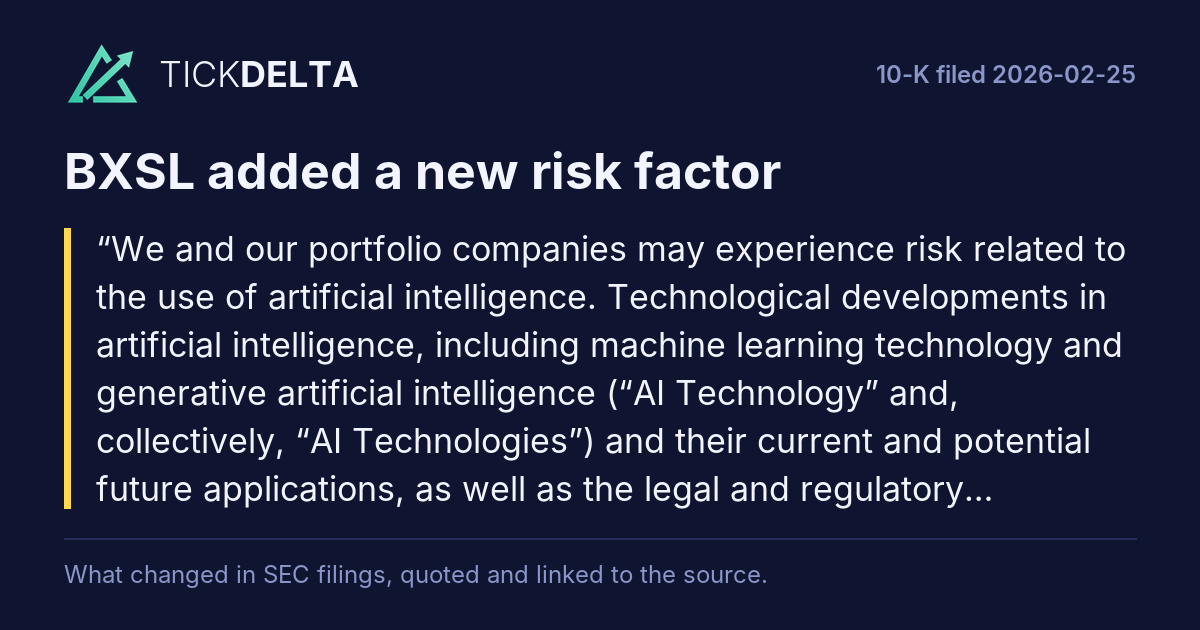
We and our portfolio companies may experience risk related to the use of artificial intelligence.
Technological developments in artificial intelligence, including machine learning technology and generative artificial intelligence (“AI Technology” and, collectively, “AI Technologies”) and their current and potential future applications, as well as the legal and regulatory frameworks within which they operate, are rapidly evolving. The full extent of current or future risks related thereto is not possible to predict and we and our portfolio companies may not be able to anticipate, prevent, mitigate or remediate all of the potential risks, challenges or impacts of such changes. Any of these technological innovations could result in harm to us, Blackstone, the Advisers or our portfolio companies; reduce demand for their products, services, software or technology offerings; significantly disrupt the markets in which they operate; and subject them to increased competition, including industry pricing or other competitive dynamics. These effects could materially and adversely affect their business, financial condition and results of operations, impact their valuations and ultimately have an adverse impact on us. Advancements in computing and AI Technologies, including efficiency improvements, without related increases in the adoption and development of such technologies, could also negatively impact demand for, and the valuation of, digital infrastructure assets of Blackstone, our affiliates, and our portfolio companies.
We, Blackstone, the Advisers and our portfolio companies avail ourselves/themselves of the benefits, insights and efficiencies that are available through the use of AI Technologies. While we, Blackstone, the Advisers, our affiliates and our portfolio companies have begun to deploy AI Technologies in a variety of ways, including in the evaluation and management of investments, legal and marketing compliance, customer engagement, content creation and rules-based operations (e.g., legal, accounting, and transaction processing), the long-term effectiveness and scalability of AI Technologies remain uncertain. In addition, the use of AI Technologies presents a number of risks that cannot be fully mitigated. For example, AI Technologies are highly reliant on the collection and analysis of large amounts of data and complex algorithms, but it is not possible or practicable to incorporate all relevant data into models that AI Technologies utilize to operate. Moreover, with the use of AI Technologies, there often exists a lack of transparency of how inputs are converted to outputs, and neither we, Blackstone, the Advisers nor our portfolio companies can fully validate this process and its accuracy. The accuracy of such inputs and the resulting impact on the results of AI Technologies cannot be verified and could result in a diminished quality of work product that includes or is derived from inaccurate or erroneous information. Further, inherent bias in the construction of AI Technologies can lead to a wide array of risks including but not limited to accuracy, efficacy and reputational harm. Therefore, it is expected that data in such models will contain a degree of inaccuracy and error, and potentially materially so, and that such data as well as algorithms in use could otherwise be inadequate or flawed, which would be likely to degrade the effectiveness of AI Technologies and could adversely impact us, Blackstone, the Advisers or our portfolio companies to the extent we/they rely on the work product of such AI Technologies. The volume and reliance on data and algorithms also make AI Technologies, and in turn us, Blackstone, the Advisers and our portfolio companies, more susceptible to cybersecurity threats, including the compromise of underlying models, training data, or other intellectual property. We, Blackstone, the Advisers and our portfolio companies could be exposed to risks to the extent third‐party service providers, or any counterparties use AI Technologies in
their business activities. At the same time, to the extent utilized by Blackstone or the Advisers, any interruption of access to or use of AI Technologies could impede the ability of us, Blackstone, the Advisers or our portfolio companies to generate information and analysis that could be beneficial to us/them and our/their business, financial condition and results of operations. AI Technologies will likely also be competitive with certain business activities or increase the obsolescence of certain organizations’ products or services, particularly as AI Technologies improve. This could also have an adverse impact on us, Blackstone, the Advisers or our portfolio companies.
AI Technologies can also be misused or misappropriated by third parties and/or employees of Blackstone, the Advisers or our portfolio companies. For example, there is a risk that a user will input confidential information, including material non-public information, or personal identifiable information, into AI Technologies applications, resulting in such information becoming part of a dataset that is accessible by other third-party AI Technologies applications and users including competitors of us, Blackstone, the Advisers or our portfolio companies. Moreover, we, Blackstone, the Advisers and our portfolio companies will not necessarily be in a position to control the manner in which third-party AI Technologies are developed or maintained or the manner in which third parties use AI Technologies to provide services, even where they have sought contractual protections. The use of AI Technologies, including potential inadvertent disclosure of confidential information or personal identifiable information, could also lead to legal and regulatory investigations and enforcement actions. Relatedly, we, Blackstone, the Advisers and our portfolio companies could be exposed to risks to the extent third-party service providers or any counterparties use AI Technologies in their business activities.
Blackstone expects to be involved in the collection of data and/or development of proprietary AI Technologies for Blackstone, the Advisers, the Company, Other Clients and/or their portfolio companies. To this end, we can be expected to pay and bear certain expenses and fees associated with developing and maintaining such technology, including the costs of any professional service providers, subscriptions and related software and hardware, server infrastructure and hosting, and internal Blackstone expenses, fees, charges and/or related costs incurred, charged or specifically attributed or allocated (based on methodologies determined by Blackstone) to us, Blackstone, the Advisers or our portfolio companies or their affiliates in connection with such AI Technologies, and none of the fees, costs or expenses described above will reduce or offset the management fees.
Regulations related to AI Technologies could also impose certain obligations and costs related to monitoring and compliance. Regulators are increasing scrutiny of, and enacting or considering enacting regulations regarding, the use of AI Technologies, including the use of “big data,” diligence of data sets and oversight of data vendors. The use of AI Technologies by us, Blackstone, the Advisers or our portfolio companies may require compliance with legal and regulatory frameworks that are not fully developed or tested, and we, Blackstone, the Advisers or our portfolio companies may face litigation and regulatory actions related to the use or the engagement of vendors that use AI Technologies. In April 2023, the Federal Trade Commission, U.S. Department of Justice, Consumer Financial Protection Bureau, and U.S. Equal Employment Opportunity Commission released a joint statement on artificial intelligence demonstrating interest in monitoring the development and use of automated systems and enforcement of their respective laws and regulations. In October 2023, an executive order established new standards for AI safety and security. In addition to the U.S. regulatory framework, the EU adopted the Artificial Intelligence Act in 2024, which applies to certain AI Technologies and the data used to train, test and deploy them, which may create additional compliance burdens, higher administrative costs and significant penalties should we, Blackstone, the Advisers and our portfolio companies fail to comply or be perceived to fail to comply.
AI Technologies and their current and potential future applications including in the private investment and financial sectors, as well as the legal and regulatory frameworks within which they operate, continue to rapidly evolve, and it is not possible to predict the full extent of current or future risks related thereto.
We may make investments related to data centers, which exposes us to related risks.
We may make investments in the data center industry, which exposes us to risks inherent in that sector. These risks include shifts in demand or consumer preferences, a decline in the broader technology industry—such as reduced use of mobile or web-based commerce, business layoffs or downsizing or business relocations—increased costs of complying with existing or new government regulations and other industry-specific factors. Additionally, a downturn in the data center market, such as oversupply or reduced demand for space, increased competition, the rapid development of new technologies or adoption of new industry standards or market devaluations, could render our portfolio companies’ current products, services or facilities obsolete or unmarketable, impair their ability to refinance existing private credit loans and restrict merger and acquisition activity in the data center industry. Any of these or other adverse conditions could negatively impact cash flows from our portfolio companies in the data center industry, which in turn could have a material adverse effect on us.
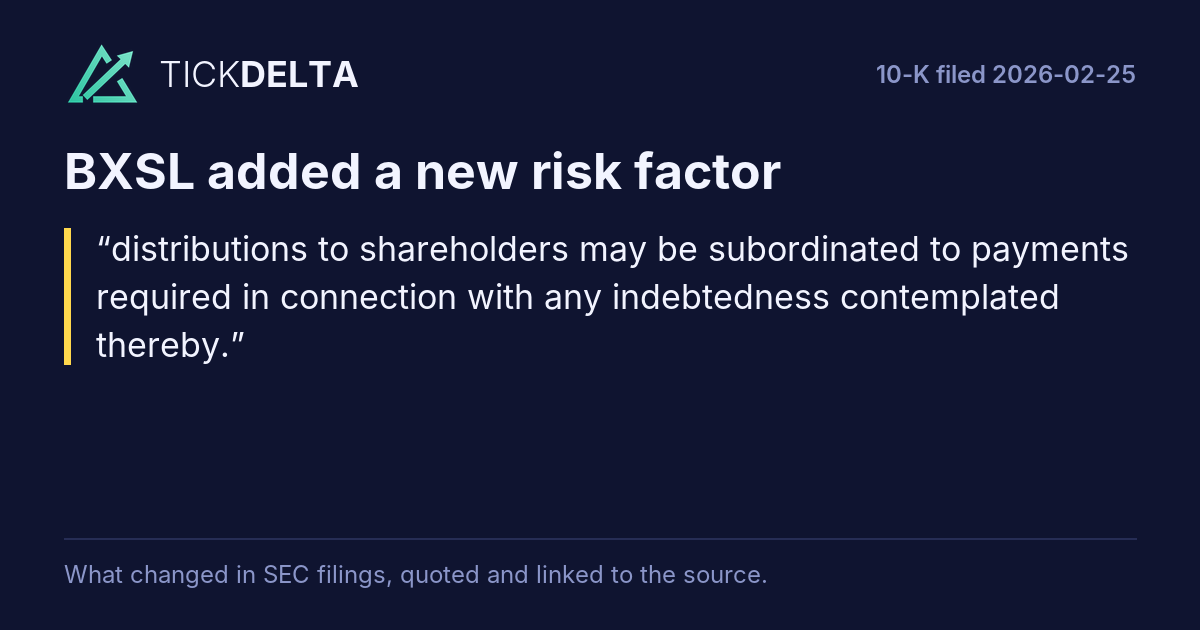
distributions to shareholders may be subordinated to payments required in connection with any indebtedness contemplated thereby.
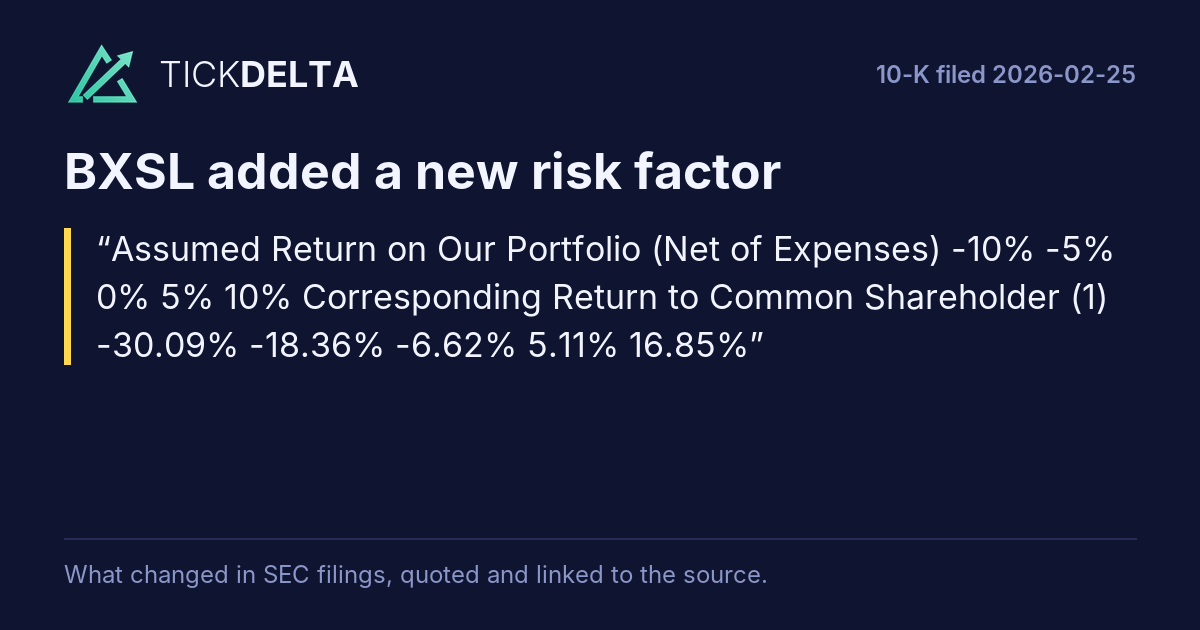
Assumed Return on Our Portfolio (Net of Expenses) -10% -5% 0% 5% 10% Corresponding Return to Common Shareholder (1) -30.09% -18.36% -6.62% 5.11% 16.85%
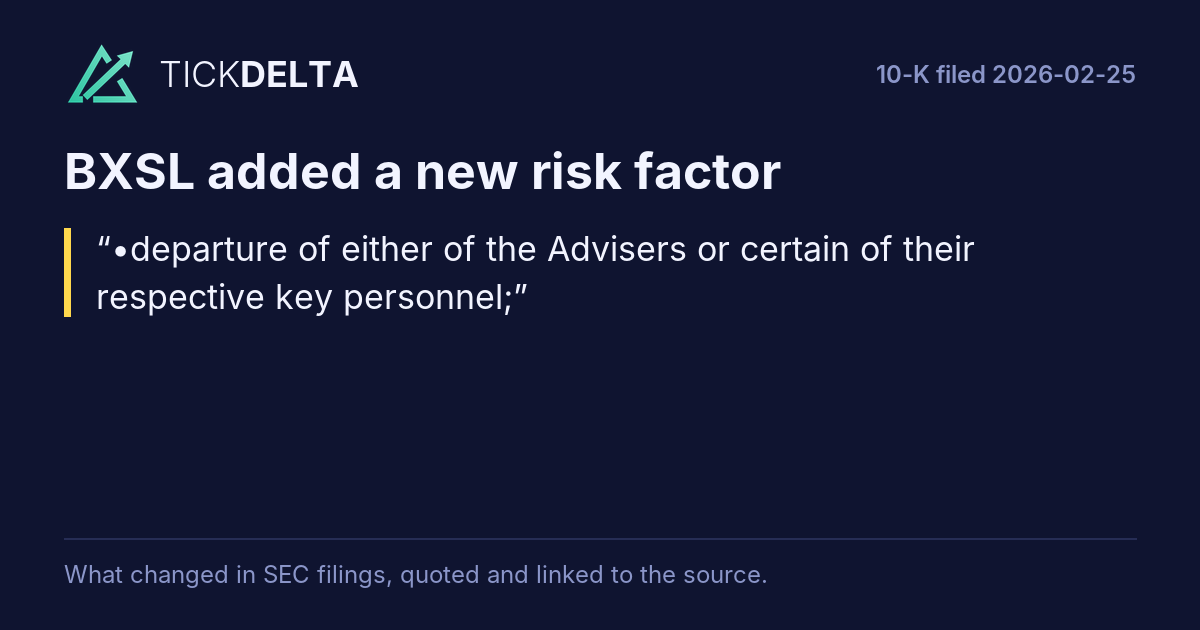
•departure of either of the Advisers or certain of their respective key personnel;
other activities, including fees and performance-based compensation. Firm personnel outside of Blackstone Credit & Insurance can share in the fees and performance-based compensation from the Company; similarly, Blackstone Credit & Insurance personnel can share in the fees and performance-based compensation generated by Other Clients. These and other factors create conflicts of interest in the allocation of time by Firm personnel. Blackstone Credit & Insurance’s determination of the amount of time necessary to conduct the Company’s activities will be conclusive, and shareholders rely on Blackstone Credit & Insurance’s judgment in this regard.
benefits resulting from their activities on behalf of the Company – for example in the same way that executives from portfolio companies of Other Clients may provide insight and/or deal origination for the benefit of the Company, the work performed by executives of the Company’s portfolio companies may benefit Senior and Other Advisors and/or Other Clients. Senior and Other Advisors may attend events and/or meetings sponsored by the Company’s portfolio companies and/or Other Clients or other members of the Blackstone network, and similarly, members of the Blackstone network may attend meetings of the Company and may be involved in fundraising activities on behalf of Blackstone.
Blackstone has developed a strong network of relationships with investment owners, leading financial institutions, operating partners, senior business executives and government officials. These relationships provide market knowledge and form the backbone of its investment-sourcing network. Blackstone has, and expects to continue to have, a significant volume of deal flow. Primary sources of Blackstone transactions include:
•Relationships of individual Blackstone Senior Managing Directors and professionals;
•Major corporations, investment owners and operators with which Blackstone has worked in the past and that wish to divest assets or partner with Blackstone;
experience. The shareholders will not receive a benefit from any fees earned by Blackstone or its personnel from these other businesses.
Subdivision of Debt Obligations. Blackstone Credit & Insurance, acting in respect of the Company and Other Clients, is permitted, from time to time, to subdivide a debt obligation (including in connection with originating such debt obligation) into two or more tranches (which may be structured as loans, notes or other instruments), each of which could have different terms from the original obligation with respect to interest and principal repayment, seniority, subordination, default remedies, rights to collateral and/or other matters. The owner of the original obligation, which could have been acquired directly from a borrower in a negotiated transaction or in the secondary market, can retain an interest in one or more tranches and elect to dispose of any such interests, including in related-party transactions between the Company and Other Clients. The subdivision or “tranching” of debt obligations typically will be undertaken when Blackstone Credit & Insurance determines that it can achieve competitive advantages or other benefits. For example, a borrower would be expected to favor a lender that is prepared to negotiate a single, consolidated credit arrangement, instead of having to negotiate senior and subordinated loans and/or secured and unsecured loans with multiple lenders. Tranching can also facilitate access to debt obligations or other securities having specific features that suit the differing risk and return and other parameters (including rating or asset eligibility requirements) of the Company or Other Clients on a more customized basis than is available in the market at the particular time. Participation by Blackstone Credit & Insurance in these tranching activities, including as a creator of tranches, will give rise to a variety of potential conflicts of interest between and among the Company and Other Clients. For example, Blackstone Credit & Insurance may determine to tranche a debt obligation into senior and subordinated instruments, notwithstanding that the Client and/or Other Clients may not be permitted to invest in subordinated instruments (which, if rated, may be rated below investment grade). Blackstone Credit & Insurance may then determine to offer such subordinated instruments to Other Clients or co-investors (including third parties), notwithstanding that such debt obligation may have been eligible for investment by the Clients and/or Other Clients if it had not been subdivided. While Blackstone Credit & Insurance will make tranching decisions in good faith based on the characteristics of particular investments, there can be no assurance that Blackstone Credit & Insurance will subdivide investments in any particular manner that would permit the Company to invest in such investments. The same considerations and potential conflicts of interest will apply to the extent Blackstone Credit & Insurance, in coordination with the borrower, structures originated investments into different instruments.
Other Affiliate Transactions and Investments in Different Levels of Capital Structure. The Company and the Other Clients may make investments at different levels of an issuer’s capital structure or otherwise in different classes of an issuer’s securities or loans, or in special purpose vehicles formed by issuers (and in certain circumstances Blackstone Credit & Insurance may be unaware of such Other Client’s investment or the size of the Other Client’s investments, as a result of information walls or otherwise), subject to the limitations of the 1940 Act. In addition, subject to applicable law, from time to time the Company could hold an investment in a different layer of the capital structure than an investor or another party with which Blackstone has a material relationship, in which case Blackstone will have an incentive to cause the Company or the
Furthermore, where the Company participates in investments alongside Other Clients of Blackstone and its affiliates, the Company and such investments also will be subject to Blackstone’s and its affiliates’ policies and procedures designed to mitigate conflicts of interest. Such policies are designed to ameliorate conflicts, but may have a detrimental effect on the ability of Blackstone Credit & Insurance to exercise certain rights or take certain actions with respect to an investment that may be detrimental to the Company (and such policies may differ from the conflicts policies of Blackstone Credit & Insurance in a manner that is detrimental to the Company). For example, in order to mitigate certain conflicts of interest, Blackstone, Blackstone Credit & Insurance or the Company, may: be recused from participating in any decisions relating or with respect to such investment; rely upon a third party to make the decisions regarding the investment; implement certain procedures or restrictions with respect to the investment, including, without limitation, maintaining a non-controlling interest in any such investment and agreeing to a forbearance of rights; rely on the presence of third-party investors in such transaction to validate the overall terms and/or pricing; agree to limit or cap its ability to vote or otherwise be recused from participating in any decisions relating or with respect to such investment; or limit the applicable portion of such investment (including particular tranches or instruments) that the Company and Other Clients are permitted to acquire (although Blackstone is under no obligation to limit the participation of the Company and Other Clients to any particular percentage and is expected to hold significant (and in certain cases majority) interests in certain issuers (or specific tranches)).
To the extent the Company is required or otherwise determines to “follow the vote” of other similarly situated third parties (if any) in voting and governance matters where conflicts of interest exist, Blackstone Credit & Insurance will have a limited ability to separately protect the Company’s investment and will be dependent upon such third parties’ actions. Such third parties may not be as capable as Blackstone Credit & Insurance and may have other conflicts arising from their other relationships that could impact their decisions. For example, Blackstone Credit & Insurance could play a role in selecting or recommending to borrowers such third-party lenders (and could have other relationships with such lenders, including such lenders being investors in Other Clients) and therefore such lenders could be incentivized to make decisions taking into account the interest of Blackstone and its affiliates, as a whole, and/or such Other Clients, and such third-party lenders will not be obligated to take into account the Company and Other Clients’ interests (beyond taking into account their own interests as lenders). In addition, the Company may forego its consent rights as a lender, in which case the other lenders, borrowers or the servicer may exercise the consent rights. Despite these, and any of the other actions described herein that Blackstone may take to mitigate conflicts, Blackstone may be required to take action when it will have conflicting loyalties between its duties to the Company and Other Clients, which may adversely impact the Company.
When Blackstone Credit & Insurance is required or determines to vote related to an amendment, waiver or modification with respect to an investment of the Company, Blackstone Credit & Insurance generally expects to act in manner intended to represent the collective interests of the Company and Other Clients participating in such investment and otherwise in accordance with its policies and procedures. However, in certain cases, Blackstone Credit & Insurance and its affiliates have agreed, and are expected in the future to agree, to provide the Company and/or Other Clients with consultation and/or consent rights on certain voting matters, including in connection with any such amendment, waiver or modification, in which case the Company and/or such Other Client will be entitled to exercise its consultation rights or direct its vote in any matter reflecting its own interests (and the Company or such Other Client may also be subject to potential conflicts of interest in such determination). Such determination will not necessarily be reflective of the collective interests of the Company and Other Clients as a whole.
opportunities and sale opportunities on a basis deemed by Blackstone Credit & Insurance, in its sole discretion, to be fair and equitable over time.
Blackstone or Blackstone Credit & Insurance, as applicable, believe in good faith to be fair and reasonable. As part of this process, the adviser to each Regulated Fund (as defined below) within a Blackstone business unit considering an investment opportunity must take into account such Regulated Fund’s Core Mandate (as adopted by the adviser to each Regulated Fund and approved by the directors of each Regulated Fund participating in co-investment transactions) and affirmatively consider all deals within the Core Mandate for the Regulated Fund. “Regulated Funds” are Other Clients that are closed-end management investment companies that have elected to be regulated as a BDC or are registered under the 1940 Act and who intend to rely on the exemptive order.
Certain Other Clients have investment discretion, including opt-in or opt-out rights for a specified period of time. Blackstone, Blackstone Credit & Insurance or their affiliates may initially allocate commitments to those Other Clients on the assumption that they will participate in an investment opportunity, subject to their election. If such Other Client subsequently elects not to participate in the investment opportunity, Blackstone, Blackstone Credit & Insurance or their affiliates may reallocate the unused portion of the investment to the Company and Other Clients that are participating, generally on a pro rata basis based on the original allocations, provided that (i) no participating fund is allocated more than its desired hold, and (ii) Blackstone, Blackstone Credit & Insurance or their affiliates determines that the reallocation is fair and equitable and in the best interests of the participating funds.
Blackstone has received an amended co-investment exemptive order (the “Amended Order”) which covers business units of Blackstone beyond Blackstone Credit & Insurance and which could impact the amount of any allocation made available to Regulated Funds and thereby affect (and potentially decrease) the allocation made available to the Company. The Amended Order contains certain conditions less restrictive than Blackstone Credit & Insurance’s prior co-investment exemptive order, and, among other things, (i) permits Blackstone increased freedom in the allocation of investment opportunities across Other Clients, including allowing previously ineligible affiliated entities and accounts to participate in transactions alongside the Company, (ii) allows the Company to more readily invest in issuers in which Other Clients have an existing position and (iii) allows a significantly greater number of transactions to be effected without the approval of the Independent Trustees of the Company.
Further, it is also possible that Blackstone could, in the future, become subject to a new exemptive order (or new provisions of the existing exemptive order), which could include restrictions, limitations and requirements affecting investment allocations that differ from or extend beyond those described above and could result in increased costs to the Company, any Other Client and any Regulated Funds. To the extent such future exemptive orders afford Blackstone greater discretion in allocating transactions among the Company, any Other Client and any Regulated Funds, Blackstone will retain sole discretion in making such determinations in accordance with such exemptive orders, notwithstanding any associated conflicts. Additionally, the other terms and conditions of any such new or revised exemptive orders may be more or less restrictive than the Amended Order.
may be allocated to investors that are not shareholders. For example, a firm with which the Firm has entered into a strategic relationship may be afforded with “first-call” rights on a particular category of investment opportunities, although there is not expected to be substantial overlap in the investment strategies and/or objectives between the Company and any such firm.
Underlying Investment Companies or BDCs. We may invest in investment companies or BDCs managed by affiliates of the Advisers, which could result in conflicts of interest. For example, the Advisers and their affiliates may be incentivized to cause us to invest in such investment companies or BDCs to help achieve economies of scale for such vehicles. In addition, the Advisers and their affiliates may be conflicted when determining whether and in what manner to submit repurchase requests to such underlying investment companies or BDCs, including in order to avoid repurchase requests exceeding the amount offered. As a result, we may end up deploying more of our assets into such vehicles than we would otherwise have done absent such conflicts. See “Risks Related to Our Investments—We may be exposed to risks associated with investments in underlying investment companies or BDCs.”
Furthermore, any such transfer or change in employment by Transferring Personnel will involve employees of different levels of experience, functional expertise and seniority (including, for avoidance of doubt, senior managing directors at Blackstone and members of the management team at the portfolio company), and in certain instances is expected to be conducted on a programmatic basis involving a designated number of Transferring Personnel across one or a range of identified portfolio companies. Where Transferring Personnel are departing from a portfolio company, Blackstone, Blackstone Credit & Insurance or their affiliates, it is not expected in all instances that such entity will hire new personnel, or transfer existing personnel, to fill such Transferring Personnel’s prior role, and in certain cases the roles intended to be occupied by Transferring Personnel will be roles newly created for such Transferring Personnel. Moreover, the respective roles of the Transferring Personnel at the entities involved in such transfer could be substantially similar and involve functional responsibilities and activities (including as between Blackstone, Blackstone Credit & Insurance or their affiliates on the one hand, and portfolio companies of the Company or an Other Client on the other hand) that do not materially differ. While in certain cases a dedicated search could be conducted by Blackstone or a portfolio company for the employment position that the Transferring Personnel will fill, a search is not required or expected to be performed in most instances.
Any such transfer will result in costs being transferred from the entity where such Transferring Personnel originated to the entity where such Transferring Personnel is going. The compensation earned and subsequently paid to such Transferring Personnel will in certain cases include arrangements designed to address Transferring Personnel’s pre-existing compensation interests, including unvested equity or carried interest attributable to such Transferring Personnel’s entity of origin (including but not limited to Blackstone, Blackstone Credit & Insurance or their affiliates) that was forfeited in connection with their departure therefrom, which is expected for certain Transferring Personnel to be material. For example, if a Blackstone employee transfers to or becomes employed by a portfolio company, such portfolio company could provide the Transferring Personnel equity of the portfolio company or other similar incentive or cash compensation to the Transferring Personnel to compensate them for the unvested equity or carried interest they are forfeiting as a result of the transfer. This will result in additional costs to the portfolio company that otherwise would have been borne by Blackstone or Blackstone Credit & Insurance. While in some cases benchmarking, verification or other analysis could be conducted in respect of the compensation package being offered to the Transferring Personnel (including any unvested equity or carried interest compensation), there is no requirement that benchmarking, verification or other analysis be conducted, and in some instances the compensation package could be above market rate and/or not verifiable.
In addition, a portfolio company of the Company will from time to time enter into agreements, transactions or other arrangements with another portfolio company of the Company or one or more portfolio companies of an Other Client (including the sale of assets between such portfolio companies). This may give rise to actual or potential conflicts of interest for Blackstone Credit & Insurance, the Company, the Other Clients and/or their respective affiliates, as such agreements, transactions or arrangements may be more favorable for one portfolio company than another, thus benefitting the Company or Other Client at the expense of the other. Such agreements, transactions or other arrangements may be entered into without the consent or direct involvement of the Company (including the investors therein) and/or such Other Client (or the consent of the limited partner advisory committee and/or the limited partners of such Other Client) (and may arise in particular in circumstances where the Company and/or such Other Client has made a non-controlling investment in the underlying portfolio company). In any such case, the Company may not be involved in the negotiation process and the terms of any such agreement, transaction or other arrangement may not be as favorable to the Company as otherwise may be the case if the Company were involved.
companies can be expected to create a conflict of interest. In general, the Advisers and Blackstone personnel will be entitled to indemnification from the Company.
executive may interview with Blackstone during the applicable contractual period with respect to such person’s existing position and later be hired by Blackstone after such period. A portfolio company may want to retain such executives or other employees, and regardless, Blackstone is under no obligation to avoid interviewing or hiring such employees. For example, Blackstone may establish a team of personnel to provide support services exclusively to the Company and Other Clients and their portfolio companies (and/or other investment funds or accounts managed or controlled by Blackstone).
The Company may invest in affiliated registered investment companies and/or business development companies that may engage affiliated portfolio company service providers and vendors implicating similar risks as those described herein.
of transactions entered into with such counterparty by the Firm, the Company and its investment and/or portfolio companies in the aggregate, Blackstone’s referrals to third parties, the provision of other strategic support by Blackstone or other factors. Further, where such agreements or other arrangements result in Blackstone or portfolio companies or affiliates paying lower rates or fees or receiving discounts, rebates or other similar concessions depending on the goods or services provided by the advisors, vendors or service providers to the Company or Other Clients, Blackstone could be incentivized to engage such advisor, vendor or service provider over other competitors. This could result in the Company or Other Clients paying such advisors, vendors or service providers higher rates than what other advisors, vendors or service providers charge for similar goods or services.
Conflicts of interest exist in the allocation of the costs and benefits of arrangements with service providers for the provision of goods or services to Blackstone, Blackstone Credit & Insurance, the Company, Other Clients and/or their respective portfolio companies. Blackstone and/or Blackstone Credit & Insurance, manages such conflicts and makes allocation judgments with respect to such costs and benefits in its fair and reasonable discretion, notwithstanding its interest in the outcome, subject to applicable law. Blackstone and/or Blackstone Credit & Insurance’s allocation decisions with respect to service providers at times are informed by input from the relevant service provider (including but not limited to where the service provider provides recommended allocation percentages across the relevant parties or provides market practice insight with respect to allocation percentages), and it is possible that the relevant service provider could, due to a conflict, recommend expense allocations that are more favorable to Blackstone and/or Blackstone Credit & Insurance than the Company or portfolio companies, subject to applicable law.
e.73 Strings. 73 Strings is an integrated platform that provides data extraction for analysis in portfolio monitoring and valuation purposes. Blackstone holds a minority investment in 73 Strings. Blackstone, the Clients and Other Clients will engage 73 Strings to collect data from portfolio companies and store critical valuation inputs. The fees, compensation and other amounts received by 73 Strings in connection with such services provided to Clients will not offset the management fee payable by Client investors and will not otherwise be shared with Client investors.
Paragraphs in the 10-Q filed Nov 4, 2026 that were not in the one before
New in the latest 10-Q
12 paragraphs in the 10-Q filed Nov 4, 2026 with nothing like them in the 10-Q filed Aug 6, 2026 (at least half the words must differ; new numbers alone do not count). Quoted exactly, grouped by the item heading above them. This is text that changed, not a judgement of how serious it is.
Financial statements and notes
Net increase (decrease) in net assets resulting from operations $ 151,575 $ 437,288
Read in the 10-Q
Adjustments to reconcile net increase (decrease) in net assets resulting from operations to net cash provided by (used in) operating activities:
Read in the 10-Q
Net change in unrealized (appreciation) depreciation on investments 99,414 89,206
Read in the 10-Q
Net change in unrealized (appreciation) depreciation on translation of assets and liabilities in foreign currencies 946 (1,125)
Read in the 10-Q
Amortization of original issue discount and debt issuance costs (including premiums and discounts) 13,327 11,029
Read in the 10-Q
Show the other 7
Proceeds from issuance of Common Shares, net of offering and underwriting costs — 274,453
Read in the 10-Q
Effect of foreign exchange rate changes on cash and cash equivalents (1,480) (11,055)
Read in the 10-Q
Cash and cash equivalents (including restricted cash), beginning of period 289,605 229,606
Read in the 10-Q
Cash and cash equivalents (including restricted cash), end of period $ 142,529 $ 249,891
Read in the 10-Q
For the Three Months Ended September 30, For the Nine Months Ended September 30,
Read in the 10-Q
rank structurally junior to all existing and future indebtedness (including trade payables) incurred by the Company’s subsidiaries, financing vehicles or similar facilities.
Read in the 10-Q
Net realized gain (loss) on foreign currency transactions 3,893 (11,558) 12,359 (13,085)
Read in the 10-Q
The 10-Q's risk factors against the 10-K
Item 1A of the 10-Q filed Nov 4, 2026 against Item 1A of the 10-K filed Feb 25, 2026.
A 10-Q repeats only the risks that changed, so a 10-K paragraph that is missing from it is not counted as removed.
Added is a paragraph with nothing like it in the 10-K, Reworded a sentence that is in both with several words changed,
Quiet changes a sentence in both where one to four words changed and one is a hedge or a modal
(cut words struck through, new words highlighted).
Text on the page, not a score; each links to the filing at sec.gov.
What the 10-Q itself says about its risk factors:There have been no material changes to the risk factors discussed in Part I, Item 1A. “Risk Factors” in our Annual Report on Form 10-K for the year ended December 31, 2025.
Read in the 10-Q
1 paragraph in the 10-Q's Item 1A, and none of them adds, rewords or quietly edits a paragraph of the 10-K's.
Phrases used for the first time
Two-word phrases in Risk Factors of the 10-K filed Feb 25, 2026 that are in none of the 1 earlier 10-Ks stored, back to Feb 26, 2025
Where each one is used
- transferring personnel: Portfolio Company Relationships Generally. The Company’s portfolio companies, including special purpose vehicles that might be formed in connection with investments, are expected to be counterparties to or participants in agreements, transactions or other arrangements with the Company, Other Clients, and/or...
- underlying investment: We may be exposed to risks associated with investments in underlying investment companies or BDCs.
- core mandate: The Advisers and individuals employed by the Advisers are generally not prohibited from raising capital for and managing other investment entities that make the same types of investments as those we target. As a result, the time and resources that these individuals may devote to us may be diverted. In addition, we...
- third-party asset: Minority Investments in Asset Management Firms. Blackstone and Other Clients, including Blackstone Strategic Capital Holdings (“BSCH”) and its related parties, regularly make minority investments in alternative asset management firms that are not affiliated with Blackstone, the Company, Other Clients and their...
- advisory agreements: The Advisory Agreements have each been approved pursuant to Section 15 of the 1940 Act. In addition, the Advisory Agreements each have termination provisions that allow the parties to terminate the agreements. The Investment Advisory Agreement may be terminated at any time, without penalty, by us or by the Adviser...
- sub-advisory agreement: The Advisory Agreements have each been approved pursuant to Section 15 of the 1940 Act. In addition, the Advisory Agreements each have termination provisions that allow the parties to terminate the agreements. The Investment Advisory Agreement may be terminated at any time, without penalty, by us or by the Adviser...
- securities markets: We may be affected by force majeure events (e.g., acts of God, fire, flood, earthquakes, outbreaks of an infectious disease, pandemic or any other serious public health concern, war, terrorism, nationalization of industry and labor strikes). Force majeure events could adversely affect the ability of the Company or...
- data center: Challenges facing a single, concentrated sector or industry can have far-reaching implications for the broader economy, including the private credit market. For example, although the U.S. economy has demonstrated strength and resiliency underpinned by the ongoing technology investment boom, there can be no...
Used at least twice, small words left out. Counted, not picked: a phrase can be new because the company renamed something.
What was taken out
29 paragraphs of last year's Risk Factors with nothing like them now. The longest are quoted.
Sources
Item 1A of each 10-K and 10-Q on EDGAR, quoted exactly. Each paragraph links to the filing at sec.gov.
Also
10-K change: what was reworded or cut, section by section.
Work with it
Excel workbook · CSV. Google Sheet that stays up to date: paste =IMPORTDATA("https://tickdelta.com/company/BXSL/export.csv") into a cell.