Screener / SEC EDGAR /CIK 0000906553 /10-K filed Feb 20, 2026, compared with Feb 21, 2025 /Numbers from the XBRL of the 10-Ks
NYSE Consumer discretionary · Hotels

Boyd Gaming Corp BYD

Compare with peers Embed
SEC comment letters, last 20 years

2 reviews of BYD's filings by SEC staff

UPLOAD and CORRESP
Reviews 2 latest letter May 20, 2021
Questions asked 3 each answered in the company's own letter
No closing letter 0 reviews without a letter saying the staff completed it

When the SEC's staff reviews a filing, it writes to the company with numbered questions, and the company answers each one in a letter. SEC publishes the exchange once the review is over, at least 20 business days later. A question is not an accusation; most reviews end with the company adding detail to its next filing.

How the reviews went

Every review on EDGAR, from the first staff letter to the letter that closes it

  1. 1. Staff letters 3 UPLOAD
  2. 2. Questions in them 3 numbered comments
  3. 3. Company replies 3 CORRESP
  4. 4. Reviews closed 2 of 2 closing letter

Half the closed reviews took 65 days or less from the first letter to the closing letter.

Form 10-K for the year ended December 31, 2020

2021-05-20 to 2021-06-03 · 1 question · 1 letter from the SEC, 1 from the company
Review closed 2021-06-03
RevenueResults discussion (MD&A)Key metrics
Operations · Our Key Performance Indicators, page 26
SEC asked
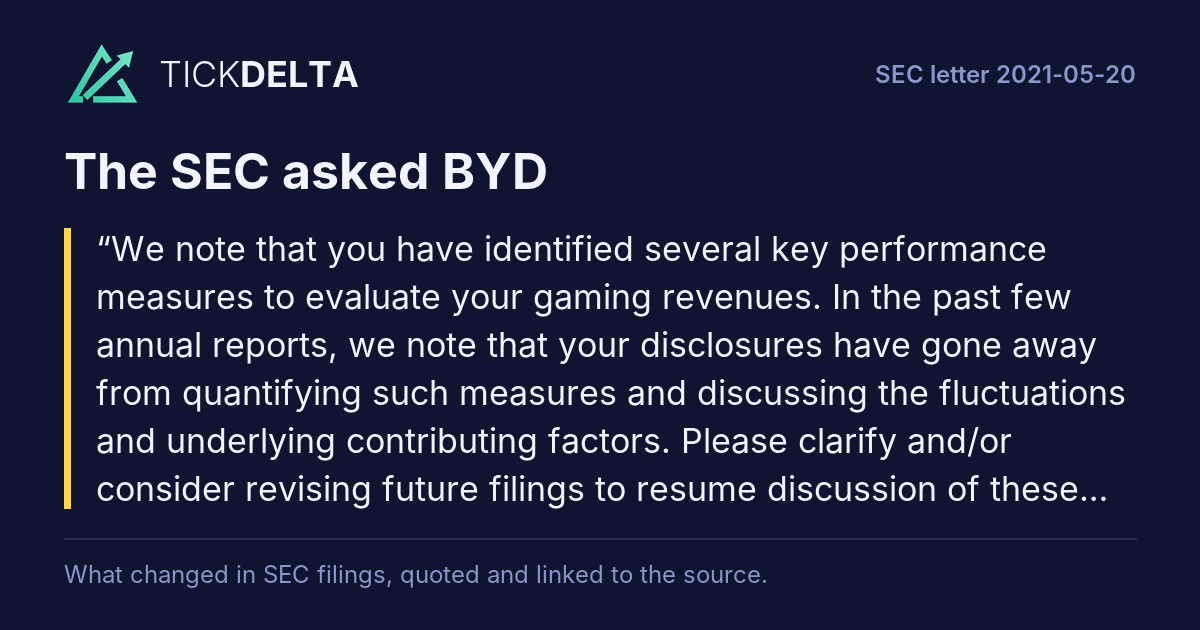
We note that you have identified several key performance measures to evaluate your gaming revenues. In the past few annual reports, we note that your disclosures have gone away from quantifying such measures and discussing the fluctuations and underlying contributing factors.
Rest of the question

Please clarify and/or consider revising future filings to resume discussion of these key performance measures and any material changes from period to period.

BYD answered
We acknowledge the Staff’s comment and respectfully advise the Staff that in recent reporting periods the primary drivers of gaming revenue changes have been the factors described in the Company’s filings, including incremental revenues contributed by acquisitions, when comparing 2019 financial results to 2018, and the impact on our business of COVID-19 pandemic, when comparing 2020 results to 2019.
Rest of the answer

As we prepare future filings, we will review the relevant guidance to ensure compliance and revise our disclosures to the extent necessary to include appropriate discussion of any material changes in the identified key performance measures.

* * *

The Company hereby acknowledges that it is responsible for the adequacy and accuracy of its disclosure in the filing reviewed by the Staff; that Staff comments or changes to disclosure in response to Staff comments in the filing reviewed by the Staff do not foreclose the Commission from taking any action with respect to the filing; and that the Company may not assert Staff comments as a defense in any proceeding initiated by the Commission or any person under the federal securities laws in the United States.
Read in the reply
In its next report

First report after the company's reply of May 27, 2021: 10-Q filed Jul 29, 2021 ↗, against the 10-Q filed May 6, 2021 ↗.

Tickdelta does not hold the text of both reports, so they are not compared here.

Also in this review: closing letter, 2021-06-03

Form 10-K

2016-04-26 to 2016-06-30 · 2 questions · 2 letters from the SEC, 2 from the company
Review closed 2016-06-30
Financial Statements · Consolidated Statements of Operations, page 57
SEC asked
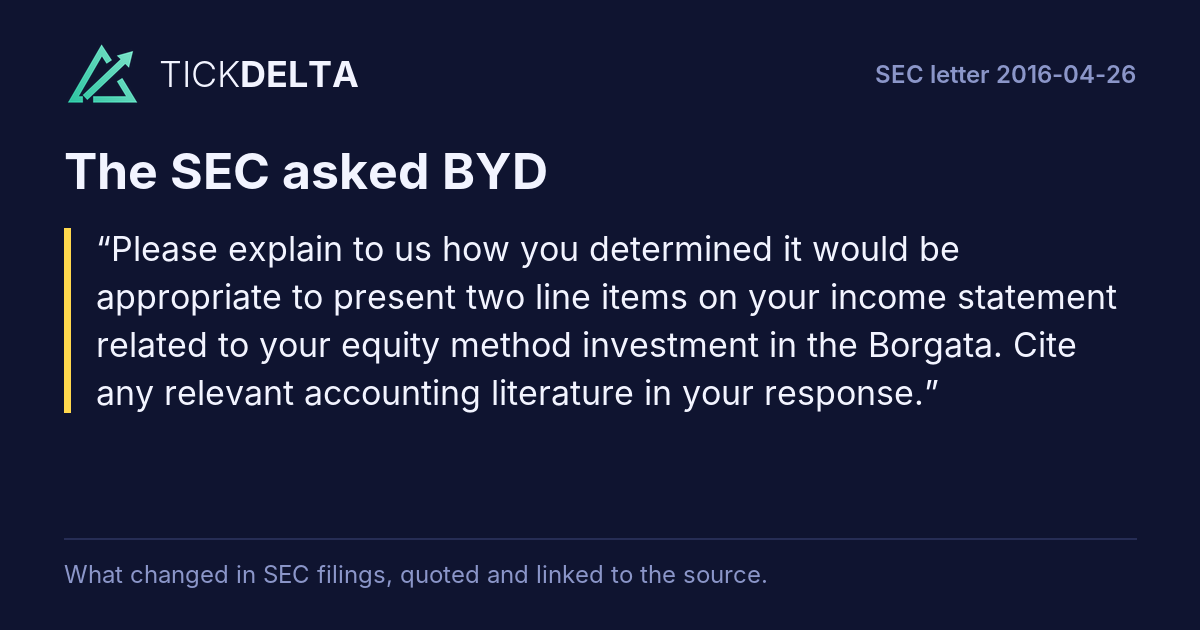
Please explain to us how you determined it would be appropriate to present two line items on your income statement related to your equity method investment in the Borgata. Cite any relevant accounting literature in your response.
BYD answered
We acknowledge the Staff’s comment and respectfully advise the Staff that, as noted in your letter, we report our pro rata share of the results of operations of Borgata in two line items of our income statement.

We hold a noncontrolling 50% equity interest in and are the managing member of the holding company that owns Borgata, which is a gaming entertainment property located in New Jersey. We believe the operations of Borgata are integral to our business.
Rest of the answer

Although Borgata is jointly controlled by us and our joint venture partner, we are responsible for Borgata’s day-to-day operations, and management of its operations is similar in nature to the management of the operations of our 21 wholly-owned gaming entertainment properties. Further, the operations of Borgata are an extension of our consolidated operations enabling our company to operate a gaming entertainment facility in an additional geographic region of the country. Given that the management of Borgata is similar to our management of our wholly-owned properties and that Borgata is an extension of our consolidated operations, we believe it is appropriate and meaningful to our investors to report the results of our investment in Borgata in two income statement lines captioned “Boyd’s share of Borgata’s operating income” and “Boyd’s share of Borgata’s non-operating items, net.”

We believe this presentation is supported by Rule 5.03 of Regulation S-X, which sets forth the major line items that should be used in income statements. The Rule provides that a line item entitled “Equity in earnings of unconsolidated subsidiaries and 50 percent or less owned persons” should typically be included. The Rule further states:

“If justified by the circumstances, this item may be presented in a different position and a different manner (see Rule 4-01(a)).”

Mr. Robert F. Telewicz, Jr.

Rule 4-01(a) states:

“Financial statements should be filed in such form and order, and should use such generally accepted terminology, as will best indicate their significance and character in light of the provisions applicable thereto. The information required with respect to any statement shall be furnished as a minimum requirement to which shall be added such further material information as is necessary to make the required statements, in light of the circumstances under which they are made, not misleading.”

We believe that the separate disclosure of the non-operating items for Borgata, which consist primarily of interest expense, loss on early extinguishments of debt and a relatively minor amount of state income taxes, in the non-operating section of our statement of operations provides the users of our financial statements with meaningful information regarding our total costs of borrowing for both wholly owned properties and unconsolidated affiliates. Since our investment in Borgata is a mechanism to invest in a gaming entertainment property (our principle line of business) and an extension of our consolidated operations, we believe reporting the results of our investment in this manner is consistent with the presentation of non-operating items for our consolidated properties and provides information that is meaningful to our investors as they evaluate our overall operating performance. Summarized income statement information for Borgata, providing a similar segregation of its standalone operating results, is presented in the notes to our financial statements.

As explained in Note 3, Deconsolidation of Certain Interests, to our consolidated financial statements in the 2015 Form 10-K, we ceased consolidating Borgata on September 30, 2014. This was the date that a divestiture trust, which had held the interest of MGM Resorts International (“MGM”), our partner in the joint venture, since February 2010, was dissolved and MGM reacquired its interest in Borgata and its substantive participation rights. Our presentation of our equity investment for periods subsequent to the deconsolidation is consistent with our historical reporting for the Borgata investment immediately prior to the placement of MGM’s interest into the divestiture trust. In addition, our reporting for this investment is consistent with how MGM accounts for its equity method investments that it believes are integral to its business. MGM’s reporting of its equity method investments was a topic of discussion in earlier comment letters from and responses to the Commission, including letters dated April 3, 2006, April 17, 2006, April 27, 2009, and May 11, 2009.

* * *

The Company hereby acknowledges that it is responsible for the adequacy and accuracy of its disclosure in the filing reviewed by the Staff; that Staff comments or changes to disclosure in response to Staff comments in the filing reviewed by the Staff do not foreclose the Commission from taking any action with respect to the filing; and that the Company may not assert Staff comments as a defense in any proceeding initiated by the Commission or any person under the federal securities laws in the United States.

Read in the reply
In its next report

First report after the company's reply of May 9, 2016: 10-Q filed Aug 8, 2016 ↗.

No earlier 10-Q before the SEC's letter is in Tickdelta, so there is nothing to compare with.

Item 8. Financial Statements and Supplementary Data · Consolidated Statements of Operations, page 57
SEC asked
We note your response to our prior comment one and are still unclear how your current presentation is appropriate. Please explain to us how Rule 5-03(b)12, which allows the presentation of the equity in earnings of unconsolidated subsidiaries to be presented in a different position or in a different manner, allows for the line item to be disaggregated.
Rest of the question

In your response please explain to us how your presentation complies ASC Topic 32310-45-1.

BYD answered
The financial reporting presentation for our 50% investment in Borgata was initially established when the joint venture commenced operations in July 2003. As the managing member of the holding company that owns Borgata, we are responsible for the venture’s day-to-day operations, which are similar in nature to the management of the operations of our wholly-owned properties. We therefore believe the operations of Borgata are integral to our business.
Rest of the answer

Beginning with our Form 10-K for the year ended December 31, 2003, we reported our share of Borgata’s results on two income statement lines captioned “Operating loss from Borgata” and “Other expense from Borgata, net” in our Consolidated Statements of Operations. This presentation reflected our belief that the reporting of the results in this manner was meaningful to our investors and compliant with Rule 5-03(b)12, which specifically allows for the presentation of the equity method earnings “in a different position or in a different manner if justified by the circumstances.” In addition, we believe this presentation was acceptable under the guidance in Accounting Principles Board (“APB”) Opinion No. 18, The Equity Method of Accounting for Investments in Common Stock (“APB 18”). In reaching that conclusion, we noted that paragraph 11 in the Discussion section of APB 18 stated the following when describing what, at the time, was current practice with regard to equity method accounting:

“Under the equity method, an investment in common stock is generally [emphasis added] shown in the balance sheet of an investor as a single amount. Likewise, an investor’s share of earnings or losses from its investment is ordinarily [emphasis added] shown in its income statement as a single amount.”

Mr. Robert F. Telewicz, Jr.

Paragraph 19(c) in the Opinion section of APB 18 then concluded:

“The investment(s) in common stock should be shown in the balance sheet of an investor as a single amount, and the investor’s share of earnings or losses of an investee(s) should ordinarily [emphasis added] be shown in the income statement as a single amount except for the extraordinary items as specified in (d) below.”

We also note that paragraph 19(c) dropped the word “generally” with respect to the balance sheet, but left the word “ordinarily” with respect to the income statement.

In June 2009, paragraph 19(c) was codified into ASC 323-10-45-1, which currently states:

“Under the equity method, an investment in common stock shall be shown in the balance sheet of an investor as a single amount. Likewise, an investor's share of earnings or losses from its investment shall be shown in its income statement as a single amount, except for the extraordinary items as specified in the following paragraph.”

We understand that the slight change in terminology between APB 18 and the Codification may imply that the FASB believed at the time of the codification that the word “ordinarily” was duplicative because it related to the qualifier that followed regarding extraordinary items (i.e., should be shown as a single amount, except for extraordinary items).

However, given that the Codification was not meant to change generally accepted accounting principles, an alternative view is that the reference to “ordinarily” was meant to be in addition to the “except for” language because otherwise the original reference to “ordinarily” in APB 18 would have been duplicative. We also note that the word “ordinarily” was preserved and included in paragraph 19 of APB 18 with regard to the income statement, but the word “generally” was dropped from paragraph 19 with regard to balance sheet (when comparing paragraphs 11 and 19 of APB 18 above). We believe this subtle change in wording may have been deliberate and implies that paragraph 19(c) of APB 18 could be reasonably interpreted as, “…the investor’s share of earnings or losses of an investee(s) should ordinarily be presented as a single line item (except for extraordinary items), but could on certain occasions be presented differently...” Since our investment in Borgata is a mechanism to invest in a gaming entertainment property (our principle line of business) and an extension of our consolidated operations, we believe that the separate disclosure of our equity in the operating income and non-operating items for Borgata is appropriate because it provides the users of our financial statements with meaningful information as they evaluate our overall operating performance.

We consistently presented our equity pick-up of our share of Borgata’s results on two income statement lines until March 2010 when the interest of our joint venture partner was transferred into a divestiture trust and our partner relinquished its substantive participation rights in the management of Borgata. As a result of this event, we commenced consolidation of Borgata in March 2010 and continued to consolidate the joint venture until September 30, 2014, when the divestiture trust was dissolved and our joint venture partner reacquired its interest and its substantive participation rights. For periods after the deconsolidation, our income statement presentation of our equity pick-up reverted to the method followed immediately prior to the placement of our joint venture partner’s interest into the divestiture trust consistent with our original interpretation of APB 18.

We would like to further advise the staff that, as reported on Form 8-K on June 2, 2016, on May 31, 2016, we announced that we have entered into an agreement to sell our equity interest in Borgata to our joint venture partner. This transaction is expected to close in the third quarter of 2016, at which time our equity pick-up of the operations of Borgata will cease.

* * *

The Company hereby acknowledges that it is responsible for the adequacy and accuracy of its disclosure in the filing reviewed by the Staff; that Staff comments or changes to disclosure in response to Staff comments in the filing reviewed by the Staff do not foreclose the Commission from taking any action with respect to the filing; and that the Company may not assert Staff comments as a defense in any proceeding initiated by the Commission or any person under the federal securities laws in the United States.

Read in the reply
In its next report

First report after the company's reply of Jun 10, 2016: 10-Q filed Aug 8, 2016 ↗.

No earlier 10-Q before the SEC's letter is in Tickdelta, so there is nothing to compare with.

Also in this review: closing letter, 2016-06-30

Letters without questions

Other letters

UPLOAD and CORRESP
9 other letters: notices that a filing will not be reviewed, requests to declare a registration effective, and the like
  • Jul 11, 2020 · SEC: will not review the filing · Boyd Gaming Corporation · Registration Statement on Form S-4 · Filed July 2, 2020 ·...
  • Jul 13, 2020 · BYD: letter to the SEC · Boyd Gaming Corporation (the “Company”) · Registration Statement on Form S-4 · File...
  • Jul 13, 2020 · BYD: letter to the SEC · Boyd Gaming Corporation and Related Guarantors · Registration Statement on Form S-4 ·...
  • Jul 9, 2018 · BYD: letter to the SEC · Boyd Gaming Corporation and Related Guarantors · Registration Statement on Form S-4 ·...
  • Jul 3, 2018 · SEC: will not review the filing · Boyd Gaming Corporation · Registration Statement on Form S-4 · Filed June 28, 2018 ·...
  • Jun 28, 2018 · BYD: letter to the SEC · Boyd Gaming Corporation (the “Company”) · Registration Statement on Form S-4 ·...
  • Dec 28, 2016 · BYD: letter to the SEC · Registration Statement on Form S-4 · Filed December 20, 2016 · File No. 333-215200
  • Dec 27, 2016 · SEC: will not review the filing · Boyd Gaming Corporation · Registration Statement on Form S-4 · Filed December 20, 2016...
  • Dec 20, 2016 · BYD: letter to the SEC · Boyd Gaming Corporation (the “Company”) · Registration Statement on Form S-4 ·...

From the SEC's correspondence on EDGAR: staff letters (form UPLOAD) and company letters (form CORRESP), 17 letters filed since 2016-04-26. Questions and answers are matched by their numbers; topics come from words in each question. The reports are compared word for word (same form, before the first SEC letter against the first report after the company's reply). No AI.

Sources

The SEC's correspondence on EDGAR: staff letters (form UPLOAD) and company letters (form CORRESP), matched question by question. No AI.

Also

Filings: the letters in the filing list.

Work with it

Excel workbook · CSV. Google Sheet that stays up to date: paste =IMPORTDATA("https://tickdelta.com/company/BYD/export.csv") into a cell.

Next in Owners and insiders:Insider trades
Esc

Type a ticker such as AAPL, a name, an investor such as Buffett, or a topic such as tariffs. ↑ ↓ to move, Enter to open.