Screener / SEC EDGAR /CIK 0000016160 /Numbers from the XBRL of the 10-Ks
Nasdaq Consumer staples · Agricultural Prod-Livestock & Animal Specialties

CAL-Maine Foods Inc CALM

Compare with peers Embed
SEC comment letters, last 20 years

5 reviews of CALM's filings by SEC staff

UPLOAD and CORRESP
Reviews 5 latest letter Mar 13, 2020
Questions asked 31 each answered in the company's own letter
No closing letter 0 reviews without a letter saying the staff completed it

When the SEC's staff reviews a filing, it writes to the company with numbered questions, and the company answers each one in a letter. SEC publishes the exchange once the review is over, at least 20 business days later. A question is not an accusation; most reviews end with the company adding detail to its next filing.

How the reviews went

Every review on EDGAR, from the first staff letter to the letter that closes it

  1. 1. Staff letters 6 UPLOAD
  2. 2. Questions in them 31 numbered comments
  3. 3. Company replies 6 CORRESP
  4. 4. Reviews closed 5 of 5 closing letter

Half the closed reviews took 40 days or less from the first letter to the closing letter.

Form 10-K for the Fiscal Year Ended June 1, 2019

2020-03-13 to 2020-04-09 · 1 question · 1 letter from the SEC, 1 from the company
Review closed 2020-04-09
Results discussion (MD&A)
Management's Discussion and Analysis of Financial Condition and Results of Operations · Fiscal Year Ended June 2, 2018 Compared to Fiscal Year Ended June 3, 2017, page 30
SEC asked
We note that you have relied upon Instruction 1 to Item 303(a) of Regulation S-K to omit a discussion of the earliest of the three years and included a statement that identifies the location of such discussion in a prior filing. However, your disclosure does not expressly state that the information is incorporated by reference as required by Exchange Act Rule 12b-23(e).
Rest of the question

Refer to Question 110.02 of the Regulation S-K Compliance & Disclosure Interpretations updated January 24, 2020 and revise future filings to properly incorporate the discussion by reference.

CALM answered
The Company will revise future filings to expressly state that the discussion regarding the earliest of the three years that has been omitted in reliance upon Instruction 1 to Item 303(a) of Regulation S-K is incorporated by reference to the extent that the Company concludes that such omitted discussion is necessary and material to an understanding of its financial condition, changes in financial condition and results of operations.
Read in the reply
In its next report

First report after the company's reply of Mar 26, 2020: 10-Q filed Mar 30, 2020 ↗, against the 10-Q filed Jan 6, 2020 ↗.

Tickdelta does not hold the text of both reports, so they are not compared here.

Also in this review: closing letter, 2020-04-09

Form 10-K

2016-02-11 to 2016-03-04 · 2 questions · 1 letter from the SEC, 1 from the company
Review closed 2016-03-04
Results discussion (MD&A)Segments
Item 1: Business, page 3
SEC asked (1)
You disclose that you operate in a single segment but with various operating facilities across the country. Your disclosures indicate your specialty eggs business differs from your non-specialty eggs business in economic characteristics, in particular:  higher prices, less cyclicality, less price volatility, apparent higher margins, specialty eggs expense for advertising promotions and franchise expense attributed
Rest of the question

to specialty eggs,  your focus on growing the business for specialty eggs, and  inelasticity of demand and price volatility for non-specialty eggs. It also appears that specialty eggs differ from non-specialty eggs in the nature of the production process, type of customer and methods used to distribute, such as:  dietary needs of and cage free environment for hens producing specialty eggs,  specialty eggs are intended to meet the demands of consumers who are sensitive to environmental, health and /or animal welfare issues, and  the producing, marketing and distributing of specialty eggs to private labels. In view of all of the preceding, please clarify for us if you have one operating segment or multiple operating segments in which you aggregate them into one reportable segment and identify them for us. In your response, please tell us how you consider ASC 280-1050-1 to support your identification of the operating segment(s). Please include the following in your evaluation:  tell us your consideration of whether your specialty eggs and non-specialty eggs businesses represent different operating segments,  tell us whether there are separate manager(s) responsible for your operating segment(s) and who these persons report to,  identify for us your chief operating decision maker and the operating decisions this person makes on a regular basis in regard to the operating segment(s) and the nature of the information used to make those decisions, including information contained in the reporting package provided to this person, if different, and  tell us how your budgets are developed with respect to the operating segment(s) including the nature of the information reviewed and approved in each step of the process, and the nature of the information conveyed to the chief operating decision maker when actual results differ from budgets. Also tell us and disclose the factors used to identify the reportable segment including the basis of organization. Refer to ASC 280-10-50-21a. Item 7: Management’s Discussion and Analysis of Financial Condition and results of Operations,

CALM answered
The Company has one operating segment, which is the production, grading, packaging, marketing, and distribution of shell eggs. We consider specialty eggs and non-specialty eggs to be different products and brands within a single operating and reportable segment. Specialty eggs represent a broad range of products. We classify nutritionally enhanced, cage free, organic and brown eggs as specialty products for accounting and reporting purposes.

In making this determination, we considered the guidance of ASC 280-10-50-1.
Rest of the answer

Specifically, we noted that discrete financial information related to certain types of costs for specialty and non-specialty eggs is neither used in making operational decisions nor available in some cases. The lack of discrete cost information is attributable to a number of factors specific to the production of eggs that determine whether an egg is considered to be a specialty or a non-specialty egg. Often these factors may be adjusted during the laying cycle of a hen resulting in a change in the type of egg produced by the same flock during the same reporting period. For example, we may alter the feed of a flock so as to convert future production from specialty eggs to non-specialty eggs. Additionally, when supply for certain types of specialty eggs exceeds demand, specialty eggs may be "down packed" and sold as non-specialty eggs. Specialty eggs that do not grade “A” under U.S.D.A inspection may also be sold as non-specialty under grade eggs.

Our organizational structure is organized based on production facilities, which are managed by general managers who report to vice presidents. Many of our facilities produce both non-specialty and specialty eggs. Each vice president oversees several facilities, consisting of specialty and non-specialty production, and reports to the Chief Operating Officer ("COO"). The COO reports to our chief operating decision maker ("CODM"), our chief executive officer. We do not have any managers who specialize in a specific type of egg production, such as specialty or non-specialty. The performance objectives we use to determine executive compensation do not differ between specialty and non-specialty eggs.

Our CODM regularly reviews reports containing information about each facility’s operational performance, such as rate of lay, grading of eggs produced, size of eggs produced, feed conversion, and mortality, as well as financial performance, such as sales, profit or loss for the period, and accounts receivable. Included in these reports is a monthly report on specialty egg sales which is used as a factor in making pricing decisions for specialty eggs. To produce this report, we use an assumed cost of production in order to arrive at a marketing margin for these eggs. This report is not used to allocate resources. Rather, as described in more detail below, we primarily allocate resources based on the demands of our customers, which reflect changing consumer preferences.

The majority of our customers rely on us to provide most of their shell egg needs, including specialty and non-specialty eggs, and the proportion of specialty and non-specialty eggs our customers request varies from period to period. As such, we make budget decisions regarding the type or brand of egg we will produce in the future based on forecasting what types of eggs we expect our customers to need during these future periods. We have seen increased demand for specialty eggs, particularly cage free eggs, largely driven by increased publicity from animal welfare groups and foodservice industry customers pledging exclusive use of cage free eggs in the future. As a result, we have increased our emphasis on specialty eggs in both our day-to-day management of our business and our regulatory filings. However, the goal of this emphasis is to highlight our desire to be a market leader in meeting the growing demand for specialty eggs, not to indicate a change in how we run our business or make business decisions.

Based on these factors, we propose to revise future filings with the following discussion:

The Company has one operating segment, which is the production, grading, packaging, marketing and distribution of shell eggs. The majority of our customers rely on us to provide most of their shell egg needs, including specialty and non-specialty eggs. Specialty eggs represent a broad range of products. We classify nutritionally enhanced, cage free, organic and brown eggs as specialty products for accounting and reporting purposes. We classify all other shell egg as non-specialty products. While we report separate sales information for these types of eggs, we note that there are a number of cost factors which are not specifically available for non-specialty or specialty eggs due to the nature of egg production. We manage our operations and allocate resources to these types of eggs on a consolidated basis based on the demands of our customers.

Read in the reply
In its next report

First report after the company's reply of Mar 1, 2016: 10-Q filed Mar 28, 2016 ↗, against the 10-Q filed Dec 23, 2015 ↗.

Tickdelta does not hold the text of both reports, so they are not compared here.

Item 1: Business, page 3
SEC asked (2)
We note your disclosure regarding the changes in total dozens of egg sold, selling prices, and feed prices. In addition to providing these metrics, please revise to quantify the impacts of these price and volume changes on net sales and cost of sales. For example, please revise future filings to quantify the actual dollar amount of aggregate net sales change during the period attributed to change in volume.
CALM answered
We will revise future quarterly and annual filings to quantify the impacts of price and volume changes on net sales and cost of sales.

In fiscal 2015, total dozens of shell eggs sold were 1,063.1 million, an increase of 49.4 million dozen, or 4.9%, compared to 1,013.7 million sold in fiscal 2014. This increase in volume resulted in an increase in net sales of $67.3 million for fiscal 2015 compared with the prior year.
Rest of the answer

Our average selling price of shell eggs increased from $1.362 per dozen for fiscal 2014 to $1.429 per dozen for fiscal 2015, an increase of $0.067 per dozen, or 4.9%, reflecting strong demand for shell eggs across our markets and a higher percentage of specialty egg sales. The increase in sales price in fiscal 2015 over 2014 resulted in a corresponding increase in net sales of $71.2 million.

Feed cost for fiscal 2014 was $0.49 per dozen, compared to $0.54 per dozen for the prior fiscal year, a decrease of 9.3%. The decrease in feed cost per dozen resulted in a decrease in cost of sales of $42.7 million for fiscal 2015 compared with 2014.

We hereby acknowledge the following:

the Company is responsible for the adequacy and accuracy of the disclosure in the filing;

staff comments or changes to disclosure in response to staff comments do not foreclose the Commission from taking any action with respect to the filing; and the Company may not assert staff comments as a defense in any proceeding initiated by the Commission or any person under the federal securities laws of the United States.

We trust that our responses satisfactorily address the issues raised in your letter. We would be happy to discuss with you any remaining questions or concerns you may have. Please contact me at (601) 718-4220 should you have any questions or require further information.

Read in the reply
In its next report

First report after the company's reply of Mar 1, 2016: 10-Q filed Mar 28, 2016 ↗, against the 10-Q filed Dec 23, 2015 ↗.

Tickdelta does not hold the text of both reports, so they are not compared here.

Also in this review: closing letter, 2016-03-04

Form 10-K

2013-03-13 to 2013-04-25 · 7 questions · 1 letter from the SEC, 1 from the company
Review closed 2013-04-25
Results discussion (MD&A)InventoryLiquidity and cashCritical estimatesRisk factorsAcquisitions
General
SEC asked (1)
In future filings, please confirm that you will reconcile disclosure related to the percentage of eggs produced by you as compared to the percentage purchased from outside producers. For example, your disclosure on page 5 indicates that companyowned facilities accounted for approximately 92% of your total fiscal 2012 egg production, while your disclosure on pages 9 and 19 state that you produce approximately 75% of
Rest of the question

the total number of shell eggs sold by you and purchase the remaining from outside producers.

CALM answered
In future filings, we will add language to clarify the percentage of eggs produced by us as compared to the eggs purchased from outside producers. In fiscal 2012, we produced 75% of the eggs sold. Of our total eggs produced, 92% were produced in company-owned facilities, with the remainder being produced by contract producers. We explained production arrangements with contract producers on page 5 of the June 2, 2012 Form

10-K under the sub-heading Shell Eggs.
Read in the reply
Operations · Capital Resources and Liquidity, page 29
SEC asked (2)
Please revise to discuss and analyze changes in your cash flows from operating activities. Your current presentation provides only the amount of cash flows provided by operating activities in each period. We refer you to the guidance in Section IV(B)(1) of Financial Reporting Release No. 72 (Release 33-8350). Please revise accordingly.
CALM answered
In future 10-K filings, we will add enhanced disclosure to discuss and analyze the changes in our cash flows from operating activities. For future 10-K filings, we will no longer simply provide the amount of cash flows from operations as presented on the statement of cash flows, but we will provide the enhanced disclosure in accord with the requirements of Financial Reporting Release No. 72 §IV(B)(1).
Read in the reply
In its next report

First report after the company's reply of Mar 22, 2013: 10-Q filed Apr 5, 2013 ↗, against the 10-Q filed Jan 8, 2013 ↗.

Tickdelta does not hold the text of both reports, so they are not compared here.

Item 7A – Commodity Price Risk, page 33
SEC asked (3)
We note that feed cost represents your largest element of farm egg production cost. You also have a risk factor stating that feed costs are volatile and changes in these costs can adversely impact results of operations and disclose herein that feed costs increased 19% year-over-year.
Rest of the question

In addition, we also note that feed cost per dozen produced has increased significantly in fiscal year 2012 and interim 2013 relative to their comparable prior year periods. As such, we believe that you should expand your discussion to provide sensitivity analysis disclosures as provided in Item 305(1)(ii)(A) of Regulation S- K for a selected hypothetical change in commodity prices for corn and soybean meal. Please revise accordingly.

CALM answered
In future 10-K filings, we will provide a tabular disclosure that satisfies the sensitivity analysis disclosure requirements as contained in Item 305(1)(ii)(A) of Regulation S- K. We have commodity price risk exposure for corn and soybean meal. The tabular disclosure of our sensitivity analysis will appear in future filings in the following manner:
Read in the reply
In its next report

First report after the company's reply of Mar 22, 2013: 10-Q filed Apr 5, 2013 ↗, against the 10-Q filed Jan 8, 2013 ↗.

Tickdelta does not hold the text of both reports, so they are not compared here.

Item 8. Financial Statements and Supplementary Data · Note 1 – Investment Securities, page 42
SEC asked (4)
In the accounting policy, you state that cost basis for realized gains and losses on available-for-sale securities is determined on a specification identification basis, while note 16 discloses that average cost is used. Please clarify and revise, as appropriate.
CALM answered
In future filings, we will correct this inconsistent wording to state that the cost basis for realized gains and losses is the specific identification basis.
Read in the reply
In its next report

First report after the company's reply of Mar 22, 2013: 10-Q filed Apr 5, 2013 ↗, against the 10-Q filed Jan 8, 2013 ↗.

Tickdelta does not hold the text of both reports, so they are not compared here.

Note 3 – Inventories, page 49
SEC asked (5)
From your inventories accounting policy in note 1 (page 44), we note that flock costs are amortized over the productive lives of the flocks, generally one to two years. It appears your table includes flock costs at its net carrying amount, including accumulated amortization.
Rest of the question

As this is an amortizable asset, please disclose the gross inventory carrying cost and accumulated amortization of this inventory component as of the end of each balance sheet date.

CALM answered

No numbered answer found in the reply. Read the reply ↗

In its next report

First report after the company's reply of Mar 22, 2013: 10-Q filed Apr 5, 2013 ↗, against the 10-Q filed Jan 8, 2013 ↗.

Tickdelta does not hold the text of both reports, so they are not compared here.

Note 3 – Inventories, page 49
SEC asked (6)
Please also separately disclose the amount of amortized flock costs and flock mortality charges that have been expensed to cost of sales in each of the annual reporting periods.
CALM answered
[5 & 6]:

We will separately disclose the amortization of flock cost, and flock mortality in each annual reporting period to the extent it is material to the Company’s financial statements. Considering the relatively short amortization period of less than two years and the extent of disclosures we have made with respect to flock inventories, we do not believe the disclosure of gross cost and accumulated amortization of our flocks provides additional meaningful information to the financial statement users.
Rest of the answer

Management does not find this information important in managing its operations and doesn’t accumulate this data from individual locations. We will add the following sentence to our inventory accounting policy note to address the omission of gross cost and accumulated amortization:

”The Company has not disclosed the gross cost and accumulated amortization with respect to its flock inventories since this information is not utilized by management in the operation of the Company.”

Read in the reply
In its next report

First report after the company's reply of Mar 22, 2013: 10-Q filed Apr 5, 2013 ↗, against the 10-Q filed Jan 8, 2013 ↗.

Tickdelta does not hold the text of both reports, so they are not compared here.

Note 2 – Acquisitions (Maxim Acquisition), page 9
SEC asked (7)
We are unclear how material this acquisition is on your results of operations, as you state that pro forma information was not available. Please completely and clearly provide us with your computation of the income test detailing this significance of this acquisition based on the guidance in Rule 1-2(w)(3) of Regulation S-X.
CALM answered
We have prepared the following table in accord with Rule 1-2(w)

3 of Regulation S-X.

Cal-Maine Foods, Inc.

For the year ended

June 2, 2012

Maxim Production Co., Inc.

December 31, 2011

Percentage

Income determined in accord with Rule 1-2(w)(3) of Reg. S-X

$139,077,000

$12,199,000

8.8%

____________________

Based upon the above computation, the Maxim acquisition does not meet the income test as described in Rule 1-2(w)(3).

We hereby acknowledge the following:

· the Company is responsible for the adequacy and accuracy of the disclosure in the filing;

· staff comments or changes to
Rest of the answer

disclosure in response to staff comments do not foreclose the Commission from taking any action with respect to the filing; and

· the company may not assert staff comments as a defense in any proceeding initiated by the Commission or any person under the federal securities laws of the United States.

We trust that our responses satisfactorily address the issues raised in your letter. We would be happy to discuss with you any remaining questions or concerns you may have. Please contact me at (601) 718-4220 should you have any questions or require further information.

Read in the reply
In its next report

First report after the company's reply of Mar 22, 2013: 10-Q filed Apr 5, 2013 ↗, against the 10-Q filed Jan 8, 2013 ↗.

Tickdelta does not hold the text of both reports, so they are not compared here.

Also in this review: closing letter, 2013-04-25

Form 10-K

2011-03-18 to 2011-04-27 · 2 questions · 1 letter from the SEC, 1 from the company
Review closed 2011-04-27
Results discussion (MD&A)Debt
Results of Operations · Cost of Sales, page 20
SEC asked (1)
Please refer to your tabular disclosure of egg quantities produced, egg quantities purchased, average farm production cost per dozen of eggs produced, and average price per dozen of eggs purchased. Based upon the amounts that have been disclosed, it appears that “cost of sales,” as reported on your consolidated statements of income, may include costs that have not been attributed to “farm production” or egg
Rest of the question

purchases. If so, please expand your disclosure to (i) describe and quantify any other material costs that are reported within “cost of sales” and (ii) discuss any material changes in those costs, if applicable. In addition, if the amounts disclosed for “farm production costs” include “feed costs,” revise your disclosure to clarify that fact. Please provide your proposed revised disclosure as part of your response.

CALM answered
In future filings on Form 10-K, our discussion of cost of sales will appear as follows:

Cost of Sales

Cost of sales consists of costs directly related to production, processing and packing shell eggs, purchases of shell eggs from outside producers, processing and packing of liquid and frozen egg products and other non-egg costs.
Rest of the answer

Farm production costs are those costs incurred at the egg production facility, including feed, facility, hen amortization, and other related farm production costs.

The following table presents the key variables affecting our cost of sales.

Fiscal Years Ended

(52 weeks)

Quarter Ended

(13 weeks)

(Amounts in thousands)

May 29, 2010

May 30, 2009

Cost of Sales:

Farm production

$

362,338

364,208

86,464

95,522

Processing and packaging

110,885

103,151

27,004

27,566

Outside egg purchases

192,818

200,345

44,923

43,733

Other costs

23,424

24,579

2,838

3,112

Total shell eggs

689,465

692,283

161,229

169,933

Egg products

24,177

29,689

5,880

5,353

Other

1,857

2,113

303

408

Total

715,499

724,085

167,412

175,694

Farm production cost (cost per dozen produced)

Feed

0.349

0.391

0.327

0.376

0.217

0.218

0.223

0.566

0.609

0.550

0.593

Outside egg purchases (average cost per dozen)

1.167

1.114

1.183

1.162

Dozen Produced

640,174

598,042

157,207

161,082

Dozen Purchased*

165,225

179,843

37,973

44,175

Dozen Sold

805,399

777,885

195,180

205,257

* Net of processing loss and inventory adjustments

Cost of sales for the fiscal year ended May 29, 2010 was $715.5 million, a decrease of $8.6 million, or 1.2%, as compared to cost of sales of $724.1 million for fiscal 2009. On a comparable basis, dozens produced increased, dozens purchased from outside shell egg producers decreased and cost of feed ingredients decreased in fiscal 2010. The cost of the shell eggs purchased from outside producers increased due to the volume of specialty shell eggs purchased. This fiscal year we produced 79% of the eggs sold by us, as compared to 77% for the previous year. Feed cost for fiscal 2010 was $.349 per dozen, compared to $.391 per dozen for the prior fiscal year, a decrease of 10.7%. Gross profit decreased from 22.0% of net sales for fiscal 2009 to 21.4% of net sales for fiscal 2010.

On a comparable basis, excluding the Acquisitions, cost of sales for fiscal 2010 was $676.4 million, a decrease of $47.7 million, or 6.6%, as compared to cost of sales of $724.1 million for fiscal 2009.

Cost of sales for the thirteen-week period ended May 29, 2010 was $167.4 million, a decrease of $8.3 million, or 4.7%, as compared to cost of sales of $175.7 million for the thirteen-week period ended May 30, 2009.

Read in the reply
In its next report

First report after the company's reply of Apr 7, 2011: 10-K filed Aug 4, 2011 ↗, against the 10-K filed Aug 2, 2010 ↗.

Tickdelta does not hold the text of both reports, so they are not compared here.

Contractual Obligations, page 27
SEC asked (2)
Please expand your contractual obligations table to include scheduled interest payments on your outstanding debt.
CALM answered
In future filings on Form 10-K our contractual obligations table will be expanded to included scheduled interest payments on our outstanding debt as follows:

Contractual Obligations

The following table summarizes future estimated cash payments, in thousands, to be made under existing contractual obligations.
Rest of the answer

Further information on debt obligations is contained in Note 9, and on lease obligations in Note 8, of Notes to Consolidated Financial Statements.

2011

2012

2013

2014

2015

Over 5 years

Long-Term Debt (Principal)

134,673

29,974

12,960

13,066

12,430

20,292

45,951

Long-Term Debt (Interest)

33,393

7,169

6,293

5,465

4,635

3,378

6,453

Operating Leases

5,372

1,747

1,177

977

449

357

665

174,438

38,890

20,430

19,508

17,514

24,027

53,069

We hereby acknowledge the following:

●

The Company is responsible for the adequacy and accuracy of the disclosures in their filings;

Staff comments or changes, if any, to disclosure in response to staff comments do not foreclose the Commission from taking any action with respect to our filings; and

The Company may not assert staff comments as a defense in any proceeding initiated by the Commission or any person under the federal securities laws of the United States.

We trust that our responses satisfactorily address the issues raised in your letter. We would be happy to discuss with you any remaining questions or concerns you may have. Please contact me at (601) 718-4220 should you have any questions or require further information.

Read in the reply
In its next report

First report after the company's reply of Apr 7, 2011: 10-K filed Aug 4, 2011 ↗, against the 10-K filed Aug 2, 2010 ↗.

Tickdelta does not hold the text of both reports, so they are not compared here.

Also in this review: closing letter, 2011-04-27

Form 10-K

2009-03-20 to 2009-07-16 · 19 questions · 2 letters from the SEC, 2 from the company
Review closed 2009-07-16
Results discussion (MD&A)AcquisitionsRevenueExecutive payLiquidity and cashRisk factorsLegal and contingenciesGoodwill and impairmentControlsDebt
Item 1A. Risk Factors · We are controlled by a principal shareholder, page 15
SEC asked (1)
We note from your risk factor that your company’s Class A Common Stock provides ten votes per share. Furthermore, we note that dividends paid on each share of your company’s Class A Common Stock were less than those paid on each share of your company’s ordinary Common Stock until October 2, 2008.
Rest of the question

Given that different rights and privileges have been ascribed to your company’s Class A Common Stock and ordinary Common Stock, please disclose all of the pertinent rights and privileges of each class of security in a footnote to your financial statements. Refer to paragraph 4 of SFAS No. 129 for further guidance.

CALM answered
We will revise all future filings to include the following disclosure related to our two classes of capital stock. This disclosure will appear in our notes to the consolidated financial statements in our future filings on Form

10-K.

The

Company has two classes of capital stock: Common Stock and Class A Common

Stock. Holders of shares of the Company’s capital stock vote as a single class on all matters submitted to a vote of the stockholders, with each share of Common Stock entitled to one vote and each share of Class A

Common Stock entitled to ten votes.
Rest of the answer

The Common Stock and Class

A Common Stock have equal liquidation rights. As of October 2,

2008, the Common Stock and Class A Common Stock have the same dividend rights, whereas previously the Class A Common Stock received an amount equal to 95% of any cash dividend payable on a share of Common

Stock. In the case of any stock dividend, holders of Common

Stock are entitled to receive the same percentage dividend (payable only in shares of Common Stock) as the holders of Class A Common Stock receive

(payable only in shares of Class A Common Stock). Upon liquidation, dissolution, or winding-up of the Company, the holders of Common Stock are entitled to share ratably with the holders of Class A Common Stock in all assets available for distribution after payment in full of creditors. The

Class A Common Stock may only be issued to Fred R. Adams, Jr., the

Company’s Chief Executive Officer, and members of his immediate family, as defined.. In the event any share of Class A Common Stock, by operation of law or otherwise is, or shall be deemed to be owned by any person other than Mr. Adams or a member of his immediate family, the voting power of such stock will be reduced from ten votes per share to one vote per share.

Also, shares of Class A Common Stock shall be automatically converted into

Common Stock on a share per share basis in the event the beneficial or record ownership of any such share of Class A Common Stock is transferred to any person other than Mr. Adams or a member of his immediate family.

Each share of Class A Common Stock is convertible, at the option of its holder, into one share of Common Stock at any time. The holders of Common

Stock and Class A Common Stock are not entitled to preemptive or subscription rights. In any merger, consolidation or business combination, the consideration to be received per share by holders of Common Stock must be identical to that received by holders of Class A Common Stock, except that if any such transaction in which shares of Capital Stock are distributed, such shares may differ as to voting rights to the extent that voting rights now differ among the classes of Capital Stock. No class of

Capital Stock may be combined or subdivided unless the other classes of

Capital Stock are combined or subdivided in the same proportion. No dividend may be declared and paid on Class A Common Stock unless the dividend is payable only to the holders of Class A Common Stock and a dividend payable to Common Stock is declared and paid concurrently in respect of outstanding shares of Common Stock in the same number of shares of Common Stock per outstanding share.

Based on our review of the requirements of paragraph 4 of SFAS No. 129, we believe the above disclosure in addition to the current discussion already in our 10-K will enhance our compliance to those requirements.

6. Selected Financial Data, page 20

Read in the reply
In its next report

First report after the company's reply of Apr 15, 2009: 10-K filed Aug 11, 2009 ↗, against the 10-K filed Aug 5, 2008 ↗.

Tickdelta does not hold the text of both reports, so they are not compared here.

Item 6. Selected Financial Data, page 20
SEC asked (2)
Please revise “Item 6” of your future filings on Form 10-K to briefly describe or cross-reference to factors such as accounting changes, business combinations, or dispositions of business operations that materially affect the comparability of the information reflected in your table of selected financial data.
Rest of the question

For example, your disclosure in “Item 6” should describe or cross-reference to discussions of your company’s acquisitions of Hillandale, LLC, Zephyr Egg, LLC, and Tampa Farms, LLC. Refer to Instruction 2 to Item 301 of Regulation S-K for further guidance. In addition, please consider whether similar disclosure should accompany your table of “Quarterly Financial Data” provided in Note 12 to your financial statements. Refer to Item 302(a)(3) of Regulation S-K for further guidance.

CALM answered
In all future filings on Form 10-K we will briefly describe or make the cross-references necessary in Item 6, as required by Item 301 of Regulation S-K, factors that may materially affect the comparability of the information reflected in our table of selected financial data. In addition, we will make similar disclosure in our table of quarterly financial data provided in note 12 to our financial statements as required by Item 302(a)(3).
Rest of the answer

The addition of the cross-references will assist readers of our future filings comprehend the most relevant factors affecting the comparability of the information reflected in “Item 6.” and the

“Quarterly Financial Data” note disclosure appearing in the footnotes to the consolidated financial statements.

7. Management’s Discussion and Analysis of Financial Condition and

Results of Operations

Overview,

Read in the reply
In its next report

First report after the company's reply of Apr 15, 2009: 10-K filed Aug 11, 2009 ↗, against the 10-K filed Aug 5, 2008 ↗.

Tickdelta does not hold the text of both reports, so they are not compared here.

Operations · Overview, page 21
SEC asked (3)
Please revise your disclosure to discuss and analyze the existence of and reasons for major trends in your company’s results of operations over the last three years – such as, the significant sales volume and unit price growth that have been realized. In addition, discuss whether you expect such trends to continue.
Rest of the question

For example, we believe that it would be useful if your overview explained in summary form why your company’s results of operations changed from a $1 million loss in fiscal year 2006 to a $152 million profit in fiscal year 2008.

CALM answered
In our Form 10-Q for the period ended February 28, 2009, we added the following disclosure to our

MD&A. We believe the following disclosure effectively encapsulates the volatility in the shell egg industry and the impact this has on our financial results. In future filings on Form 10-K and Form 10-Q we will disclose the following in our MD&A discussion.
Rest of the answer

We believe the following additional disclosure adequately describes the primary cause of fluctuations in our financial results both historically and prospectively.

Our operating results are directly tied to egg prices, which are highly volatile and subject to wide fluctuations, and are outside of our control.

The shell egg industry has traditionally been subject to periods of high profitability followed by periods of significant loss. In the past, during periods of high profitability, shell egg producers have tended to increase the number of layers in production with a resulting increase in the supply of shell eggs, which generally has caused a drop in shell egg prices until supply and demand return to balance. As a result, our financial results from year to year may vary significantly. Prices for shell eggs fluctuate in response to seasonal factors and a natural increase in shell egg production during the spring and early summer. Shell egg prices tend to increase with the start of the school year and are highest prior to holiday periods, particularly

Thanksgiving, Christmas and Easter. Consequently, we generally experience lower sales and net income in our first and fourth fiscal quarters ending in August and May, respectively. As a result of these seasonal and quarterly fluctuations, comparisons of our sales and operating results between different quarters within a single fiscal year are not necessarily meaningful comparisons.

We will make all necessary disclosures in the event that there are any significant trends in the overall marketplace other than changes to egg prices, which significantly impacts the comparability of our financial results for all current and previous periods presented in our future Form 10-K and Form 10-Q filings.

Read in the reply
Results of Operations, page 22
SEC asked (4)
Your MD&A disclosure regarding shell egg revenue, the quantity of shell eggs sold, and the average selling price of shell eggs appears to place significant emphasis on the aggregate sales of non-specialty and specialty shell eggs and their blended average selling price, without providing a detailed analysis of the quantity of non-specialty and specialty shell eggs sold and their average selling prices on an
Rest of the question

individual basis. However, we note the following with regard to your company’s sales of non-specialty shell eggs, specialty shell eggs, and shell eggs sales in the aggregate: • Although the quantity of non-specialty shell eggs sold, as well as the aggregate number of shell eggs sold, declined in fiscal year 2008, the quantity of specialty shell eggs sold during fiscal year 2008 increased significantly. • Although the average selling price of non-specialty shell eggs, as well as the blended average selling price of all shell eggs, was significantly higher in fiscal year 2008 than in fiscal year 2007, the average selling price of specialty shell eggs did not increase significantly in fiscal year 2008. blended average selling price of all shell eggs, increased significantly in fiscal year 2008, those average selling prices remained significantly lower than the average selling price of specialty shell eggs during fiscal year 2008. Based upon the aforementioned information, it appears that the quantities of specialty eggs sold and non-specialty eggs sold have fluctuated independent of each other, the average selling price of specialty shell eggs is less volatile than the average selling price of non-specialty eggs, and the average selling price of specialty eggs continues to be significantly higher than the average selling price of non-specialty eggs. As such, we believe that your MD&A disclosure should be expanded to separately discuss the revenue generated by specialty shell eggs and non-specialty shell eggs, as well as the underlying trends or factors (e.g. changes in quantities sold or price) impacting the revenue generated by each.

CALM answered
Since we are the nation’s largest domestic shell egg producer and the only publicly traded company in the shell egg industry, for competitive reasons we are concerned that segregating our shell egg sales by type and providing a detailed analysis of the quantity of non-specialty and specialty shell eggs sold and their average selling prices by type could put us in an unfair advantage against our competitors.
Rest of the answer

The shell egg industry is fiercely competitive and we believe that providing the level of detail called for in the Staff’s comment will allow our competitors to easily determine the prices we charge our customers which could leave the Company at a competitive disadvantage.

In future filings on Form 10-K and Form 10-Q, we will enhance our discussion of the specialty and non-specialty egg sales, but for competitive reasons specific disclosures related to dozens sold and average selling prices by type of product sold will not be made. Our enhanced disclosures in future filings will reflect that specialty eggs prices are not tied to the prices of our non-specialty or generic eggs which are tied to the commodity prices of eggs, and prices for specialty eggs are more stable; whereas prices for our generic eggs are highly volatile and subject to wide fluctuations, and are outside of our control. We believe that our existing disclosures along with the enhanced disclosures described above will allow the readers to understand the impact of quantities sold and pricing on our net sales for the periods presented.

Read in the reply
In its next report

First report after the company's reply of Apr 15, 2009: 10-K filed Aug 11, 2009 ↗, against the 10-K filed Aug 5, 2008 ↗.

Tickdelta does not hold the text of both reports, so they are not compared here.

Results of Operations, page 22
SEC asked (5)
We note that your MD&A discussion of “Cost of sales” focuses primarily on changes in your company’s feed costs and the impact of such changes on the amount of expense recognized. However, eggs purchased from outside producers, as well as “other operating costs,” appear to be material components of cost of sales, which also impact the amount of expense recognized.
Rest of the question

We believe that you should quantify and discuss the extent to which changes in your company’s costs of sales have resulted from each material component. In this regard, please consider enhancing your disclosure by: • utilizing a table to list and quantify the amount of expense attributable to each material component of cost of sales (e.g., feed costs, eggs purchased from outside producers, etc.) for each reporting period discussed in MD&A; • expanding your narrative disclosure to provide a detailed discussion and analysis of each component of cost of sales that has been identified in the table referenced above – including the factors or trends impacting those components; • ensuring that the expense recognized for each material component of costs of sales is discussed in terms of both price and volume, as applicable (e.g., consider quantifying the changes in the unit price of eggs purchased from outside producers, as well as changes in the volume purchased). In addition, we believe that you should (i) consider utilizing tables to list and quantify the material components of your company’s selling, general, and administrative expenses (e.g., franchise fees, equity compensation expense, administrative payroll expenses, employee insurance costs, etc.) and (ii) expand your narrative disclosure to discuss the factors or trends resulting in changes to each material component, as appropriate.

CALM answered
In all future filings where we feel that the utilization of tables will enhance disclosure we will provide the necessary tables. We were in receipt of this letter prior to filing our Form 10-Q for the period ended February 28,

2009. The Form 10-Q for the period ended February 28,

2009 was filed with the Commission on April 1, 2009. In that Form

10-Q, we did utilize tables to enhance the disclosure of the changes in our selling, general, and administrative expenses, and will continue to provide similar tables in future filings.
Rest of the answer

We will also enhance our narrative disclosure for the above named areas in all future filings where there are factors or trends having a significant impact on each material component in the abovementioned areas.

Read in the reply
In its next report

First report after the company's reply of Apr 15, 2009: 10-K filed Aug 11, 2009 ↗, against the 10-K filed Aug 5, 2008 ↗.

Tickdelta does not hold the text of both reports, so they are not compared here.

Capital Resources and Liquidity, page 25
SEC asked (6)
In each of your last two annual reports on Form 10-K, you have stated that your company’s need for working capital and seasonal borrowings are generally higher in the first and second fiscal quarters, which end in August and November, respectively.
Rest of the question

However, in each of your Form 10-Qs filed during the last two years, you have stated that your company’s need for working capital and seasonal borrowings is generally higher in the first and last fiscal quarters, which end in August and May, respectively. Please reconcile your disclosure.

CALM answered
We will reconcile this disclosure in future filings, on Form 10-Q and Form 10-K, and in the absence of any changes will state the following:

need for working capital generally is highest in the last and first fiscal quarters ending in May and August, respectively, when egg prices are normally at seasonal lows. Seasonal borrowing needs frequently are higher during these quarters than during other fiscal quarters.

8. Financial Statements and Supplementary Data
Read in the reply
In its next report

First report after the company's reply of Apr 15, 2009: 10-K filed Aug 11, 2009 ↗, against the 10-K filed Aug 5, 2008 ↗.

Tickdelta does not hold the text of both reports, so they are not compared here.

Notes to Consolidated Financial Statements · General
SEC asked (7)
You have discussed your company’s material legal proceedings in “Item 3” of your Form 10-K. However, you have not discussed those legal proceedings in the footnotes to your financial statements. In this regard, please revise your footnotes to disclose all material contingencies for which it is at least reasonably possible that a loss may have been incurred. Refer to paragraph 10 of SFAS No. 5 for further guidance.
CALM answered
In making our assessments for disclosure of material contingencies related to our legal proceedings we reviewed paragraphs 1, 8 & 10 of SFAS No. 5.

As required by paragraph 10 of SFAS 5, we will include in future filings a discussion of the legal proceedings as they appear in “Item. 3” of our Form 10-K filings, because of the reasonable possibility that a loss may have been incurred.

Note

1. Significant Accountant Policies
Read in the reply
In its next report

First report after the company's reply of Apr 15, 2009: 10-K filed Aug 11, 2009 ↗, against the 10-K filed Aug 5, 2008 ↗.

Tickdelta does not hold the text of both reports, so they are not compared here.

Note 1. Significant Accounting Policies · Revenue Recognition and Delivery Costs, page 42
SEC asked (8)
Please revise your disclosure to not only state the criteria that must be met prior to revenue recognition, but when specifically these criteria are met in your business. In other words, if revenue is recognized when products are shipped or delivered to customers, please state so.
CALM answered
In our

Form 10-K annual report we state the following:

Revenue Recognition and Delivery

Costs

Company recognizes revenue only when all of the following criteria have been met:

Persuasive evidence of an arrangement exists;

Delivery has occurred;

fee for the arrangement is determinable; and

Collectibility is reasonably assured.

For future filings on Form 10-K we will add that the above criteria are typically met upon delivery of product to our customers.
Read in the reply
In its next report

First report after the company's reply of Apr 15, 2009: 10-K filed Aug 11, 2009 ↗, against the 10-K filed Aug 5, 2008 ↗.

Tickdelta does not hold the text of both reports, so they are not compared here.

Note 2. Acquisitions, page 45
SEC asked (9)
We note that on July 28, 2005, your company entered into an agreement with Hillandale Farms, Inc. and Hillandale Farms of Florida, Inc. Pursuant to such agreement, it appears that (i) the aforementioned entities transferred identified assets and liabilities to Hillandale, LLC (i.e.
Rest of the question

a newly formed entity) in exchange for 100% of that entity’s initial membership interests and (ii) your company has agreed to acquire 100% of the membership interests of Hillandale, LLC through a series of acquisition installments, which have already begun and continue through your 2010 fiscal year. Based upon your footnote, it appears that (a) your company initially acquired 51% of the membership interest of Hillandale, LLC on October 12, 2005 for approximately $27,000 million, (b) your company has subsequently acquired an additional 25% of the membership interest of Hillandale, LLC based upon the book value of the membership interest, as measured shortly before each of the subsequent acquisition dates, and (c) your company plans to acquire the remaining 24% of the membership interest of Hillandale, LLC based upon the book value measured shortly before each of the remaining two acquisition dates. However, it appears that you may be accounting for the acquisition of Hillandale, LLC, as if your company has owned 100% of the entity since the initial acquisition date. In this regard, please address the following items, so that we may gain a better understanding of the Hillandale Acquisition, as well as your accounting treatment: (1) Tell us the underlying business reason why 100% of the membership interest of Hillandale, LLC is being acquired through periodic installments, as opposed to acquiring 100% of the membership interest upon consummation of the transaction. (2) Tell us whether or not your initial purchase price allocation is based upon your company’s proportionate share of the estimated fair value of the acquired Hillandale, LLC assets and liabilities (i.e., the 51% of the membership interest initially acquired). If not, please tell us the basis for your purchase price allocation and cite the accounting literature that you believe supports your accounting treatment. (3) Tell us whether or not you are accounting for your company’s subsequent purchase installments as acquisitions of a portion of the non-controlling interest in the Hillandale, LLC (e.g., a step-acquisition). Refer to paragraph 14 of SFAS No. 141. If each installment is not being accounted for similar to a step-acquisition, please tell us how you are accounting for the subsequent purchases and cite the accounting literature that you believe supports your (4) Tell us why you believe that it was appropriate to base your initial purchase price allocation on the sum of your company’s initial cash investment and your estimate of the aggregate installment payments required to acquire the remaining 49% of Hillandale, LLC – particularly, as the minority interest holders appear to maintain the risks and rewards associated with their remaining beneficial ownership until such ownership is subsequently acquired. (5) Explain to us why you believe it was appropriate to record a liability for the estimated remaining acquisition payments upon consummation of the transaction. (6) Tell us why you believe that it is appropriate to adjust the purchase obligation recorded on your balance sheet for changes in your estimate of your company’s remaining acquisition installments. As part of your response, also explain why you believe that changes in your estimate of future purchase installments should be recorded as additional purchase price (i.e., goodwill). Please cite the accounting literature that you believe supports your accounting treatment. (7) Tell us whether your financial statements reflect the recognition of minority interest related to the portion of Hillandale, LLC’s income and/or losses that will be allocated to the non-controlling members of Hillandale, LLC. If not, please explain why you believe that the recognition of minority interest is not necessary and tell us how much such minority interest would be if recognized. As part of your response, please cite the accounting literature that you believe supports your accounting treatment.

CALM answered
There were several underlying business reasons why 100 percent of the membership interest in Hillandale, LLC (“Hillandale”) is being acquired through periodic installments. First and foremost, the Company was able to obtain control of Hillandale on July 28, 2005 (the “Acquisition Date”). In its negotiations with the selling members of Hillandale, the Company agreed to purchase 51 percent of the membership interests on October 12, 2005 and the remaining 49 percent over the next four years based upon the fair value of the tangible assets of Hillandale as of the Acquisition Date.
Rest of the answer

In addition, the Company agreed to adjust the purchase price of the remaining 49 percent based upon the earnings or losses of Hillandale in the four years subsequent to the Acquisition Date, effectively providing an earn-out to the selling members. The president of Hillandale Farms, Inc. and

Hillandale Farms of Florida, Inc., who was also the majority shareholder, desired to continue employment with Hillandale for at least the next four years following the Acquisition Date. His continued employment aided in the integration of Hillandale into the Company’s business. Accordingly, the structure of the Hillandale

Acquisition was also designed to facilitate the president’s continuing involvement in Hillandale.

(2) Tell us whether or not your initial purchase price allocation is based upon your company's proportionate share of the estimated fair value of the acquired Hillandale, LLC assets and liabilities (i.e., the 51 percent of the membership interest initially acquired). If not, please tell us the basis for your purchase price allocation and cite the accounting literature that you believe supports your accounting treatment.

(3) Tell us whether or not you are accounting for your company's subsequent purchase installments as acquisitions of a portion of the non-controlling interest in the Hillandale, LLC

(e.g., a step-acquisition). Refer to paragraph 14 of SFAS

141. If each installment is not being accounted for similar to a step-acquisition, please tell us how you are accounting for the subsequent purchases and cite the accounting literature that you believe supports your

(4) Tell us why you believe that it was appropriate to base your initial purchase price allocation on the sum of your company's initial cash investment and your estimate of the aggregate installment payments required to acquire the remaining 49 percent of Hillandale,

LLC – particularly, as the minority interest holders appear to maintain the risks and rewards associated with their remaining beneficial ownership until such ownership is subsequently acquired.

(5) Explain to us why you believe it was appropriate to record a liability for the estimated remaining acquisition payments upon consummation of the transaction.

Response (items (2) through (5)):

The initial purchase price allocation is based on the purchase price of the 51 percent of the membership interest initially acquired plus the present value of the purchase obligation for the remaining 49 percent of membership interest over the next four years. Accordingly, subsequent purchases of membership interests are reported as reductions to the purchase obligation rather than as acquisitions of non-controlling interests. Because the

Company obtained control of Hillandale on the Acquisition Date and had an unconditional obligation to acquire the remaining 49 percent of the membership interests, and the members had an unconditional obligation to sell their membership interests to the Company, the Company recorded its purchase obligation at the fair value as of the Acquisition Date in accordance with paragraphs 4, 5 and 6 of SFAS 141. Paragraph 4 of SFAS 141 states, in part, “If the consideration given is in the form of liabilities incurred or equity interests issued, the liabilities incurred and equity interests issued are initially recognized at the date of the acquisition.” Paragraph 6 of SFAS specifies that the measurement is based on the fair value of the consideration given or the fair value of net assets acquired, whichever is more clearly evident. The Company determined the fair value of the purchase obligation based on the discounted cash flows without regard to possible future increases or decreases to the obligation. Such increases or decreases to the purchase obligation are accounted for as contingent consideration based upon the provisions of paragraphs 25 through 28 of SFAS

141. Accordingly, subsequent increases or decreases to the purchase obligation are recorded as increases or decreases to the cost of the acquired entity (i.e., adjustment to the purchase price).

considered the applicability of certain other accounting literature to the accounting for the Hillandale Acquisition. Paragraph 14 of SFAS 141 specifies that the acquisition of some or all of the noncontrolling interests shall be accounted for using the purchase method (e.g., a step acquisition). By obtaining control of Hillandale and incurring an unconditional obligation to acquire the noncontrolling interests, as well as the noncontrolling interest holders incurring an unconditional obligation to sell, management believes that the Company had substantially all of the risks and rewards of ownership of

Hillandale on the Acquisition Date. While the minority interest holders participate in the earnings and losses of Hillandale, they do not participate in market value changes in the underlying value of their membership interests. Accordingly, subsequent payments for the membership interests in Hillandale are accounted for as a reduction to the purchase obligation rather than as a step acquisition as described in paragraph 14 of

SFAS 141. We also considered whether the forward purchase obligation represents a derivative financial instrument in accordance with SFAS 133 and thus remeasured at fair value at each reporting period. Based upon the terms of the purchase obligation, it cannot be settled net. Accordingly, SFAS 133 does not apply. SFAS 150 and EITF 00-6 are applicable only to freestanding financial instruments. Since the forward purchase contracts were entered into in connection with the agreement to acquire 100 percent of the membership interest in Hillandale, the purchase obligations are not considered freestanding and SFAS 150 and EITF 00-6 do not apply. The guidance in EITF 00-4 specifies the appropriate accounting for a fixed-price forward purchase contract to acquire noncontrolling interests in a business entered into in connection with the acquisition of a controlling majority interest of that business. The guidance of

EITF 00-4 is consistent with the fact pattern in the Hillandale Acquisition, except that the Company’s forward purchase obligation is not at a fixed price.

Accordingly EITF 00-4 does not apply. The conclusion in EITF 00-4 is that the forward purchase contract should be accounted for as a financing of the purchase of the noncontrolling interest. While EITF 00-4 is not applicable to the Hillandale Acquision, the Company determined that the appropriate accounting is similar to that described in EITF 00-4.

(6) Tell us why you believe that it is appropriate to adjust the purchase obligation recorded on your balance sheet for changes in your estimate of your company's remaining acquisition installments. As part of your response, also explain why you believe that changes in your estimate of future purchase installments should be recorded as additional purchase price (i.e.

goodwill). Please cite the accounting literature that you believe supports your accounting treatment.

Response: In August 2006 and

2007, the Company acquired a total of 25 percent of the noncontrolling interests in Hillandale in accordance with the terms of the acquisition agreement. The cash paid for the 25 percent noncontrolling interest approximated the recorded amount of the purchase obligation and the difference was recorded as an adjustment to the purchase price in accordance with paragraph 28 of SFAS 141. In the Company’s fiscal year ended May 31, 2008, Hillandale experienced a significant increase in earnings which substantially increased the amount of the purchase obligation that would be paid in August 2008. While the purchase obligation for 12 percent of the membership interest in August 2008 was based upon earnings of Hillandale through July 26, 2008, the Company determined it was appropriate to increase the purchase obligation to the estimated amount that would be paid so as not to understate the purchase obligation in its May 31,

2008 financial statements. By the time the Company filed its 2008 Form 10-K on

August 5, 2008, the amount of the August 2008 purchase obligation was reasonably determinable.

(7) Tell us whether your financial statements reflect the recognition of minority interest related to the portion of Hillandale, LLC's income and/or losses that will be allocated to the non-controlling members of Hillandale,

LLC. If not, please explain why you believe that the recognition of minority interest is not necessary and tell us how much such minority interest would be if recognized. As part of your response, please cite the accounting literature that you believe supports your accounting treatment.

Response: The Company’s financial statements do not reflect the recognition of minority interest related to Hillandale’s income and/or losses. An explanation of why we believe that the recognition of minority interest is not appropriate is described in our response to comments (2) through (5) above. The amount of minority interest income (expense) that would be recognized had the

Company accounted for the noncontrolling interest in Hillandale as minority interests rather than as a purchase obligation was approximately $2,143,000,

$1,214,000 and ($13,201,000) for the years ended June 3, 2006, June 2, 2007 and

May 31, 2008, respectively.

Read in the reply
In its next report

First report after the company's reply of Apr 15, 2009: 10-K filed Aug 11, 2009 ↗, against the 10-K filed Aug 5, 2008 ↗.

Tickdelta does not hold the text of both reports, so they are not compared here.

Exhibits 31.1 and 31.2
SEC asked (10)
We note that the identification of the certifying individual at the beginning of the certification required by Exchange Act Rule 13a-14(a) also includes the title of the certifying individual. In future filings, the identification of the certifying individual at the beginning of the certification should be revised so as not to include the individual’s title.
CALM answered
In future filings we will not include the title on the certifying individual on the certification required by Exchange Act Rule 13a-14(a).
Read in the reply
In its next report

First report after the company's reply of Apr 15, 2009: 10-K filed Aug 11, 2009 ↗, against the 10-K filed Aug 5, 2008 ↗.

Tickdelta does not hold the text of both reports, so they are not compared here.

Exhibits 31.1 and 31.2
SEC asked (11)
We note that the certifications of your Principal Executive Officer and Principal Financial Officer exclude the language in paragraph 4, which refers to the certifying officers’ responsibility for establishing and maintaining internal control over financial reporting (as defined in Exchange Act Rules 13a-15(f) and 15d15(f)), as well as the language required by Item 601(b)(31)(i)(4)(b) of Regulation S-K.
Rest of the question

In this regard, please confirm to us that your certifying officers have designed, established, and maintained internal control over financial reporting (as defined in Exchange Act Rules 13a-15(f) and 15d-15(f)). In addition, please ensure that the certifications provided in your future filings fully comply with the requirements of Item 601(b)(31) of Regulation S-K.

CALM answered
In all future certifications of the Principal Executive Officer (“PEO”) and Principal

Financial Officer (“PFO”) we will include the language in paragraph

4. The PEO and PFO have designed, established, and maintained internal control over financial reporting. In all future filings paragraph 4 of the abovementioned certifications will read as follows:

4.
Rest of the answer

registrant's other certifying officer and I are responsible for establishing and maintaining disclosure controls and procedures (as defined in Exchange Act Rules 13a-15(e) and 15d-15(e)) and internal control over financial reporting (as defined in Exchange Act Rules

13a-15(f) and 15d-15(f)) for the registrant and have:

a)

Designed such disclosure controls and procedures, or caused such disclosure controls and procedures to be designed under our supervision, to ensure that material information relating to the registrant, including its consolidated subsidiaries, is made known to us by others within those entities, particularly during the period in which this report is being prepared;

b) such internal control over financial reporting, or caused such internal control over financial reporting to be designed under our supervision, to provide reasonable assurance regarding the reliability of financial reporting and the preparation of financial statements for external purposes in accordance with generally accepted accounting principles;

c)

Evaluated the effectiveness of the registrant's disclosure controls and procedures and presented in this report our conclusions about the effectiveness of the disclosure controls and procedures, as of the end of the period covered by this report based on such evaluation;

and d)

Disclosed in this report any change in the registrant’s internal control over financial reporting that occurred during the registrant’s most recent fiscal quarter (the registrant’s fourth fiscal quarter in the case of an annual report) that has materially affected, or is reasonably likely to materially affect, the registrant’s internal control over financial reporting; and

1. Financial

Read in the reply
In its next report

First report after the company's reply of Apr 15, 2009: 10-K filed Aug 11, 2009 ↗, against the 10-K filed Aug 5, 2008 ↗.

Tickdelta does not hold the text of both reports, so they are not compared here.

Item 1. Financial Statements · Condensed Consolidated Statements of Cash Flows, page 5
SEC asked (12)
Per your statement of cash flows, it appears that your company received $26 million from debt issued during the 26-week period ended November 29, 2008. In this regard, we note that your company’s total outstanding debt balance increased approximately 22.1% subsequent to the fiscal year ended May 31, 2008.
Rest of the question

However, you have not discussed the terms of your company’s additional borrowings in the footnotes to your financial statements. In future filings, please revise your footnote disclosure to discuss significant new borrowings obtained during your company’s interim periods. Refer to Rule 10-01(a)(5) of Regulation S-X for further guidance.

CALM answered
In future filings we will include in our footnotes disclosure of any significant new borrowings obtained during the interim periods. We made disclosure of the significant new borrowings in note 11 of Form 10-Q for the interim period ended February 28, 2009 which was filed April 1,

2009.
Read in the reply
In its next report

First report after the company's reply of Apr 15, 2009: 10-K filed Aug 11, 2009 ↗, against the 10-K filed Aug 5, 2008 ↗.

Tickdelta does not hold the text of both reports, so they are not compared here.

Compensation Discussion and Analysis · Bonus Plans, page 9
SEC asked (13)
In future filings, please quantify all performance targets under the general bonus program that must be achieved in order for your executive officers to earn their incentive compensation. To the extent you believe that disclosure of the targets is not required because it would result in competitive harm such that the targets could be excluded under Instruction 4 to Item 402(b) of Regulation S-K, please provide on a
Rest of the question

supplemental basis a detailed explanation for such conclusion. Please also note that to the extent that you have an appropriate basis for omitting the specific targets, you must discuss how difficult it would be for the named executive officers or how likely it will be for you to achieve the undisclosed target levels or other factors. General statements regarding the level of difficulty, or ease, associated with achieving performance goals either corporately or individually are not sufficient. Please provide insight into the factors considered by the committee prior to the awarding of performance-based compensation such as historical analyses prior to the granting of these awards or correlations between historical bonus practice and the incentive parameters set for the relevant fiscal period.

CALM answered
In future filings, we will comply with recommendations set forth in the Staff’s comments.
Read in the reply
In its next report

First report after the company's reply of Apr 15, 2009: 10-K filed Aug 11, 2009 ↗, against the 10-K filed Aug 5, 2008 ↗.

Tickdelta does not hold the text of both reports, so they are not compared here.

Compensation Discussion and Analysis · Bonus Plans, page 9
SEC asked (14)
In this regard, in future filings please revise your discussion to clarify how you calculate named executive officers’ bonuses, or advise. We note your disclosure on page 9 that each of your named executive officers may earn a bonus of up to fifty percent of his base salary. However, the bonus amounts to Mr. Paramore and Mr.
Rest of the question

Hardin disclosed in the summary compensation table appear to be substantially more than fifty percent of their respective base salaries.

CALM answered
In future filings,
Read in the reply
In its next report

First report after the company's reply of Apr 15, 2009: 10-K filed Aug 11, 2009 ↗, against the 10-K filed Aug 5, 2008 ↗.

Tickdelta does not hold the text of both reports, so they are not compared here.

Summary Compensation Table, page 11
SEC asked (15)
We note that your summary compensation table only discloses named executive officer compensation for your most recent fiscal year. In future filings, please revise the summary compensation table to provide information for your three most recent fiscal years. Refer to Item 402(c) of Regulation S-K and Securities Act Release No. 33-8732A (Nov. 7, 2006).
CALM answered
In future filings,

We hereby acknowledge the following:

•

Company is responsible for the adequacy and accuracy of the disclosures in their filings;

Staff comments or changes, if any, to disclosure in response to staff comments do not foreclose the Commission from taking any action with respect to our filings; and

Company may not assert staff comments as a defense in any proceeding initiated by the Commission or any person under the federal securities laws of the United States.

We hope that our responses address the issues raised in your letter and would be happy to discuss with you any
Rest of the answer

remaining questions or concerns you may have. Please contact me at (601) 718-4220 should you have any questions or require further information.

Read in the reply
In its next report

First report after the company's reply of Apr 15, 2009: 10-K filed Aug 11, 2009 ↗, against the 10-K filed Aug 5, 2008 ↗.

Tickdelta does not hold the text of both reports, so they are not compared here.

Operations · Overview, page 21
SEC asked (1)
We have reviewed your response to our prior comment number 3, but we do not believe that our comment has been fully addressed by your proposed disclosure. Your proposed disclosure appears very useful in explaining the nature of your business and the key factors that generally affect your company and your industry.
Rest of the question

In this regard, we believe that this proposed disclosure would be more appropriately included in the “Business” section of your filing. However, the intent of our prior comment was to request an overview-type discussion and analysis of actual major trends in your company’s results of operations over the last three years. Following on the example in our prior comment, your overview should address why your company’s results of operations changed from a $1 million loss in fiscal year 2006 to a $152 million profit in fiscal year 2008, whether such trend is expected to continue or not, and why. Please revise your MD&A disclosure accordingly. Provide us with your proposed disclosure as part of your response.

CALM answered
In future filings on Form 10-K, we will add a more robust overview-type discussion and analysis of any actual major trends in the Company’s results of operations for all periods presented and discussed in Management’s Discussion and Analysis of

Financial Condition and Results of Operations. The following proposed form of disclosure will be included in future filings on Form

10-K:

Our operating results are directly tied to shell egg prices, which are highly volatile and subject to wide fluctuations, and are outside of our control.
Rest of the answer

Primarily, our shell eggs are sold at prices related to the

Urner Barry Spot Egg Market Quotations for the southeastern region of the country. The following table shows our net income (loss), net average shell egg selling price, and the average Urner Barry wholesale quotation for large grade A eggs in the Southeastern Region, for each of our three most recent fiscal years.

Fiscal

Year ended

May

31, 2008

June

2, 2007

3, 2006

Net

Income (Loss) - (in thousands)

$

151,861

36,656

( 1,013

) average shell egg selling price

1.26

0.83

0.67

Urner

Barry Spot Egg Market Quotations1

1.38

0.93

0.75

Average daily price for the fiscal year

The shell egg industry has traditionally been subject to periods of high profitability followed by periods of significant loss. The periods of high profitability reflect increased consumer demand relative to supply while the periods of significant loss reflect excess supply for the then prevailing consumer demand. Historically, demand for shell eggs increases in line with overall population growth. As reflected above, our operating results correspond with changes in the spot egg market quote. The net average shell egg selling price is the blended price for all sizes and grades of shell eggs, including non-graded shell egg sales, breaking stock and undergrades. In fiscal 2003 and 2004, shell egg demand increased at higher than normal trend rates due to the increased popularity of high protein diets. This demand imbalance caused shell egg prices to increase. In late fiscal 2004, the popularity of these high protein diets began to diminish, but our egg production had been increased to meet the earlier higher demand levels. Lower egg prices followed, and we experienced net losses in fiscal 2005 and 2006. Beginning in the latter part of fiscal 2006, our egg supplies started to become more aligned with demand. Since that time, the supply-demand balance has tightened. Tighter supplies resulted in increased prices in fiscal

2007, and prices reached record levels in fiscal 2008. These increased prices resulted in significantly improved profitability. Future levels of profitability will be highly dependent on the relationship between demand levels and the supply of eggs available.

Read in the reply
Results of Operations, page 22
SEC asked (2)
We have reviewed your response to our prior comment number 4, as well as your concern that such disclosure would put your company at a competitive disadvantage. However, given the significant difference in the average selling prices of your company’s specialty shell eggs as compared to non-specialty shell eggs, the significant difference in the price volatility of non-specialty shell eggs as compared to specialty
Rest of the question

shell eggs, the recent increases in the quantity of specialty shell eggs sold (i.e., in absolute and as a percentage of the aggregate shell eggs sold by your company), and the recent increases in the amount of revenue generated from the sale of specialty shell eggs, we believe that it is necessary to separately discuss the revenue generated from specialty shell eggs and nonspecialty shell eggs in order to adequately explain the changes in the your company’s net sales between comparative reporting periods. In this regard, we believe that separate analyses of specialty shell egg sales and non-specialty shell egg sales would enhance investors’ ability to (i) see and evaluate your business through the eyes of management, (ii) assess the extent to which specialty shell egg sales are impacted by factors or trends affecting the broader non-specialty shell egg industry, (iii) analyze the variability of your company’s revenue in the past and better predict the potential for variability in the future, (iv) evaluate your success in growing your specialty shell egg operations, as well as the impact of such growth on your company’s margins, and (v) evaluate the extent to which recent acquisitions have increased your company’s participation/ market share in the specialty shell egg market versus the non-specialty shell egg market. For example, expanding your disclosure would enhance your investors’ ability to assess and analyze the following information related to the change in your company’s net sales between fiscal year 2007 and fiscal year 2008: • the extent to which the average selling price of your company’s shell eggs was influenced by increases in the average selling price of non-specialty shell eggs, versus the increase in the quantity of specialty shell eggs sales as a percentage of total eggs sales (i.e., product mix); • the extent that the decrease in the quantity of non-specialty shell egg sales was offset by an increase in specialty shell egg sales; • the reason(s) why the quantity of specialty shell eggs sold increased significantly, despite the decline in the quantity of non-specialty eggs sold; and • the extent to which factors such as the volatility/variability of non-specialty shell egg prices and changes in product mix have directly impacted the net sales recognized for the comparable periods. Based upon the observations noted above, we continue to believe that you should expand your MD&A disclosure to provide a separate analysis of the revenue generated by specialty eggs and non-specialty eggs, as well as the underlying trends or factors (e.g., changes in quantities sold or price) impacting the amount of revenue generated by each. Furthermore, your MD&A disclosure should be expanded to discuss the impact of changes in the sales mix between non-specialty shell eggs and specialty shell eggs on cost of sales and/or gross margin percentage, if material. Please revise your MD&A disclosure accordingly, or advise. In addition, provide us with your proposed disclosure as part of your response.

CALM answered
In future filings on Form 10-K we will provide the information as per your commentary. We believe the following disclosure will meet investor expectations. Similar disclosure, consistent with materiality considerations, will appear in future filings on Form

10-K. The following disclosure includes tabular presentation for each fiscal year.
Rest of the answer

We believe that this presentation will enhance the ability of an investor to (i) see and evaluate our business through the eyes of management, (ii) assess the extent to which specialty shell egg sales are impacted by factors or trends affecting the broader non-specialty shell egg industry, (iii) analyze the variability of the Company’s revenue in the past and better predict the potential for variability in the future, (iv) evaluate the

Company’s success in growing the specialty shell egg operations, as well as the impact of such growth on the Company’s margins, and (v) evaluate the extent to which recent acquisitions have increased the Company’s participation/market share in the specialty shell egg market versus the non-specialty shell egg market.

We have determined that the impact of the changes in the sales mix between non-specialty and specialty shell eggs on the cost of sales and gross margins were not material. Thus, we believe that separate disclosure would not provide meaningful information necessary for a current or potential investor. However, we will continue to evaluate the impact of the changes in the sales mix between non-specialty and specialty shell eggs on cost of sales and gross margins. Our evaluation will allow us to assess the materiality of separate disclosure of this information in our

MD&A. We believe the current discussion in the MD&A on cost of sales and gross margins, provides the transparency necessary for current and potential investors. This transparency will be enhanced as we make modifications as suggested in your previous comment letter. Our proposed disclosure below would appear in future filings on Form

10-K. The proposed disclosure includes tabular presentation of the non-specialty and specialty egg sales. We feel that this table along with the accompanying discussion meets the Company’s and the investor’s disclosure needs. Since we are the only publicly traded U.S. shell egg company, we feel that the following disclosure is appropriate and will not be competitively disadvantageous to us.

RESULTS

OF OPERATIONS

Year Ended May 31, 2008 Compared to Fiscal Year Ended June 2, 2007

Specialty and Non-Specialty Shell Egg Sales

Years Ended

(Amounts in thousands)

Total

Net Sales

915,939

598,128

Non-Specialty

Shell Egg Sales

736,968

485,058

121,229

86,619

858,197

571,677

Shell Egg Sales as a percent of Total Net Sales

%

Non-

Specialty Shell Egg Dozens Sold

597,496

626,052

Shell Egg Dozens Sold

80,997

59,486

Dozens Sold

678,493

685,538 non-specialty shell eggs include all shell egg sales not specifically identified as specialty shell egg sales. The non-specialty shell egg market is characterized by an inelasticity of demand, and small increases in production or decreases in demand can have a large adverse effect on prices and vice-versa. According to statistics from the USDA, the number of table-egg laying hens was down from the previous year. An improved supply-demand balance led to higher average shell egg selling prices throughout the fiscal year ended May 31, 2008, as compared to the previous year. In fiscal

2008, non-specialty shell eggs represented approximately 86% of our shell egg dollar sales, as compared to 85% for fiscal 2007. Sales of non-specialty shell eggs accounted for approximately 88.0% of our total shell egg dozen volumes in fiscal 2008, as compared to 91.3% in fiscal

2007.

shell eggs include nutritionally enhanced, cage free and organic eggs. They are a rapidly growing part of the shell egg market. In fiscal 2008, specialty shell eggs represented approximately 14% of our shell egg dollar sales, as compared to 15% for fiscal 2007. Retail prices for specialty eggs are less cyclical than non-specialty shell egg prices and are generally higher due to consumer willingness to pay for the increased benefits from those products. Sales of specialty shell eggs accounted for approximately 12.0% of our total shell egg dozen volumes in fiscal 2008, as compared to 8.7% in fiscal

Year Ended June 2, 2007 Compared to Fiscal Year Ended June 3, 2006

477,555

386,441

63,201

449,642

626,920

44,285

671,205 market, as stated above, is characterized by an inelasticity of demand, and small increases in production or decreases in demand can have a large adverse effect on prices and vice-versa. During fiscal 2004, consumer demand increased, partially due to the popularity of high protein diets. Egg producers increased egg supply to meet consumer demand. During our second fiscal 2005 quarter, consumer demand decreased to normal levels. At the same time, egg supply continued at the higher levels and resulted in a drop in egg selling prices for the remainder of fiscal 2005. During fiscal 2006, consumer demand improved slightly, but egg supply continued at higher levels. During fiscal

2007, consumer demand remained steady, but egg supply was lower, which resulted in stronger egg prices. In fiscal 2007, non-specialty shell eggs represented approximately 85% of our shell egg dollar sales, as compared to 86% for fiscal

2006. Sales of non-specialty shell eggs accounted for approximately 91.3% of our total shell egg dozen volumes in fiscal 2007, as compared to 93.4% in fiscal 2006.

fiscal 2007, specialty shell eggs represented approximately 15% of our shell egg dollar sales, as compared to 14% for fiscal 2006. Retail prices for specialty products. Sales of specialty shell eggs accounted for approximately 8.7% of our total shell egg dozen volumes in fiscal 2007, as compared to 6.6% in fiscal

2006.

Read in the reply
In its next report

First report after the company's reply of Jul 2, 2009: 10-K filed Aug 11, 2009 ↗, against the 10-K filed Aug 5, 2008 ↗.

Tickdelta does not hold the text of both reports, so they are not compared here.

Notes to Consolidated Financial Statements · Note 2. Acquisitions, page 45
SEC asked (3)
We have reviewed your response to our prior comment number 9. However, it remains unclear to us why it is appropriate to account for Hillandale, LLC as if your company purchased and owned 100 percent of the entity prior to acquiring 100 percent of the entity’s outstanding membership units.
Rest of the question

In this regard, we acknowledge that the initial acquisition of 51 percent of the outstanding membership units of Hillandale, LLC provided your company with control, which would result in consolidation of the entity. We also acknowledge that the underlying purchase agreement established unconditional commitments for your company to acquire the remaining membership units of Hillandale, LLC and for the other Hillandale, LLC members (i.e., the “Hillandale Companies”) to sell those remaining membership units to your company. However, it is not clear how the terms of the transaction result in your company acquiring – that is, legally or in substance – 100 percent of the membership units of Hillandale, LLC prior to the subsequent purchases outlined in section 5.2 of the purchase agreement. In this regard, we first note that Hillandale, LLC does not appear to meet the definition of a wholly-owned subsidiary due to the voting rights retained by the Hillandale Companies until their remaining membership units are subsequently purchased. Refer to Rule 1-02(aa) of Regulation S-X. Furthermore, we note that both your purchase agreement and the Hillandale, LLC operating agreement provide for significant rights to remain with the Hillandale Companies until their remaining membership units are subsequently purchased. For example, we note the following: • Section 2.2 of the purchase agreement provides for two of the five members of Hillandale, LLC’s Board of Directors to be selected by and represent the “Hillandale Companies” until such time that your company has acquired all of Hillandale, LLC’s outstanding units of membership and the entity becomes a wholly-owned subsidiary of your company. • Section 6.2.3 of the purchase agreement and Article 10.01 of the Hillandale, LLC operating agreement provide for net profits and net losses of Hillandale, LLC to be allocated pro rata based upon the number of common units owned by each member. • Article 7.10 of the Hillandale, LLC operating agreement provides for one vote for each unit of membership interest, based upon the holder of record for each respective unit. • Article 10.03 of the Hillandale, LLC operating agreement provides for all distributions of cash or other property to be made to the entity’s members in proportion to their respective ownership of common units on the record date of such distribution. • Article 9.03 and 13.03 of the Hillandale, LLC operating agreement provides for the distribution of assets upon liquidation or dissolution based upon the proportionate ownership of membership units. Based upon the observations noted above, it appears that the transfer of the rights, risks, and rewards attributable to the membership units retained by the Hillandale Companies has only occurred and will only occur in the future upon consummation of the subsequent purchase installments. As such, it does not appear that your company owns such membership units, legally or in substance, until the subsequent dates of purchase. In this regard, it also does not appear appropriate to apply the guidance outlined in EITF 00-4 to your transaction, as such guidance assumes that the risks and rewards of owning the non-controlling interest are held by the parent (i.e., your company) during the period(s) prior to the subsequent acquisition dates, such that the same economic result could have been accomplished in a single transaction. Refer to paragraph 6 of EITF 00-4. In addition, while an unconditional commitment to purchase the remainder of Hillandale, LLC was established upon entering the purchase agreement, it does not appear that this commitment reflects a liability of your company until your company has received the rights, risks, and rewards attributable to the additional investments in Hillandale, LLC. In this regard, it is unclear to us how an unconditional obligation to purchase 49 percent of an entity is different than an unconditional obligation to purchase 100 percent of an entity; the latter of which would not be consolidated at the date of the contractual obligation, but rather when the risks and rewards of ownership have transferred. Finally, based upon your response, as well as the terms of your contracts, it does not appear that the intent of the transaction was to fully transfer the risks and rewards of ownership and to finance a portion of the purchase consideration as of the closing date. In this regard, we note that there were no notes or deeds securing payment, no shares escrowed to your benefit pending payment, and only 51 percent of the units of membership were tendered at closing. Furthermore, we note that paragraph 48 of SFAS 141 states that the date of acquisition ordinarily is the date “assets are received and other assets are given, liabilities are assumed or incurred, or equity interests are issued.” In your case, this occurs in steps at each subsequent purchase date. Based on the above, we cannot concur with your accounting. Please revise, as appropriate.

CALM answered
We agree that the accounting literature cited in your comment letter is the appropriate guidance that governs the accounting for our acquisition of Hillandale, LLC

(“Hillandale”). We also agree that the transfer of rights, risks, and rewards of ownership (“Ownership Rights”) is the key factor in determining the most appropriate accounting for the transaction.
Rest of the answer

In your comment letter, you cite specific instances in the acquisition agreement and in the

Hillandale operating agreement which indicate that certain Ownership Rights were not transferred to the Company until such time as the membership units were purchased. While we acknowledge that certain Ownership Rights were retained by the minority unit holders of Hillandale, we believe the intent of the agreement, as well as the operation of Hillandale subsequent to the acquisition date, resulted in effectively transferring all substantive Ownership

Rights of Hillandale to the Company as of July 28, 2005 (the “Acquisition

Date”). We considered this intent and actual operation of Hillandale subsequent to the acquisition in our decision to account for the transaction as a 100% purchase as of the Acquisition Date.

It may be useful to consider that our accounting treatment for the acquisition resulted in the Company recording a purchase commitment liability of $25,947 thousand as of the Acquisition Date compared to recording minority interest of $11,492 thousand had we accounted for the purchase under the step acquisition method. At the time of the Hillandale acquisition, we were in a cyclical downturn with no clear indications of when the industry would return to profitability. In addition, Hillandale was operating at a proportionately higher operating loss than the Company due to inefficiencies in

Hillandale’s operations. Although the accounting treatment we chose resulted in the least attractive balance sheet presentation and resulted in our recording 100% of the losses of Hillandale in our financial statements, we chose this method of accounting based upon our strong belief that it represented the substance of our arrangement with the sellers of Hillandale and because it was the most conservative treatment at the time of the acquisition.

While we believe our accounting for the acquisition most appropriately reflects the substance of the acquisition agreement, we acknowledge that the legal structure of the transaction has resulted in valid questions about when the transfer of certain Ownership Rights occurred. We have addressed in detail below under the

Transfer of Ownership Rights section why we believe the substantive Ownership

Rights were transferred to the Company on the Acquisition

Date. We have also included below under the Materiality

Analysis section an analysis of the impact on the Company’s historical balance sheets and statements of income of treating the Hillandale acquisition as a 100% purchase on the Acquisition Date rather than as a step acquisition.

In August

2009, the Company will make its payment for the final 12% of the membership units of Hillandale in accordance with the terms of the acquisition agreement.

At that time we will have legal ownership of 100% of the membership units. We have fully disclosed the methods we used to account for the acquisition in our annual filings on Form 10-K and quarterly filings on Form 10-Q since the acquisition in fiscal 2006. Considering the transparency of our disclosure of the transaction, the intent of our agreement to transfer substantially all

Ownership Rights on the Acquisition Date and the analysis of the impact of the step acquisition method of accounting on the historical financial statements, which is attached as Exhibit

I, we respectfully suggest that it would not be very meaningful to the users of the financial statements to restate our prior financial statements or to reflect any adjustments to the Hillandale accounting in the 2009 Form 10-K to be filed.

respectively request that you consider the information provided below in addition to the information provided in our previous letter in assessing the appropriateness of our accounting for the Hillandale acquisition.

Transfer of Ownership Rights

Background of the Deal

Structure

The

Company operates primarily in the fresh shell egg business. The shell egg industry is fragmented with many small producers that developed from family farms over the last 40 to 50 years. The Company started in the 1950s as Adams Foods. Our chairman is Fred Adams who started the

Company. He is still active in our business and was the primary negotiator for the Company in the Hillandale acquisition. We are the largest producer and marketer of shell eggs in the United States and the only publicly traded company in our industry. A key part of our strategy is to grow through acquisitions. We are known in the industry as an acquirer and have completed 16 acquisitions since 1989.

Jack

Hazen, who is in his late 70s, was one of the principal owners of the former

Hillandale companies and has been involved in the industry for over 40 years. He approached Mr. Adams about selling their business, which consisted of facilities located in Florida and Alabama, to the

Company. In fiscal 2006, when we made the Hillandale acquisition, the egg industry was in the middle of a cyclical downturn. The Company and

Hillandale each experienced significant net losses in their most recent fiscal year ending prior to the acquisition. The egg industry is cyclical with periods of tight supply and demand balance where we enjoy higher prices and stronger margins, usually followed by periods with excess supply and accompanying lower prices and reduced margins. Due to the depressed state of the industry, at the time of the acquisition, the Company was willing to pay, and

Mr. Hazen was willing to accept, a purchase price equal only to our estimate of the fair value of the tangible assets. In contrast our two acquisitions of

Florida companies in fiscal 2009 were at a premium over the fair value of the tangible assets. Jack Hazen proposed the structure of the cash settlement to the

Company as a way to help the Company finance the acquisition while we were in this downturn. The operation of this deferred payment mechanism would also allow the sellers to get a higher price for their business if there was an upturn in the industry. Accordingly, we acquired 51% of the membership units at closing with a commitment to purchase the remaining membership units on a regular schedule over four years. This structure required less up-front cash and the sellers would be able to receive a purchase price adjustment should the commodity environment improve. The adjustment was intended to reflect a possible increase in the value of the acquired

Hillandale assets, should conditions improve. It was not intended as an adjustment to reflect a share in the “risk and rewards” associated with ownership.

Your comment letter cited Section 6.2.3 of the purchase agreement and Article 10.01 and 10.03 of the Hillandale operating agreement as evidence that significant

Ownership Rights were retained by the sellers. While this cash settlement mechanism was in the form of a proportionate share of future earnings as outlined in Section 6.2.3 of the purchase agreement and Article 10.01 of the

Hillandale operating agreement, the intent, as outlined above, was to allow the sellers to be paid more for their business if markets improved, not to condition the transfer of the entire ownership interest. Article 10.03 provides for all distributions to be made to members in proportion to their respective ownership of membership units. Such distributions to the minority interest holders reduced the amount of the purchase obligation and accordingly had no impact on the total purchase price paid for Hillandale.

Management and Operation of

Hillandale management and operation of Hillandale subsequent to the acquisition date is consistent with our belief that all substantive Ownership Rights were transferred to the Company as of the Acquisition Date. The Company currently manages and operates 36 egg production facilities throughout the country. Each of those facilities is overseen by a general manger who reports to one of our five Vice-Presidents of Operations. Prior to the acquisition, Jack Hazen functioned as the Chief Executive Officer of the former Hillandale entities. Within a few months of our acquisition,

Mr. Hazen stepped down from daily operations and Bob Scott, our Regional

Vice-President of Operations, assumed control of the Hillandale facilities. In addition the chief operating manager and certain other members of management of the former Hillandale entities were dismissed within the first year of the acquisition.

Upon our acquisition of Hillandale, we began implementation of all of our production practices which we believe have made us successful and have allowed us to grow to be the largest egg producer in the United States. We have significantly improved key performance factors at Hillandale, such as feed conversion, that have helped to lower costs and make the Hillandale locations more profitable. We brought in new managers from our existing facilities to beef up the management team. We also have integrated the Hillandale production into our marketing program which has resulted in significant improvement in the average selling prices of product produced at the Hillandale facilities. We have conformed Hillandale’s accounting systems and controls to that of the Company’s other operations. In summary, we have operated the Hillandale locations as we have all of our wholly-owned facilities.

comment letter correctly pointed out that the purchase agreement provides that two of the five members of Hillandale’s board of directors be selected by and represent the minority holder of the Hillandale membership units until such time as the Company has acquired all of Hillandale’s outstanding membership units. As a practical matter, all operating, financing, accounting and marketing decisions related to Hillandale rested with the Company and the

Company’s board of directors. As such, we do not believe that the requirement in section 2.2 of the purchase agreement for the minority holders to have two members on the Hillandale board of directors or the requirement in

Article 7.10 of the Hillandale operating agreement requiring one vote for each unit of membership interest are determinative of substantive Ownership

Rights.

Financing of the

Acquisition

Another factor that is consistent with our belief that in essence we acquired 100% of the business on the acquisition date is our financing of this transaction. The Company and Hillandale were co-borrowers on a $28 million term loan secured by the assets of Hillandale for the financing of this transaction. Prior to returning to profitable operations, the Company also provided working capital to finance Hillandale’s cash flow needs through an intercompany line of credit. We believe it is important to note that the Company was liable as co-borrower for the $28 million loan and for working capital loans to Hillandale, while the other Hillandale unit holders had no actual or contingent obligations to make payments to Hillandale or to the

Company. As such, the Company was proportionately more at risk of loss than the minority holders of the Hillandale membership units. As stated in your comment letter, Article 9.03 and 13.03 of the Hillandale operating agreement provides for distribution of assets upon liquidation or dissolution based upon the proportionate ownership of membership units. As indicated above, the Company was proportionately more at risk than the minority holders of membership units due to the Company being a co-borrower on the $28 million term loan and providing an unsecured working capital line to

Hillandale. In addition, with the Company managing and operating

Hillandale consistent with all of its other facilities, the Company was committed to fund any working capital needs of Hillandale as it would any of its wholly-owned facilities until they returned to profitability. The likelihood of any liquidation or dissolution of Hillandale was remote.

In summary, while certain Ownership Rights were retained by the minority holders of

Hillandale membership units, we believe the substance of the acquisition as well as the subsequent operations of Hillandale support our belief that all substantive Ownership Rights were transferred to the Company on the Acquisition

Date, thus supporting our accounting treatment for financial reporting purposes.

Materiality

Analysis

We also reviewed the impact to the Company’s historical consolidated financial statements had the Company accounted for the Hillandale acquisition under the step acquisition method. Attached as Exhibit

I are unaudited pro forma consolidated balance sheets and consolidated statements of income as of and for the periods ended June 3, 2006, June 2, 2007,

May 31, 2008 and February 28, 2009 which include adjustments necessary to reflect the Hillandale acquisition under the step acquisition method of accounting.

In fiscal

2006, the egg industry continued to be in a cyclical downturn and the Company reported a near break even net loss. The pro forma adjustments would change the net loss in fiscal 2006 to a near break even net income, which we believe is immaterial to the consolidated financial statements in fiscal

2006. The pro forma adjustments would change operating income, income before income taxes, net income and net income per share by less than 5% of the respective totals for the periods ended June 2, 2007, May 31, 2008 and February 28, 2009, with the exception of net income and net income per share in fiscal 2008 which would change 7.9% and 7.8%, respectively. The pro forma adjustments are also less that 5% of total assets and shareholders’ equity as of June 3, 2006,

June 2, 2007, May 31, 2008 and February 28, 2009. Accordingly, we believe the impact of the pro forma adjustments is quantitatively immaterial to all key measures in the consolidated financial statements, with the exception of net income and net income per share for fiscal 2008.

considered qualitative factors in assessing the impact of the adjustments that would be necessary had we used the step acquisition method as follows:

pro forma adjustments would not materially change the earnings trend for the periods impacted. The Company experienced a cyclical upturn in its business in fiscal 2007 and 2008 primarily as the result of a tighter supply and demand balance. In fiscal 2008, the

Company’s operating income, income before income taxes and net income were more than double the amounts reported in any other previously reported annual period in the history of the Company. Accordingly, while the pro forma adjustments are quantitatively significant to fiscal 2008 net income, we do not believe the pro forma adjustments would have materially impacted the users of the consolidated financial statements due to the significance of earnings for the period in relation to historical earnings.

pro forma adjustments would not impact employee bonuses, debt covenant compliance or other significant contractual requirements for any of the periods presented.

Company does not provide earnings guidance due to the volatility in its earnings. Also, the Company did not have analyst coverage until fiscal 2009. Since analyst coverage began in fiscal 2009, the

Company’s results have been under the analysts’ earnings estimates.

upon the above quantitative and qualitative factors, we do not believe the accounting for the Hillandale acquisition as a step acquisition rather than as a

100% purchase on the Acquisition Date would have a significant impact on the users of the Company’s consolidated financial statements.
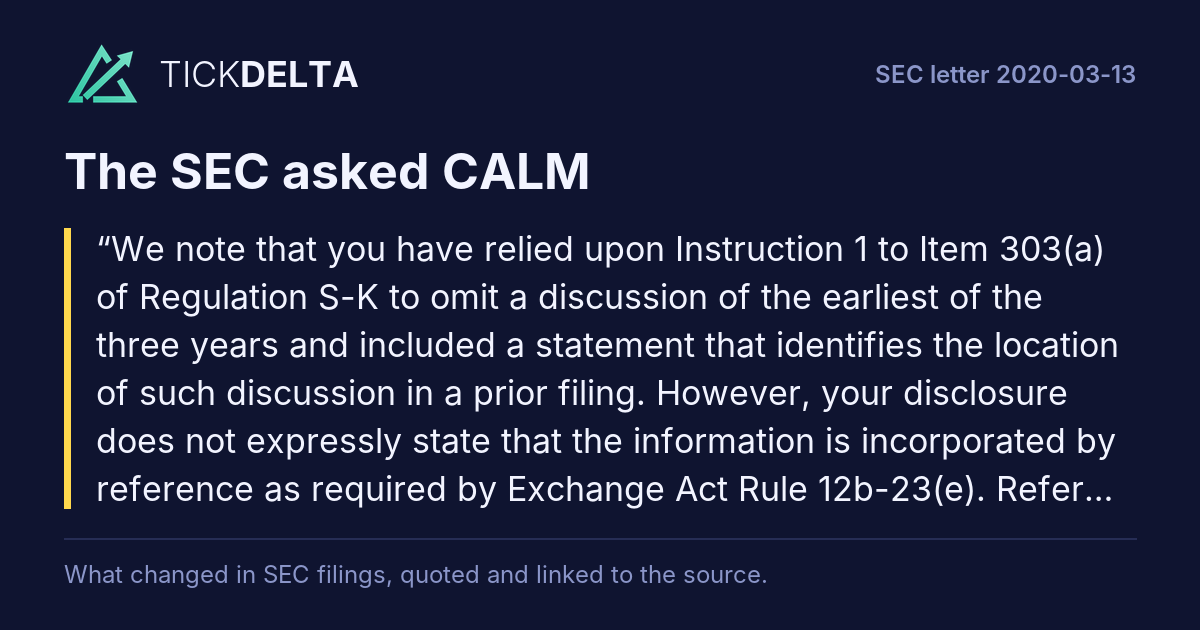
Read in the reply
In its next report

First report after the company's reply of Jul 2, 2009: 10-K filed Aug 11, 2009 ↗, against the 10-K filed Aug 5, 2008 ↗.

Tickdelta does not hold the text of both reports, so they are not compared here.

Exhibits
SEC asked (4)
We have reviewed your response to our prior comment number 11. However, we note that the certifications provided by your Principal Executive Officer and Principal Financial Officer for the quarterly period ended February 28, 2009 are missing a portion of the introductory language that is required to be included in paragraph 4.
Rest of the question

In this regard, please confirm that the certifications provided in future filings will fully comply with the requirements of Item 601(b)(31) of Regulation S-K.

CALM answered
In future filings, the certifications provided by the Principal Executive Officer and

Principal Financial Officer will fully comply with the requirements of Item

We hereby acknowledge the following:

•

Company is responsible for the adequacy and accuracy of the disclosures in their filings;

Staff comments or changes, if any, to disclosure in response to staff comments do not foreclose the Commission from taking any action with respect to our filings; and

Company may not assert staff comments as a defense in any proceeding initiated by the Commission or any person under the federal
Rest of the answer

securities laws of the United States.

We trust that our responses satisfactorily address the issues raised in your letter. We would be happy to discuss with you any remaining questions or concerns you may have. Please contact me at (601) 718-4220 should you have any questions or require further information.

Read in the reply

Also in this review: closing letter, 2009-07-16

From the SEC's correspondence on EDGAR: staff letters (form UPLOAD) and company letters (form CORRESP), 17 letters filed since 2009-04-15. Questions and answers are matched by their numbers; topics come from words in each question. The reports are compared word for word (same form, before the first SEC letter against the first report after the company's reply). No AI.

Sources

The SEC's correspondence on EDGAR: staff letters (form UPLOAD) and company letters (form CORRESP), matched question by question. No AI.

Also

Filings: the letters in the filing list.

Work with it

Excel workbook · CSV. Google Sheet that stays up to date: paste =IMPORTDATA("https://tickdelta.com/company/CALM/export.csv") into a cell.

Next in Owners and insiders:Insider trades
Esc

Type a ticker such as AAPL, a name, an investor such as Buffett, or a topic such as tariffs. ↑ ↓ to move, Enter to open.