CarGurus, Inc. CARG
New risk paragraphs, branching off last year
Each branch is a paragraph in Risk Factors with nothing like it in the 10-K filed Feb 20, 2025. A box jumps to the paragraph as filed, below.
Paragraphs with nothing like them in last year's 10-K
31 paragraphs in Risk Factors of the 10-K filed Feb 19, 2026 with nothing like them in the 10-K filed Feb 20, 2025. Quoted exactly. Paragraphs that were only edited are under 10-K change.
•Certain of our key business metrics are subject to inherent challenges in measurement and real or perceived inaccuracies in such metrics may harm our reputation and negatively affect our business.
•Litigation and other legal proceedings may adversely affect our business, financial condition, and results of operations.
We have made, and intend to continue making, significant investments in developing products that incorporate AI. The development of such new features will incur significant costs and there is no guarantee that such new product offerings will ultimately be successful. Additionally, use of newly-developed AI technology could increase cybersecurity and data protection risks and result in reputational harm, operational risks, or legal liability. Moreover, uncertainty in the regulatory landscape relating to AI, along with new or enhanced governmental or regulatory scrutiny, could negatively impact our business in the U.S. or in other jurisdictions where we operate. For example, several U.S. states have proposed, and in certain cases have enacted, legislation covering the deployment and regulation of AI technology, or otherwise imposing obligations in connection with the use of AI. Additionally, the EU enacted the Artificial Intelligence Act in March 2024 that prohibits certain AI applications and systems and imposes additional requirements on the use of certain applications or systems.
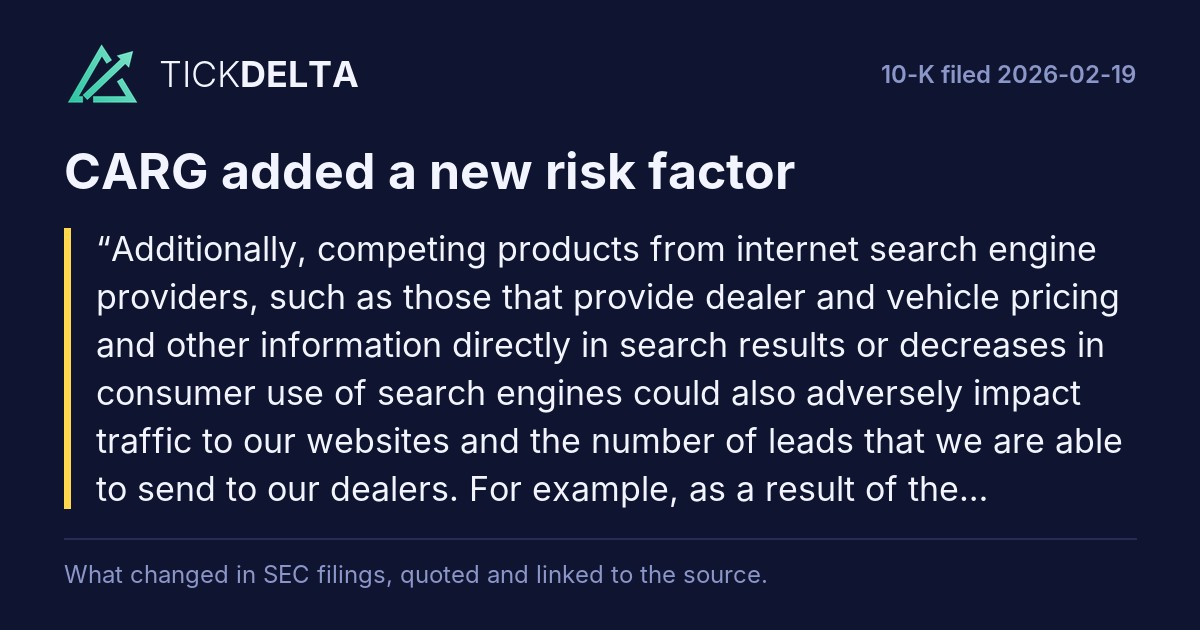
Additionally, competing products from internet search engine providers, such as those that provide dealer and vehicle
pricing and other information directly in search results or decreases in consumer use of search engines could also adversely impact traffic to our websites and the number of leads that we are able to send to our dealers. For example, as a result of the continued development of AI technology, search engines now have the ability to create customized search engine results pages that display AI-generated answers for users, which could result in our websites not being displayed prominently or at all. We expect AI to have a significant impact on the future of online automotive marketplaces as AI technologies become increasingly important for consumers buying and selling cars online. If we are unable to identify popular AI providers and AI technologies, or if we fail to utilize those technologies or develop our own technologies, our business may be harmed. For example, consumers may increasingly search for cars using chatbots, virtual assistants, or other AI technologies powered by large language models instead of using traditional search engines. If current and future AI technologies do not send referrals to us at the rate of traditional search engines for any reason, the amount of consumers using our platforms could decrease, which could negatively impact on our business and results of operations.
Decreases in consumer demand could adversely affect the market for automobile purchases and, in turn, reduce the
Show the other 9
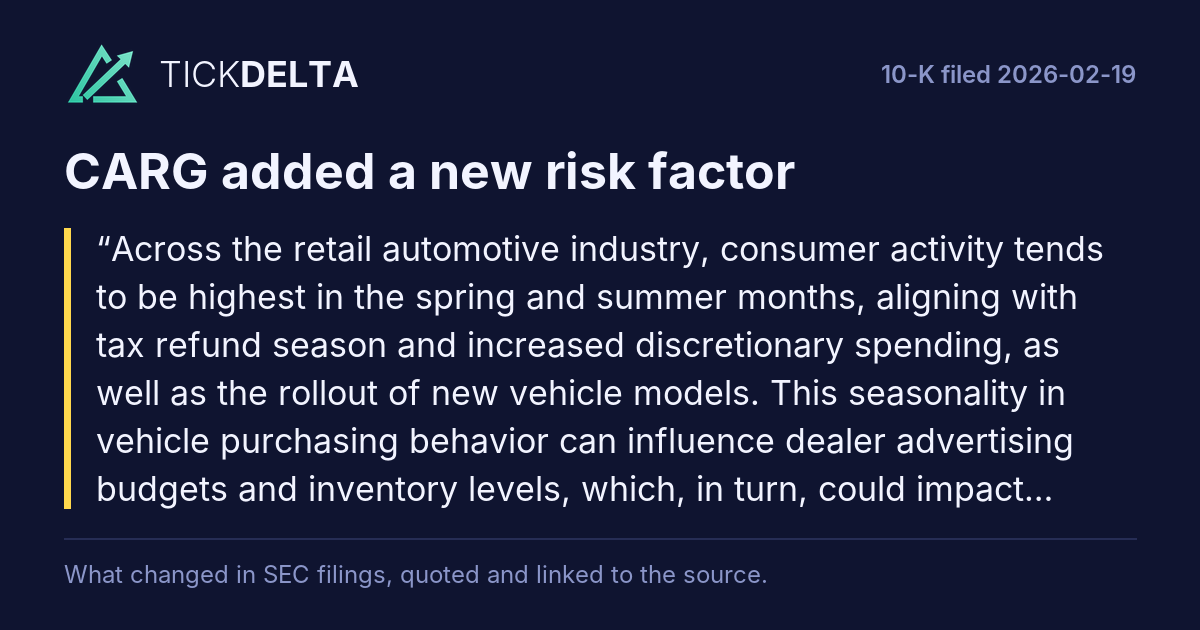
Across the retail automotive industry, consumer activity tends to be highest in the spring and summer months, aligning with tax refund season and increased discretionary spending, as well as the rollout of new vehicle models. This seasonality in vehicle purchasing behavior can influence dealer advertising budgets and inventory levels, which, in turn, could impact demand for our products and services. These trends may impact the timing and effectiveness of both consumer and dealer marketing initiatives, which could impact the efficiency of our marketing spend.
As our platform and offerings continue to scale, including our growing suite of software and data products for consumers and dealers, and our growth rates moderate or cease, we may become more susceptible to seasonal trends that affect vehicle transactions, consumer engagement, or dealer marketing behavior.
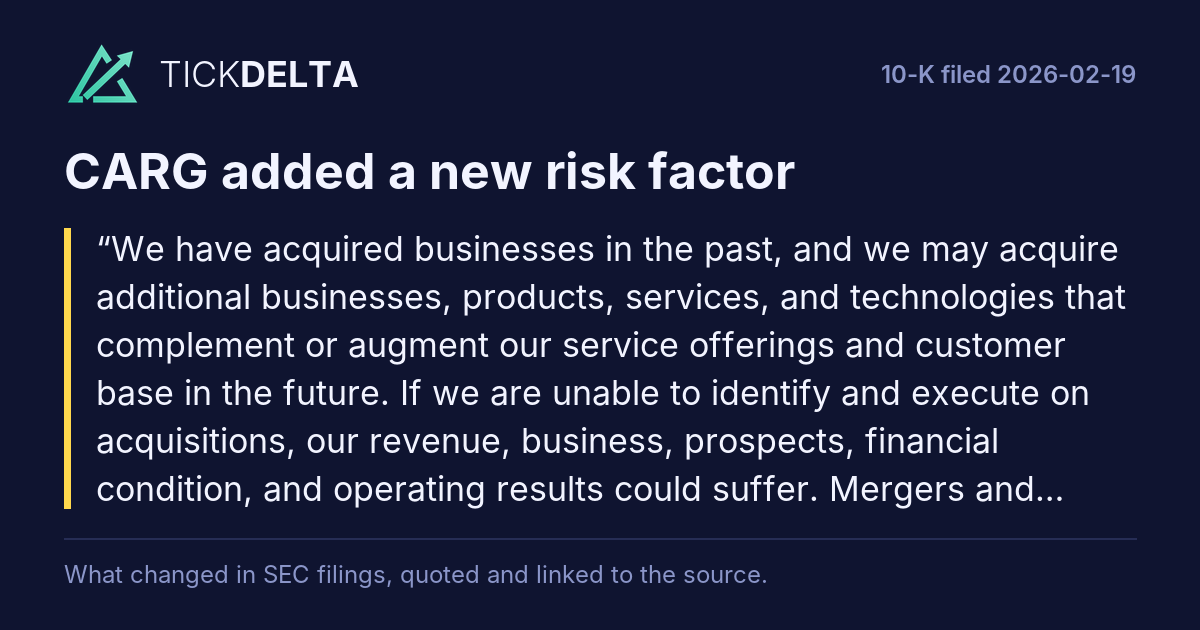
We have acquired businesses in the past, and we may acquire additional businesses, products, services, and technologies that complement or augment our service offerings and customer base in the future. If we are unable to identify and execute on acquisitions, our revenue, business, prospects, financial condition, and operating results could suffer.
Mergers and acquisitions are inherently risky and subject to many factors outside of our control. We cannot give assurances that our previous or future acquisitions will be successful and will not materially adversely affect our business, operating results, or financial condition. Failure to manage and successfully integrate acquisitions could materially harm our business and operating results.
Use of new and evolving technologies, including AI, could also impact our ability to protect our data and intellectual property from misappropriation by third parties. AI is becoming increasingly powerful and sophisticated, and third parties (including our competitors) and copycat websites may utilize AI to misappropriate our data more quickly and at a larger scale than in the past. Use of AI also increases the risk of cyberattacks and data breaches, which can occur more quickly and evolve more rapidly when AI is used. Further, the use of AI, whether by us or by third parties, may increase the risk that our data, intellectual property, or confidential information will be inadvertently disclosed, which may result in reputational harm, competitive harm, or legal liability and adversely affect our business, results of operations, or financial condition.
Certain of our key business metrics are subject to inherent challenges in measurement and real or perceived inaccuracies in such metrics may harm our reputation and negatively affect our business.
We track certain key business metrics using internally produced data and data received from third parties, including third-party platforms, to track certain performance indicators and metrics. Data from both such sources may include information relating to fraudulent accounts and interactions with our sites or the social media accounts of our influencers (including as a result of the use of bots or other automated or manual mechanisms to generate false impressions that are delivered through our sites or their accounts). We have only limited abilities to verify data from our sites or third parties and perpetrators of fraudulent impressions may change their tactics and may become more sophisticated, which would make it still more difficult to detect such activity.
Our methodologies for tracking metrics may also change over time, which could result in changes to the metrics we report. If we undercount or overcount performance due to the internal data analytics tools we use or issues with the data received from third parties, or if our internal data analytics tools contain algorithmic or other technical errors, the data we report may not be accurate or comparable with prior periods. In addition, limitations, changes, or errors with respect to how we measure data may affect our understanding of certain details of our business, which could affect our longer-term strategies.
If our key business metrics are not accurate representations of the reach or monetization of our brand, if we discover material inaccuracies in our metrics or the data on which such metrics are based, or if we can no longer calculate any of our key business metrics with a sufficient degree of accuracy and cannot find an adequate replacement for the metric, our business, financial condition, and operating results could be adversely affected.
techniques or to implement adequate measures for prevention and detection. For example, as AI continues to evolve, cybercriminals could also use AI to develop malicious code and sophisticated phishing attempts.
Cybersecurity risks and cyber incidents, as well as other significant disruptions of our information technology networks and related systems and resources, could adversely affect our business, disrupt operations, and expose us to liabilities to employees, customers, governmental regulators, and other third parties.
We use information technology and other computer resources to carry out important operational activities and to maintain our business records. As part of our normal business activities, we permit certain employees to perform some or all of their business activities remotely, we collect and store certain personal identifying and/or confidential information relating to our employees, customers, vendors, and suppliers, and we maintain operational and financial information related to our business. Furthermore, we rely on products and services provided by third-party suppliers to operate certain critical business systems, including cloud-based infrastructure, encryption and authentication technology, email, and other functions, which exposes us to supply-chain attacks or other business disruptions.
We face risks associated with security breaches through cyber-attacks or cyber-intrusions, malware, computer viruses and malicious codes, ransomware, attachments to e-mail, unauthorized access attempts, denial of service attacks, phishing, social engineering, persons with access to systems inside our organization, and other significant disruptions of our information technology networks and related systems. We have experienced in the past, and may in the future experience, security breaches and threats. The risk of a security breach has generally increased as the frequency, intensity, and sophistication of attempted attacks and intrusions from around the world have increased. Even the most well protected information, networks, systems, and facilities remain potentially vulnerable because the techniques, tools, and tactics used in such attempted security breaches evolve and generally are not recognized until launched against a target, and in some cases are designed to not be detected and, in fact, may not be detected. Accordingly, we may be unable to anticipate these techniques or to implement adequate security barriers, disaster recovery, or other preventative or corrective measures, and thus it is impossible for us to entirely counteract this risk or fully mitigate the harms after such an attack.
We have implemented certain systems and processes intended to address ongoing and evolving cybersecurity risks, secure our information technology, applications and computer systems, and prevent unauthorized access to or loss of sensitive, confidential, and personal data. However, our security measures, taken as a whole, may not be sufficient for all possible situations and may be vulnerable to, among other things, fraud, hacking, employee error, system error, and faulty password management.
Our ability to conduct our business may be impaired if our or our services providers’ information technology networks, systems, or resources, including our and their websites or e-mail systems, are compromised, degraded, damaged, or fail, whether due to a virus or other harmful circumstance, fraud, intentional penetration, or disruption of our or their information technology resources by:
A significant and extended disruption could damage our business or reputation and cause, amongst other things, loss of revenue or customer relationships, unintended and/or unauthorized public disclosure, or the misappropriation of
proprietary, personal identifying, and confidential information, and us to incur significant expenses to address and remediate or otherwise resolve these kinds of issues.
The release of confidential information may also lead to litigation or other proceedings against us by affected individuals, business partners, and/or regulators, and the outcome of such proceedings, which could include losses, penalties, fines, injunctions, expenses, and charges recorded against our earnings and cause us reputational harm and/or could have a material and adverse effect on our business, financial position, or results of operations.
There is also uncertainty over sales tax liability. For example, in 2018 the U.S. Supreme Court decided South Dakota v. Wayfair, Inc. That decision overturned earlier case law that online sellers are not required to collect sales and use taxes unless they have a physical presence in the buyer’s state. Although the Wayfair decision has not had a material effect on our business, it continues to reshape the sales tax landscape and responses from federal and state legislators, regulators, and courts and could materially increase our tax administrative costs and tax risk.
Additionally, certain states require sales and use tax to be collected and remitted with respect to the provision of software as a service, or SaaS, downloadable software, information services, data processing services, digital services, digital goods, and, under certain circumstances, lead generating services. The application of such sales and use taxes to businesses like ours is complex and evolving. To the extent regulators take the position that such laws require us to collect and remit sales and use taxes or characterize any of our existing or future product offerings as taxable SaaS, downloadable software, information services, data processing services, digital services, digital goods, lead generation services, or as any other taxable product or service, our business could be adversely affected.
A number of our team members are foreign nationals who rely on visas and entry permits in order to legally work in the U.S. and other countries. On September 19, 2025, President Trump issued a Proclamation entitled “Restrictions on Entry of Certain Nonimmigrant Workers” that provided for, among other things, the imposition of a $100,000 fee for certain H-1B visas. Our talent pool for U.S. positions includes workers outside the U.S. who would require new H-1B visas to work for us in the U.S. Given the size of the increased fee, this Proclamation significantly increases the cost of recruiting new talent from outside the U.S., effectively reducing our talent pool for U.S. positions, which may make recruiting for such positions more difficult, especially for those positions that require certain technical skills. Compliance with new and unexpected U.S. immigration and labor laws could also require us to incur additional unexpected labor costs and expenses or could restrain our ability to retain and attract skilled professionals. Any of these restrictions could have a material adverse effect on our business, results of operations, and financial conditions.
Litigation and other legal proceedings may adversely affect our business, financial condition, and results of operations.
From time to time we may become involved in legal proceedings, claims, government investigations, and other proceedings relating to labor and employment, commercial, tort, contract, privacy, consumer protection, intellectual property matters, tax, state or federal regulatory investigations, securities (including class action litigation), competition or antitrust, and other legal proceedings or investigations, which could have an adverse impact on our business, financial condition, and results of operations and divert the attention of our management from the operation of our business. Litigation is inherently unpredictable and can result in excessive or unanticipated verdicts and/or injunctive relief that affect how we operate our business. We could incur judgments or enter into settlements of claims for monetary damages or for agreements to change the way we operate our business, or both. There may be an increase in the scope of these matters or there may be additional lawsuits, claims, proceedings, or investigations in the future, which could have a material adverse effect on our business, financial condition, and results of operations. Adverse publicity about regulatory or legal action against us could damage our reputation and brand image, undermine our customers’ or dealers’ confidence, and reduce long-term demand for our products, even if the regulatory or legal action is unfounded or not material to our operations.
Our business, operations, and financial conditions may be adversely affected by tariffs, trade restrictions, trade disputes, or other changes in trade policy or trade regulation.
Our business is affected by general business and economic conditions. The imposition of new or increased tariffs, trade restrictions, trade disputes, or other changes in trade policy or trade regulation by the U.S. or other countries could lead to an economic downturn that may impact our business. For example, purchases of new and used automobiles are typically discretionary for consumers and have been, and may continue to be, affected by negative trends in the economy, including the availability and cost of credit, reductions in business and consumer confidence, recessions, interest rates, inflation, stock market volatility, tariffs or the imposition of new tariffs, trade wars, barriers, or restrictions, or threats of such actions, and increased unemployment. Recent developments in international trade relations, including significant changes in U.S. trade policy and actions which include threatened, new, and increased tariffs on other countries and retaliatory tariffs and actions, if maintained for a sufficient period of time, could result in increased costs to American consumers for automobiles and automobile components produced or assembled in those countries, which could decrease demand for automobiles and negatively impact our business. Additionally, tariffs on steel, aluminum, and raw materials used significantly in automobile manufacturing, as well as the tariffs that may be imposed on automobile imports, if maintained for a sufficient period of time, could each have similar negative impacts on the prices of cars, consumer demand, and our business. Any significant change or deterioration in economic conditions could have a material adverse effect on our business, operations, results of operations, and financial condition.
Paragraphs in the 10-Q filed Nov 5, 2026 that were not in the one before
New in the latest 10-Q
2 paragraphs in the 10-Q filed Nov 5, 2026 with nothing like them in the 10-Q filed Aug 6, 2026 (at least half the words must differ; new numbers alone do not count). Quoted exactly, grouped by the item heading above them. This is text that changed, not a judgement of how serious it is.
Financial statements and notes
September 30, September 30, 2026 2025 2026 2025 ─────────────────────────────────────────────────────────────────────────────────────────────────────────────────────────────────────────────────────────────────────────────────────────────────── (dollars in thousands) (dollars in thousands) Cost of revenue $ 55 $ 70 $ 171 $ 209 Sales and marketing expense 2,550 2,664 8,450 8,240 Product, technology, and development expense 5,337 5,240 16,373 16,209 General and administrative expense 5,061 4,052 14,639 12,268 Total stock-based compensation expense from continuing operations 13,003 12,026 39,633 36,926 Total stock-based compensation expense from discontinued operations - 601 - 1,626 Total $ 13,003 $ 12,627 $ 39,633 $ 38,552 For the three months ended September 30, 2026 and 2025 and for the nine months ended September 30, 2026 and 2025, consolidated stock-based compensation expense excluded $1.3 million, $1.7 million, $4.2 million, and $5.2 million, respectively, of capitalized website development costs, capitalized internal-use software costs, and capitalized hosting arrangements.
Read in the 10-Q
Other information
Name & Title Date Adopted Aggregate Number of Shares of Class A Common Stock to be Purchased or Sold Pursuant to Trading Arrangement Expiration Date(1)
Read in the 10-Q
The 10-Q's risk factors against the 10-K
Item 1A of the 10-Q filed Nov 5, 2026 against Item 1A of the 10-K filed Feb 19, 2026.
A 10-Q repeats only the risks that changed, so a 10-K paragraph that is missing from it is not counted as removed.
Added is a paragraph with nothing like it in the 10-K, Reworded a sentence that is in both with several words changed,
Quiet changes a sentence in both where one to four words changed and one is a hedge or a modal
(cut words struck through, new words highlighted).
Text on the page, not a score; each links to the filing at sec.gov.
What the 10-Q itself says about its risk factors:Careful consideration should be given to the factors discussed in Part I, Item 1A, “Risk Factors,” in our Annual Report, which could materially affect our business, financial condition, or future results, in addition to the information set forth in this Quarterly Report.
Read in the 10-Q
1 paragraph in the 10-Q's Item 1A, and none of them adds, rewords or quietly edits a paragraph of the 10-K's.
Phrases used for the first time
Two-word phrases in Risk Factors of the 10-K filed Feb 19, 2026 that are in none of the 1 earlier 10-Ks stored, back to Feb 20, 2025
Where each one is used
- increased tariffs: •Our future revenue is uncertain, including due to potential macroeconomic effects, including financial market volatility and disruption, inflationary concerns, changes in tax laws and regulations, interest and currency exchange rates, uncertain economic conditions in the U.S. and abroad, and the imposition of new...
- legal proceedings: •Litigation and other legal proceedings may adversely affect our business, financial condition, and results of operations.
- services digital: Additionally, certain states require sales and use tax to be collected and remitted with respect to the provision of software as a service, or SaaS, downloadable software, information services, data processing services, digital services, digital goods, and, under certain circumstances, lead generating services. The...
- technology networks: Cybersecurity risks and cyber incidents, as well as other significant disruptions of our information technology networks and related systems and resources, could adversely affect our business, disrupt operations, and expose us to liabilities to employees, customers, governmental regulators, and other third parties.
- security breaches: We face risks associated with security breaches through cyber-attacks or cyber-intrusions, malware, computer viruses and malicious codes, ransomware, attachments to e-mail, unauthorized access attempts, denial of service attacks, phishing, social engineering, persons with access to systems inside our organization,...
- tariffs trade: Our business, operations, and financial conditions may be adversely affected by tariffs, trade restrictions, trade disputes, or other changes in trade policy or trade regulation.
- trade policy: Our business, operations, and financial conditions may be adversely affected by tariffs, trade restrictions, trade disputes, or other changes in trade policy or trade regulation.
- foreign governments: •Our future revenue is uncertain, including due to potential macroeconomic effects, including financial market volatility and disruption, inflationary concerns, changes in tax laws and regulations, interest and currency exchange rates, uncertain economic conditions in the U.S. and abroad, and the imposition of new...
Used at least twice, small words left out. Counted, not picked: a phrase can be new because the company renamed something.
What was taken out
23 paragraphs of last year's Risk Factors with nothing like them now. The longest are quoted.
Sources
Item 1A of each 10-K and 10-Q on EDGAR, quoted exactly. Each paragraph links to the filing at sec.gov.
Also
10-K change: what was reworded or cut, section by section.
Work with it
Excel workbook · CSV. Google Sheet that stays up to date: paste =IMPORTDATA("https://tickdelta.com/company/CARG/export.csv") into a cell.