Paragraph 221 · 49% changed
Every version of it
Screener
/
SEC EDGAR
/CIK 0001579091
/10-K filed Feb 26, 2026, compared with Feb 28, 2025
/Numbers from the XBRL of the 10-Ks
Nasdaq
Industrials · Business Services
Maplebear Inc. CART
The 10-K against last year's
232 changes: 20 added, 29 removed, 177 reworded, 6 quiet changes
10-K Feb 26, 2026 vs Feb 28, 2025
Risk Factors
17.4%
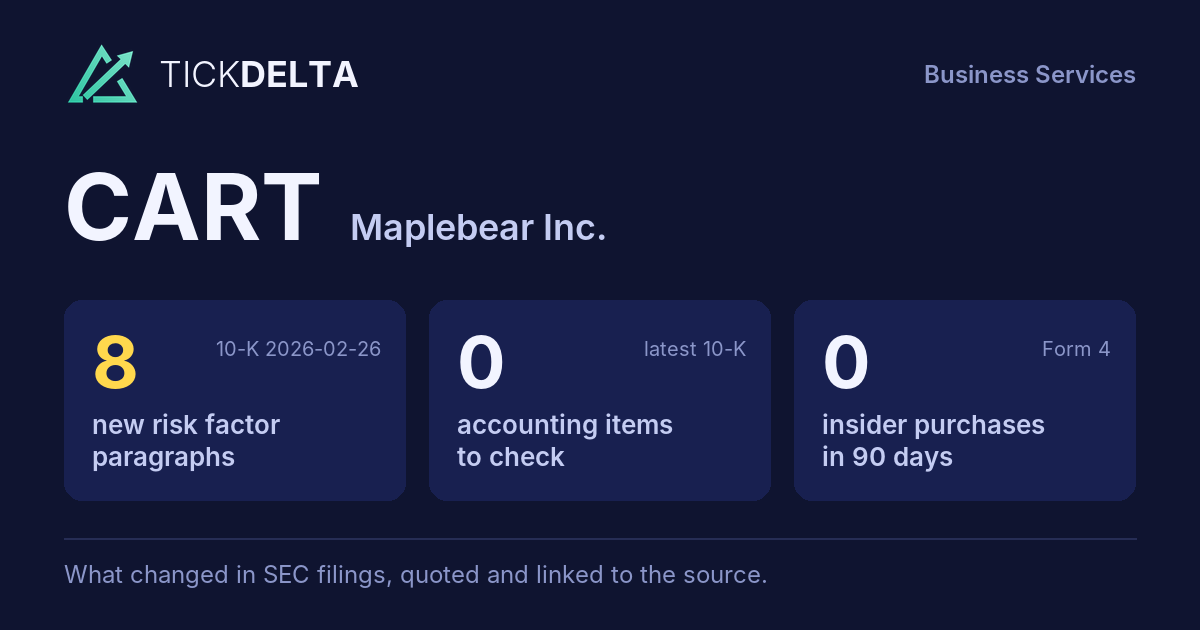
of the text changed · 39,873 words now · 8 new paragraphs, 22 gone
MD&A
22.4%
of the text changed · 11,370 words now · 12 new paragraphs, 7 gone
Legal Proceedings
25.6%
of the text changed · 2,107 words now
Accounting Policies
13.1%
of the text changed · 7,727 words now
10-K 0001579091-26-000018 (Feb 26, 2026) vs 10-K 0001579091-25-000015 (Feb 28, 2025)
Every paragraph, and how much of it changed
One bar per paragraph, in the order of the 10-K. Height and colour show the share of its words not in the closest paragraph a year earlier; the tallest bars are new paragraphs.
Risk Factors
381 paragraphs · 8 new · 157 reworded · 22 gone · 10-K Feb 26, 2026 against Feb 28, 2025
New paragraph
Reworded (5% of its words or more)
Same or nearly
Paragraph 145 · 48% changed
Every version of it
We have made substantial investments to expand our offerings and technologies to capitalize on new and unproven business opportunities, including new fulfillment options and use cases, international expansion, expansion into retail categories outside of grocery, the development of hardware products, and automated, AIML automated AI technologies. We intend to continue investing significant resources in developing these technologies, tools, initiatives, features, and offerings that we believe will enable our success in new markets or areas of business and/or strengthen our core business. For example, we have expanded our launched AI Solutions, a new collection of enterprise offerings to retailers in categories adjacent to the grocery industry, including alcohol, pharmacy, electronics, beauty, and home improvement. We also launched Connected Stores, a suite of in-store technologies, including artificial intelligence-powered shopping carts and customer checkout solutions, offered that bring AI-powered capabilities to our retail partners. If we do not spend our development budget efficiently or effectively on commercially successful and innovative technologies or ventures, or if we are unable to timely introduce and commercialize such offerings, we may not realize the expected benefits of our strategy. These initiatives also have a high degree of risk, as they involve nascent industries and unproven business strategies and technologies with which we have limited or no prior development or operating experience. Because these initiatives are new, they may involve claims and liabilities, expenses, regulatory challenges, and other risks, some of which we cannot currently anticipate. Certain initiatives may also involve committed incremental investments or payments over long periods of time before they become accretive to our revenue or margin, and if they never become accretive, we may be contractually obligated to make payments or incur expenses in connection with initiatives for an extended period without sufficient, or any, economic or financial benefit. Further, our development efforts with respect to new offerings and technologies could distract management from current operations and divert capital and other resources from our more established offerings and technologies. For example, the design, development, manufacture, and global distribution of hardware products produced by Caper will require continued investment in operating expenses, headcount, and executive time and attention.
Paragraph 156 · 48% changed
Every version of it
Demand for our offerings is highly sensitive to a range of factors, including our strategies relating to the amount of potential earnings required to attract shoppers, incentives paid to shoppers, and the fees we charge retailers, customers, and brands. Many factors, including operating costs, launching or scaling new strategic initiatives or use cases, legal and regulatory requirements, constraints constraints, or changes, supply chain issues, the price sensitivity of consumers in different income groups or other demographics, inflation, and our current and future competitors’ pricing and marketing strategies, have in the past significantly affected and may in the future significantly affect our pricing strategies. Competition, regulation, or other factors may cause us to change the pricing or implementation of our delivery or service fees for customers, increase the incentives we pay to shoppers that utilize Instacart, adjust the fees we charge retailers or brands, or increase our marketing and other expenses to attract and increase the engagement of retailers, customers, brands, and shoppers in response to competitive, regulatory, and other external pressures. For example, certain of our competitors offer, or may in the future offer, lower-priced or a broader range of offerings, including subscription offerings for bundled services. We may need Moreover, some jurisdictions in which we operate have established requirements to spend significant amounts on marketing engage certain delivery workers, including around shopper pay and both customer benefits, shopper access to our platform, and shopper incentives to deploy innovative and novel pricing and incentive strategies to retain or attract new customers and shoppers. We have launched, and may in the future launch, new or updated pricing strategies and initiatives, such as subscription offerings like Instacart+, and customer or shopper loyalty programs, or modify existing pricing methodologies or pricing models and fulfillment options, due to a variety other types of reasons, including to address changes in the market for our offerings as competitors introduce new offerings and features or in response to actions taken by our retail partners, to regulatory or other legal challenges, or as we launch and scale new strategic initiatives or use cases. These new or updated pricing strategies and initiatives may not ultimately be successful in attracting and engaging retailers, customers, brands, or shoppers or may negatively impact growth rates, customer retention, and engagement as well as our financial results. We also offer brands and retailers tools and products, including through our Eversight business, to enable them to optimize online pricing and promotions strategies. If these solutions fail to generate improved results for brands and retailer sales, brands and retailers may choose to not use such solutions. If these solutions negatively impact consumer price perception, our brand reputation and our ability to attract and retain customers could be harmed. The increasing complexity of our pricing models and related expansion of our business may also require us to update our internal systems for invoicing retailers or brands or incur costs to remediate errors or disputes in existing invoices. regulations
Paragraph 180 · 47% changed
Every version of it
Our accounts receivable are subject to collection and credit risks, which could negatively impact our results of operations and affect our liquidity and our ability to fully fund our ongoing operations. Retailers are generally obligated to pay our fees within 45 days of invoicing, and brands are generally obligated to do so within 30 to 90 days. In times of economic recession or uncertainty or as a result of any disruptive event such as uncertainty in the political and regulatory environment and financial markets or future public health outbreaks, the number of retailers or brands that default on payments owed to us may increase. In addition, our results of operations may be impacted by significant bankruptcies among retailers or brands, which could negatively impact our revenue and cash flows. We cannot assure you that our processes to monitor and mitigate these risks will be effective. If we fail to adequately assess and monitor our collection and credit risks, we could experience longer payment cycles, increased collection costs, and higher bad debt expense, and our business, financial condition, and results of operations could be harmed.
Paragraph 167 · 46% changed
Every version of it
Paragraph 83 · 45% changed
Every version of it
Paragraph 208 · 44% changed
Every version of it
Paragraph 235 · 44% changed
Every version of it
As part of our normal business activities, we collect, use, store, share, transmit, and otherwise process sensitive, proprietary, and confidential information, including personal information of retailers, customers, brands, shoppers, employees, and others. These activities We are regulated by subject to a variety of federal, state, local, and foreign privacy, data security, and data protection laws, regulations, and industry standards, which have become increasingly stringent in recent years. In addition, existing laws and regulations are complex and constantly evolving, and new laws and regulations that apply to our business are being introduced at every level of government in the United States, as well as internationally which could further restrict certain uses of the personal information of retailers, customers, brands, shoppers, employees, and others. We are, and may increasingly become, subject to various laws, regulations, and standards, and are subject to certain contractual obligations, industry standards, codes of conduct, and regulatory guidance relating to privacy, data security, and data protection in the jurisdictions in which we operate. Our efforts to comply with such obligations may not be successful.
Paragraph 221 · 49% changed
Every version of it
10-K Feb 28, 2025a new standard, referred to as the “ABC” test, for determining whether a company “employs” or is the “employer” for purposes of the California Wage Orders. The Dynamex decision altered the analysis of whether an individual has been properly classified as an independent contractor in California, making it more difficult to properly classify a worker as such. The California legislature subsequently codified the “ABC” test in the Dynamex decision as the default standard for independent contractor misclassification. On December 16, 2020, the California state ballot initiative, Proposition 22, which provides a framework that offers legal certainty regarding the status of independent workers offering delivery services and protects worker flexibility, the quality of on-demand work, and access to benefits for those who qualify, among other things, became effective. Although the constitutionality of Proposition 22 was subsequently challenged, on July 25, 2024, the California Supreme Court upheld Proposition 22 as constitutional. As a result, we expect Proposition 22 to provide more legal certainty over the status of independent workers offering delivery services in California. However, there may continue to be legal challenges, or legislative or other attempts to amend or otherwise invalidate the benefits, protections or the independent worker status provided by Proposition 22. Additionally, even though Proposition 22 was determined to be enforceable, we may still face allegations that certain of our business practices do not satisfy all the elements of Proposition 22. Further, Proposition 22 entitles shoppers in California to certain new pay standards and benefits, and imposes certain requirements, which increases costs for us in California, where a large number of shoppers who use Instacart are located. While we believe we properly provide all requisite pay standards and benefits under Proposition 22, we may nonetheless face various claims involving disputes over such pay standards and benefits.
10-K Feb 26, 2026
Further, the state of the law regarding independent contractor status varies from jurisdiction to jurisdiction and among governmental agencies and is subject to change based on court decisions and regulation. For example, Proposition 22 provides more legal certainty over the status of independent workers offering delivery services in California. However, there may continue to be legal challenges, or legislative or other attempts to amend or otherwise invalidate the benefits, protections, or the independent worker status provided by Proposition 22. To date, no such challenges or attempts have been successful. Additionally, we may face allegations that certain of our business practices do not satisfy all the elements
Paragraph 145 · 48% changed
Every version of it
10-K Feb 28, 2025
We have made substantial investments to expand our offerings and technologies to capitalize on new and unproven business opportunities, including new fulfillment options and use cases, expansion into retail categories outside of grocery, the development of hardware products, and automated, AIML technologies. We intend to continue investing significant resources in developing these technologies, tools, initiatives, features, and offerings that we believe will enable our success in new markets or areas of business and/or strengthen our core business. For example, we have expanded our offerings to retailers in categories adjacent to the grocery industry, including alcohol, pharmacy, electronics, beauty, and home improvement. We also launched Connected Stores, a suite of in-store technologies, including artificial intelligence-powered shopping carts and customer checkout solutions, offered to our retail partners. If we do not spend our development budget efficiently or effectively on commercially successful and innovative technologies or ventures, or if we are unable to timely introduce and commercialize such offerings, we may not realize the expected benefits of our strategy. These initiatives also have a high degree of risk, as they involve nascent industries and unproven business strategies and technologies with which we have limited or no prior development or operating experience. Because these initiatives are new, they may involve claims and liabilities, expenses, regulatory challenges, and other risks, some of which we cannot currently anticipate. Certain initiatives may also involve committed incremental investments or payments over long periods of time before they become accretive to our revenue or margin, and if they never become accretive, we may be contractually obligated to make payments or incur expenses in connection with initiatives for an extended period without sufficient, or any, economic or financial benefit. Further, our development efforts with respect to new offerings and technologies could distract management from current operations and divert capital and other resources from our more established offerings and technologies. For example, the design, development, manufacture, and global distribution of hardware products produced by Caper will require continued investment in operating expenses, headcount, and executive time and attention.
10-K Feb 26, 2026
We have made substantial investments to expand our offerings and technologies to capitalize on new and unproven business opportunities, including new fulfillment options and use cases, international expansion, expansion into retail categories outside of grocery, the development of hardware products, and automated AI technologies. We intend to continue investing significant resources in developing these technologies, tools, initiatives, features, and offerings that we believe will enable our success in new markets or areas of business and/or strengthen our core business. For example, we launched AI Solutions, a new collection of enterprise offerings that bring AI-powered capabilities to our retail partners. If we do not spend our development budget efficiently or effectively on commercially successful and innovative technologies
Paragraph 156 · 48% changed
Every version of it
10-K Feb 28, 2025
Demand for our offerings is highly sensitive to a range of factors, including our strategies relating to the amount of potential earnings required to attract shoppers, incentives paid to shoppers, and the fees we charge retailers, customers, and brands. Many factors, including operating costs, legal and regulatory requirements, constraints or changes, supply chain issues, the price sensitivity of consumers in different income groups or other demographics, inflation, and our current and future competitors’ pricing and marketing strategies, have in the past significantly affected and may in the future significantly affect our pricing strategies. Competition, regulation, or other factors may cause us to change the pricing or implementation of our delivery or service fees for customers, increase the incentives we pay to shoppers that utilize Instacart, adjust the fees we charge retailers or brands, or increase our marketing and other expenses to attract and increase the engagement of retailers, customers, brands, and shoppers in response to competitive, regulatory, and other external pressures. For example, certain of our competitors offer, or may in the future offer, lower-priced or a broader range of offerings, including subscription offerings for bundled services. We may need to spend significant amounts on marketing and both customer and shopper incentives to deploy innovative and novel pricing and incentive strategies to retain or attract new customers and shoppers. We have launched, and may in the future launch, new or updated pricing strategies and initiatives, such as subscription offerings like Instacart+, and customer or shopper loyalty programs, or modify existing pricing methodologies or pricing models and fulfillment options, due to a variety of reasons, including to address changes in the market for our offerings as competitors introduce new offerings and features or in response to actions taken by our retail partners, to regulatory or other legal challenges, or as we launch and scale new strategic initiatives or use cases. These new or updated pricing strategies and initiatives may not ultimately be successful in attracting and engaging retailers, customers, brands, or shoppers or may negatively impact growth rates, customer retention, and engagement as well as our financial results. We also offer brands and retailers tools and products, including through our Eversight business, to enable them to optimize online pricing and promotions strategies. If these solutions fail to generate improved results for brands and retailer sales, brands and retailers may choose to not use such solutions. If these solutions negatively impact consumer price perception, our brand reputation and our ability to attract and retain customers could be harmed. The increasing complexity of our pricing models and related expansion of our business may also require us to update our internal systems for invoicing retailers or brands or incur costs to remediate errors or disputes in existing invoices.
10-K Feb 26, 2026
Demand for our offerings is highly sensitive to a range of factors, including our strategies relating to the amount of potential earnings required to attract shoppers, incentives paid to shoppers, and the fees we charge retailers, customers, and brands. Many factors, including operating costs, launching or scaling new strategic initiatives or use cases, legal and regulatory requirements, constraints, or changes, supply chain issues, the price sensitivity of consumers in different income groups or other demographics, inflation, and our current and future competitors’ pricing and marketing strategies, have in the past significantly affected and may in the future significantly affect our pricing strategies. For example, certain of our competitors offer, or may in the future offer, lower-priced or a broader range of offerings, including subscription offerings for bundled services. Moreover, some jurisdictions in which we operate have established requirements to engage certain delivery workers, including around shopper pay and benefits, shopper access to our platform, and other types of regulations
Paragraph 180 · 47% changed
Every version of it
10-K Feb 28, 2025
Our accounts receivable are subject to collection and credit risks, which could negatively impact our results of operations and affect our liquidity and our ability to fully fund our ongoing operations. Retailers are generally obligated to pay our fees within 45 days of invoicing, and brands are generally obligated to do so within 30 to 90 days. In times of economic recession or uncertainty or as a result of any disruptive event such as uncertainty in the political and regulatory environment and financial markets or future public health outbreaks, the number of retailers or brands that default on payments owed to us may increase. In addition, our results of operations may be impacted by significant bankruptcies among retailers or brands, which could negatively impact our revenue and cash flows. We cannot assure you that our processes to monitor and mitigate these risks will be effective. If we fail to adequately assess and monitor our collection and credit risks, we could experience longer payment cycles, increased collection costs, and higher bad debt expense, and our business, financial condition, and results of operations could be harmed.
10-K Feb 26, 2026
Our accounts receivable are subject to collection and credit risks, which could negatively impact our results of operations and affect our liquidity and our ability to fully fund our ongoing operations. Retailers are generally obligated to pay our fees within 45 days of invoicing, and brands are generally obligated to do so within 30 to 90 days. In times of
Paragraph 167 · 46% changed
Every version of it
10-K Feb 28, 2025For example, our business is impacted by the amount of disposable income that consumers have to spend on online grocery shopping. Actual or perceived risks of an economic recession, elevated interest rates, cessation of or changes to government aid programs, and recent inflationary pressures have adversely impacted consumer disposable income and resulted in decreased customer retention and engagement as well as reduced advertising spending by brands. We may continue to experience these impacts, including as a result of tariffs or other trade restrictions enacted by the United States and responses by foreign governments to such policies. In addition, in response to adverse economic conditions or a decrease in discretionary income, consumers may opt to purchase groceries or other consumer goods themselves, instead of through Instacart, or choose to purchase groceries from bargain or other lower-cost retailers that are not on Instacart. We may not be able to fully offset higher costs through operational efficiencies and/or price optimizations, and while certain of our new offerings are focused on value and affordability, these initiatives may not fully offset pricing challenges faced by customers. In addition, increases in food, labor, fuel, rent, energy, supply, and other costs, many of which are beyond the control of our retail partners, have increased retailers’ operating costs and caused our retail partners to raise prices and may cause further price increases in the future. In many cases, these retailers may not be able to pass along these increased costs to consumers and, as a result, may reduce product offerings or cease operations. If spending at many of the retailers in our network declines, or if a significant number of these retailers goes out of business, consumers may be less likely to use our service, which could harm our business and results of operations. Reduced customer spending on Instacart could also cause our retail partners to reduce or cease engagement with Instacart. Further, increases in gas prices or other factors that increase the costs to operate motor vehicles could make it prohibitively expensive for shoppers to deliver to customers.
10-K Feb 26, 2026
reduce product offerings or cease operations. If spending at many of the retailers in our network declines, or if a significant number of these retailers goes out of business, consumers may be less likely to use our service, which could harm our business and results of operations. Reduced customer spending on Instacart could also cause our retail partners to reduce or cease engagement with Instacart. Further, increases in gas prices or other factors that increase the costs to operate motor vehicles could make it prohibitively expensive for shoppers to deliver to customers.
Paragraph 83 · 45% changed
Every version of it
10-K Feb 28, 2025We currently generate significant GTV and revenue from a small number of retailers. Our top three retailers accounted for approximately 43% of our GTV for the years ended December 31, 2022 and 2023, and 42% for the year ended December 31, 2024. While GTV and revenue from our largest retail partners may decrease as a percent of our total GTV and revenue over time as we generate more GTV and revenue from other retailers, we believe that GTV and revenue from our largest retailers will continue to account for a significant portion of our GTV and revenue for the foreseeable future. If any of these retailers were to suspend, limit, or cease their operations or otherwise terminate their relationships with us, the attractiveness of Instacart to consumers and brands could be materially and adversely affected.
10-K Feb 26, 2026
any of these retailers were to suspend, limit, or cease their operations or otherwise terminate their relationships with us, the attractiveness of Instacart to consumers and brands could be materially and adversely affected.
Paragraph 208 · 44% changed
Every version of it
10-K Feb 28, 2025Our business is subject to changing laws, rules, and regulations, including, without limitation, federal, state, and local laws, and in the future, country specific laws, governing the internet, e-commerce, and hardware devices, including electronic payments, privacy, data security, data protection, the use of AIML technologies, pay and fee transparency, health information privacy and security, consumer protection, marketing and advertising, gift cards, health and safety, food and product safety, product labeling and traceability, import and export, zoning and permitting, hardware device certification, sustainability, environmental, tax, insurance, employment, weights and measures, alcohol and other age-restricted products, and worker classification compensation, and transparency. Some of these laws were adopted prior to the advent of the internet and mobile and related technologies and, as a result, do not contemplate or address the unique issues of the internet and related technologies. New laws and regulations have been and may continue to be adopted, implemented, or interpreted to apply to us, and existing laws and regulations that we currently comply with and operate under may be interpreted differently in the future, including as a result of changes to our business. Some of these laws and regulations will, or may in the future, require us to change our business and operations or pricing, which may be costly and harm our customer retention and engagement as well as our results of operations. Recent financial, political, and other events may increase the level of regulatory scrutiny on larger companies, technology companies in general, and in particular, companies in the “gig economy” that rely on the services of independent contractors.
10-K Feb 26, 2026
under may be interpreted differently in the future, including as a result of changes to our business. Some of these laws and regulations will, or may in the future, require us to change our business and operations, pricing, or fee disclosures, which may be costly and harm our customer retention and engagement as well as our results of operations. Recent financial, political, and other events may increase the level of regulatory scrutiny on larger companies, technology companies in general, and in particular, companies in the “gig economy” that rely on the services of independent contractors.
Paragraph 235 · 44% changed
Every version of it
10-K Feb 28, 2025
As part of our normal business activities, we collect, use, store, share, transmit, and otherwise process sensitive, proprietary, and confidential information, including personal information of retailers, customers, brands, shoppers, employees, and others. These activities are regulated by a variety of federal, state, local, and foreign privacy, data security, and data protection laws, regulations, and industry standards, which have become increasingly stringent in recent years. In addition, existing laws and regulations are complex and constantly evolving, and new laws and regulations that apply to our business are being introduced at every level of government in the United States, as well as internationally which could further restrict certain uses of the personal information of retailers, customers, brands, shoppers, employees, and others. We are, and may increasingly become, subject to various laws, regulations, and standards, and are subject to certain contractual obligations, industry standards, codes of conduct, and regulatory guidance relating to privacy, data security, and data protection in the jurisdictions in which we operate. Our efforts to comply with such obligations may not be successful.
10-K Feb 26, 2026
As part of our normal business activities, we collect, use, store, share, transmit, and otherwise process sensitive, proprietary, and confidential information, including personal information of retailers, customers, brands, shoppers, employees, and others. We are subject to a variety of federal, state, local, and foreign privacy, data security, data
MD&A
176 paragraphs · 12 new · 89 reworded · 7 gone · 10-K Feb 26, 2026 against Feb 28, 2025
New paragraph
Reworded (5% of its words or more)
Same or nearly
Paragraph 37 · 50% changed
Paragraph 74 · 48% changed
The increase in the provision for income taxes during fiscal year 2024, 2025, compared to fiscal year 2023, 2024, was primarily driven by the tax benefit related to the recognition of stock-based compensation expense, including certain restructurings associated with the vested RSUs as expense and a result of the satisfaction of the liquidity event-based vesting condition upon the effective date of our registration statement on Form S-1 filed under the Securities Act in connection with our IPO in the third quarter of 2023. decrease to federal and state research and development credits generated during 2025.
Paragraph 60 · 47% changed
Year Ended December 31, 2022 2023 2024 2025 $ Change % Change (in millions, except percentages) Cost of revenue $ 720 $ 764 $ 836 Adjusted to exclude the following: Depreciation and amortization expense (20) (25) (37) Stock-based compensation expense — (18) (8) Adjusted cost of revenue $ 700 $ 721 $ 791 Cost of revenue as a percent of GTV 2.5 % 2.5 % 2.5 % Adjusted cost of revenue as a percent of GTV 2.4 % 2.4 % 2.4 % $836 $984 $148 18% Gross profit $2,542 $2,758 $216 8% Gross margin 75% 74%
Paragraph 65 · 43% changed
Year Ended December 31, 2022 2023 2024 2025 $ Change % Change (in millions, except percentages) Cost Research and development $ 604 $ 650 $45 8% Percent of revenue $ 720 $ 764 $ 836 Adjusted to exclude the following: Depreciation and amortization expense (20) (25) (37) Stock-based compensation expense — (18) (8) Adjusted cost of revenue $ 700 $ 721 $ 791 Cost of revenue as a percent of GTV 2.5 18 % 2.5 17 % 2.5 % Adjusted cost of revenue as a percent of GTV 2.4 % 2.4 % 2.4 %
Paragraph 67 · 43% changed
Year Ended December 31, 2022 2023 2024 2025 $ Change % Change (in millions, except percentages) Cost Sales and marketing $ 808 $ 854 $47 6% Percent of revenue $ 720 $ 764 $ 836 Adjusted to exclude the following: Depreciation and amortization expense (20) (25) (37) Stock-based compensation expense — (18) (8) Adjusted cost of revenue $ 700 $ 721 $ 791 Cost of revenue as a percent of GTV 2.5 24 % 2.5 23 % 2.5 % Adjusted cost of revenue as a percent of GTV 2.4 % 2.4 % 2.4 %
Paragraph 69 · 43% changed
Year Ended December 31, 2022 2023 2024 2025 $ Change % Change (in millions, except percentages) Cost General and administrative $ 363 $ 482 $119 33% Percent of revenue $ 720 $ 764 $ 836 Adjusted to exclude the following: Depreciation and amortization expense (20) (25) (37) Stock-based compensation expense — (18) (8) Adjusted cost of revenue $ 700 $ 721 $ 791 Cost of revenue as a percent of GTV 2.5 11 % 2.5 13 % 2.5 % Adjusted cost of revenue as a percent of GTV 2.4 % 2.4 % 2.4 %
Paragraph 92 · 43% changed
(3) Represents certain legal, regulatory, and policy expenses expenses, including those related to worker classification matters. classification, as well as non-recurring intellectual property matters and regulatory settlements.
Paragraph 126 · 43% changed
(3) Represents certain legal, regulatory, and policy expenses expenses, including those related to worker classification matters. classification, as well as non-recurring intellectual property matters and regulatory settlements.
Paragraph 37 · 50% changed
10-K Feb 28, 2025Research and development expense primarily consists of compensation costs for our engineering employees, third-party consulting fees, allocations of various overhead and occupancy costs, and depreciation and amortization expense. Compensation costs include salaries, taxes, benefits, bonuses, and stock-based compensation expense.
10-K Feb 26, 2026
Compensation costs include salaries, taxes, benefits, bonuses, and stock-based compensation expense.
Paragraph 74 · 48% changed
10-K Feb 28, 2025
The increase in the provision for income taxes during fiscal year 2024, compared to fiscal year 2023, was primarily driven by the tax benefit related to the recognition of stock-based compensation expense, including certain restructurings associated with the vested RSUs as a result of the satisfaction of the liquidity event-based vesting condition upon the effective date of our registration statement on Form S-1 filed under the Securities Act in connection with our IPO in the third quarter of 2023.
10-K Feb 26, 2026
The increase in the provision for income taxes during 2025, compared to 2024, was primarily driven by the tax benefit related to the recognition of stock-based compensation expense and a decrease to federal and state research and development credits generated during 2025.
Paragraph 60 · 47% changed
10-K Feb 28, 2025
Year Ended December 31, 2022 2023 2024 (in millions, except percentages) Cost of revenue $ 720 $ 764 $ 836 Adjusted to exclude the following: Depreciation and amortization expense (20) (25) (37) Stock-based compensation expense — (18) (8) Adjusted cost of revenue $ 700 $ 721 $ 791 Cost of revenue as a percent of GTV 2.5 % 2.5 % 2.5 % Adjusted cost of revenue as a percent of GTV 2.4 % 2.4 % 2.4 %
10-K Feb 26, 2026
Year Ended December 31, 2024 2025 $ Change % Change (in millions, except percentages) Cost of revenue $836 $984 $148 18% Gross profit $2,542 $2,758 $216 8% Gross margin 75% 74%
Paragraph 65 · 43% changed
10-K Feb 28, 2025
Year Ended December 31, 2022 2023 2024 (in millions, except percentages) Cost of revenue $ 720 $ 764 $ 836 Adjusted to exclude the following: Depreciation and amortization expense (20) (25) (37) Stock-based compensation expense — (18) (8) Adjusted cost of revenue $ 700 $ 721 $ 791 Cost of revenue as a percent of GTV 2.5 % 2.5 % 2.5 % Adjusted cost of revenue as a percent of GTV 2.4 % 2.4 % 2.4 %
10-K Feb 26, 2026
Year Ended December 31, 2024 2025 $ Change % Change (in millions, except percentages) Research and development $ 604 $ 650 $45 8% Percent of revenue 18 % 17 %
Paragraph 67 · 43% changed
10-K Feb 28, 2025
Year Ended December 31, 2022 2023 2024 (in millions, except percentages) Cost of revenue $ 720 $ 764 $ 836 Adjusted to exclude the following: Depreciation and amortization expense (20) (25) (37) Stock-based compensation expense — (18) (8) Adjusted cost of revenue $ 700 $ 721 $ 791 Cost of revenue as a percent of GTV 2.5 % 2.5 % 2.5 % Adjusted cost of revenue as a percent of GTV 2.4 % 2.4 % 2.4 %
10-K Feb 26, 2026
Year Ended December 31, 2024 2025 $ Change % Change (in millions, except percentages) Sales and marketing $ 808 $ 854 $47 6% Percent of revenue 24 % 23 %
Paragraph 69 · 43% changed
10-K Feb 28, 2025
Year Ended December 31, 2022 2023 2024 (in millions, except percentages) Cost of revenue $ 720 $ 764 $ 836 Adjusted to exclude the following: Depreciation and amortization expense (20) (25) (37) Stock-based compensation expense — (18) (8) Adjusted cost of revenue $ 700 $ 721 $ 791 Cost of revenue as a percent of GTV 2.5 % 2.5 % 2.5 % Adjusted cost of revenue as a percent of GTV 2.4 % 2.4 % 2.4 %
10-K Feb 26, 2026
Year Ended December 31, 2024 2025 $ Change % Change (in millions, except percentages) General and administrative $ 363 $ 482 $119 33% Percent of revenue 11 % 13 %
Paragraph 92 · 43% changed
10-K Feb 28, 2025
(3) Represents certain legal, regulatory, and policy expenses related to worker classification matters.
10-K Feb 26, 2026
(3) Represents certain legal, regulatory, and policy expenses, including those related to worker classification, as well as non-recurring intellectual property matters and regulatory settlements.
Paragraph 126 · 43% changed
10-K Feb 28, 2025
(3) Represents certain legal, regulatory, and policy expenses related to worker classification matters.
10-K Feb 26, 2026
(3) Represents certain legal, regulatory, and policy expenses, including those related to worker classification, as well as non-recurring intellectual property matters and regulatory settlements.
A paragraph is matched with the one last year that shares the most of its words; under half in common makes it new. The paragraphs shown are the 8 reworded the most in each section.
The paragraph that changed most in each section
The redline
Marked against last year's 10-K: cut words struck through, new words highlighted.
Risk Factors367 words changed in this paragraph; it is 40% similar to last year's version.
Demand for our offerings is highly sensitive to a range of factors, including our strategies relating to the amount of potential earnings required to attract shoppers, incentives paid to shoppers, and the fees we charge retailers, customers, and brands. Many factors, including operating costs, launching or scaling new strategic initiatives or use cases, legal and regulatory requirements, constraints constraints, or changes, supply chain issues, the price sensitivity of consumers in different income groups or other demographics, inflation, and our current and future competitors’ pricing and marketing strategies, have in the past significantly affected and may in the future significantly affect our pricing strategies. Competition, regulation, or other factors may cause us to change the pricing or implementation of our delivery or service fees for customers, increase the incentives we pay to shoppers that utilize Instacart, adjust the fees we charge retailers or brands, or increase our marketing and other expenses to attract and increase the engagement of retailers, customers, brands, and shoppers in response to competitive, regulatory, and other external pressures. For example, certain of our competitors offer, or may in the future offer, lower-priced or a broader range of offerings, including subscription offerings for bundled services. We may need Moreover, some jurisdictions in which we operate have established requirements to spend significant amounts on marketing engage certain delivery workers, including around shopper pay and both customer benefits, shopper access to our platform, and shopper incentives to deploy innovative and novel pricing and incentive strategies to retain or attract new customers and shoppers. We have launched, and may in the future launch, new or updated pricing strategies and initiatives, such as subscription offerings like Instacart+, and customer or shopper loyalty programs, or modify existing pricing methodologies or pricing models and fulfillment options, due to a variety other types of reasons, including to address changes in the market for our offerings as competitors introduce new offerings and features or in response to actions taken by our retail partners, to regulatory or other legal challenges, or as we launch and scale new strategic initiatives or use cases. These new or updated pricing strategies and initiatives may not ultimately be successful in attracting and engaging retailers, customers, brands, or shoppers or may negatively impact growth rates, customer retention, and engagement as well as our financial results. We also offer brands and retailers tools and products, including through our Eversight business, to enable them to optimize online pricing and promotions strategies. If these solutions fail to generate improved results for brands and retailer sales, brands and retailers may choose to not use such solutions. If these solutions negatively impact consumer price perception, our brand reputation and our ability to attract and retain customers could be harmed. The increasing complexity of our pricing models and related expansion of our business may also require us to update our internal systems for invoicing retailers or brands or incur costs to remediate errors or disputes in existing invoices. regulations
Source: Item 1A, 10-K 0001579091-26-000018 vs Item 1A, 10-K 0001579091-25-000015
MD&A263 words changed in this paragraph; it is 40% similar to last year's version.
For the year ended December 31, 2024, 2025, net cash provided by operating activities was $687 $971 million, which consisted of net income of $457 million, adjusted by $447 million and adjustments for certain non-cash items of $449 $586 million, primarily from stock-based compensation expense of $300 million, and partially offset by net cash outflows from changes in operating assets and liabilities of $219 $61 million. The year over year increase in net income from a net loss of $1,622 million to net income of $457 million was Adjustments for certain non-cash items were primarily driven by a year over year decrease in stock-based compensation expense due to of $352 million, which increased from the vesting of RSUs and restricted stock as a result of the satisfaction of the liquidity event-based vesting condition upon the effective date of the registration statement on Form S-1 filed under the Securities Act in connection with our initial public offering in the prior year, in addition to the growth of our business and further optimization of expenses. The year over year decrease in net changes ended December 31, 2024. Fluctuations in operating assets and liabilities, which impacted cash provided by operating activities, from a net cash outflow of $165 million to $219 million was primarily liabilities were driven by general business impacts such as including (i) the timing of customer, vendor, and other third party payments and accruals including legal, regulatory, and non-recurring intellectual property matters; (ii) the timing of customer collections impacted by due to the collection of a large accounts receivable balance from a retailer and the mix of transaction types, such as those involving EBT SNAP and alcohol sales, SNAP, which result in longer and uneven collection cycles, lower release cycles; (iii) the timing of sales tax reserves due to resolutions spend and usage of certain state examinations in the prior year, software subscriptions for hosting arrangements; and (iv) the overall growth of our business, and business. Included in regulatory accruals above is the timing of customer, vendor, and other third party payments. $60 million settlement with the FTC, which was paid with cash on hand in January 2026.
Source: Item 7, 10-K 0001579091-26-000018 vs Item 7, 10-K 0001579091-25-000015
Legal Proceedings151 words changed in this paragraph; it is 63% similar to last year's version.
The Company has also been, is also currently, and may in the future be involved in administrative audits with various state and local enforcement agencies, including audits related to shopper classification, state and local ordinance requirements, and unemployment insurance and workers’ compensation contributions, contributions. The Company is currently involved in Alaska, Florida, New Jersey, New York, and Pennsylvania. such audits in several states. The Company believes that it complies with applicable legal requirements and that shoppers are properly classified as independent contractors; therefore, the Company disputes that it is obligated to provide such additional benefits under state law and plans to vigorously contest any adverse assessment or determination. The Company’s chances of success on the merits are still uncertain, such uncertain; however, the Company records a liability within accrued and other current liabilities when it believes that any reasonably possible it is both probable that a loss or range of loss cannot has been incurred and the amount can be estimated. However, the The results of these audits audits, assessments, or any negotiated agreements with these agencies, may result in additional payments, including settlement payments, penalties, and interest, and such additional amounts could have a material impact on the Company’s business, financial conditions, results of operations, and cash flows. In March 2023, the Company entered into a settlement agreement with the California Employment Development Department to resolve disputes concerning alleged unemployment insurance contributions for $32 million. In April 2023, the settlement became effective after the approval by the California Attorney General and an Administrative Law Judge of the California Unemployment Insurance Appeal Board. This amount was previously accrued for and subsequently paid during the year ended December 31, 2023.
Source: Item 3, via Note 10 – Commitments and Contingencies, 10-K 0001579091-26-000018 vs Item 3, via Note 9 – Commitments and Contingencies, 10-K 0001579091-25-000015
Accounting Policies77 words changed in this paragraph; it is 31% similar to last year's version.
Source: Item 8, Note 2 – Significant Accounting Policies, 10-K 0001579091-26-000018 vs Item 8, Note 2 – Significant Accounting Policies, 10-K 0001579091-25-000015
Sentences and paragraphs added, removed or reworded
Every change, by type
Sentences and paragraphs of CART's Risk Factors and MD&A, 10-K Feb 26, 2026 against 10-K Feb 28, 2025. Each links to the text at sec.gov.
Quiet changes are sentences kept from last year with one to four words changed, at least one of them a hedge, a modal or a qualifier (may, could, will, not, significant, material…). A year or date rolling forward is not counted.
The full word list
adverse, adversely, all, although, anticipate, anticipates, any, approximately, believe, believes, can, cannot, certain, could, expect, expects, generally, however, if, intend, intends, largely, likely, many, material, materially, may, might, most, must, never, no, not, possible, primarily, probable, should, significant, significantly, some, substantial, substantially, unlikely, will, would
AddedRisk Factors
•market acceptance of online grocery shopping and our in-store technology offerings;
Read it in 10-K Feb 26, 2026 at sec.gov
AddedRisk Factors
Many customers initially access Instacart to take advantage of certain promotions, such as discounts and other reduced fees. We strive to demonstrate the value of our offerings to such customers, thereby encouraging them to access Instacart regularly or subscribe to Instacart+, through prompts, notifications, and reduced fees or time-limited trials of Instacart+ and other offerings. However, these customers or other customers we acquire inorganically may be lower intent users of Instacart with reduced engagement compared to customers that we acquire organically, may never convert to paying Instacart+ members, or may discontinue using Instacart after they take advantage of our promotions. Further, our initiatives to retain customers, such as encouraging them to subscribe to Instacart+ or providing additional use cases and fulfillment
Read it in 10-K Feb 26, 2026 at sec.gov
AddedRisk Factors
options, may result in negative impacts to other metrics. For example, an increase in Instacart+ orders, changes in product categories shopped, reduced spend on more premium or discretionary products, or a shift toward convenience or priority, may result in a decrease in average order value. Such shifts may also negatively impact certain retailers’ and brands’ actual or perceived benefit from engaging with Instacart.
Read it in 10-K Feb 26, 2026 at sec.gov
AddedRisk Factors
collection, and credit risks, our ability to hire and retain highly skilled personnel, our ability to effectively scale our operations, and the continuing evolution of the online grocery industry, many of which are beyond our control.
Read it in 10-K Feb 26, 2026 at sec.gov
AddedRisk Factors
•timing of strategic investments and expenditures, including international expansion;
Read it in 10-K Feb 26, 2026 at sec.gov
AddedRisk Factors
and the existing seasonality and customer and shopper behavior that we experience may change or become more significant, which would contribute to fluctuations in our results of operations.
Read it in 10-K Feb 26, 2026 at sec.gov
AddedRisk Factors
If shoppers or individuals impersonating shoppers or customers engage in criminal activity, fraud, including identity theft, use of stolen or fraudulent credit card data, misconduct, breach of our terms of service, or inappropriate conduct or use Instacart as a conduit for criminal activity, or we fail to identify or detect, or experience delays in identifying or detecting such activity or events, or if we are prevented from deactivating such individuals or otherwise taking action to
Read it in 10-K Feb 26, 2026 at sec.gov
AddedRisk Factors
•changing perceptions or reputation of U.S. products and services in non-U.S. markets;
Read it in 10-K Feb 26, 2026 at sec.gov
Show the other 61
RemovedRisk Factors
RemovedRisk Factors
RemovedRisk Factors
RemovedRisk Factors
RemovedRisk Factors
RemovedRisk Factors
RemovedRisk Factors
RemovedRisk Factors
RemovedRisk Factors
RemovedRisk Factors
RemovedRisk Factors
RemovedRisk Factors
RewordedRisk Factors
We have in the past been, are subject to investigations currently, and may in the future become, involved in claims, lawsuits, arbitration proceedings, administrative actions, government investigations, and other legal and regulatory proceedings relating to various matters matters, including whether we fulfilled our contractual obligations to or improperly withheld pay or tips from shoppers, whether we adequately protected the public’s or shoppers’ health and safety, whether we properly provide protected leave, whether we properly paid sales tax, taxes, whether we properly implemented and disclosed our service fees, whether we improperly conduct background checks of shoppers, and whether we are responsible for injury resulting from alleged shopper actions or negligence. negligence, as well as those involving bodily injury and property damage, labor and employment, anti-discrimination claims, commercial and contract disputes, unfair competition, consumer protection regulations, including fees, pricing, and related disclosures, marketing practices, and automatic renewal laws, intellectual property, transactions involving our securities, privacy, data security, and data protection, environmental laws and regulations, health and safety, weights and measures, compliance with regulatory requirements, and other matters.
Read it in 10-K Feb 26, 2026 at sec.gov
RewordedRisk Factors
Our efforts to maintain and increase our profitability may not succeed due to factors such as evolving consumer behavior trends in grocery shopping, including the impacts of future public health outbreaks, impacts on prices of goods due to trade policies enacted or proposed by the United States, such as tariffs or other trade restrictions, uncertainty related thereto, and responses by foreign governments to such policies, inflationary pressures or other factors, actual or perceived risk of an economic recession, unfavorable macroeconomic conditions, customer engagement and retention, changes in our revenue mix and retailer, customer, and brand partner fees, the costs associated with complying with evolving regulatory regimes, including costs associated with order fulfillment, collection and credit risks, our ability to hire and retain highly skilled personnel, unfavorable macroeconomic conditions, our ability to effectively scale our operations, and the continuing evolution of the online grocery industry, many of which are beyond our control.
Read it in 10-K Feb 26, 2026 at sec.gov
RewordedRisk Factors
Actual or perceived risks of an economic recession, elevated interest rates, cessation of of, interruptions to, or changes to government aid programs, tariffs or other trade restrictions enacted by the United States and recent responses by foreign governments to such policies, and inflationary pressures have adversely impacted consumer disposable income in the past resulted and resulted may in the future result in decreased customer retention and engagement as consumers may opt to purchase groceries or other consumer goods themselves, instead of through Instacart, or choose to purchase groceries from bargain or other lower-cost retailers that are not on Instacart, as well as reduced advertising spending by brands.
Read it in 10-K Feb 26, 2026 at sec.gov
RewordedRisk Factors
Our business is subject to complex and changing laws, rules, and regulations, regulations in the United States and other jurisdictions in which we operate, including, without limitation, federal, state, those governing internet usage and local laws, and in the future, country specific laws, governing the internet, access, e-commerce, and hardware devices, including electronic payments, privacy, data security, data protection, the use of AIML technologies, AI, machine learning, automated decision-making, pay and fee transparency, health information privacy and security, consumer protection, marketing and advertising, advertising (including terms and conditions and disclosure), gift cards, health and safety, food and product safety, product labeling and traceability, import and export, zoning and permitting, hardware device certification, sustainability, environmental, tax, insurance, employment, weights and measures, alcohol and other age-restricted products, collective bargaining, worker classification, and worker classification compensation, shopper rights and transparency. compensation (including minimum earnings).
Read it in 10-K Feb 26, 2026 at sec.gov
RewordedRisk Factors
If such mobile operating systems or app marketplaces limit or prohibit us from making our apps available to retailers, customers, brands, or shoppers, make changes that degrade the functionality of our apps, change the way we collect or use data, increase the cost of using our apps, impose terms of use unsatisfactory to us, alter how we collect fees, increase our compliance costs, impair or inhibit our ability to enter into partnerships or effectively market partnerships, or modify their search or ratings algorithms in ways that are detrimental to us, or if our competitors’ placement in such mobile operating systems’ app marketplace is more prominent than the placement of our apps, our
Read it in 10-K Feb 26, 2026 at sec.gov
RewordedRisk Factors
We have launched, and may in the future launch, new or updated pricing strategies and initiatives, such as subscription offerings like Instacart+, and customer or shopper loyalty programs, or we may modify existing pricing methodologies or pricing models and fulfillment options, due to a variety of reasons, including to address changes in the market for our offerings as competitors introduce new offerings and features or in response to actions taken by our retail partners, to regulatory or other legal challenges, or as we launch and scale new strategic initiatives or use cases. options.
Read it in 10-K Feb 26, 2026 at sec.gov
RewordedRisk Factors
However, our growth rates have decreased from what we historically experienced and may continue to decrease or fluctuate as a result of macroeconomic and geopolitical uncertainty, conflicts, including as a result of trade policies enacted or proposed by the United States, such as tariffs or other trade restrictions enacted by the United States restrictions, uncertainty related thereto, and responses by foreign governments to such policies, inflation risk, actual or perceived risk of an economic recession, cessation of, interruptions to, or changes to government aid programs, the effects of severe weather patterns, increasing competition, strategic initiatives, and the maturation of our business, among others.
Read it in 10-K Feb 26, 2026 at sec.gov
RewordedRisk Factors
The GDPR and UK GDPR impose strict requirements for processing personal data of individuals, give individuals extensive rights with respect to their personal data, and carry penalties and potential corrective action for violations of up to the greater of EUR 20 million or 4% of total global annual turnover in the European Union, violations, and up to the greater of GBP 17.5 million or 4% total global annual turnover in the United Kingdom. provide for private litigation.
Read it in 10-K Feb 26, 2026 at sec.gov
RewordedRisk Factors
In particular, macroeconomic factors, including trade policies enacted or proposed by the United States, such as tariffs or other trade restrictions, uncertainty related thereto, and responses by foreign governments to such policies, inflationary pressures, elevated interest rates, actual or perceived risks of an economic recession, and bank failures have caused disruption in the credit and financial markets in the United States and worldwide, which may reduce our ability to access capital and negatively affect our liquidity in the future.
Read it in 10-K Feb 26, 2026 at sec.gov
RewordedRisk Factors
RewordedRisk Factors
For example, we have seen and may continue to see reduced demand for advertising from brands that are exercising caution with their spending budgets and either slowing or reducing their campaigns due to, among other things, macroeconomic uncertainty, including as a result of trade policies enacted or proposed by the United States, such as tariffs or other trade restrictions enacted by the United States restrictions, uncertainty related thereto, and responses by foreign governments to such policies, global supply chain disruptions, labor shortages or disputes, changing consumer preferences, geopolitical conflicts including the war in Ukraine and conflicts in the Middle East, conflicts, and reduced consumer confidence.
Read it in 10-K Feb 26, 2026 at sec.gov
RewordedRisk Factors
In addition, impacts to brand partner partners have in the past reduced, and may in the future reduce, their spend on Instacart as a result of decreases in our GTV growth, along with the timing of adoption of new advertising formats and offerings, have or for any other reason, which has in the past resulted and may continue to result in reductions in the growth of brand partner digital marketing spend on Instacart and related decreases in advertising and other revenue growth in future periods.
Read it in 10-K Feb 26, 2026 at sec.gov
Quiet changesRisk Factors
We and certain of our third-party providers regularly experience cyberattacks and other security incidents, and we expect such attacks and incidents to continue.
Read it in 10-K Feb 26, 2026 at sec.gov
Quiet changesRisk Factors
In particular, if as we were to continue expanding internationally, we may be required to change our pricing strategies and to adjust to different cultural norms, including with respect to consumer pricing and gratuities.
Read it in 10-K Feb 26, 2026 at sec.gov
Quiet changesRisk Factors
In addition, we offer certain features or use cases to our customers, such as restaurants, through certain collaborations.
Read it in 10-K Feb 26, 2026 at sec.gov
Quiet changesRisk Factors
We may operate in jurisdictions that provide limited internet connectivity, particularly if as we continue to expand internationally.
Read it in 10-K Feb 26, 2026 at sec.gov
Quiet changesRisk Factors
Additionally, actuarial projections make no provision for the extraordinary future emergence of losses or types of losses not sufficiently represented in the historical data or which are not yet quantifiable.
Read it in 10-K Feb 26, 2026 at sec.gov
Quiet changesRisk Factors
Furthermore, there is an increasing number of open-source software license types, almost none many of which have been tested in a court of law, resulting in a dearth of guidance regarding the proper legal interpretation of such licenses.
Read it in 10-K Feb 26, 2026 at sec.gov
AddedMD&A
For purposes of clarity and ease of presentation, numbers presented within this section may not sum precisely to the totals provided. The underlying data used in the calculations, including percentages, is not rounded.
Read it in 10-K Feb 26, 2026 at sec.gov
AddedMD&A
Instacart is the leading technology and enablement partner for the grocery industry — helping consumers save time, retailers run their businesses online and in-store, and connect brands with customers.
Read it in 10-K Feb 26, 2026 at sec.gov
AddedMD&A
When shopping for groceries, consumers want selection, quality, affordability, and convenience, and they shop in many different ways. Customers can place orders for delivery or pickup across a variety of use cases including the weekly shop, bulk stock-up, convenience, special occasions, from restaurants, and using our in-store technologies. We help our customers shop at their favorite retailers, order from their favorite restaurants, and enjoy selection, quality, affordability, and convenience. Our membership program, Instacart+, offers expanded customer benefits including unlimited $0 delivery fees on orders over a certain size, and other exclusive benefits.
Read it in 10-K Feb 26, 2026 at sec.gov
AddedMD&A
Instacart Ads offers brands a highly measurable ads offering that leverages first-party transaction data to move products off store shelves more efficiently. We provide discovery and attractive return on investment through our industry-leading advertising tools and insights purpose-built for the online grocery category.
Read it in 10-K Feb 26, 2026 at sec.gov
AddedMD&A
We offer shoppers an immediate, flexible earnings opportunity that allows them to choose when and how much to work. Shoppers are deeply valued members of the Instacart community, and we strive to make the shopping experience as seamless as possible so they can continue to deliver superior customer service.
Read it in 10-K Feb 26, 2026 at sec.gov
AddedMD&A
As previously announced, Fidji Simo resigned as our Chief Executive Officer and President on August 15, 2025, and we appointed Chris Rogers as our Chief Executive Officer, President, and a member of our board of directors, all effective as of that date. Ms. Simo initially continued to serve as Chair of our board of directors in order to ensure a smooth transition. On November 24, 2025, Ms. Simo resigned as Chair and a member of our board of directors, and Chris Rogers was appointed as Chair.
Read it in 10-K Feb 26, 2026 at sec.gov
AddedMD&A
On July 4, 2025, the One Big Beautiful Bill Act (“OBBBA”) was enacted into law. The OBBBA introduces changes to U.S. tax law, with certain provisions applicable to us beginning in 2025. These changes include the immediate expensing of domestic research and experimental expenditures, accelerated tax deductions for qualified property, and modifications to certain international tax frameworks. These changes were incorporated into the provision for income taxes for the year ended December 31, 2025, resulting in a decrease in deferred tax assets, offset by a corresponding decrease in income tax payable. The provisions under the OBBBA did not have a material impact on our provision for income tax for the year ended December 31, 2025.
Read it in 10-K Feb 26, 2026 at sec.gov
AddedMD&A
The decrease in operations and support expense during 2025, compared to 2024, was immaterial.
Read it in 10-K Feb 26, 2026 at sec.gov
AddedMD&A
Year Ended December 31, 2024 2025 $ Change % Change (in millions, except percentages) Interest income $66 $57 $ (10) (15)%
Read it in 10-K Feb 26, 2026 at sec.gov
AddedMD&A
Year Ended December 31, 2024 2025 $ Change % Change (in millions, except percentages) Provision for (benefit from) income taxes $95 $109 $14 14%
Read it in 10-K Feb 26, 2026 at sec.gov
AddedMD&A
On November 10, 2025, we entered into the ASR Agreement with a third-party financial institution to repurchase $250 million of our common stock. Pursuant to the terms of the ASR Agreement, we paid $250 million to the financial institution and received and retired an initial delivery of 5.4 million shares of common stock on November 12, 2025, representing 80% of the value of the $250 million payment. Repurchases under the ASR Agreement were completed in January 2026. Refer to Note 12 - Stockholders’ Equity for further discussion.
Read it in 10-K Feb 26, 2026 at sec.gov
AddedMD&A
Share repurchases in excess of issuances are subject to a 1% excise tax enacted by the Inflation Reduction Act.
Read it in 10-K Feb 26, 2026 at sec.gov
RemovedMD&A
RemovedMD&A
RemovedMD&A
RemovedMD&A
RemovedMD&A
RemovedMD&A
RemovedMD&A
RewordedMD&A
Depreciation and amortization expense (5) (8) (8) (18) (19) (22) Stock-based compensation expense (1) (4) (316) (62) (2,738) (292) (343) Payroll taxes related to stock-based compensation (2) — (2) (24) (24) (20) Certain legal and regulatory accruals and settlements, net (3) 4 (10) (125) Reserves for sales and other indirect taxes, net (4) 35 14 3 Acquisition-related expenses 2 4 — (2) (2) Restructuring charges (5) — (18) — Other (6) (3) — — (3) Adjusted sales and marketing expense total operating expenses $ 653 1,680 $ 639 1,702 $ 731 Sales and marketing expense 1,750 Total operating expenses as a percent of GTV 2.3 14.6 % 3.2 6.1 % 2.4 6.1 % Adjusted sales and marketing expense total operating expenses as a percent of GTV 2.3 5.5 % 2.1 5.1 % 2.2 4.7 %
Read it in 10-K Feb 26, 2026 at sec.gov
RewordedMD&A
Depreciation and amortization expense (5) (8) (8) (4) (4) (4) Stock-based compensation expense (1) (4) (316) (62) (532) (73) (66) Payroll taxes related to stock-based compensation (2) (6) (3) (4) Certain legal and regulatory accruals and settlements, net (3) 4 (10) (125) Reserves for sales and other indirect taxes, net (4) 35 14 3 Acquisition-related expenses — (2) (4) Acquisition-related expenses 2 4 — (2) Restructuring charges (5) — (4) — Other (6) (3) — — (3) Adjusted sales general and marketing administrative expense $ 653 297 $ 639 281 $ 731 Sales 284 General and marketing administrative expense as a percent of GTV 2.3 2.6 % 3.2 1.1 % 2.4 1.3 % Adjusted sales general and marketing administrative expense as a percent of GTV 2.3 1.0 % 2.1 0.8 % 2.2 0.8 %
Read it in 10-K Feb 26, 2026 at sec.gov
RewordedMD&A
Operations and support 10 11 8 (1) (2) 344 278 274 Research and development 20 76 18 (1) (2) 2,312 604 650 Sales and marketing 26 32 24 (1) (2) 961 808 854 General and administrative 13 26 11 (1) (2) 803 363 482 Total operating expenses 69 145 61 4,420 2,053 2,259 Income (loss) from operations 2 (70) 14 (2,142) 489 498 Other expense, income (expense), net — — — (3) 1 Interest income 1 3 2 81 66 57 Income (loss) before provision for (benefit from) income taxes 3 (68) 16 (2,061) 552 556 Provision for (benefit from) income taxes (14) (14) 3 (439) 95 109 Net income (loss) 17% (53)% 14% $ (1,622) $ 457 $ 447
Read it in 10-K Feb 26, 2026 at sec.gov
RewordedMD&A
The increase in cost of revenue during fiscal year 2024, 2025, compared to fiscal year 2023, 2024, was primarily due to an increase increases of $35 $51 million in credit card processing fees, an increase of $14 $51 million in payments to publishers, an increase of $13 million in delivery-related insurance, an increase of $11 and $33 million in depreciation and amortization expense expense, primarily related to capitalized internal-use software, and an increase of $10 million in consulting costs, partially offset by a decrease of $19 $16 million in compensation costs primarily for in-store shoppers cancellation and a decrease of $12 million in payment chargebacks. redelivery costs.
Read it in 10-K Feb 26, 2026 at sec.gov
RewordedMD&A
For additional information about the risks to our business related to independent contractor classification, see the section titled “Risk Factors—Risks Related to Our Legal and Regulatory Environment—If the contractor status of shoppers who use Instacart Environment—Our business is successfully challenged, subject to various laws and regulations, which may change or if additional requirements are placed on our engagement of independent contractors, we may face adverse business, financial, tax, legal, increase over time and other consequences.” subject us to increased compliance costs and liabilities.”
Read it in 10-K Feb 26, 2026 at sec.gov
RewordedMD&A
Provision for (benefit from) income taxes (357) (439) 95 109 Interest income (17) (81) (66) (57) Other (income) expense, net 8 — 3 (1) Depreciation and amortization expense 34 43 56 91 Stock-based compensation expense (1) 33 2,756 300 352 Payroll taxes related to stock-based compensation (2) — 24 24 21 Certain legal and regulatory accruals and settlements, net (3) 50 (4) 10 125 Reserves for sales and other indirect taxes taxes, net (4) (1) (35) (14) (3) Acquisition-related expenses 4 (4) 2 2 Restructuring charges (5) — 18 — 18 Other (6) 5 3 — — Adjusted EBITDA $ 187 $ 641 $ 885 $ 1,087 GTV $ 28,826 $ 30,322 $ 33,461 $ 37,224 Net income (loss) as a percent of GTV 1.5 % (5.3) % 1.4 % 1.2 % Adjusted EBITDA as a percent of GTV 0.6 % 2.1 % 2.6 % 2.9 % Revenue $ 2,551 $ 3,042 $ 3,378 $ 3,742 Net income (loss) as a percent of revenue 17 % (53) % 14 % 12 % Adjusted EBITDA margin 7 % 21 % 26 % 29 %
Read it in 10-K Feb 26, 2026 at sec.gov
RewordedMD&A
Depreciation and amortization expense (4) (4) (5) (2) (2) (2) Stock-based compensation expense (1) (18) (1,800) (144) (90) (13) (14) Payroll taxes related to stock-based compensation (2) — (14) (15) Acquisition-related expenses (2) (2) (1) — — Restructuring charges (3) — (2) — (9) Adjusted research operations and development support expense $ 495 250 $ 494 259 $ 431 Research 257 Operations and development support expense as a percent of GTV 1.8 1.1 % 7.6 0.8 % 1.8 0.7 % Adjusted research operations and development support expense as a percent of GTV 1.7 0.8 % 1.6 0.8 % 1.3 0.7 %
Read it in 10-K Feb 26, 2026 at sec.gov
RewordedMD&A
Our business, financial condition, customer acquisition and retention, and key business metrics metrics, including GTV and orders, may be impacted by macroeconomic trends affecting our markets and industry and consumer shopping habits, such as inflation or and interest rate fluctuations, the effects of supply chain challenges, the impact of trade policies enacted or proposed by the United States, such as tariffs or other trade restrictions, and uncertainty related thereto, geopolitical conflicts, regulatory changes, uncertainty regarding an economic recession and associated decreases in its impact on consumer discretionary income, changing consumer preferences, behavior, and the effects of severe weather patterns.
Read it in 10-K Feb 26, 2026 at sec.gov
RewordedMD&A
We encourage investors and others to review our business, results of operations, and financial information in their entirety, not to rely on any single financial measure, and carefully consider our results under GAAP, as well as our supplemental non-GAAP information and the reconciliation between these presentations, to view more fully understand our Non-GAAP Measures in conjunction with their respective most directly comparable financial measure calculated in accordance with GAAP. business.
Read it in 10-K Feb 26, 2026 at sec.gov
RewordedMD&A
The year over year decrease in net changes in operating assets and liabilities, which impacted cash provided by operating activities, from a net cash outflow of $165 million to $219 million was primarily driven by (i) general business impacts such as the timing of customer collections impacted by the mix of transaction types, such as those involving EBT SNAP and alcohol sales, which result in longer and uneven collection cycles, lower release of sales tax reserves due to resolutions of certain state examinations in the prior year, the overall growth of our business, and the timing of customer, vendor, and other third party payments. cycles;
Read it in 10-K Feb 26, 2026 at sec.gov
RewordedMD&A
The decrease increase in sales and marketing expense during fiscal year 2024, 2025, compared to fiscal year 2023, 2024, was primarily due to a decrease increases of $249 $25 million in compensation marketing costs, partially offset by an increase of $75 million in primarily from increased paid marketing costs and an increase of $13 $11 million in consulting costs.
Read it in 10-K Feb 26, 2026 at sec.gov
RewordedMD&A
The increase in transaction revenue during fiscal year 2024, 2025, compared to fiscal year 2023, 2024, was primarily driven by growth in GTV, which grew 10%, and 11%, increased fulfillment efficiencies, and lower consumer incentives, partially offset by increased investments in our ongoing investment into affordability initiatives and consumer incentives in fiscal year 2024. designed to increase customer engagement.
Read it in 10-K Feb 26, 2026 at sec.gov
Sources
The two latest 10-Ks on EDGAR, section by section. Each change links to the text at sec.gov.
Also
New risk factors: paragraphs with nothing like them last year, quoted in full.
Work with it
Excel workbook · CSV. Google Sheet that stays up to date: paste =IMPORTDATA("https://tickdelta.com/company/CART/export.csv") into a cell.