tickdelta
Sign in

Tickdelta is free for now. Sign up and get Pro free

← Screener

CASYCasey's

Consumer staples · Auto Dealers · Nasdaq
Headquarters
Ankeny, IA
CEO
Darren M. Rebelez
Next results
around Dec 8, 2026
Compare with peers → Embed

When the SEC's staff reviews a filing, it writes to the company with numbered questions, and the company answers each one in a letter. SEC publishes the exchange once the review is over, at least 20 business days later. Below: what the staff asked CASY, and the company's answer to each question, quoted from the letters. A question is not an accusation; most reviews end with the company adding detail to its next filing.

Form 10-K

2024-02-26 to 2024-03-26 · 2 questions · 1 letter from the SEC, 1 from the company
Review closed 2024-03-26
RevenueResults discussion (MD&A)Liquidity and cashIncome taxes
Item 7. Management's Discussion and Analysis of Financial Condition and Results of Operations · Fiscal 2023 Compared with Fiscal 2022, page 21
SEC asked (1)
Where you identify multiple factors which contributed to material changes in your period over period results, please expand your disclosures to quantify the individual impact of each factor. As an example, your non-fuel revenues were impacted by operating more stores than a year ago, strategic retail price adjustments, and strong or increased sales without providing quantification of the individual factors cited to
Rest of the question

allow users to understand the magnitude and relative impact of each factor. Additionally, to the extent you can quantify the impact inflation has had on your pricing and cost of good sold, please revise to provide such quantification. Refer to Item 303 of Regulation S-K and section III.D of Release No. 33-6835.

CASY answered
The Company respectfully acknowledges the Staff’s comment. In response to the Staff’s comment, the Company has referred to Item 303 of Regulation S-K and section III.D of Release

No. 33-6835. The Company will enhance our disclosures with respect to our non-fuel revenues (reported as grocery and general merchandise and prepared food and dispensed beverage) in future filings in “Management's Discussion and Analysis of Financial Condition and

Results of Operations”, as appropriate, to quantify the impact of primary drivers when multiple factors contribute to material changes in our period over
Rest of the answer

periods results. The Company’s disclosure will be consistent with the example presented below, which includes additions to the original disclosure included in the Form 10-K that was reviewed by the Staff (numbers below are presented in thousands):

Total revenue for fiscal 2023 increased by $2,141,881 (16.5%) since the prior fiscal year. Retail fuel sales for the fiscal year were $10,027,310, an increase of 20.6% primarily due to a 16.5% increase in the average price of fuel. Fuel gallons sold increased 3.6% to 2.7 billion gallons, which increased fuel revenue by an additional $349,451. Grocery and general merchandise revenue increased by $304,520

(9.7%), due to an increase in same-store sales of 6.3% and an increase of 3.4% due to operating 69 more stores than a year ago. The increase in same-store sales was driven by strong sales of packaged beverages, snacks, and candy due to strategic retail price adjustments in response to increased costs. Prepared food and dispensed beverage revenue increased by $118,460 (9.8%), due to an increase in same-store sales of 7.1% and an increase of 2.7% due to operating 69 more stores than a year ago. The increase in same- store sales was driven by strong sales of pizza slices, whole pies, and donuts due to strategic retail price adjustments in response to increased costs.

In response to the Staff’s comment on inflation, the Company will enhance our disclosures in future filings, if the impact from inflation on our pricing and cost of goods sold materially contributes to period over period changes of revenue and revenue less cost of goods sold (excluding depreciation and amortization).

In the revised example above, the Company has quantified the impact inflation had on pricing. If applicable, the Company’s disclosure on revenue less cost of goods sold (excluding depreciation and amortization) will be consistent with the example presented below, which includes additions to the original disclosure included in the Form 10-K that was reviewed by the Staff:

Total revenue less cost of goods sold (excluding depreciation and amortization) was 20.4% for fiscal 2023 compared with 21.3% for the prior year. Fuel cents per gallon increased to 40.2 cents in fiscal 2023 from 36.0 cents in fiscal 2022. Grocery and general merchandise revenue less related cost of goods sold (excluding depreciation and amortization) increased to 33.6% from 32.7% during fiscal 2023 compared to fiscal 2022 primarily due to a mix shift to higher margin items like energy drinks, candy, and private label products. Grocery and general merchandise revenue less related cost of goods sold (excluding depreciation and amortization) was not materially impacted by inflation as the higher cost of goods sold was offset by strategic retail price adjustments. Prepared food and dispensed beverage revenue less related cost of goods sold (excluding depreciation and amortization) decreased to 56.6% from 59.2% during fiscal 2023 compared to the prior year, a decrease of 2.6%. This was primarily due to higher cheese costs (1%) and increased total waste (1%). The remainder of the decrease was primarily driven by higher costs on other ingredients, which were partially offset by retail price adjustments.

Read in the reply ↗
In its next report

First report after the company's reply of 2024-03-25: 10-K filed 2024-06-24 ↗, against the 10-K filed 2023-06-23 ↗.

Tickdelta does not hold the text of both reports, so they are not compared here.
Liquidity and Capital Resources, page 25
SEC asked (2)
In your analysis of changes in reported operating cash flows you refer to the impact of deferred taxes. It appears deferred taxes are a noncash item that do not directly impact cash of operating activities. You also refer to the change in income tax balances as a factor for the increase in operating activities in 2023 compared to 2022.
Rest of the question

However, the supplemental disclosures of cash flows information reports cash paid for income taxes was a greater direct use of operating cash in 2023 compared to 2022 in contradiction to what the change in income tax balances indicates. Substituting this direct use of cash for income taxes paid for the indirect change in income tax balances appears to impact the overall analysis of material factors contributing to changes in operating activities between periods. Please note reference to reconciling items presented in the statement of cash flows in deriving reported operating cash flows for a period may not necessarily provide a sufficient basis to understand how actual operating cash was directly affected between periods. Refer to the introductory paragraph of section IV.B and B.1 of Release No. 338350 for guidance on the analysis of operating cash flows and incorporate it in your analysis as appropriate.

CASY answered
comment on the direct use of cash paid for income taxes in 2023 compared to 2022 as reported in the Form 10-K, and we have included a more detailed explanation below. For convenience of reference, cash paid for taxes increased by $40,833 in fiscal 2023, compared to fiscal

2022 as a result of the following:

● The Company had lower accelerated tax depreciation on acquisitions and capital expenditures during the 2023 fiscal year compared to the 2022 fiscal year, which resulted in an increase in cash paid for taxes during the 2023 fiscal year.
Rest of the answer

The impacts on the operating cash flow from changes in deferred income taxes decreased by $59,595, which generally approximated the impact on cash paid for taxes due to changes in accelerated tax depreciation.

● Cash paid for taxes was also impacted by the timing of tax payments across fiscal years 2023 and 2022, due to applying a higher outstanding income tax receivable to reduce our estimated tax payments for fiscal 2023, compared to fiscal 2022. Impacts from changes in other income tax balances increased

$56,368, which generally approximated the impacts from payment timing across the two fiscal years.

● Cash paid for taxes was additionally impacted by an increase in federal and state income taxes on the consolidated statements of income of $39,889. Given the impacts from lower accelerated tax depreciation in 2023 were offset by impacts due to the timing of tax payments, the Company views the increase in federal and state income taxes as the primary driver of the increase in cash paid for taxes in 2023 of $40,833.

The Company acknowledges that the explanation above references changes in certain non-cash items, which had an indirect impact on cash paid for income taxes.

The Company has reviewed and considered the referenced sections of Release No. 33-8350, and in response to the Staff’s comment, the Company will provide information in future filings regarding period over period variances in operating cash flows to the extent it is material to changes in our cash flow statement, with a focus on changes in the sources and uses of cash. The Company’s disclosure will be consistent with the example presented below, which includes additions to the original disclosure included in the Form 10-K that was reviewed by the Staff (numbers below are presented in thousands):

Net cash provided by operating activities was $881,951 for the year ended April 30, 2023, compared to $788,741 for the year ended April 30, 2022, an increase of $93,210. Our primary source of operating cash flows is from sales to guests at our stores. The primary uses of operating cash flows are payments to our team members and suppliers, as well as payments for taxes and interest. Cash flow from operations was favorably impacted by improved revenue less cost of goods sold (excluding depreciation and amortization) of $309,692, offset by an increase in operating expenses of approximately

$158,469 and an increase in cash paid for taxes of approximately $40,833. The increase in cash paid for taxes was primarily the result of an increase in federal and state income taxes on the consolidated statements of income from fiscal 2022. Refer to “Fiscal 2023

Compared with Fiscal 2022” on page 21 for further details on the primary drivers for the changes in revenue, cost of goods sold, operating expenses, and federal and state income taxes. Cash flows from operations can also be impacted by variability in the timing of payments and receipts for certain assets and liabilities, such as wage related accruals, accounts payable, and receivables from credit card companies or our vendors. Operating cash flows in the prior year were favorably impacted by an initiative to better utilize available payment terms, which increased operating cash flows in the prior year by approximately $10,000.

Read in the reply ↗
In its next report

First report after the company's reply of 2024-03-25: 10-K filed 2024-06-24 ↗, against the 10-K filed 2023-06-23 ↗.

Tickdelta does not hold the text of both reports, so they are not compared here.

Also in this review: closing letter, 2024-03-26
Form 10-K

2023-02-10 to 2023-04-12 · 6 questions · 2 letters from the SEC, 2 from the company
Review closed 2023-04-12
InventoryResults discussion (MD&A)Liquidity and cashIncome taxesLeases
Management’s Discussion and Analysis of Financial Condition and Results of Operations · Liquidity and Capital Resources, page 25
SEC asked (1)
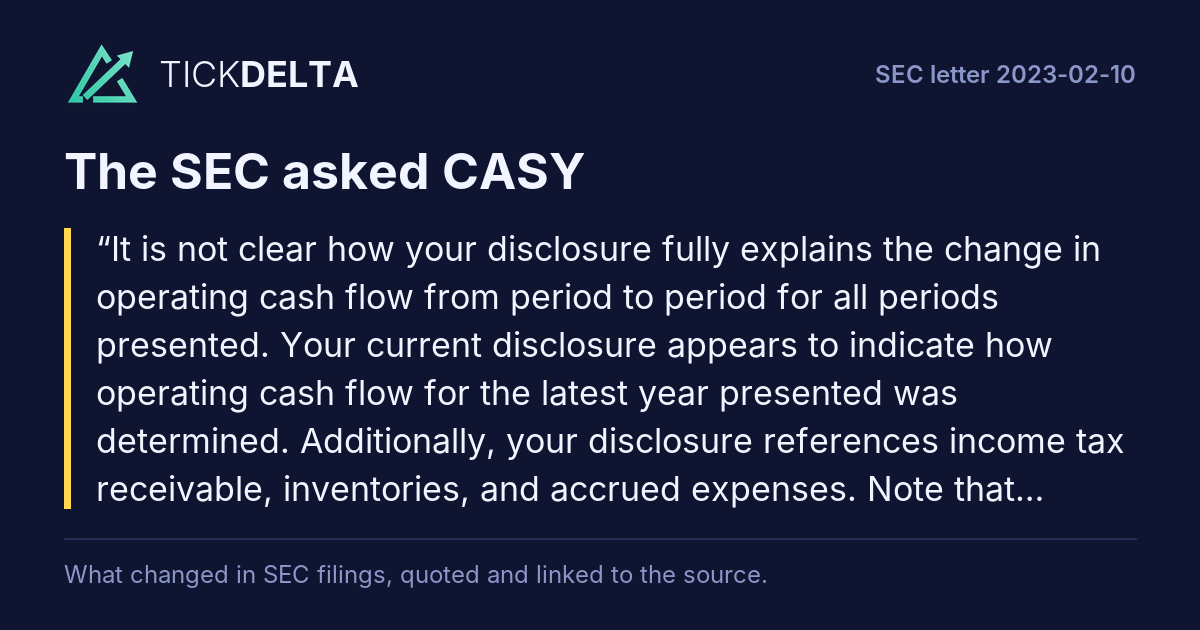
It is not clear how your disclosure fully explains the change in operating cash flow from period to period for all periods presented. Your current disclosure appears to indicate how operating cash flow for the latest year presented was determined. Additionally, your disclosure references income tax receivable, inventories, and accrued expenses.
Rest of the question

Note that references to these items may not provide a sufficient basis to understand how operating cash actually was affected between periods. Your discussion should be a comparable analysis between periods that discusses all material factors that actually affected operating cash. Also, your analysis should discuss the reasons underlying factors cited, particularly in regard to changes for which the impact on cash is not readily apparent. Refer to Item 303(b) of Regulation S-K, the introductory paragraph of section IV.B and paragraph B.1 of Release No. 33-8350 for guidance, and section 501.04 of our Codification of Financial Reporting Releases regarding quantification of variance factors cited. Please revise your disclosure as appropriate.

CASY answered
The Company respectfully acknowledges the Staff’s comment. In response, the Company will enhance its disclosure in future filings, beginning with the Company’s

Annual Report on Form 10-K for the year ending April 30, 2023, as appropriate. The Company will include disclosure consistent with our response on March 3, 2023 and will provide information regarding period over period variances in operating cash to the extent it is material to changes in our cash flow statement.
Rest of the answer

The Company also respectfully acknowledges the Staff’s comment regarding noncash factors that do not affect cash and in future filings will revise its disclosure to ensure discussion around noncash factors is appropriate.

Read in the reply ↗
In its next report

First report after the company's reply of 2023-03-29: 10-K filed 2023-06-23 ↗, against the 10-K filed 2022-06-24 ↗.

Tickdelta does not hold the text of both reports, so they are not compared here.

Consolidated Statements of Income, page 35
SEC asked (2)
Please explain to us and in your filing what footnote (a) at the end of the line item "Cost of goods sold ..." refers to.
CASY answered
In response to the Staff’s comment, the Company will expand the proposed revisions to explicitly address how the Company determined the value of RINs at the time transferred and recorded in cost of goods sold. Specifically, the Company’s disclosure will be consistent with the example presented below:

Renewable identification numbers

(“RINs”) are assigned to gallons of renewable fuels produced and are used to track compliance with the renewable fuel standard.

At times, we purchase fuel components (ethanol, gasoline, biodiesel or diesel) and blend those components into a finished product in
Rest of the answer

a fuel truck. This process enables the Company to take title to the RIN assigned to each gallon of ethanol or biodiesel produced. RINs are recorded as a reduction in cost of goods sold at the contracted sales price, in the period when the Company transfers the RIN. The Company does not record inventories on the balance sheet related to RINs, as they are acquired at no cost to the Company.

Read in the reply ↗
In its next report

First report after the company's reply of 2023-03-29: 10-K filed 2023-06-23 ↗, against the 10-K filed 2022-06-24 ↗.

Tickdelta does not hold the text of both reports, so they are not compared here.

Note 1. Significant Accounting Policies · Inventories, page 38
SEC asked (3)
Please describe what "renewable identification numbers" represent and how you obtain and use or sell them.
CASY answered

No numbered answer found in the reply. Read the reply ↗

In its next report

First report after the company's reply of 2023-03-29: 10-K filed 2023-06-23 ↗, against the 10-K filed 2022-06-24 ↗.

Tickdelta does not hold the text of both reports, so they are not compared here.

Notes to Consolidated Financial Statements · Note 7. Leases, page 51
SEC asked (4)
Please explain to us where the disclosure for cash paid for amounts included in the measurement of lease liabilities pursuant to ASC 842-20-50-4.g.1 is located. In closing, we remind you that the company and its management are responsible for the accuracy and adequacy of their disclosures, notwithstanding any review, comments, action or absence of action by the staff.
CASY answered

No numbered answer found in the reply. Read the reply ↗

In its next report

First report after the company's reply of 2023-03-29: 10-K filed 2023-06-23 ↗, against the 10-K filed 2022-06-24 ↗.

Tickdelta does not hold the text of both reports, so they are not compared here.

SEC letter of 2023-03-16 ↗ no reply letter on EDGAR
Management’s Discussion and Analysis of Financial Condition and Results of Operations · Liquidity and Capital Resources, page 25
SEC asked (1)
We note your response to comment 1 and your proposed revised disclosure. We note therein the references to depreciation, amortization and deferred income taxes as factors contributing to the change in operating cash. Note these are noncash factors that do not affect cash.
Rest of the question

In regard to your disclosure in the Form 10-Q for the quarterly period ended January 31, 2023, we note the material change between periods in income taxes presented in the operating and supplemental sections of the statement of cash flows but did not note inclusion in your analysis of the impact of income taxes on operating cash flows. Note the requirement within Item 303(b) of Regulation S-K to describe the underlying reasons for material changes from period to period reflected in the financial statements, including where material changes within a line item offset one another. Please consider these items in your disclosures.

CASY answered

No reply letter found.

In its next report

First report after the SEC's letter of 2023-03-16: 10-K filed 2023-06-23 ↗, against the 10-K filed 2022-06-24 ↗.

Tickdelta does not hold the text of both reports, so they are not compared here.

Note 1. Significant Accounting Policies · Inventories, page 38
SEC asked (2)
We note your proposed revisions in response to comment 3. Please further expand your disclosure to discuss how you determine the value of RINs at the time transferred and recorded in cost of goods sold.
CASY answered

No reply letter found.

In its next report

First report after the SEC's letter of 2023-03-16: 10-K filed 2023-06-23 ↗, against the 10-K filed 2022-06-24 ↗.

Tickdelta does not hold the text of both reports, so they are not compared here.

Also in this review: request for more time, 2023-02-27, company letter, 2023-03-03, closing letter, 2023-04-12

Form 10-K

2015-02-27 to 2015-05-01 · 9 questions · 2 letters from the SEC, 2 from the company
Review closed 2015-05-01
Results discussion (MD&A)Liquidity and cashRevenueControls
Management’s Discussion and Analysis of Financial Condition and Results of Operations · Company Total Revenue and Gross Profit by Category, page 24
SEC asked (1)
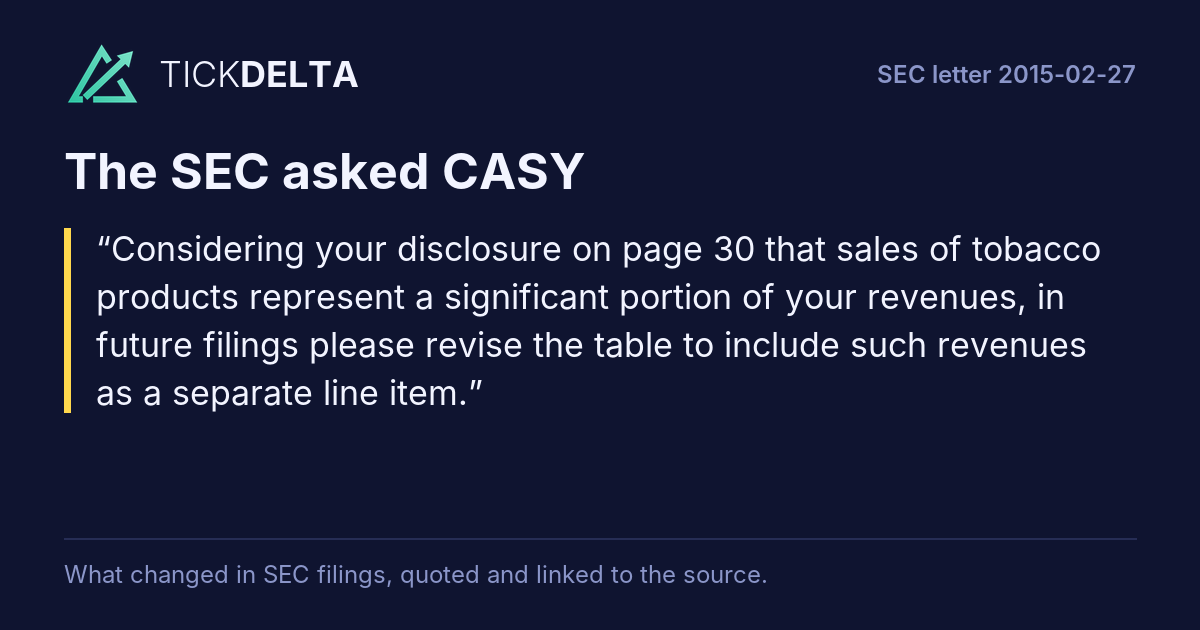
Considering your disclosure on page 30 that sales of tobacco products represent a significant portion of your revenues, in future filings please revise the table to include such revenues as a separate line item.
CASY answered
Your comments have been noted. In future filings of our Form 10-K and Form 10-Q, we will include specific disclosures regarding the impact cigarettes has on overall Company revenues and within the Grocery and Other Merchandise category (we define cigarettes as a sub-category item within our Grocery and Other Merchandise category). While changes to the cigarette environment could have a noticeable impact on our business, total cigarette sales are less than 10% of total Company revenues.
Rest of the answer

Therefore, we believe cigarettes are not significant enough to warrant a separate line item with our three distinct categories. We plan to change the disclosure on page 30 in future fillings of our Form 10-K (and corresponding place in future filings of our Form 10-Q) to clarify that cigarettes are a significant portion of our Grocery and Other Merchandise category, rather than overall Company revenue.

Read in the reply ↗
In its next report

First report after the company's reply of 2015-03-19: 10-K filed 2015-06-26 ↗, against the 10-K filed 2014-06-27 ↗.

Tickdelta does not hold the text of both reports, so they are not compared here.

Same Store Sales Growth by Category, page 25
SEC asked (2)
We note your disclosure in footnote one (1) of this section and the discussion from your Earnings Call dated June 10, 2014 that your growth in same store fuel sales was due to your “fuel saver program.” In future filings, please provide a detailed discussion and analysis of this program, including any plans for possible expansion of the program into different geographic markets.
Rest of the question

Please tell us what this disclosure will look like.

CASY answered
Your comments have been noted. The fuel saver program did have a positive impact to our same-store sales when it was introduced in December 2012. In fiscal 2014, stores with 10 or more fuel saver transactions posted same-store gallon increases of 4.7%, compared to the chainwide same-store growth of 3.1%.
Rest of the answer

However, the current impact in fiscal 2015 is not significant as we have eclipsed the introduction of the program, and there is not a noticeable difference in fuel sales between stores deemed to be fuel saver stores, and the rest of the chain.

In future filings of our Form 10-K and Form 10-Q (as applicable), we nonetheless will provide more detail regarding the current geographic impact of the fuel saver program and any possible expansion of the same, and we will disclose any significant fuel saver agreements with other parties when they are executed.

Read in the reply ↗
In its next report

First report after the company's reply of 2015-03-19: 10-K filed 2015-06-26 ↗, against the 10-K filed 2014-06-27 ↗.

Tickdelta does not hold the text of both reports, so they are not compared here.

Liquidity and Capital Resources, page 28
SEC asked (3)
In future filings, please quantify the size your bank line of credit and the amount you have drawn upon at the time of filing and discuss the material terms of the line of credit. Please refer to Item 303(a)(1) of Regulation S-K. Please tell us what this disclosure will look like.
CASY answered
Your comments have been noted, and in future filings on Form 10-K, we plan to add a paragraph to the Liquidity and Capital Resources section (below the paragraph on current ratio), that will read substantially as follows:

At April 30, 201_, the Company had a bank line of credit arrangement consisting of two Promissory Notes, in the principal amount of $50,000 each (together, the “Notes”).
Rest of the answer

The Notes evidenced a revolving line of credit in the aggregate principal amount of $100,000 and bear interest at variable rates subject to change from time to time based on changes in an independent index known as the Federal Funds Offered Rate (the “Index”). The interest rate to be applied to the unpaid principal balance of the first Note was at a rate of 0.750% over the Index. The interest rate to be applied to the second note is 1.000% over the Index. There was $_____ and $____ outstanding on the line at April 30, 201__ and 201__ respectively, with a weighted average interest rate of _______%. The line of credit is due upon demand.

We also plan to add a more abbreviated discussion to our future filings on Form 10-Q within the liquidity section about the outstanding balance on our line of credit.

Read in the reply ↗
In its next report

First report after the company's reply of 2015-03-19: 10-K filed 2015-06-26 ↗, against the 10-K filed 2014-06-27 ↗.

Tickdelta does not hold the text of both reports, so they are not compared here.

Forward Looking Statements · Fuel Operations, page 30
SEC asked (4)
We note that you purchase your fuel from a variety of national and regional petroleum distributors. In future filings, please disclose whether such purchases are made in accordance with long-term contracts or on the spot market. Please explain how such purchases affect your liquidity, margins, and results of operations. Refer to Item 303(a) of Regulation S-K. Please tell us what this disclosure will look like.
CASY answered
Your comment has been noted. In future filings we will include disclosure to the effect that fuel is purchased at current daily prices at the rack in which the fuel is loaded onto tanker trucks. While the Company has annual purchase agreements with a few distributors, those agreements are in place primarily to specify the purchasing volumes the Company must maintain in order to be eligible for certain discounts.

We will also note that we typically sell the fuel before we pay the vendor as a result of the short fuel inventory turnover rate.
Rest of the answer

Any substantial change to the terms our fuel vendors provide could impact the amount of cash and working capital we would need to conduct operations.

Fluctuations in wholesale cost can impact fuel margins and results of operations, but as we have already disclosed in the Competition section on page 30 of our Form 10-K, the competitive landscape has a much greater impact on margins and performance as fuel sales are intensely competitive, and would impact our ability to pass thru the fluctuations in wholesale cost to the customer.

We have added clarifying language to the Fuel Operations section in our Form 10-Q filed on March 9, 2015, and plan to include similar disclosure in our future Form10-K and Form 10-Q filings.

Read in the reply ↗
In its next report

First report after the company's reply of 2015-03-19: 10-K filed 2015-06-26 ↗, against the 10-K filed 2014-06-27 ↗.

Tickdelta does not hold the text of both reports, so they are not compared here.

Notes to Consolidated Financial Statements · Note 2. Correction of Immaterial Errors, page 41
SEC asked (5)
We note your conclusion that the identified errors in excise taxes owed on ethanol gallon purchases, that resulted in an understatement of accrued expenses at April 30, 2014 and 2013 and cost of goods sold for the fiscal years ended 2014, 2013 and 2012 were immaterial to your historical financial statements.
Rest of the question

Please provide us with your Staff Accounting Bulletin (SAB) Number 99 and SAB Number 108 analysis to support this conclusion. We may have further comments after reviewing your response.

CASY answered
We have supplementally provided the staff with our SAB 99 and SAB 108 materiality analysis under separate cover. Read in the reply ↗
In its next report

First report after the company's reply of 2015-03-19: 10-K filed 2015-06-26 ↗, against the 10-K filed 2014-06-27 ↗.

Tickdelta does not hold the text of both reports, so they are not compared here.

Signatures, page 64
SEC asked (6)
The report should be signed by the registrant and on behalf of the registrant by your principal executive officer, principal financial officer, controller or principal accounting officer and at least a majority of the board of directors. Your report appears to have been signed by only the registrant, its principal executive officer and its board of directors.
Rest of the question

Also, any person who occupies more than one of the specified positions shall indicate each capacity in which he signs the report. Please refer to the Signature Page and General Instruction D to Form 10-K, and revise future filings to include the signatures of your principal financial officer and principal accounting officer, in the second signature section of Form 10-K.

CASY answered
Your comment has been noted, and in future filings of Form 10-K we will include the signatures of our principal financial officer and principal accounting officer in the second signature section. Read in the reply ↗
Recent Compensation Decisions, page 24
SEC asked (7)
In future filings, please describe the registrant’s policies for review, approval or ratification of any transaction required to be reported under Item 404(a) of Regulation S- K. See Item 404(b) of Regulation S-K for additional detail.
CASY answered
Your comment has been noted, and in future filings of our Definitive Proxy Statement we will incorporate a discussion of our policies for review, approval, or ratification of any transaction required to be reported under Item 404(a) of Regulation S-K. Read in the reply ↗
In its next report

First report after the company's reply of 2015-03-19: 10-K filed 2015-06-26 ↗, against the 10-K filed 2014-06-27 ↗.

Tickdelta does not hold the text of both reports, so they are not compared here.

Form 10-Q for the Fiscal Quarter Ended October 31, 2014 · Item 4. Controls and Procedures, page 25
SEC asked (8)
Please tell us whether management evaluated the effectiveness of the Company’s disclosure controls and procedures as of October 31, 2014 and whether a conclusion was reached on that effectiveness. If no evaluation was conducted by management, please tell us why.
CASY answered
Prior to filing our Form 10-Q for the quarter ended October 31, 2014, the Company's chief executive officer and its chief financial officer evaluated the effectiveness of the Company's disclosure controls and procedures (as that term is defined in Rule 13a-15(e) of the Securities Exchange Act of 1934, as amended) as of October 31, 2014.
Rest of the answer

Our chief executive officer and chief financial officer concluded that, as a result of the material weakness in internal control over financial reporting as of April 30, 2014, our disclosure controls and procedures were not effective as of October 3l, 2014.

We have included a description of this evaluation and conclusion as of October 31, 2014 under Item 4 in our Form 10-Q for the quarter ended January 31, 2015, which was filed on March 9, 2015.

I also want to acknowledge that (i) the Company is responsible for the adequacy and accuracy of the disclosure in the filing, (ii) staff comments or changes to disclosure in response to staff comments do not foreclose the Commission from taking any action with respect to the filing, and (iii) the Company may not assert staff comments as a defense in any proceeding initiated by the Commission or any person under the federal securities laws of the United States.

I hope this information adequately responds to the staff's comments. Should you have any additional questions, or need any additional information, please don’t hesitate to contact me.

Read in the reply ↗
In its next report

First report after the company's reply of 2015-03-19: 10-K filed 2015-06-26 ↗, against the 10-K filed 2014-06-27 ↗.

Tickdelta does not hold the text of both reports, so they are not compared here.

Management’s Discussion and Analysis of Financial Condition and Results of Operations · Same Store Sales Growth by Category, page 25
SEC asked
We note your response to comment 2. In addition to disclosure of the program’s current geographic markets, its possible expansion prospects, and future significant agreements, in future filings please provide a narrative description of the Fuel Saver Program and the mechanics by which it drives same-store sales.
CASY answered
This letter is being written in response to your letter of April 13, 2015, in which you provided an additional staff comment concerning our response to your letter of February 27, 2015. In that earlier letter, you provided several staff comments concerning our most recent Proxy Statement, and the Form 10-K/A (Amendment No. 1) and Form 10-Q filed on December 10, 2014. We appreciate having the staff’s comments. In the following paragraphs, I have set forth the staff's additional comment (in bold face type) followed by my response (in italics):

Amendment No.
Rest of the answer

1 to Form 10-K for Fiscal Year Ended April 30, 2014

Management’s Discussion and Analysis of Financial Condition and Results of Operations

Same Store Sales Growth by Category, page 25

We note your response to comment 2. In addition to disclosure of the program’s current geographic markets, its possible expansion prospects, and future significant agreements, in future filings please provide a narrative description of the Fuel Saver Program and the mechanics by which it drives same-store sales.

Your comments have been noted, and in future filings on Form 10-K, we will provide, to the extent material, a narrative description of the current fuel saver program and the manner in which such programs are thought to contribute to our same-store sales.

* * * *

I also want to acknowledge that (i) the Company is responsible for the adequacy and accuracy of the disclosure in the filing, (ii) staff comments or changes to disclosure in response to staff comments do not foreclose the Commission from taking any action with respect to the filing, and (iii) the Company may not assert staff comments as a defense in any proceeding initiated by the Commission or any person under the federal securities laws of the United States.

I hope this information adequately responds to the staff's additional comment. Should you have any additional questions, or need any additional information, please don’t hesitate to contact me.

Read in the reply ↗
In its next report

First report after the company's reply of 2015-04-23: 10-K filed 2015-06-26 ↗, against the 10-K filed 2014-06-27 ↗.

Tickdelta does not hold the text of both reports, so they are not compared here.

Also in this review: request for more time, 2015-03-02, closing letter, 2015-05-01

Form 10-K for the fiscal year ended April 30, 2013

2014-03-06 to 2014-04-09 · 2 questions · 1 letter from the SEC, 0 from the company
Review closed 2014-04-09
RevenueResults discussion (MD&A)
SEC letter of 2014-03-06 ↗ no reply letter on EDGAR
Form 10-K for the Fiscal Year Ended April 30, 2013 · Management’s Discussion and Analysis of Financial Condition and Results of Operations, page
SEC asked (1)
Please address the following items related to your results of operations discussion:  Please provide a discussion of the extent to which changes in your revenues are attributable to changes in price and changes in volume. Although you disclose the percentage change in gas prices and gallons sold, you do not quantify the dollar impact of those changes between periods.
Rest of the question

We also note that you disclose same store sales changes by major product category on page 23. To provide your investors with a better understanding of the underlying drivers of changes in your results, where same store sales for a particular product category changed significantly between periods, please disclose management’s insight into the reasons for such a change. See Item 303(a)(3)(iii) of Regulation S-K.  Where you describe two or more business reasons that contribute to a material change in a financial statement line item between periods, please quantify, where possible, the extent to which each change contributed to the overall change in that line item. For example, with respect to the changes in inside sales, please quantify the extent to which the changes are attributable to the various contributing factors you identify. Also apply this comment to your operating expenses discussion. See Item 303(a) of Regulation S-K and SEC Release No. 33-8350.  We note that you quantify the gross profit margins of your major product categories. Please supplement this discussion by disclosing within your filing the nature of the costs you include in cost of goods sold.

CASY answered

No reply letter found.

In its next report

First report after the SEC's letter of 2014-03-06: 10-Q filed 2014-03-10 ↗, against the 10-Q filed 2013-12-09 ↗.

Tickdelta does not hold the text of both reports, so they are not compared here.

Form 10-Q for the quarter ended October 31, 2013 · Note 3. Revenue Recognition, page 8
SEC asked (2)
We note your disclosure that renewable identification numbers (RINs) are treated as a reduction in cost of goods sold in the period you enter into a commitment to sell them. Please explain to us your accounting for these RINs in more detail.
Rest of the question

Please include in your response how you determined that a reduction in cost of goods sold was the appropriate classification, how you determined the appropriate timing of recognition, and any other alternatives you considered.

CASY answered

No reply letter found.

In its next report

First report after the SEC's letter of 2014-03-06: 10-Q filed 2014-03-10 ↗, against the 10-Q filed 2013-12-09 ↗.

Tickdelta does not hold the text of both reports, so they are not compared here.

Also in this review: request for more time, 2014-03-10, request for more time, 2014-03-27, closing letter, 2014-04-09

Form 10-K for the fiscal year ended April 30, 2011

2012-03-14 to 2012-05-14 · 11 questions · 2 letters from the SEC, 2 from the company
Review closed 2012-05-14
Goodwill and impairmentSegmentsInventoryNon-GAAP measuresResults discussion (MD&A)Critical estimatesRevenueIncome taxesReserves and insurance
Operations, page 18 · Overview, page 18
SEC asked (1)
We note your discussion of earnings per share for the quarter and year end excluding the effect of fees related to the unsolicited offer from Alimentation Couche-Tard and/or expenses pertaining to your recapitalization plan. We additionally note that you have presented and discussed these adjusted earnings per share amounts in your Forms 10-Q and earnings releases.
Rest of the question

Since the excluded expenses are presented on a pre-tax basis and EPS is a post-tax measure, please clearly quantify the tax effect of such items included in your non-GAAP EPS figures and explain how the tax impact was calculated. Furthermore, when discussing these non-GAAP measures in regards to your fourth quarter, please disclose the weighted average number of shares outstanding used in your calculation. Please also ensure you provide the applicable disclosures required by Regulation G and Item 10(e) of Regulation S-K in your filings. In particular, you may be required to explain why management believes presentation of these non-GAAP measures is useful information to investors and how management uses the non-GAAP measures.

CASY answered
The post-tax impact of the expenses associated with the unsolicited offer that were mentioned in the Overview on page 18 was $4,405 for the fourth quarter of fiscal 2010, and $17,591 for fiscal 2011.

The weighted average shares used in the calculation for the fourth quarter of fiscal 2010 were 50,919,595. The tax rate applied to the pre-tax expense was 35.8% for both the fourth quarter 2010 EPS impact and the fiscal 2011 impact.
Rest of the answer

That rate was the effective rate on those specific expenses after assessing their deductibility for income tax purposes, within the subsidiary of the Company that the activity occurred in (Casey’s Retail Company).

In future filings, the Company will disclose the post-tax impact of the expenses associated with the unsolicited offer by

Alimentation Couche-Tard so the reader can clearly reconcile the impact to the GAAP measures on the face of the financial statements. We will also include any other information that may be required under Regulation G and Item 10(e) of

Regulation S-K.

Management made this calculation as a courtesy to investors to assist them in comparing the financial performance of the Company without the non-operational expenses associated with the unsolicited hostile offer. The Company does not expect to make this comparison in its disclosures after the fiscal 2012 Form 10-K filing is made.

Read in the reply ↗
In its next report

First report after the company's reply of 2012-03-30: 10-K filed 2012-06-26 ↗, against the 10-K filed 2011-06-28 ↗.

Tickdelta does not hold the text of both reports, so they are not compared here.

Operations, page 18 · Overview, page 18
SEC asked (2)
Please clearly disclose how you calculate the change in same store sales from period to period, including how you treat relocated and remodeled stores as well as stores that were closed during the period.
CASY answered
The same store sales comparison includes aggregated individual store results for all stores opened throughout both periods presented. When comparing monthly data, the store must be open for each month. When comparing quarterly data the store must be open for each entire quarter. When comparing annual data, the store must be open for each entire fiscal year being compared.

Remodeled stores that remained open or were closed for just a very brief period of time (less than a week) during the period being compared remain in the same store sale comparison.
Rest of the answer

If a store is replaced, either at the same location (razed and rebuilt) or relocated to a new location, it is removed from the comparison until the new store has been open for each entire period being compared. Newly constructed and acquired stores do not enter the calculation until they are open for each entire period being compared as well.

Read in the reply ↗
Fiscal 2011 Compared with Fiscal 2010, page 19
SEC asked (3)
We note your disclosure on page 19 that during fiscal 2010 you received an approximate $1.5 million “rebate of contractual amounts of credit card transaction fees which should have been recorded in prior periods.” Please explain the nature of this adjustment to us.
Rest of the question

Specifically indicate whether or not it represents the correction of an error and, if so, clarify how you determined recording the adjustment during fiscal 2010 did not result in the material misstatement of any quarterly or annual financial statements.

CASY answered
The approximately $1.5 million rebate payment disclosed on page 19 was the result of a billing dispute with a credit card provider over transaction fees that had been paid over a three year period beginning in the first quarter of fiscal 2008. After reviewing qualitative and quantitative considerations, in accordance with SAB 99, we determined that the amount overpaid by us in any one quarter was not material. The largest quarterly overpayment was approximately $350,000.
Rest of the answer

In addition, we concluded the correction in the fourth quarter of fiscal 2010 did not materially impact the financial statements. KPMG concurred with our evaluation.

Read in the reply ↗
In its next report

First report after the company's reply of 2012-03-30: 10-K filed 2012-06-26 ↗, against the 10-K filed 2011-06-28 ↗.

Tickdelta does not hold the text of both reports, so they are not compared here.

Critical Accounting Policies, page 22 · Long-Lived Assets, page 22
SEC asked (4)
We note your statement that an impairment loss is recognized to the extent the carrying value of the assets are less than their estimated fair value. Please confirm that you meant to state an impairment loss is recognized to the extent that carrying value exceeds fair value and revise future filings as necessary.
Rest of the question

Please also apply this comment to your significant accounting policy in footnote 1 for store closings and asset impairments on page 34.

CASY answered
We confirm that we meant to state an impairment loss is recognized to the extent that carrying value exceeds fair value. We will apply this revised terminology to future filings where applicable. Read in the reply ↗
In its next report

First report after the company's reply of 2012-03-30: 10-K filed 2012-06-26 ↗, against the 10-K filed 2011-06-28 ↗.

Tickdelta does not hold the text of both reports, so they are not compared here.

Note 1. Significant Accounting Policies, page 33 · Operations, page 33
SEC asked (5)
Please tell us and disclose in future filings the factors used to identify your reportable segments and whether operating segments have been aggregated. See ASC 280-10-5021a. In your response, please also tell us how you determined your operating segment(s) and, if applicable, how they met the aggregation criteria of ASC 280-10-50-11.
Rest of the question

Since you present total revenue and gross profit for your gasoline, grocery & other merchandise, prepared food & fountain, and other product categories and these products appear to have dissimilar gross margins, please explain how you considered your product categories under the operating and reportable segment guidance of ASC 280.

CASY answered
Our stores offer a broad selection of merchandise, fuel and other products and services designed to appeal to the convenience needs of our customers. We manage the business on the basis of one operating segment and therefore, have only one reportable segment. Our stores sell similar products and services, use similar processes to sell those products and services, and sell their products and services to similar classes of customers.
Rest of the answer

We make specific disclosures concerning the three broad merchandise category groups of gasoline, grocery & other merchandise, and prepared food and fountain because it makes it easier for us to discuss trends and operational initiatives within our business and industry. Although we can separate gross margins within these categories (and further sub-categories), the operating expenses associated with operating a store that sells these products are not separable by these three groups.

In future filings, we will add disclosure in our Summary of Significant Accounting Policies to specifically address our policy on segment reporting and why we feel we have only one reportable segment under ASC 280.

Read in the reply ↗
In its next report

First report after the company's reply of 2012-03-30: 10-K filed 2012-06-26 ↗, against the 10-K filed 2011-06-28 ↗.

Tickdelta does not hold the text of both reports, so they are not compared here.

Inventories, page 33
SEC asked (6)
Please address the following items regarding your inventory accounting policies and disclosures:  We note your disclosure on page 22 that cost for your merchandise inventories “is determined through the use of the last-in, first-out (LIFO) method applied to inventory values determined primarily by the FIFO method for warehouse inventories.” Please clarify what you mean by this statement and revise your disclosures
Rest of the question

accordingly. For example, please disclose, if true, that your accounting system uses FIFO but you use LIFO for financial and income tax reporting.  We note that your inventory table on page 33 includes “Merchandise” and “Merchandise LIFO reserve” line items. Please tell us whether or not the “Merchandise” line item represents the value of your merchandise inventory on a FIFO basis. If so, please remove the LIFO reserve line item from your table, present only one merchandise inventory line item, and separately disclose the excess of replacement or current cost over stated LIFO value pursuant to Rule 5-02(6)(c) of Regulation S-X.  Tell us and disclose if you had any material LIFO liquidations during the periods presented. See SAB Topic 11:F.

CASY answered
As your comment concerning our disclosure on page 22 suggests, our accounting system for warehouse inventories uses FIFO but we use

LIFO for financial reporting and income tax reporting. We will revise and include that clarification in future filings.

On the inventory table on page 33, the Merchandise line item represents the value of our merchandise inventory on a FIFO basis.
Rest of the answer

In future filings, we will remove the LIFO reserve line from our table and present only one merchandise line item, and separately disclose the excess of replacement or current cost over stated LIFO value pursuant to Rule 5-02(6)(c) of Regulation S-X.

There were no material LIFO liquidations during the periods presented.

If true, we will disclose this in future filings.

Read in the reply ↗
Inventories, page 33
SEC asked (7)
We note that you account for vendor rebates in the form of “rack display allowances” as a reduction in cost of sales. Please explain to us the nature of these allowances and clarify why they do not represent reimbursements of specific, incremental, identifiable costs incurred by you in selling the vendor’s products under ASC 605-50-45-13b.
CASY answered
The “rack display allowances” are funds that we receive from various vendors for allocating certain shelf space to carry their specific products or to introduce new products in our stores for a particular period of time. These funds do not represent reimbursements of specific, incremental, identifiable costs incurred by us in selling the vendor’s products. Read in the reply ↗
Note 4. Preferred and Common Stock, page 38
SEC asked (8)
We note your stock option rollforward on page 39. Please tell us if this table includes grants of stock options only or if it also includes grants of restricted stock units. Please additionally tell us how the amounts granted in this table reconcile to the narrative summary on page 38.
CASY answered
The stock option rollforward table on page 39 only includes stock options, and it does not include any grants of restricted stock units. The narrative summary on page 38 does not include the stock option grants to the non-employee members of the Board. On May 1, 2008, there were 12,000 stock options granted and on May 1, 2009, there were 16,000 stock options granted to the non-employee members of the Board. Those options vested immediately and were no longer listed in the narrative. In future filings, we will make sure the reader is able to reconcile the narrative summary to the table. Read in the reply ↗
In its next report

First report after the company's reply of 2012-03-30: 10-K filed 2012-06-26 ↗, against the 10-K filed 2011-06-28 ↗.

Tickdelta does not hold the text of both reports, so they are not compared here.

Signatures, page 53
SEC asked (9)
The report should be signed on your behalf by your principal executive officer, principal financial officer, controller or principal accounting officer and at least a majority of the board of directors. Also, any person who occupies more than one of the specified positions shall indicate each capacity in which he signs the report.
Rest of the question

Please refer to the Signature Page and General Instruction D to Form 10-K, and revise future filings to include the signatures of your principal financial officer and principal accounting officer, in the second signature section of Form 10-K.

CASY answered
Your comment has been noted, and in future filings on Form 10-K we will ensure that the signatures of our principal financial officer and principal accounting officer are appropriately indicated on the signature page.

* * *

*

I also want to acknowledge that (i) the Company is responsible for the adequacy and accuracy of the disclosure in the filing, (ii) staff comments or changes to disclosure in response to staff comments do not foreclose the Commission from taking any action with respect to the filing, and (iii) the Company may not assert staff comments as a defense in any proceeding
Rest of the answer

initiated by the Commission or any person under the federal securities laws of the United States.

I hope this information adequately responds to the staff’s comments. Should you have any additional questions, or need any additional information, please don’t hesitate to contact me.

Read in the reply ↗
Operations, page 18 · Overview, page 18
SEC asked (1)
We have read your response to comment 2 from our letter dated March 14, 2012. Please add the information provided in your response to future filings to clearly disclose how you calculate the change in same store sales from period to period, including how you treat relocated and remodeled stores as well as stores that were closed during the period.
CASY answered
Your comment has been noted, and in the future we will ensure that our filings clearly disclose how we calculate the change in same store sales from period to period, including how we treat relocated and remodeled stores as well as stores that were closed during the period.

Item 8. Financial Statements and Supplementary Data, page 27

Note 1.

Significant Accounting Policies, page 33

Operations, page 33

5. We have read your response to comment 5 from our letter dated March 14, 2012 noting that you manage your business on the basis of one operating segment.
Rest of the answer

As your disclosures appear to suggest that management regularly reviews store results and that discrete financial information is available for each store, please tell us why you do not consider each store to be an operating segment. We note, for example, your disclosures on page 33 that goodwill is assigned to individual stores and your disclosures on page 34 that you monitor closed and underperforming stores for impairment and group assets for impairment testing purposes on a store-by-store basis.

Please identify your chief operating decision maker (“CODM”) and clarify the extent to which your CODM reviews store-level data. Since you monitor assets for impairment at the individual store level and assign goodwill to individual stores, please also clarify why it is appropriate to evaluate goodwill for impairment at the enterprise level.

Per Accounting Standards Codification (ASC) 280-10-50, an operating segment is a business that earns revenues and incurs expenses, its operating results are regularly reviewed by the chief operating decision maker, or “CODM”, and has discrete financial information available. Although discrete financial information is available on a store by store basis, the Company’s CEO, who serves as the CODM, does not regularly review store-level operating results to make decisions about resource allocation nor to assess performance of the Company. The CODM generally reviews discrete information in aggregate by initiatives being undertaken by the Company at the present time. For example, the Company is currently analyzing a major remodel program. The CODM reviews the combined performance of those stores to determine if the program should be expanded to more locations. The same would be true of other initiatives such as 24 hour operations, new store design, and a pizza delivery program. However, these groups are not considered segments as many of the initiatives overlap, and the initiatives being analyzed continuously change. The Company has several stores that were recently remodeled, converted to 24 hour operation, and began delivering pizzas. Due to that overlap, it would not be reasonable to consider these initiatives as operating segments. As a result, we consider the Company to be a single operating segment. We believe this is consistent with other retailers with multiple stores.

Financial Accounting Standards Board (“FASB”) ASC 360 requires an impairment test to be performed on long-lived assets at the lowest level for which cash flows are largely independent of the cash flows of other assets and liabilities. The Company does have the ability to identify cash flows on a store-level basis; therefore management assesses long-lived asset impairment (other than goodwill) on a store-by-store basis. Levels of management below our CODM monitor closed and underperforming stores for impairment. Although the CODM is occasionally made aware of the results of the impairment analysis, he is not an instrumental part of that review and decision making process.

Goodwill is assigned to each store in our accounting systems. This is done for tracking purposes, but not for the purpose of evaluation for impairment. FASB ASC 350 requires that goodwill be evaluated for impairment at the reporting unit, which is one level below the operating segment. As the Company considers itself to be a single operating segment, each individual store could be considered the reporting unit, or component, as discrete financial information is available. However, per ASC 350-20-35-35, components of an operating segment should be aggregated if the components have similar economic characteristics. We believe our stores meet the criteria for aggregation per FASB ASC 280-10-50-11 as the stores sell the same products, processes at each store are similar, the type of customer is similar, and similar methods are used to distribute products. Therefore, for purposes of analyzing goodwill, the Company concluded we have a single reporting unit. The evaluation of goodwill impairment at the enterprise level is appropriate as that is the level by which management organizes its operations for making operating decisions and assessing performance.

* * * *

I also want to acknowledge that (i) the Company is responsible for the adequacy and accuracy of the disclosure in the filing, (ii) staff comments or changes to disclosure in response to staff comments do not foreclose the Commission from taking any action with respect to the filing, and (iii) the Company may not assert staff comments as a defense in any proceeding initiated by the Commission or any person under the federal securities laws of the United States.

I hope this information adequately responds to the staff’s comments. Should you have any additional questions, or need any additional information, please don’t hesitate to contact me.

Read in the reply ↗
Note 1. Significant Accounting Policies, page 33 · Operations, page 33
SEC asked (2)
We have read your response to comment 5 from our letter dated March 14, 2012 noting that you manage your business on the basis of one operating segment. As your disclosures appear to suggest that management regularly reviews store results and that discrete financial information is available for each store, please tell us why you do not consider each store to be an operating segment.
Rest of the question

We note, for example, your disclosures on page 33 that goodwill is assigned to individual stores and your disclosures on page 34 that you monitor closed and underperforming stores for impairment and group assets for impairment testing purposes on a store-by-store basis. Please identify your chief operating decision maker (“CODM”) and clarify the extent to which your CODM reviews store-level data. Since you monitor assets for impairment at the individual store level and assign goodwill to individual stores, please also clarify why it is appropriate to evaluate goodwill for impairment at the enterprise level.

CASY answered

No numbered answer found in the reply. Read the reply ↗

In its next report

First report after the company's reply of 2012-05-07: 10-K filed 2012-06-26 ↗, against the 10-K filed 2011-06-28 ↗.

Tickdelta does not hold the text of both reports, so they are not compared here.

Also in this review: closing letter, 2012-05-14

From the SEC's correspondence on EDGAR: staff letters (form UPLOAD) and company letters (form CORRESP), 24 letters filed since 2012-03-14. Questions and answers are matched by their numbers; topics come from words in each question. The reports are compared word for word (same form, before the first SEC letter against the first report after the company's reply). No AI.

Work on CASY in a spreadsheet: Excel workbook (a sheet per section, ten years by column, charts, links to the filings) · CSV. For a Google Sheet that stays up to date, paste =IMPORTDATA("https://tickdelta.com/company/CASY/export.csv") into a cell.