Form 10-K for the fiscal year ended April 30, 2011
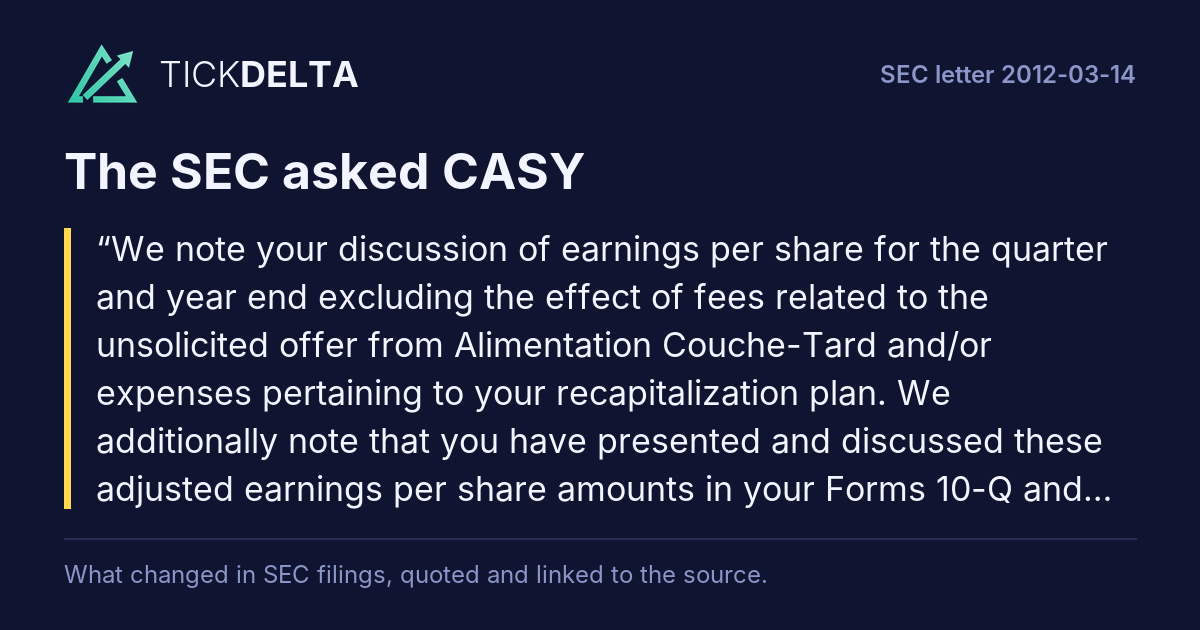
We note your discussion of earnings per share for the quarter and year end excluding the effect of fees related to the unsolicited offer from Alimentation Couche-Tard and/or expenses pertaining to your recapitalization plan. We additionally note that you have presented and discussed these adjusted earnings per share amounts in your Forms 10-Q and earnings releases.Rest of the question
Since the excluded expenses are presented on a pre-tax basis and EPS is a post-tax measure, please clearly quantify the tax effect of such items included in your non-GAAP EPS figures and explain how the tax impact was calculated. Furthermore, when discussing these non-GAAP measures in regards to your fourth quarter, please disclose the weighted average number of shares outstanding used in your calculation. Please also ensure you provide the applicable disclosures required by Regulation G and Item 10(e) of Regulation S-K in your filings. In particular, you may be required to explain why management believes presentation of these non-GAAP measures is useful information to investors and how management uses the non-GAAP measures.
The post-tax impact of the expenses associated with the unsolicited offer that were mentioned in the Overview on page 18 was $4,405 for the fourth quarter of fiscal 2010, and $17,591 for fiscal 2011.
The weighted average shares used in the calculation for the fourth quarter of fiscal 2010 were 50,919,595. The tax rate applied to the pre-tax expense was 35.8% for both the fourth quarter 2010 EPS impact and the fiscal 2011 impact.Read in the reply ↗Rest of the answer
That rate was the effective rate on those specific expenses after assessing their deductibility for income tax purposes, within the subsidiary of the Company that the activity occurred in (Casey’s Retail Company).
In future filings, the Company will disclose the post-tax impact of the expenses associated with the unsolicited offer by
Alimentation Couche-Tard so the reader can clearly reconcile the impact to the GAAP measures on the face of the financial statements. We will also include any other information that may be required under Regulation G and Item 10(e) of
Regulation S-K.
Management made this calculation as a courtesy to investors to assist them in comparing the financial performance of the Company without the non-operational expenses associated with the unsolicited hostile offer. The Company does not expect to make this comparison in its disclosures after the fiscal 2012 Form 10-K filing is made.
First report after the company's reply of 2012-03-30: 10-K filed 2012-06-26 ↗, against the 10-K filed 2011-06-28 ↗.
Tickdelta does not hold the text of both reports, so they are not compared here.
Please clearly disclose how you calculate the change in same store sales from period to period, including how you treat relocated and remodeled stores as well as stores that were closed during the period.
The same store sales comparison includes aggregated individual store results for all stores opened throughout both periods presented. When comparing monthly data, the store must be open for each month. When comparing quarterly data the store must be open for each entire quarter. When comparing annual data, the store must be open for each entire fiscal year being compared.
Remodeled stores that remained open or were closed for just a very brief period of time (less than a week) during the period being compared remain in the same store sale comparison.Read in the reply ↗Rest of the answer
If a store is replaced, either at the same location (razed and rebuilt) or relocated to a new location, it is removed from the comparison until the new store has been open for each entire period being compared. Newly constructed and acquired stores do not enter the calculation until they are open for each entire period being compared as well.
We note your disclosure on page 19 that during fiscal 2010 you received an approximate $1.5 million “rebate of contractual amounts of credit card transaction fees which should have been recorded in prior periods.” Please explain the nature of this adjustment to us.Rest of the question
Specifically indicate whether or not it represents the correction of an error and, if so, clarify how you determined recording the adjustment during fiscal 2010 did not result in the material misstatement of any quarterly or annual financial statements.
The approximately $1.5 million rebate payment disclosed on page 19 was the result of a billing dispute with a credit card provider over transaction fees that had been paid over a three year period beginning in the first quarter of fiscal 2008. After reviewing qualitative and quantitative considerations, in accordance with SAB 99, we determined that the amount overpaid by us in any one quarter was not material. The largest quarterly overpayment was approximately $350,000.Read in the reply ↗Rest of the answer
In addition, we concluded the correction in the fourth quarter of fiscal 2010 did not materially impact the financial statements. KPMG concurred with our evaluation.
First report after the company's reply of 2012-03-30: 10-K filed 2012-06-26 ↗, against the 10-K filed 2011-06-28 ↗.
Tickdelta does not hold the text of both reports, so they are not compared here.
We note your statement that an impairment loss is recognized to the extent the carrying value of the assets are less than their estimated fair value. Please confirm that you meant to state an impairment loss is recognized to the extent that carrying value exceeds fair value and revise future filings as necessary.Rest of the question
Please also apply this comment to your significant accounting policy in footnote 1 for store closings and asset impairments on page 34.
We confirm that we meant to state an impairment loss is recognized to the extent that carrying value exceeds fair value. We will apply this revised terminology to future filings where applicable. Read in the reply ↗
First report after the company's reply of 2012-03-30: 10-K filed 2012-06-26 ↗, against the 10-K filed 2011-06-28 ↗.
Tickdelta does not hold the text of both reports, so they are not compared here.
Please tell us and disclose in future filings the factors used to identify your reportable segments and whether operating segments have been aggregated. See ASC 280-10-5021a. In your response, please also tell us how you determined your operating segment(s) and, if applicable, how they met the aggregation criteria of ASC 280-10-50-11.Rest of the question
Since you present total revenue and gross profit for your gasoline, grocery & other merchandise, prepared food & fountain, and other product categories and these products appear to have dissimilar gross margins, please explain how you considered your product categories under the operating and reportable segment guidance of ASC 280.
Our stores offer a broad selection of merchandise, fuel and other products and services designed to appeal to the convenience needs of our customers. We manage the business on the basis of one operating segment and therefore, have only one reportable segment. Our stores sell similar products and services, use similar processes to sell those products and services, and sell their products and services to similar classes of customers.Read in the reply ↗Rest of the answer
We make specific disclosures concerning the three broad merchandise category groups of gasoline, grocery & other merchandise, and prepared food and fountain because it makes it easier for us to discuss trends and operational initiatives within our business and industry. Although we can separate gross margins within these categories (and further sub-categories), the operating expenses associated with operating a store that sells these products are not separable by these three groups.
In future filings, we will add disclosure in our Summary of Significant Accounting Policies to specifically address our policy on segment reporting and why we feel we have only one reportable segment under ASC 280.
First report after the company's reply of 2012-03-30: 10-K filed 2012-06-26 ↗, against the 10-K filed 2011-06-28 ↗.
Tickdelta does not hold the text of both reports, so they are not compared here.
Please address the following items regarding your inventory accounting policies and disclosures: We note your disclosure on page 22 that cost for your merchandise inventories “is determined through the use of the last-in, first-out (LIFO) method applied to inventory values determined primarily by the FIFO method for warehouse inventories.” Please clarify what you mean by this statement and revise your disclosuresRest of the question
accordingly. For example, please disclose, if true, that your accounting system uses FIFO but you use LIFO for financial and income tax reporting. We note that your inventory table on page 33 includes “Merchandise” and “Merchandise LIFO reserve” line items. Please tell us whether or not the “Merchandise” line item represents the value of your merchandise inventory on a FIFO basis. If so, please remove the LIFO reserve line item from your table, present only one merchandise inventory line item, and separately disclose the excess of replacement or current cost over stated LIFO value pursuant to Rule 5-02(6)(c) of Regulation S-X. Tell us and disclose if you had any material LIFO liquidations during the periods presented. See SAB Topic 11:F.
As your comment concerning our disclosure on page 22 suggests, our accounting system for warehouse inventories uses FIFO but we use
LIFO for financial reporting and income tax reporting. We will revise and include that clarification in future filings.
On the inventory table on page 33, the Merchandise line item represents the value of our merchandise inventory on a FIFO basis.Read in the reply ↗Rest of the answer
In future filings, we will remove the LIFO reserve line from our table and present only one merchandise line item, and separately disclose the excess of replacement or current cost over stated LIFO value pursuant to Rule 5-02(6)(c) of Regulation S-X.
There were no material LIFO liquidations during the periods presented.
If true, we will disclose this in future filings.
We note that you account for vendor rebates in the form of “rack display allowances” as a reduction in cost of sales. Please explain to us the nature of these allowances and clarify why they do not represent reimbursements of specific, incremental, identifiable costs incurred by you in selling the vendor’s products under ASC 605-50-45-13b.
The “rack display allowances” are funds that we receive from various vendors for allocating certain shelf space to carry their specific products or to introduce new products in our stores for a particular period of time. These funds do not represent reimbursements of specific, incremental, identifiable costs incurred by us in selling the vendor’s products. Read in the reply ↗
We note your stock option rollforward on page 39. Please tell us if this table includes grants of stock options only or if it also includes grants of restricted stock units. Please additionally tell us how the amounts granted in this table reconcile to the narrative summary on page 38.
The stock option rollforward table on page 39 only includes stock options, and it does not include any grants of restricted stock units. The narrative summary on page 38 does not include the stock option grants to the non-employee members of the Board. On May 1, 2008, there were 12,000 stock options granted and on May 1, 2009, there were 16,000 stock options granted to the non-employee members of the Board. Those options vested immediately and were no longer listed in the narrative. In future filings, we will make sure the reader is able to reconcile the narrative summary to the table. Read in the reply ↗
First report after the company's reply of 2012-03-30: 10-K filed 2012-06-26 ↗, against the 10-K filed 2011-06-28 ↗.
Tickdelta does not hold the text of both reports, so they are not compared here.
The report should be signed on your behalf by your principal executive officer, principal financial officer, controller or principal accounting officer and at least a majority of the board of directors. Also, any person who occupies more than one of the specified positions shall indicate each capacity in which he signs the report.Rest of the question
Please refer to the Signature Page and General Instruction D to Form 10-K, and revise future filings to include the signatures of your principal financial officer and principal accounting officer, in the second signature section of Form 10-K.
Your comment has been noted, and in future filings on Form 10-K we will ensure that the signatures of our principal financial officer and principal accounting officer are appropriately indicated on the signature page.
* * *
*
I also want to acknowledge that (i) the Company is responsible for the adequacy and accuracy of the disclosure in the filing, (ii) staff comments or changes to disclosure in response to staff comments do not foreclose the Commission from taking any action with respect to the filing, and (iii) the Company may not assert staff comments as a defense in any proceedingRead in the reply ↗Rest of the answer
initiated by the Commission or any person under the federal securities laws of the United States.
I hope this information adequately responds to the staff’s comments. Should you have any additional questions, or need any additional information, please don’t hesitate to contact me.
We have read your response to comment 2 from our letter dated March 14, 2012. Please add the information provided in your response to future filings to clearly disclose how you calculate the change in same store sales from period to period, including how you treat relocated and remodeled stores as well as stores that were closed during the period.
Your comment has been noted, and in the future we will ensure that our filings clearly disclose how we calculate the change in same store sales from period to period, including how we treat relocated and remodeled stores as well as stores that were closed during the period.
Item 8. Financial Statements and Supplementary Data, page 27
Note 1.
Significant Accounting Policies, page 33
Operations, page 33
5. We have read your response to comment 5 from our letter dated March 14, 2012 noting that you manage your business on the basis of one operating segment.Read in the reply ↗Rest of the answer
As your disclosures appear to suggest that management regularly reviews store results and that discrete financial information is available for each store, please tell us why you do not consider each store to be an operating segment. We note, for example, your disclosures on page 33 that goodwill is assigned to individual stores and your disclosures on page 34 that you monitor closed and underperforming stores for impairment and group assets for impairment testing purposes on a store-by-store basis.
Please identify your chief operating decision maker (“CODM”) and clarify the extent to which your CODM reviews store-level data. Since you monitor assets for impairment at the individual store level and assign goodwill to individual stores, please also clarify why it is appropriate to evaluate goodwill for impairment at the enterprise level.
Per Accounting Standards Codification (ASC) 280-10-50, an operating segment is a business that earns revenues and incurs expenses, its operating results are regularly reviewed by the chief operating decision maker, or “CODM”, and has discrete financial information available. Although discrete financial information is available on a store by store basis, the Company’s CEO, who serves as the CODM, does not regularly review store-level operating results to make decisions about resource allocation nor to assess performance of the Company. The CODM generally reviews discrete information in aggregate by initiatives being undertaken by the Company at the present time. For example, the Company is currently analyzing a major remodel program. The CODM reviews the combined performance of those stores to determine if the program should be expanded to more locations. The same would be true of other initiatives such as 24 hour operations, new store design, and a pizza delivery program. However, these groups are not considered segments as many of the initiatives overlap, and the initiatives being analyzed continuously change. The Company has several stores that were recently remodeled, converted to 24 hour operation, and began delivering pizzas. Due to that overlap, it would not be reasonable to consider these initiatives as operating segments. As a result, we consider the Company to be a single operating segment. We believe this is consistent with other retailers with multiple stores.
Financial Accounting Standards Board (“FASB”) ASC 360 requires an impairment test to be performed on long-lived assets at the lowest level for which cash flows are largely independent of the cash flows of other assets and liabilities. The Company does have the ability to identify cash flows on a store-level basis; therefore management assesses long-lived asset impairment (other than goodwill) on a store-by-store basis. Levels of management below our CODM monitor closed and underperforming stores for impairment. Although the CODM is occasionally made aware of the results of the impairment analysis, he is not an instrumental part of that review and decision making process.
Goodwill is assigned to each store in our accounting systems. This is done for tracking purposes, but not for the purpose of evaluation for impairment. FASB ASC 350 requires that goodwill be evaluated for impairment at the reporting unit, which is one level below the operating segment. As the Company considers itself to be a single operating segment, each individual store could be considered the reporting unit, or component, as discrete financial information is available. However, per ASC 350-20-35-35, components of an operating segment should be aggregated if the components have similar economic characteristics. We believe our stores meet the criteria for aggregation per FASB ASC 280-10-50-11 as the stores sell the same products, processes at each store are similar, the type of customer is similar, and similar methods are used to distribute products. Therefore, for purposes of analyzing goodwill, the Company concluded we have a single reporting unit. The evaluation of goodwill impairment at the enterprise level is appropriate as that is the level by which management organizes its operations for making operating decisions and assessing performance.
* * * *
I also want to acknowledge that (i) the Company is responsible for the adequacy and accuracy of the disclosure in the filing, (ii) staff comments or changes to disclosure in response to staff comments do not foreclose the Commission from taking any action with respect to the filing, and (iii) the Company may not assert staff comments as a defense in any proceeding initiated by the Commission or any person under the federal securities laws of the United States.
I hope this information adequately responds to the staff’s comments. Should you have any additional questions, or need any additional information, please don’t hesitate to contact me.
We have read your response to comment 5 from our letter dated March 14, 2012 noting that you manage your business on the basis of one operating segment. As your disclosures appear to suggest that management regularly reviews store results and that discrete financial information is available for each store, please tell us why you do not consider each store to be an operating segment.Rest of the question
We note, for example, your disclosures on page 33 that goodwill is assigned to individual stores and your disclosures on page 34 that you monitor closed and underperforming stores for impairment and group assets for impairment testing purposes on a store-by-store basis. Please identify your chief operating decision maker (“CODM”) and clarify the extent to which your CODM reviews store-level data. Since you monitor assets for impairment at the individual store level and assign goodwill to individual stores, please also clarify why it is appropriate to evaluate goodwill for impairment at the enterprise level.
No numbered answer found in the reply. Read the reply ↗
First report after the company's reply of 2012-05-07: 10-K filed 2012-06-26 ↗, against the 10-K filed 2011-06-28 ↗.
Tickdelta does not hold the text of both reports, so they are not compared here.
Also in this review: closing letter, 2012-05-14