Form 10-K
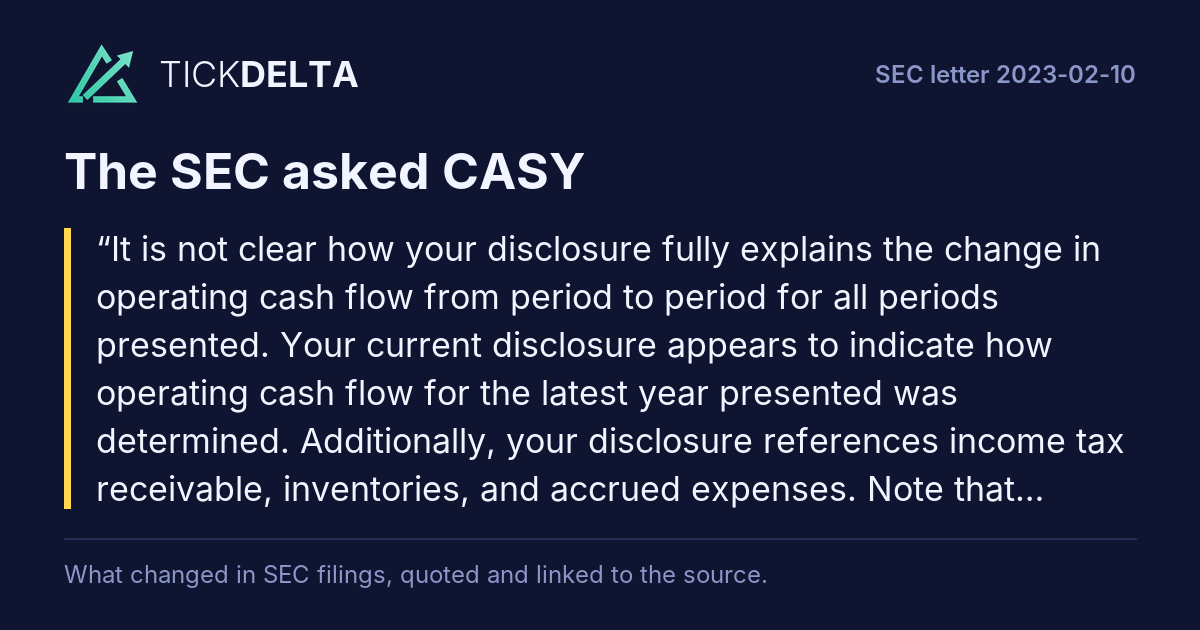
It is not clear how your disclosure fully explains the change in operating cash flow from period to period for all periods presented. Your current disclosure appears to indicate how operating cash flow for the latest year presented was determined. Additionally, your disclosure references income tax receivable, inventories, and accrued expenses.Rest of the question
Note that references to these items may not provide a sufficient basis to understand how operating cash actually was affected between periods. Your discussion should be a comparable analysis between periods that discusses all material factors that actually affected operating cash. Also, your analysis should discuss the reasons underlying factors cited, particularly in regard to changes for which the impact on cash is not readily apparent. Refer to Item 303(b) of Regulation S-K, the introductory paragraph of section IV.B and paragraph B.1 of Release No. 33-8350 for guidance, and section 501.04 of our Codification of Financial Reporting Releases regarding quantification of variance factors cited. Please revise your disclosure as appropriate.
The Company respectfully acknowledges the Staff’s comment. In response, the Company will enhance its disclosure in future filings, beginning with the Company’s
Annual Report on Form 10-K for the year ending April 30, 2023, as appropriate. The Company will include disclosure consistent with our response on March 3, 2023 and will provide information regarding period over period variances in operating cash to the extent it is material to changes in our cash flow statement.Read in the reply ↗Rest of the answer
The Company also respectfully acknowledges the Staff’s comment regarding noncash factors that do not affect cash and in future filings will revise its disclosure to ensure discussion around noncash factors is appropriate.
First report after the company's reply of 2023-03-29: 10-K filed 2023-06-23 ↗, against the 10-K filed 2022-06-24 ↗.
Tickdelta does not hold the text of both reports, so they are not compared here.
Please explain to us and in your filing what footnote (a) at the end of the line item "Cost of goods sold ..." refers to.
In response to the Staff’s comment, the Company will expand the proposed revisions to explicitly address how the Company determined the value of RINs at the time transferred and recorded in cost of goods sold. Specifically, the Company’s disclosure will be consistent with the example presented below:
Renewable identification numbers
(“RINs”) are assigned to gallons of renewable fuels produced and are used to track compliance with the renewable fuel standard.
At times, we purchase fuel components (ethanol, gasoline, biodiesel or diesel) and blend those components into a finished product inRead in the reply ↗Rest of the answer
a fuel truck. This process enables the Company to take title to the RIN assigned to each gallon of ethanol or biodiesel produced. RINs are recorded as a reduction in cost of goods sold at the contracted sales price, in the period when the Company transfers the RIN. The Company does not record inventories on the balance sheet related to RINs, as they are acquired at no cost to the Company.
First report after the company's reply of 2023-03-29: 10-K filed 2023-06-23 ↗, against the 10-K filed 2022-06-24 ↗.
Tickdelta does not hold the text of both reports, so they are not compared here.
Please describe what "renewable identification numbers" represent and how you obtain and use or sell them.
No numbered answer found in the reply. Read the reply ↗
First report after the company's reply of 2023-03-29: 10-K filed 2023-06-23 ↗, against the 10-K filed 2022-06-24 ↗.
Tickdelta does not hold the text of both reports, so they are not compared here.
Please explain to us where the disclosure for cash paid for amounts included in the measurement of lease liabilities pursuant to ASC 842-20-50-4.g.1 is located. In closing, we remind you that the company and its management are responsible for the accuracy and adequacy of their disclosures, notwithstanding any review, comments, action or absence of action by the staff.
No numbered answer found in the reply. Read the reply ↗
First report after the company's reply of 2023-03-29: 10-K filed 2023-06-23 ↗, against the 10-K filed 2022-06-24 ↗.
Tickdelta does not hold the text of both reports, so they are not compared here.
We note your response to comment 1 and your proposed revised disclosure. We note therein the references to depreciation, amortization and deferred income taxes as factors contributing to the change in operating cash. Note these are noncash factors that do not affect cash.Rest of the question
In regard to your disclosure in the Form 10-Q for the quarterly period ended January 31, 2023, we note the material change between periods in income taxes presented in the operating and supplemental sections of the statement of cash flows but did not note inclusion in your analysis of the impact of income taxes on operating cash flows. Note the requirement within Item 303(b) of Regulation S-K to describe the underlying reasons for material changes from period to period reflected in the financial statements, including where material changes within a line item offset one another. Please consider these items in your disclosures.
No reply letter found.
First report after the SEC's letter of 2023-03-16: 10-K filed 2023-06-23 ↗, against the 10-K filed 2022-06-24 ↗.
Tickdelta does not hold the text of both reports, so they are not compared here.
We note your proposed revisions in response to comment 3. Please further expand your disclosure to discuss how you determine the value of RINs at the time transferred and recorded in cost of goods sold.
No reply letter found.
First report after the SEC's letter of 2023-03-16: 10-K filed 2023-06-23 ↗, against the 10-K filed 2022-06-24 ↗.
Tickdelta does not hold the text of both reports, so they are not compared here.
Also in this review: request for more time, 2023-02-27, company letter, 2023-03-03, closing letter, 2023-04-12