Added10-Q 2026-10-28 vs 10-K 2026-02-27
The following table provides information with respect to purchases by Chubb of its Common Shares during the three months ended September 30, 2026:
Tickdelta is free for now. Sign up and get Pro free
4 paragraphs in Risk Factors of the 10-K filed Feb 27, 2026 with nothing like them in the 10-K filed Feb 27, 2025. Quoted exactly. Paragraphs that were only edited are under 10-K change.
Compared with the Risk Factors in the latest 10-K of the other 75 Financials companies: a paragraph with at least half its words the same at another company is called similar, and the companies are listed under it. A paragraph most of them have is marked boilerplate. No line means no other company has one like it. This counts text; it does not say how serious a risk is.
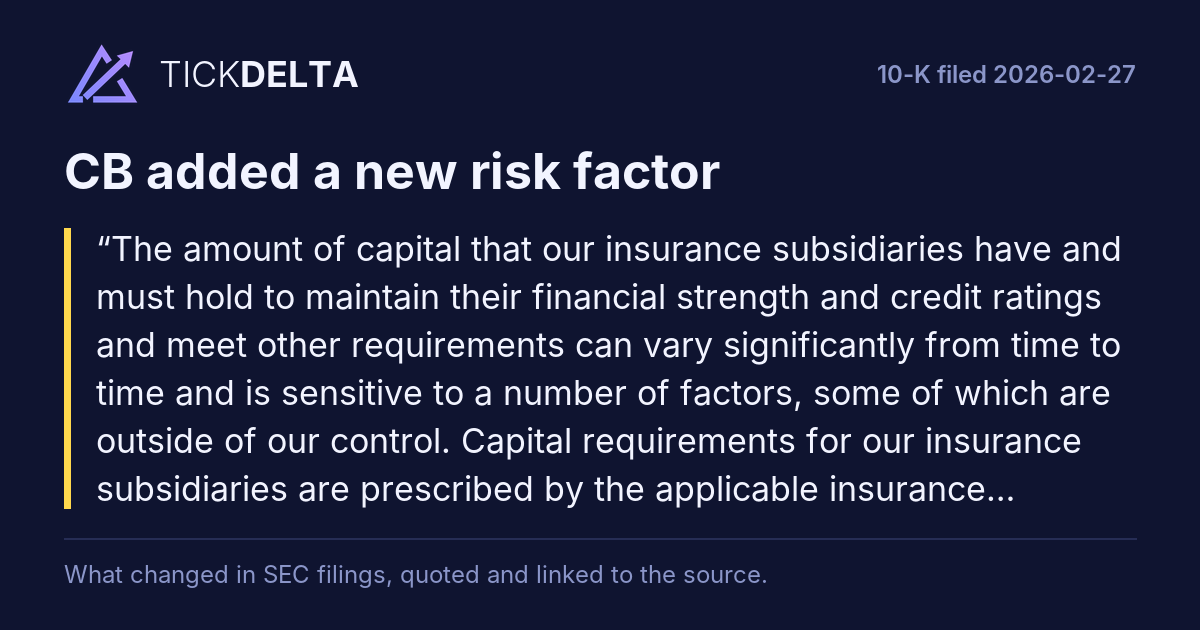
The amount of capital that our insurance subsidiaries have and must hold to maintain their financial strength and credit ratings and meet other requirements can vary significantly from time to time and is sensitive to a number of factors, some of which are outside of our control.
Capital requirements for our insurance subsidiaries are prescribed by the applicable insurance regulators, while rating agencies establish requirements that inform ratings for our insurance subsidiaries. Projecting surplus and the related capital requirements is complex and requires making assumptions regarding how our business will perform within the broader macroeconomic environment. Insurance regulators and rating agencies evaluate company capital through financial models that calculate minimum capitalization requirements based on risk-based capital formulas for property and casualty insurance groups and their subsidiaries. In any particular year, capital levels and risk-based capital requirements may increase or decrease depending on a variety of factors including the mix of business written by our insurance subsidiaries and correlation or diversification in the business profile, the amount of additional capital our insurance subsidiaries must hold to support business growth, the value of securities in our investment portfolio, changes in interest rates and foreign currency exchange rates, as well as changes to the regulatory and rating agency models used to determine our required capital.
Read in the 10-K ↗
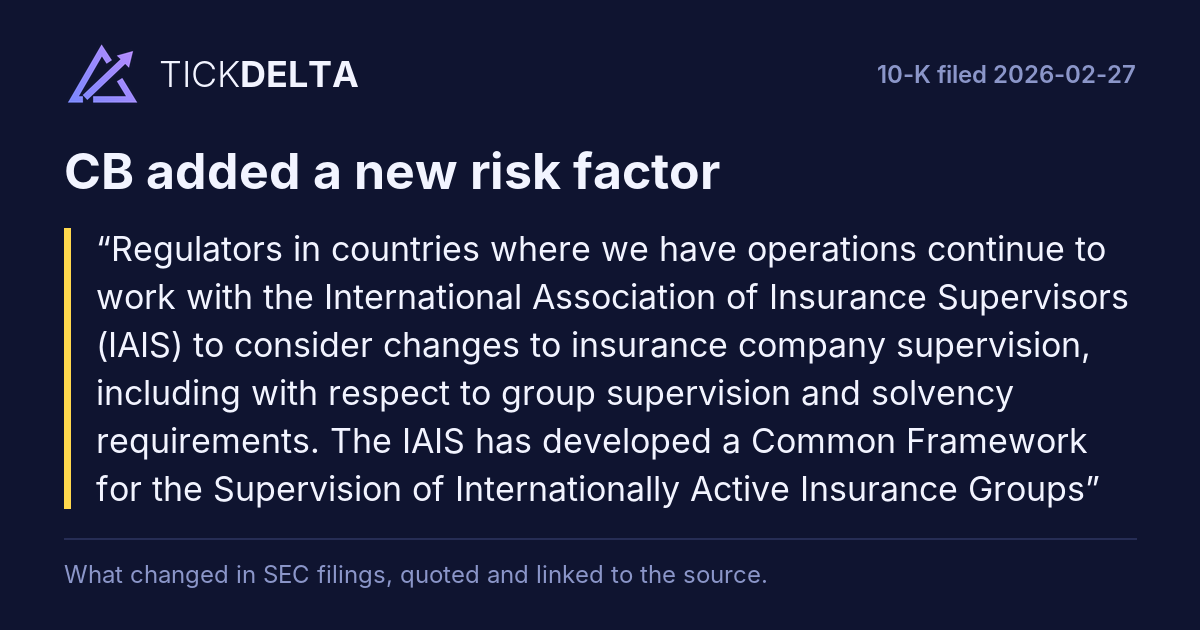
Regulators in countries where we have operations continue to work with the International Association of Insurance Supervisors (IAIS) to consider changes to insurance company supervision, including with respect to group supervision and solvency requirements. The IAIS has developed a Common Framework for the Supervision of Internationally Active Insurance Groups
Read in the 10-K ↗
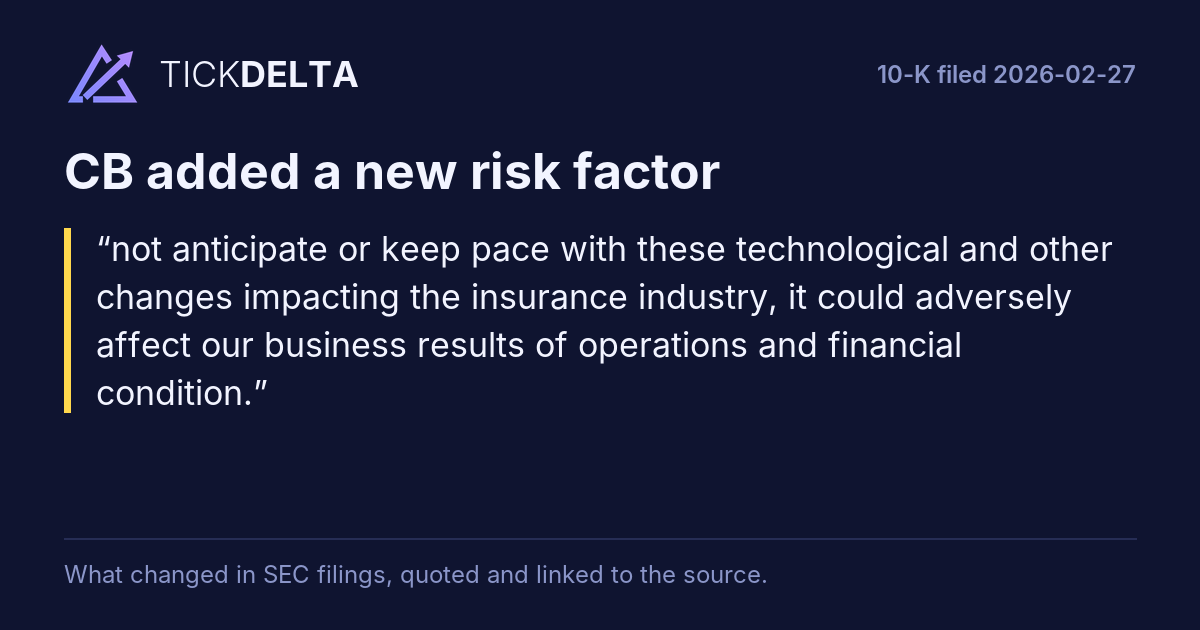
not anticipate or keep pace with these technological and other changes impacting the insurance industry, it could adversely affect our business results of operations and financial condition.
Similar paragraph at 13 of 75 other Financials companies: AIZ, AMP, AXP, BAC, BRO, CFG, EG, HIG and 5 moreRead in the 10-K ↗
10 paragraphs in the 10-Q filed Oct 28, 2026 with nothing like them in the 10-Q filed Jul 28, 2026 (at least half the words must differ; new numbers alone do not count). Quoted exactly, grouped by the item heading above them. This is text that changed, not a judgement of how serious it is.
In the third quarter of 2026 and 2025, we completed our annual actuarial assumptions review, resulting in immaterial changes to the liability for future policy benefits.
Read in the 10-Q ↗
In the third quarter, we completed a review of policyholder behavior related to annuitizations, partial withdrawals, lapses, and mortality for our variable annuity reinsurance business. These refinements resulted in a net increase of approximately $ 114 million in 2026 to the MRB fair value, recognized as a Market risk benefits loss.
Read in the 10-Q ↗
• We refreshed our partial withdrawal assumptions to include an additional year of experience and refined the withdrawal rates for policies with guaranteed values far in excess of their account values.
Read in the 10-Q ↗
• We updated the annuitization assumptions to include an additional year of experience, refreshing guarantee-based, treaty-based, and age-based behavior assumptions.
Read in the 10-Q ↗
• We updated mortality and lapse assumptions to include an additional year of experience.
Read in the 10-Q ↗
Effective for the quarter ending September 30, 2026, amortization expenses related to certain intangible assets acquired through business combinations (primarily agency distribution relationships and renewal rights) are excluded from reportable segment results and included in Corporate amortization of purchased intangibles. We believe that this presentation better reflects the operating results of the segments as such expenses are a result of our corporate mergers and acquisitions strategy and not indicative of segment operating performance. Prior-period segment results have been recast to conform to the current presentation.
Read in the 10-Q ↗
(1) Recast to exclude amortization expense related to certain intangible assets acquired through business combinations from reportable segment results.
Read in the 10-Q ↗
(1) Recast to exclude amortization expense related to certain intangible assets acquired through business combinations from reportable segment results.
Read in the 10-Q ↗
Effective for the quarter ending September 30, 2026, amortization expenses related to certain intangible assets acquired through business combinations (primarily agency distribution relationships and renewal rights) are excluded from reportable segment results and included in Corporate amortization of purchased intangibles. We believe that this presentation better reflects the operating results of the segments as such expenses are a result of our corporate mergers and acquisitions strategy and not indicative of segment operating performance. Prior-period segment results have been recast to conform to the current presentation.
Read in the 10-Q ↗
Net Premiums Written Three Months Ended % Nine Months Ended % September 30 September 30
Read in the 10-Q ↗
Item 1A of the 10-Q filed Oct 28, 2026 against Item 1A of the 10-K filed Feb 27, 2026.
A 10-Q repeats only the risks that changed, so a 10-K paragraph that is missing from it is not counted as removed.
Added is a paragraph with nothing like it in the 10-K, Reworded a sentence that is in both with several words changed,
Quiet changes a sentence in both where one to four words changed and one is a hedge or a modal
(cut words struck through, new words highlighted and underlined).
Text on the page, not a score; each links to the filing at sec.gov.
What the 10-Q itself says about its risk factors:
Read in the 10-Q ↗
There have been no material changes to the risk factors described under "Risk Factors" under Item 1A of Part I of our 2025 Form 10-K.