CBRECBRE Group
CBRE is the world’s largest commercial real estate services and investments firm (based on 2025 revenue). 10-K, Item 1
- Employees
- 155,000
- Headquarters
- Dallas, TX
- CEO
- Robert E. Sulentic
- Next results
- around Feb 11, 2027
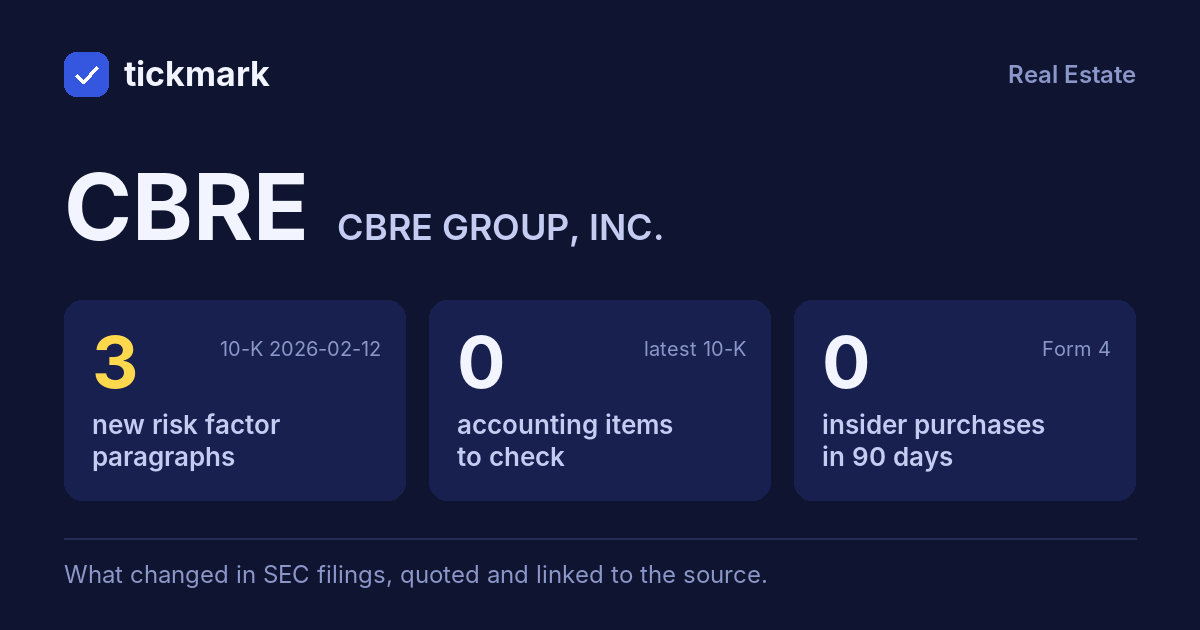
3 paragraphs in Risk Factors of the 10-K filed Feb 12, 2026 with nothing like them in the 10-K filed Feb 14, 2025. Quoted exactly. Paragraphs that were only edited are under 10-K change.
Compared with the Risk Factors in the latest 10-K of the other 29 Real estate companies: a paragraph with at least half its words the same at another company is called similar, and the companies are listed under it. A paragraph most of them have is marked boilerplate. No line means no other company has one like it. This counts text; it does not say how serious a risk is.
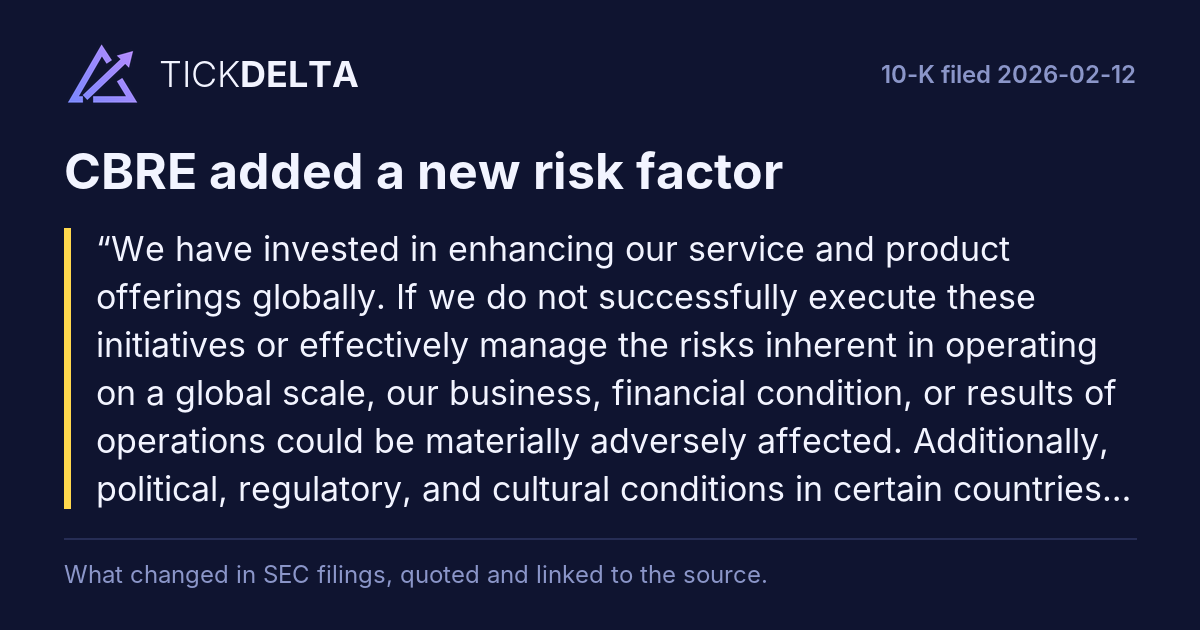
We have invested in enhancing our service and product offerings globally. If we do not successfully execute these initiatives or effectively manage the risks inherent in operating on a global scale, our business, financial condition, or results of operations could be materially adversely affected. Additionally, political, regulatory, and cultural conditions in certain countries may limit our ability to operate effectively or implement our strategic priorities, which could negatively impact our performance in those regions.
Read in the 10-K ↗
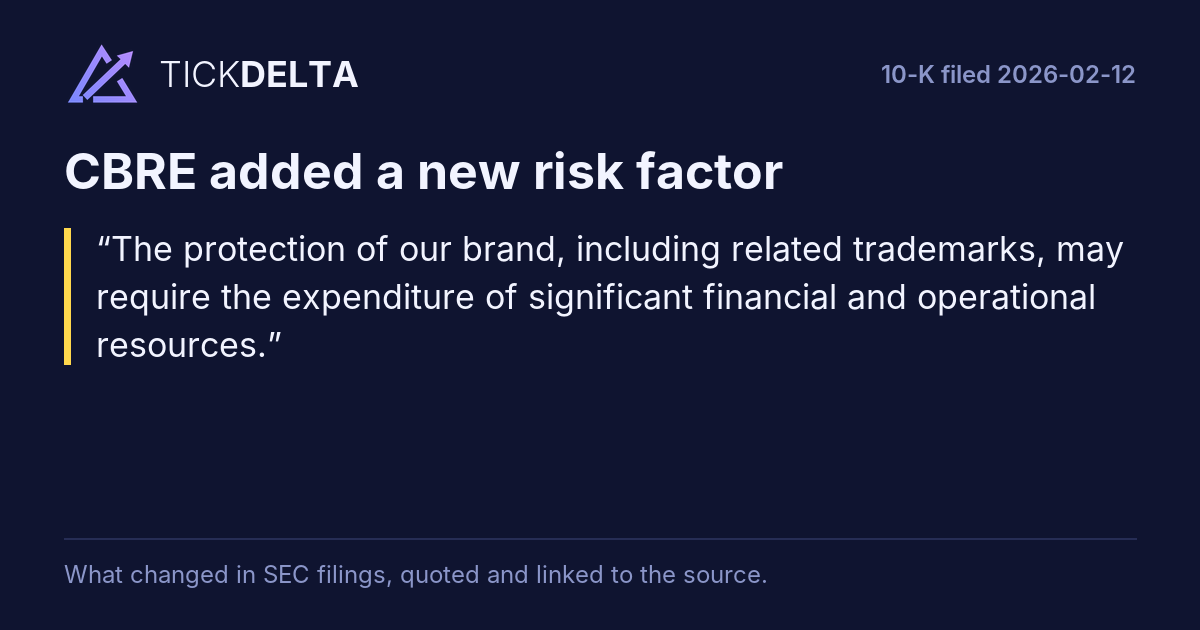
The protection of our brand, including related trademarks, may require the expenditure of significant financial and operational resources.
Read in the 10-K ↗
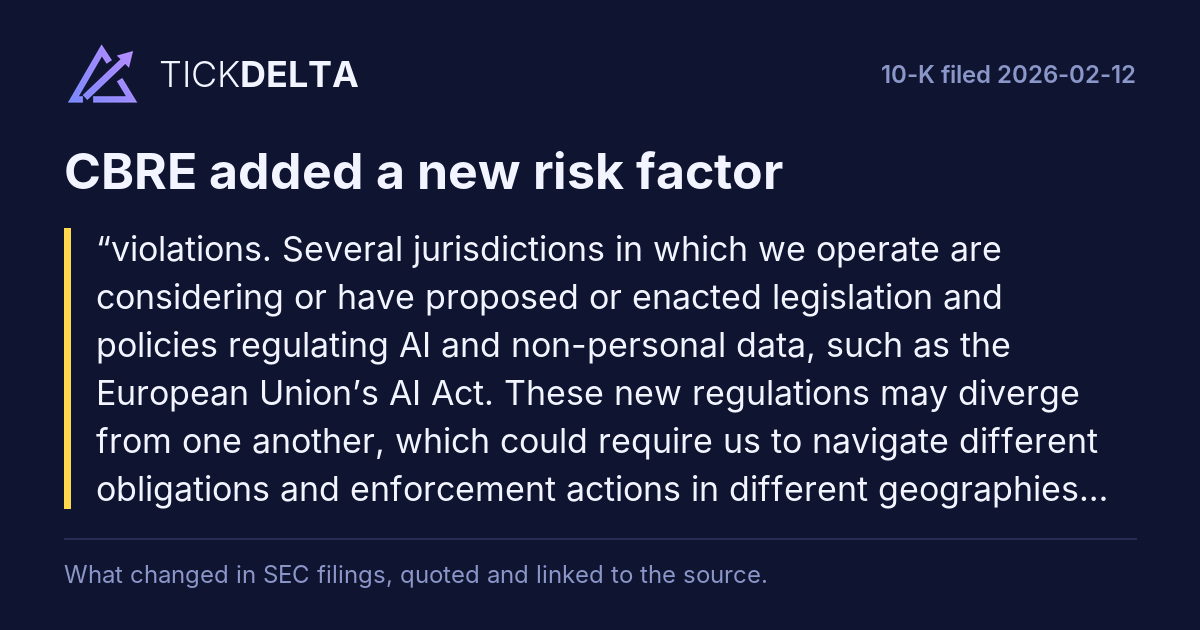
violations. Several jurisdictions in which we operate are considering or have proposed or enacted legislation and policies regulating AI and non-personal data, such as the European Union’s AI Act. These new regulations may diverge from one another, which could require us to navigate different obligations and enforcement actions in different geographies. Any violations of these laws may lead to reputational damage, financial penalties and increased regulatory scrutiny and oversight.
Read in the 10-K ↗
New in the latest 10-Q
52 paragraphs in the 10-Q filed Oct 22, 2026 with nothing like them in the 10-Q filed Jul 29, 2026 (at least half the words must differ; new numbers alone do not count). Quoted exactly, grouped by the item heading above them. This is text that changed, not a judgement of how serious it is.
Financial statements and notes
In May 2025, the FASB issued ASU 2025-03, “Business Combination (Topic 805) and Consolidation (Topic 810): Determining the Accounting Acquirer in the Acquisition of a Variable Interest Entity. ” This ASU requires public business entities to assess which entity is the accounting acquirer for a business combination that is effected primarily by exchanging equity interest in which a Variable Interest Entity (VIE) is acquired. This guidance is effective for fiscal years and interim periods beginning after December 15, 2026, with early adoption permitted. These requirements should be applied on a prospective basis to any transaction that occurs after the initial application date. We do not expect the adoption of ASU 2025-03 to have a material impact on our consolidated financial statements and related disclosures. In September 2025, the FASB issued ASU 2025-06, “Intangibles - Goodwill and Other (Topic 350): Internal-use Software. ” This ASU removes all references to prescriptive and sequential software development stages (referred to as “project stages”) throughout Subtopic 350-40 and requires the capitalization of software costs to begin when 1) management has authorized and committed to funding the software project and 2) it is probable that the project will be completed and the software will be used to perform the function intended. This guidance is effective for fiscal years and interim periods beginning after December 15, 2027, with early adoption permitted. These requirements should be applied using a prospective, modified transition, or retrospective approach. We do not expect the adoption of ASU 2025-06 to have a material impact on our consolidated financial statements and disclosures. In September 2025, the FASB issued ASU 2025-07, “Derivatives and Hedging (Topic 815) and Revenue from Contracts with Customers (Topic 606): Derivatives Scope Refinements and Scope Clarification for Share-Based Noncash Consideration from a Customer in a Revenue Contract. ” This ASU excludes from derivative accounting non-exchange-traded contracts with underlyings based on operations or activities specific to one of the parties to the contract. This guidance is effective for fiscal years and interim periods beginning after December 15, 2026, with early adoption permitted. These requirements may be applied prospectively or on a modified retrospective basis through a cumulative-effect adjustment to the opening balance of retained earnings. We do not expect the adoption of ASU 2025-07 to have a material impact on our consolidated financial statements and related disclosures. In November 2025, the FASB issued ASU 2025-08, “Financial Instruments - Credit Losses (Topic 326): Purchased Loans. ” This ASU introduces the concept of “purchased seasoned loans” through new seasoning guidance and expands the use of the gross-up approach for non-Purchased Credit Deteriorated loans. This guidance is effective for fiscal years and interim periods beginning after December 15, 2026, with early adoption permitted. The amendments must be applied prospectively to loans that are acquired on or after the date of initial application. We do not expect the adoption of ASU 2025-08 to have a material impact on our consolidated financial statements and related disclosures. In November 2025, the FASB issued ASU 2025-09, “Derivatives and Hedging (Topic 815): Hedge Accounting Improvements. ” This ASU clarifies and increases flexibility in hedge accounting and further aligns hedge accounting with the economics of an entity’s risk management activities through clarification of five primary issues. This guidance is effective for fiscal years and interim periods beginning after December 15, 2026, with early adoption permitted and should be applied on a prospective basis. We do not expect the adoption of ASU 2025-09 to have a material impact on our consolidated financial statements and related disclosures. In December 2025, the FASB issued ASU 2025-10, “Government Grants (Topic 832): Accounting for Government Grants Received by Business Entities. ” This ASU provides authoritative guidance for the recognition, measurement, and presentation of government grants, aiming to reduce diversity in practice and improve consistency. This guidance is effective for fiscal years and interim periods beginning after December 15, 2028, with early adoption permitted. These requirements may be applied using a modified prospective, modified retrospective, or retrospective approach. We do not expect the adoption of ASU 2025-10 to have a material impact on our consolidated financial statements and related disclosures. In May 2026, the FASB issued ASU 2026-02, “Environmental Credits and Environmental Credit Obligations (Topic 818). ” This ASU establishes a new Codification topic that provides comprehensive accounting guidance for environmental credits and environmental credit obligations. This guidance is effective for fiscal years and interim periods beginning after December 15, 2027, with early adoption permitted. These requirements should be applied retrospectively through a cumulative- effect adjustment to the opening balance of retained earnings in the period of adoption. We do not expect the adoption of ASU 2026-02 to have a material impact on our consolidated financial statements and related disclosures.
Read in the 10-Q ↗
recognized in the reporting period in which the adjustment amounts are determined. Any such adjustments may be material.
Read in the 10-Q ↗
period when Freddie Mac or Fannie Mae buys the loans or upon settlement of the Fannie Mae or Ginnie Mae MBS, while we
Read in the 10-Q ↗
retain the servicing rights. Loans are funded at the prevailing market rates. We elected the fair value option for all warehouse
Read in the 10-Q ↗
The following table is a summary of our warehouse lines of credit in place as of September 30, 2026 and
Read in the 10-Q ↗
(1)This facility was renewed on February 10, 2026, and the $ 15 million sublimit for Small Business Administration loans was removed.
Read in the 10-Q ↗
(2)On December 4, 2025, the Fannie Mae ASAP line capacity was temporarily increased from $ 650 million to $ 1.2 billion through January 30, 2026 and was
Read in the 10-Q ↗
(3)On July 15, 2026, this facility was renewed to September 13, 2026 with an uncommitted facility of $ 300 million. On September 13, 2026, this facility was
Read in the 10-Q ↗
extended to October 13, 2026. On October 13, 2026, this facility was renewed through October 13, 2027 with a committed line of $ 150 million and an
Read in the 10-Q ↗
accordion of $ 150 million. The new line has a margin of 1.20 % and the SOFR adjustment was removed.
Read in the 10-Q ↗
During the nine months ended September 30, 2026, we had a maximum of $ 1.6 billion of warehouse lines of credit
Read in the 10-Q ↗
investments of subsidiaries with local functional currencies that differ from their parent subsidiaries. These contracts are
Read in the 10-Q ↗
designated as net investment hedges at the date of contract inception, in accordance with the appropriate accounting guidance.
Read in the 10-Q ↗
spot rates recorded within foreign currency translation (loss) gain as a component of AOCL, where it will remain until the
Read in the 10-Q ↗
attributable to time value and spot-forward rate differences (the “Excluded Net Investment Hedge Components”) from the
Read in the 10-Q ↗
Components on Cross Currency Swap Contracts are recognized in interest expense, net of interest income in the consolidated
Read in the 10-Q ↗
The following table summarizes the gains and losses recognized within AOCL and net income related to the cross-
Read in the 10-Q ↗
currency swap contracts designated as net investment hedges for the three and nine months ended September 30, 2026 and 2025
Read in the 10-Q ↗
Three Months Ended Nine Months Ended September 30, September 30, 2026 2025 2026 2025 ────────────────────────────────────────────────────────────────────────────────────────────────────────────────────────────────────────────────────── Derivative instruments designated as net investment hedges: Gains (losses) recognized in AOCL on cross-currency swaps related to changes $37 $(36) $124 $(169) included in the assessment of hedge effectiveness Gains (losses) recognized in AOCL on cross-currency swaps related to changes (60) (45) (194) (208) excluded from the assessment of hedge effectiveness Total gains (losses) recognized in AOCL on cross-currency swaps $(23) $(81) $(70) $(377) Net gains recognized in income (amount excluded from effectiveness testing): Interest income $22 $14 $58 $32
Read in the 10-Q ↗
The company is exposed to the risk of credit loss in the event of nonperformance by counterparties to derivative
Read in the 10-Q ↗
contracts. Counterparties to our derivative contracts are major financial institutions with whom we have negotiated derivatives
Read in the 10-Q ↗
agreements (International Swaps and Derivatives Association, Inc., or ISDA, master agreements) and credit support annex
Read in the 10-Q ↗
Certain of these CSA agreements contain date and exposure thresholds after which either we or our counterparties may
Read in the 10-Q ↗
be required to hold or post collateral based upon changes in outstanding positions. At both September 30, 2026 and
Read in the 10-Q ↗
December 31, 2025, we did not hold any collateral. At September 30, 2026, we posted $ 100 million of collateral related to
Read in the 10-Q ↗
derivative contracts under collateral exchange agreements, which were recorded as Other current assets in our consolidated
Read in the 10-Q ↗
balance sheets, and as a cash outflow from investing activities in the Consolidated Statements of Cash Flows. At December 31,
Read in the 10-Q ↗
2025, we did not post collateral. We do not offset fair value amounts recognized for derivative instruments and fair value
Read in the 10-Q ↗
amounts recognized for the right to reclaim cash collateral or the obligation to return cash collateral arising from derivative
Read in the 10-Q ↗
While we may be exposed to credit losses due to the nonperformance of our counterparties, we consider the risk
Read in the 10-Q ↗
remote and do not expect that any such nonperformance would result in a significant impact on our results of operations or
Read in the 10-Q ↗
financial condition due to our diversified pool of counterparties. In addition to the above, the ISDA master agreements contain
Read in the 10-Q ↗
master netting provisions providing certain legal rights and abilities to offset exposures across trades with each counterparty.
Read in the 10-Q ↗
Notwithstanding any such rights, the company presents derivative balances on a gross basis in the consolidated balance sheets.
Read in the 10-Q ↗
On October 20, 2026, CBRE announced a definitive agreement to acquire Onnec Group Limited (Onnec), a leading
Read in the 10-Q ↗
provider of data center infrastructure services across Europe and Asia Pacific. The initial purchase price is £ 460 million
Read in the 10-Q ↗
Onnec achieving certain growth thresholds. Following the completion of the acquisition, Onnec will operate as part of CBRE's
Read in the 10-Q ↗
for facilities management and project management activities. The commercial real estate market recovery continued. In the
Read in the 10-Q ↗
third quarter, leasing volumes were notably strong in the U.K., while growth in the U.S. was muted given a tougher year-ago
Read in the 10-Q ↗
comparison. Global investment sales activity remained strong, most notably in the U.S.; however, transaction activity slowed
Read in the 10-Q ↗
late in the period as the 10-year Treasury rate rose rapidly to well above 5%. Through the first nine months of 2026, the
Read in the 10-Q ↗
an increase in current year earnings and a reduction of favorable permanent book tax differences. Our effective tax rate
Read in the 10-Q ↗
the United States up 3.9%. Property sales revenue grew 27.9%, driven primarily by growth in the U.S. across industrial, retail,
Read in the 10-Q ↗
Kingdom, Europe, North America and the Middle East supported by strong growth in real estate and energy. Foreign currency
Read in the 10-Q ↗
largely from higher accounts receivable due to revenue growth and the timing of cash collections.
Read in the 10-Q ↗
by CBRE Group and CBRE Services. The 2023 Credit Agreement, including the amendments thereto, is described in Note 10 -
Read in the 10-Q ↗
of this Quarterly Report, and such description is incorporated by reference herein.
Read in the 10-Q ↗
Each series of our outstanding senior notes described above are unsecured obligations of CBRE Services with semi-
Read in the 10-Q ↗
Market risk
(1)The GBP pre-tax loss during the nine months ended September 30, 2026 is driven by the $168 million provision associated with Telford's fire safety
Read in the 10-Q ↗
Controls and procedures
September 30, 2026 to accomplish their objectives at the reasonable assurance level.
Read in the 10-Q ↗
Other information
conditions of Rule 10b5-1(c) and was adopted on April 24, 2026. The Trading Plan provided for the purchase of 500 shares of
Read in the 10-Q ↗
As of the date of the termination, Mr. Lopez had not purchased any shares under the Trading Plan.
Read in the 10-Q ↗
The 10-Q's risk factors against the 10-K
Item 1A of the 10-Q filed Oct 22, 2026 against Item 1A of the 10-K filed Feb 12, 2026.
A 10-Q repeats only the risks that changed, so a 10-K paragraph that is missing from it is not counted as removed.
Added is a paragraph with nothing like it in the 10-K, Reworded a sentence that is in both with several words changed,
Quiet changes a sentence in both where one to four words changed and one is a hedge or a modal
(cut words struck through, new words highlighted and underlined).
Text on the page, not a score; each links to the filing at sec.gov.
What the 10-Q itself says about its risk factors:
Read in the 10-Q ↗
There have been no material changes to our risk factors as previously disclosed in our 2025 Annual Report.
1 paragraph in the 10-Q's Item 1A, and none of them adds, rewords or quietly edits a paragraph of the 10-K's.
Work on CBRE in a spreadsheet:
Excel workbook (a sheet per section, ten years by column, charts, links to the filings) ·
CSV.
For a Google Sheet that stays up to date, paste =IMPORTDATA("https://tickdelta.com/company/CBRE/export.csv") into a cell.