Screener / SEC EDGAR /CIK 0001219601 /10-K filed Feb 27, 2026, compared with Mar 3, 2025 /Numbers from the XBRL of the 10-Ks
NYSE Industrials · Packaging

Crown Holdings, Inc. CCK

Compare with peers Embed
The 10-K against last year's

121 changes: 13 added, 22 removed, 82 reworded, 4 quiet changes

10-K Feb 27, 2026 vs Mar 3, 2025

10-K 0001628280-26-012904 (Feb 27, 2026) vs 10-K 0001219601-25-000009 (Mar 3, 2025) Not compared: Accounting Policies.

Every paragraph, and how much of it changed

One bar per paragraph, in the order of the 10-K. Height and colour show the share of its words not in the closest paragraph a year earlier; the tallest bars are new paragraphs.

Risk Factors

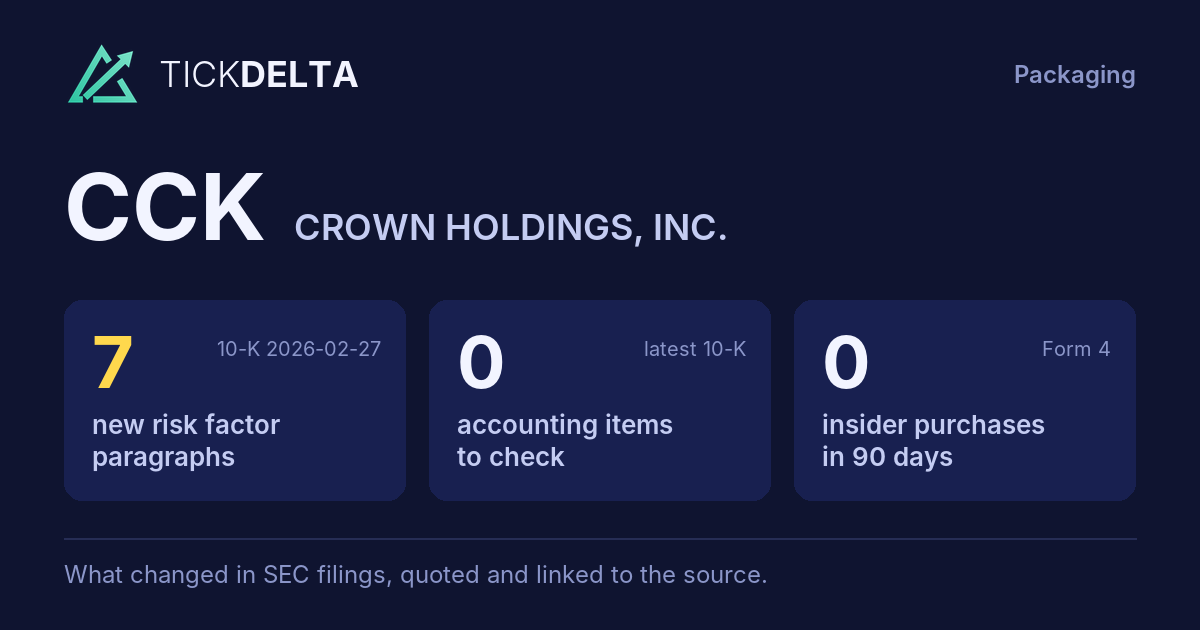
148 paragraphs · 7 new · 97 reworded · 3 gone · 10-K Feb 27, 2026 against Mar 3, 2025
New paragraph Reworded (5% of its words or more) Same or nearly
Paragraph 4 · 42% changed Every version of it
natural disasters such as floods and earthquakes, and pandemics. The U.S. has signaled its intention to change U.S. trade policy, including potentially renegotiating or terminating existing trade agreements and leveraging tariffs. In February 2025, the U.S. imposed additional tariffs on aluminum and steel as well as on imports from China and announced and subsequently paused implementation of tariffs from Canada and Mexico. In April 2025, the U.S. imposed additional tariffs on imports from a broad range of companies and materials. These additional tariffs, as well as potential retaliation by another government against such tariffs or policies could significantly affect the price of steel, aluminum aluminum, and other raw materials used by the Company, which may adversely affect the Company's Company’s profits and financial results. The scope, timing, and duration of tariffs on imports and exports and any retaliatory measures on U.S. goods remain uncertain and could impact the Company’s business. On February 20, 2026, the Supreme Court of the United States ruled that many tariffs imposed by the current administration were unlawful. The scope, timing and practical effect of this decision including whether and how such tariffs may be modified, refunded, replaced or otherwise addressed through new measures and its impact on tariffs, duties and broader trade relations remain uncertain, and could be material to our business, results of operations and financial condition.
Paragraph 9 · 35% changed Every version of it
If the Company is unable to purchase aluminum, steel, resins or other raw materials for a significant period of time, the Company's Company’s operations would be disrupted and any such disruption may adversely affect the Company's Company’s financial results. If customers believe that the Company's Company’s competitors have greater access to raw materials, perceived certainty of supply at the Company's Company’s competitors may put the Company at a competitive disadvantage with respect to pricing and product volumes. The financial stability of the Company’s suppliers can also impact the continuity of the Company’s supply chain. The Company’s suppliers may face higher prices due to inflation or increased tariffs. If one or more of the Company’s suppliers encounter financial hardships, delivery setbacks, or other performance-related difficulties, the Company may be unable to fulfill its obligations to customers. Furthermore, if any of the raw materials critical to the Company’s manufacturing become unavailable to the Company’s suppliers, or are only accessible at significantly higher costs, including due to increased tariffs or trade restrictions, or are affected by quality problems or defects, the Company’s ability to deliver certain products on schedule or within budget could be compromised.
Paragraph 23 · 33% changed Every version of it
A significant portion of the Company's Company’s workforce is unionized, and a prolonged work stoppage or strike at any facility with unionized and labor disruptions employees could increase the Company's costs and prevent the Company from supplying its customers. In addition, upon the
Paragraph 141 · 33% changed Every version of it
The concentration of processes in shared services centers means that any disruption could impact a large portion of the Company's business within the operating zones served by the affected service center. If the Company does not allocate, and effectively manage, the resources necessary to build, sustain and protect the proper technology infrastructure, the Company could be subject to transaction errors, processing inefficiencies, loss of customers, business disruptions, the loss of or damage to intellectual or physical property through security breach, and reputational harm, as well as potential litigation, civil liability and fines under various laws and regulatory regimes of jurisdictions in which the Company does business. While the Company has security measures in place designed to protect the integrity of customer information and prevent data loss, misappropriation, and other security breaches, the Company's information technology systems could nevertheless be penetrated by outside parties intent on extracting information, corrupting information or disrupting business processes (including for purposes of ransom demands or other forms of blackmail), particularly if the Company's information security training and compliance programs prove to be inadequate. In addition, if the Company's information technology systems suffer severe damage, disruption or shutdown and the Company's Company’s business continuity plans do not effectively resolve the issues in a timely manner, the Company may lose customers and suppliers and revenue and profits as a result of its inability to timely manufacture, distribute, invoice and collect payments from its customers, and could experience delays in reporting its financial results, including with respect to the Company's Company’s operations in emerging markets. Furthermore, if the Company is unable to prevent security breaches, it may suffer financial and reputational damage because of lost or misappropriated confidential information belonging to the Company or to its customers or suppliers, and it may suffer indirect economic loss if its existing insurance policies and coverage related to information security risks prove to be insufficient. Failure or disruption of the Company's Company’s information technology systems, or the back-up systems, for any reason could disrupt the Company's Company’s operations and negatively impact the Company's Company’s cash flows or financial condition.
Paragraph 91 · 33% changed Every version of it
In March 2015, the Bundeskartellamt, or German Federal Cartel Office (“FCO”), conducted unannounced inspections of the premises of several metal packaging manufacturers, including a German subsidiary of the Company. The local court order authorizing the inspection cited FCO suspicions of anti-competitive agreements in the German market for the supply of metal packaging products. The Company conducted an internal investigation into the matter and discovered instances of inappropriate conduct by certain employees of German subsidiaries of the Company. The Company cooperated with the FCO and submitted a leniency application with the FCO which disclosed the findings of its internal investigation to date. In April 2018, the FCO discontinued its national investigation and referred the matter to the European Commission (the “Commission”). Following the referral, Commission officials conducted unannounced inspections of the premises of several metal packaging manufacturers, including Company subsidiaries in Germany, France and the U.K. The Company cooperated with the Commission and submitted a leniency application with the Commission with respect to the findings of its internal investigation in Germany. In July 2022, the Company reached a settlement with the Commission relating to the Commission’s investigation, pursuant to which the Company agreed to pay a fine in the amount of $8. Fining decisions based on settlements can be appealed under EU law and the Company sought annulment of the Commission’s fining decision on the basis that the referral of the case from the FCO to the Commission was unjustified. In October 2024, the General Court of the EU issued a judgment dismissing the Company’s appeal. In December 2024, the Company appealed the General Court’s judgment to the European Court of Justice. There can be no assurance regarding the outcome of such appeal.
Paragraph 116 · 32% changed Every version of it
Many of the Company's Company’s largest customers have acquired companies with similar or complementary product lines. This consolidation has increased the concentration of the Company's Company’s business with its largest customers. In many cases, such consolidation has been accompanied by pressure from customers for lower prices, reflecting the increase in the total volume of product purchased or the elimination of a price differential between the acquiring customer and the company acquired. Increased pricing pressures from the Company's customers may reduce the Company's net sales and net income. In addition, customer concentration could expose the Company to increased credit risk if large customers were unable to fulfill their payment obligations to the Company.
Paragraph 117 · 26% changed Every version of it
Many of the Company's largest customers have acquired companies with similar or complementary product lines. This consolidation has increased the concentration of the Company's business with its largest customers. In many cases, such consolidation has been accompanied by pressure from customers for lower prices, reflecting the increase in the total volume of product purchased or the elimination of a price differential between the acquiring customer and the company acquired. Increased pricing pressures from the Company's Company’s customers may reduce the Company's Company’s net sales and net income. In addition, customer concentration could expose the Company to increased credit risk if large customers were unable to fulfill their payment obligations to the Company.
Paragraph 102 · 25% changed Every version of it
Laws and regulations relating to environmental protection and health and safety may increase the Company’s costs of operating and reduce its profitability. The Company’s operations are subject to numerous U.S. federal and state and non-U.S. laws and regulations governing the protection of the environment, including those relating to operating permits, treatment, storage and disposal of waste, the use of chemicals in the Company’s products and manufacturing process, discharges into water, emissions into the atmosphere, remediation of soil and groundwater contamination and protection of employee health and safety. Future regulations may impose stricter environmental or employee safety requirements affecting the Company’s operations or may impose additional requirements regarding consumer health and safety, such as potential restrictions on the use of bisphenol-A, a starting material used to produce internal and external coatings for some food, beverage, and aerosol containers and metal closures. The EU and Canada have banned the use of bisphenol-A in baby bottles, and the U.S. Environmental Protection Agency ("EPA") has considered adding bisphenol-A, which it has described as a potential reproductive, developmental, and systemic toxicant, to the chemical concern list and using its Design for the Environment program to encourage reductions in bisphenol-A manufacturing and use. Certain other nations, including Denmark, Belgium, the Netherlands, Canada Canada, and France, have implemented or considered implementing legislation restricting the use of bisphenol-A, including imposing product labeling requirements or restrictions on the importation and placement in the market of packaging and utensils containing bisphenol-A, and the European Food Safety Authority has recommended that the tolerable daily intake of bisphenol-A be lowered. Domestic and international, federal, state, municipal or other regulatory authorities could further restrict or prohibit the use of bisphenol-A in the future. In addition, public reports, litigation litigation, and other allegations regarding the potential health hazards of bisphenol-A could contribute to a perceived safety risk about the Company’s products and adversely impact sales or otherwise disrupt the Company’s business. While the Company is exploring various alternatives to the use of bisphenol-A and conversion to alternatives is underway in some applications, there can be no assurance the Company will be completely successful in its efforts or that the alternatives will not be more costly to the Company.

MD&A

137 paragraphs · 6 new · 67 reworded · 19 gone · 10-K Feb 27, 2026 against Mar 3, 2025
New paragraph Reworded (5% of its words or more) Same or nearly
Paragraph 30 · 49% changed
Other includes the Company's Company’s North America tinplate businesses: food can, aerosol can can, and closures businesses in North America, closures, and beverage tooling and equipment operations in the U.S. and U.K.. The Company added a third two-piece food can line to its Owatonna, Minnesota plant in 2022 and a pet food can line to its Dubuque, Iowa plant in 2024. U.K.
Paragraph 42 · 49% changed
At December 31, 2024, the The Company had has cross-currency swaps with an aggregate notional values of $875. The swaps are designated as hedges of the Company's net investment in a euro-based subsidiary and $875 that mature in February 2026. The fair value of these contracts at December 31, 2024 was a net gain of $86. These swaps reduced interest expense by $25 in 2025.
Paragraph 129 · 47% changed
In November 2024, September 2025, the Financial Accounting Standards Board FASB issued guidance to clarify and modernize the accounting for costs related to internal-use software. The guidance eliminates references to various stages of a final standard on disaggregation of income statement expenses. software development project and clarifies the threshold to apply to begin capitalizing costs. The standard requires disclosure of more detailed information about certain costs and expenses in the notes to the financial statements. The standard guidance is effective for fiscal years beginning after December 15, 2026 2027, and for interim periods beginning after December 15, 2027. within those fiscal years. The guidance is applied on a prospective basis with the option to apply the standard retrospectively or using a modified transition approach. Early adoption is permitted. The standard is applied prospectively with an option for retrospective adoption. The Company is currently evaluating the impact of adopting this standard that the new guidance will have on its disclosures. consolidated financial statements.
Paragraph 130 · 47% changed
In November 2024, 2025, the Financial Accounting Standards Board FASB issued a final standard on disaggregation of income statement expenses. improvements to hedge accounting, which introduces five targeted improvements to better align hedge accounting with entities’ risk management activities. The standard requires disclosure of more detailed information about certain costs and expenses in the notes to the financial statements. The standard is will be effective for fiscal years beginning after December 15, 2026 and for interim annual reporting periods beginning after December 15, 2027. 2026, and interim periods within those annual reporting periods. Early adoption is permitted. The standard is applied prospectively with an option for retrospective adoption. The Company is currently evaluating the impact of adopting this standard that the new guidance will have on its disclosures. consolidated financial statements.
Paragraph 22 · 43% changed
In June 2022, the Company's The Company’s Yangon, Myanmar beverage can plant was temporarily idled in 2022 and has operated at limited capacity since 2023 due to currency restrictions, which resulted in the inability to source U.S. dollars required to procure U.S. dollar raw materials. The In the third quarter of 2025, the Company began production on a limited basis in 2023 and had net sales recorded an asset impairment charge of $6 for the year-ended December 31, 2024. Property, plant and equipment in Myanmar as of December 31, 2024 was $49, including $24 of land and buildings and $25 of machinery and equipment. The Company will continue $30 due to monitor the economic conditions and the impact to its the Company’s business in Myanmar, including any alternative uses for its machinery and equipment. Myanmar. In February 2026, the Company sold the Myanmar beverage can plant. The sale is not expected to have a material impact on the Company’s results of operations or cash flows.
Paragraph 29 · 42% changed
Segment income decreased primarily related to lower volumes across most product lines and margin compression due to unfavorable product mix, driven by lower selling prices, equipment volumes, partially offset by improved cost performance. performance of $21.
Paragraph 50 · 40% changed
Cash used for investing activities decreased increased from $804 in 2023 to $12 in 2024 to $320 in 2025 primarily due to lower capital expenditures and the $338 proceeds received in 2024 from the distribution related to the sale of Eviosys. Additionally, 2023 included the purchase of Helvetia Packaging AG for $126 and a distribution from Eviosys of $68. See Note B for more information. equity method investment.
Paragraph 16 · 39% changed
Net sales decreased increased primarily due to 14% lower volumes, $405 from the pass-through of lower higher aluminum costs and $8 from the impact of unfavorable foreign currency translation. costs.

A paragraph is matched with the one last year that shares the most of its words; under half in common makes it new. The paragraphs shown are the 8 reworded the most in each section.

The paragraph that changed most in each section

The redline

Marked against last year's 10-K: cut words struck through, new words highlighted.

Risk Factors178 words changed in this paragraph; it is 68% similar to last year's version.
Laws and regulations relating to environmental protection and health and safety may increase the Company’s costs of operating and reduce its profitability. The Company’s operations are subject to numerous U.S. federal and state and non-U.S. laws and regulations governing the protection of the environment, including those relating to operating permits, treatment, storage and disposal of waste, the use of chemicals in the Company’s products and manufacturing process, discharges into water, emissions into the atmosphere, remediation of soil and groundwater contamination and protection of employee health and safety. Future regulations may impose stricter environmental or employee safety requirements affecting the Company’s operations or may impose additional requirements regarding consumer health and safety, such as potential restrictions on the use of bisphenol-A, a starting material used to produce internal and external coatings for some food, beverage, and aerosol containers and metal closures. The EU and Canada have banned the use of bisphenol-A in baby bottles, and the U.S. Environmental Protection Agency ("EPA") has considered adding bisphenol-A, which it has described as a potential reproductive, developmental, and systemic toxicant, to the chemical concern list and using its Design for the Environment program to encourage reductions in bisphenol-A manufacturing and use. Certain other nations, including Denmark, Belgium, the Netherlands, Canada Canada, and France, have implemented or considered implementing legislation restricting the use of bisphenol-A, including imposing product labeling requirements or restrictions on the importation and placement in the market of packaging and utensils containing bisphenol-A, and the European Food Safety Authority has recommended that the tolerable daily intake of bisphenol-A be lowered. Domestic and international, federal, state, municipal or other regulatory authorities could further restrict or prohibit the use of bisphenol-A in the future. In addition, public reports, litigation litigation, and other allegations regarding the potential health hazards of bisphenol-A could contribute to a perceived safety risk about the Company’s products and adversely impact sales or otherwise disrupt the Company’s business. While the Company is exploring various alternatives to the use of bisphenol-A and conversion to alternatives is underway in some applications, there can be no assurance the Company will be completely successful in its efforts or that the alternatives will not be more costly to the Company.

Source: Item 1A, 10-K 0001628280-26-012904 vs Item 1A, 10-K 0001219601-25-000009

MD&A154 words changed in this paragraph; it is 81% similar to last year's version.
performance of the Company’s pension plans; costs and difficulties related to the acquisition of a business and integration of acquired businesses; the impact of any actual or potential dispositions, acquisitions or other strategic realignments (such as the Company's recently completed divestiture of its European Tinplate business), which may impact the Company’s operations, financial profile, investments or levels of indebtedness; the Company’s ability to realize efficient capacity utilization and inventory levels and to innovate new designs and technologies for its products in a cost-effective manner; competitive pressures, including new product developments, industry overcapacity, or changes in competitors’ pricing for products; the Company’s ability to achieve high capacity utilization rates for its equipment; the Company’s ability to maintain, develop and capitalize on competitive technologies for the design and manufacture of products and to withstand competitive and legal challenges to the proprietary nature of such technology; the Company’s ability to protect its information technology systems from attacks or catastrophic failure; the strength of the Company’s cyber-security (including with respect to human vulnerabilities associated with cyber-security risks); the Company’s ability to generate sufficient production capacity; the Company’s ability to improve and expand its existing product and product lines; the impact of overcapacity on the end-markets the Company serves; loss of customers, including the loss of any significant customers; changes in consumer preferences for different packaging products; the financial condition of the Company’s vendors and customers; weather conditions, including their effect on demand for beverages and on crop yields for fruits and vegetables stored in food containers; the impact of natural disasters, including in emerging markets; changes in governmental regulations or enforcement practices, including with respect to environmental, health and safety matters and restrictions as to foreign investment or operation; the impact of increased governmental regulation on the Company and its products, including the regulation or restriction of the use of bisphenol-A; the impact of the Company’s recent initiatives to generate additional cash, including the reduction of working capital levels and capital spending; the impact of the Company's Company’s comprehensive Board-led review of its portfolio and capital allocation/return; the ability of the Company to realize cost savings from its restructuring programs; the Company’s ability to maintain adequate sources of capital and liquidity; costs and payments to certain of the Company’s executive officers in connection with any termination of such executive officers or a change in control of the Company; the impact of existing and future legislation regarding refundable mandatory deposit laws in Europe for non-refillable beverage containers and the implementation of an effective return system; the impact of existing and future legislation regarding the taxation of sugar-sweetened beverages or energy drinks, the impact of tariffs and potential limits on steel supply in the U.S. from certain foreign countries; and changes in the Company’s strategic areas of focus, which may impact the Company’s operations, financial profile or levels of indebtedness.

Source: Item 7, 10-K 0001628280-26-012904 vs Item 7, 10-K 0001219601-25-000009

Sentences and paragraphs added, removed or reworded

Every change, by type

Sentences and paragraphs of CCK's Risk Factors and MD&A, 10-K Feb 27, 2026 against 10-K Mar 3, 2025. Each links to the text at sec.gov.

Quiet changes are sentences kept from last year with one to four words changed, at least one of them a hedge, a modal or a qualifier (may, could, will, not, significant, material…). A year or date rolling forward is not counted.

The full word list

adverse, adversely, all, although, anticipate, anticipates, any, approximately, believe, believes, can, cannot, certain, could, expect, expects, generally, however, if, intend, intends, largely, likely, many, material, materially, may, might, most, must, never, no, not, possible, primarily, probable, should, significant, significantly, some, substantial, substantially, unlikely, will, would

AddedRisk Factors
The Company is exposed to fluctuations in foreign currencies as a significant portion of its consolidated net sales, costs, assets and liabilities, are denominated in currencies other than the U.S. dollar. The Company’s international operations generated
Read it in 10-K Feb 27, 2026 at sec.gov
AddedRisk Factors
ability to satisfy its obligations. Further information regarding Crown’s Cork’s asbestos-related liabilities is presented within “Management’s Discussion and Analysis of Financial Condition and Results of Operations” under the headings, “Provision for Asbestos” and “Critical Accounting Policies and Estimates” and under Note P to the Company’s audited consolidated financial statements included in this Annual Report.
Read it in 10-K Feb 27, 2026 at sec.gov
AddedRisk Factors
On July 4, 2025, the President of the United States signed and enacted tax legislation into law through a reconciliation bill titled 'An Act to provide for reconciliation pursuant to title II of H. Con. Res. 14,' commonly referred to as the "One Big Beautiful Bill Act" (the "OBBBA"). The OBBBA makes permanent key elements of the Tax Cuts and Jobs Act, including 100% bonus depreciation, domestic research cost expensing, and the business interest expense limitation. The legislation has multiple effective dates, with certain provisions effective in 2025 and others implemented through 2027. The Company continues to review the OBBBA tax provisions to assess impacts to the Company’s consolidated financial statements, effective tax rate, and cash tax obligations. The ultimate impact of this legislation on the Company’s financial results remains uncertain and could be material.
Read it in 10-K Feb 27, 2026 at sec.gov
AddedRisk Factors
Given the increasing complexity and sophistication of techniques used by bad actors to obtain unauthorized access to or disable information technology systems, and the fact that cyber-attacks are being made by groups and individuals with a wide range of expertise and motives, it is increasingly difficult to anticipate and defend against cyber-attacks.
Read it in 10-K Feb 27, 2026 at sec.gov
AddedRisk Factors
The Company’s reliance on cloud-based systems owned by third parties creates particular risks. Because the Company does not control the underlying infrastructure, the Company depends on the security and reliability of third-party providers, and any outage, misconfiguration, or loss of data could compromise the integrity of the Company’s and the Company’s customers’ operations. New technologies, such as artificial intelligence and quantum computing, may present new technological risks or vulnerabilities that could compromise the Company’s systems and data.
Read it in 10-K Feb 27, 2026 at sec.gov
AddedRisk Factors
Artificial intelligence technologies have rapidly developed, and the Company’s business may be adversely affected if the Company cannot successfully integrate the technology into its internal business processes, products, and services in a timely, cost-effective, compliant, and responsible manner. If the data used to train artificial intelligence solutions or the content, analyses, or recommendations that machine learning applications assist in producing is deemed to be inaccurate, incomplete, biased, or questionable, the Company’s brand and reputation may be harmed, and the Company may be subject to legal liability claims. Such risks could result in significant costs, operational disruptions, regulatory penalties, litigation, reputational damage, and material adverse effects on the Company’s business and financial condition.
Read it in 10-K Feb 27, 2026 at sec.gov
Show the other 48
RemovedRisk Factors
effect in 2015. On December 29, 2023, the FCA issued a decision imposing a fine of €4 million on the Company. The Company intends to appeal the decision of the FCA and there can be no assurance regarding the outcome of such appeal.
Read it in 10-K Mar 3, 2025 at sec.gov
RewordedRisk Factors
The Company's Company’s indebtedness includes its $875 million 4.75% senior notes due in February 2026; its €500 million ($518 million at December 31, 2024) 2.875% senior notes due in February 2026; its $400 million 4.25% senior notes due in September 2026; its $350 million 7.375% senior notes due in December 2026; its €500 million ($518 ($587 million at December 31, 2024) 2025) 5.00% senior notes due in May 2028; its €500 million ($518 ($587 million at December 31, 2024) 2025) 4.75% senior notes due in March 2029; its €600 million ($621 ($705 million at December 31, 2024) 2025) 4.50% senior notes due in January 2030; its $500 million 5.25% senior notes due in April 2030; its €500 million ($587 million at December 31, 2025) 3.75% senior notes due in September 2031; its $700 million 5.875% senior notes due June 2033; its $40 million 7.50% senior notes due in December 2096; and its $118 $54 million of other indebtedness in various currencies due at various dates through 2027.
Read it in 10-K Feb 27, 2026 at sec.gov
RewordedRisk Factors
Pension expense was $562 million, including settlement charges of $47 $27 million and $469 million for the Canadian and U.S. pension plans and is expected to be $32 $33 million in 2025, 2026, using foreign currency exchange rates in effect at December 31, 2024. 2025.
Read it in 10-K Feb 27, 2026 at sec.gov
RewordedRisk Factors
In periods of low worldwide demand for its products or in situations where industry expansion creates excess capacity, the Company experiences relatively low capacity utilization rates in its operations, which can lead to reduced margins and can have an adverse effect on the Company’s business.
Read it in 10-K Feb 27, 2026 at sec.gov
RewordedRisk Factors
The availability of various raw materials and their prices depend on global and local supply and demand forces, governmental regulations and trade policies (including tariffs and duties), level of production, resource availability, transportation, and other factors, including natural disasters such as floods and earthquakes, and pandemics (including possible reemergence of the COVID 19 pandemic). disruptions caused by accident or
Read it in 10-K Feb 27, 2026 at sec.gov
RewordedRisk Factors
Based on current assumptions, the Company expects to make pension contributions of $20 million in 2025, $29 $28 million in 2026, $27 $19 million in 2027, $51 $65 million in 2028 and $28 2028, $48 million in 2029. 2029, and $40 million in 2030.
Read it in 10-K Feb 27, 2026 at sec.gov
RewordedRisk Factors
A significant portion of the Company's Company’s workforce is unionized, and a prolonged work stoppage or strike at any facility with unionized and labor disruptions employees could increase the Company's costs and prevent the Company from supplying its customers.
Read it in 10-K Feb 27, 2026 at sec.gov
RewordedRisk Factors
The Company's Company’s international operations generated approximately 61% of its consolidated net sales in the year ended 2025 and 63% of its consolidated net sales in the years ended 2024, 2023 2024 and 2022. 2023.
Read it in 10-K Feb 27, 2026 at sec.gov
RewordedRisk Factors
In many cases, such consolidation has been accompanied by pressure from customers for lower prices, reflecting the increase in the total volume of product purchased or the elimination of a price differential between the acquiring customer and the company acquired.
Read it in 10-K Feb 27, 2026 at sec.gov
RewordedRisk Factors
The Company's Company’s annual interest expense was $398 million, $452 million, and $436 million for 2025, 2024, and $284 million for 2024, 2023 and 2022, 2023, respectively.
Read it in 10-K Feb 27, 2026 at sec.gov
RewordedRisk Factors
Crown Cork made cash payments of $19 million, $15 million, and $17 million in 2025, 2024, and $21 million in 2024, 2023 and 2022 2023, respectively, to settle asbestos claims and pay related legal and defense costs.
Read it in 10-K Feb 27, 2026 at sec.gov
Quiet changesRisk Factors
The Company has significant pension plan obligations worldwide and significant unfunded postretirement obligations, which could reduce its cash flow and negatively impact its results of operations and its financial condition.
Read it in 10-K Feb 27, 2026 at sec.gov
AddedMD&A
This segment may be subject to direct and indirect effects from tariffs which may slow consumer and industrial activity, the impact of which cannot be reasonably predicted. The Company will continue to monitor these conditions, including potential actions to mitigate their impact. This economic uncertainty could affect projected future financial performance and may require a quantitative goodwill impairment test in the future to determine if an impairment charge is necessary.
Read it in 10-K Feb 27, 2026 at sec.gov
AddedMD&A
Segment income increased primarily due to increased profitability in the Company’s North America tinplate business; due to $22 from higher volumes and improved customer mix, $12 lower costs from continued operational improvements, as well as higher sales in the Company’s beverage can equipment operations.
Read it in 10-K Feb 27, 2026 at sec.gov
AddedMD&A
On July 4, 2025, the U.S. government enacted tax reform, commonly referred to as the One Big Beautiful Bill Act ("OBBBA"). OBBBA did not have a material impact on the Company’s financial results for 2025 and it is not expected to have a material impact on its financial results for 2026.
Read it in 10-K Feb 27, 2026 at sec.gov
AddedMD&A
Effective January 1, 2024, various jurisdictions in which the Company operates have enacted the Pillar II directive which establishes a global minimum corporate tax rate of 15% initiated by the Organisation for Economic Co-operation and Development ("OECD"). Pillar II did not have a material impact on its financial results for 2025 and is not expected to have a material impact on its financial results for 2026, including its annual estimated tax rate or liquidity, based on currently enacted tax laws. However, the Company continues to monitor developments across its jurisdictions, including any additional guidance issued by the OECD.
Read it in 10-K Feb 27, 2026 at sec.gov
RemovedMD&A
To meet volume requirements in these markets, the Company added additional line capacity in Monterrey, Mexico (2022) and new greenfield facilities in Uberaba, Brazil (2022), Martinsville, Virginia (2022) and Mesquite, Nevada (2023).
Read it in 10-K Mar 3, 2025 at sec.gov
RemovedMD&A
Segment income increased primarily due to higher volumes, improved manufacturing performance, including lower start-up costs compared to 2023 and $18 lower depreciation expense primarily driven by the useful life change effective January 1, 2024.
Read it in 10-K Mar 3, 2025 at sec.gov
RemovedMD&A
Segment income increased primarily due to contractual pass-through mechanisms put in place to recover prior costs net of current year expenses and higher volumes and customer mix, partially offset by $19 higher depreciation associated with recent capacity expansions.
Read it in 10-K Mar 3, 2025 at sec.gov
RemovedMD&A
Segment income increased primarily due to higher volumes and improved manufacturing performance, including savings realized as part of prior year restructuring actions and lower start-up costs.
Read it in 10-K Mar 3, 2025 at sec.gov
RemovedMD&A
In 2023, volume softness was noted across each country in the Asia Pacific segment as the region continues to struggle with the effects of higher inflation and interest rates. In the fourth quarter of 2023, the Company announced the closure of its beverage can facilities in Ho Chi Minh City, Vietnam and Singapore with capacity relocated to the Company's Vung Tau, Vietnam facility and in the fourth quarter of 2024, the Company announced the closure of its beverage can facility in Sihanoukville, Cambodia.
Read it in 10-K Mar 3, 2025 at sec.gov
RemovedMD&A
Segment income increased primarily due to improved manufacturing performance, including savings realized as part of prior year restructuring actions, and $16 lower depreciation expense driven by the useful life change effective January 1, 2024.
Read it in 10-K Mar 3, 2025 at sec.gov
RemovedMD&A
In 2023, the Company right-sized the beverage can equipment operations in the U.K. to reflect the expected significant reduction in orders from global beverage can manufactures. Additionally, in the fourth quarter of 2023, the Company announced the closure of its Decatur, IL aerosol can plant in response to lower aerosol can demand.
Read it in 10-K Mar 3, 2025 at sec.gov
RemovedMD&A
During the second quarter of 2024, the Company closed its food can plant in La Villa, Mexico and entered into an agreement to sell equipment for $30 to be paid in three annual installments, with the first $10 installment received during 2024. The Company recorded a gain of $22 for the sale of the equipment in the third quarter of 2024.
Read it in 10-K Mar 3, 2025 at sec.gov
RemovedMD&A
Segment income decreased primarily due to a steel repricing gain of $48 in 2022 as compared to a repricing loss of $12 in 2023, volume declines and customer mix and costs and expenses in excess of contractual pass-through mechanisms.
Read it in 10-K Mar 3, 2025 at sec.gov
RemovedMD&A
The Company periodically reviews the useful lives of property, plant and equipment. Based on the Company’s experience with the duration over which equipment and buildings of its aluminum beverage can business can be utilized, the Company engaged a third-party appraiser to assist in this review and, as a result, increased the estimated useful lives of buildings up to 50 years and machinery and equipment up to 23 years effective January 1, 2024. The change in accounting estimate was applied on a prospective basis. The change in useful lives resulted in a net reduction in depreciation expense of $64 for the year ended December 31, 2024 as compared to the amount of depreciation expense that would have been recorded by utilizing the prior depreciable lives.
Read it in 10-K Mar 3, 2025 at sec.gov
RemovedMD&A
In 2022, the benefit from restructuring and other, net, included a $113 gain from the sale of the Transit Packaging segment's Kiwiplan business and $29 of charges related to an overhead cost reduction program initiated by the Transit Packaging segment in the second quarter of 2022 that reduced headcount by approximately 600 employees. The annual savings were approximately $60.
Read it in 10-K Mar 3, 2025 at sec.gov
RewordedMD&A
Important factors that could cause the actual results of operations or financial condition of the Company to differ include, but are not necessarily limited to, the ability of the Company to expand successfully in international and emerging markets; the ability of the Company to repay, refinance or restructure its short and long-term indebtedness on adequate terms and to comply with the terms of its agreements relating to debt; the Company’s ability to generate significant cash to meet its obligations and invest in its business and to maintain appropriate debt levels; restrictions on the Company’s use of available cash under its debt agreements; changes or differences in U.S. or international economic or political conditions, such as inflation or fluctuations in interest or foreign exchange rates (and the effectiveness of any currency or interest rate hedges), tax rates, and applicable tax laws (including with respect to taxation of unrepatriated non-U.S. earnings or as a result of the depletion of net loss or foreign tax credit carryforwards); the impact of foreign trade laws and practices; the collectability of receivables; war or acts of terrorism that may disrupt the Company’s production or the supply or pricing of raw materials impact the financial condition of customers or adversely affect the Company’s ability to refinance or restructure its remaining indebtedness; changes in the availability and pricing of raw materials (including aluminum can sheet, steel tinplate, energy, water, inks and coatings) and the Company’s ability to pass raw material, energy and freight price increases and surcharges through to its customers or to otherwise manage these commodity pricing risks; the Company’s ability to obtain and maintain adequate pricing for its products, including the impact on the Company’s revenue, margins and market share and the ongoing impact of price increases; energy and natural resource costs; the cost and other effects of legal and administrative cases and proceedings, settlements and investigations; the outcome of asbestos-related litigation; the Company’s ability to realize deferred tax benefits; changes in the Company’s critical or other accounting policies or the assumptions underlying those policies; labor relations and workforce and social costs, including the Company’s pension and postretirement obligations and other employee or retiree costs; investment performance of the Company’s pension plans; costs and difficulties related to the acquisition of a business and integration of acquired businesses; the impact of any actual or potential dispositions, acquisitions or other strategic realignments (such as the Company’s recently completed divestiture of its European Tinplate business), which may impact the Company’s operations, financial profile, investments or levels of indebtedness; the Company’s ability to realize efficient capacity utilization and inventory levels and to innovate new designs and technologies for its products in a cost-effective manner; competitive pressures, including new product developments, industry overcapacity, or changes in competitors’ pricing for products; the Company’s ability to achieve high capacity utilization rates for its equipment; the Company’s ability to maintain, develop and capitalize on competitive technologies for the design and manufacture of products and to withstand competitive and legal challenges to the proprietary nature of such technology; the Company’s ability to protect its information technology systems
Read it in 10-K Feb 27, 2026 at sec.gov
RewordedMD&A
Net sales decreased increased primarily due to $196 $507 from the pass-through of lower higher aluminum, steel steel, and other commodity costs, unfavorable higher volumes in European Beverage and Other, and favorable foreign currency translation of $23, and $84, partially offset by lower volumes in Transit Packaging, Asia Pacific and Other segments, partially offset by 7% higher beverage can volumes in both Americas and European Beverage. Transit Packaging.
Read it in 10-K Feb 27, 2026 at sec.gov
RewordedMD&A
The Company has managed its various pension plan liabilities through opportunistic purchases of annuity insurance contracts for portions of outstanding defined pension obligations using plan assets for For further information on the group annuity insurance contracts purchased in 2024 to transfer portions of the Company's Company’s Canadian and primary U.S. defined benefit pension liabilities in refer to Note S.
Read it in 10-K Feb 27, 2026 at sec.gov
RewordedMD&A
Additionally, in December 2023, In October 2025, the Company issued €500 principal amount of 4.75% 3.75% senior unsecured notes due 2029 2031 and used a portion of the proceeds to pay down redeem the U.S. dollar term loan facility. €500 principal amount of 2.875% senior unsecured notes due February 2026.
Read it in 10-K Feb 27, 2026 at sec.gov
RewordedMD&A
The Company has managed its various pension plan liabilities through opportunistic purchases of annuity insurance contracts for portions of outstanding defined pension obligations using plan assets for further information on the group annuity insurance contracts purchased to transfer portions of the Company's Canadian and primary U.S. defined benefit pension liabilities in Note S. assets.
Read it in 10-K Feb 27, 2026 at sec.gov
RewordedMD&A
Inventories decreased increased from $1,613 at December 31, 2023 to $1,440 at December 31, 2024 to $1,577 at December 31, 2025 primarily due to efforts to reduce inventory levels across most businesses higher raw material costs and unfavorable foreign currency translation.
Read it in 10-K Feb 27, 2026 at sec.gov
RewordedMD&A
Interest expense increased decreased from $284 $452 in 2022 2024 to $436 $398 in 2023 2025 and interest income increased decreased from $15 $82 in 2022 2024 to $53 $55 in 2023 2025 primarily due to higher lower borrowings, cash balances, and interest rates.
Read it in 10-K Feb 27, 2026 at sec.gov
RewordedMD&A
Cash used for investing activities decreased increased from $804 in 2023 to $12 in 2024 to $320 in 2025 primarily due to lower capital expenditures and the $338 proceeds received in 2024 from the distribution related to the sale of Eviosys. the Eviosys equity method investment.
Read it in 10-K Feb 27, 2026 at sec.gov
RewordedMD&A
The standard is will be effective for fiscal years beginning after December 15, 2026 and for interim annual reporting periods beginning after December 15, 2027. 2026, and interim periods within those annual reporting periods.
Read it in 10-K Feb 27, 2026 at sec.gov
RewordedMD&A
Segment income decreased primarily related to lower volumes across most product lines and margin compression due to unfavorable product mix, driven by lower selling prices, equipment volumes, partially offset by improved cost performance. performance of $21.
Read it in 10-K Feb 27, 2026 at sec.gov
RewordedMD&A
Net sales decreased increased primarily due to lower volumes in the equipment, aerosol can and Mexico 5% higher North America food can business volumes and $46 $63 from the pass-through of lower steel higher tinplate costs.
Read it in 10-K Feb 27, 2026 at sec.gov
RewordedMD&A
Net sales decreased increased primarily due to 14% lower volumes, $405 from the pass-through of lower higher aluminum costs and $8 from the impact of unfavorable foreign currency translation. costs.
Read it in 10-K Feb 27, 2026 at sec.gov
Quiet changesMD&A
To meet such demand, the Company made long-term investments of approximately at least $2,000 for new manufacturing facilities and additional production lines in existing facilities since 2019.
Read it in 10-K Feb 27, 2026 at sec.gov

Sources

The two latest 10-Ks on EDGAR, section by section. Each change links to the text at sec.gov.

Also

New risk factors: paragraphs with nothing like them last year, quoted in full.

Work with it

Excel workbook · CSV. Google Sheet that stays up to date: paste =IMPORTDATA("https://tickdelta.com/company/CCK/export.csv") into a cell.

Next:Related parties
Esc

Type a ticker such as AAPL, a name, an investor such as Buffett, or a topic such as tariffs. ↑ ↓ to move, Enter to open.