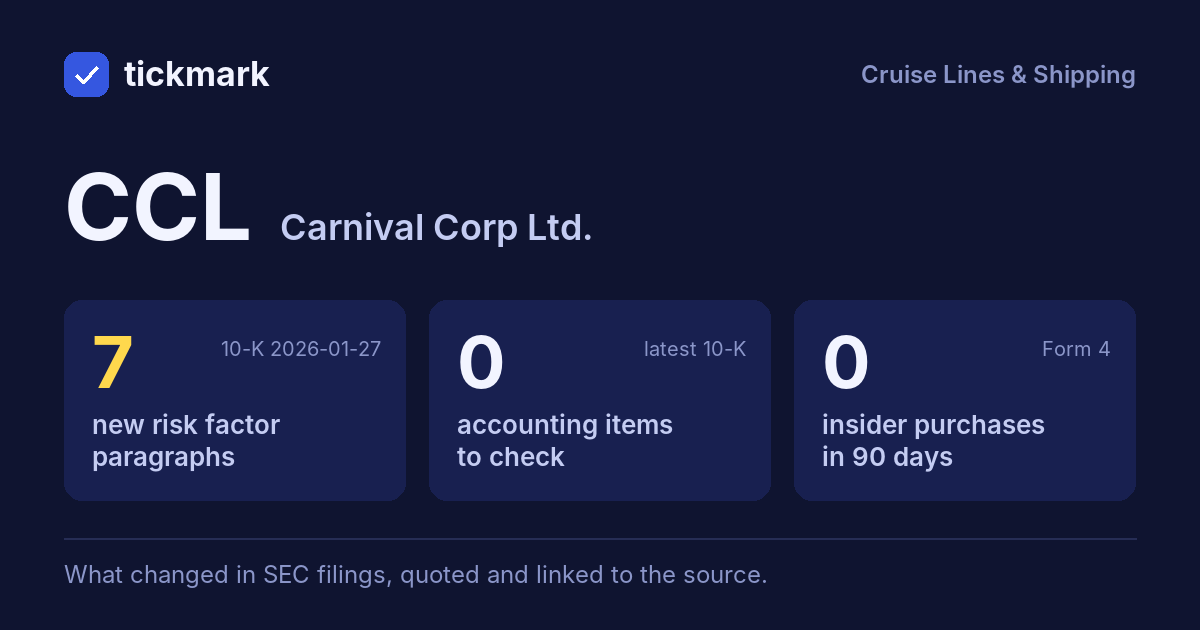
Marked against last year's 10-K:
cut words struck through, new words highlighted and underlined.
Risk Factors 270 words changed in this paragraph; it is 36% similar to last year's version.
Growing recognition among consumers globally of Our business has faced and may in the negative effects of climate change and future continue to face increased scrutiny from our guests, our team members, the impact of GHG investment community, media (including social media), governments, regulators, destinations and other emissions may lead parties related to material changes in consumer preferences. For instance, our guests may choose a vacation option that they perceive sustainability and environmental activities. If our sustainability practices do not meet, are adverse to, or are perceived to diverge from the expectations of our guests, team members, investors or other stakeholders, the demand for cruising, our reputation, our ability to attract or retain team members as operating in a manner that is more sustainable for the climate, seek alternative methods of travel, or reduce the amount and frequency of their travel. well as our attractiveness as an investment could be negatively impacted. In addition, some environmental focused groups have and may continue to generate negative publicity regarding the environmental impact of the cruise industry and are advocating for more stringent oversight and regulation of our industry, including of ship emissions while the ship is docked and at sea. At the same time, we may also face negative impacts from consumers those who do not support climate-related sustainability-related initiatives or concerns. Environmental scrutiny concerns or disagree with our actual or perceived initiatives or positions, or lack of our operations thereof, on various sustainability, environmental, political, social, governance, or other issues. Evolving views among consumers about the impact of GHG and other emissions on the industry from the investment community, other stakeholders, and the media (including social media) have impacted and environment may continue also lead to impact how we are perceived, which may have a material impact on our operations and financial results. Certain climate-related actions and investments we make today may not lead us to our intended future emissions related goals or may not be favorably perceived changes in future years based on continuing evolving regulations and perceptions around effective emissions mitigation strategies and technologies. consumer preferences.
Source: Item 1A, 10-K 0000815097-26-000007 vs Item 1A, 10-K 0000815097-25-000007
MD&A 231 words changed in this paragraph; it is 63% similar to last year's version.
The We are pursuing our aspiration of net zero emissions from ship operations by 2050 in line with the IMO’s 2023 Strategy on Reduction of GHG Emissions from Ships (“IMO Strategy”) strives to peak GHG emissions from international shipping as soon as possible and to reach net zero GHG emissions on a well-to-wake basis by or around 2050. The IMO Strategy includes checkpoints in 2030 and 2040 that seek reductions in Ships. Given the absolute GHG emissions from international shipping by at least 20% and 70%, respectively, compared to 2008. It also includes a target of a 40% reduction in CO2 emissions intensity by 2030 compared to 2008. The EU has also proposed several regulations that will likely impact the cost of fossil fuels and has recently adopted the inclusion of maritime shipping in the EU’s Emissions Trading System. We have established Climate Action Goals, which include a GHG intensity reduction goal of 20% by 2030 from the 2019 baseline and we are pursuing our aspiration of net zero emissions by 2050. Given a 30-year estimated useful life for our ships, our most recently delivered vessels’ lives will extend beyond this 2050 date. To provide a path to net zero emissions, alternative low GHG emission fuels will be necessary for the maritime industry; however, there are significant supply challenges that must be resolved before viability is reached. We are closely monitoring technology developments and partnering with organizations on research and development to which may support our sustainability goals and aspirations. goals. Our fleet’s engines are capable of being modified for use with using certain alternative fuels and we have completed tests on the use of marine biofuel blends on certain ships in our fleet. In addition, and in support of our Climate Action Goals, we invest in technologies, including the use of LNG liquefied natural gas (“LNG”) powered cruise ships, the installation of Advanced Air Quality Systems on board our ships to aid in the reduction of sulfur emissions, the use of shore power, enabling ships to use shoreside electric power where available while in port and various other efficiency related upgrades intended to reduce our emissions. It is uncertain how proposed and possible future regulatory changes related to the environment and climate change and changes, as well as our aspiration of 2050 net zero emissions by 2050, aspiration, may impact our ships’ useful lives and residual values and as the impact is dependent on future regulatory actions and technological advances. As of November 30, 2024, management concluded that there were no changes in our ship useful lives and residual value estimates.
Source: Item 7, 10-K 0000815097-26-000007 vs Item 7, 10-K 0000815097-25-000007
Accounting Policies 91 words changed in this paragraph; it is 66% similar to last year's version.
Our payment terms generally require an initial deposit to confirm a reservation, with the balance due prior to the commencement of the voyage. We also offer our guests the advance purchase of onboard and other services. Cash received from guests in advance of the cruise is recorded in customer deposits and in other long-term liabilities on our Consolidated Balance Sheets. These amounts include refundable deposits. We had total customer deposits of $6.8 $7.2 billion and $6.4 $6.8 billion as of November 30, 2024 2025 and 2023, which includes approximately $25 million of unredeemed Future Cruise Credits (“FCCs”) as of November 30, 2024. At November 30, 2023, we had approximately $134 million of unredeemed FCCs, of which $111 million were refundable. During 2024 2025 and 2023, 2024, we recognized revenues of $5.5 $6.1 billion and $4.1 $5.5 billion related to our customer deposits as of November 30, 2023 2024 and 2022. 2023. Our customer deposits balance changes due to the seasonal nature of cash collections, which typically results from higher ticket prices and occupancy levels during the third quarter, the recognition of revenue, refunds of customer deposits and foreign currency changes.
Source: Item 8, Note 2 – Summary of Significant Accounting Policies, 10-K 0000815097-26-000007 vs Item 8, Note 2 – Summary of Significant Accounting Policies, 10-K 0000815097-25-000007
Legal Proceedings 78 words changed in this paragraph; it is 64% similar to last year's version.
On June 20, 2022, Princess Cruises notified the Australian Maritime Safety Authorization (“AMSA”) and the flag state, Bermuda, regarding approximately six cubic meters of comminuted food waste (liquid biodigester effluent) inadvertently released by Coral Princess inside the Great Barrier Reef Marine Park. On June 23, 2022, the UK P&I Club N.V. provided a letter of undertaking for approximately $1.9 million (being the estimated maximum combined penalty). On May 31, 2023, we received a summons from the Australia Federal Prosecution Service indicating that formal charges are being would be pursued against Princess Cruises and the Captain of the vessel. We believe On November 17, 2025, Princess Cruises entered a guilty plea, and the ultimate outcome will not have a material impact on our consolidated financial statements. charges against the Captain were accordingly dismissed. The Magistrates Court of Queensland imposed an immaterial fine against Princess Cruises. This matter is now concluded.
Source: Item 3, 10-K 0000815097-26-000007 vs Item 3, 10-K 0000815097-25-000007