tickdelta
Sign in

Tickdelta is free for now. Sign up and get Pro free

← Screener

CCLCarnival Corporation

Consumer discretionary · Cruise Lines & Shipping · NYSE

Carnival Corporation was incorporated in Panama in 1974 and Carnival plc was incorporated in England and Wales in 2000. 10-K, Item 1

Employees
101,000
Headquarters
Miami, FL
CEO
joshua ian weinstein
Next results
around Dec 18, 2026
Compare with peers → Embed

When the SEC's staff reviews a filing, it writes to the company with numbered questions, and the company answers each one in a letter. SEC publishes the exchange once the review is over, at least 20 business days later. Below: what the staff asked CCL, and the company's answer to each question, quoted from the letters. A question is not an accusation; most reviews end with the company adding detail to its next filing.

Form 10-K for the Fiscal Year Ended November 30, 2016

2017-02-22 to 2017-03-23 · 4 questions · 1 letter from the SEC, 1 from the company
Review closed 2017-03-23
Liquidity and cashResults discussion (MD&A)DebtNon-GAAP measuresRevenue
Consolidated Balance Sheets, page F-4
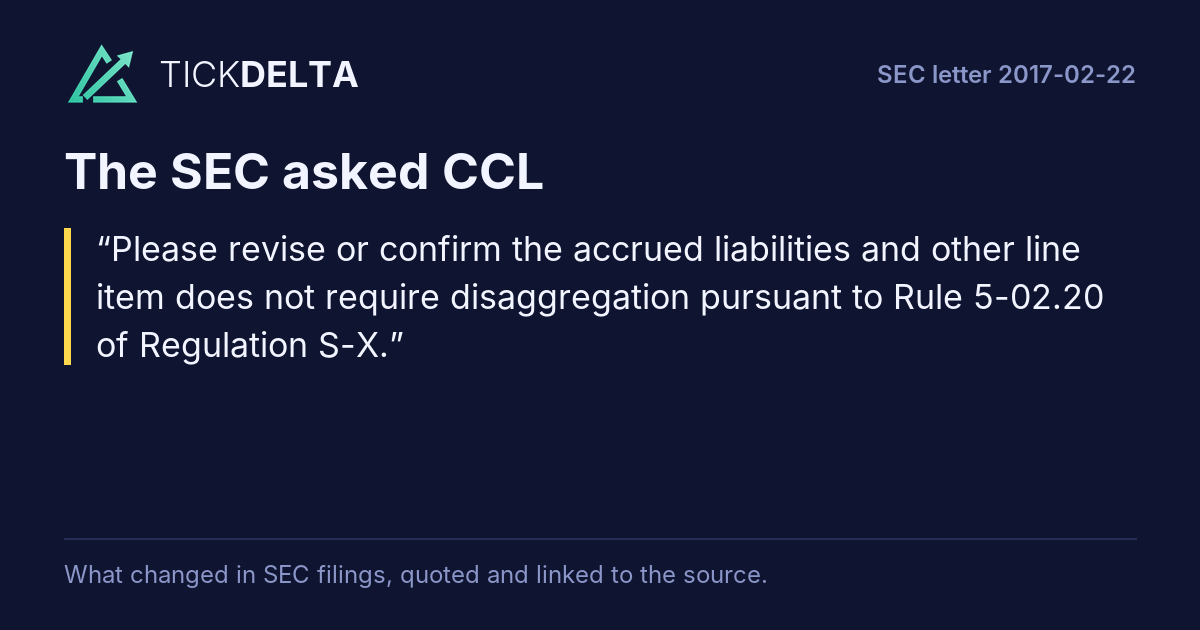
SEC asked (1)
Please revise or confirm the accrued liabilities and other line item does not require disaggregation pursuant to Rule 5-02.20 of Regulation S-X.
CCL answered
We confirm the accrued liabilities and other line item does not require disaggregation pursuant to Rule 5-02.20 of Regulation S-X and we confirm that we will continue to monitor on an annual basis and disaggregate in future filings, if required. Read in the reply ↗
In its next report

First report after the company's reply of 2017-03-16: 10-Q filed 2017-03-30 ↗, against the 10-Q filed 2016-09-30 ↗.

Tickdelta does not hold the text of both reports, so they are not compared here.
Consolidated Statements of Cash Flows, page F-5
SEC asked (2)
We note from your financing activities section in your statement of cash flows that you present net proceeds (repayments) of short-term borrowings rather than on a gross basis. Please explain to us your basis for this presentation. Refer to ASC 230-10-45-7 through 9.
CCL answered
We have considered the guidance provided by ASC

230-10-45-7 through 9 in determining whether information about gross cash receipts and payments is more relevant than net cash receipts and payments. ASC 230-10-45-8 provides that only net changes in assets and liabilities for which the turnover is quick, the amounts are large and the maturities are short need to be reported. ASC 230-10-45-9 states that if the original maturity of the liability is three months or less, cash receipts and payments for debt can qualify for net reporting.

Carnival Corporation at

Carnival Place, 3655 N.W.
Rest of the answer

87 Avenue, Miami, Florida 33178-2428 Tel: (305) 599-2600 Fax: (305) 406-4811

Carnival plc, Registered in

England, No. 4039524, with its Registered Office at

Carnival House, 100 Harbour Parade, Southampton SO15 1st Tel: +44 023 8065 5000

During 2016, we had $8.4 billion in gross proceeds from commercial paper (presented net within short-term borrowings) with an average of 17 days outstanding and 3% of these borrowings had maturities that were greater than three months, and in all circumstances less than 110 days. During 2015, we had $7.4 billion in gross proceeds from commercial paper with an average of 17 days outstanding and less than 1% of these borrowings had maturities that were greater than three months, and in all circumstances less than 98 days. Similarly during 2014, we had $6.9 billion in gross proceeds from commercial paper with an average of 22 days outstanding and less than 2% of these borrowings had maturities that were greater than three months, and in all circumstances less than 95 days. Due to the overall size of the program and maturities that average less than three months, as well as, the materiality of amounts greater than three months, we believe net presentation is appropriate and is more relevant to users of our financial statements in accordance with ASC 230-10-45-7 through 9. We will continue to monitor the nature of our short-term borrowings and present gross in the future should there be any change in the program including extending maturities which warrants gross presentation.

Read in the reply ↗
In its next report

First report after the company's reply of 2017-03-16: 10-Q filed 2017-03-30 ↗, against the 10-Q filed 2016-09-30 ↗.

Tickdelta does not hold the text of both reports, so they are not compared here.

Management’s Discussion and Analysis of Financial Condition and Results of Operation · Liquidity, Financial Condition and Capital Resources, page F-52
SEC asked (3)
We note your disclosure of working capital (deficit) less current customer deposits and current debt obligation and that it is a non-GAAP measure important to investors in understanding your capital requirements. Please clearly label this measure and revise to provide disclosures required by Item 10(e)(1)(i) of Regulation S-K related to the usefulness of this measure.
Rest of the question

Specifically, disclosures required by Item 10(e)(1)(i)(C)-(D) of Regulation S-K should be specific to each non-GAAP financial measure explaining the specific reason(s) why management believes the measures are useful to investors.

CCL answered
In response to the Staff’s comments, we will revise our disclosure in future filings to remove the current non-GAAP presentation of working capital deficit and disclose as described below. For illustrative purposes, we have prepared the disclosure using

November 30, 2016 and 2015 information.

We had a working capital deficit of $5.4 billion as of November 30, 2016 as compared to a working capital deficit of $4.5 billion as of November 30, 2015. The increase in working capital deficit was primarily due to the decrease in cash and cash equivalents and the increase in customer deposits.
Rest of the answer

We operate with a substantial working capital deficit. This deficit is mainly attributable to the fact that, under our business model, a vast majority of our passenger ticket receipts are collected in advance of the applicable sailing date. These advance passenger receipts remain a current liability until the sailing date. The cash generated from these advance receipts is used interchangeably with cash on hand from other sources, such as our borrowings and other cash from operations. The cash received as advanced receipts can be used to fund operating expenses, pay down our debt, invest in long term investments or any other use of cash. Included within our working capital deficit are $3.5 billion and $3.3 billion of customer deposits as of

November 30, 2016 and November 30, 2015, respectively. In addition, we have a relatively low-level of accounts receivable and limited investment in inventories. We generate substantial cash flows from operations and our business model has historically allowed us to maintain this working capital deficit and still meet our operating, investing and financing needs. We expect that we will continue to have working capital deficits in the future.

Read in the reply ↗
In its next report

First report after the company's reply of 2017-03-16: 10-Q filed 2017-03-30 ↗, against the 10-Q filed 2016-09-30 ↗.

Tickdelta does not hold the text of both reports, so they are not compared here.

Management’s Discussion and Analysis of Financial Condition and Results of Operation · Liquidity, Financial Condition and Capital Resources, page F-52
SEC asked (4)
Further, please tell us why you believe these adjustments are meaningful and appropriate. For example, you state that current customer deposits are substantially more like deferred revenue balances rather than actual current cash liabilities. Please explain to us why you believe it is appropriate to include the cash received from these deposits but to exclude the equal amount of liability.
Rest of the question

Similarly, tell us why excluding short-term borrowings and the current-portion of long-term debt, which are normally included in working capital, is appropriate. For example, if you do not intend to use cash or other current assets to repay your current debt obligations, please explain this and your history of refinancing such obligations.

CCL answered
Refer to our response to comment 3 above with our revised disclosure for future filings.

*********************************************************

As requested in the Comment Letter, I hereby acknowledge that the Company is responsible for the adequacy and accuracy of the disclosure in the filing; staff comments or changes to disclosure in response to staff comments do not foreclose the Commission from taking any action with respect to the filing; and the Company may not assert staff comments as a defense in any proceeding initiated by the

Commission or any person under the federal
Rest of the answer

securities laws of the United States.

Read in the reply ↗
In its next report

First report after the company's reply of 2017-03-16: 10-Q filed 2017-03-30 ↗, against the 10-Q filed 2016-09-30 ↗.

Tickdelta does not hold the text of both reports, so they are not compared here.

Also in this review: closing letter, 2017-03-23
Form 10-K for the Year Ended November 30, 2014

2015-02-18 to 2015-03-19 · 2 questions · 1 letter from the SEC, 1 from the company
Review closed 2015-03-19
Non-GAAP measuresResults discussion (MD&A)Liquidity and cash
Management's Discussion and Analysis · 2014 Executive Overview, page F-34
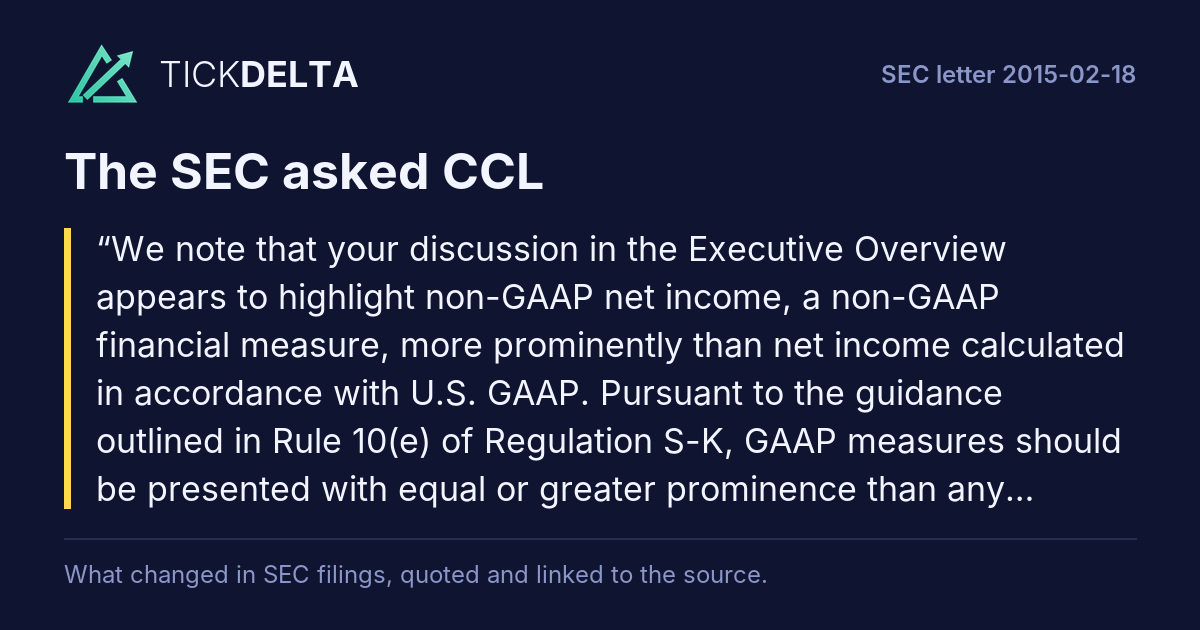
SEC asked (1)
We note that your discussion in the Executive Overview appears to highlight non-GAAP net income, a non-GAAP financial measure, more prominently than net income calculated in accordance with U.S. GAAP. Pursuant to the guidance outlined in Rule 10(e) of Regulation S-K, GAAP measures should be presented with equal or greater prominence than any non-GAAP measures.
Rest of the question

Please revise by reorganizing your disclosures and include a more balanced discussion accordingly.

CCL answered
In future Form 10-K filings, we will ensure that our GAAP measures, such as the U.S. GAAP net income discussion in our

“Executive Overview,” are presented with equal or greater prominence than any of our non-GAAP measures. Read in the reply ↗
In its next report

First report after the company's reply of 2015-03-11: 10-Q filed 2015-04-02 ↗, against the 10-Q filed 2014-10-03 ↗.

Tickdelta does not hold the text of both reports, so they are not compared here.

Liquidity, Financial Condition, and Capital Resources, page F-52
SEC asked (2)
Please expand your liquidity discussion to cover the three-year period covered by the financial statements, using year-to-year comparisons or any other format to enhance the reader’s understanding. Refer to Instruction 1 to paragraph 303(a) of Regulation S-K.
CCL answered
In future filings, we will expand our “Sources and Uses of

Cash” discussion included under “Liquidity, Financial Condition and Capital Resources” to cover the periods presented by the financial statements.

Carnival Corporation at Carnival Place, 3655 N.W. 87 Avenue, Miami, Florida 33178-2428 Tel: (305) 599-2600 Fax: (305) 406-4811

Carnival plc, Registered in England, No.
Rest of the answer

4039524, with its Registered Office at

Carnival House, 100 Harbour Parade, Southampton SO15 1st Tel: +44 023 8065 5000 Fax: +44 023 8065 7513

***********************************************

As requested in the Comment Letter, I hereby acknowledge that the Company is responsible for the adequacy and accuracy of the disclosure in the filing; staff comments or changes to disclosure in response to staff comments do not foreclose the Commission from taking any action with respect to the filing; and the Company may not assert staff comments as a defense in any proceeding initiated by the

Commission or any person under the federal securities laws of the United States.

Read in the reply ↗
In its next report

First report after the company's reply of 2015-03-11: 10-Q filed 2015-04-02 ↗, against the 10-Q filed 2014-10-03 ↗.

Tickdelta does not hold the text of both reports, so they are not compared here.

Also in this review: request for more time, 2015-02-24, closing letter, 2015-03-19

Form 10-K for the fiscal year ended November 30, 2012

2013-05-07 to 2013-07-09 · 4 questions · 1 letter from the SEC, 1 from the company
Review closed 2013-07-09
Non-GAAP measuresResults discussion (MD&A)Revenue
Management’s Discussion and Analysis, page F-29 · 2012 Compared to 2011, page F-33
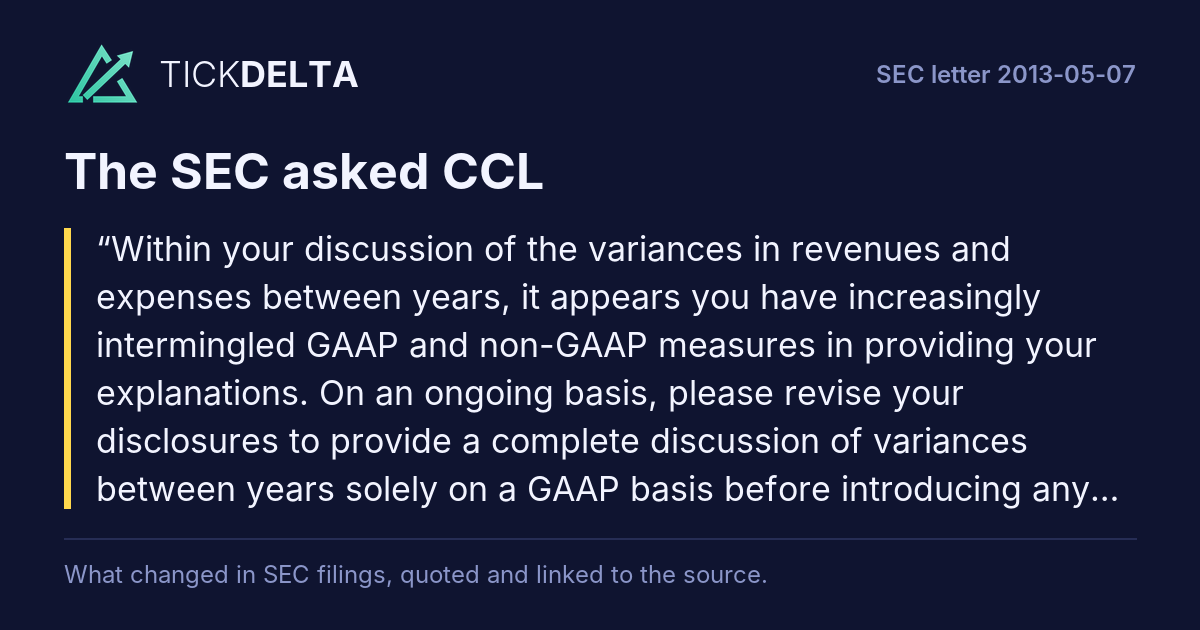
SEC asked (1)
Within your discussion of the variances in revenues and expenses between years, it appears you have increasingly intermingled GAAP and non-GAAP measures in providing your explanations. On an ongoing basis, please revise your disclosures to provide a complete discussion of variances between years solely on a GAAP basis before introducing any non-GAAP measures into the discussion.
CCL answered
Available lower berth days (“ALBDs”), which is a statistical measure of passenger capacity for the period, is used to perform rate and capacity variance analyses to determine the main non-capacity driven factors that cause our cruise revenues and expenses to vary. We use ALBDs as one of the many factors to explain the significant GAAP revenue and expense variances. In accordance with Item 10(e)(4) of Regulation S-K, statistical measures, such as ALBDs, are excluded from non-GAAP measures since ALBDs are not a non-GAAP financial measure.
Rest of the answer

Accordingly, we believe our explanations for revenue and expense variances related to a percentage change in ALBDs are not a non-GAAP disclosure. However, we understand that our disclosure on page F-33 appears to intermingle GAAP and non-GAAP measures because of the cross-reference to “Key Performance

Non-GAAP Financial Indicators” within our GAAP variance explanations. Therefore, we will remove this cross-reference when disclosing GAAP measures in our future filings.

In addition, in future filings we will remove the first paragraph under “Key Performance Non-GAAP Financial Indicators” on page F-35 that defines ALBDs and insert this disclosure beneath the

“Statistical Information” table on page F-33. Finally, in future filings we will expand our disclosure to include the reasons for any material variances in ALBDs between reporting periods and will also insert this disclosure beneath the

“Statistical Information” table on page F-33.

Carnival Corporation at Carnival Place, 3655 N.W. 87 Avenue, Miami, Florida 33178-2428 Tel: (305) 599-2600 Fax: (305) 406-4811

Read in the reply ↗
In its next report

First report after the company's reply of 2013-06-14: 10-Q filed 2013-07-02 ↗, against the 10-Q filed 2013-04-03 ↗.

Tickdelta does not hold the text of both reports, so they are not compared here.

Management’s Discussion and Analysis, page F-29 · 2012 Compared to 2011, page F-33
SEC asked (2)
As a related matter, we note the addition of “Non-GAAP Net Income” and “Non-GAAP earnings per share” information in the Selected Financial Data presentation on page F-45 and the Selected Quarterly Financial Data presentation on page F-49. In each case, your accompanying footnotes refer the reader to a discussion of the reconciliation to U.S. GAAP in the MD&A section of the filing.
Rest of the question

The reliance upon such a cross-reference is not sufficient. If you elect to continue to present Non-GAAP financial information in either or both of these tables, a complete reconciliation should be presented in an accompanying footnote to the related table(s).

CCL answered
In future Form 10-K filings, we will include a complete discussion of the reconciliation between

“U.S. GAAP Net Income” and “U.S. GAAP earnings per share” and their non-GAAP amounts in the accompanying footnotes to the related tables. Read in the reply ↗
In its next report

First report after the company's reply of 2013-06-14: 10-Q filed 2013-07-02 ↗, against the 10-Q filed 2013-04-03 ↗.

Tickdelta does not hold the text of both reports, so they are not compared here.

Costs and Expenses, page F-34 · Consolidated, page F-34
SEC asked (3)
When there are many factors which had a material impact on the variance between periods, it may be useful to provide these factors in a chart to facilitate the reader’s understanding of the impact of certain items between periods.
CCL answered
In future filings, we will either provide a chart or bullet points when there are many factors that have a material impact on the variance between periods. Read in the reply ↗
In its next report

First report after the company's reply of 2013-06-14: 10-Q filed 2013-07-02 ↗, against the 10-Q filed 2013-04-03 ↗.

Tickdelta does not hold the text of both reports, so they are not compared here.

Form 10-Q for the quarterly period ended February 28, 2013
SEC asked (4)
It was noted that, in February 2013, there was an incident with your ship the Carnival Triumph. It has been widely reported in the media that, as a result of this incident, you will be subjected to a class action lawsuit, in addition to other reparations offered to passengers, such as refunds and discounts on future cruises.
Rest of the question

With past similar incidents, it appears that insurance has minimized the financial impact to your operating results. Please tell us the extent to which you expect that insurance will cover the potential liabilities resulting from this incident. Also, explain whether or not any portion or type of passenger claim may not be covered by insurance, or any other limitations on the insurance coverage, which could result in a material impact to the company. Finally, please address the potential impact of your recent decision to reimburse the government for costs incurred in the Carnival Triumph fire and in connection with a fire on the Carnival Splendor in 2010.

CCL answered
We expect that any material potential liabilities resulting from the Carnival Triumph incident will be covered under our insurance policies to the extent that such amounts exceed our insurance deductibles. In addition, we are not aware of any portions or types of passenger claims that will not be covered under our insurance policies, or of any other limitations on our insurance coverages, which could result in a material impact to the Company.

Finally, the voluntary reimbursement of $4 million to the U.S.
Rest of the answer

Government for costs incurred in the Carnival Triumph incident and in connection with the 2010 Carnival Splendor incident was recognized as an expense in the second quarter of 2013 and did not have a material impact on our financial statements.

***********************************************

As requested in the Comment Letter, I hereby acknowledge that the Company is responsible for the adequacy and accuracy of the disclosure in the filing; staff comments or changes to disclosure in response to staff comments do not foreclose the Commission from taking any action with respect to the filing; and the Company may not assert staff comments as a defense in any proceeding initiated by the Commission or any person under the federal securities laws of the United States.

Read in the reply ↗

Also in this review: request for more time, 2013-05-08, closing letter, 2013-07-09

3 other letters: notices that a filing will not be reviewed, requests to declare a registration effective, and the like
  • 2026-02-25 · CCL: asks the SEC to declare a registration effective · Carnival Corporation · Registration Statement on Form S-4 · File No. 333-292990 ·...
  • 2026-02-20 · CCL: letter · Carnival Corporation · Amendment No. 1 to Registration Statement on Form S-4 · CIK No....
  • 2026-01-27 · CCL: letter · Carnival Corporation · Registration Statement on Form S-4 · CIK No. 0000815097 · Irene...

From the SEC's correspondence on EDGAR: staff letters (form UPLOAD) and company letters (form CORRESP), 14 letters filed since 2013-05-07. Questions and answers are matched by their numbers; topics come from words in each question. The reports are compared word for word (same form, before the first SEC letter against the first report after the company's reply). No AI.

Work on CCL in a spreadsheet: Excel workbook (a sheet per section, ten years by column, charts, links to the filings) · CSV. For a Google Sheet that stays up to date, paste =IMPORTDATA("https://tickdelta.com/company/CCL/export.csv") into a cell.