Cogent Communications Holdings, Inc. CCOI
New risk paragraphs, branching off last year
Each branch is a paragraph in Risk Factors with nothing like it in the 10-K filed Feb 28, 2025. A box jumps to the paragraph as filed, below.
Paragraphs with nothing like them in last year's 10-K
22 paragraphs in Risk Factors of the 10-K filed Feb 20, 2026 with nothing like them in the 10-K filed Feb 28, 2025. Quoted exactly. Paragraphs that were only edited are under 10-K change.
Our ability to maintain or grow revenue from leasing IPv4 addresses is subject to factors beyond our control.
We own a significant inventory of IPv4 addresses, including a large block acquired through our acquisition of the Cogent Fiber Business. These addresses are critical to the operation of our network and represent an important component of the Services we
provide to our customers. We generate revenue by leasing IPv4 addresses to our customers and may also seek to realize additional value through the strategic sale of excess addresses.
Our ability to maintain or grow revenue from IPv4 leasing, or realize value through an asset sale, is subject to factors beyond our control, including market liquidity, price volatility and the adoption of IPv6. Although IPv4 addresses are a finite resource, the market has historically experienced fluctuations in lease and sale rates. An increase in the supply of IPv4 addresses or a decline in demand could result in lower lease and sale rates.
If lease rates for IPv4 addresses decline, our revenue and profit margins would be negatively impacted.
In our optical wavelength business, we compete with long - established network operators. These operators also have well - established brand name, larger customer bases and a sales and marketing capabilities experienced in the wavelength business. As these operators have a long history offering wavelength services, we may face challenges persuading customers to add us as a provider or to end a longstanding relationship with an existing provider.
Our Optical Wave Network footprint is connected primarily to CNDCs, which may not allow us to serve the entire addressable market.
Our Optical Wave Network is architecturally distinct from our IP Network and is currently designed to provide connectivity primarily to CNDCs, which may constrain our ability to compete for customers requiring wave services at MTOBs or other service locations. Although we believe our current Optical Wave Network connects to a majority of the addressable market for wave services in North America, our lack of connections to additional service locations may prevent us from fulfilling demand for end - to - end wave services at corporate offices, potentially forcing us to forgo certain opportunities. Some of our competitors maintain wave network footprints that directly reach MTOBs and other service locations allowing them to offer solutions that we cannot currently provide. If we are incorrect in our assumption about the service locations that make up the majority of the addressable market for wave services or there is a shift in demand for wave services from CNDCs to MTOBs, we may lose, or be unable to gain, market share to and from our competitors, which could have an adverse effect on our revenue growth and overall financial condition.
or proceedings (such as class actions), regulatory investigations and enforcement actions, fines and penalties, negative reputational impacts that cause us to lose existing or future customers, and/or significant incident response, system restoration or remediation and future compliance costs. Any or all of the foregoing could materially adversely affect our business, operating results, and financial condition.
Our IPv4 address space is now covered by Resource Public Key Infrastructure (“RPKI”) which may not fully protect against potential risks.
Show the other 8
undertaking preparations, responses, and mitigation measures for the physical impacts of climate change. Despite these considerations, accurately predicting the materiality of potential losses or costs associated with these effects remains challenging.
Our new wavelength service is delivered as specific wavelengths on defined physical routes. Because these wave services are tied to a specific physical path, a single interruption on a route, such as a fiber cut, will affect all wavelengths on that route simultaneously. Such disruptions could result in a total loss of service for all wave customers on the affected route. In addition, we may incur unexpected and significant costs, delays or other difficulties in maintaining or repairing our fiber infrastructure, resulting in increased disruption in services to our customers. We may, as a result, lose revenue or customers.
If Cisco, Ciena or Arista fail to provide equipment on a timely basis or fail to meet our performance expectations, including in the event that any vendor fails to enhance, maintain, upgrade or improve the hardware or software products we purchase from them when and how we need them, we may be delayed or unable to provide services as and when requested by our customers. In particular, the telecommunications industry has experienced, and may continue to experience, significant volatility in global supply chains, including shortages of routers and transmission equipment. If our primary vendors experience manufacturing or shipping delays, or geopolitical disruptions, our lead times for critical infrastructure upgrades could extend significantly. Any such delays in the receipt of equipment could force us to defer or cancel network expansion and improvement projects, resulting in our inability to fulfill customer orders or meet installation deadlines. This could lead to a loss of potential revenue, the payment of contractual penalties or service level credits to customers, and damage to our reputation in the marketplace. Further, if we are unable to procure equipment as needed, we may be forced to pay premium prices to secure limited supply or be required to hold higher levels of inventory at increased cost, which would negatively impact our capital expenditures, liquidity, and overall financial performance. If our competitors are able to secure equipment more quickly than we are, we may be unable to gain market share in the wave segment and face a significant competitive disadvantage.
We have expanded our IP Network into 57 countries worldwide on every continent, other than Antarctica, and our Optical Wave Network into Canada and Mexico. We continue to explore expansion opportunities for our IP Network. We have experienced
In addition, in 2024, the National Security Division of the U.S. Department of Justice issued a new rule, referred to as the Data Security Program (“DSP”), to implement Executive Order 14117 aimed at preventing access to “bulk U.S. sensitive personal data” and “government-related data” by “countries of concern” (including China, Russia, Iran, North Korea, Cuba, and Venezuela) and “covered persons” (as all such terms are defined in the DSP). Effective as of April 8, 2025, and fully enforceable as of July 9, 2025, the DSP imposes stringent obligations on companies within its scope and prohibits or restricts “covered data transactions” that grant countries of concern or covered persons access to bulk U.S. sensitive personal data or any amount of government-related data. The DSP is new, complex and has yet to be enforced, and as such, there is a risk that our interpretation of its applicability, scope, and requirements is incorrect, incomplete, or misapplied. Based on our assessment of the DSP, we do not believe we engage in covered data transactions at this time, though we may discover that we do or we may begin doing so in the future. Compliance with the DSP may require us to invest heavily in data security and compliance measures, such as implementing and complying with the Cybersecurity and Infrastructure Security Agency’s guidelines and other burdensome recordkeeping, reporting, and auditing requirements. It may also require us to implement new processes, stop or restrict certain data transfers, alter the geographic scope of our operations, cease doing business with certain third parties or using certain tools or vendors, or change how data flows throughout our business, any of which could materially impact our business operations or hinder our ability to grow our business. Finally, non-compliance with the DSP could result in significant civil or criminal penalties, which could materially adversely affect our business, results of operations, and financial condition.
In 2025, President Trump announced new and additional tariffs for most imports, including imports from Canada, Mexico and China. As a result, China later announced and implemented retaliatory tariffs on U.S. goods and expanded export controls on certain critical raw materials, including rare earth minerals. The amount import tariffs and the number of products subject to tariffs have changed numerous times based on action by the U.S. government, and certain of these tariffs have been subsequently paused or modified. Following a meeting between President Trump and President Xi in October 2025, U.S. and China announced a temporary truce, including the U.S. suspending escalation of planned reciprocal tariffs for approximately one year and China suspending its 2025 retaliatory tariffs and pausing its export controls on rare earth minerals and other materials. The Administration also refrained from implementing the previously announced additional 100% tariff on Chinese imports. However, the tariff situation remains fluid. Given the uncertainty surrounding U.S. international trade policy and the U.S.-China relationship, we cannot predict how future changes in tariffs or trade restrictions will affect us.
At least one of our primary equipment vendors manufactures and ships equipment that we purchase from China. If higher tariffs are applied to our equipment purchases, it would increase our cost of equipment and our capital expenditures. To the extent that we are unable to pass all or any such cost increases on to our customers, such cost increases could adversely affect our financial results. In addition, higher costs stemming from tariffs could lead customers to seek alternative products or services from competitors in regions not affected by such trade policies, which may further impact our financial results due to declines in our sales and operating income. As a result, our financial condition and results of operations could be adversely affected.
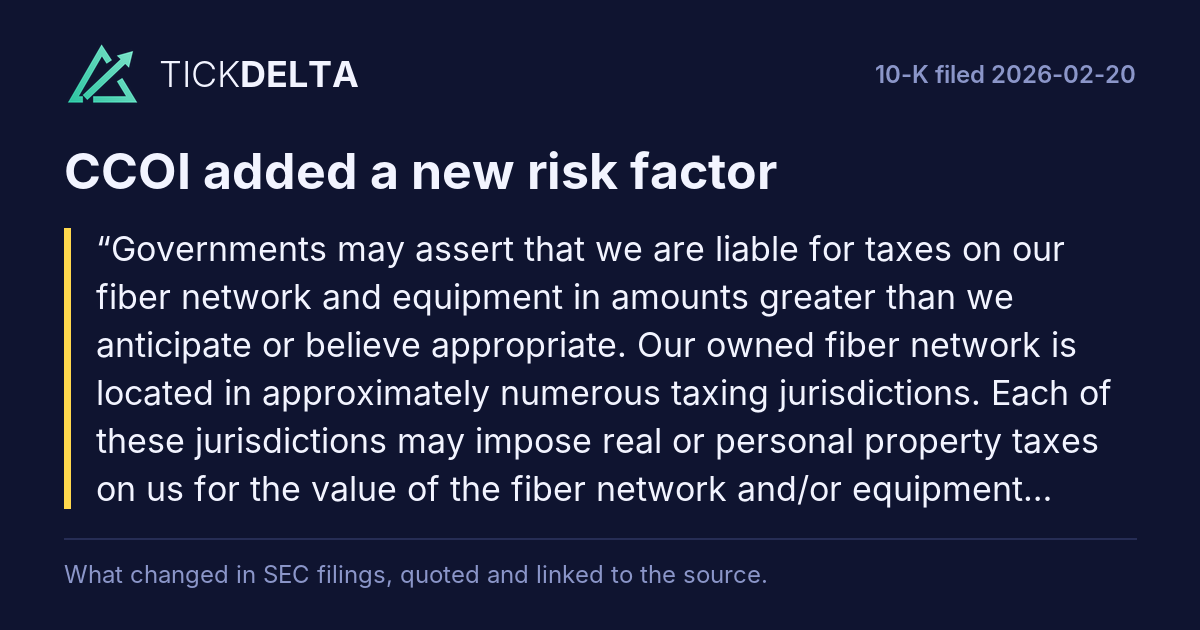
Governments may assert that we are liable for taxes on our fiber network and equipment in amounts greater than we anticipate or believe appropriate.
Our owned fiber network is located in approximately numerous taxing jurisdictions. Each of these jurisdictions may impose real or personal property taxes on us for the value of the fiber network and/or equipment located within their jurisdiction. We may, from time to time, disagree with these valuations and seek to reduce the valuations and the attendant taxes. Our ultimate success is disputing these valuations and appealing these taxes is unknown, and as a result, we may be subject to taxes in jurisdictions or of an amount that we did not anticipate, and these amounts may be material and have an adverse effect on us.
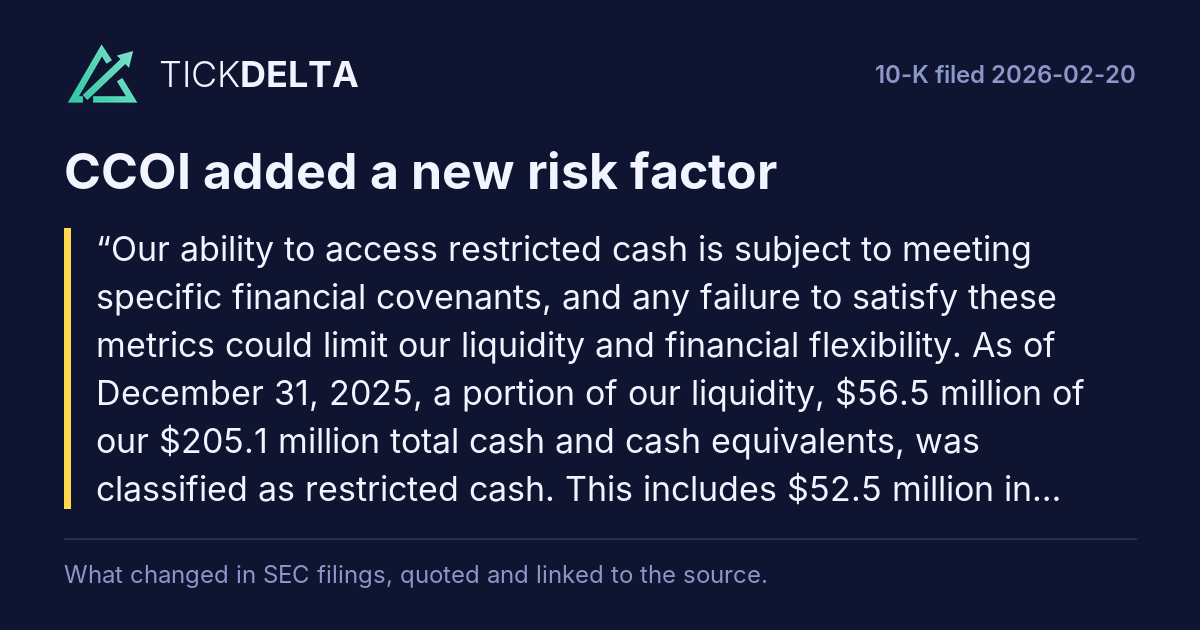
Our ability to access restricted cash is subject to meeting specific financial covenants, and any failure to satisfy these metrics could limit our liquidity and financial flexibility.
As of December 31, 2025, a portion of our liquidity, $56.5 million of our $205.1 million total cash and cash equivalents, was classified as restricted cash. This includes $52.5 million in restricted proceeds from our IPv4 Notes. Under the terms of the IPv4 Notes indenture, this restricted cash only becomes available to us upon the achievement of specific improvements in our monthly leverage ratio and our debt service coverage ratio, which are directly tied to the performance of IPv4 address leasing by IPv4 Issuer. While we successfully unlocked $26.9 million of restricted cash during the year ended December 31, 2025, primarily due to improvements in these ratios, there is no guarantee that our future financial performance within the IPv4 leasing market will continue to meet the required thresholds. Under the Terms of the indenture, we have until October 2026 to satisfy the performance metrics and unlock the remaining restricted funds. Any amounts remaining on deposit in the prefunding account after October 2026 will be withdrawn and applied to prepay the April 2025 IPv4 Notes on a pro rata basis based on the initial principal amount.
If our operational results deteriorate, or if we fail to meet the threshold metrics required by the IPv4 Notes Indenture, we may be unable to access the remaining restricted funds. A prolonged inability to unlock this cash could limit our ability to fund capital expenditures, service our debt obligations, or respond to competitive pressures. Furthermore, our belief that we will have continued access to public debt and equity markets is subject to broader market conditions; if we are unable to unlock our internal cash reserves and simultaneously face a tightening of the capital markets, our financial condition and results of operations could be materially and adversely affected.
Paragraphs in the 10-Q filed Nov 5, 2026 that were not in the one before
New in the latest 10-Q
11 paragraphs in the 10-Q filed Nov 5, 2026 with nothing like them in the 10-Q filed Aug 6, 2026 (at least half the words must differ; new numbers alone do not count). Quoted exactly, grouped by the item heading above them. This is text that changed, not a judgement of how serious it is.
Financial statements and notes
Adjustments to reconcile net loss to net cash provided by (used in) operating activities:
Read in the 10-Q
Amortization of discounts, due from T-Mobile, IP Transit Services & Purchase Agreements (9,420) (14,187)
Read in the 10-Q
Accounts payable, accrued liabilities and other long-term liabilities (1,866) (27,339)
Read in the 10-Q
Net proceeds from issuance of secured IPv4 notes – net of debt costs of $4.0 million and $7.6 million, respectively — 170,479
Read in the 10-Q
Net proceeds from issuance of senior secured 2032 notes - net of debt costs of $2.2 million — 597,842
Read in the 10-Q
Show the other 6
Based upon recent trading prices (Level 2 - market approach) at September 30, 2026:
Read in the 10-Q
The following details the determination of diluted weighted-average shares: Three Months Three Months Nine Months Nine Months Ended Ended Ended Ended September 30, 2026 September 30, 2025 September 30, 2026 September 30, 2025 ──────────────────────────────────────────────────────────────────────────────────────────────────────────────────────────────────────────── Weighted average common shares - basic 48,001,733 47,603,287 48,044,535 47,827,343 Dilutive effect of stock options - - - - Dilutive effect of restricted stock - - - - Weighted average common shares - diluted 48,001,733 47,603,287 48,044,535 47,827,343 The following details unvested shares of restricted common stock as well as the anti-dilutive effects of stock options and restricted stock awards outstanding: Three Months Three Months Nine Months Nine Months Ended Ended Ended Ended September 30, 2026 September 30, 2025 September 30, 2026 September 30, 2025 ─────────────────────────────────────────────────────────────────────────────────────────────────────────────────────────────────────────────────── Unvested shares of restricted common stock 3,220,873 1,548,485 3,220,873 1,548,485 Anti-dilutive options for common stock 246,777 233,573 247,189 216,016 Anti-dilutive shares of restricted common stock 2,040,902 1,076,796 1,996,251 829,402 Stockholders’ (Deficit) Equity The following details the changes in stockholders’ (deficit) equity for the three and nine months ended September 30, 2026 and 2025 (in thousands except share data): Accumulated Additional Other Total Common Stock Paid-in Comprehensive Accumulated Stockholders’ Shares Amount Capital Loss Deficit Deficit Balance at June 30, 2026 51,215,736 $ 51 $ 659,927 $ (9,040) $ (685,068) $ (34,130) Forfeitures of shares granted to employees (36,968) - - - - - Equity-based compensation - - 8,567 - - 8,567 Foreign currency translation - - - (386) - (386) Issuances of common stock 25,115 - - - - - Dividends paid - - - - (1,304) (1,304) Net loss - - - - (29,766) (29,766) Balance at September 30, 2026 51,203,883 $ 51 $ 668,494 $ (9,426) $ (716,138) $ (57,019)
Read in the 10-Q
As of September 30, 2026, the Company had committed to additional IRU agreements totaling $106.2 million in future payments to be paid over periods of up to 20 years. These obligations begin when the related fiber is accepted, which is generally expected to occur in the next 12 months.
Read in the 10-Q
Notwithstanding our plans to improve liquidity and address the Company’s 2027 Notes and the Company’s 2027 Mirror Notes prior to their maturity, substantial doubt exists about our ability to continue as a going concern over the next twelve months.
Read in the 10-Q
We expect that we will continue to grow our shares of these segments by offering our customers a series of attractive features including:
Read in the 10-Q
We completed a series of debt issuances in the nine months ended September 30, 2025.
Read in the 10-Q
The 10-Q's risk factors against the 10-K
Item 1A of the 10-Q filed Nov 5, 2026 against Item 1A of the 10-K filed Feb 20, 2026.
A 10-Q repeats only the risks that changed, so a 10-K paragraph that is missing from it is not counted as removed.
Added is a paragraph with nothing like it in the 10-K, Reworded a sentence that is in both with several words changed,
Quiet changes a sentence in both where one to four words changed and one is a hedge or a modal
(cut words struck through, new words highlighted).
Text on the page, not a score; each links to the filing at sec.gov.
What the 10-Q itself says about its risk factors:Management believes that as of September 30, 2026, there have been no material changes to our risk factors from those disclosed in Item 1A “Risk Factors,” of our annual report on Form 10-K for the year ended December 31, 2025.
Read in the 10-Q
1 paragraph in the 10-Q's Item 1A, and none of them adds, rewords or quietly edits a paragraph of the 10-K's.
Phrases used for the first time
Two-word phrases in Risk Factors of the 10-K filed Feb 20, 2026 that are in none of the 1 earlier 10-Ks stored, back to Feb 28, 2025
Where each one is used
- cogent fiber: We may not realize the anticipated benefits of the acquisition of the Cogent Fiber Business, and the integration of the Cogent Fiber Business may disrupt our business and management.
- wave network: We have grown our Company rapidly through expansion of our IP Network, obtaining new customers through our sales efforts, the acquisition of the Cogent Fiber Business and the expansion of our Optical Wave Network. Our expansion places significant strains on our management, operational and financial infrastructure....
- wave services: Our Optical Wave Network is architecturally distinct from our IP Network and is currently designed to provide connectivity primarily to CNDCs, which may constrain our ability to compete for customers requiring wave services at MTOBs or other service locations. Although we believe our current Optical Wave Network...
- service locations: Our Optical Wave Network is architecturally distinct from our IP Network and is currently designed to provide connectivity primarily to CNDCs, which may constrain our ability to compete for customers requiring wave services at MTOBs or other service locations. Although we believe our current Optical Wave Network...
- restricted cash: Our ability to access restricted cash is subject to meeting specific financial covenants, and any failure to satisfy these metrics could limit our liquidity and financial flexibility.
- new internet-based: A downturn in the world economy, especially the economies of North America and Europe, would negatively impact our growth. Our net-centric business would be particularly impacted by a decline in the development of new Internet-based applications and
- internet-based applications: A downturn in the world economy, especially the economies of North America and Europe, would negatively impact our growth. Our net-centric business would be particularly impacted by a decline in the development of new Internet-based applications and
- leasing ipv: Our ability to maintain or grow revenue from leasing IPv4 addresses is subject to factors beyond our control.
Used at least twice, small words left out. Counted, not picked: a phrase can be new because the company renamed something.
What was taken out
6 paragraphs of last year's Risk Factors with nothing like them now. The longest are quoted.
Sources
Item 1A of each 10-K and 10-Q on EDGAR, quoted exactly. Each paragraph links to the filing at sec.gov.
Also
10-K change: what was reworded or cut, section by section.
Work with it
Excel workbook · CSV. Google Sheet that stays up to date: paste =IMPORTDATA("https://tickdelta.com/company/CCOI/export.csv") into a cell.