Celanese Corp CE
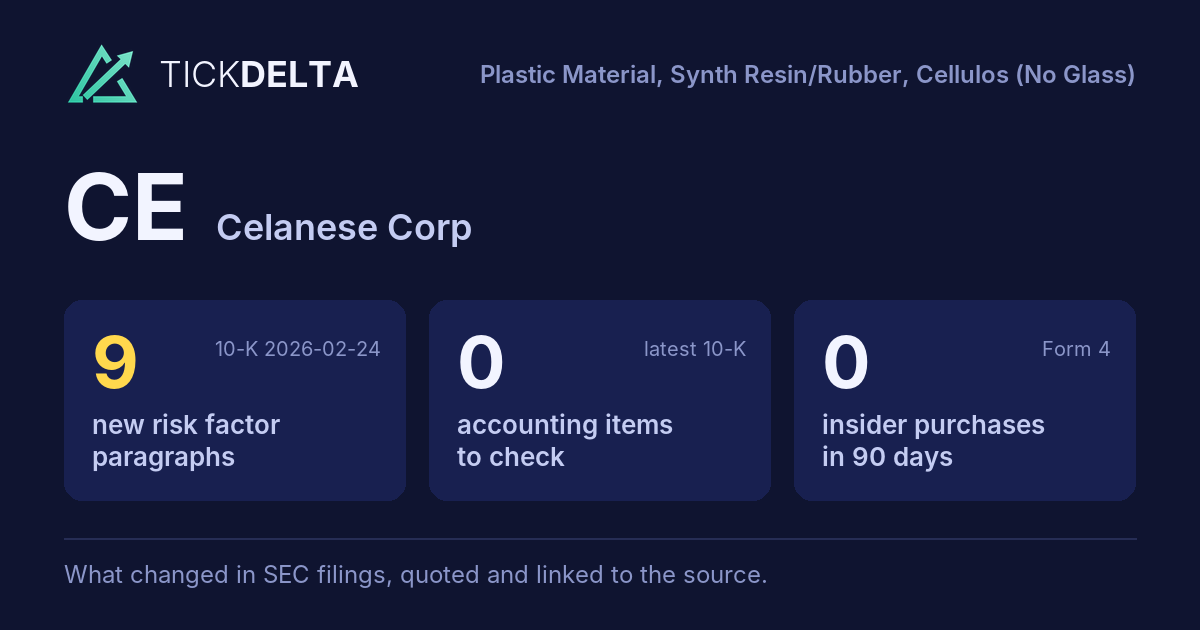
New risk paragraphs, branching off last year
Each branch is a paragraph in Risk Factors with nothing like it in the 10-K filed Feb 21, 2025. A box jumps to the paragraph as filed, below.
Paragraphs with nothing like them in last year's 10-K
9 paragraphs in Risk Factors of the 10-K filed Feb 24, 2026 with nothing like them in the 10-K filed Feb 21, 2025. Quoted exactly. Paragraphs that were only edited are under 10-K change.
for loss. Furthermore, in certain cases where we benefit from local government subsidies or other undertakings, such benefits are subject to the solvency of local government entities and are subject to termination without meaningful recourse or remedies.
From time to time, we provide guidance regarding our expected financial performance, which may take the foregoing and other factors into account. Correctly identifying key factors affecting business conditions and predicting future events is inherently an uncertain process, and our guidance may not ultimately be accurate. If our guidance varies from actual results, the market value of our common stock could decline significantly.
Our increasing reliance on artificial intelligence ("AI") technologies in our products, services, and operations presents risks that could adversely impact our business, financial condition, and results of operations.
We are increasingly incorporating AI capabilities into the development of technologies and our business operations, and into our products and services, including, for example, our Chemille platform. AI technology is complex and rapidly evolving, and
may subject us to significant competitive, reputational, cybersecurity, legal, regulatory, operational and other risks. If our products and services incorporating AI fail to operate as anticipated or as well as competing offerings or otherwise do not meet customer needs, our business and reputation may be adversely impacted. Our use of AI may introduce operational vulnerabilities by producing inaccurate outcomes or suggestions. Incorporating AI also gives rise to litigation risk and risk of non-compliance and unknown cost of compliance, as AI is an emerging technology for which the legal and regulatory landscape is not fully developed or uniform.
Our efforts to develop and use AI responsibly, may not successfully mitigate all associated risks. Any failure to address concerns relating to the responsible use of AI technology may cause harm to our reputation or financial liability and, as such, may increase our costs to address or mitigate such risks and issues.
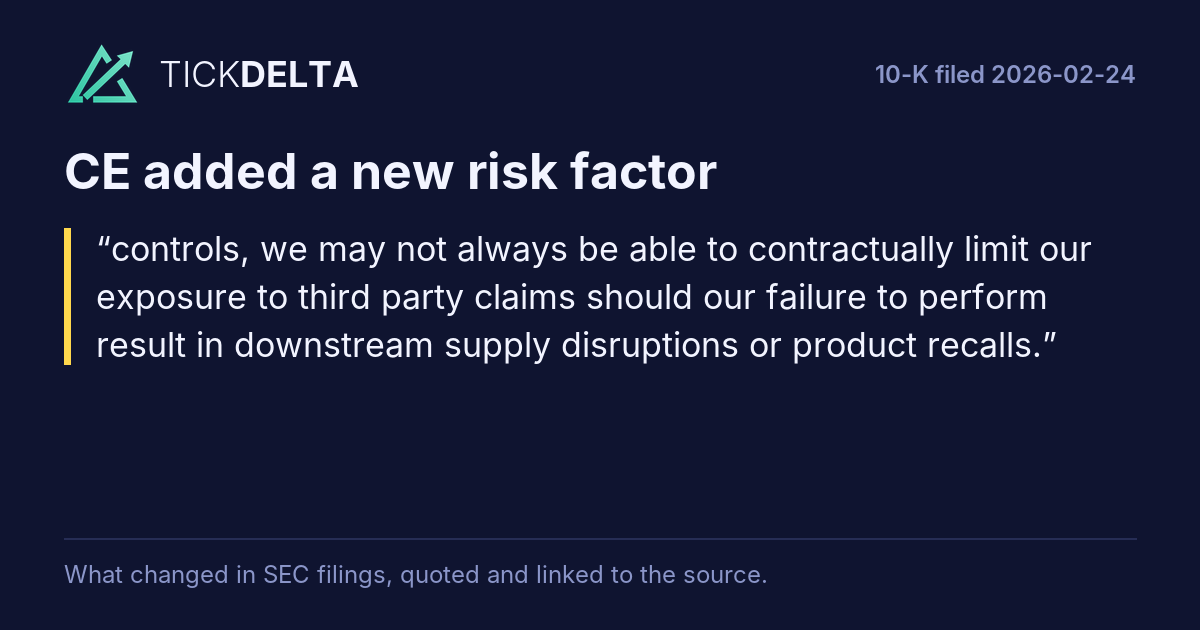
controls, we may not always be able to contractually limit our exposure to third party claims should our failure to perform result in downstream supply disruptions or product recalls.
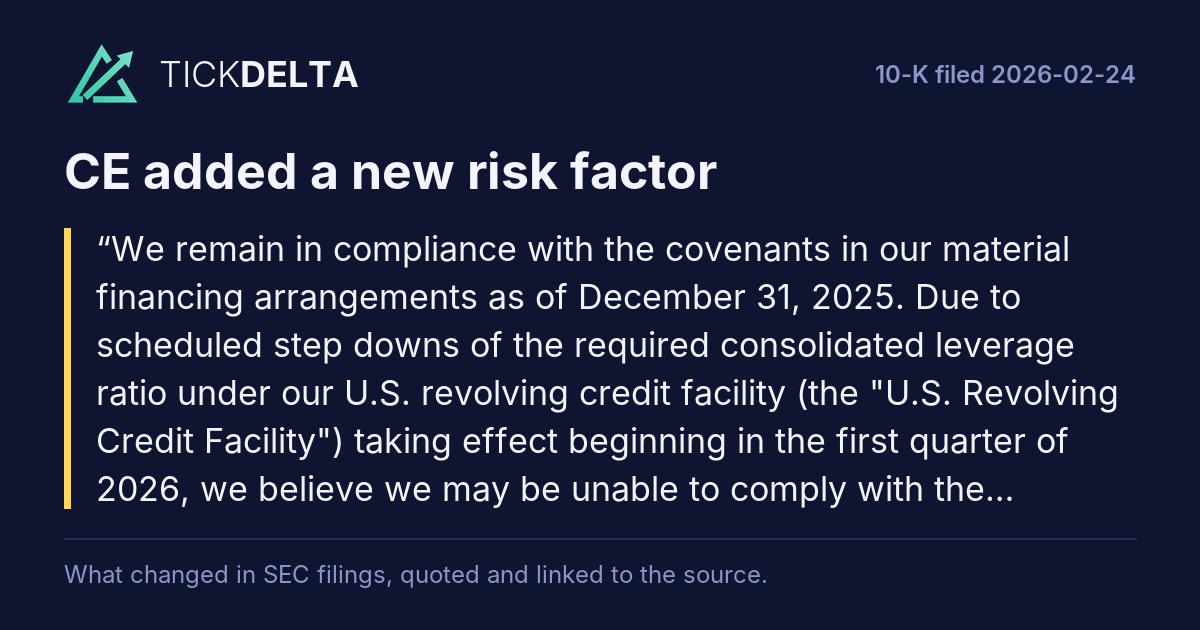
We remain in compliance with the covenants in our material financing arrangements as of December 31, 2025.
Due to scheduled step downs of the required consolidated leverage ratio under our U.S. revolving credit facility (the "U.S. Revolving Credit Facility") taking effect beginning in the first quarter of 2026, we believe we may be unable to comply with the consolidated leverage ratio in its current form within the twelve-month period subsequent to the date of this filing unless we are able to implement sufficient mitigation strategies. Such strategies include, but are not limited to, amending the outstanding U.S. Revolving Credit Facility consistent with prior similar amendments we have obtained over the past several years, obtaining a waiver of the default, replacing the U.S. Revolving Credit Facility with a new revolving credit facility, consummating additional divestiture opportunities, and/or reducing operating costs. Implementation of such strategies may increase our borrowing costs under existing material financing arrangements. If we are not able to implement sufficient mitigating strategies and are therefore not able to comply with the consolidated leverage ratio, the lenders under the U.S. Revolving Credit Facility could elect to terminate the facility. As of the date of this filing, the U.S. Revolving Credit Facility has no outstanding borrowings.
Paragraphs in the 10-Q filed Nov 3, 2026 that were not in the one before
New in the latest 10-Q
54 paragraphs in the 10-Q filed Nov 3, 2026 with nothing like them in the 10-Q filed Aug 5, 2026 (at least half the words must differ; new numbers alone do not count). Quoted exactly, grouped by the item heading above them. This is text that changed, not a judgement of how serious it is.
Financial statements and notes
Non-operating pension and other postretirement employee benefit (expense) income 5 2 15 5
Read in the 10-Q
On August 31, 2026, the Company announced the signing of a definitive agreement with Mitsui & Co., Ltd. ("Mitsui"), to sell 19 % of the Company's interest in Nutrinova Netherlands B.V. ("Nutrinova"), the Company's food ingredients joint venture, to Mitsui in a transaction with total cash proceeds of approximately $ 152 million (the "Nutrinova transaction"), subject to customary transaction adjustments. The Nutrinova transaction allows the Company to retain an 11 % interest in the joint venture and is expected to close in the fourth quarter of 2026, subject to customary closing conditions.
Read in the 10-Q
The Company assesses the recoverability of the carrying amount of its reporting unit goodwill either qualitatively or quantitatively annually during the third quarter of its fiscal year using June 30 balances or whenever events or changes in circumstances indicate that the carrying amount of the asset may not be fully recoverable.
Read in the 10-Q
During the three months ended September 30, 2026 and September 30, 2025, the Company completed qualitative evaluations of its reporting units, with the exception of the engineered materials reporting unit, which was tested quantitatively. The Company concluded that it was more likely than not that the fair value of the reporting units evaluated qualitatively exceeded such units' carrying amount.
Read in the 10-Q
The results of the quantitative test performed during the three months ended September 30, 2026 of the engineered materials reporting unit determined that the estimated fair value of the engineered materials reporting unit exceeded its carrying amount by approximately 8 %.
Read in the 10-Q
Show the other 49
The results of the quantitative test performed during the three months ended September 30, 2025 of the engineered materials reporting unit determined that the carrying amount of the engineered materials reporting unit exceeded its estimated fair value. As such, the Company recorded a non-cash goodwill impairment loss of approximately $ 1.0 billion in Other (charges) gains, net (Note 18) within the Engineered Materials segment during the three months ended September 30, 2025. Although the projected cash flows of the engineered materials reporting unit had not declined from the projections used in the December 31, 2024 quantitative analysis, the impairment loss was primarily driven by a decline in the Company's market capitalization as a result of a decrease in the stock price as of the testing date which led to a 275 basis point increase in the discount rate used in the model.
Read in the 10-Q
The Company recorded an additional non-cash goodwill impairment loss of $ 98 million in Other (charges) gains, net (Note 18) within the Engineered Materials segment during the three months ended September 30, 2025, due to the impact on the engineered materials reporting unit of classifying the Micromax® portfolio of products as held for sale as of September 30, 2025 (Note 3).
Read in the 10-Q
The quantitative evaluations of the engineered materials reporting unit utilized an equal weighting of the income approach based on a discounted cash flow valuation model of the reporting unit and market approach using the guideline public company method. The Company applied equal weighting as both methods were determined to be equally relevant and reliable indicators of the reporting unit's fair value. The key assumptions used in the discounted cash flow valuation model include discount rates, revenue growth rates, tax rates, cash flow projections and terminal value rates. The discount rates used were based on the rates estimated by the weighted average cost of capital ("WACC") considering relevant peer companies and adjusting for company-specific risk factors. The revenue growth rates and cash flow projections were based on historical trends, macroeconomic trends in the industries and territories in which the reporting units operate, expected market segment growth rates and other internal and external sources, which methodology aligns with the Company's internal financial planning and analysis forecasting process. The tax rates considered the operating structure of the reporting unit and jurisdictions in which the reporting unit operates. A terminal value rate was applied to the final year of the projected periods to reflect continued stable, perpetual growth and is based on long-term inflation forecasts, industry growth and long-term economic growth potential. The market approach estimated the fair value using valuation multiples of comparable companies operating in similar industries.
Read in the 10-Q
While the Company believes the estimates and assumptions used in the impairment tests were reasonable, the Company's estimates and assumptions are inherently uncertain and change over time based on operating results, market conditions and other factors. These changes could materially affect key assumptions made in future quantitative tests, including discount rates, revenue growth rates, tax rates, cash flow projections and terminal value rates and could negatively impact the results of future impairment testing for each of the Company's reporting units and result in the recognition of impairment losses. Such losses could be material to the statements of operations and balance sheets in the period(s) recorded.
Read in the 10-Q
The Company assesses the recoverability of the carrying amount of its indefinite-lived intangible assets either qualitatively or quantitatively annually during the third quarter of its fiscal year using June 30 balances or whenever events or changes in circumstances indicate that the carrying amount of the assets may not be fully recoverable.
Read in the 10-Q
During the three months ended September 30, 2026 and September 30, 2025, the Company qualitatively determined that the fair value of each indefinite-lived intangible asset more likely than not exceeded its carrying amount, with the exception of those assigned to the engineered materials reporting unit.
Read in the 10-Q
The results of the quantitative tests of all indefinite-lived intangible assets assigned to the engineered material reporting unit performed during the three months ended September 30, 2026 determined that the estimated fair values of certain indefinite-lived intangible assets, primarily the Zytel® trade name, exceeded their carrying amounts by a range of 1 % to 6 %. As of September 30, 2026, the combined carrying amount of those indefinite-lived intangible assets was $ 910 million. The estimated fair values of the remaining indefinite-lived intangible assets subject to quantitative assessment exceeded their carrying amounts by a substantial margin.
Read in the 10-Q
The results of the quantitative tests of all indefinite-lived intangible assets assigned to the engineered material reporting unit performed during the three months ended September 30, 2025 determined that the carrying amount of certain of the Company's trade names, primarily Zytel®, exceeded their fair value. The Company recorded a non-cash impairment loss of $ 346 million in Other (charges) gains, net (Note 18) during the three months ended September 30, 2025. The impairment of these trade names was primarily driven by a decline in the Company's market capitalization as a result of a decrease in the stock price as of the testing date which led to an increase in the discount rates used in the models.
Read in the 10-Q
Indefinite-lived intangible assets assigned to the engineered materials reporting unit were tested quantitatively utilizing the relief from royalty method under the income approach to determine the estimated fair value for each indefinite-lived intangible asset. The key assumptions used in this model include discount rates, royalty rates, revenue growth rates and sales projections, tax rates and terminal value rates. The discount rates were based on the rates estimated by the Company's weighted average return on assets which considers the WACC and risks specific to the indefinite-lived intangible assets. Royalty rates were based on market transactional data and the most recent third party valuations which are periodically substantiated by third-party valuation consultants. The revenue growth rates and sales projections were based on historical trends and expected growth drivers such as macroeconomic trends in the industries and territories in which the indefinite-lived intangible assets operate, expected industry and product growth rates and other internal and external sources, which methodology aligns with the Company's internal financial planning and analysis process. The tax rates considered the operating structure of the Company and tax rates and jurisdictions in which the entity that owns the indefinite-lived intangible assets operates. A terminal value rate was applied to the final year of the projected period to reflect continued stable, perpetual growth and is based on long-term inflation forecast, industry and product growth and long-term economic growth potential.
Read in the 10-Q
While the Company believes the estimates and assumptions used in the impairment tests were reasonable, the estimates and assumptions are inherently uncertain and change over time based on operating results, market conditions and other factors. These changes could materially affect key assumptions made in future quantitative tests, including discount rates, royalty rates, revenue growth rates and sales projections, tax rates and terminal value rates and could negatively impact the results of future impairment testing for each of the Company's indefinite-lived intangible assets and result in the recognition of impairment losses. Such losses could be material to the statements of operations and balance sheets in the period(s) recorded.
Read in the 10-Q
The Company's activity under the accounts receivable purchasing facilities is as follows:
Read in the 10-Q
(1) Unsold U.S. accounts receivable of $ 104 million were pledged by the U.S. SPE as collateral to the U.S. Purchasers as of September 30, 2026.
Read in the 10-Q
(2) Unsold EU accounts receivable of $ 267 million were pledged by the EU SPE as collateral to the EU Purchasers as of September 30, 2026.
Read in the 10-Q
The Company is currently subject to an inquiry by the local Chinese taxing authorities in Nantong, Zhuhai and Kunming for the taxable years 2021 through 2026 related to qualification for the beneficial treaty withholding rate of 5% on the Company's dividends from its acetate tow joint ventures received by its wholly-owned Hong Kong affiliate as opposed to the standard 10% withholding rate on dividends. The Company believes that its Hong Kong affiliate has the requisite operational substance and ownership of the dividend funds received and is in full compliance with the beneficial ownership language in the treaty and with previous notices issued by the State Taxation Administration.
Read in the 10-Q
(1) Intersegment sales primarily relate to the sale of certain Acetyl Chain segment products to the Engineered Materials segment.
Read in the 10-Q
(4) All interest income and expense is attributable to the Company's Other Activities segment.
Read in the 10-Q
(1) Intersegment sales primarily relate to the sale of certain Acetyl Chain segment products to the Engineered Materials segment.
Read in the 10-Q
(2) Excludes elimination of intersegment Cost of sales of $ 68 million and $ 65 million for the nine months ended September 30, 2026 and 2025, respectively, related to the sale of certain Acetyl Chain segment products to the Engineered Materials segment.
Read in the 10-Q
(4) All interest income and expense is attributable to the Company's Other Activities segment.
Read in the 10-Q
In addition, the Company incurred a net loss from continuing operations for the three and nine months ended September 30, 2025, resulting in 231,627 and 222,970, respectively, of incremental shares attributable to equity awards being excluded from the number of weighted average shares - diluted as their effect would be antidilutive.
Read in the 10-Q
(2) Primarily related to non-cash impairment losses on goodwill and certain trade names, primarily Zytel® during the three and nine months ended September 30, 2025 (Note 5).
Read in the 10-Q
Three Months Ended September 30, 2026 Compared to Three Months Ended September 30, 2025
Read in the 10-Q
Nine Months Ended September 30, 2026 Compared to Nine Months Ended September 30, 2025
Read in the 10-Q
Three Months Ended September 30, 2026 Compared to Three Months Ended September 30, 2025
Read in the 10-Q
Our effective income tax rate for the three months ended September 30, 2026 was 15% compared to 1% for the same period in 2025. The higher effective income tax rate was primarily due to a non-cash goodwill impairment loss of $1.1 billion in the Engineered Materials segment recorded during the three months ended September 30, 2025, which is not deductible for tax purposes (see Note 5 - Goodwill and Intangible Assets, Net). See Note 11 - Income Taxes in the accompanying unaudited interim consolidated financial statements for further information.
Read in the 10-Q
Nine Months Ended September 30, 2026 Compared to Nine Months Ended September 30, 2025
Read in the 10-Q
Three Months Ended September 30, Change % Nine Months Ended September 30, Change %
Read in the 10-Q
Three Months Ended September 30, 2026 Compared to Three Months Ended September 30, 2025
Read in the 10-Q
Nine Months Ended September 30, 2026 Compared to Nine Months Ended September 30, 2025
Read in the 10-Q
Three Months Ended September 30, Change % Nine Months Ended September 30, Change %
Read in the 10-Q
Three Months Ended September 30, 2026 Compared to Three Months Ended September 30, 2025
Read in the 10-Q
Nine Months Ended September 30, 2026 Compared to Nine Months Ended September 30, 2025
Read in the 10-Q
Three Months Ended September 30, Change % Nine Months Ended September 30, Change %
Read in the 10-Q
Three Months Ended September 30, 2026 Compared to Three Months Ended September 30, 2025
Read in the 10-Q
Nine Months Ended September 30, 2026 Compared to Nine Months Ended September 30, 2025
Read in the 10-Q
We are currently subject to an inquiry by the local Chinese taxing authorities in Nantong, Zhuhai and Kunming for the taxable years 2021 through 2026 related to qualification for the beneficial treaty withholding rate of 5% on our dividends from our acetate tow joint ventures received by our wholly-owned Hong Kong affiliate as opposed to the standard 10% withholding rate on dividends. We believe that our Hong Kong affiliate has the requisite operational substance and ownership of the dividend funds received and is in full compliance with the beneficial ownership language in the treaty and with previous notices issued by the State Taxation Administration.
Read in the 10-Q
We assess the recoverability of the carrying amount of our goodwill and other indefinite-lived intangible assets annually during the third quarter of our fiscal year using June 30 balances or whenever events or changes in circumstances indicate that the carrying amount of the asset may not be fully recoverable.
Read in the 10-Q
We reevaluate our identified reporting units annually or when triggered, such as upon reorganization of our operating segments or due to business reasons that result in material changes as to how our reporting units are organized and managed.
Read in the 10-Q
When assessing the recoverability of goodwill and other indefinite-lived intangible assets, we may first assess qualitative factors in determining whether it is more likely than not that the fair value of a reporting unit or another indefinite-lived intangible asset is less than its carrying amount. The qualitative evaluation is an assessment of multiple factors, including the current operating environment, financial performance, market considerations and other relevant events and factors affecting our reporting units. For example, qualitative factors may include a sustained decrease in our consolidated market capitalization or one of our reporting units' market capitalization relative to its respective net book value, significant business-specific actions, or current or projected deterioration of a reporting unit's financial performance. Under such qualitative assessment, if it is more likely than not that a reporting unit's fair value is less than its carrying amount, then we perform a quantitative assessment. We may elect to bypass the qualitative assessment for some or all of our reporting units or other indefinite-lived intangible assets and proceed directly to a quantitative analysis depending on the facts and circumstances.
Read in the 10-Q
In performing a quantitative analysis of goodwill, recoverability of goodwill for each reporting unit is measured using the income approach based on a discounted cash flow valuation model incorporating discount rates commensurate with the risks involved or a combination of the income approach and the market approach using the guideline public company method. The key assumptions used in the discounted cash flow valuation model include discount rates, revenue growth rates, tax rates, cash flow projections and terminal value rates. Discount rates used are based on the rates estimated by the weighted average cost of capital ("WACC") considering relevant peer companies and adjusting for company-specific risk factors. Revenue growth rates and cash flow projections are based on historical trends, macroeconomic trends in the industries and territories in which the reporting units operate, expected market segment growth rates and other internal and external sources, which methodology aligns with our internal financial planning and analysis forecasting process. Tax rates consider the operating structure of the reporting unit and jurisdictions in which the reporting unit operates. A terminal value rate is applied to the final year of the projected periods to reflect continued stable, perpetual growth and is based on long-term inflation forecast, industry growth and long-term economic growth potential. The market approach estimates fair value using valuation multiples of comparable companies operating in similar industries. Our quantitative impairment assessment is sensitive to changes in underlying estimates and assumptions, the most sensitive of which is the discount rate. To corroborate our fair value conclusions, we perform a market capitalization reconciliation as of the goodwill assessment date.
Read in the 10-Q
During the three months ended September 30, 2026, as a part of our annual goodwill impairment assessment, we qualitatively determined that the estimated fair value of each reporting unit more likely than not exceeded the assigned carrying amount, with the exception of the engineered materials reporting unit. During the three months ended September 30, 2026, we performed a quantitative evaluation of the engineered materials reporting unit, which indicated that the reporting unit's fair value exceeded its carrying amount by approximately 8%.
Read in the 10-Q
This quantitative evaluation was based on a combination of the income approach utilizing a discount rate of 12% and the market approach, with a 50% weighting applied to each method. We applied equal weighting as both methods were determined
Read in the 10-Q
to be equally relevant and reliable indicators of the reporting unit's fair value. This methodology and weighting is consistent with our prior quantitative evaluations as of September 30, 2025, December 31, 2024 and September 30, 2024.
Read in the 10-Q
As of September 30, 2026, our engineered materials reporting unit had $3.8 billion in recorded goodwill and our remaining reporting units had a combined $382 million in recorded goodwill. Should our estimates change based on the engineered materials reporting unit's operating results, market conditions, or other factors in our forecast, including changes in the discount rate, the engineered materials reporting unit may become subject to impairment in future periods. A 1% increase in the discount rate would have resulted in a decrease in the percentage by which the engineered materials reporting unit's fair value exceeded its carrying amount to approximately 4%.
Read in the 10-Q
Management tests other indefinite-lived intangible assets quantitatively utilizing the relief from royalty method under the income approach to determine the estimated fair value for each indefinite-lived intangible asset. The key assumptions used in this model include discount rates, royalty rates, revenue growth rates and sales projections, tax rates and terminal value rates. The discount rates are based on the rates estimated by the Company's weighted average return on assets which considers the WACC and risks specific to the indefinite-lived intangible assets. Royalty rates are based on comparable market transactional data and the most recent third party valuations which are periodically substantiated by third-party valuation consultants. Revenue growth rates and sales projections are based on historical trends and expected growth drivers such as macroeconomic trends in the industries and territories in which the indefinite-lived intangible assets operate, expected industry and product growth rates and other internal and external sources, which methodology aligns with our internal financial planning and analysis process. Tax rates consider our operating structure and jurisdictions in which the entity that owns the rights to the indefinite-lived intangible assets operates. A terminal value rate is applied to the final year of the projected periods to reflect continued stable, perpetual growth and is based on long-term inflation forecasts, industry and product growth and long-term economic growth potential. Our quantitative impairment assessment is sensitive to changes in underlying estimates and assumptions, the most sensitive of which is the discount rate.
Read in the 10-Q
During the three months ended September 30, 2026, as part of our annual indefinite-lived intangible asset impairment assessment, we qualitatively determined that the estimated fair value of each indefinite-lived intangible asset more likely than not exceeded its carrying amount, with the exception of those assigned to the engineered materials reporting unit. During the three months ended September 30, 2026, we performed a quantitative evaluation of the indefinite-lived intangible assets assigned to the engineered materials reporting unit. The estimated fair values of certain indefinite-lived intangible assets, primarily our Zytel® trade name, were in excess of their carrying amounts by a range of 1% to 6%. As of September 30, 2026, the combined carrying amount of those indefinite-lived intangible assets was $910 million. The estimated fair values of the remaining indefinite-lived intangible assets subject to quantitative assessment exceeded their carrying amounts by a substantial margin.
Read in the 10-Q
The quantitative evaluations utilized the relief from royalty method under the income approach to determine the estimated fair value of each indefinite-lived intangible asset, utilizing a discount rate of 12.5%. Should our estimates change based on engineered materials reporting unit's operating results, market conditions, or other factors in our forecast, including changes in the discount rate, indefinite-lived intangible assets may become subject to impairment in future periods. For example, a 1% increase in the discount rate would result in a $59 million impairment of certain of our indefinite-lived intangible assets assigned to the engineered materials reporting unit, primarily our Zytel® trade name.
Read in the 10-Q
Specific assumptions discussed above are updated at the date of each test to consider current industry and company-specific risk factors from the perspective of a market participant. Our estimates and assumptions are inherently uncertain and change over time based on operating results, market conditions and other factors and could materially affect the determination of the fair value and potential impairment of goodwill for each reporting unit or indefinite-lived intangible assets associated with each reporting unit. The current business environment is subject to evolving market conditions and requires significant management judgment to interpret the potential impact to our assumptions. To the extent that changes in the current business environment or other factors result in adjustments to key assumptions or management projections, impairment losses may occur in future periods, and these impairment losses may be material.
Read in the 10-Q
Item 6
† The Company has omitted certain schedules and similar attachments to such agreements pursuant to Item 601(a)(5) of Regulation S-K. The Company will furnish a copy of such omitted documents to the SEC upon request.
Read in the 10-Q
The 10-Q's risk factors against the 10-K
Item 1A of the 10-Q filed Nov 3, 2026 against Item 1A of the 10-K filed Feb 24, 2026.
A 10-Q repeats only the risks that changed, so a 10-K paragraph that is missing from it is not counted as removed.
Added is a paragraph with nothing like it in the 10-K, Reworded a sentence that is in both with several words changed,
Quiet changes a sentence in both where one to four words changed and one is a hedge or a modal
(cut words struck through, new words highlighted).
Text on the page, not a score; each links to the filing at sec.gov.
What the 10-Q itself says about its risk factors:In addition to the information in this Quarterly Report, readers should carefully consider the information in Part I, Item 1A. Risk Factors of our 2025 Form 10-K.
Read in the 10-Q
1 paragraph in the 10-Q's Item 1A, and none of them adds, rewords or quietly edits a paragraph of the 10-K's.
Phrases used for the first time
Two-word phrases in Risk Factors of the 10-K filed Feb 24, 2026 that are in none of the 1 earlier 10-Ks stored, back to Feb 21, 2025
Where each one is used
- revolving credit: Due to scheduled step downs of the required consolidated leverage ratio under our U.S. revolving credit facility (the "U.S. Revolving Credit Facility") taking effect beginning in the first quarter of 2026, we believe we may be unable to comply with the consolidated leverage ratio in its current form within the...
- credit facility: Due to scheduled step downs of the required consolidated leverage ratio under our U.S. revolving credit facility (the "U.S. Revolving Credit Facility") taking effect beginning in the first quarter of 2026, we believe we may be unable to comply with the consolidated leverage ratio in its current form within the...
- targets aspirations: We have developed and publicized, and expect to continue to establish, goals, targets, aspirations, and other objectives related to sustainability matters. These include a GHG intensity reduction target and other environmental targets. Such statements reflect our current plans at the time they are made, and do not...
- safe harbor: For example, the Organization of Economic Cooperation and Development (the "OECD"), which represents a coalition of member countries, is supporting changes to numerous long-standing tax principles through its base erosion and profit shifting initiatives, which focus on a number of issues, including (i) the shifting...
- side-by-side safe: For example, the Organization of Economic Cooperation and Development (the "OECD"), which represents a coalition of member countries, is supporting changes to numerous long-standing tax principles through its base erosion and profit shifting initiatives, which focus on a number of issues, including (i) the shifting...
- consolidated leverage: Due to scheduled step downs of the required consolidated leverage ratio under our U.S. revolving credit facility (the "U.S. Revolving Credit Facility") taking effect beginning in the first quarter of 2026, we believe we may be unable to comply with the consolidated leverage ratio in its current form within the...
- leverage ratio: Due to scheduled step downs of the required consolidated leverage ratio under our U.S. revolving credit facility (the "U.S. Revolving Credit Facility") taking effect beginning in the first quarter of 2026, we believe we may be unable to comply with the consolidated leverage ratio in its current form within the...
- catastrophic events: A disruption in production at one or more of our manufacturing facilities, or those of our suppliers, could have a material adverse effect on our business. Disruptions or interruptions of operations could occur for many reasons, including fire, flood, hurricanes, natural disasters, severe weather, unplanned...
Used at least twice, small words left out. Counted, not picked: a phrase can be new because the company renamed something.
What was taken out
2 paragraphs of last year's Risk Factors with nothing like them now. The longest are quoted.
Sources
Item 1A of each 10-K and 10-Q on EDGAR, quoted exactly. Each paragraph links to the filing at sec.gov.
Also
10-K change: what was reworded or cut, section by section.
Work with it
Excel workbook · CSV. Google Sheet that stays up to date: paste =IMPORTDATA("https://tickdelta.com/company/CE/export.csv") into a cell.