Celsius Holdings, Inc. CELH
New risk paragraphs, branching off last year
Each branch is a paragraph in Risk Factors with nothing like it in the 10-K filed Mar 3, 2025. A box jumps to the paragraph as filed, below.
Paragraphs with nothing like them in last year's 10-K
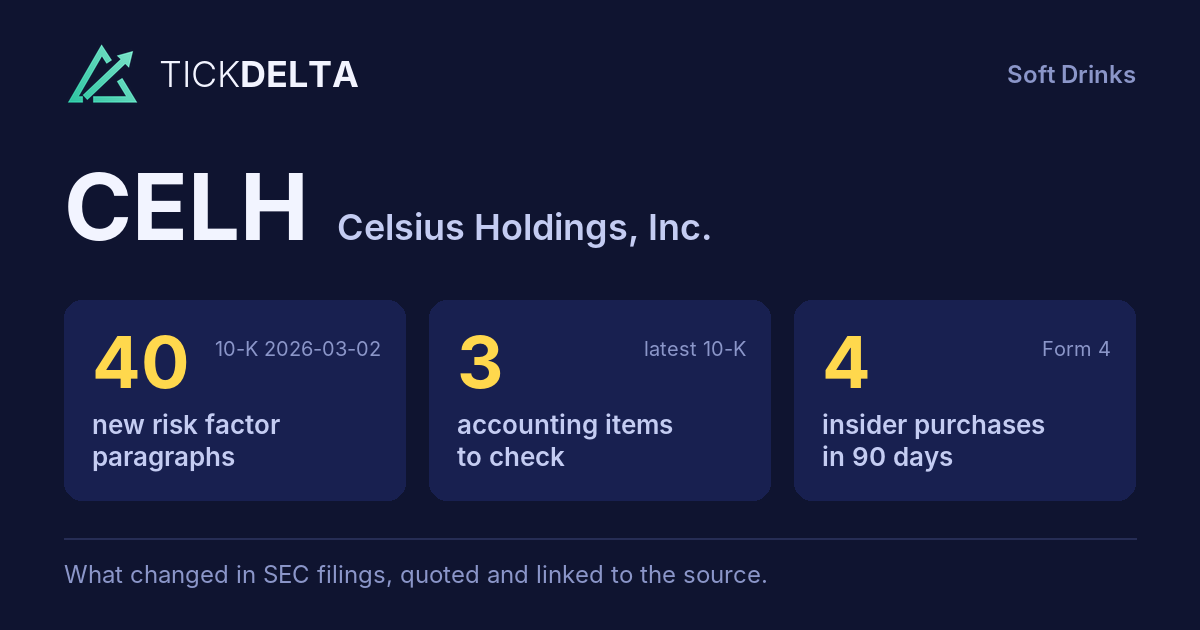
40 paragraphs in Risk Factors of the 10-K filed Mar 2, 2026 with nothing like them in the 10-K filed Mar 3, 2025. Quoted exactly. Paragraphs that were only edited are under 10-K change.
Pepsi’s increased ownership stake and additional Board representation may allow it to exert greater influence over our strategic and governance decisions.
Pepsi holds a significant ownership position in the Company through its preferred equity investments and has two designated directors serving on the Board. As a result, Pepsi may exert greater influence over certain strategic, operational and governance matters, including decisions related to distribution, marketing priorities and long-term business planning. The interests of Pepsi may not always align with those of our other stockholders. In addition, under our A&R Distribution Agreements and the Captaincy, Pepsi has a prominent role in the commercialization and distribution of our portfolio in the U.S. While we believe this partnership provides substantial benefits, the increased ownership and Board representation by Pepsi could create potential conflicts of interest, affect our ability to operate independently or limit our flexibility in pursuing alternative strategic initiatives. Any such influence could have a material impact on our governance practices, business, financial condition, results of operations and cash flows.
Our ability to successfully execute our responsibilities under the Captaincy and the A&R Distribution Agreements with Pepsi is critical to our long-term performance.
Our A&R Distribution Agreements with Pepsi and related Transaction Agreement formalized the Captaincy, which has been designed to strengthen coordination within Pepsi’s U.S. distribution system by giving us more influence over category management decisions such as product facings, merchandising allocations and promotional execution for our brands. While this structure enhances collaboration with Pepsi and market visibility, it also requires significant alignment with Pepsi’s operational priorities and execution capabilities. Any failure by either us or Pepsi to fulfill its obligations, maintain consistent execution or effectively manage our business under the Captaincy could result in lost sales opportunities, channel inefficiencies or reputational harm. Because the Captaincy is central to the long-term distribution of CELSIUS®, Alani Nu® and Rockstar® in the U.S., any deterioration in this relationship or inability to perform under the arrangement could materially adversely affect our business, financial condition, results of operations and cash flows.
In addition, the rapid growth of AI-generated content increases the risk that misinformation, manipulated media, or unauthorized endorsements relating to our products could be created and disseminated without our knowledge or consent. AI tools may also facilitate the automated spread or amplification of false or misleading information about our ingredients, product safety or business practices. Due to the inherent nature of social media and the speed with which AI-driven content can propagate, we may be unable to detect or correct such information before it reaches a wide audience and causes harm to our brands. Any negative publicity, regulatory action or litigation arising from influencer activity, third-party conduct or the dissemination of AI-generated or AI-amplified misinformation could materially adversely affect our reputation, business, financial condition, results of operations and cash flows.
Any failure by our co-packers to comply with applicable food safety, quality, labor, environmental or other regulatory requirements, or any actual or perceived product contamination, quality issue or misconduct at a co-packer facility, could result in product recalls, regulatory action, litigation, negative publicity, or loss of consumer confidence in our brands. Such events could have a disproportionate impact on our reputation and brand value, even if isolated to a single co-packer or limited production run.
In addition, although we acquired one of our co-packers on November 1, 2024, such acquisition does not mitigate the risks presented by our continued reliance on third-party co-packers and instead exposes us to additional risks associated with owning and operating a manufacturing facility, including operational disruptions, labor and safety issues, capital and maintenance costs, increased regulatory compliance requirements and potential reputational harm, any of which could have a material adverse effect on our business, financial condition, results of operations and cash flows.
We may not be able to successfully integrate Alani Nu, Rockstar or other businesses that we may acquire in the future or achieve the expected benefits of such acquisitions, and any such acquisitions may expose us to potential brand overlap, market cannibalization or cultural integration challenges.
The successful integration of Alani Nu, Rockstar or other businesses that we may acquire involves complex operational, financial and cultural challenges. These integrations require significant financial or management attention and resources, including aligning accounting policies, systems and controls, consolidating technology platforms and supply chains and harmonizing business practices and corporate cultures. Integration efforts may also create demands on management related to the increased scale of our operations and may divert attention from ongoing daily activities. We must retain key employees critical to managing the integration of acquired departments and information systems while maintaining consistent internal controls and procedures. In addition, integration activities may expose us to undisclosed or potential liabilities associated with acquired entities. If we fail to effectively execute integration plans and achieve operational alignment across brands, we may not achieve the anticipated benefits, synergies or operating efficiencies, which could result in lower revenue, increased costs or reduced profitability. The costs of achieving these benefits may be higher, or the timing may be longer than we expect. Furthermore, our acquisitions have increased our indebtedness and will result in ongoing interest, contingent liability and amortization expenses related to intangible assets, any of which could have a material adverse effect on our business, financial condition, results of operations and cash flows.
The Alani Nu and Rockstar acquisitions have expanded our portfolio into new energy and wellness segments, which may create overlap in consumer bases, retail placement or brand positioning. While we view these acquisitions as complementary to our business, there is a risk that certain product offerings may compete for similar customers or retail shelf space, leading to brand cannibalization or dilution. Effectively managing brand identity, pricing strategies and promotional focus across our expanded portfolio is critical to maintaining distinct market positioning. In addition, the integration of Alani Nu and Rockstar requires the alignment of different brand cultures, marketing approaches and operational models. If we are unable to successfully differentiate our brands, preserve their individual strengths or integrate their operations and teams without disruption, our growth potential could be limited and our results of operations and brand equity could be adversely affected.
We regularly review and evaluate potential acquisitions, joint ventures, distribution agreements, divestitures and other strategic transactions. The success of these transactions depends on our ability to identify suitable opportunities, obtain required consents and approvals and realize the expected benefits, cost savings and synergies within anticipated timeframes, if at all. Growth through acquisitions involves a number of risks, including challenges in identifying and completing transactions with complementary businesses, integrating acquired operations and management teams, maintaining effective internal controls and retaining key employees and customer relationships. Such transactions may divert management’s attention from ongoing operations, result in the issuance of equity that dilutes existing stockholders, or require us to incur significant debt or contingent liabilities.
Show the other 10
Tariffs, inflationary pressures and global supply-chain disruptions could increase costs and reduce profitability.
Tariffs, inflationary pressures and global supply-chain disruptions could increase our costs and reduce profitability. The imposition or expansion of tariffs on raw materials, packaging or imported goods, including aluminum, may increase production and distribution costs or limit the availability of key inputs. While tariffs have not materially impacted our results of operations to date, inflationary trends affecting commodities, freight, labor and fuel can also increase our cost base and reduce margins. In addition, supply-chain disruptions, whether driven by geopolitical events, trade restrictions, transportation constraints or macroeconomic volatility, could delay product shipments, increase lead times and impact our ability to meet customer demand. Although we seek to mitigate these risks through supplier diversification and cost management initiatives, our ability to recover increased costs through pricing is limited by competitive market conditions. Sustained or worsening inflation, tariff actions or supply-chain instability could materially adversely affect our operations, financial condition and results of operations.
We must continually maintain, protect, and upgrade our information-technology systems, including protecting against internal and external cyber-security threats, data breaches and emerging AI-driven attacks. Any such breach or system failure could result in significant business disruption, reputational harm and regulatory exposure.
IT enables us to operate efficiently, manage and support customer-facing digital interactions, maintain financial accuracy and safeguard proprietary data. If we fail to allocate and manage sufficient resources to build and maintain proper technology infrastructure, we could be exposed to transaction errors, process inefficiencies, data breaches, business interruptions, an inability to process or fulfill customer orders or loss of intellectual property and brand value. Cybersecurity threats, whether from hackers, criminal groups or nation-state actors, continue to evolve and may include malicious software, phishing, social engineering, cyber extortion or unauthorized access to networks and data, including malicious or negligent actions by employees or other insiders. The emergence of AI has further increased the speed, sophistication and frequency of these threats. Any such incident could lead to business disruptions, system outages, loss of customer or confidential information, data alteration or destruction, reputational harm and regulatory or legal exposure.
We rely extensively on enterprise resource planning systems and other IT systems to support key business processes, including financial reporting, accounting, inventory management, supply chain operations and other operational activities. The effective operation of these systems depends on their integrity, availability and ability to integrate with other internal and third-party systems. Any failure, disruption, degradation or security incident affecting our enterprise resource planning systems, including those arising from system defects, human error, power outages, cyber incidents, unsuccessful upgrades or implementations or reliance on third-party vendors, could impair our ability to operate efficiently, process transactions accurately or produce timely and reliable financial information. Such events could result in operational disruptions, control deficiencies, remediation costs or delays in reporting and could materially adversely affect our business, financial condition, results of operations and cash flows.
We also rely on numerous third parties, including suppliers, distributors, co-packers, cloud providers and other business partners, for critical technology and operational functions. Our reliance on cloud service providers such as Amazon Web Services, Microsoft Azure and other third-party platforms exposes us to risks from service interruptions, outages or security failures outside of our control. Prolonged downtime or performance issues with these providers could impair our ability to process transactions, manage operations or access essential data. Because we do not control the cybersecurity or data protection practices of these third parties, breaches or outages affecting their systems could also compromise our data or disrupt our operations. Because we do not control the operations, governance, or compliance practices of these third parties, our reliance on them may increase our exposure to cybersecurity incidents, business interruptions, and regulatory or legal risk. Although we maintain procedures, training and insurance coverage designed to reduce these risks, no system is completely secure or immune to interruption. Coordination with third-party providers in responding to an incident may delay containment or mitigation efforts, increasing potential losses.
We use AI and automated technologies in certain operational, analytical and forecasting processes and overreliance on, or errors in these systems, could impair decision-making, disrupt operations or introduce unintended vulnerabilities. A significant cybersecurity breach, third-party outage or prolonged system failure could result in violations of data protection laws, reputational damage, operational delays, loss of intellectual property or material financial costs. There can be no assurance that our insurance coverage will be adequate to cover all losses associated with such incidents or will remain available on commercially reasonable terms. Any such event could have a material adverse effect on our business, financial condition, results of operations and cash flows.
Furthermore, as with many innovations, AI presents risks, challenges and unintended consequences that could affect its adoption, and therefore our business. AI algorithms and training methodologies may be flawed, ineffective or inadequate. The rapid evolution of AI, particularly the anticipated government regulation of AI, could require significant resources for compliance, whether in the development, testing or maintenance of such systems or software. AI development or deployment practices by us or third-party providers could increase vulnerability to cybersecurity risks and require additional resources to implement heightened cybersecurity measures to protect the security of our data. These potential issues and other failures of any potential AI systems could subject us to competitive harm, regulatory action, legal liability and brand or reputational harm.
The legal, regulatory and ethical landscape surrounding the use of AI and machine learning technologies is rapidly evolving. As we use AI and automated tools in certain operational, analytical, marketing and forecasting activities, we have established a Responsible AI Framework that sets forth principles, governance and operational practices intended to support the responsible, safe and secure deployment of these technologies in alignment with our business objectives, values and regulatory obligations; however, the effectiveness of this framework cannot be fully assured given the evolving nature of AI technologies and applicable regulations. AI systems may produce inaccurate, biased or misleading outputs, compromise confidential or sensitive information, or give rise to intellectual property or data-related claims, despite the application of the Responsible AI Framework, any of which could result in operational disruptions, increased costs, regulatory scrutiny or reputational harm and could have a material adverse effect on our business, financial condition, results of operations and cash flows.
We rely on the availability of sufficient quantities of quality water for the manufacture of our products. Water scarcity, drought conditions, restrictions on water usage, infrastructure limitations, increased water costs or heightened scrutiny of water sourcing practices in the jurisdictions in which we or our co-packers operate could disrupt production, limit manufacturing capacity or increase our operating costs. In addition, adverse publicity or regulatory action relating to water usage or sustainability practices, whether or not warranted, could negatively impact our brands and reputation. Any of the foregoing could have a material adverse effect on our business, financial condition, results of operations and cash flows.
Compliance with climate-disclosure and environmental-reporting requirements may increase costs and regulatory risk.
We are subject to evolving federal, state and international regulations concerning climate-related disclosure and greenhouse gas emissions. The Environmental Protection Agency has made efforts to repeal or otherwise modify regulation of greenhouse gas emissions at the federal level, including issuing a proposal to revoke the Environmental Protection Agency’s greenhouse gas “Endangerment Finding,” which underpins the majority of the Environmental Protection Agency’s greenhouse gas regulations. Separately, various states and groups of states have adopted or are considering adopting legislation, regulations or other regulatory initiatives that are focused on such areas as greenhouse gas cap and trade programs, carbon taxes, reporting and tracking programs, disclosure of climate risk management, and restriction of emissions. California’s Climate Accountability Package, for example, may require companies doing business in the State of California to publicly disclose greenhouse gas emissions, climate-related financial risks and mitigation strategies in the future. We cannot predict whether any such efforts will ultimately be successful or what effects they may have on our business or results of operations.
At the international level, there exists the United Nations-sponsored “Paris Agreement,” which requires nations to submit non-binding greenhouse gas emissions reduction goals every five years after 2020, though in January 2025, the U.S. submitted notification to the United Nations that it intends to withdraw from the Paris Agreement regarding climate change, with the withdrawal effective January 27, 2026. Additionally, various agreements and commitments have been made at the annual Conference of the Parties to eliminate certain fossil fuel subsidies, phase out fossil fuels in energy systems, and pursue further action on non-carbon dioxide greenhouse gases, though none have been legally binding. The federal government has undertaken efforts to decrease the U.S.’ participation in such initiatives, including the withdrawal of the U.S. from the Paris Agreement and all other agreements made under the United Nations Framework Convention on Climate Change, and has sought other legislative and regulatory changes related to climate change. Notwithstanding the U.S.' withdrawal from the Paris Agreement, various state and local governments remain committed to the Paris Agreement.
Compliance with any applicable disclosure frameworks may increase our reporting and assurance costs, require additional data collection and systems investment and expose us to potential enforcement actions or reputational harm if our disclosures are viewed as inaccurate or insufficient. Expanding regulatory expectations around climate and environmental transparency could therefore result in higher compliance costs and legal exposure, which may adversely affect our operations, financial condition and reputation.
Termination of distributor relationships could expose us to legal, financial and competitive risks.
We may from time to time terminate, or be required to terminate, relationships with distributors as part of our strategic, operational, or compliance decisions. The termination of distributor relationships may expose us to risks including claims for damages, fines, penalties, or other forms of legal or regulatory action, as well as the cost of defending against potential litigation or disputes. In addition, terminated distributors may have contractual, statutory, or other rights that could result in additional costs or adverse outcomes.
Following termination, a former distributor may have increased capacity, shelf space, sales focus and operational resources available to support other brands, including our competitors. As a result, such distributors may choose to scale, prioritize, or expand distribution of competing products, including brands that directly compete with ours, within the same markets or channels. This could strengthen competitors’ market positions and intensify competitive pressures against us, which may adversely affect our sales, market share, and relationships with other distributors or retail partners. Any of these factors could have a material adverse effect on our business, results of operations and financial condition.
Our portfolio, which includes Celsius®, Alani Nu®, and Rockstar®, competes in the highly competitive functional beverage product category. This category is subject to shifting consumer preferences, new product introductions, aggressive pricing and significant promotional activity by established and emerging brands. Any decline in sales of our functional beverage products or loss of market share in these categories, could materially adversely affect our future revenues and profitability.
Our business is subject to seasonality, with higher sales volumes typically occurring during the warmer months of the year. Sales may fluctuate from period to period due to customer purchasing patterns, consumer demand and seasonal factors, including weather conditions. As a result, our results for any particular quarter may not be indicative of the results to be achieved for the entire fiscal year.
We have incurred significant indebtedness in connection with our recent acquisitions, which increases our financial leverage and exposes us to risks related to liquidity, compliance with debt covenants and future refinancing.
Our outstanding debt requires ongoing interest and principal payments that may limit our ability to obtain additional financing, pursue strategic opportunities or respond to changing business or economic conditions. Because some of our debt accrues interest at variable interest rates, movements in interest rates could increase our borrowing costs and reduce our available cash flow.
Our debt agreements also contain covenants that impose operating and financial restrictions, and our failure to comply with these covenants could materially adversely affect our business, financial condition, results of operations and cash flows. Our ability to comply with these restrictions and covenants is uncertain and will be affected by the levels of cash flow from operations and other events or circumstances beyond our control. If market or other economic conditions deteriorate, our ability to comply with these covenants may be impaired. If we violate any provisions of our debt agreements, particularly our Credit Agreement, that are not cured or waived within the applicable time periods provided in such agreements, a significant portion of our indebtedness may become immediately due and payable, and our lenders’ commitment to make further loans to us under certain of our credit facilities may terminate. We might not have, or be able to obtain, sufficient funds to make these accelerated payments. If we were unable to repay the accelerated amounts, the lenders under our Credit Agreement could proceed against the collateral granted to them to secure our indebtedness thereunder. If the payment of our debt is accelerated, our assets may be insufficient to repay such debt in full, which could result in our insolvency.
Changes in U.S. tax law, including those introduced under the OBBBA, may further impact our tax obligations and planning strategies.
The OBBBA introduced substantial modifications to the U.S. corporate tax system, including changes to international tax provisions, interest expense limitations and foreign tax credit rules. Future regulatory guidance or amendments could affect the deductibility of certain expenses, the timing of income recognition or the treatment of intercompany transactions. These changes, individually or in combination, could increase our effective tax rate, alter the value of deferred tax assets and liabilities and require adjustments to our tax planning strategies. Additionally, ongoing uncertainty regarding global tax reforms and the implementation of minimum tax standards in various jurisdictions could increase compliance complexity and costs. Any such changes could materially affect our business, financial condition, results of operations and cash flows.
A portion of our debt bears interest at variable rates, which makes our borrowing costs sensitive to fluctuations in benchmark interest rates and credit spreads. The Federal Reserve implemented significant benchmark interest rate reductions in late 2024 and maintained rates at relatively stable levels through much of 2025. During the fourth quarter of 2025, the Federal Reserve implemented additional rate cuts of a smaller magnitude. Despite these reductions, and while recent refinancing activity has reduced our interest rate, our overall debt service obligations remain exposed to market rate volatility. We are subject to interest rate risk in connection with the Term Loan Facility and Revolving Credit Facility, which bear interest at either a benchmark rate or an alternate base rate, plus an applicable spread which is subject to potential step-downs in 0.25% increments pursuant to a pricing grid based on net leverage. A one-percentage-point increase in the interest rate would raise our annual interest expense obligations by approximately $6.9 million, based on the outstanding balances under the Term Loan Facility as of December 31, 2025. There were no borrowings under the Revolving Credit Facility as of December 31, 2025. Sustained or further increases in interest rates could reduce the availability of capital, constrain our ability to invest in growth initiatives and negatively impact profitability and cash flow. We do not currently use derivative instruments or other hedging arrangements to mitigate exposure to interest rate fluctuations.
Future issuances of Common Stock or Preferred Stock could dilute existing stockholders and reduce the market value of our Common Stock.
In the future, we may issue Common Stock or shares of preferred stock senior to our Common Stock, such as our issued and outstanding Preferred Stock, to finance acquisitions, repay debt or raise capital for general corporate purposes. In connection with the Alani Nu Acquisition, we issued shares of our Common Stock as part of the purchase consideration, and in connection with the Rockstar Acquisition and related Pepsi Transactions, we issued Series B Preferred Stock. Future issuances could dilute the interests of existing stockholders, including voting power and financial interests, and reduce the market value of our Common Stock.
We cannot guarantee that any share repurchase program will be fully consummated or that it will enhance long-term stockholder value. Share repurchases could also increase volatility in the trading price of our stock and reduce our cash reserves.
Although our Board has authorized a share repurchase program, the program does not obligate us to repurchase any specific number of shares or dollar amount of Common Stock and may be modified, suspended or terminated at any time. In addition, our ability to repurchase or retire shares is subject to limitations under our Credit Agreement. As a result, our ability to repurchase shares may be limited in practice and dependent on our ability to access the equity capital markets on acceptable terms. The timing, amount and method of any repurchases will depend on factors such as market conditions, share price, business performance, available liquidity and other capital allocation priorities, including acquisitions, integration activities and debt repayments. We cannot guarantee that any repurchases will be fully executed or that they will result in an increase in long-term stockholder value. Announcements of share repurchase activity or changes to the program could also increase volatility in the trading price of our Common Stock. In addition, any share repurchases will reduce our cash reserves, which could limit our ability to pursue strategic opportunities or respond to changing business or economic conditions.
Paragraphs in the 10-Q filed Nov 5, 2026 that were not in the one before
New in the latest 10-Q
22 paragraphs in the 10-Q filed Nov 5, 2026 with nothing like them in the 10-Q filed Aug 6, 2026 (at least half the words must differ; new numbers alone do not count). Quoted exactly, grouped by the item heading above them. This is text that changed, not a judgement of how serious it is.
Financial statements and notes
[2] The non-cash proceeds were used for the ASC 606 upfront payment to customer and the Rockstar purchase consideration as part of the Pepsi Transactions, see Note 5. Acquisitions.
Read in the 10-Q
During 2026, the Company completed the integration of the Alani Nu and Rockstar businesses into its expanded multi-brand energy platform and rationalized certain SKUs across its portfolio in connection with evolving consumer demand, product innovation and distribution strategies.
Read in the 10-Q
During the quarter ended September 30, 2026, the Company finalized the fair values of the assets acquired and liabilities assumed in connection with the Rockstar Acquisition. The finalization occurred within the one-year measurement period. Accordingly, the amounts presented herein are final. No measurement period adjustments were recorded in 2026.
Read in the 10-Q
As of December 31, 2025, accrued legal included $ 59.5 million related to the Strong Arm Productions litigation. During the nine months ended September 30, 2026, the Company recorded an additional $ 25.5 million, increasing the accrual to $ 85.0 million. In September 2026, the Company entered into a settlement agreement for the amount previously reported and paid the first installment of $ 60.0 million. The remaining $ 25.0 million unpaid balance was reclassified to other current liabilities on the Condensed Consolidated Balance Sheets as of September 30, 2026. For more information see Note 15. Commitments and Contingencies.
Read in the 10-Q
The fair value of the Term Loan Facility was $ 661.1 million at September 30, 2026. At December 31, 2025, the carrying value of the Term Loan Facility approximated its fair value.
Read in the 10-Q
Show the other 17
The Company is involved in various legal proceedings and regulatory matters arising in the ordinary course of business. The Company evaluates developments in these matters on an ongoing basis and adjusts its accruals and disclosures, as appropriate.
Read in the 10-Q
The outcomes of legal proceedings and regulatory matters are inherently unpredictable and subject to significant uncertainties. An adverse outcome in one or more of these matters, individually or in the aggregate, could have a material adverse effect on the Company's results of operations or cash flows. Except as otherwise disclosed below, the Company is unable to reasonably estimate a possible loss or range of loss in excess of amounts accrued, if any.
Read in the 10-Q
On September 4, 2026, the Company entered into a settlement agreement with the plaintiffs resolving the lawsuits and all related claims between the parties. Under the settlement agreement, without admitting any wrongdoing or liability, the Company agreed to pay the plaintiffs an aggregate amount of $ 85.0 million, consisting of $ 60.0 million paid on September 15, 2026 and $ 25.0 million payable on January 5, 2027. The settlement amount equals the amount the Company previously reported and accrued as of prior quarter end in connection with these matters. As of September 30, 2026, the remaining unpaid balance of $ 25.0 million was recorded in other current liabilities on the Condensed Consolidated Balance Sheets.
Read in the 10-Q
On September 4, 2026, a putative securities class action was filed in the U.S. District Court for the Southern District of Florida. The complaint asserts claims under Sections 10(b) and 20(a) of the Securities Exchange Act of 1934 and Rule 10b-5 promulgated thereunder. The complaint is filed on behalf of a putative class that purchased the Company’s securities between February 21, 2025 and June 3, 2026. The complaint names as defendants the Company, its CEO, CFO and Chief of Staff.
Read in the 10-Q
The complaint alleges that the defendants made materially false or misleading statements and failed to disclose material information concerning the health risks associated with Alani Nu energy drinks, the marketing of Alani Nu products, and the Company’s compliance practices. The complaint further alleges that the defendants’ statements concerning the Company’s products, operations, and business prospects were materially misleading because the Company allegedly failed to disclose risks associated with the caffeine content of Alani Nu energy drinks and the potential impact of those risks on the Company’s business, reputation, and financial performance. The complaint refers to the Glazer Action and the June 2026 investigation announced by the Attorney General of the State of Texas concerning the marketing and safety of Celsius and Alani Nu energy drinks. The complaint alleges that the Company’s stock price declined following public reports concerning those matters.
Read in the 10-Q
On October 26, 2026, a putative consumer class action, Nielsen v. Celsius Holdings, Inc., was filed against the Company and Celsius, Inc. in the U.S. District Court for the Western District of Washington. The complaint alleges that certain statements on Celsius product labels are misleading and not adequately substantiated. The complaint asserts claims for violation of the Washington Consumer Protection Act and fraudulent concealment. The putative class covers all persons who bought a covered product in Washington from October 26, 2022, through trial.
Read in the 10-Q
On October 28, 2026, a nearly identical putative class action, Valente v. Celsius Holdings, Inc., was filed against the Company in the U.S. District Court for the Northern District of Illinois. The complaint makes substantially similar allegations on behalf of a putative class of Illinois purchasers and asserts claims for violation of the Illinois Consumer Fraud and Deceptive Business Practices Act and fraudulent misrepresentation. The putative class covers all persons who bought a covered product in Illinois from October 27, 2022, through trial.
Read in the 10-Q
Additionally, as of September 30, 2026, the Company had long-term contractual obligations aggregating approximately $ 91.3 million, which related primarily to non-production-related commitments including information technology transition projects, sponsorships, and other sales and marketing activities.
Read in the 10-Q
In September 2026, the Company reached a settlement resolving litigation with Strong Arm Productions USA, Inc., Tramar Dillard (professionally known as Flo Rida), and D3M Licensing Group, LLC related to two endorsement and licensing agreements entered into in 2014 and 2016. Under the settlement, the Company agreed to pay an aggregate of $85.0 million, of which $60.0 million was paid in September 2026, with the remaining $25.0 million payable in January 2027. For more information, see Note 15. Commitments and Contingencies in the notes to our Condensed Consolidated Financial Statements included elsewhere in this Quarterly Report.
Read in the 10-Q
Our financial condition as of September 30, 2026 reflected the following significant changes compared to December 31, 2025:
Read in the 10-Q
• Accrued expenses decreased by $68.7 million, primarily due to the $ 60.0 million payment made on September 15, 2026 under the $ 85.0 million settlement agreement related to the Strong Arm Productions litigation. The remaining $ 25.0 million, payable on January 5, 2027, was recorded within other current liabilities as of September 30, 2026;
Read in the 10-Q
• Accrued distributor termination fees decreased by $262.0 million, primarily reflecting the settlement of termination fees owed to former Alani Nu distributors for the transfer of territory rights to Pepsi under the A&R Distribution Agreements and Channel Transition Amendment, offset by the additional fees incurred under the Channel Transition Amendment during the nine months ended September 30, 2026;
Read in the 10-Q
• Accrued promotional allowance increased by $171.2 million, primarily due to timing of payments and changes in the Alani Nu sales channel mix, including a higher mix of DSD sales; and
Read in the 10-Q
• Treasury stock increased by $180.5 million, primarily reflecting repurchases under the share repurchase program approved in November 2025, which included nine months of activity during 2026 compared to two months of activity in 2025.
Read in the 10-Q
Three months ended September 30, 2026 compared to three months ended September 30, 2025
Read in the 10-Q
Nine months ended September 30, 2026 compared to nine months ended September 30, 2025
Read in the 10-Q
For the nine months ended September 30, 2026, revenue attributable to the Rockstar brand was approximately $213.5 million compared to $12.2 million for the nine months ended September 30, 2025. The prior year amount reflects revenue from only August 28, 2025, the Closing Date of the Pepsi Transactions, through September 30, 2025, and does not represent a full nine months of revenue for the 2025 period.
Read in the 10-Q
The 10-Q's risk factors against the 10-K
Item 1A of the 10-Q filed Nov 5, 2026 against Item 1A of the 10-K filed Mar 2, 2026.
A 10-Q repeats only the risks that changed, so a 10-K paragraph that is missing from it is not counted as removed.
Added is a paragraph with nothing like it in the 10-K, Reworded a sentence that is in both with several words changed,
Quiet changes a sentence in both where one to four words changed and one is a hedge or a modal
(cut words struck through, new words highlighted).
Text on the page, not a score; each links to the filing at sec.gov.
What the 10-Q itself says about its risk factors:We face a variety of risks that are inherent in our business and our industry, including operational, legal, regulatory and product risks. Such risks could cause our actual results to differ materially from our forward-looking statements, expectations and historical trends. Except for the risks discussed elsewhere in this Quarterly Report, during the reporting period covered by this Quarterly Report, there have been no material changes to our risk factors as set forth in Part I, Item 1A. Risk Factors in our Annual Report.
Read in the 10-Q
1 paragraph in the 10-Q's Item 1A, and none of them adds, rewords or quietly edits a paragraph of the 10-K's.
Phrases used for the first time
Two-word phrases in Risk Factors of the 10-K filed Mar 2, 2026 that are in none of the 1 earlier 10-Ks stored, back to Mar 3, 2025
Where each one is used
- paris agreement: At the international level, there exists the United Nations-sponsored “Paris Agreement,” which requires nations to submit non-binding greenhouse gas emissions reduction goals every five years after 2020, though in January 2025, the U.S. submitted notification to the United Nations that it intends to withdraw from...
- interest rates: Our outstanding debt requires ongoing interest and principal payments that may limit our ability to obtain additional financing, pursue strategic opportunities or respond to changing business or economic conditions. Because some of our debt accrues interest at variable interest rates, movements in interest rates...
- promotional activities: Our advertising and promotional activities may be subject to regulatory review of the truthfulness and substantiation of product claims.
- operational disruptions: In addition, although we acquired one of our co-packers on November 1, 2024, such acquisition does not mitigate the risks presented by our continued reliance on third-party co-packers and instead exposes us to additional risks associated with owning and operating a manufacturing facility, including operational...
- supply-chain disruptions: Tariffs, inflationary pressures and global supply-chain disruptions could increase costs and reduce profitability.
- intelligence act: We receive, process, transmit and store information relating to certain identified or identifiable individuals (“personal data”), including current and former employees, in the ordinary course of business. As a result, we are subject to various U.S. federal and state and foreign laws and regulations relating to...
- unfair competition: Our advertising, labeling and promotional activities are subject to a wide range of laws and regulations in the jurisdictions in which our products are sold. In the U.S. our advertising activities are subject to regulation by the FTC under the Federal Trade Commission Act. In addition, our advertising and...
- environmental protection: We are subject to evolving federal, state and international regulations concerning climate-related disclosure and greenhouse gas emissions. The Environmental Protection Agency has made efforts to repeal or otherwise modify regulation of greenhouse gas emissions at the federal level, including issuing a proposal to...
Used at least twice, small words left out. Counted, not picked: a phrase can be new because the company renamed something.
What was taken out
29 paragraphs of last year's Risk Factors with nothing like them now. The longest are quoted.
Sources
Item 1A of each 10-K and 10-Q on EDGAR, quoted exactly. Each paragraph links to the filing at sec.gov.
Also
10-K change: what was reworded or cut, section by section.
Work with it
Excel workbook · CSV. Google Sheet that stays up to date: paste =IMPORTDATA("https://tickdelta.com/company/CELH/export.csv") into a cell.