Screener / SEC EDGAR /CIK 0001486159 /10-K filed Feb 26, 2026, compared with Feb 27, 2025 /Numbers from the XBRL of the 10-Ks
Nasdaq Energy · Oil & Gas Production

Chord Energy Corp CHRD

Compare with peers Embed
SEC comment letters, last 20 years

3 reviews of CHRD's filings by SEC staff

UPLOAD and CORRESP
Reviews 3 latest letter Nov 17, 2017
Questions asked 8 each answered in the company's own letter
No closing letter 0 reviews without a letter saying the staff completed it

When the SEC's staff reviews a filing, it writes to the company with numbered questions, and the company answers each one in a letter. SEC publishes the exchange once the review is over, at least 20 business days later. A question is not an accusation; most reviews end with the company adding detail to its next filing.

How the reviews went

Every review on EDGAR, from the first staff letter to the letter that closes it

  1. 1. Staff letters 4 UPLOAD
  2. 2. Questions in them 8 numbered comments
  3. 3. Company replies 4 CORRESP
  4. 4. Reviews closed 3 of 3 closing letter

Half the closed reviews took 6 days or less from the first letter to the closing letter.

Form 10-K

2017-11-17 to 2018-01-11 · 4 questions · 1 letter from the SEC, 1 from the company
Review closed 2018-01-11
Reserves and insuranceResults discussion (MD&A)RevenueNon-GAAP measures
Business, page 4 · Proved Undeveloped Reserves, page 8
SEC asked (1)
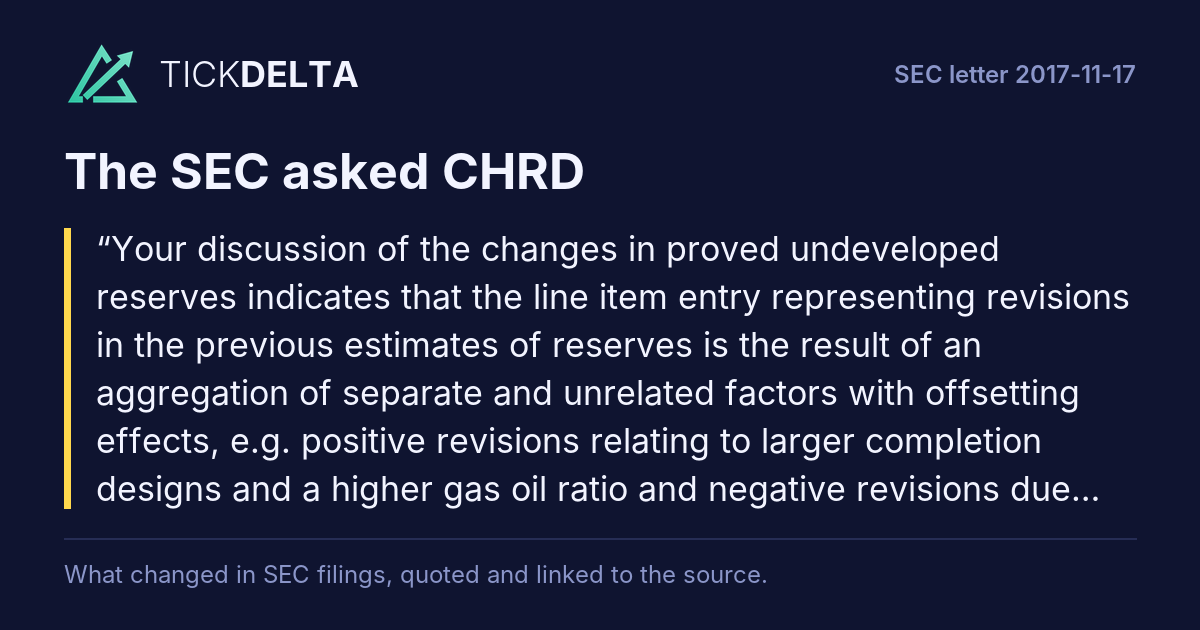
Your discussion of the changes in proved undeveloped reserves indicates that the line item entry representing revisions in the previous estimates of reserves is the result of an aggregation of separate and unrelated factors with offsetting effects, e.g.
Rest of the question

positive revisions relating to larger completion designs and a higher gas oil ratio and negative revisions due to the removal of proved undeveloped locations that are no longer aligned with the anticipated five-year drilling plan and negative revisions due to lower commodity prices. Please expand your disclosure to reconcile the overall change in the line item by separately identifying and quantifying the net amount attributable to each factor so that the change in net reserves between periods is fully explained. In regards to your disclosure of revisions in the previous estimates of reserves, please expand your discussion to identify any additional factors such as changes caused by well performance, uneconomic proved undeveloped locations or changes resulting from the removal of proved undeveloped locations due to changes in a previously adopted development plan in addition to the changes in the net quantities caused by commodity prices. Refer to Item 1203(b) of Regulation S-K. This comment also applies to the comparable disclosure of the revisions in net quantities of total proved reserves pursuant to FASB ASC 932235-50-5 for each of the periods presented on page 122.

CHRD answered
We acknowledge the Staff’s comment, and we respectfully submit to the Staff that the Company’s disclosure as to the changes attributed to revisions in proved undeveloped reserves for the year ended December 31, 2016 were made in accordance with Item 1203(b) of Regulation S-K and, as such, the Company believes the disclosure regarding changes in proved undeveloped reserves is materially accurate as presented. However, the Company agrees in future filings to quantify the individual factors driving its net revisions.
Rest of the answer

For the year ended December 31,

2016, its net positive revision in proved undeveloped reserves of 30,030 MBoe was attributable to positive revisions of 27,608 MBoe due to larger completion designs, 8,221 MBoe due to a higher gas to oil ratio and 5,744 MBoe due to ownership adjustments, offset by 9,455 MBoe due to the removal of proved undeveloped reserves that were no longer aligned with the Company’s anticipated five-year drilling plan and 1,617 MBoe due to the impact of price on producing life.

Similarly, we respectfully submit to the Staff that the Company’s disclosure as to the changes attributed to revisions in total proved reserves for the periods presented were made in accordance with FASB ASC 932-235-50-5 and, as such, the Company believes the disclosure regarding changes in total proved reserves is materially accurate as presented. For the year ended December 31, 2016, the Company’s net positive revision in proved reserves of 31,136 MBoe was attributable to positive revisions of 30,374 MBoe due to well performance and larger completion designs, 8,221 MBoe due to a higher gas to oil ratio and 8,165 MBoe due to ownership adjustments, offset by 9,455 MBoe due to the removal of proved undeveloped reserves that were no longer aligned with the Company’s anticipated five-year drilling plan and 8,206 MBoe due to lower commodity prices. For the year ended December 31, 2015, the Company’s net negative revision in proved reserves of 84,635 MBoe was primarily attributable to negative revisions of 71,945 MBoe due to the removal of proved undeveloped reserves that were not economic at the lower oil price or were no longer aligned with the Company’s anticipated five-year drilling plan and 17,214 MBoe due to the impact of price on producing life, partially offset by positive revisions of 3,004 MBoe due to ownership adjustments and 1,914 MBoe due to performance. For the year ended December 31, 2014, the Company’s net negative revision in proved reserves of 25,117 MBoe was primarily attributable to negative revisions of 21,411 MBoe due to the removal of proved undeveloped reserves that were not aligned with the Company’s anticipated five-year drilling plan and 3,796 MBoe due to performance.

In future filings, beginning with the Company’s Annual Report on Form 10-K for the year ended December 31, 2017, the Company will quantify the individual material factors underlying changes in the Company’s proved undeveloped reserves and total proved reserves.

Read in the reply
In its next report

First report after the company's reply of Dec 4, 2017: 10-K filed Feb 28, 2018 ↗, against the 10-K filed Feb 23, 2017 ↗.

Tickdelta does not hold the text of both reports, so they are not compared here.

Business, page 4 · Proved Undeveloped Reserves, page 8
SEC asked (2)
The disclosure provided on page 8 indicates that approximately 33% of your proved undeveloped reserves at December 31, 2016 are attributable to wells that have been drilled but not yet completed. Please provide us with the total number of gross wells and the net quantities of proved undeveloped reserves attributable to those wells as of December 31, 2016 which are not scheduled to be completed and the related
Rest of the question

reserves converted to developed reserves within five years of the initial disclosure as proved undeveloped reserves. To the extent that there are any such reserves, please tell us the specific circumstances that you believe justify a period longer than five years from the initial disclosure date to complete the development these reserves.

CHRD answered
We acknowledge the Staff’s comment, and we respectfully submit to the Staff that for the year ended December 31, 2016, two gross wells that were drilled but not yet completed were scheduled to be completed, and the related proved undeveloped reserves converted to developed reserves, five years and four months beyond the initial disclosure as proved undeveloped reserves.
Rest of the answer

These two wells were initially disclosed as proved undeveloped reserves on December 31, 2012 and 2013, respectively, and, at the time of their initial disclosure, they were scheduled to be developed within five years, and the wells were, in fact, drilled within five years of their initial disclosure date. When the Company performed its annual evaluation of proved undeveloped reserves as of December 31, 2016, the Company had the financial capacity and resources to complete these two wells within five years of initial booking of the associated reserves as proved undeveloped reserves. The Company had flexibility in its 2017-2018 capital program, and believed that these wells could be completed earlier than what the December 31, 2016 schedule estimated. There are 1,089 MBoe of proved undeveloped reserves attributable to these two wells, representing approximately 0.35% of the Company’s total proved reserves.

Read in the reply
In its next report

First report after the company's reply of Dec 4, 2017: 10-K filed Feb 28, 2018 ↗, against the 10-K filed Feb 23, 2017 ↗.

Tickdelta does not hold the text of both reports, so they are not compared here.

Production, Revenues and Price History, page 10
SEC asked (3)
Tell us how you considered the requirements with regard to disclosure of production, by final product sold, for each field and/or geological formation that contains 15% or more of your total proved reserves. Refer to Item 1204(a) of Regulation S-K and the definition of a field provided in Rule 4-10(a)(15) of Regulation S-X.
CHRD answered
We acknowledge the Staff’s comment and respectfully advise the Staff that, upon consideration of the requirements pursuant to Item 1204(a) of Regulation S-K, we determined that for the year ended December 31, 2016, the Company’s production, by final product sold, was generated from only one named field and/or geological formation. In this regard, we note that Rule 4-10(a)(15) of Regulation S-X defines a “field” as:

An area consisting of a single reservoir or multiple reservoirs all grouped on or related to the same individual geological structural feature and/or stratigraphic condition.
Rest of the answer

There may be two or more reservoirs in a field that are separated . . . laterally by local geological barriers . . . . Reservoirs that are associated by being in overlapping or adjacent fields may be treated as a single or common operational field. The geological terms structural feature and stratigraphic condition are intended to identify localized geological features as opposed to the broader terms of basins, trends, provinces, plays, areas-of-interest, etc. [Emphasis Added]

In accordance with the definition set forth above, we group the Company’s Williston

Basin assets into one named field and/or geological formation and operate such assets consistent with this classification. We refer to this one named field and/or geological formation as the Bakken and Three Forks formations. The Company’s target horizontal zones in the Bakken and Three Forks formations produce from a continuous hydrocarbon formation present across all of the Company’s operated properties in the Williston Basin, as the Three Forks formation is generally found immediately beneath the Bakken formation. All of the Company’s wells in the Bakken and Three Forks formations are drilled, completed and equipped in a similar manner. Additionally, the Company’s properties in the Bakken and Three Forks formations share sales arrangements, infrastructure and substantially similar cost structures. Purchasers of the Company’s products do not make any differentiation based on the wells or reservoirs from which such production originated, and such production is generally commingled at central pipeline or rail delivery points.

We believe this approach is consistent both with the manner in which other registrants that operate in the Williston Basin report their results, including production by final product sold, and the understanding of investors. The final products sold from our reserves are oil and natural gas, which are presented.

Read in the reply
In its next report

First report after the company's reply of Dec 4, 2017: 10-K filed Feb 28, 2018 ↗, against the 10-K filed Feb 23, 2017 ↗.

Tickdelta does not hold the text of both reports, so they are not compared here.

Management’s Discussion and Analysis of Financial Condition and Results of Operations, page · Non-GAAP Financial Measures, page 72
SEC asked (4)
The adjustments you make in connection with your presentation of Adjusted Net Income (Loss) for the year ended December 31, 2015 result in changing a GAAP loss for the period to non-GAAP income. However, the number of shares used to determine adjusted diluted earnings per share does not appear to have been adjusted to include the impact of dilutive securities which had been excluded from the calculation of GAAP loss
Rest of the question

per share. Revise your presentation to include dilutive securities in your calculation of adjusted diluted earnings per share. Note that similar considerations apply in circumstances where non-GAAP adjustments result in changing GAAP income to non-GAAP loss such as appears to have occurred for the three and six month periods ended June 30, 2017; antidilutive securities should be excluded from your calculation of adjusted loss per share.

CHRD answered
We acknowledge the Staff’s comment and respectfully advise the Staff that the Company did not have dilutive securities under the treasury stock method for the year ended December 31, 2015. The treasury stock method assumes that any proceeds from the exercise of options and warrants (and their equivalents) would be used to purchase common stock at the average market price during the period.
Rest of the answer

To have dilutive securities under the treasury stock method for restricted stock, the average unamortized compensation cost (assumed proceeds) from all unvested shares outstanding must be less than the cost to repurchase such unvested shares at the average stock price during the period. For the year ended December 31, 2015, our average unamortized compensation cost of $43.6 million exceeded the cost to repurchase all 2,842,144 unvested shares at the average 2015 stock price of $13.14 per share.

In future filings, we will include a revised calculation of non-GAAP diluted loss per share for the three and six month periods ended June 30, 2017. The revised non-GAAP diluted loss per share will divide Adjusted Net Loss by weighted average shares outstanding excluding anti-dilutive securities. For the three and six month periods ended June 30, 2017, the impact is immaterial and does not change the reported non-GAAP diluted loss per share amount. The following table reflects non-GAAP diluted loss per share for the three and six month periods ended June 30, 2017 as previously reported and as revised:

Three Months Ended

June 30, 2017

Six Months Ended

Previously

Reported

As

Revised

(in thousands, except per share data)

Adjusted Net Loss

$

(11,152

)

(22,619

Diluted weighted average shares outstanding

234,917

233,283

236,281

233,176

Non-GAAP Diluted Loss Per Share

(0.05

(0.10

Read in the reply
In its next report

First report after the company's reply of Dec 4, 2017: 10-K filed Feb 28, 2018 ↗, against the 10-K filed Feb 23, 2017 ↗.

Tickdelta does not hold the text of both reports, so they are not compared here.

Also in this review: closing letter, 2018-01-11

Form 10-K

2015-10-30 to 2015-11-05 · 3 questions · 2 letters from the SEC, 2 from the company
Review closed 2015-11-05
Results discussion (MD&A)Reserves and insuranceLiquidity and cash
Overview, page 48
SEC asked
Disclosure appearing in your annual report and on page 20 of your Form 10-Q for the period ended June 30, 2015 indicates that sustained periods of low prices for oil or natural gas could materially and adversely affect your financial position, results of operations, and the quantities of oil and natural gas reserves that you can economically produce. Per Section III.B.3 of SEC Release No.
Rest of the question

33-8350, quantitative disclosure of the reasonably likely effects of material trends and uncertainties should be provided, and may be required, if reasonably available. Please revise the disclosure under this section and in additional areas of your filing, as applicable, to provide additional language addressing the risks resulting from the uncertainty associated with recent changes in commodity prices. Specifically, include quantitative disclosure regarding your reserve quantities reflecting potential scenarios deemed reasonably likely to occur by management. Refer to Item 303(a) of Regulation S-K.

CHRD answered
In order to clarify the potential near-term effects of how sustained periods of low prices for oil or natural gas could materially and adversely affect our financial position, results of operations, and the quantities of oil and natural gas reserves that we can economically produce as of the most recent reporting date, we propose to include additional disclosures in our future quarterly and annual reports, when applicable.
Rest of the answer

These additional disclosures will be applicable in periods that we expect to incur future downward revisions to our estimated net proved reserves and/or an impairment of proved oil and natural gas properties as a result of changes in commodity prices.

Please see below for an example of this disclosure:

Changes in commodity prices may significantly impact our estimates of oil and natural gas reserves, which are estimated and reported as of December 31 of each calendar year. Our estimated net proved reserves at December 31, 2014 were determined using unweighted arithmetic average first-day-of-the-month prices for the prior twelve months of $95.28/Bbl for oil and $4.35/MMBtu for natural gas. If commodity prices remain at current levels, while assuming all other inputs remain constant, we expect a material revision to our previously reported estimated net proved reserves, most significantly, but not limited to, our proved undeveloped reserves in areas outside of our core acreage within the Williston Basin, which make up approximately 47% of our estimated proved undeveloped reserves at December 31, 2014. The lower commodity prices will also reduce our estimated proved developed reserves through higher abandonment rates. We are still in the initial stages of our year-end reserves estimation process with our independent reserve engineers, including aligning our proved undeveloped reserves with our anticipated five-year drilling plan. We are also awaiting final year-end pricing as well as revised differentials, capital and operating expense assumptions, all of which have significantly decreased since year-end 2014 as a result of lower oil prices. Therefore, we are unable to quantify the amount of future reserve revisions at this time.

Forward commodity prices and estimates of future production also play a significant role in determining impairment of proved oil and natural gas properties. As a result of lower commodity prices and their impact on our estimated future cash flows, we have continued to review our proved oil and natural gas properties for impairment. In the fourth quarter of 2014, we recorded an impairment loss of $40.0 million due to lower expected future oil prices. No impairment of proved oil and natural gas properties was recorded during the three and nine months ended September 30, 2015, although the difference between the expected undiscounted future cash flows and the carrying value of our proved oil and natural gas properties has narrowed as of September 30, 2015. Even if forward commodity prices remain at current levels, we are unable to quantify the amount of impairment of our proved oil and natural gas properties, if any, at this time until our year-end reserves estimation process is complete.

Read in the reply
Management's Discussion and Analysis of Financial Condition and Results of Operations, page · Overview, page 48
SEC asked (1)
We note the proposed disclosure provided in your response to prior comment 1 and reissue the comment. Your proposed disclosure states that if commodity prices remain at current levels, while assuming all other inputs remain constant, you expect a material revision to your previously reported estimated net proved reserves.
Rest of the question

Based on this disclosure, it appears that the current commodity price environment reflects a known material trend and uncertainty that is reasonably likely to impact your reserve quantities. Items 303(a)(1), (2)(ii) and (3)(ii) of Regulation S-K, as well as Instruction 3 to that guidance, require you to address the reasonably likely effects of trends and uncertainties on liquidity, capital resources, and results of operations. SEC Release No. 33-8350 clarifies that quantified disclosure regarding the effects of known material trends and uncertainties should be provided, and may be required, if quantitative information is reasonably available. Please revise your disclosure accordingly.

CHRD answered
In order to clarify the potential near-term effects of how sustained periods of low prices for oil or natural gas could materially and adversely affect our financial position, results of operations, and the quantities of oil and natural gas reserves that we can economically produce as of the most recent reporting date, we propose to include additional disclosures in our future quarterly and annual reports, when applicable.
Rest of the answer

These additional disclosures will be applicable in periods that we expect to incur future downward revisions to our estimated net proved reserves and/or an impairment of proved oil and natural gas properties as a result of changes in commodity prices.

Please see below for an example of this disclosure:

Changes in commodity prices may significantly impact our estimates of oil and natural gas reserves, which are estimated and reported as of December 31 of each calendar year. Our estimated net proved reserves at December 31, 2014 were determined using unweighted arithmetic average first-day-of-the-month prices for the prior twelve months of $95.28/Bbl for oil and $4.35/MMBtu for natural gas. If commodity prices remain at current levels, while assuming all other inputs remain constant, we expect a material price related revision to our previously reported estimated net proved reserves, most significantly, but not limited to, removing the majority of our proved undeveloped reserves in areas outside of our core acreage within the Williston Basin, which make up approximately 47% of our estimated proved undeveloped reserves at December 31, 2014. The lower commodity prices will also reduce our estimated proved developed reserves through higher abandonment rates. We are still in the initial stages of our year-end reserves estimation process with our independent reserve engineers, including aligning our proved undeveloped reserves with our anticipated five-year drilling plan and accounting for current year activity. We are also awaiting final year-end pricing as well as revised differentials, capital costs and operating expense assumptions, all of which have significantly decreased since year-end 2014 as a result of lower oil prices. Therefore, we are unable to quantify the amount of future reserve revisions at this time.

However, if we reduced the twelve-month average price to $50.35/Bbl for oil and $2.69/MMBtu for natural gas, holding all other factors constant, then our estimated net proved reserves would have been reduced by approximately 33%, including a 10% reduction of proved developed reserves and a 60% reduction of proved undeveloped reserves, from our reported estimated net proved reserves at December 31, 2014. The foregoing prices were calculated using the unweighted arithmetic average first-day-of-the-month prices for each of the ten months ended October 2015, with the prices for October 1, 2015 held constant for the remaining two months to create a twelve-month period. Price is only one variable in the estimation of our net proved reserves. There are numerous uncertainties inherent in the estimation of proved reserves and accounting for oil and natural gas properties in subsequent periods. As such, this decrease should not be construed as indicative of our final year-end reserve estimation process, which as noted above, is still in its initial phase.

Forward commodity prices and estimates of future production also play a significant role in determining impairment of proved oil and natural gas properties. As a result of lower commodity prices and their impact on our estimated future cash flows, we have continued to review our proved oil and natural gas properties for impairment. In the fourth quarter of 2014, we recorded an impairment loss of $40.0 million due to lower expected future oil prices. No impairment of proved oil and natural gas properties was recorded during the three and nine months ended September 30, 2015, although the difference between the expected undiscounted future cash flows and the carrying value of our proved oil and natural gas properties has narrowed as of September 30, 2015. At December 31, 2014, our expected undiscounted future cash flows exceeded the carrying value of our proved oil and natural gas properties in the Bakken and Three Forks formations by $2,881.0 million, or 71%. This ceiling has decreased to $68.5 million, or 2%, as of September 30, 2015. The key assumptions used to determine the undiscounted future cash flows include estimates of future production, future commodity pricing, differentials, net estimated operating costs and anticipated capital expenditures, all of which have decreased from December 31, 2014 to September 30, 2015, and new wells on production which have increased from December 31, 2014 to September 30, 2015. Future commodity pricing is based on five-year WTI strip prices, which decreased 20% from an average of $64.74/Bbl at December 31, 2014 to an average of $51.67/Bbl at September 30, 2015, and on five-year Henry Hub strip prices, which decreased 21% from an average of $3.67/MMBtu at December 31, 2014 to an average of $2.91/MMBtu at September 30, 2015.

As part of our year-end reserves estimation process, we expect changes in the key assumptions used, which could be significant, including updates to future production estimates to align with our anticipated five-year drilling plan and changes in our differentials, capital costs and operating expense assumptions, which we expect to decrease further as a result of sustained lower commodity prices. Therefore, even if forward commodity prices remain at current levels, we are unable to quantify the amount of impairment of our proved oil and natural gas properties, if any, at this time until our year-end reserves estimation process is complete.

Read in the reply
In its next report

First report after the company's reply of Nov 3, 2015: 10-Q filed Nov 5, 2015 ↗, against the 10-Q filed Aug 5, 2015 ↗.

Tickdelta does not hold the text of both reports, so they are not compared here.

Management's Discussion and Analysis of Financial Condition and Results of Operations, page · Overview, page 48
SEC asked (2)
The proposed disclosure provided in your response to prior comment 1 includes a statement that the difference between the expected undiscounted future cash flows and the carrying value of your proved oil and natural gas properties has narrowed as of September 30, 2015.
Rest of the question

Please revise to provide expanded disclosure addressing the following:  State the percentage by which the undiscounted cash flows exceeded the carrying value of your oil and gas properties as of September 30, 2015;  Describe how the key assumptions used to determine the undiscounted cash flows changed from December 31, 2014 to September 30, 2015;  Discuss the degree of uncertainty associated with these key assumptions; and  Identify potential events and/or changes in circumstances that could reasonably be expected to negatively affect these key assumptions. In responding to our comments, please provide a written statement from the company acknowledging that:  the company is responsible for the adequacy and accuracy of the disclosure in the filing;  staff comments or changes to disclosure in response to staff comments do not foreclose the Commission from taking any action with respect to the filing; and  the company may not assert staff comments as a defense in any proceeding initiated by the Commission or any person under the federal securities laws of the United States.

CHRD answered
Please see our revised disclosure under 1 above.

Closing Comments

In connection with responding to the foregoing comments, the Company hereby acknowledges that:

the Company is responsible for the adequacy and accuracy of the disclosure in the filing;

staff comments or changes to disclosure in response to staff comments do not foreclose the Commission from taking any action with respect to the filing; and the Company may not assert staff comments as a defense in any proceeding initiated by the Commission or any person under the federal securities laws of the United States.
Read in the reply
In its next report

First report after the company's reply of Nov 3, 2015: 10-Q filed Nov 5, 2015 ↗, against the 10-Q filed Aug 5, 2015 ↗.

Tickdelta does not hold the text of both reports, so they are not compared here.

Also in this review: closing letter, 2015-11-05

Form 10-K

2013-02-27 to 2013-03-05 · 1 question · 1 letter from the SEC, 1 from the company
Review closed 2013-03-05
Financial Statements · Consolidated Statement of Operations, page 73
SEC asked
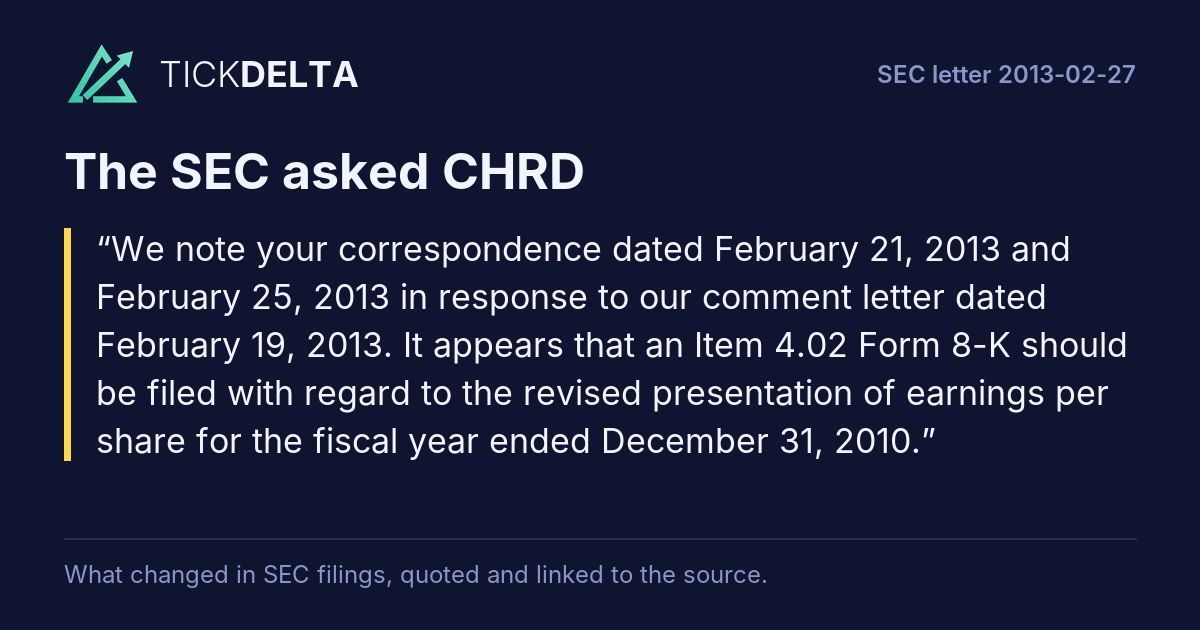
We note your correspondence dated February 21, 2013 and February 25, 2013 in response to our comment letter dated February 19, 2013. It appears that an Item 4.02 Form 8-K should be filed with regard to the revised presentation of earnings per share for the fiscal year ended December 31, 2010.
CHRD answered

No numbered answer found in the reply. Read the reply ↗

In its next report

First report after the company's reply of Mar 5, 2013: 10-Q filed May 8, 2013 ↗.

No earlier 10-Q before the SEC's letter is in Tickdelta, so there is nothing to compare with.

Also in this review: closing letter, 2013-03-05

Letters without questions

Other letters

UPLOAD and CORRESP
4 other letters: notices that a filing will not be reviewed, requests to declare a registration effective, and the like

From the SEC's correspondence on EDGAR: staff letters (form UPLOAD) and company letters (form CORRESP), 15 letters filed since 2013-02-21. Questions and answers are matched by their numbers; topics come from words in each question. The reports are compared word for word (same form, before the first SEC letter against the first report after the company's reply). No AI.

Sources

The SEC's correspondence on EDGAR: staff letters (form UPLOAD) and company letters (form CORRESP), matched question by question. No AI.

Also

Filings: the letters in the filing list.

Work with it

Excel workbook · CSV. Google Sheet that stays up to date: paste =IMPORTDATA("https://tickdelta.com/company/CHRD/export.csv") into a cell.

Next in Owners and insiders:Insider trades
Esc

Type a ticker such as AAPL, a name, an investor such as Buffett, or a topic such as tariffs. ↑ ↓ to move, Enter to open.