Form S-4
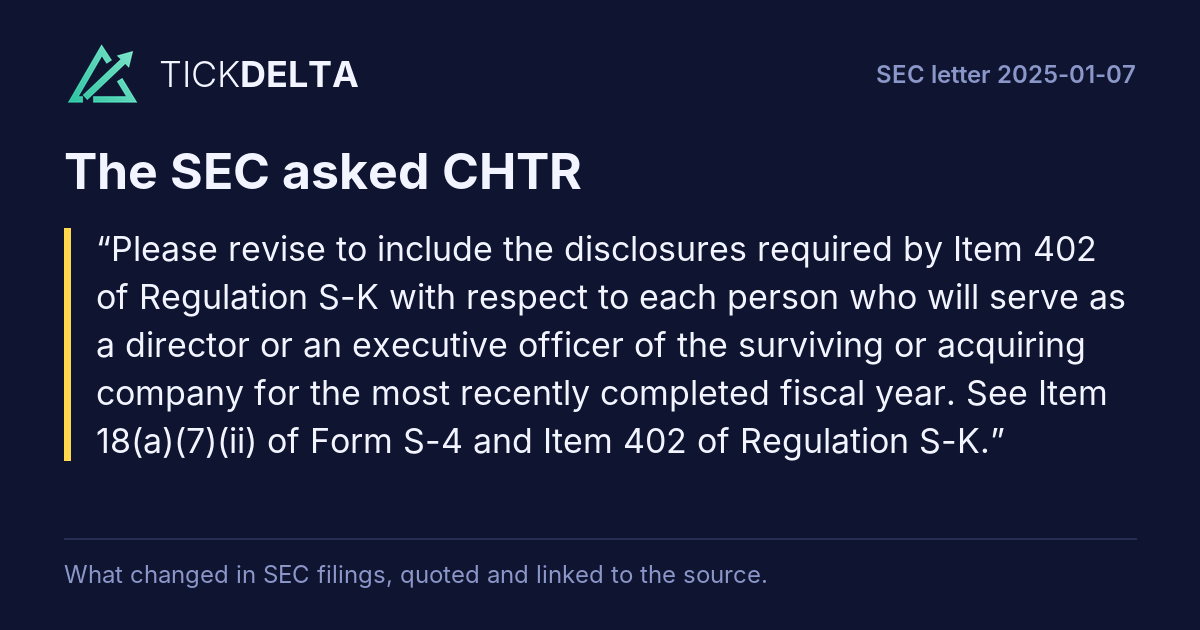
Please revise to include the disclosures required by Item 402 of Regulation S-K with respect to each person who will serve as a director or an executive officer of the surviving or acquiring company for the most recently completed fiscal year. See Item 18(a)(7)(ii) of Form S-4 and Item 402 of Regulation S-K.
We acknowledge the Staff’s comment and respectfully submit that Item 18(b) of Form S-4 provides that if the registrant or the company being acquired meets the requirements for use of
Form S-3, as do both Charter and Liberty Broadband, any information required by Item 18(a)(7) (including the information required by Item 402 of Regulation S-K) with respect to such company may be incorporated by reference to its latest annual report on Form 10-K.Read in the reply ↗Rest of the answer
As permitted by General Instruction G(3) to Form 10-K, the requested information was provided in the definitive proxy statement for each of Charter’s and Liberty Broadband’s 2024 annual meeting of stockholders, filed on March 14, 2024 and April 25, 2024, respectively. On pages 204 and 205 of Amendment No. 1, we incorporate by reference Charter’s Form 10-K for the year ended December 31, 2023, Liberty Broadband’s Form 10-K for the year ended December 31, 2023, the definitive proxy statement for the 2024 annual meeting of stockholders of Charter and the definitive proxy statement for the 2024 annual meeting of stockholders of Liberty Broadband.
We are aware of the Regulation S-K Compliance and Disclosure Interpretation 117.05, last updated November 21, 2023 (the “C&DI”). The C&DI provides that a registration statement on Form S-1 that seeks effectiveness following a registrant’s fiscal year-end and prior to the filing of the registrant’s annual report on Form 10-K for that fiscal year must include Item 402 disclosure for the last completed fiscal year. The C&DI draws a distinction between Form S-1 and Form S-3, however, and states that Form S-3 permits incorporation by reference of filed and subsequently filed Exchange Act documents and states that Securities Act Forms
Compliance and Disclosure Interpretation 123.01 addresses the situation in which a company requests effectiveness of a Form S-3 during the period between the filing of the Form 10-K and the definitive proxy statement.
A similar distinction between Form S-1 and Form S-4 also exists with respect to incorporation by reference of Exchange Act reports. As a precondition to a registrant’s ability to incorporate by reference
Exchange Act reports into a Form S-1 registration statement, General Instruction VII.C to Form S-1 requires that a registrant have filed an annual report required under Section 13(a) or Section 15(d) of the Exchange Act for its most recently completed fiscal year. Thus, by way of example only, on January 7, 2025 a registrant seeking to incorporate by reference into its Form S-1 would be expressly required to have first filed its
Form 10-K with respect to the year ended December 31, 2024. Conversely, Item 11 of Form S-4 permits a registrant meeting the requirements of Form S-3 to incorporate by reference information contained in the registrant’s latest annual report on Form 10-K filed pursuant to Section 13(a) or Section 15(d) of the Exchange Act which contains audited financial statements for the registrant’s latest fiscal year for which a Form 10-K was required to be filed. Similarly, if the company being acquired meets the requirements for use of Form S-3, Item 15 of Form S-4 permits the company being acquired to furnish the information that would be required by Items 10 and 11 if securities of such company were being registered; as such, the company being acquired (if S-3 eligible) is also permitted to incorporate by reference information contained in its latest annual report on Form 10-K filed pursuant to Section 13(a) or Section 15(d) of the Exchange Act which contains audited financial statements for its latest fiscal year for which a Form 10-K was required to be filed.
As companies that meet the requirements for use of Form S-3, each of Charter and Liberty Broadband is permitted to incorporate by reference its Form 10-K for the year ended December 31, 2023 until its
Form 10-K for the year ended December 31, 2024 is required to be filed. More specifically with respect to the Item 18(a)(7)(ii) information that you have requested, Item 18(b) states that if the registrant or the company being acquired meets the requirements for use of Form S-3, any such information may be incorporated by reference from its latest annual report on Form 10-K. Moreover, we would direct the Staff’s attention to the lead-in to Item 18(a), which provides in pertinent part “…furnish the following information, except as provided by paragraph (b) of this item” (emphasis added). The plain meaning of this lead-in is that all subsequently listed disclosure requirements in Item 18(a) are expressly qualified by paragraph (b) of such item, which as described above in turn provides that the disclosure requirements at issue here are met through incorporation by reference of the latest annual report (notably, not the “annual report for its most recently completed fiscal year”). To take a different view would render these words surplusage—effectively, during the first two to three months of a fiscal year, an S-3 eligible registrant would as a result be in the same position as a non-S-3 eligible registrant with respect to these disclosure items.
Such a result would be at odds with the basic principles underlying the integrated disclosure system which Form S-4 employs. As expressed in Securities Act Release No. 33-6578 (April 23, 1985), the adopting release for Form S-4, “[t]he integrated disclosure system, on which Form S-4 is based, proceeds from the premise that investors in the primary market need much the same information as investors in the trading market.” Thus, “the amount of prospectus presentation for management information, like company information, depends on which form could be used in a primary offering not involving a business combination.” By permitting S-3 eligible companies to satisfy the disclosure requirements of Item 18(a)(7) through incorporation by reference from their last annual report on Form 10-K, “Form S-4 reflects the premise that decisions made in the context of business combination transactions and those made otherwise in the purchase of a security in the primary or trading market are substantially similar,” at least with respect to the management information required by Item 18(a)(7). Requiring an update of the management information would have the unintended consequence of requiring selective updating of the registration statement, which we believe is inconsistent with the principles underlying the integrated disclosure system.
In our experience, the Staff’s approach with respect to this issue has been consistent with the distinction we have drawn both prior to and following the publication of the C&DI in 2010. For example, in the Staff’s review of the Form S-4 filed by Columbia Banking Systems, Inc. (“Columbia”) in connection with its acquisition of West Coast Bancorp, the Staff noted in its letter dated January 11, 2013 that “Regulation S-K requires that certain information be current as of the last completed fiscal year. Where appropriate, please update your disclosure to include the information required by Item 18(a)(7) of Form S-4 for the year ended December 31, 2012.” In its written response to the Staff on January 17, 2013, Columbia included a substantially similar response as set forth herein, and following further discussion of this comment between the Staff and Columbia, the Staff concurred with Columbia and declared the S-4 effective on February 1, 2013. The Staff also made a similar comment in its review of the Form S-4 filed by PacWest Bancorp (“PacWest”) in connection with its acquisition of First California Financial Group, Inc., to which PacWest responded along the same lines as Columbia and as included herein. The Staff declared PacWest’s S-4 effective on February 8, 2013.
In addition to the analysis of the relevant forms set forth above, which we believe draws a clear and appropriate distinction between S-3 eligible registrants filing a Form S-4, and registrants filing a
Form S-1 where the market and investors have not had the benefit of regular prior disclosure, we believe that as a practical matter substantially all large public companies with a fiscal year ending on December 31 would not be in a position to provide complete disclosure regarding compensation during this time of year. Incentive compensation decisions are often not made until late February or March. This timeline is a direct outgrowth, at least in part, of the required timeline for compensation disclosure dictated by Form 10-K, including General Instruction G(3) thereto, and additionally reflects the necessity of verifying and auditing year-end financial results which often provide the basis for incentive compensation. And, for many named executive officers of public companies, incentive compensation represents a substantial portion or a majority of total annual compensation. Compelled early disclosure for those S-3 eligible registrants who find themselves in the position of having a merger approaching closing in the opening months of the year would result in incomplete and potentially misleading information being delivered to investors in the merger proxy, which would then be confusingly superseded by a then-complete and different version of the compensation disclosure a month or two later at the time of the annual meeting proxy filing. The alternative would be to delay the effectiveness of Form S-4s that would otherwise be in a position to be declared effective generally until the annual meeting proxy disclosure is completed, which could result in substantial financial cost and transaction-related risks to such companies and their respective stockholders.