Form 10-K for the Fiscal Year Ended December 31, 2017
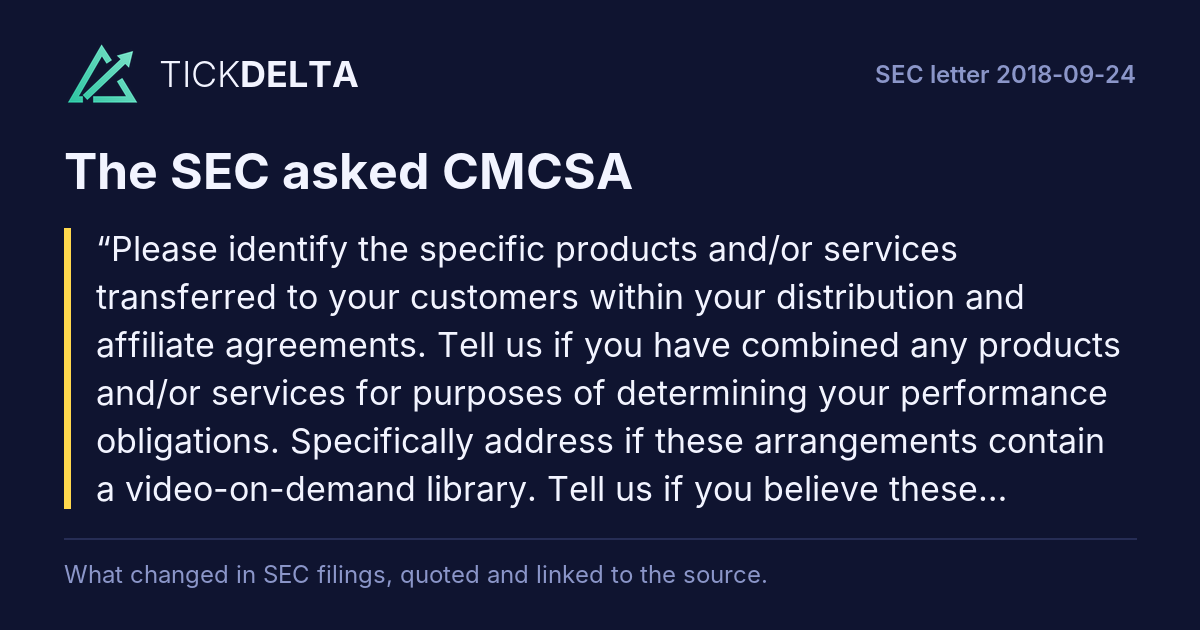
Please identify the specific products and/or services transferred to your customers within your distribution and affiliate agreements. Tell us if you have combined any products and/or services for purposes of determining your performance obligations. Specifically address if these arrangements contain a video-on-demand library.Rest of the question
Tell us if you believe these arrangements contain a functional license of intellectual property and if this is the predominant item to which royalties relate. Please also describe the judgements used in determining both the timing of satisfaction and amounts allocated to each performance obligation. Refer to ASC 606-10-50-12 and 606-10-50-17.
No reply letter found.
First report after the SEC's letter of 2018-09-24: 10-Q filed 2018-10-25 ↗, against the 10-Q filed 2018-07-26 ↗.
Tickdelta does not hold the text of both reports, so they are not compared here.
Please tell us if content licensing agreements include promises to provide content libraries. If these arrangements are material, please tell us how you considered if existing content and new content represent separate performance obligations and explain how you considered judgments in determining both amounts allocated to and the timing of satisfaction of each performance obligation.Rest of the question
Refer to ASC 606-10-50-12 and 606-10-5017.
No reply letter found.
First report after the SEC's letter of 2018-09-24: 10-Q filed 2018-10-25 ↗, against the 10-Q filed 2018-07-26 ↗.
Tickdelta does not hold the text of both reports, so they are not compared here.
For content licensing agreements that include variable pricing, you disclose that you recognize revenue as variable amounts become known. Please further clarify your statement and tell us how you consider amounts earned when there is a lag in reporting. Please refer to ASC 606-10-32-5 and 606-10-50-20.
No reply letter found.
First report after the SEC's letter of 2018-09-24: 10-Q filed 2018-10-25 ↗, against the 10-Q filed 2018-07-26 ↗.
Tickdelta does not hold the text of both reports, so they are not compared here.
Please identify the specific products and/or services transferred to your customers within your distribution and affiliate agreements. Tell us if you have combined any products and/or services for purposes of determining your performance obligations. Specifically address if these arrangements contain a video-on-demand library.Rest of the question
Tell us if you believe these arrangements contain a functional license of intellectual property and if this is the predominant item to which royalties relate. Please also describe the judgements used in determining both the timing of satisfaction and amounts allocated to each performance obligation. Refer to ASC 606-10-50-12 and 606-10-50-17.
Our Cable Networks segment generates distribution revenue from the distribution of cable network programming to traditional and virtual multichannel video providers.
Our Broadcast Television segment generates distribution revenue from the fees received under retransmission consent agreements and associated fees received from NBC-affiliated local broadcast television stations.Read in the reply ↗Rest of the answer
These arrangements with multichannel video providers and local stations (collectively the “customers” in accordance with ASC 606) are generally multiyear agreements providing for monthly fees based on contracted programming rates and the number of reported subscribers. Payment terms and conditions vary by contract type, although terms generally include payment within 30 to 60 days.
NBCUniversal distribution arrangements provide customers with rights to a 24/7 live broadcast (“linear programming”). In addition, the distribution agreements often include requirements to provide other features, including those based on certain technologies, such as DVR capabilities, certain video on demand capabilities and instant playback (collectively described as “enhanced features”). Generally, video on demand content provided relates to programming aired during the term of the distribution agreement and typically does not include broader access to NBCUniversal’s existing library or specified content.
Each promise in the contract, including the enhanced features, is assessed to identify whether there are separate performance obligations. We believe the enhanced features are significantly integrated with the linear programming in accordance with ASC 606-10-25-21, as these promises provide enhanced value to the customer and its subscribers and together form the desired output from the arrangement. Therefore, we have determined that the enhanced features should be
Securities and Exchange Commission October 9, 2018 combined with the linear programming as a single performance obligation, which is a license of functional intellectual property, in accordance with ASC 606-10-55-62, as it grants the customer a right to use the programming delivered.
As we determined that distribution arrangements are licenses of intellectual property and they generally have payment terms that vary based on the number of the customer’s subscribers during each reporting period, distribution revenue is subject to the royalty constraint in ASC 606-10-55-65 and the revenue is recognized as the customer’s sales occur and the performance obligation is satisfied. Further, as we have concluded there is one single performance obligation in our distribution arrangements, we believe the functional intellectual property would be the predominant item to which the royalty relates.
Content Licensing, page 11
(Comcast Financial Statements)
Content Licensing, page 59
(NBCUniversal Financial Statements)
Please tell us if content licensing agreements include promises to provide content libraries. If these arrangements are material, please tell us how you considered if existing content and new content represent separate performance obligations and explain how you considered judgments in determining both amounts allocated to and the timing of satisfaction of each performance obligation.Rest of the question
Refer to ASC 606-10-50-12 and 606-10-5017.
NBCUniversal does not have content licensing arrangements that provide access rights to its content library as a whole with a promise to refresh the library as new content is created. Instead, our content licensing arrangements generally include fixed pricing, span multiple years, and specify, at the onset of the agreement, individually identified content to be delivered in a defined geographic area (i.e., titles).Read in the reply ↗Rest of the answer
Revenue from these agreements is recognized when the content is delivered and available for use by the licensee.
If content has been identified but is not yet available for use by the licensee, a portion of the overall fixed consideration is allocated to the content that will be available in future license periods. In addition, these arrangements often include general terms for future content, which has yet to be produced or otherwise identified. The pricing related to these titles will often be established at a future point, such as when box office statistics are made available. We recognize revenue related to future content after the content is delivered and available for use by the licensee.
First report after the company's reply of 2018-10-09: 10-Q filed 2018-10-25 ↗, against the 10-Q filed 2018-07-26 ↗.
Tickdelta does not hold the text of both reports, so they are not compared here.
For content licensing agreements that include variable pricing, you disclose that you recognize revenue as variable amounts become known. Please further clarify your statement and tell us how you consider amounts earned when there is a lag in reporting. Please refer to ASC 606-10-32-5 and 606-10-50-20.
For our content licensing agreements that also include variable pricing, such as pricing based on the number of subscribers to a subscription video on demand service sold by our customers, revenue is subject to the royalty constraint in ASC 606-10-55-65 and is generally recognized when the licensee’s sales occur. The licensee generally provides their sales information to us on a monthly or quarterly basis, and sometimes with a lag in reporting. When subscriber data is reported on a lag, we estimate the revenue until actual subscriber data is received.Read in the reply ↗Rest of the answer
Estimated amounts are not material for any period presented.
In consideration of the Staff’s comment, beginning with our Quarterly Report on Form 10-Q for the quarter ending September 30, 2018, we plan to revise our disclosure as follows (edits to previous disclosure are indicated by underline and strike-through):
Content Licensing
Our
Cable Networks, Broadcast Television and Filmed Entertainment segments generate revenue from the licensing of our owned film and television content in the United States and internationally to cable, broadcast and premium networks and subscription video on demand services. Our content licensing agreements generally include fixed pricing and span multiple years. For example, following a film’s theatrical release, our Filmed Entertainment segment may license the exhibition rights of a film to different customers over multiple successive distribution windows.
We recognize revenue when the content is delivered and available for use by the licensee. When the term of an existing agreement is renewed or extended, we recognize revenue at the later of when the content is available or when the renewal or extension period begins. Payment terms and conditions vary by contract type, although payments are generally collected over the license term. The amount of future revenue to be earned related to fixed pricing under existing agreements primarily relates to our Filmed Entertainment segment, which at any given time equals approximately 1 to 2 years of our annual Filmed Entertainment content licensing revenue.
The substantial majority of this revenue will be recognized within 2 years. This amount may fluctuate from period to period depending on the timing of the release and the availability of content under existing agreements and may not represent the total content licensing revenue expected to be recognized as it does not include revenue from future agreements or from variable pricing or optional purchases under existing agreements.
For our content licensing agreements that also include variable pricing, such as pricing based on the number of subscribers to a subscription video on demand service sold by our customers, we generally recognize revenue as our customers sell to their subscribers for variable pricing as the content is delivered and available and as the variable amounts become known.
First report after the company's reply of 2018-10-09: 10-Q filed 2018-10-25 ↗, against the 10-Q filed 2018-07-26 ↗.
Tickdelta does not hold the text of both reports, so they are not compared here.
We note your response to prior comment 1. Please revise your disclosures in future filings to clarify that you consider your distribution agreements to be functional licenses of intellectual property. Please refer to ASC 606-10-50-12.
No reply letter found.
First report after the SEC's letter of 2018-11-05: 10-K filed 2019-01-31 ↗.
No earlier 10-K before the SEC's letter is in Tickdelta, so there is nothing to compare with.
We note your response to prior comment 1. Please revise your disclosures in future filings to clarify that you consider your distribution agreements to be functional licenses of intellectual property. Please refer to ASC 606-10-50-12.
In consideration of the Staff’s comment, beginning with our Annual Report on Form 10-K for the year ending December 31, 2018, we will revise our disclosure to state that we account for our distribution agreements as functional licenses of intellectual property. Read in the reply ↗
Also in this review: closing letter, 2018-11-15