tickdelta
Sign in

Tickdelta is free for now. Sign up and get Pro free

← Screener

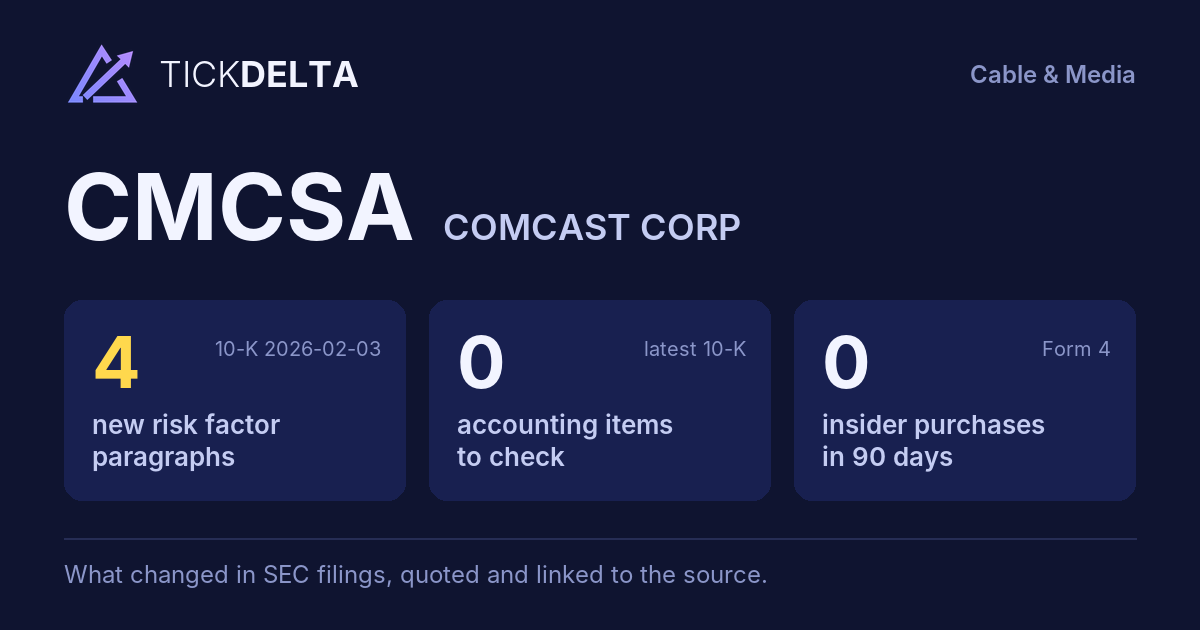
CMCSAComcast

Communication · Cable & Media · Nasdaq, NYSE

We are a global media and technology company that reaches customers, viewers and guests worldwide through the connectivity and platforms services we provide and the content and experiences we create. 10-K, Item 1

Employees
179,000
Headquarters
Philadelphia, PA
CEO
Brian L. Roberts
Next results
around Jan 28, 2027
Compare with peers → Embed

When the SEC's staff reviews a filing, it writes to the company with numbered questions, and the company answers each one in a letter. SEC publishes the exchange once the review is over, at least 20 business days later. Below: what the staff asked CMCSA, and the company's answer to each question, quoted from the letters. A question is not an accusation; most reviews end with the company adding detail to its next filing.

Schedule 14A

2022-09-02 to 2022-10-18 · 3 questions · 1 letter from the SEC, 1 from the company
Review closed 2022-10-18
Controls
Definitive Proxy Statement on Schedule 14A filed April 22, 2022 · General
SEC asked (1)
Please expand your discussion of the reasons you believe that your leadership structure is appropriate, addressing your specific characteristics or circumstances. In your discussion, please also address how the experience of the Lead Independent Director is brought to bear in connection with your board’s role in risk oversight.
CMCSA answered
Comcast Corporation (the “Company,” or “we,” “our” or “us”) acknowledges receipt of the comment letter of the Staff of the U.S. Securities and Exchange Commission (the “Staff”) dated September 2, 2022 relating to the Company’s Definitive Proxy Statement on Schedule 14A filed April 22, 2022. We confirm that we will enhance our future proxy disclosures in accordance with the topics discussed in the Staff’s comment letter, to the extent applicable. One letter for all the questions, without numbered answers. Read the reply ↗
Definitive Proxy Statement on Schedule 14A filed April 22, 2022 · General
SEC asked (2)
Please expand upon the role that your Lead Independent Director plays in the leadership of the board. For example, please enhance your disclosure to address whether or not your Lead Independent Director may: • represent the board in communications with shareholders and other stakeholders; • require board consideration of, and/or override your CEO on, any risk matters; or • provide input on design of the board itself.
CMCSA answered

See the reply above.

Definitive Proxy Statement on Schedule 14A filed April 22, 2022 · General
SEC asked (3)
Please expand upon how your board administers its risk oversight function. For example, please disclose: • why your board elected to retain direct oversight responsibility for core enterprise risks, rather than assign oversight to a board committee; • the timeframe over which you evaluate risks (e.g., short-term, intermediate-term, or long-term) and how you apply different oversight standards based upon the
Rest of the question

immediacy of the risk assessed; • whether you consult with outside advisors and experts to anticipate future threats and trends, and how often you re-assess your risk environment; • how the board interacts with management to address existing risks and identify significant emerging risks; • to whom your Chief Compliance Officer reports; and • how your risk oversight process aligns with your disclosure controls and procedures.

CMCSA answered

See the reply above.
Also in this review: closing letter, 2022-10-18
Form 10-K

2021-09-14 to 2022-02-07 · 13 questions · 3 letters from the SEC, 3 from the company
Review closed 2022-02-07
ClimateResults discussion (MD&A)
SEC asked (1)
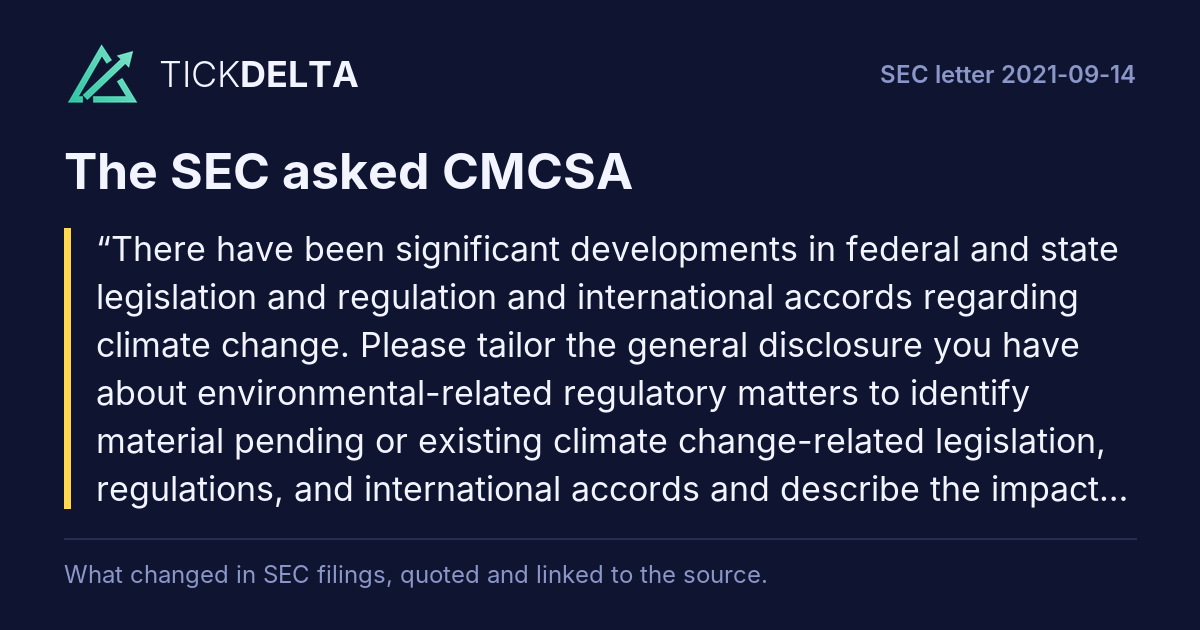
There have been significant developments in federal and state legislation and regulation and international accords regarding climate change. Please tailor the general disclosure you have about environmental-related regulatory matters to identify material pending or existing climate change-related legislation, regulations, and international accords and describe the impact to your business, financial condition, and
Rest of the question

results of operations.

CMCSA answered
The Company understands that climate-related issues are generally of interest and concern to a broad range of our stakeholders, including our customers, employees, suppliers, the communities in which we operate and investors. It is within this vein that the Company in May 2021 set a goal to be carbon neutral for its Scope 1 and Scope 2 emissions by 2035 and has begun providing more information to all stakeholders regarding the Company’s climate-related initiatives.
Rest of the answer

Information that is of general interest to a broad range of our stakeholders, however, is distinguishable from information that is material to an investor’s understanding of our business or otherwise is required to be disclosed in our SEC filings, including the Form

10-K. The Company’s Form 10-K includes the legally required information that is material to an understanding of the Company’s business and otherwise is responsive to the Form 10-K disclosure requirements.

Our responses in this letter should be understood in the context of our current carbon footprint. In 2020, based on our reporting methodology and consistent with the World Resource Institute and World Business Council for Sustainable Development Greenhouse Gas Protocol’s Corporate Accounting and Reporting Standard – Revised Edition (the “GHG Protocol”), 75% of our Scope

1 and Scope 2 greenhouse gas emissions was from purchased electricity powering our global operations, including our facilities, cable and broadband distribution network and data centers, and theme parks. 16% of those Scope 1 and 2 emissions was from our owned and operated vehicle fleet. Given the significant impact of electricity on our overall carbon footprint, we expect that, based on reasonable estimates and information available today, we will effectively be able to meet our carbon neutrality goal over the next fourteen years primarily by sourcing more renewable electricity and improving energy efficiency across our operations. At present, we do not expect that the financial impact of attaining this long-term carbon neutral goal for Scope 1 and Scope 2 emissions would have a material impact on our business, results of operations or financial condition.

In addition, we currently are working to better understand our Scope 3 emissions inventory, using a number of the possible calculation methodologies for the fifteen

Scope 3 categories under the GHG Protocol to establish the extent of, and set boundaries for, our upstream and downstream Scope 3 emissions, with a view to begin work in 2022 to establish science-based targets. As we expect you are aware, the identification of, and boundaries and allocation of responsibility for, Scope 3 emissions are significantly more complex than established Scope 1 and 2 emissions reporting methodologies. We will continue to evaluate whether any future carbon-related goals would have a material impact on our business, results of operations and financial condition as U.S. and international regulatory frameworks and laws evolve.

With respect to the regulatory matters disclosures set forth in the Form 10-K, while all of our businesses are subject to various laws and regulations in the ordinary course, the structure and emphasis of our disclosures proportionately reflects the level of actual and potential business impact of the relevant regulatory consideration discussed. Our cable communications and broadcast television businesses, in particular, are subject to communications-related laws and regulations that affect the core of our business model and could have material impacts on our business. The impact or potential impact to our business, results of operations and financial condition of these laws and regulations are set forth on pages 14-18 of the Form 10-K. The “Legislation and Regulation” section of the Form 10-K concludes with a section called, “Other Areas of Regulation,” that refers to laws and regulations generally applicable to our Company, as well as to many other companies, including environmental-related matters. While many jurisdictions where we operate have current or pending climate-related laws and regulations, such as vehicle emission standards, new electric purchase mandates, energy efficient building codes and carbon tax surcharges based on carbon emissions, compliance costs with respect to such laws and regulations are not, and have not been, material to our business, results of operations or financial condition. As such, we believe that there are no material pending or existing climate-related legislation, regulations and international accords that are required to be further described in the Form 10-K.

Notwithstanding the foregoing, the Company will continue to evaluate whether inclusion of any specific material pending or existing climate change-related legislation, regulations and international accords may be warranted in future filings.

Read in the reply ↗
SEC asked (2)
To the extent material, discuss the indirect consequences of climate-related regulation or business trends, such as the following: • decreased demand for goods or services that produce significant greenhouse gas emissions or are related to carbon-based energy sources, including energy use across your network, production studios and theme parks; • increased demand for goods or services that result in lower emissions
Rest of the question

than competing products or services; • increased competition to develop innovative new products or services that result in lower emissions; and • any anticipated reputational risks resulting from operations, products, or services that produce material greenhouse gas emissions.

CMCSA answered
As of the date hereof and at the time of the Form 10-K filing, we have not experienced material indirect consequences of climate-related regulation or business trends, such as decreased or increased demand or competition for, or reputational risks resulting from, our goods or services due to their level of greenhouse gas emissions or use of carbon-based energy sources. Nor do we believe that any such trends are reasonably likely to have a material impact on our business, results of operations or financial condition in the foreseeable future.
Rest of the answer

However, were any such trends to materialize, the Company recognizes its obligation to include in future periodic reports disclosures consistent with the requirements of Regulation S-K.

Read in the reply ↗
SEC asked (3)
You disclose that severe weather events such as hurricanes and wildfires have impacted your products, services and properties, and could lead to large expenditures. In addition, your CSR report outlines projects and initiatives you will undertake to meet your goal of becoming carbon neutral by 2035.
Rest of the question

Please revise your disclosure to identify any material past and/or future capital expenditures for climate-related projects. If material, please quantify these expenditures. In addition, discuss the significant physical effects of climate change on your operations and results, if material. This disclosure may include the following: • severity of weather from climate change, such as floods, hurricanes, sea levels, wildfires, and water availability and quality; • quantification of material weather-related damages to your property or operations; • potential for indirect weather-related impacts that have affected or may affect your major customers or suppliers; and • any weather-related impacts on the cost or availability of insurance.

CMCSA answered
Severe weather events such as hurricanes and floods have impacted our business and operations in various parts of the United States and internationally for many years.

In response to severe weather events and other nonweather-related crises, over the years we have established business continuity disaster and recovery programs so our network and operations can continue to operate reliably and efficiently.
Rest of the answer

For example, in our Cable Communications segment, as a provider of communication services, we have sought to build resiliency into our operations by continually strengthening our distribution network against hazards, incorporating key redundancies to expedite recovery capabilities and leveraging our broad geographic footprint and technical expertise to create mutually supportive layers of response capabilities. While these capabilities may help mitigate the extent of the impact of severe weather events on our operations, some weather-related events nonetheless have impacted our operations by requiring us to repair or replace plant and equipment, incurring capital and labor costs to do so, and in some cases, issuing customer credits for service interruptions or temporarily closing operations such as our theme parks. The business impact and financial costs of these severe weather mitigation efforts, without regard to the availability of insurance, have not materially affected our business, results of operations or financial condition to date. The Company, however, undertakes to disclose the impacts of such events to the extent material in the future, consistent with the requirements of Regulation S-K.

Capital expenditures related directly to our climate-related projects and compliance with climate-related laws (as described more fully in response to Questions 1, 4 and 5) have not, to date, been a material component of our capital expenditures. Page 59 of the Form 10-K identifies and quantifies the categories of capital expenditures that are material and responsive to the Form 10-K disclosure requirements. While certain initiatives within these categories, such as network virtualization efforts that are reflected in the reported $2.3 billion of scalable infrastructure capital expenditures, may indirectly yield climate-related benefits, the direct purpose of these virtualization efforts is the more efficient management of the growth of our cable and broadband distribution network. Likewise, in our NBCUniversal segment, while the development of new theme parks reflects environmentally-sustainable designs, the core capital costs directly relate to the overall commercial development of the parks and their attractions. To the extent the Company has any material capital expenditure plans in the future that are directly attributable to climate-related projects, we undertake to disclose such expenditures consistent with the requirements of Item 303 of Regulation S-K.

Read in the reply ↗
SEC asked (4)
Disclose the material effects of transition risks related to climate change that may affect your business, financial condition, and results of operations, such as policy and regulatory changes that could impose operational and compliance burdens, market trends that may alter business opportunities, credit risks, or technological changes.
Rest of the question

In this regard, we note disclosure in your CSR report about your goal to become carbon neutral by 2035 and steps you plan to take to meet that goal.

CMCSA answered
As described in more detail in response to Question 1 above, in May 2021, we announced our goal to become carbon neutral for our Scope 1 and Scope 2 emissions by 2035. At present, we primarily plan to source more renewable and clean energy and improve energy efficiency over this fourteen-year period to achieve our goal. We recognize that supply and demand trends for fossil fuel and non-carbon power sources may lead to higher energy costs as companies transition their energy and emissions footprint to consuming renewable electricity and to purchasing carbon credits.
Rest of the answer

Based on our analysis to date, however, while such transition will by necessity result in the incurrence of additional costs such as the incremental cost of green energy, we do not anticipate that these costs will be material to our results of operations or financial condition. Please also see our response to Question 5 below with respect to compliance costs.

Further, as stated in the Company’s response to Question

3, to the extent the Company has any material standalone climate-related capital expenditure plans in the future, it undertakes to disclose such expenditures consistent with the requirements of Item 303 of Regulation S-K. We do not otherwise anticipate that any material business opportunities, credit risks or technological changes would arise from our carbon neutral goal, although we will continue to evaluate that judgment as policy and regulatory changes and market trends evolve.

Read in the reply ↗
SEC asked (5)
Quantify any material increased compliance costs related to climate change.
CMCSA answered
Although annual compliance costs related to climate change have increased and are expected to increase in future years with additional regulation in the United States and internationally, the compliance cost increase has, to date, not been material to the Company. As new laws and regulations become effective, the Company will assess the materiality of their impact and whether such impact would require disclosure under SEC rules and regulations.

* * *

In connection with our response to the Staff’s comments, we acknowledge that the Company and its management are responsible for the accuracy
Rest of the answer

and adequacy of its disclosures, notwithstanding any review, comments, action or absence of action by the Staff.

Read in the reply ↗
General
SEC asked (1)
Your response to prior comment 1 refers to current or pending climate-related laws and regulations in the jurisdictions where you operate. Explain in greater detail how you determined whether these laws and regulations are reasonably likely to have a material effect on you.
Rest of the question

Also, tell us how you considered providing disclosure regarding the difficulties involved in assessing the timing and effect of pending climate-related laws or regulations.

CMCSA answered
As noted in the Prior Response

Letter, while certain jurisdictions where we operate have current or pending climate-related laws and regulations, such as vehicle emission standards, new electric vehicle mandates, building energy codes that impose efficiency mandates and carbon taxes, we have determined, applying our Disclosure Approach, that no material climate-related laws or regulations were required to be described in the Form 10-K.

More generally, in considering our disclosure obligations in respect of laws and regulations applicable to our businesses, whether identified as
Rest of the answer

climate-related or otherwise, we are cognizant of the guidance provided by the Commission in its “Modernization of Regulation S-K Items 101, 103, and 105” that Item 101(c) reflects a “principles-based approach” designed to allow a registrant to disclose “only those governmental regulations that are of particular importance to it.”iv

(emphasis added.) The Company similarly considers the disclosure requirements of other provisions of Regulation S-K that may be implicated by the laws and regulations to which the Company is subject, such as other provisions of Item 101 and Items 103,

303 and 503(c), among others.

These considerations involve, among other things:

actual or reasonably foreseeable potential impact of current laws or regulations on our business, including demand for our products and services, the actual and reasonably foreseeable impact on our ability to provide products and services, the competitive landscape of our businesses and consumer behavior and preferences;

actual or reasonably foreseeable potential costs to comply with current laws or regulations, including actual or reasonably foreseeable capital expenditures and costs that might impact our ability to continue to provide our products and services; and

· with respect to laws or regulations that have been proposed but not enacted or adopted, the likelihood that the proposal will be enacted as proposed and the reasonably foreseeable potential impacts and costs to our business if so enacted or adopted.

In determining whether laws and regulations are reasonably likely to have a material effect on us, we consider, in short, whether there is a substantial likelihood that a reasonable investor would consider information concerning any particular law or regulation important in deciding how to vote or make an investment decision, or, put another way, if providing (or not providing) information on such law or regulation would significantly alter the total mix of information made available.

As a result, the Form 10-K contains extensive disclosure about current and pending communications-related laws and regulations, which are of particular importance to us given the nature of the services we offer. We believe that these laws and regulations, and any changes thereto, could have material impacts on our core businesses – namely, our communications services such as broadband internet and video services and our broadcast media businesses – and could have disproportionate impacts on our operations as compared to certain of our competitors. In contrast, given the nature of the industries in which we operate, we believe that specific severe weather impact-related or climate-related laws and regulations, including the following examples, have not had, and we expect are not reasonably likely to have, material adverse effects on our company for the foreseeable future, given their financial or other impact. For example:

· The

California Public Utility Commission requires certain providers of wireline services to maintain backup power at facilities in high wildfire risk areas. Although these regulations encourage the use of green energy backup facilities, they do permit the use of brown energy backup facilities. We estimate that compliance with the California Public Utility Commission’s backup power requirement will require an average of approximately $44 million in annual capital expenditures over three years beginning in 2021. For context, this annualized amount represents approximately 0.5% of our capital expenditures of $9.2 billion in 2020.

· Internationally, we pay carbon taxes based on certain gas and electricity usage and diesel tank storage in certain jurisdictions. By way of example, our largest international operations are conducted through our Sky business in Europe, which has been carbon neutral since 2006. As such, Sky paid approximately £1 million of carbon taxes in 2020. For context, this amount represents less than 0.01% of our other operating and administrative costs and expenses of $33.1 billion in 2020.

States of Washington and California will require that all cars sold or purchased in those states be electric by model year 2030 or 2035, respectively, and the State of New York will ban the sale of fossil fuel vehicles starting in 2035. Similar mandates exist in certain other international jurisdictions, including in Europe. Our vehicle needs are currently met through both ownedand leased-fleets. For owned-fleets, we expect that the incremental costs of purchasing electric vehicles in place of traditional vehicles in these states will be managed in the normal course of our vehicle replacement programs through our annual budgeting and long-range financial planning processes. For our leased-fleets, we expect that the providers through which we lease vehicles will make electric vehicles available to us once they become more broadly available and that any incremental costs associated with leasing such vehicles will similarly be managed through our annual budgeting and long-range financial planning processes.

· Other jurisdictions where we operate have current or pending building codes requiring certain energy efficiency standards. Costs to comply with these regulations are integrated within our ordinary course property maintenance activities, are not separately broken out and are incorporated into local business unit budgets and long-range financial planning processes in the normal course of business.

Regarding the Staff’s question about disclosures regarding the difficulties involved in assessing the timing and effect of pending climate-related laws or regulations, we acknowledge that there is a significant amount of inherent uncertainty in legislative and administrative rulemaking processes.

To that end, consistent with the approach set forth in the Climate Guidance, for pending climate-related laws and regulations that we are unable to determine are not reasonably likely to be enacted in all material respects as proposed, we assume such law or regulation would be enacted. We then consider whether any such laws and regulations are reasonably likely to have a material effect on our business, results of operations or financial condition. In this regard, we were and remain conscious of our general obligation, in the context of our MD&A disclosure, to describe any “known material trends and uncertainties.”v

As a result of the considerations as outlined above, we have determined that there is not a substantial likelihood that a reasonable investor would consider information concerning any particular current or pending severe weather impact-related or climate-related law or regulation, individually or in the aggregate, important in deciding how to vote or make an investment decision.

Finally, as we noted in the

Prior Response Letter, the Company will continue to evaluate whether inclusion of material information in respect of pending or existing severe weather impact-related or climate-related laws and regulations may be required in future filings with the Commission in accordance with Commission rules and regulations then in effect.

Read in the reply ↗
General
SEC asked (2)
Your response to prior comment 2 states that you have not experienced material indirect consequences of climate-related regulation or business trends and that you do not believe any such trends are reasonably likely to have a material impact on your business, results of operations or financial condition.
Rest of the question

Please describe the indirect consequences you considered in your analysis and explain how you concluded they were not material.

CMCSA answered
As we noted in the Prior

Response Letter, we have not experienced material indirect consequences of climate-related regulation or business trends. As described in greater detail below, indirect consequences that we have considered in our analysis include whether we have experienced decreased demand or increased competition for, or reputational risks resulting from, our products or services due to their level of greenhouse gas emissions or use of carbon-based energy sources, including energy consumption by our customers to use our products and services.

Further, we do not expect that any
Rest of the answer

such trends

(should they materialize) are reasonably likely to have a material impact on our business, results of operations or financial condition in the foreseeable future. However, were any such material trends to materialize, the Company recognizes our obligation to make any required disclosure.

Specifically, the indirect consequences of climate-related regulation or business trends we have considered in our analysis include the following.

· We primarily provide communications services, such as broadband, video, phone and wireless phone services, create and distribute media and entertainment programming and operate theme parks.

Competition for our businesses in general depends on pricing, quality and reliability of our services, quality of our programming and our theme park experiences. We believe that reasonably foreseeable indirect consequences of climate-related regulation or business trends for our business therefore would primarily include consideration as to whether we have lost, or acquired, customers as a result of our carbon emissions, either in isolation or as compared to the carbon emissions of our competitors and any potential associated reputational risks.

As disclosed in the Form 10-K, we continue to add customer relationships in our Cable Communications and Sky businesses consistent with prior year trends, including growing our broadband services customers, and NBCUniversal’s businesses continue to compete effectively in the ordinary course of business against other media and theme park businesses. Therefore, we do not believe that the number of broadband services customers or attendance at our theme parks has been impacted, positively or negatively, by our carbon footprint. Moreover, we have for many years collaborated with other companies in our industry and suppliers to reduce the energy consumption of devices such as set-top boxes for cable services in customer homes such that we expect competition for customers in the communications industry is unlikely to be impacted by the amount of energy required for such devices.

· As previously noted, we set a goal in May 2021 to be carbon neutral across our Scope 1 and 2 emissions by 2035 and have begun long-range planning to help us achieve that goal. In assessing potential reputational risks to our business, we considered that goal and the steps we have taken and expect to continue to take as we further refine our goals and plans, as science and technology further evolve, and as practices emerge to better adapt to climate change risks over time.

Read in the reply ↗
General
SEC asked (3)
Your response to prior comment 3 states that severe weather events have impacted your business and operations for many years and discusses some severe weather mitigation efforts; however, it does not appear to discuss the significant physical effects of climate change, such as effects on the severity of weather, on your operations and results.
Rest of the question

Accordingly, please revise to discuss the physical effects of climate change on your operations and results or explain in greater detail how you concluded that such effects have been, and are expected to continue to be, immaterial to your operations and results. In order to help us assess your response, please provide a quantification of material weather-related damages to your property or operations, a discussion of how weatherrelated impacts have affected or may affect your customers and suppliers and a discussion of any weather-related impacts on the cost or availability of insurance.

CMCSA answered
Response Letter, we have experienced severe weather events, such as hurricanes and floods, that have impacted our business and operations in various parts of the United States and internationally, and we have incurred costs in connection with related mitigation efforts.

Although, as described in greater detail below, the impact of such events and mitigation efforts have not been material to date, the Company will continue to monitor the impact of severe weather events to evaluate whether inclusion of material information relating to such events may be required in future filings with the
Rest of the answer

Commission.

question to discuss the physical effects of climate change on our operations and results or to explain how we concluded such effects have been, and are expected to continue to be, immaterial to our operations and results, we note that in the Climate Guidance, the Commission stated that “[s]ignificant physical effects of climate change …[include] effects on the severity of weather (for example, floods or hurricanes), sea levels, the arability of farmland, and water availability and quality.”vi

Consistent with our Disclosure

Approach, we consider whether there is a substantial likelihood that a reasonable investor would consider information concerning the severity of physical effects of climate change on our business important in deciding how to vote or make an investment decision, or, put another way, if providing (or not providing) information on such effects would significantly alter the total mix of information made available. We also consider, similar to our response to Comment 1, the actual and reasonably foreseeable potential impact of the severity of weather events on our results of operations and financial condition.

By way of example, when considering whether disclosure of the impact of the physical effects of climate change is required under Item 303 of Regulation S-K, the Company considers whether the physical effects of weather-related events (such as floods, hurricanes and wildfires, rising sea levels and the availability and quality of water) constitute a known trend or uncertainty that is reasonably likely to have a material impact on the

Company’s operating results and material cash requirements. As part of this analysis, we consider the impact on our operating results of severe weather events, as well as the reasonably foreseeable likelihood that the severity of weather-related events and any such weather-related costs could increase in the foreseeable future, the potential magnitude of such increase and related capital expenditures, and weather-related impacts on the cost or availability of insurance.

Based on these considerations, including the associated costs described below, we have determined that the actual impact of severe weather events has not been, and we expect is not reasonably likely to be, material to our results of operations or financial condition. For completeness, the Company also notes that we do not consider the other significant physical effects of climate change identified by the Climate Guidance, i.e., sea levels, the arability of farmland, and water availability and quality, to be material to the Company currently or in the reasonably foreseeable future.vii

Notwithstanding the foregoing, in the “Risk Factors” section of the Form 10-K, the Company has noted that, to the extent it experiences material weather-related damages in the future, such damages could result in a variety of adverse consequences for our business. Specifically, we disclosed that

“severe weather events such as hurricanes and wild fires have impacted our services, products and properties from time to time in the past and will in the future” and that such events “may result in large expenditures to repair or replace the damaged properties, products, services, networks or information systems to protect them from similar events in the future, and any such events could lead to litigation or otherwise have an adverse effect on our results of operations.”

The Staff also requested that we provide a quantification of material weather-related damages to our property or operations, discuss how weather-related impacts have affected or may affect our customers and suppliers and discuss weather-related impacts on the cost or availability of insurance.

For the three years ended

December 31, 2020, hurricanes and wildfires in California impacted our Cable Communications segment as follows: (i) capital expenditures of $1 million, $51 million and $82 million in 2020, 2019 and 2018, respectively; (ii) operating costs and expenses of $5 million and

$13 million in 2020 and 2018, respectively; and (iii) $17 million of customer credits issued for service outages in 2018. For reference, in each of these years, these amounts, not including insurance reimbursements received, represented 1% or less of the corresponding Cable

Communications segment capital expenditures, operating costs and expenses and revenue for such year. Impacts to our customers of such events typically include loss of service until we are able to restore service. We are not aware of material impacts to our suppliers’ ability to provide goods or services to us as a result of severe weather, although certain utility providers have and we expect will continue to migrate some of their electric lines, to which we attach devices to provide our cable services, from poles above ground to underground. We do incur costs in that instance, and expect to spend an average of $9 million in annual capital expenditures in each of 2021 to 2025 as a result of moving such pole attachments underground.

Although severe weather events have had a more tangible direct impact on our Cable Communications segment, these types of events also impacted the NBCUniversal segments during the three years ended December 31, 2020. In 2018, multiple severe weather events, including earthquakes and typhoons, occurred in Japan that resulted in our theme park closing for periods of time primarily due to public infrastructure challenges that had negatively impacted the ability to travel to the park. The estimated impact to Theme Parks segment Adjusted EBITDA was approximately $85 million, comprised of estimated lost revenue opportunity, offset by the benefit of lower variable costs, from the park’s temporary closure.

Similarly, severe weather events in 2019, including a hurricane in Florida, had an estimated impact to Theme Parks segment Adjusted EBITDA of approximately $30 million, also comprised of estimated lost revenue and lower variable costs from the park’s temporary closure.

These events, during the three years ended December 31, 2020, resulted in an aggregate of approximately $3 million of capital expenditures.

For completeness, we note that severe weather events have not had negative impacts on our Sky segment during the three years ended December

31, 2020.

While availability of insurance coverage for fire-related events in wildfire-prone geographies has been significantly reduced, we have not experienced meaningful constraints in insurance coverage for other types of severe weather-related events. For reference, in 2020, 2019 and 2018, we received approximately

$112 million of aggregate insurance reimbursements in respect of prior severe weather events.

Notwithstanding the determinations outlined above that severe weather events have not had a material adverse effect on the Company’s results of operations or financial condition, the Company has in the past disclosed the impact of severe weather-related events when it has determined such disclosure otherwise may be useful in evaluating the comparability of operating results. For example, the Company has in the past disclosed:

· On page 42 of the Company’s Form 10-Q for the Quarter Ended September 30, 2018 that: “Theme

Parks revenue decreased for the three months ended September 30, 2018 compared to the same period in 2017 primarily as a result of lower attendance driven by inclement weather conditions and natural disasters in Japan” and “Operating costs and expenses increased for the three and nine months ended September 30, 2018 compared to the same periods in 2017 primarily due to higher operating costs related to newer rides and attractions, and for Volcano BayTM in Orlando, which was partially offset by the impact of inclement weather conditions and natural disasters in Japan.” In that quarter, Theme Parks segment revenue and operating costs and expenses were $1.5 billion and $0.8 billion, respectively; the estimated impact to Theme Parks segment Adjusted

EBITDA is addressed above.

page 32 of the Company’s Form 10-Q for the Quarter Ended September 30, 2017 that: “Adjusted

EBITDA [for our Cable Communications segment] was negatively impacted by two hurricanes that affected our service areas in the third quarter of 2017.” In that period, the impact to Cable Communications segment Adjusted EBITDA, which had totaled $5.2 billion, was approximately

$37 million, comprised of customer credits for service outages issued and increased operating costs and expenses.

To the extent the Company experiences material impacts to its results of operations or financial condition from severe weather events in the future, we undertake to disclose such events consistent with the requirements of Item 303 of Regulation S-K and our Disclosure Approach generally.

Read in the reply ↗
General
SEC asked (4)
We note from your response to prior comment 3 that capital expenditures for your climate-related projects have not, to date, been a material component of your capital expenditures. Please provide us with additional detail supporting this statement, including quantitative information.
CMCSA answered
Pursuant to Item 303(b)(1)(ii) of Regulation S-K,viii Form 10-K requires disclosure of the

Company’s material cash requirements, including commitments for capital expenditures, and any known material trends. In addition,

Item 101(c)(2)(i)ix requires disclosure of the material effects that compliance with government regulations may have on, among other things, capital expenditures.

In addition to the specific requirements set forth above, consistent with our Disclosure Approach, we consider whether there is a substantial likelihood that a reasonable investor would consider information
Rest of the answer

concerning capital expenditures for climate-related projects important in deciding how to vote or make an investment decision, or, put another way, if providing (or not providing) such information would significantly alter the total mix of information made available.

Capital projects involve complex business decisions that often are supported by multiple rationales. As reflected in the Prior Response Letter, capital costs for most projects are driven by a largely commercial rationale but may produce an ancillary climate benefit, such as network virtualization efforts that expand the capacity of our broadband network or construction of a new building that incorporates sustainable design. Such capital expenditures are fully integrated into overall project costs. However, in addition to the foregoing, we have had specific climate-related projects, such as solar panel installations or electric trams, that are separately identifiable and tracked as stand-alone climate-related projects, beyond the expenditures resulting from severe weather events as noted in our response to Comment 3. For the three years ended

December 31, 2020, our average annual capital expenditures on such separately identifiable climate-related projects were approximately

$5 million. In the context of our capital expenditures of $9.2 billion, $10.0 billion and $9.8 billion for 2020, 2019 and 2018, respectively, these amounts were not material to the Company, representing less than 0.1% of each year’s total capital expenditures.

has material capital expenditure plans in the future that are not otherwise integrated into the overall project costs and are directly attributable to climate-related projects similar to those outlined above, we undertake to disclose such expenditures consistent with the requirements of Item 303 of Regulation S-K and our Disclosure Approach generally.

Read in the reply ↗
General
SEC asked (5)
Your response to prior comment 4 appears to focus on your transition to carbon neutrality by 2035 and concludes that you do not anticipate costs connected to this goal to be material to your results of operations or financial condition.
Rest of the question

Please tell us more about how you considered providing disclosure quantifying the estimated costs of achieving your carbon neutral goal and explain how you analyzed the materiality of these costs. Lastly, please tell us about transition risks related to climate change separate from those arising from your carbon neutral goal and explain how you considered providing disclosure regarding their possible effects.

CMCSA answered
Letter, based on our analysis to date, while our transition to carbon neutrality will by necessity result in the incurrence of additional costs such as the incremental cost of green energy, applying our Disclosure Approach, we have concluded that we do not anticipate that these costs would be material to our results of operations or financial condition.

With respect to the quantification of the estimated costs of achieving our carbon neutral goal, we first assessed, among other things, the extent of and components comprising our carbon footprint for both Scope 1 and Scope 2 greenhouse gas
Rest of the answer

emissions. For reference, in 2020, electricity for our businesses represented approximately 75% of our Scope 1 and 2 emissions. We then applied an estimate based on current and projected premium costs for green energy, coupled with purchasing carbon offsets, to estimate the incremental costs to transition over the next fourteen years to renewable electricity and meet our carbon neutral goal. Based on that estimate, we would expect to incur between $40 million to $75 million of incremental costs per year in order to reach our goal. For reference, our total electricity costs represented less than 1% of our total costs and expenses of $86.1 billion in 2020, and the high-end estimate of an incremental $75 million of annual costs represents less than 0.1% of such total costs and expenses.

Beyond electricity costs, our vehicle fleet represents approximately 16% of our 2020 Scope 1 and 2 emissions. In addition to our response to Comment 1 above with respect to new electric vehicle mandates that will become effective in the next 9 to 14 years, we continue to evaluate plans as to what proportion and how quickly to transition our vehicle fleet that uses traditional fuel to electric. While we would expect our annual replacement costs to incrementally increase over time as we near 2030 to 2035 and purchase more electric vehicles, we have not, as of the present time, made any decisions and do not have any specific capital expenditure plans with respect thereto beyond our normal course processes to replace portions of our owned fleet annually as vehicles reach a certain age. For reference, most of our owned vehicles are in the

Cable Communications segment, which typically maintains an average vehicle fleet age of approximately 8 years. Similarly, we will continue to evaluate plans to transition our leased vehicle fleet over time to electric once viable options for the types of vehicles we use become more broadly available.

In response to the Staff’s request to explain how we considered providing disclosure regarding transition risks related to climate change, we note that climate change transition risk drivers have been described by the Basel Committee on Banking Supervision as “the societal changes arising from a transition to a low-carbon economy …. [that] can arise through: changes in public sector policies; innovation and changes in the affordability of existing technologies (eg that make renewable energies cheaper or allow for the removal of atmospheric GHG emissions);

or investor and consumer sentiment towards a greener environment.”x

As noted above, we apply our Disclosure Approach when considering if we are required to include information in our Form 10-K relating to any material risk, trend or uncertainty, including any risk, trend or uncertainty related to climate change. In this respect, we refer you to our responses to Comment 1 (regarding climate-related laws and regulations), Comment 2 (regarding indirect consequences of climate-related regulation or business trends) and Comment 4 (regarding capital expenditures for climate-related projects). By necessity, our consideration of each of these topics involved consideration of associated “transition risks.” In the course of such consideration, we did not identify information concerning the impact, actual or reasonably foreseeable, of climate change-related transition risk on the Company, our business, results of operations or financial condition that we believe results in a substantial likelihood that a reasonable investor would consider important in deciding how to vote or make an investment decision, or, put another way, would significantly alter the total mix of information made available.

Read in the reply ↗
General
SEC asked (6)
Your response to prior comment 5 states that while annual compliance costs related to climate change have increased, the increases have not been material to the company. Please tell us about the nature of the compliance costs incurred, quantify the increased amounts and explain how you analyzed the materiality of these increases.
CMCSA answered
Please refer to our response to Comment 1 above. In addition, we have incurred incremental costs, primarily including outside consultants and additional internal headcount, as well as increased time allocations of various personnel whose primary responsibilities fall outside of dedicated environmental sustainability matters, such as legal, accounting and finance personnel, in preparation for greenhouse gas emission and other similar reporting mandates.
Rest of the answer

These costs, not including increased time allocations of personnel outside of dedicated sustainability matters, have increased over the past 12 to 18 months to approximately $5 million on an annualized basis, representing less than 0.02% of our other operating and administrative costs and expenses in 2020. Based on these considerations, the incremental cost with respect thereto is not significant relative to the Company’s financial condition and results of operations.

In connection with our response to the

Staff’s comments, we acknowledge that the Company and our management are responsible for the accuracy and adequacy of our disclosures, notwithstanding any review, comments, action or absence of action by the Staff.

Read in the reply ↗
General
SEC asked (1)
Your response to prior comment 2 (second bullet point) makes reference to your goal to be carbon neutral across your Scope 1 and 2 emissions as a consideration in your assessment of reputational risks. Please clarify your response to explain how you considered these goals in your assessment of anticipated reputational risks resulting from operations, products, or services that produce material greenhouse gas
Rest of the question

emissions.

CMCSA answered
In the Second Response Letter, we referred to our goal to be carbon neutral across our Scope 1 and 2 emissions by 2035 in the context of responding to the Staff’s comment that requested, among other things, that we explain how we concluded that we have not experienced material indirect consequences of climate-related regulation or business trends.

Consistent with the Climate

Guidance, implicit in our conclusion that we have not experienced such material indirect consequences was that we had not experienced

(and do not expect to experience) any impact to our reputation as a result of our
Rest of the answer

carbon footprint that had exposed (or is expected to expose) the Company to material adverse consequences to our business operations or financial condition.

As part of our assessment of such potential reputational risks, we considered our current carbon footprint and our goal to be carbon neutral across our Scope 1 and 2 emissions by 2035. Though we have no reason to believe, as we explained in the Second Response Letter, that we have experienced

(or should expect to experience) material indirect consequences of climate-related business trends as a result of our carbon footprint

(including those that may result from the reputational impact thereof), we nonetheless understand, as we noted in the First Response

Letter, that climate-related issues are generally of interest and concern to a broad range of our stakeholders, including our customers, employees, suppliers, the communities in which we operate and investors. With that in mind, we consider our carbon neutral goal and the steps we have taken and expect to continue to take as we further refine our goals and plans as a positive contribution to our reputation in this area.

Read in the reply ↗
General
SEC asked (2)
Please expand on your response to prior comment 3 to provide additional information explaining and quantifying the weather-related impacts on the cost of insurance. In addition, tell us how you considered providing disclosure regarding the reduced availability of insurance coverage for fire-related events in wildfire-prone geographies.
CMCSA answered
There are a myriad of factors that affect pricing and availability of insurance coverage, including the amount that we insure through third-party insurers and the amount that we self-insure through our wholly-owned captive insurer. Insurance also can be further broken down into insurance for property damage and business interruption that we suffer, on the one hand, and insurance for third-party liability that we incur, on the other hand.
Rest of the answer

As we noted in the Second Response Letter, we have experienced reduced availability of insurance coverage for events such as fire-related events in wildfire-prone geographies. Specifically, our amounts of available third-party liability coverage have decreased by approximately 45% over the past five years. Although we believe, based on conversations with our insurance advisors, that weather-related impacts, primarily with respect to wild fire risks, have resulted in changes to the pricing and coverage availability of third-party liability insurance policies in particular, it is difficult to identify one key driver of such changes, in part because our insurance policies cover a variety of different risks and events, including weather-related events.

In the years ended December

31, 2018, 2019 and 2020, our insurance premiums for property and business interruption protection paid to third-party insurers were $26 million, $42 million and $52 million, respectively. For reference, our premiums paid for 2021 decreased to $47 million, as compared to premiums for 2020. In addition, for reference, we noted in the Second Response Letter that in 2020, 2019 and 2018, we received approximately

$112 million of aggregate insurance reimbursements in respect of prior severe weather events. We estimate that our insurance premiums for third-party liability coverage, which includes the maximum coverage we can obtain for legal liability across a broad range of events, from automobile accidents to wildfires, have increased from approximately $8 million for 2018 to $22 million for 2022. In the context of our other operating and administrative expenses of $33.1 billion, $32.8 billion and $28.1 billion for 2020, 2019 and 2018, respectively, expenses associated with our insurance premiums were not material to the Company.

Second, though we have experienced reduced availability of insurance coverage, particularly of third-party liability coverage, the coverage reduction has not had a material impact on the Company (because, as an initial matter, we have not incurred annual losses from weather-related events in excess of our third-party liability coverage limits). However, in the Form 10-K, we have described the risks associated with such reduced coverage in this context. Specifically, we refer the Staff to the risk factor titled “We rely on network and information systems and other technologies, as well as key properties, and a disruption, cyber attack, failure or destruction of such networks, systems, technologies or properties may disrupt our businesses.”

In this risk factor, the

Company explained that “…natural disasters…or other similar events, could result in a degradation or disruption of our products and services, excessive call volume to call centers, theft or misuse of our intellectual property or other assets, a reduction in demand for our theme parks, disruption of the security of our internal systems and products and services or satellite transmission signals, the compromise of confidential or technical business information or damage to our equipment, data, properties and reputation.”

We also noted that “…severe weather events such as hurricanes and wild fires have impacted our services, products and properties from time to time in the past and will in the future.” Later in the same risk factor, the Company addressed the availability of insurance coverage, noting that “…the amount and scope of insurance we maintain against losses resulting from any such events…likely would not be sufficient to cover our losses or otherwise adequately compensate us for any disruptions to our business that may result, and the occurrence of any such events or security breaches could have an adverse effect on our business.”

We further advise the Staff that we intend to revise the risk factor described above in our Form 10-K for the year ended December 31, 2021 to delineate more clearly risks related to natural disasters and severe weather events from risks that relate primarily to our network and information systems as a result of events such as cyber attacks and the destruction of such networks and systems. We believe that such clarification will be useful for investors.

* * *

In connection with our response to the

Staff’s comments, we acknowledge that the Company and our management are responsible for the accuracy and adequacy of our disclosures, notwithstanding any review, comments, action or absence of action by the Staff.

Read in the reply ↗

Also in this review: request for more time, 2021-10-26, closing letter, 2022-02-07

Form 10-K for the Year Ended December 31, 2019

2020-07-21 to 2020-08-26 · 1 question · 1 letter from the SEC, 2 from the company
Review closed 2020-08-26
Debt
After reviewing your response to this comment, we may have additional comments. Guarantee Structure, page 32
SEC asked
We note that you have chosen to voluntarily comply with the amendments contained in SEC Release No. 33-10762, “Financial Disclosures about Guarantors and Issuers of Guaranteed Securities and Affiliates Whose Securities Collateralize a Registrant’s Securities,” in advance of the effective date of the amendments.
Rest of the question

Please tell us how you considered the requirement to disclose summarized financial information of each issuer and guarantor of each guaranteed security as specified in Rule 13-01(a)(4) of Regulation S-X. Additionally, revise your disclosure of the Guarantors’ notes payable to and receivables from other Comcast subsidiaries as of March 31, 2020 to also disclose such amounts as of December 31, 2019 as required by Rule 13-01(a)(4)(v), and clarify whether those amounts, or any other amounts disclosed pursuant to Rule 13-01(a)(4), represent current or non-current assets and liabilities.

CMCSA answered
This letter is in response to the comment letter of the Staff of the Securities and Exchange Commission (the “Staff”) dated July

21, 2020 relating to Comcast Corporation’s Form 10-K for the year ended December 31, 2019 and Form 10-Q for the quarter ended March 31, 2020. In that letter, you requested that we respond to the comment contained in the letter within ten business days or advise the Staff when we will respond.

As discussed with the Staff on July 30, 2020, we respectfully request a ten business day extension of the original due date requested by the

Staff in order to allow us to
Rest of the answer

prepare a complete response to the Staff’s comment. We anticipate that our response will be submitted to your office no later than August 18, 2020.

Read in the reply ↗
In its next report

First report after the company's reply of 2020-08-04: 10-Q filed 2020-10-29 ↗, against the 10-Q filed 2020-04-30 ↗.

Tickdelta does not hold the text of both reports, so they are not compared here.

Also in this review: company letter, 2020-08-18, closing letter, 2020-08-26

Form 10-K for the Fiscal Year Ended December 31, 2017

2018-09-24 to 2018-11-15 · 8 questions · 4 letters from the SEC, 2 from the company
Review closed 2018-11-15
RevenueSegments
SEC letter of 2018-09-24 ↗ no reply letter on EDGAR
Note 3: Revenue · Distribution, page 58
SEC asked (1)
Please identify the specific products and/or services transferred to your customers within your distribution and affiliate agreements. Tell us if you have combined any products and/or services for purposes of determining your performance obligations. Specifically address if these arrangements contain a video-on-demand library.
Rest of the question

Tell us if you believe these arrangements contain a functional license of intellectual property and if this is the predominant item to which royalties relate. Please also describe the judgements used in determining both the timing of satisfaction and amounts allocated to each performance obligation. Refer to ASC 606-10-50-12 and 606-10-50-17.

CMCSA answered

No reply letter found.

In its next report

First report after the SEC's letter of 2018-09-24: 10-Q filed 2018-10-25 ↗, against the 10-Q filed 2018-07-26 ↗.

Tickdelta does not hold the text of both reports, so they are not compared here.

Content Licensing, page 59
SEC asked (2)
Please tell us if content licensing agreements include promises to provide content libraries. If these arrangements are material, please tell us how you considered if existing content and new content represent separate performance obligations and explain how you considered judgments in determining both amounts allocated to and the timing of satisfaction of each performance obligation.
Rest of the question

Refer to ASC 606-10-50-12 and 606-10-5017.

CMCSA answered

No reply letter found.

In its next report

First report after the SEC's letter of 2018-09-24: 10-Q filed 2018-10-25 ↗, against the 10-Q filed 2018-07-26 ↗.

Tickdelta does not hold the text of both reports, so they are not compared here.

Content Licensing, page 59
SEC asked (3)
For content licensing agreements that include variable pricing, you disclose that you recognize revenue as variable amounts become known. Please further clarify your statement and tell us how you consider amounts earned when there is a lag in reporting. Please refer to ASC 606-10-32-5 and 606-10-50-20.
CMCSA answered

No reply letter found.

In its next report

First report after the SEC's letter of 2018-09-24: 10-Q filed 2018-10-25 ↗, against the 10-Q filed 2018-07-26 ↗.

Tickdelta does not hold the text of both reports, so they are not compared here.

NBCUniversal Segments · Distribution, page 11
SEC asked (1)
Please identify the specific products and/or services transferred to your customers within your distribution and affiliate agreements. Tell us if you have combined any products and/or services for purposes of determining your performance obligations. Specifically address if these arrangements contain a video-on-demand library.
Rest of the question

Tell us if you believe these arrangements contain a functional license of intellectual property and if this is the predominant item to which royalties relate. Please also describe the judgements used in determining both the timing of satisfaction and amounts allocated to each performance obligation. Refer to ASC 606-10-50-12 and 606-10-50-17.

CMCSA answered
Our Cable Networks segment generates distribution revenue from the distribution of cable network programming to traditional and virtual multichannel video providers.

Our Broadcast Television segment generates distribution revenue from the fees received under retransmission consent agreements and associated fees received from NBC-affiliated local broadcast television stations.
Rest of the answer

These arrangements with multichannel video providers and local stations (collectively the “customers” in accordance with ASC 606) are generally multiyear agreements providing for monthly fees based on contracted programming rates and the number of reported subscribers. Payment terms and conditions vary by contract type, although terms generally include payment within 30 to 60 days.

NBCUniversal distribution arrangements provide customers with rights to a 24/7 live broadcast (“linear programming”). In addition, the distribution agreements often include requirements to provide other features, including those based on certain technologies, such as DVR capabilities, certain video on demand capabilities and instant playback (collectively described as “enhanced features”). Generally, video on demand content provided relates to programming aired during the term of the distribution agreement and typically does not include broader access to NBCUniversal’s existing library or specified content.

Each promise in the contract, including the enhanced features, is assessed to identify whether there are separate performance obligations. We believe the enhanced features are significantly integrated with the linear programming in accordance with ASC 606-10-25-21, as these promises provide enhanced value to the customer and its subscribers and together form the desired output from the arrangement. Therefore, we have determined that the enhanced features should be

Securities and Exchange Commission October 9, 2018 combined with the linear programming as a single performance obligation, which is a license of functional intellectual property, in accordance with ASC 606-10-55-62, as it grants the customer a right to use the programming delivered.

As we determined that distribution arrangements are licenses of intellectual property and they generally have payment terms that vary based on the number of the customer’s subscribers during each reporting period, distribution revenue is subject to the royalty constraint in ASC 606-10-55-65 and the revenue is recognized as the customer’s sales occur and the performance obligation is satisfied. Further, as we have concluded there is one single performance obligation in our distribution arrangements, we believe the functional intellectual property would be the predominant item to which the royalty relates.

Content Licensing, page 11

(Comcast Financial Statements)

Content Licensing, page 59

(NBCUniversal Financial Statements)

Read in the reply ↗
Content Licensing, page 11
SEC asked (2)
Please tell us if content licensing agreements include promises to provide content libraries. If these arrangements are material, please tell us how you considered if existing content and new content represent separate performance obligations and explain how you considered judgments in determining both amounts allocated to and the timing of satisfaction of each performance obligation.
Rest of the question

Refer to ASC 606-10-50-12 and 606-10-5017.

CMCSA answered
NBCUniversal does not have content licensing arrangements that provide access rights to its content library as a whole with a promise to refresh the library as new content is created. Instead, our content licensing arrangements generally include fixed pricing, span multiple years, and specify, at the onset of the agreement, individually identified content to be delivered in a defined geographic area (i.e., titles).
Rest of the answer

Revenue from these agreements is recognized when the content is delivered and available for use by the licensee.

If content has been identified but is not yet available for use by the licensee, a portion of the overall fixed consideration is allocated to the content that will be available in future license periods. In addition, these arrangements often include general terms for future content, which has yet to be produced or otherwise identified. The pricing related to these titles will often be established at a future point, such as when box office statistics are made available. We recognize revenue related to future content after the content is delivered and available for use by the licensee.

Read in the reply ↗
In its next report

First report after the company's reply of 2018-10-09: 10-Q filed 2018-10-25 ↗, against the 10-Q filed 2018-07-26 ↗.

Tickdelta does not hold the text of both reports, so they are not compared here.

Content Licensing, page 11
SEC asked (3)
For content licensing agreements that include variable pricing, you disclose that you recognize revenue as variable amounts become known. Please further clarify your statement and tell us how you consider amounts earned when there is a lag in reporting. Please refer to ASC 606-10-32-5 and 606-10-50-20.
CMCSA answered
For our content licensing agreements that also include variable pricing, such as pricing based on the number of subscribers to a subscription video on demand service sold by our customers, revenue is subject to the royalty constraint in ASC 606-10-55-65 and is generally recognized when the licensee’s sales occur. The licensee generally provides their sales information to us on a monthly or quarterly basis, and sometimes with a lag in reporting. When subscriber data is reported on a lag, we estimate the revenue until actual subscriber data is received.
Rest of the answer

Estimated amounts are not material for any period presented.

In consideration of the Staff’s comment, beginning with our Quarterly Report on Form 10-Q for the quarter ending September 30, 2018, we plan to revise our disclosure as follows (edits to previous disclosure are indicated by underline and strike-through):

Content Licensing

Our

Cable Networks, Broadcast Television and Filmed Entertainment segments generate revenue from the licensing of our owned film and television content in the United States and internationally to cable, broadcast and premium networks and subscription video on demand services. Our content licensing agreements generally include fixed pricing and span multiple years. For example, following a film’s theatrical release, our Filmed Entertainment segment may license the exhibition rights of a film to different customers over multiple successive distribution windows.

We recognize revenue when the content is delivered and available for use by the licensee. When the term of an existing agreement is renewed or extended, we recognize revenue at the later of when the content is available or when the renewal or extension period begins. Payment terms and conditions vary by contract type, although payments are generally collected over the license term. The amount of future revenue to be earned related to fixed pricing under existing agreements primarily relates to our Filmed Entertainment segment, which at any given time equals approximately 1 to 2 years of our annual Filmed Entertainment content licensing revenue.

The substantial majority of this revenue will be recognized within 2 years. This amount may fluctuate from period to period depending on the timing of the release and the availability of content under existing agreements and may not represent the total content licensing revenue expected to be recognized as it does not include revenue from future agreements or from variable pricing or optional purchases under existing agreements.

For our content licensing agreements that also include variable pricing, such as pricing based on the number of subscribers to a subscription video on demand service sold by our customers, we generally recognize revenue as our customers sell to their subscribers for variable pricing as the content is delivered and available and as the variable amounts become known.

Read in the reply ↗
In its next report

First report after the company's reply of 2018-10-09: 10-Q filed 2018-10-25 ↗, against the 10-Q filed 2018-07-26 ↗.

Tickdelta does not hold the text of both reports, so they are not compared here.

SEC letter of 2018-11-05 ↗ no reply letter on EDGAR
Note 3: Revenue · Distribution, page 61
SEC asked
We note your response to prior comment 1. Please revise your disclosures in future filings to clarify that you consider your distribution agreements to be functional licenses of intellectual property. Please refer to ASC 606-10-50-12.
CMCSA answered

No reply letter found.

In its next report

First report after the SEC's letter of 2018-11-05: 10-K filed 2019-01-31 ↗.

No earlier 10-K before the SEC's letter is in Tickdelta, so there is nothing to compare with.

NBCUniversal Segments · Distribution, page 11
SEC asked
We note your response to prior comment 1. Please revise your disclosures in future filings to clarify that you consider your distribution agreements to be functional licenses of intellectual property. Please refer to ASC 606-10-50-12.
CMCSA answered
In consideration of the Staff’s comment, beginning with our Annual Report on Form 10-K for the year ending December 31, 2018, we will revise our disclosure to state that we account for our distribution agreements as functional licenses of intellectual property. Read in the reply ↗

Also in this review: closing letter, 2018-11-15

3 other letters: notices that a filing will not be reviewed, requests to declare a registration effective, and the like

From the SEC's correspondence on EDGAR: staff letters (form UPLOAD) and company letters (form CORRESP), 25 letters filed since 2018-09-24. Questions and answers are matched by their numbers; topics come from words in each question. The reports are compared word for word (same form, before the first SEC letter against the first report after the company's reply). No AI.

Work on CMCSA in a spreadsheet: Excel workbook (a sheet per section, ten years by column, charts, links to the filings) · CSV. For a Google Sheet that stays up to date, paste =IMPORTDATA("https://tickdelta.com/company/CMCSA/export.csv") into a cell.